Wise people, even though all laws were abolished, would still live the same life.
Aristophanes (c. 450-c. 388 BC) Athenian comedic playwright
(Attributed)
Alt trans: "Wise men, though all laws were abolished, would lead the same lives."
Quotations by:
Aristophanes
DICAEPOLIS: Comedy too can sometimes discern what is right. I shall not please, but I shall say what is true.
Aristophanes (c. 450-c. 388 BC) Athenian comedic playwright
Acharnians, li. 500-501 (425 BC) [tr. Athen. (1912)]
Full text.
DICAEPOLIS: Comedy too can sometimes discern what is right. I shall not please, but I shall say what is true.
Aristophanes (c. 450-c. 388 BC) Athenian comedic playwright
Acharnians, ll. 500-501 (425 BC) [tr. Athenian Society (1912)]
(Source)
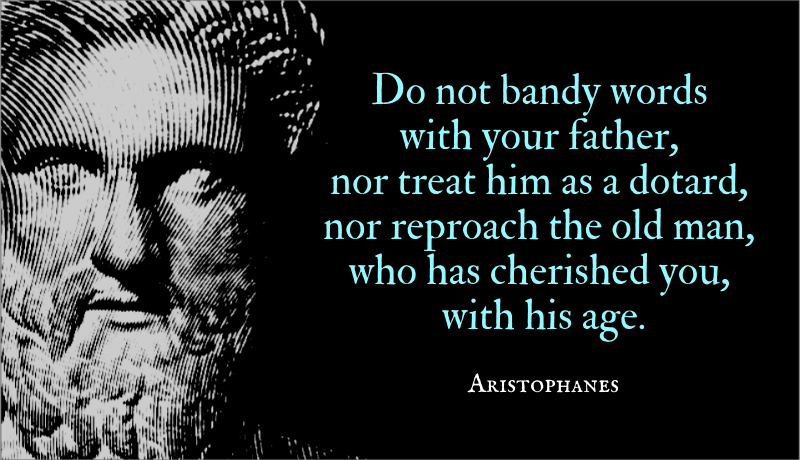
JUST DISCOURSE: Do not bandy words with your father, nor treat him as a dotard, nor reproach the old man, who has cherished you, with his age.
Aristophanes (c. 450-c. 388 BC) Athenian comedic playwright
Clouds, ll. 998-999 (423 BC) [tr. Athenian Soc. (1912)]
(Source)
Alt. trans.:
- JUST ΛΟΓΟΣ: "[Learn] not to contradict your father in any thing; nor by calling him Iapetus, to reproach him with the ills of age, by which you were reared in your infancy." [tr. Hickie (1853)]
- RIGHT LOGIC: "Nor dare to reply when your Father is nigh, nor 'musty old Japhet' to call / In your malice and rage that Sacred Old Age which lovingly cherished your youth." [tr. Rogers (1924)]

PRAXAGORA: I want all to have a share of everything and all property to be in common; there will no longer be either rich or poor; […] I shall begin by making land, money, everything that is private property, common to all. […]
BLEPYRUS: But who will till the soil?
PRAXAGORA: The slaves.Aristophanes (c. 450-c. 388 BC) Athenian comedic playwright
Ecclesiazusae, ll. 590-591, 597-598, 651 (392 BC) [tr. O’Neill (1938)]
Full text.
DEMOSTHENES: And dare you rail at wine’s inventiveness?
I tell you nothing has such go as wine.
Why, look you now; ’tis when men drink, they thrive,
Grow wealthy, speed their business, win their suits,
Make themselves happy, benefit their friends.
Go, fetch me out a stoup of wine, and let me
Moisten my wits, and utter something bright.Aristophanes (c. 450-c. 388 BC) Athenian comedic playwright
Knights, ll. 90-96 [tr. Rogers (1924)]
(Source)
Alt. trans.
- [O'Neill (1938)]: "Do you dare to accuse wine of clouding the reason? Quote me more marvellous effects than those of wine. Look! when a man drinks, he is rich, everything he touches succeeds, he gains lawsuits, is happy and helps his friends. Come, bring hither quick a flagon of wine, that I may soak my brain and get an ingenious idea."
- [Hickie (1853)]: "Have you the audacity to abuse wine for witlessness? Can you find anything more business-like than wine? Do you see? when men drink, then they are rich, they transact business, gain causes, are happy, assist their friends. Come, bring me out quickly a stoup of wine, that I may moisten my intellect, and say something clever."
PISTHETAERUS: Undoubtedly; words give wings to the mind and make a man soar to heaven.
Aristophanes (c. 450-c. 388 BC) Athenian comedic playwright
The Birds, l. 1447-48 (414 BC) [tr. O’Neill 1938)
Full text.
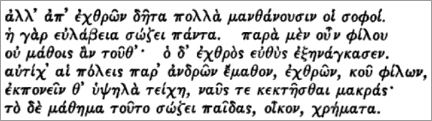
EPOPS: You’re mistaken: men of sense often learn from their enemies. Prudence is the best safeguard. This principle cannot be learned from a friend, but an enemy extorts it immediately. It is from their foes, not their friends, that cities learn the lesson of building high walls and ships of war. And this lesson saves their children, their homes, and their properties.
Aristophanes (c. 450-c. 388 BC) Athenian comedic playwright
The Birds, l. 375 (414 BC) [tr. Anon. (1812)]
Full text.
Alt trans. [Hickie (1853)]: "Yet, certainly, the wise learn many things from their enemies; for caution preserves all things. From a friend you could not learn this, but your foe immediately obliges you to learn it. For example, the states have learned from enemies, and not from friends, to build lofty walls, and to possess ships of war. And this lesson preserves children, house, and possessions."
Alt trans. [O'Neill (1938)] : "The wise can often profit by the lessons of a foe, for caution is the mother of safety. It is just such a thing as one will not learn from a friend and which an enemy compels you to know. To begin with, it's the foe and not the friend that taught cities to build high walls, to equip long vessels of war; and it's this knowledge that protects our children, our slaves and our wealth."
Alt trans. [Goldstein-Jackson (1983)]: "A man may learn wisdom even from a foe."
EPOPS: You’re mistaken: men of sense often learn from their enemies. Prudence is the best safeguard. This principle cannot be learned from a friend, but an enemy extorts it immediately. It is from their foes, not their friends, that cities learn the lesson of building high walls and ships of war. And this lesson saves their children, their homes, and their properties.
CHORUS [LEADER]: It appears then that it will be better for us to hear what they have to say first; for one may learn something at times even from one’s enemies.
Aristophanes (c. 450-c. 388 BC) Athenian comedic playwright
The Birds, l. 375ff (414 BC) [tr. Anon. (1812), Ramage (1864)]
(Source)
Alt. trans. [Hickie (1853)]:
EPOPS: Yet, certainly, the wise learn many things from their enemies; for caution preserves all things. From a friend you could not learn this, but your foe immediately obliges you to learn it. For example, the states have learned from enemies, and not from friends, to build lofty walls, and to possess ships of war. And this lesson preserves children, house, and possessions.
CHORUS [LEADER]: It is useful, as it appears to me, to hear their arguments first; for one might learn some wisdom even from one's foes.
Alt. trans. [O'Neill (1938)]:
EPOPS: The wise can often profit by the lessons of a foe, for caution is the mother of safety. It is just such a thing as one will not learn from a friend and which an enemy compels you to know. To begin with, it's the foe and not the friend that taught cities to build high walls, to equip long vessels of war; and it's this knowledge that protects our children, our slaves and our wealth.
LEADER OF THE CHORUS: Well then, I agree, let us first hear them, for that is best; one can even learn something in an enemy's school.
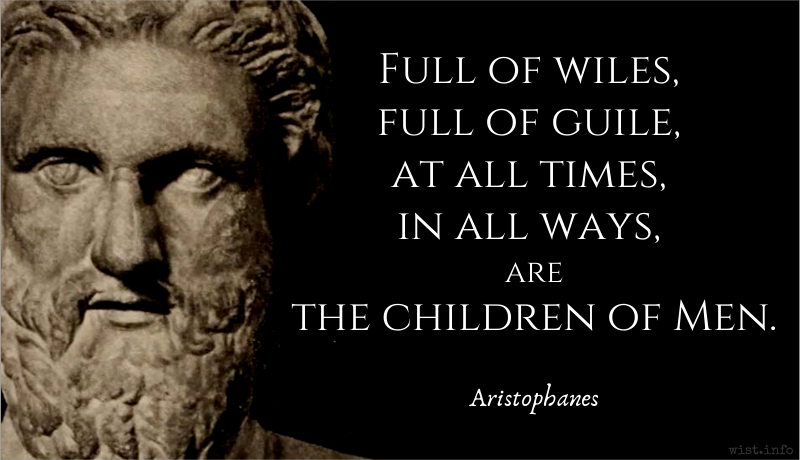
CHORUS: Full of wiles, full of guile, at all times, in all ways, are the children of Men.
[δολερὸν μὲν ἀεὶ κατὰ πάντα δὴ τρόπον / πέφυκεν ἄνθρωπος]
Aristophanes (c. 450-c. 388 BC) Athenian comedic playwright
The Birds, ll. 451-2 (414 BC) [tr. Rogers (1906)]
(Source)
Alt. trans.:
- "Man naturally is deceitful, ever indeed, and always, in every one thing." [tr. Warter (1830)]
- "Man is naturally deceitful ever, in every way!" [tr. Hickie (1853)]
- "Man is a truly cunning creature." [abridged tr. O'Neill (1938)]
- "A treacherous thing always in every way is human nature." [tr. Henderson (1998)]
CHORUS [LEADER]:
Ye Children of Man! whose life is a span,
Protracted with sorrow from day to day,
Naked and featherless, feeble and querulous,
Sickly, calamitous creatures of clay![ἄγε δὴ φύσιν ἄνδρες ἀμαυρόβιοι, φύλλων γενεᾷ προσόμοιοι,
ὀλιγοδρανέες, πλάσματα πηλοῦ, σκιοειδέα φῦλ᾽ ἀμενηνά,
ἀπτῆνες ἐφημέριοι ταλαοὶ βροτοὶ ἀνέρες εἰκελόνειροι]Aristophanes (c. 450-c. 388 BC) Athenian comedic playwright
The Birds, ll. 685-687 (414 BC) [tr. Frere (1839)]
(Source)
Alt. trans.:
- "Come now, ye men, in nature darkling, like to the race of leaves, of little might, figures of clay, shadowy feeble tribes, wingless creatures of a day, miserable mortals, dream-like men." [tr. Hickie (1853)]
- "Weak mortals, chained to the earth, creatures of clay as frail as the foliage of the woods, you unfortunate race, whose life is but darkness, as unreal as a shadow, the illusion of a dream." [tr. O'Neill (1938)]
- "Come, ye of mortal mould, whose life is spent in darkness, ye who are like to the race of leaves, ye that are weak in action, ye images of clay, ye feeble shadowy tribes, ye wingless creatures of a day, ye miserable mortals, ye men like unto the stuff which dreams are made of ...." [tr. Warter (1830)]
- "Now then, ye men by nature just faintly alive, like to the race of leaves, do-littles, artefacts of clay, tribes shadowy and feeble, wingless ephemerals, suffering mortals, dreamlike people ...." [tr. Henderson (1998)]
- "Ye men who are dimly existing below, who perish and fade as the leaf, / Pale, woebegone, shadowlike, spiritless folk, life feeble and wingless and brief, / Frail castings in clay, who are gone in a day, like a dream full of sorrow and sighing ...." [tr. Rogers (1906)]
LEADER OF THE CHORUS: Weak mortals, chained to the earth, creatures of clay as frail as the foliage of the woods, you unfortunate race, whose life is but darkness, as unreal as a shadow, the illusion of a dream.
Aristophanes (c. 450-c. 388 BC) Athenian comedic playwright
The Birds, ll. 685-687 (414 BC) [tr. O’Neill (1938)]
Full text.
Alt. trans.: Frere (1839) (text): "CHORUS (LEADER): Ye Children of Man! whose life is a span, / Protracted with sorrow from day to day, / Naked and featherless, feeble and querulous, / Sickly, calamitous creatures of clay!"
Alt. trans.: Hickie (1853) (text): "CHORUS (LEADER): Come now, ye men, in nature darkling, like to the race of leaves, of little might, figures of clay, shadowy feeble tribes, wingless creatures of a day, miserable mortals, dream-like men."
EPOPS: Come let me see, what shall the name be for our city? […]
EUELPIDES: Hence, from the clouds, and these meteoric regions, some all-swelling name.
PISTHETAERUS: Would you “Cloud-cuckoo-land?”Aristophanes (c. 450-c. 388 BC) Athenian comedic playwright
The Birds, ll. 812, 817-819 (414 BC) [tr. Warter (1830)]
(Source)
Alt. trans. [Hickie (1853)]
EPOPS: Come, let me see, what shall the name of our city be? [...]
EUEL.: Something very grand, from hence, from the clouds and elevated regions.
PISTH.: Would you "Cloud-cuckoo-town?"
Alt. trans. [Rogers (1906)]
CH.: Then let's consider what the name shall be.
CH.: Invent some fine
Magniloquent name, drawn from these upper spaces
And clouds.
PEI.: What think you of Cloudcuckoobury?
Alt. trans. [O'Neill (1938)]
LEADER OF THE CHORUS: Let's see. What shall our city be called? [...]
EUELPIDES: Some name borrowed from the clouds, from these lofty regions in which we dwell -- in short, some well-known name.
PISTHETAERUS: Do you like Nephelococcygia?
Times change. The vices of your age are stylish today.
Aristophanes (c. 450-c. 388 BC) Athenian comedic playwright
The Clouds, l. 914 (c. 423 BC) [tr. Arrowsmith (1962)]
This phrase comes from a single translation, by William Arrowsmith (1962), of Aristophanes, The Clouds, l. 914. It is the only translation that includes anything like that:
[909] Philosophy: Why, you Precocious Pederast! You Palpable Pervert!
[910] Sophistry: Pelt me with roses!
[910] Philosophy: You Toadstool! O Cesspool!
[911] Sophistry: Wreath my hairs with lilies!
[911] Philosophy: Why, you Parricide!
[912] Sophistry: Shower me with gold! Look, don't you see I welcome your abuse?
[913] Philosophy: Welcome it, monster? In my day we would have cringed with shame.
[914] Sophistry: Whereas now we're flattered. Times change. The vices of your age are stylish today.
Compare to Hickey (1853):[909] Just Cause: You are debauched and shameless.
[910] Unjust Cause: You have spoken roses of me.
[910] Just Cause: And a dirty lickspittle.
[911] Unjust Cause: You crown me with lilies.
[911] Just Cause: And a parricide.
[912] Unjust Cause: You don't know that you are sprinkling me with gold.
[913] Just Cause: Certainly not so formerly, but with lead.
[914] Unjust Cause: But now this is an ornament to me.
O ay, you’re like the fisher-folk, the men who hunt for eels,
Who when the mere is still and clear catch nothing for their creels,
But when they rout the mud about and stir it up and down,
‘Tis then they do; and so do you when you perturb the town.[ὅπερ γὰρ οἱ τὰς ἐγχέλεις θηρώμενοι πέπονθας.
ὅταν μὲν ἡ λίμνη καταστῇ, λαμβάνουσιν οὐδέν·
ἐὰν δ᾽ ἄνω τε καὶ κάτω τὸν βόρβορον κυκῶσιν,
αἱροῦσι· καὶ σὺ λαμβάνεις, ἢν τὴν πόλιν ταράττῃς.]Aristophanes (c. 450-c. 388 BC) Athenian comedic playwright
The Knights [Ἱππεῖς], ll. 864-67 [Sausage Seller] (424 BC) [tr. Rogers (1924)]
(Source)
Speaking of demagogues like Paphlagonian (Cleon).
Alt. trans.:
- "You are like the fishers for eels; in still waters they catch nothing, but if they thoroughly stir up the slime, their fishing is good; in the same way it's only in troublous times that you line your pockets." [tr. O'Neill (1938)]
- "For you are circumstanced like those who fish for eels. When the lake is still, they catch nothing; but if they stir the mud up and down, they take. And you catch, if you disturb the city." [tr. Hickie (1853)]
DEMOSTHENES: A demagogue must be neither an educated nor an honest man; he has to be an ignoramus and a rogue.