

So, whatsoever that be within us which feels, thinks, desires, and animates us, it is something celestial, divine, and, consequently, imperishable.
Aristotle (384-322 BC) Greek philosopher
(Attributed)
(Source)
The earliest reference to this text that I can find is in Louis Alphonse Cahagnet, Magnétisme: The Celestial Telegraph (1850), who attributes it to Cicero's "Explanation of the Doctrines of Aristotle." It is unclear which of Cicero's actual works this refers to, and it doesn't come across as Aristotelian (or even Ciceronian), and, given the source, may be distorted, poorly translated, or bogus.
Quotations by:
Aristotle
Dignity does not consist in possessing honors, but in deserving them.
Aristotle (384-322 BC) Greek philosopher
(Attributed)
Variant: "Dignity consists not in possessing honors, but in the consciousness that we deserve them."
Citation not identified. Earliest reference found in 1854.
There is no great genius without a touch of madness.
[Nullum magnum ingenium sine mixtura dementiae fuit.]
Aristotle (384-322 BC) Greek philosopher
(Attributed)
Attributed to Aristotle in Seneca the Younger, "On Tranquility of Mind [De Tranquillitate Animi]" (17.10) (c. AD 60). (Source (Latin)).
Alternate translations:
This quotation as such is not found in surviving Aristotle. It may either represent something from Aristotle that has been lost since Seneca, or else Seneca fabricating a quote, quoting something spurious, or paraphrasing something Aristotle did write, e.g., his comments about madness/melancholy and poets/prominent talents (here and here). See also the Pseudo-Aristotle, Problemata, Book 30, ch. 1:
- "There is no great genius without a mixture of madness." [Example (1851)]
- "No great genius was without a mixture of insanity." [tr. Langsdorf (1900)]
- "No great genius has ever been without a touch of insanity." [tr. Stewart (1900), "On Peace of Mind"]
- "No excellent soul is exempt from a mixture of madness." [Example (1906)]
- "No great genius has ever existed without some touch of madness." [tr. Basore (1932)]
- "No great genius has ever existed without a dash of lunacy." [tr. Davie (2007)]
- "There was never any great genius without a tincture of insanity." [tr. @sentantiq (2018)]
- "There was never a genius without a tincture of madness."
- "No great mind has ever existed without a touch of madness."
Why is it that all those who have become eminent in philosophy or politics or poetry or the arts are clearly of an atrabilious temperament, and some of them to such an extent as to be affected by diseases caused by black bile, as is said to have happened to Heracles among the heroes? [tr. Forster (1927)]
There is a foolish corner in the brain of the wisest man.
Aristotle (384-322 BC) Greek philosopher
(Attributed)
Not found anywhere except modern books of inspiring aphorisms and sites of citationless quotations. It also doesn't sound very Aristotelian.
It is the mark of an educated mind to be able to entertain a thought without accepting it.
Aristotle (384-322 BC) Greek philosopher
(Spurious)
First attributed to Aristotle in Lowell L. Bennion, Religion and the Pursuit of Truth (1959). Unfound as such.
Sometimes thought (though I feel it's a bit of a stretch) a misinterpretation of Nicomachean Ethics 1.3.4 (1094b): "For it is the mark of an educated person to search for the same kind of clarity in each topic to the extent that the nature of the matter accepts it."
More discussion of this quotation:
Character is made by many acts; it may be lost by a single one.
Aristotle (384-322 BC) Greek philosopher
(Spurious)
Frequently attributed to Aristotle, but not found in his works. One of the earliest references is in J. A. Haigh, "Character," Great Thoughts from Master Minds (5 Oct 1907). Haigh does not present it as his own thought ("Character, it has been well said, is made up ..."). John Christensen notes that the sentiment of the quote is very non-Aristotelian, feeling more like a Christian teaching about sin than a philosophical commentary. Aristotle generally speaks about developing a habit toward virtue (1, 2, 3), not some sort of all-or-nothing moral imperative.
Tolerance and apathy are the last virtues of a dying society.
Aristotle (384-322 BC) Greek philosopher
(Spurious)
Not found in the writings of Aristotle, or, with variation, anywhere early than the 19th Century. More discussion of this quotation's origins and misuses:
And bad luck reveals those who are not real friends, but just happen to be so because of utility.
[ἡ δ᾽ ἀτυχία δηλοῖ τοὺς μὴ ὄντως [20] ὄντας φίλους, ἀλλὰ διὰ τὸ χρήσιμον τυχόντας.]
Aristotle (384-322 BC) Greek philosopher
Eudemian Ethics [Ἠθικὰ Εὐδήμεια], Book 7, ch. 2 / 1238a.19-20 [tr. Reeve (2021)]
(Source)
(Source (Greek)). Alternate translations:
Misfortune shows those who are not really friends, but friends only for some accidental utility.
[tr. Solomon (1915)]
Misfortune shows those who are not friends really but only because of some casual utility.
[tr. Rackham (1981)]
But misfortune shows those who are friends not really but because of chance utility.
[tr. Simpson (2013)]
We are what we repeatedly do. Excellence, therefore, is not an act but a habit.
Aristotle (384-322 BC) Greek philosopher
Nicomachean Ethics [Ἠθικὰ Νικομάχεια] (c. 325 BC) (paraphrase)
(Source)
Variants:Not actually Aristotle, but a summary by Will Durant, The Story of Philosophy: The Lives and Opinions of the World's Greatest Philosophers (1926), ch. 2 "Aristotle and Greek Science," sec. 7 "Ethics and the Nature of Happiness" (1926):
- "We are what we repeatedly do. Excellence, then, is not an act, but a habit."
- "We are what we repeatedly do, therefore excellence is not an act, but a habit."
Excellence is an art won by training and habituation: we do not act rightly because we have virtue or excellence, but we rather have these because we have acted rightly; "these virtues are formed in man by his doing the actions"; we are what we repeatedly do. Excellence, then, is not an act but a habit: "the good of man is a working of the soul in the way of excellence in a complete life ... for as it is not one swallow or one fine day that makes a spring, so it is not one day or a short time that makes a man blessed and happy."
The quoted phrases are from the Nicomachean Ethics, Book 2, ch. 4; Book 1, ch. 7.
Now if of the things we do there is an end which we wish for its own sake […] then clearly this end would be good and the highest good. Will not knowledge of it, then, have a great influence on our way of life, and would we not as a consequence be more likely to attain the desired end, like archers who have a mark to aim at? If so, then we should try to grasp, in outline at least, what that end is and to which of the sciences or faculties it belongs.
[εἰ δή τι τέλος ἐστὶ τῶν πρακτῶν ὃ δι᾽ αὑτὸ βουλόμεθα, τἆλλα δὲ διὰ τοῦτο, καὶ μὴ πάντα δι᾽ ἕτερον αἱρούμεθα (πρόεισι γὰρ οὕτω γ᾽ εἰς ἄπειρον, ὥστ᾽ εἶναι κενὴν καὶ ματαίαν τὴν ὄρεξιν), δῆλον ὡς τοῦτ᾽ ἂν εἴη τἀγαθὸν καὶ τὸ ἄριστον. ἆρ᾽ οὖν καὶ πρὸς τὸν βίον ἡ γνῶσις αὐτοῦ μεγάλην ἔχει ῥοπήν, καὶ καθάπερ τοξόται σκοπὸν ἔχοντες μᾶλλον ἂν τυγχάνοιμεν τοῦ δέοντος; εἰ δ᾽ οὕτω, πειρατέον τύπῳ γε περιλαβεῖν αὐτὸ τί ποτ᾽ ἐστὶ καὶ τίνος τῶν ἐπιστημῶν ἢ δυνάμεων.]
Aristotle (384-322 BC) Greek philosopher
Nicomachean Ethics [Ἠθικὰ Νικομάχεια], Book 1, ch. 2 (1.2, 1094a.18ff) (c. 325 BC) [tr. Apostle (1975)]
(Source)
(Source (Greek)). Alternate translations:
Since then of all things which may be done there is some one End which we desire for its own sake, [...] this plainly must be the Chief Good, i.e. the best thing of all. Surely then, even with reference to actual life and conduct, the knowledge of it must have great weight; and like archers, with a mark in view, we shall be more likely to hit upon what is right: and if so, we ought to try to describe, in outline at least, what it is and of which of the sciences and faculties it is the End.
[tr. Chase (1847)]
If then there be some one end of all that we do, for which we wish for its own sake [...] it is evident that this end will be the chief and supreme good. Surely then a scientific knowledge of it will have a critical influence upon our lives, and will make us, like bowmen who have a mark at which to aim, all the more likely to hit upon that which is good. And if this be so, we must endeavour to describe it at least in outline, and to say of what science or of what art it is the province.
[tr. Williams (1869)]
If it is true that in the sphere of action there is an end which we wish for its own sake [...] it is clear this will be the good or the supreme good. Does it not follow then that the knowledge of this supreme good is of great importance for the conduct of life, and that, if we know it, we shall be like archers who have a mark at which to aim, we shall have a better chance of attaining what we want? But, if this is the case, we must endeavor to comprehend, at least in outline, its nature, and the science or faculty to which it belongs.
[tr. Welldon (1892), ch. 1]
If then in what we do there be some end which we wish for on its own account, [...] this evidently will be the good or the best of all things. And surely from a practical point of view it much concerns us to know this good; for then, like archers shooting at a definite mark, we shall be more likely to attain what we want. If this be so, we must try to indicate roughly what it is, and first of all to which of the arts or sciences it belongs.
[tr. Peters (1893)]
If, then, there is some end of the things we do, which we desire for its own sake [...] clearly this must be the good and the chief good. Will not the knowledge of it, then, have a great influence on life? Shall we not, like archers who have a mark to aim at, be more likely to hit upon what is right? If so, we must try, in outline at least, to determine what it is, and of which of the sciences or capacities it is the object.
[tr. Ross (1908)]
If therefore among the ends at which our actions aim there be one which we will for its own sake [...] it is clear that this one ultimate End must be the Good, and indeed the Supreme Good. Will not then a knowledge of this Supreme Good be also of great practical importance for the conduct of life? Will it not better enable us to attain our proper object, like archers having a target to aim at? If this be so, we ought to make an attempt to determine at all events in outline what exactly this Supreme Good is, and of which of the sciences or faculties it is the object.
[tr. Rackham (1934)]
If, then, there is some end of things doable in action that we wish for because of itself, [...] it is clear that this will be the good -- that is, the best good. Hence regarding our life as well, won't knowing the good have great influence and -- like archers with a target -- won't we be better able to hit what we should? If so, we should try to grasp in outline, at least, what the good is and to which of the sciences or capacities it properly belongs.
[tr. Reeve (1948)]
So if what is done has some end that we want for its own sake [...] then clearly this will be the good, indeed the chief good. surely, then, knowledge of the good must be very important for our lives? And if, like archers, we have a target, are we not more likely to hit the right mark? If so, we must try at least roughly to comprehend what it is and which science of faculty is concerned with it.
[tr. Crisp (2000)]
If, therefore, there is some end of our actions that we wish for on account of itself, [...] clearly this would be the good, that is, the best. And with a view to our life, then, is not the knowledge of this good of greater weight, and would we not, like archers in possession of a target, better hit on what is needed? If this is so, then one must try to grasp, in outline at least, whatever it is and to which of the sciences or capacities it belongs.
[tr. Bartlett/Collins (2011)]
For it is the mark of an educated man to look for precision in each class of things just so far as the nature of the subject admits; it is evidently equally foolish to accept probable reasoning from a mathematician and to demand from a rhetorician scientific proofs.
[πεπαιδευμένου γάρ ἐστιν ἐπὶ τοσοῦτον τἀκριβὲς ἐπιζητεῖν καθ᾽ ἕκαστον γένος, ἐφ᾽ ὅσον ἡ τοῦ πράγματος φύσις ἐπιδέχεται: παραπλήσιον γὰρ φαίνεται μαθηματικοῦ τε πιθανολογοῦντος ἀποδέχεσθαι καὶ ῥητορικὸν ἀποδείξεις ἀπαιτεῖν.]
Aristotle (384-322 BC) Greek philosopher
Nicomachean Ethics [Ἠθικὰ Νικομάχεια], Book 1, ch. 3 (1.3.4) / 1094b.24ff (c. 325 BC) [tr. Ross (1908)]
(Source)
Possibly the source of this spurious Aristotle quote. (Source (Greek)). Alternate translations:
For the man of education will seek exactness so far in each subject as the nature of the thing admits, it being plainly much the same absurdity to put up with a mathematician who tries to persuade instead of proving, and to demand strict demonstrative reasoning of a Rhetorician.
[tr. Chase (1847), ch. 1]
It is the mark of an instructed mind to rest satisfied with the degree of precision which the nature of the subject admits and not to seek exactness where only an approximation is possible.
[Source (1852) - earliest version of this frequent translation I found.]
A man who has been well trained will not in any case look for more accuracy than the nature of the matter allows; for to expect exact demonstration from a rhetorician is as absurd as to accept from a mathematician a statement only probable.
[tr. Williams (1869)]
For an educated person will expect accuracy in each subject only so far as the nature of the subject allows; he might as well accept probable reasoning from a mathematician as require demonstrative proofs from a rhetorician.
[tr. Welldon (1892), ch. 2]
For it is the mark of an educated man to require, in each kind of inquiry, just so much exactness as the subject admits of: it is equally absurd to accept probable reasoning from a mathematician, and to demand scientific proof from an orator.
[tr. Peters (1893)]
For it is the mark of an educated mind to expect that amount of exactness in each kind which the nature of the particular subject admits. It is equally unreasonable to accept merely probable conclusions from a mathematician and to demand strict demonstration from an orator.
[tr. Rackham (1934)]
For it is characteristic of a well-educated person to look for the degree of exactness in each kind of investigation that the nature of the subject itself allows. For it is evident that accepting persuasive arguments from a mathematician is like demanding demonstrations from a rhetorician.
[tr. Reeve (1948)]
For a well-schooled man is one who searches for that degree of precision in each kind of study which the nature of the subject at hand admits: it is obviously just as foolish to accept arguments of probability from a mathematician as to demand strict demonstrations from an orator.
[tr. Ostwald (1962)]
For it is the mark of an educated man to seek as much precision in things of a given genus as their nature allows, for to accept persuasive arguments from a mathematician appears to be [as improper as] to demand demonstrations from a rhetorician.
[tr. Apostle (1975)]
For it is the mark of the trained mind never to expect more precision in the treatment of any subject than the nature of that subject permits; for demanding logical demonstrates from a teacher of rhetoric is clearly about as reasonable as accepting mere plausibility from a mathematician.
[tr. Thomson/Tredennick (1976)]
Since it is the mark of an educated person to look in each area for only that degree of accuracy that the nature of the subject permits. Accepting persuasive arguments from a mathematician is like demanding demonstrations from a rhetorician.
[tr. Crisp (2000)]
For it is the mark of an educated person to search for the same kind of clarity in each topic to the extent that the nature of the matter accepts it. For it is similar to expect a mathematician to speak persuasively or for an orator to furnish clear proofs!
[tr. @sentantiq (2018)]
For it belongs to an educated person to seek out precision in each genus to the extent that the nature of the matter allows: to accept persuasive speech from a skilled mathematician appears comparable to demanding demonstrations from a skilled rhetorician.
[tr. Bartlett/Collins (2011)]
Hence a young man is not a proper hearer of lectures on political science; for he is inexperienced in the actions that occur in life, but its discussions start from these and are about these; and, further, since he tends to follow his passions, his study will be vain and unprofitable, because the end aimed at is not knowledge but action.
[διὸ τῆς πολιτικῆς οὐκ ἔστιν οἰκεῖος ἀκροατὴς ὁ νέος: ἄπειρος γὰρ τῶν κατὰ τὸν βίον πράξεων, οἱ λόγοι δ᾽ ἐκ τούτων καὶ περὶ τούτων: ἔτι δὲ τοῖς πάθεσιν ἀκολουθητικὸς ὢν ματαίως ἀκούσεται καὶ ἀνωφελῶς, ἐπειδὴ τὸ τέλος ἐστὶν οὐ γνῶσις ἀλλὰ πρᾶξις.]
Aristotle (384-322 BC) Greek philosopher
Nicomachean Ethics [Ἠθικὰ Νικομάχεια], Book 1, ch. 3 (1.3.5-6) / 1095a.2-5 (c. 325 BC) [tr. Ross (1908)]
(Source)
(Source (Greek)). Alternate translations:
Hence the young man is not a fit student of Moral Philosophy, for he has no experience in the actions of life, while all that is said presupposes and is concerned with these: and in the next place, since he is apt to follow the impulses of his passions, he will hear as though he heard not, and to no profit, the end in view being practice and not mere knowledge.
[tr. Chase (1847), ch. 1]
And hence it is that a young man is not a fit student of the art political; for he has had no experience in matters of daily life, with which matters our premises are concerned, and of which our conclusions treat. And since, moreover, he is prone to follow his desires, he will listen without purpose, and so without benefit. For the true object of ethical study is not merely the knowledge of what is good, but the application of that knowledge.
[tr. Williams (1869), sec. 3]
Hence the young are not proper students of political science, as they have no experience of the actions of life which form the premises and subjects of the reasonings. Also it may be added that from their tendency to follow their emotions they will not study the subject to any purpose or profit, as its end is not knowledge but action.
[tr. Welldon (1892), ch. 1]
And hence a young man is not qualified to be a student of Politics; for he lacks experience of the affairs of life, which form the data and the subject-matter of Politics. Further, since he is apt to be swayed by his feelings, he will derive no benefit from a study whose aim is not speculative but practical.
[tr. Peters (1893)]
Hence the young are not fit to be students of Political Science. For they have no experience of life and conduct, and it is these that supply the premisses and subject matter of this branch of philosophy. And moreover they are led by their feelings; so that they will study the subject to no purpose or advantage, since the end of this science is not knowledge but action.
[tr. Rackham (1934)]
That is why a young person is not a suitable audience for politics. For he has no experience with the actions of life, and the accounts are in accord with these and concerned with these. Further, since he tends to follow his feelings, it will be pointless and not beneficial to him to be in the audience, since the end is not knowledge but action.
[tr. Reeve (1948)]
In view of this, a young man is not a proper student of [lectures on] politics; for he is inexperienced in actions concerning human life, and discussions proceed from [premisses concerning those actions] and deal with [those actions]. Moreover, being disposed to follow his passions, he will listen in vain and without benefit, since the end of such discussions is not knowledge but actions.
[tr. Apostle (1975), ch. 1]
This is why a young man is not a fit person to attend lectures on political science, because he is not versed in the practical business of life from which politics draws its premisses and subject matter. Besides, he tends to follow his feelings, with the result that he will make no headway and derive no benefit from his course, since the object of it is not knowledge but action.
[tr. Thomson/Tredennick (1976)]
This is why a youth is not a suitable student of political science; for he lacks experience of the actions of life which political science argues from and about. Moreover, since he tends to be guided by his feelings, his study will be futile and useless; for its end is action, not knowledge.
[tr. Irwin/Fine (1995)]
This is why a young person is not fitted to hear lectures on political science, since our discussions begin from and concern the actions of life, and of these he has no experience. Again, because of his tendency to follow his feelings, his studies will be useless and to no purpose, since the end of the study is not knowledge but action.
[tr. Crisp (2000)]
Hence of the political art, a young person is not an appropriate student, for he is inexperienced in the actions pertaining to life, and the arguments are based on these actions and concern them. Further, because he is disposed to follow the passions, he will listen pointlessly and unprofitably, since the end involved is not knowledge but action.
[tr. Bartlett/Collins (2011)]
Note that this passage was the basis for these lines from Shakespeare, Troilus and Cressida, Act 2, sc. 2, l. 165 (1609):
Young men, whom Aristotle thought
Unfit to hear moral philosophy
The life of making money is a life people are, as it were, forced into, and wealth is clearly not the good we are seeking, since it is merely useful, for getting something else.
[ὁ δὲ χρηματιστὴς βίαιός τις ἐστίν, καὶ ὁ πλοῦτος δῆλον ὅτι οὐ τὸ ζητούμενον ἀγαθόν.]
Aristotle (384-322 BC) Greek philosopher
Nicomachean Ethics [Ἠθικὰ Νικομάχεια], Book 1, ch. 5 (1.5, 1096a.5) (c. 325 BC) [tr. Crisp (2000)]
(Source)
Rackham notes the term βίαιος (translated under compulsion/constraint) is "literally ‘violent’; the adjective is applied to the strict diet and and laborious exercises of athletes, and to physical phenomena such as motion, in the sense of ‘constrained,’ ‘not natural.’"
(Source (Greek)). Alternate translations:
As for the life of money-making, it is one of constraint, and wealth manifestly is not the good we are seeking, because it is for use, that is, for the sake of something further.
[tr. Chase (1847), ch. 3]
As for the money-getting life, it violates the natural fitness of things. Wealth is clearly not the absolute good of which we are in search, for it is a utility, and nonly desirable as a means.
[tr. Williams (1869)]
The life of money-making is in a sense a life of constraint, and it is clear that wealth is not the good of which we are in quest; for it is useful in part as a means to something else.
[tr. Welldon (1892), ch. 3]
As for the money-making life, it is something quite contrary to nature; and wealth evidently is not the good of which we are in search, for it is merely useful as a means to something else.
[tr. Peters (1893)]
The life of money-making is one undertaken under compulsion, and wealth is evidently not the good we are seeking; for it is merely useful and for the sake of something else.
[tr. Ross (1908)]
The Life of Money-making is a constrained kind of life, and clearly wealth is not the Good we are in search of, for it is only good as being useful, a means to something else.
[tr. Rackham (1934), 1.5.8]
The life of a moneymaker is in a way forced, and wealth is clearly not the good we are looking for, since it was useful and for the sake of something else.
[tr. Reeve (1948), ch. 5]
As for the life of a money-maker, it is one of tension; and clearly the good sought is not wealth, for wealth is instrumental and is sought for the sake of something else.
[tr. Apostle (1975), ch. 3]
As for the life of the businessman, it does not give him much freedom of action. Besides, wealth is obviously not the good that we are seeking, because it serves only as a means; i.e., for getting something else.
[tr. Thomson/Tredennick (1976)]
The moneymaking life is characterized by a certain constraint, and it is clear that wealth is not the good being sought, for it is a useful thing and for the sake of something else.
[tr. Bartlett/Collins (2011)]
It will presumably be thought better, indeed one’s duty, to do away with even what is close to one’s heart in order to preserve the truth, especially when one is a philosopher. For one might love both, but it is nevertheless a sacred duty to prefer the truth to one’s friends.
[ἀληθείας καὶ τὰ οἰκεῖα ἀναιρεῖν, ἄλλως τε καὶ φιλοσόφους ὄντας: ἀμφοῖν γὰρ ὄντοιν φίλοιν ὅσιον προτιμᾶν τὴν ἀλήθειαν.]
Aristotle (384-322 BC) Greek philosopher
Nicomachean Ethics [Ἠθικὰ Νικομάχεια], Book 1, ch. 6 (1.6, 1096a.15) (c. 325 BC) [tr. Crisp (2000)]
(Source)
This is actually not given as a general guideline for living life, but specifically about offering a philosophical argument in opposition that offered by friends. (Source (Greek)). Alternate translations:
Still perhaps it may appear better, nay to be our duty where the safety of the truth is concerned, to upset if need be even our own theories, specially as we are lovers of wisdom: for since both are dear to us, we are bound to prefer the truth.
[tr. Chase (1847), ch. 3]
And yet, where the interests of truth are at actual stake, we ought, perhaps, to sacrifice even that which is our own -- if, at least, we are to lay any claim to a philosophic spirit. Both are dear to us alike, but truth must be religiously preserved.
[tr. Williams (1869)]
Yet it will perhaps seem the best, and indeed the right course, at least when the truth is at stake, to go so far as to sacrifice what is near and dear to us, especially as we are philosophers. For friends and truth are both dear to us, but it is a sacred duty to prefer the truth.
[tr. Welldon (1892)]
In the interests of truth we ought to sacrifice even what is nearest to us, especially as we call ourselves philosophers. Both are dear to us, but it is a sacred duty to give the preference to truth.
[tr. Peters (1893)]
Yet it would perhaps be thought to be better, indeed to be our duty, for the sake of maintaining the truth even to destroy what touches us closely, especially as we are philosophers or lovers of wisdom; for, while both are dear, piety requires us to honour truth above our friends.
[tr. Ross (1908)]
Still perhaps it would appear desirable, and indeed it would seem to be obligatory, especially for a philosopher, to sacrifice even one's closest personal ties in defense of the truth. Both are dear to us, yet 'tis our duty to prefer the truth.
[tr. Rackham (1934)]
Yet it would seem better, perhaps, and something we should do, at any rate when the preservation of the truth is at stake, to confute even what is properly our own, most of all because we are philosophers. For while we love both our friends and the truth, it is a pious thing to accord greater honor to the truth.
[tr. Reeve (1948)]
Yet it would perhaps be thought better, and also our duty, to forsake even what is close to us in order to preserve the truth, especially as we are philosophers; for while both are dear, it is sacred to honor truth above friendship.
[tr. Apostle (1975), ch. 4]
Yet surely it would be thought better, or rather necessary (above all for philosophers), to refute, in defence of truth , even views to which one is attached; since both are dear, it is right to give preference to the truth.
[tr. Thomson/Tredennick (1976)]
Still, it presumably seems better, indeed only right, to destroy even what is close to us if that is the way to preserve truth. And we must especially do this when we are philosophers, lovers of wisdom; for though we love both the truth and our friends, piety requires us to honor the truth first.
[tr. Irwin/Fine (1995)]
But perhaps it might be held to be better, in fact to be obligatory, at least for the sake of preserving the truth, to do away with even one's own things, especially for those who are philosophers. For although both are clear, it is a pious thing to honor the truth first.
[tr. Bartlett/Collins (2011)]
For one swallow does not make spring, nor does one fine day; and similarly one day or a brief period of happiness does not make a man supremely blessed and happy.
[μία γὰρ χελιδὼν ἔαρ οὐ ποιεῖ, οὐδὲ μία ἡμέρα: οὕτω δὲ οὐδὲ μακάριον καὶ εὐδαίμονα]
Aristotle (384-322 BC) Greek philosopher
Nicomachean Ethics [Ἠθικὰ Νικομάχεια], Book 1, ch. 7 (1.7, 1098a.18) (c. 325 BC) [tr. Rackham (1934)]
(Source)
Rackham notes that μακάριος ("blessed"/"happy") derives from μάκαρ, applied in Homer and Hesiod to the gods, and to humans admitted to the Islands of the Blessed. (Source (Greek)). Alternate translations:
For as it is not one swallow or one fine day that makes a spring, so it is not one day or a short time that makes a man blessed and happy.
[tr. Chase (1847)]
For a single day, or even a short period of happiness, no more makes a blessed and a happy man than one sunny day or one swallow makes a spring.
[tr. Williams (1869)]
For as one swallow or one day does not make a spring, so one day or a short time does not make a fortunate or happy man.
[tr. Welldon (1892), ch. 6]
For one swallow or one fine day does not make a spring, nor does one day or any small space of time make a blessed or happy man.
[tr. Peters (1893), 1.7.16]
For one swallow does not make a summer, nor does one day; and so too one day, or a short time, does not make a man blessed and happy.
[tr. Ross (1908)]
For one swallow does not make a spring, nor does one day. Nor, similarly, does one day or a short time make someone blessed and happy.
[tr. Reeve (1948)]
One swallow does not make a summer; neither does one fine day. And one day, or indeed any brief period of felicity, does not make a man entirely and perfectly happy.
[tr. Thomson (1953)]
For one swallow does not make a spring, nor does one day; and so too one day or a short time does not make a man blessed or happy.
[tr. Apostle (1975)]
One swallow does not make a summer; neither does one day. Similarly neither can one day, or a brief space of time, make a man blessed and happy.
[tr. Thomson/Tredennick (1976)]
For one swallow does not make a summer, nor one day. Neither does one day or a short time make someone blessed and happy.
[tr. Crisp (2000)]
For one swallow does not make a spring, nor does one day. And in this way, one day or a short time does not make someone blessed and happy either.
[tr. Bartlett/Collins (2011)]
For one swallow does not make a spring, nor does one day. Nor, similarly, does one day or a short time make someone blessed and happy.
[tr. Reeve (2014)]
For with the truth, all the given facts harmonize; but with what is false, the truth soon hits a wrong note.
[τῷ μὲν γὰρ ἀληθεῖ πάντα συνᾴδει τὰ ὑπάρχοντα, τῷ δὲ ψευδεῖ ταχὺ διαφωνεῖ τἀληθές.]
Aristotle (384-322 BC) Greek philosopher
Nicomachean Ethics [Ἠθικὰ Νικομάχεια], Book 1, ch. 8 (1.8, 1098b.11) (c. 325 BC) [tr. Bartlett/Collins (2011)]
(Source)
(Source (Greek)). Alternate translations:
With what is true all things which really are are in harmony, but with that which is false the true very soon jars.
[tr. Chase (1847), ch. 6]
For with a true theory all facts agree, while with what is false truth is quickly found to conflict.
[tr. Williams (1869)]
For while all, experience harmonizes with the truth, it is never long before truth clashes with falsehood.
[tr. Welldon (1892)]
For all experience harmonizes with a true principle, but a false one is soon found to be incompatible with the facts.
[tr. Peters (1893)]
For with a true view all the data harmonize, but with a false one the facts soon clash.
[tr. Ross (1908)]
For if a proposition be true, all the facts harmonize with it, but if it is false, it is quickly seen to be discordant with them.
[tr. Rackham (1934)]
For all the data are in tune with a true view, whereas they soon clash with a false one.
[tr. Reeve (1948)]
For all things which belong to it are in harmony with a true [definition of it], but truth is soon bound to clash with a false [definition of it].
[tr. Apostle (1975)]
Because if a statement is true all the data are in harmony with it, while if it is false they soon reveal a discrepancy.
[tr. Thomson/Tredennick (1976)]
For all the data harmonize with the truth, but soon clash with falsity.
[tr. Crisp (2000)]
As in the Olympic Games it is not the most attractive and the strongest who are crowned, but those who compete (since it is from this group that winners come), so in life it is those who act rightly who will attain what is noble and good.
[ὥσπερ δ᾽ Ὀλυμπίασιν οὐχ οἱ κάλλιστοι καὶ ἰσχυρότατοι στεφανοῦνται ἀλλ᾽ οἱ ἀγωνιζόμενοι (τούτων γάρ τινες νικῶσιν), οὕτω καὶ τῶν ἐν τῷ βίῳ καλῶν κἀγαθῶν οἱ πράττοντες ὀρθῶς ἐπήβολοι γίνονται.]
Aristotle (384-322 BC) Greek philosopher
Nicomachean Ethics [Ἠθικὰ Νικομάχεια], Book 1, ch. 9 (1.9, 1099a.4) (c. 325 BC) [tr. Crisp (2000)]
(Source)
(Source (Greek)). Alternate translations:
And as at the Olympic games it is not the finest and strongest men who are crowned, but they who enter the lists, for out of these the prize-men are selected; so too in life, of the honourable and the good, it is they who act who rightly win the prizes.
[tr. Chase (1847), ch. 6]
For as at the Olympic games it is not the fairest and the strongest who are crowned, but they that run -- for some of these it is that win the victory -- so too, among the noble and good in life, it is they that act rightly who become masters of life's prize.
[tr. Williams (1869)]
As in the Olympian games it is not the most beautiful and strongest persons who receive the crown, but they who actually enter the lists as combatants -- for it is some of these who become victors -- so it is they who act rightly that attain what is noble and good in life.
[tr. Welldon (1892), ch. 9]
And as at the Olympic games it is not the fairest and strongest who receive the crown, but those who contend (for among these are the victors), so in life, too, the winners are those who not only have all the excellences, but manifest these in deed.
[tr. Peters (1893)]
And as in the Olympic Games it is not the most beautiful and the strongest that are crowned but those who compete (for it is some of these that are victorious), so those who act win, and rightly win, the noble and good things in life.
[tr. Ross (1908)]
And just as at the Olympic games the wreaths of victory are not bestowed upon the handsomest and strongest persons present, but on men who enter for the competitions -- since it is among these that the winners are found, -- so it is those who act rightly who carry off the prizes and good things of life.
[tr. Rackham (1934), ch. 8, sec. 9]
And just as in the Olympic Games it is not the noblest and strongest who get the victory crown but the competitors (since it is among these that the ones who win are found), so also among the noble and good aspects of life it is those who act correctly who win the prizes.
[tr. Reeve (1948)]
And as at the Olympic Games it is not the most beautiful or the strongest who are crowned but those who compete (for it is some of these who become victors), so in life it is those who act rightly who become the winners of good and noble things.
[tr. Apostle (1975), ch. 9]
Just as at the Olympic Games it is not the best-looking or the strongest men present that are crowned with wreaths, but the competitors (because it is from them that the winners come), so it is those who act that rightly win the honors and rewards in life.
[tr. Thomson/Tredennick (1976)]
For just as it is not the noblest and strongest who are crowned with the victory wreath at the Olympic Games but rather the competitors (for it is certain of these who win), so also it is those who act correctly who attain the noble and good things in life.
[tr. Bartlett/Collins (2011)]
For we hold that the man who is truly good and wise will bear with dignity whatever fortune sends, and will always make the best of his circumstances, as a good general will turn the forces at his command to the best account, and a good shoemaker will make the best shoe that can be made out of a given piece of leather, and so on with all other crafts.
[τὸν γὰρ ὡς ἀληθῶς ἀγαθὸν καὶ ἔμφρονα πάσας οἰόμεθα τὰς τύχας εὐσχημόνως φέρειν καὶ ἐκ τῶν ὑπαρχόντων ἀεὶ τὰ κάλλιστα πράττειν, καθάπερ καὶ στρατηγὸν ἀγαθὸν τῷ παρόντι στρατοπέδῳ χρῆσθαι πολεμικώτατα καὶ σκυτοτόμον ἐκ τῶν δοθέντων σκυτῶν κάλλιστον ὑπόδημα ποιεῖν: τὸν αὐτὸν δὲ τρόπον καὶ τοὺς ἄλλους τεχνίτας ἅπαντας.]
Aristotle (384-322 BC) Greek philosopher
Nicomachean Ethics [Ἠθικὰ Νικομάχεια], Book 1, ch. 10, sec. 13 (1.10.13) / 1101a.1-6 (c. 325 BC) [tr. Peters (1893)]
(Source)
(Source (Greek)). Alternate translations:
For the man who is truly good and sensible bears all fortunes, we presume, becomingly, and always does what is noblest under the circumstances, just as a good general employs to the best advantage the force he has with him; or a good shoemaker makes the handsomest shoe he can out of the leather which has been given him; and all other good artisans likewise.
[tr. Chase (1847), ch. 8]
For we hold that the really good and prudent man will bear all changes of fortune with good grace, and will always, as the case may allow, act most nobly; exactly as a good general will use such forces as are at his disposal most skilfully, and even as a good cobbler will, out of such leather as he may have, make the most perfect show; and of all those who practice any other art the same rule will hold good.
[tr. Williams (1869), sec. 17]
For our conception of the truly good and sensible man is that he bears all the chances of life with decorum and always does what is noblest in the circumstances, as a good general uses the forces at his command to the best advantage in war, a good cobbler makes the best shoe with the leather that is given him, and so on through the whole series of the arts.
[tr. Welldon (1892)]
For the man who is truly good and wise, we think, bears all the chances life becomingly and always makes the best of circumstances, as a good general makes the best military use of the army at his command and a good shoemaker makes the best shoes out of the hides that are given him; and so with all other craftsmen.
[tr. Ross (1908)]
We hold that the truly good and wise man will bear all kinds of fortune in a seemly way, and will always act in the noblest manner that the circumstances allow; even as a good general makes the most effective use of the forces at his disposal, and a good shoemaker makes the finest shoe possible out of the leather supplied him, and so on with all the other crafts and professions.
[tr. Rackham (1934)]
For a truly good and practically-wise person, we think, will bear what luck brings graciously, and, making use of the resources at hand, will always do the noblest actions, just as a good general makes the best uses in warfare of the army he has and a good shoemaker makes the best shoes out of the hides he has been given, and the same with all other craftsmen.
[tr. Reeve (1948)]
For we hold that a truly good and sensible man will bear all fortunes of life with propriety and will always act most nobly under whatever the given circumstances may be, like a good general, who uses a given army most effectively, or a good shoemaker, who makes the best shoes out of a given leather, and likewise with any artist.
[tr. Apostle (1975)]
For we believe that the truly good and wise man bears all his fortunes with dignity, and always takes the most honorable course that circumstances permit, just as a good general uses his available forces in the most militarily effective way, and a good shoemaker makes the neatest shoe out of the leather supplied to him, and the same with all the other kinds of craftsmen.
[tr. Thomson/Tredennick (1976)]
For a truly good and intelligent person, we suppose, will bear strokes of fortune suitably, and from his resources at any time will do the finest action, just as a good general will make best use of his forces in war, and a good shoemaker will produce the finest shoe from the hides given him, and similarly for all other craftsmen.
[tr. Irwin/Fine (1995)]
For the truly good and wise person, we believe, bears all the fortunes of life with dignity and always does the noblest thing in the circumstances, as a good general does the most strategically appropriate thing with the army at his disposal, and a shoemaker makes the noblest shoe out of the leather he is given, and so on with other practitioners of skills.
[tr. Crisp (2000)]
For we suppose that someone who is truly good and sensible bears up under all fortunes in a becoming way and always does what is noblest given the circumstances, just as a good general makes use, with the greatest military skill, of the army he has and a shoemaker makes the most beautiful shoe out of the leather given him. It holds in the same manner with all the other experts as well.
[tr. Bartlett/Collins (2011)]
Nevertheless even here, when a man bears patiently a number of heavy disasters, not because he does not feel them but because he has a high and generous nature, his nobility shines through. And if, as we said, the quality of a life is determined by its activities, no man who is truly happy can become miserable; because he will never do things that are hateful and mean.
[ὅμως δὲ καὶ ἐν τούτοις διαλάμπει τὸ καλόν, ἐπειδὰν φέρῃ τις εὐκόλως πολλὰς καὶ μεγάλας ἀτυχίας, μὴ δι᾽ ἀναλγησίαν, ἀλλὰ γεννάδας ὢν καὶ μεγαλόψυχος. εἰ δ᾽ εἰσὶν αἱ ἐνέργειαι κύριαι τῆς ζωῆς, καθάπερ εἴπομεν, οὐδεὶς ἂν γένοιτο τῶν μακαρίων ἄθλιος: οὐδέποτε γὰρ πράξει τὰ μισητὰ καὶ τὰ φαῦλα.]
Aristotle (384-322 BC) Greek philosopher
Nicomachean Ethics [Ἠθικὰ Νικομάχεια], Book 1, ch. 11 (1.11) / 1100b.30-35 (c. 325 BC) [tr. Thomson/Tredennick (1976)]
(Source)
(Source (Greek))
Often highly paraphrased: "Suffering becomes beautiful when anyone bears great calamities with cheerfulness, not through insensibility but through greatness of mind."
Alternate translations:
But nevertheless, even in these, nobility of the soul is conspicuous, when a man bears and digests many and great misfortunes, not from insensibility, but because he is high spirited and magnanimous. But if the energies are the things that constitute the bliss or the misery of life, as we said, no happy man can ever become miserable, for he will never do hateful and worthless actions.
[tr. Vincent (1835)]
But still, even in these, nobleness shines through when a man bears contentedly many and great mischances not from insensibility to pain but because he is noble and high-spirited. And if, as we have said, the acts of working are what determine the character of the life, no one of the blessed can ever become wretched, because he will never do those things which are hateful and mean.
[tr. Chase (1847)]
But nevertheless even here true nobility sines out, when a man bears calmly man and great mishaps, not through dullness of feeling, but from true high-breeding, and greatness of spirit. And since, as we have said, it is our own acts that determine our life, no one of the really blessed can ever become wretched, for he will never do hateful and disgraceful deeds.
[tr. Williams (1869), sec. 17]
Still even in these circumstances nobility shines out, when a person bears the weight of accumulated misfortunes with calmness, not from insensibility but from innate dignity and magnanimity. But if it is the activities which determine the life, as we said, nobody who is fortunate can become miserable; for he will never do what is hateful and mean.
[tr. Welldon (1892)]
But nevertheless true worth shines out even here, in the calm endurance of many great misfortunes, not through insensibility, but through nobility and greatness of soul. And if it is what a man does that determines the character of his life, as we said, then no happy man will become miserable; for he will never do what is hateful and base. [tr. Peters (1893), 1.10.13]
Nevertheless even under these the force of nobility shines out, when a man bears calmly many great disasters, not from insensibility, but because he is generous and of a great soul. Setting happiness then, as we do, not in the outward surroundings of man, but in his inward state, we may fairly say that no one who has attained to the bliss of virtue will ever justly become an object of pity or contempt: for he will never do things that are hateful and vile.
[tr. Stock (1897)]
Yet even in these nobility shines through, when a man bears with resignation many great misfortunes, not through insensibility to pain but through nobility and greatness of soul. If activities are, as we said, what gives life its character, no happy man can become miserable; for he will never do the acts that are hateful and mean.
[tr. Ross (1908), 1.10]
Yet nevertheless even in adversity nobility shines through, when a man endures repeated and severe misfortune with patience, not owing to insensibility but from generosity and greatness of soul. And if, as we said, a man's life is determined by his activities, no supremely happy man can ever become miserable. For he will never do hateful or base actions.
[tr. Rackham (1934), 1.10.12-13]
All the same, even in these cases nobility shines through when someone calmly bears repeated strokes of great bad luck -- not because he is insensitive to suffering but because of being well bred and great-souled. And if it is activities that control living, as we said, no blessed person will ever become wretched, since he will never do hateful or base actions.
[tr. Reeve (1948)]
The beauty of the soul shines out when a man bears with composure one heavy mischance after another, not because he does not feel them, but because he is a man of high and heroic temper. Besides, if it be true, as I affirmed, that the quality of life is determined by its activities, it is impossible for the entirely happy man to become miserable. For he will never be guilty of base or detestable actions.
[tr. Thomson (1953)]
Yet nobility shines out even there, when a man bears many and great misfortunes with calm and ease, not through insensibility to pain, but through nobility of character and highmindedness. Thus if it is the activities that play a dominant role in life, as we have said, no blessed man can become wretched; for he will never do what is hateful or bad.
[tr. Apostle (1975)]
And yet, even here, what is fine shines through, whenever someone bears many severe misfortunes with good temper, not because he feels no distress, but because he is noble and magnanimous. And since it is activities that control life, as we said, no blessed person could ever become miserable, since he will never do hateful and base actions.
[tr. Irwin/Fine (1995)]
What is noble shines through, when a person calmly bears many great misfortunes, not through insensibility, but by being well bred and great-souled. If activities are, as we have said, what really matter in life, no one blessed could become wretched, since he will never do hateful and petty actions.
[tr. Crisp (2000)]
Nevertheless, even in the midst of these, nobility shines through, whenever someone bears up calmly under many great misfortunes, not because of any insensitivity to pain but because he is wellbore and great souled. And if the activities have authoritative control over life, just as we said, then no one who is blessed would become wretched, since he will never do things that are hateful and base.
[tr. Bartlett/Collins (2011)]
Still, nobility shines bright even in tough times, when someone bears even many severe misfortunes patiently, not because they cannot sense them, but because of their unselfishness and greatness of spirit. If the actions one takes rules their life -- as we just said -- then none of the happy people can ever be miserable.
[tr. @sentantiq (2020)]
But all the same, even in these instances, nobility shines through whenever someone good-naturedly bears a multitude of great misfortunes, and does so not because he's numb to pain, but because he's noble and great-souled.
[tr. Benn (2021)]
Virtues, however, we acquire by first exercising them. The same is true with skills, since what we need to learn before doing, we learn by doing; for example, we become builders by building, and lyre-players by playing the lyre. So too we become just by doing just actions, temperate by temperate actions, and courageous by courageous actions.
[τὰς δ’ ἀρετὰς λαμβάνομεν ἐνεργήσαντες πρότερον, ὥσπερ καὶ ἐπὶ τῶν ἄλλων τεχνῶν· ἃ γὰρ δεῖ μαθόντας ποιεῖν, ταῦτα ποιοῦντες μανθάνομεν, οἷον οἰκοδομοῦντες οἰκοδόμοι γίνονται καὶ κιθαρίζοντες κιθαρισταί· οὕτω δὴ καὶ τὰ μὲν δίκαια πράττοντες δίκαιοι γινόμεθα, τὰ δὲ σώφρονα σώφρονες, τὰ δ’ ἀνδρεῖα ἀνδρεῖοι.]
Aristotle (384-322 BC) Greek philosopher
Nicomachean Ethics [Ἠθικὰ Νικομάχεια], Book 2, ch. 1 (2.1, 1103a.32ff) (c. 325 BC) [tr. Crisp (2000)]
(Source)
(Source (Greek)). Alternate translations:
But the Virtues we get by first performing single acts of working, which, again, is the case of other things, as the arts for instance; for what we have to make when we have learned how, these we learn how to make by making: men come to be builders, for instance, by building; harp-players, by playing on the harp: exactly so, by doing just actions we come to be just; by doing the actions of self-mastery we come to be perfected in self-mastery; and by doing brave actions brave.
[tr. Chase (1847)]
But the virtues we acquire by previous practice of their acts, exactly as we acquire our knowledge of the various arts. For, in the case of the arts, that which we have to be taught to do, that we learn by doing it. We become masons, for instance, by building; and harpers b y playing upon the harp. And so, in like manner, we become just by doing what is just, temperate by doing what is temperate, and brave by doing what is brave.
[tr. Williams (1869), sec. 23]
But the virtues we acquire by first exercising them, as is the case with all the arts, for it is by doing what we ought to do when we have learnt the arts that we learn the arts themselves; we become e.g. builders by building and harpists by playing the harp. Similarly it is by doing just acts that we become just, by doing temperate acts that we become temperate, by doing courageous acts that we become courageous.
[tr. Welldon (1892)]
But the virtues we acquire by doing the acts, as is the case with the arts too. We learn an art by doing that which we wish to do when we have learned it; we become builders by building, and harpers by harping. And so by doing just acts we become just, and by doing acts of temperance and courage we become temperate and courageous.
[tr. Peters (1893)]
But the virtues we get by first exercising them, as also happens in the case of the arts as well. For the things we have to learn before we can do them, we learn by doing them, e.g. men become builders by building and lyreplayers by playing the lyre; so too we become just by doing just acts, temperate by doing temperate acts, brave by doing brave acts.
[tr. Ross (1908)]
The virtues on the other hand we acquire by first having actually practised them, just as we do the arts. We learn an art or craft by doing the things that we shall have to do when we have learnt it: for instance, men become builders by building houses, harpers by playing on the harp. Similarly we become just by doing just acts, temperate by doing temperate acts, brave by doing brave acts.
[tr. Rackham (1934), ch. 1, sec. 4]
The virtues, by contrast, we acquire by first engaging in the activities, as is also true in the case of the various crafts. For the things we cannot produce without learning to do so are the very ones we learn to produce by producing them -- for example, we become builders by building houses and lyre players by playing the lyre. Similarly, then, we become just people by doing just actions, temperate people by doing temperate actions, and courageous people by doing courageous ones.
[tr. Reeve (1948)]
In the case of the virtues, on the other hand, we acquire them as a result of prior activities; and this is like the case of the arts, for that which we are to perform by art after learning, we first learn by performing, e.g., we become builders by building and lyre-players by playing the lyre. Similarly, we become just by doing what is just, temperate by doing what is temperate, and brave by doing brave deeds.
[tr. Apostle (1975)]
Virtues, by contrast, we acquire, just as we acquire crafts, by having previously activated them. For we learn a craft by producing the same product that we must produce when we have learned it, becoming builders, for instance, by building and harpists by playing the harp, so also, then, we become just by doing just actions, temperate by doing temperate actions, brave by doing brave actions.
[tr. Irwin/Fine (1995)]
For as regards those things we must learn how to do, we learn by doing them -- for example by building houses, people become house builders, and by playing the cithara, they become cithara players. So too, then, by doing just things become just; moderate things, moderate; and courageous things, courageous.
[tr. Bartlett/Collins (2011)]
We develop virtues after we have practiced them beforehand, the same way it works with the other arts. For, we learn as we do those very things we need to do once we have learned the art completely. So, for example, men become carpenters by building homes and lyre-players by practicing the lyre. In the same way, we become just by doing just things, prudent by practicing wisdom, and brave by committing brave deeds.
[tr. @sentantiq (2017)]
In a word, our moral dispositions are formed as a result of the corresponding activities. Hence it is incumbent on us to control the character of our activities, since on the quality of these depends the quality of our dispositions. It is therefore not of small moment whether we are trained from childhood in one set of habits or another; on the contrary it is of very great, or rather of supreme, importance.
[καὶ ἑνὶ δὴ λόγῳ ἐκ τῶν ὁμοίων ἐνεργειῶν αἱ ἕξεις γίνονται. διὸ δεῖ τὰς ἐνεργείας ποιὰς ἀποδιδόναι: κατὰ γὰρ τὰς τούτων διαφορὰς ἀκολουθοῦσιν αἱ ἕξεις. οὐ μικρὸν οὖν διαφέρει τὸ οὕτως ἢ οὕτως εὐθὺς ἐκ νέων ἐθίζεσθαι, ἀλλὰ πάμπολυ, μᾶλλον δὲ τὸ πᾶν.]
Aristotle (384-322 BC) Greek philosopher
Nicomachean Ethics [Ἠθικὰ Νικομάχεια], Book 2, ch. 1 (2.1, 1103b.20ff) (c. 325 BC) [tr. Rackham (1934), sec. 7-8]
(Source)
(Source (Greek)). Alternate translations:
Or, in one word, the habits are produced from the acts of working like to them: and so what we have to do is to give a certain character to these particular acts, because the habits formed correspond to the differences of these. So then, whether we are accustomed this way or that straight from childhood, makes not a small but an important difference, or rather I would say it makes all the difference.
[tr. Chase (1847)]
And indeed, in a word, all habits are formed by acts of like nature to themselves. And hence it becomes our duty to see that our acts are of a right character. For, as our acts vary, our habits will follow in their course. It makes no little difference, then, to what kind of habituation we are subjected from our youth up; but it is, on the contrary, a matter that is important to us, or rather all-important.
[tr. Williams (1869), sec. 24]
In a word moral states are the results of activities corresponding to the moral states themselves. It is our duty therefore to give a certain character to the activities, as the moral states depend upon the differences of the activities. Accordingly, the difference between one training of the habits and another from early days is not a light matter, but is serious or rather all-important.
[tr. Welldon (1892)]
In a word, acts of any kind produce habits or characters of the same kind. Hence we ought to make sure that our acts be of a certain kind; for the resulting character varies as they vary. It makes no small difference, therefore, whether a man be trained from his youth up in this way or in that, but a great difference, or rather all the difference.
[tr. Peters (1893)]
Thus, in one word, states of character arise out of like activities. This is why the activities we exhibit must be of a certain kind; it is because the states of character correspond to the differences between these. It makes no small difference, then, whether we form habits of one kind or of another from our very youth; it makes a very great difference, or rather all the difference.
[tr. Ross (1908)]
In a word, then, states come about from activities that are similar to them. That is why the activities must exhibit a certain quality, since the states follow along in accord with the differences between these. So it makes no small difference whether people are habituated in one way or in another way straight from childhood; on the contrary, it makes a huge one -- or rather, all the difference.
[tr. Reeve (1948)]
In short, it is by similar activities that habits are developed in men; and in view of this, the activities in which men are engaged should be of [the right] quality, for the kinds of habits which develop follow the corresponding differences in these activities. So in acquiring habit it makes no small difference whether we are acting in one way or on the contrary way right from our early youth; it makes a great difference, or rather all the difference.
[tr. Apostle (1975)]
In a word, then, like activities produce like dispositions. Hence we must give our activities a certain quality, because it is their characteristics that determine the resulting dispositions. So it is a matter of no little importance what sort of habits we form from the earliest age -- it makes a vast difference, or rather all the difference in the world.
[tr. Thomson/Tredennick (1976)]
In a word, then, like states arise from like activities. This is why we must give a certain character to our activities, since it is on the differences between them that the resulting states depend. So it is not unimportant how we are habituated from our early days; indeed it makes a huge difference -- or rather all the difference.
[tr. Crisp (2000)]
And so, in a word, the characteristics come into being as a result of the activities akin to them. Hence we must make our activities be of a certain quality, for the characteristics correspond to the differences among the activities. It makes no small difference, then, whether one is habituated to this or that way straight from childhood but a very great difference -- or rather the whole difference.
[tr. Bartlett/Collins (2011)]
But the many do not act upon this rule; they rather betake themselves to mere talk about what is right, deluding themselves into the belief that they are philosophers, and are consequently upon the high road to virtue; but, in reality, acting not unlike a sick man who listens attentively to his physicians, and then carries out none of their advice.
[ἀλλ᾽ οἱ πολλοὶ ταῦτα μὲν οὐ πράττουσιν, ἐπὶ δὲ τὸν λόγον καταφεύγοντες οἴονται φιλοσοφεῖν καὶ οὕτως ἔσεσθαι σπουδαῖοι, ὅμοιόν τι ποιοῦντες τοῖς κάμνουσιν, οἳ τῶν ἰατρῶν ἀκούουσι μὲν ἐπιμελῶς, ποιοῦσι δ᾽ οὐδὲν τῶν προσταττομένων. ὥσπερ οὖν οὐδ᾽ ἐκεῖνοι εὖ ἕξουσι τὸ σῶμα οὕτω θεραπευόμενοι, οὐδ᾽ οὗτοι τὴν ψυχὴν οὕτω φιλοσοφοῦντες.]
Aristotle (384-322 BC) Greek philosopher
Nicomachean Ethics [Ἠθικὰ Νικομάχεια], Book 2, ch. 4 (2.4, 1105b.12) (c. 325 BC) [tr. Williams (1869)]
(Source)
On practicing virtuous acts to become virtuous. (Source (Greek)). Alternate translations:
Yet people in general do not perform these actions, but taking refuge in talk they flatter themselves they are philosophising, and that they will so be good men: acting in truth very like those sick people who listen to the doctor with great attention but do nothing that he tells them.
[tr. Chase (1847), ch. 3]
But most people, instead of doing such actions, take refuge in theorizing; they imagine that they are philosophers and that philosophy will make them virtuous; in fact they behave like people who listen attentively to their doctors but never do anything that their doctors tell them.
[tr. Welldon (1892)]
But most men, instead of doing thus, fly to theories, and fancy that they are philosophizing and that this will make them good, like a sick man who listens attentively to what the doctor says and then disobeys all his orders.
[tr. Peters (1893)]
But most people do not do these, but take refuge in theory and think they are being philosophers and will become good in this way, behaving somewhat like patients who listen attentively to their doctors, but do none of the things they are ordered to do.
[tr. Ross (1908)]
But the mass of mankind, instead of doing virtuous acts, have recourse to discussing virtue, and fancy that they are pursuing philosophy and that this will make them good men. In so doing they act like invalids who listen carefully to what the doctor says, but entirely neglect to carry out his prescriptions.
[tr. Rackham (1934), ch. 4, sec. 6]
Ordinary people, however, do not do these actions but, taking refuge in argument, think that they are doing philosophy and that this is the way to become excellent -- thus behaving a bit like sick people who listen carefully to their doctors but do none of the things that are prescribed.
[tr. Reeve (1948)]
Yet most men do not do these; instead, they resort to merely talking about them and think that they are philosophizing and that by so doing they will become virtuous, thus behaving somewhat like patients who listen to their doctors attentively but do none of the things they are ordered to do.
[tr. Apostle (1975)]
This is not, however, the course that moes people follow: they have recourse to their principle, and imagine that they are being philosophical and that in this way they will become serious-minded -- behaving rather like invalids who listen carefully to their doctor, but carry out none of his instruction.
[tr. Thomson/Tredennick (1976)]
The many, however, do not do these actions but take refuge in arguments, thinking that they are doing philosophy, and that this is the way to become excellent people. In this they are like a sick person who listens attentively to the doctor, but acts on none of his instructions.
[tr. Irwin/Fine (1995)]
But the masses do not do them. They take refuge in argument, thinking that they are being philosophers and that this is the way to be good. they are rather like patients who listen carefully to their doctors, but do not do what they are told.
[tr. Crisp (2000)]
Yet most people [or the many] do not do them; and, seeking refuge in argument, they suppose that they are philosophizing and that they will in this way be serious, thereby doing something similar to the sick who listen attentively to their physicians but do nothing prescribed.
[tr. Bartlett/Collins (2011)]
Virtue, then, is a state involving rational choice, consisting in a mean relative to us and determined by reason — the reason, that is, by reference to which the practically wise person would determine it. It is a mean between two vices, one of excess, the other of deficiency. It is a mean also in that some vices fall short of what is right in feelings and actions, and others exceed it, while virtue both attains and chooses the mean.
[ἔστιν ἄρα ἡ ἀρετὴ ἕξις προαιρετική, ἐν μεσότητι οὖσα τῇ πρὸς ἡμᾶς, ὡρισμένῃ λόγῳ καὶ ᾧ ἂν ὁ φρόνιμος ὁρίσειεν. μεσότης δὲ δύο κακιῶν, τῆς μὲν καθ᾽ ὑπερβολὴν τῆς δὲ κατ᾽ ἔλλειψιν: καὶ ἔτι τῷ τὰς μὲν ἐλλείπειν τὰς δ᾽ ὑπερβάλλειν τοῦ δέοντος ἔν τε τοῖς πάθεσι καὶ ἐν ταῖς πράξεσι, τὴν δ᾽ ἀρετὴν τὸ μέσον καὶ εὑρίσκειν καὶ αἱρεῖσθαι.]
Aristotle (384-322 BC) Greek philosopher
Nicomachean Ethics [Ἠθικὰ Νικομάχεια], Book 2, ch. 5 (2.6.15-16) / 1106b.35 (c. 325 BC) [tr. Crisp (2000)]
(Source)
(Source (Greek)). Alternate translations:
Virtue then is “a state apt to exercise deliberate choice, being in the relative mean, determined by reason, and as the man of practical wisdom would determine.” It is a middle state between too faulty ones, in the way of excess on one side and of defect on the other: and it is so moreover, because the faulty states on one side fall short of, and those on the other exceed, what is right, both in the case of the feelings and the actions; but Virtue finds, and when found adopts, the mean.
[tr. Chase (1847)]
Moral virtue, then, is a certain formed state, or habit of purpose, which conforms to the relative mean in action, and which is determined to that mean by reason, or as the prudent man would determine it. And it is the mean between two vices, one of which consists in excess, and the other in defect. So that vices sometimes fall short of what is right in our emotions and in our actions, and sometimes exceed it, while virtue fines the mean and chooses it.
[tr. Williams (1869)]
Virtue then is a state of deliberate moral purpose consisting in a mean that is relative to ourselves, the mean being determined by reason, or as a prudent man would determine it. It is a mean state firstly as lying between two vices, the vice of excess on the one hand, and the vice of deficiency on the other, and secondly because, whereas vices either fall short of or go beyond what is proper in the emotions and actions, virtue not only discovers but embraces the mean.
[tr. Welldon (1892)]
Virtue, then, is a habit or trained faculty of choice, the characteristic of which lies in moderation or observance of the mean relatively to the persons concerned, as determined by reason, i.e. by the reason by which the prudent man would determine it. And it is a moderation, firstly, inasmuch as it comes in the middle or mean between two vices, one on the side of excess, the other on the side of defect; and, secondly, inasmuch as, while these vices fall short of or exceed the due measure in feeling and in action, it finds and chooses the mean, middling, or moderate amount.
[tr. Peters (1893)]
Virtue, then, is a state of character concerned with choice, lying in a mean, i.e. the mean relative to us, this being determined by a rational principle, and by that principle by which the man of practical wisdom would determine it. Now it is a mean between two vices, that which depends on excess and that which depends on defect; and again it is a mean because the vices respectively fall short of or exceed what is right in both passions and actions, while virtue both finds and chooses that which is intermediate.
[tr. Ross (1908)]
Virtue then is a settled disposition of the mind determining the choice of actions and emotions, consisting essentially in the observance of the mean relative to us, this being determined by principle, that is, as the prudent man would determine it. And it is a mean state between two vices, one of excess and one of defect. Furthermore, it is a mean state in that whereas the vices either fall short of or exceed what is right in feelings and in actions, virtue ascertains and adopts the mean.
[tr. Rackham (1934)]
Virtue, then, is a deliberately choosing state, which is in a medial condition in relation to us, one defined by a reason and the one by which a practically-wise person would define it. Also, it is a medial condition between two vices, one of excess and the other of deficiency. Further, it is also such a condition because some vices are deficient in relation to what the relevant feelings and actions should be and other are excessive, but virtue both finds the mean and chooses it.
[tr. Reeve (1948)]
[Ethical] virtue, then, is a habit, disposed toward action by deliberate choice, being at the mean relative to us, and defined by reason and as a prudent man would define it. It is a mean between two vices, one by excess and the other by deficiency; and while some of the vices exceed while the others are deficient in what is right in feelings and actions, virtue finds and chooses the mean.
[tr. Apostle (1975)]
So virtue is a purposive disposition, lying in a mean that is relative to us and determined by a rational principle, and by that which a prudent man would use to determine it. It is a mean between two kinds of vice, one of excess and the other of deficiency; and also for this reason, that whereas these vices fall short of or exceed the right measure in both feelings and actions, virtue discovers the mean and chooses it.
[tr. Thomson/Tredennick (1976)]
Virtue, therefore, is a characteristic marked by choice, residing in the mean relative to us, a characteristic defined by reason and as the prudent person would define it. Virtue is also a mean with respect to two vices, the one vice related to excess, the other to deficiency; and further, it is a mean because some vices fall short of and others exceed what should be the case in both passions and actions, whereas virtue discovers and chooses the middle term.
[tr. Bartlett/Collins (2011)]
So also anybody can become angry — that is easy, and so it is to give and spend money; but to be angry with or give money to the right person, and to the right amount, and at the right time, and for the right purpose, and in the right way — this is not within everybody’s power and is not easy; so that to do these things properly is rare, praiseworthy, and noble.
[οὕτω δὲ καὶ τὸ μὲν ὀργισθῆναι παντὸς καὶ ῥᾴδιον, καὶ τὸ δοῦναι ἀργύριον καὶ δαπανῆσαι: τὸ δ᾽ ᾧ καὶ ὅσον καὶ ὅτε καὶ οὗ ἕνεκα καὶ ὥς, οὐκέτι παντὸς οὐδὲ ῥᾴδιον: διόπερ τὸ εὖ καὶ σπάνιον καὶ ἐπαινετὸν καὶ καλόν.]
Aristotle (384-322 BC) Greek philosopher
Nicomachean Ethics [Ἠθικὰ Νικομάχεια], Book 2, ch. 9 (2.9, 1109a.27) (c. 325 BC) [tr. Rackham (1934)]
(Source)
(Source (Greek)). Alternate translations:
Just so to be angry, to give money, and be expensive, is what any man can do, and easy: but to do these to the right person, in due proportion, at the right time, with a right object, and in the right manner, this is not as before what any man can do, nor is it easy; and for this cause goodness is rare, and praiseworthy, and noble.
[tr. Chase (1847)]
And so, too, to get angry is an easy matter, and in any man's power; or to give away money or to spend it: but to decide to whom to give it, and how large a sum, and when, and for what purpose, and how, is neither in every many's power, nor an easy matter. And hence it is that excellence herein is rare and praiseworthy and noble.
[tr. Williams (1869), sec. 37]
So too anybody can get angry -- that is an easy matter -- and anybody can give or spend money, but to give it to the right persons, to give the right amount of it and to give it at the right time and for the right cause and in the right way, this is not what anybody can do, nor is it easy. That is the reason why it is rare and laudable and noble to do well.
[tr. Welldon (1892)]
Thus anyone can be angry -- that is quite easy; anyone can give money away or spend it: but to do these things to the right person, to the right extent, at the right time, with the right object, and in the right manner, is not what everybody can do, and is by no means easy; and that is the reason why right doing is rare and praiseworthy and noble.
[tr. Peters (1893)]
So, too, anyone can get angry -- that is easy -- or give or spend money; but to do this to the right person, to the right extent, at the right time, with the right motive, and in the right way, that is not for everyone, nor is it easy; wherefore goodness is both rare and laudable and noble.
[tr. Ross (1908)]
In the same way, getting angry is also something everyone can do and something easy, as is giving or spending money. Determining whom to give it to, though, and how much, when, for the sake of what, and in what way -- that is no longer something everyone can do or something easy. That is why doing it well is a rare thing and a praiseworthy and noble one.
[tr. Reeve (1948)]
So, too, anyone can get angry or give money or spend it, and it is easy. But to give to the right person, the right amount, at the right time, for the right purpose, and in the right manner, this is not something anyone can do nor is it easy to do; and it is in view of this that excellence is rare and praiseworthy and noble.
[tr. Apostle (1975)]
So too it is easy to get angry -- anyone can do that -- or to give and spend money; but to feel or act towards the right person to the right extent at the right time for the right reason in the right way -- that is not easy, and it is not everyone that can do it. Hence to do these things well is a rare, laudable, and fine achievement.
[tr. Thomson/Tredennick (1976)]
So too anyone can get angry, or give and spend money -- these are easy, but doing them in relation to the right person, in the right amount, at the right time, with the right aim in view, and in the right way -- that is not something anyone can do, nor is it easy. This is why excellence in these things is rare, praiseworthy, and noble.
[tr. Crisp (2000)]
And so too, to become angry belongs to everyone and is an easy thing, as is also giving and spending money; but to whom [one ought to do so], how much, when for the sake fo what, and how -- these no longer belong to everyone nor are easy. Thus in fact acting well is rare, praiseworthy, and noble.
[tr. Bartlett/Collins (2011)]
Note that some translations paraphrase this only to speak of anger, e.g., Edith M. Leonard, et al., The Child: At Home and School (1944):
Anybody can become angry, that is easy; but to be angry with the right person, and to the right degree, and at the right time, for the right purpose, and in the right way, that is not within everybody's power and is not easy.
Therefore virtue also depends on ourselves. And so also does vice. For where we are free to act we are also free to refrain from acting, and where we are able to say No we are also able to say Yes; if therefore we are responsible for doing a thing when to do it is right, we are also responsible for not doing it when not to do it is wrong, and if we are responsible for rightly not doing a thing, we are also responsible for wrongly doing it. But if it is in our power to do and to refrain from doing right and wrong, and if, as we saw, being good or bad is doing right or wrong, it consequently depends on us whether we are virtuous or vicious.
Aristotle (384-322 BC) Greek philosopher
Nicomachean Ethics [Ἠθικὰ Νικομάχεια], Book 3, ch. 5 (3.5) / 1113b (c. 325 BC) [tr. Rackham (1934)]
(Source)
Source of the common summary, "What lies in our power to do, it lies in our power not to do." Alternate translations:
Virtue is in our power. And so too is Vice: because wherever it is in our power to do it is also in our power to forbear doing, and vice versâ: therefore if the doing (being in a given case creditable) is in our power, so too is the forbearing (which is in the same case discreditable), and vice versâ. But if it is in our power to do and to forbear doing what is creditable or the contrary, and these respectively constitute the being good or bad, then the being good or vicious characters is in our power.
[tr. Chase (1847), ch. 7]
Virtue is in our own power, and, by parity of reasoning, so is vice. For where it is in our power to do a thing, it is equally in our power to abstain from doing it; where refusal is in our power, assent is equally so. So that, if to do such or such a thing, which is noble, be in our power, to abstain from it, which is disgraceful, will be equally in our power; and ift0o abstain from doing such or such a thing, which is noble, be in our power, then to do it, which is disgraceful, will be equally in our power. And if, in a word, it be in our power to do what is noble and what is disgraceful, it is equally in our power not to do it. Or in other words, it is in our power to be good men or bad. It rests, then, with ourselves whether we are to be virtuous or vicious.
[tr. Williams (1869)]
Virtue and vice are both alike in our own power; for where it is in our power to act, it is also in our power to refrain from acting, and where it is our power to refrain from acting, it is also in our power to act. Hence if it is in our power to act when action is noble, it will also be in our power to refrain from acting when inaction is shameful, and if it is our power to refrain from acting when inaction is noble, it will also be in our power to act when action is shameful. But if it is in our power to do, and likewise not to do, what is noble and shameful, and if so to act or not to act is as we have seen to be good or bad, it follows that it is in our power to be virtuous or vicious.
[tr. Welldon (1892), ch. 7]
Therefore virtue depends upon ourselves: and vice likewise. For where it lies with us to do, it lies with us not to do. Where we can say no, we can say yes. If then the doing a deed, which is noble, lies with us, the not doing it, which is disgraceful, lies with us; and if the not doing, which is noble, lies with us, the doing, which is disgraceful, also lies with us. But if the doing and likewise the not doing of noble or base deeds lies with us, and if this is, as we found, identical with being good or bad, then it follows that it lies with us to be worthy or worthless men.
[tr. Peters (1893)]
Therefore virtue also is in our own power, and so too vice. For where it is in our power to act it is also in our power not to act, and vice versa; so that, if to act, where this is noble, is in our power, not to act, which will be base, will also be in our power, and if not to act, where this is noble, is in our power, to act, which will be base, will also be in our power. Now if it is in our power to do noble or base acts, and likewise in our power not to do them, and this was what being good or bad meant, then it is in our power to be virtuous or vicious.
[tr. Ross (1908)]
Virtue too is up to us, then, and similarly, vice. For where acting is up to us, so is not acting, and where saying "No" is up to us, so is saying "Yes." Hence if acting, when it is noble, is up to us, not acting, when it is shameful, will also be up to us. And if not acting, when it is noble, is up to us, acting, when it is shameful, will also be up to us. But if doing noble actions or doing shameful ones is up to us, and similarly, also not doing them (which is what being good people and being bad people consisted in), then being decent or base will be up to us.
[tr. Reeve (1948)]
So virtue, too, is in our power, and also vice for a similar reason. For where it is in our power to act, it is also in our power not to act, and where it is in our power not to act, it is also in our power to act; so if to act, when it is noble, is in our power, then also not to act, which would then be disgraceful, would be in our power, and if not to act, when it is noble, is in our power, then also to act, which would then be disgraceful, would be in our power. If it is in our power, then, to do what is noble or disgraceful, and likewise not to do what is noble or disgraceful, and to act or not to act nobly or disgracefully, as stated earlier, is to be good or bad, then it is our power to be good or bad men.
[tr. Apostle (1975)]
Therefore virtue lies in our power, and similarly so does vice; because where it is in our power to act, it is also in our power not to act, and where we can refuse we can also also comply. So if is in our power to do a thing when it is right, it will also be in our power not to do it when it is wrong; and if it is in our power not to do it when it is right, it will also be in our power to do it when it is wrong. And if it is in our power to do right and wrong, and similarly not to do them; and if, as we saw, doing right or wrong is the essence of being good or bad, it follows that it is in our power to be decent or worthless.
[tr. Thomson/Tredennick (1976)]
Virtue, then, is in our power, and so is vice. Where it is in our power to act, it is also in our power not to act, and where saying "No" is in our power, so is saying "Yes" so that if it is in our power to act when it would be noble, it will also be in our power not to act when it would be shameful, and if it is in our power not to act when it would be noble, it will also be in our power to act when it would be shameful. Now if it is in our power to do noble and shameful actions, and the same goes for not doing them, and if, as we saw, being good and bad consists in this, then it is in our power to be good or bad.
[tr. Crisp (2000)]
So the courageous person is the one who endures and fears — and likewise is confident about — the right things, for the right reason, in the right way, and at the right time.
[ὁ μὲν οὖν ἃ δεῖ καὶ οὗ ἕνεκα ὑπομένων καὶ φοβούμενος, καὶ ὡς δεῖ καὶ ὅτε, ὁμοίως δὲ καὶ θαρρῶν, ἀνδρεῖος.]
Aristotle (384-322 BC) Greek philosopher
Nicomachean Ethics [Ἠθικὰ Νικομάχεια], Book 3, ch. 7 (3.7.5) / 1115b.19 (c. 325 BC) [tr. Crisp (2000)]
(Source)
(Source (Greek)). Alternate translations:
He is Brave then who withstands, and fears, and is bold, in respect of right objects, from a right motive, in right manner, and at right times.
[tr. Chase (1847), ch. 10]
He then who with the right end in view faces what he ought, and fears it, and does so as he ought, and when he ought, and who in a similar manner faces with confidence that which ought to be so faced, -- he is brave.
[tr. Williams (1869), sec. 52]
Thus he who faces and fears the right things for the right motive and in the right way and at the right time, and whose confidence is similarly right, is courageous.
[tr. Welldon (1892), ch. 10]
He, then, that endures and fears what he ought from the right motive, and in the right manner, and at the right time, and similarly feels confidence, is courageous.
[tr. Peters (1893)]
The man, then, who faces and who fears the right things and from the right motive, in the right way and from the right time, and who feels confidence under the corresponding conditions, is brave.
[tr. Ross (1908)]
The courageous man then is he that endures or fears the right things and for the right purpose and in the right manner and at the right time, and who shows confidence in a similar way.
[tr. Rackham (1934)]
So a person is courageous who endures and fears the things he should, in the way he should, when he should, and is similarly confident.
[tr. Reeve (1948)]
The brave man is the man who faces or fears the right thing for the right purpose in the right manner at the right moment.
[tr. J. Thomson (1953)]
So he who faces and fears those fearful things which he should, and for the right cause, and in the right manner, and at the right time, and who shows courage in a similar manner, is a brave man.
[tr. Apostle (1975)]
The man who faces and fears (or similarly feels confident about) the right things for the right reason and in the right way and at the right time is courageous.
[tr. Thomson/Tredennick (1976)]
Hence whoever stands firm against the right things and fears the right things, for the right end, at the right time, and is correspondingly confident, is the brave person.
[tr. Irwin/Fine (1995)]
He, then, who endures and fears what he ought and for the sake of what he ought, and in the way he ought and when, and who is similarly confident as well, is courageous.
[tr. Bartlett/Collins (2011)]
In fact generally, doing well by others is more characteristic of virtue than being done well by, and doing things positively honourable than forbearing to do things dishonourable.
[τῆς γὰρ ἀρετῆς μᾶλλον τὸ εὖ ποιεῖν ἢ τὸ εὖ πάσχειν, καὶ τὰ καλὰ πράττειν μᾶλλον ἢ τὰ αἰσχρὰ μὴ πράττειν]
Aristotle (384-322 BC) Greek philosopher
Nicomachean Ethics [Ἠθικὰ Νικομάχεια], Book 4, ch. 1 (4.1.7) / 1120a.11 (c. 325 BC) [tr. Chase (1847)]
(Source)
(Source (Greek)). Alternate translations:
For virtue rather shows itself in treating others as we ought, than in being treated as we ought; and in doing noble acts, rather than in abstaining from disgraceful acts.
[tr. Williams (1869)]
For it is more truly distinctive of virtue to be the author than to be the recipient of benefactions, and to do what is noble than to abstain from doing what is shameful.
[tr. Welldon (1892)]
For it is more distinctive of virtue to do good to others than to have good done to you, and to do what is noble than not to do what is base.
[tr. Peters (1893)]
For it is more characteristic of virtue to do good than to have good done to one, and more characteristic to do what is noble than not to do what is base.
[tr. Ross (1908)]
Virtue is displayed in doing good rather than in having good done to one, and in performing noble acts rather than in avoiding base ones.
[tr. Rackham (1934)]
The good man thinks it more blessed to give than to receive, and virtue is more clearly shown in the performance of fine actions than in the non-performance of base ones.
[tr. Thomson (1953)]
Virtue consists more in doing good than in receiving it, and more in doing fine actions than in refraining from disgraceful ones.
[tr. Thomson/Tredennick (1976)]
For it is more proper to virtue to do good than to receive good, and more proper to do fine actions than not to do shameful ones.
[tr. Irwin (1999)]
For it is more characteristic of virtue to do good than to receive it, and to do noble actions than not to do shameful ones.
[tr. Crisp (2000)]
Cf. the Bible, Acts 20:35 [KJV]:
I have shewed you all things, how that so labouring ye ought to support the weak, and to remember the words of the Lord Jesus, how he said, It is more blessed to give than to receive.
Again, it is proper to the magnanimous person to ask for nothing, or hardly anything, but to help eagerly. When he meets people with good fortune or a reputation for worth, he displays his greatness, since superiority over them is difficult and impressive, and there is nothing ignoble in trying to be impressive with them. But when he meets ordinary people, he is moderate, since superiority over them is easy, and an attempt to be impressive among inferiors is as vulgar as a display of strength against the weak.
[μεγαλοψύχου δὲ καὶ τὸ μηδενὸς δεῖσθαι ἢ μόλις, ὑπηρετεῖν δὲ προθύμως, καὶ πρὸς μὲν τοὺς ἐν ἀξιώματι καὶ εὐτυχίαις μέγαν εἶναι, πρὸς δὲ τοὺς μέσους μέτριον: τῶν μὲν γὰρ ὑπερέχειν χαλεπὸν καὶ σεμνόν, τῶν δὲ ῥᾴδιον, καὶ ἐπ᾽ ἐκείνοις μὲν σεμνύνεσθαι οὐκ ἀγεννές, ἐν δὲ τοῖς ταπεινοῖς φορτικόν, ὥσπερ εἰς τοὺς ἀσθενεῖς ἰσχυρίζεσθαι.]
Aristotle (384-322 BC) Greek philosopher
Nicomachean Ethics [Ἠθικὰ Νικομάχεια], Book 4, ch. 3 (4.3.26) / 1124b.18 (c. 325 BC) [tr. Irwin (1999)]
(Source)
The core word Aristotle is using is μεγαλοψυχία (translated variously as high-mindedness, great-mindedness, pride, great-soulness, magnanimity). (Source (Greek)). Alternate translations:
Further, it is characteristic of the Great-minded man to ask favours not at all, or very reluctantly, but to do a service very readily; and to bear himself loftily towards the great or fortunate, but towards people of middle station affably; because to be above the former is difficult and so a grand thing, but to be above the latter is easy; and to be high and mighty towards the former is not ignoble, but to do it towards those of humble station would be low and vulgar; it would be like parading strength against the weak.
[tr. Chase (1847)]
It would seem, too, that the high-minded man asks favours of no one, or, at any rate, asks them with the greatest reluctance, but that he is always eager to do good offices to others; and that towards those in high position and prosperity he bears himself with pride, but towards ordinary men with moderation; for in the former case it is difficult to show superiority, and to do so is a lordly mater; whereas in the latter case it is easy. To be haughty among the great is no proof of bad breeding, but haughtiness among the lowly is as base-born a thing as it is to make trial of great strength upon the weak.
[tr. Williams (1869)]
It is characteristic too of the high-minded man that he never, or hardly ever, asks a favor, that he is ready to do anybody a service, and that, although his bearing is stately towards person of dignity and affluence, it is unassuming toward the middle class; for while it is a difficult and dignified thing to be superior to the former, it is easy enough to be superior to the latter, and while a dignified demeanour in dealing with the former is a mark of nobility, it is a mark of vulgarity ind ealing with the latter, as it like a display of physical strength at the expense of an invalid.
[tr. Welldon (1892), ch. 8]
It is characteristic of the high-minded man, again, never or reluctantly to ask favours, but to be ready to confer them, and to be lofty in his behaviour to those who are high in station and favoured by fortune, but affable to those of the middle ranks; for it is a difficult thing and a dignified thing to assert superiority over the former, but easy to assert it over the latter. A haughty demeanour in dealing with the great is quite consistent with good breeding, but in dealing with those of low estate is brutal, like showing off one’s strength upon a cripple.
[tr. Peters (1893)]
It is a mark of the proud man also to ask for nothing or scarcely anything, but to give help readily, and to be dignified towards people who enjoy high position and good fortune, but unassuming towards those of the middle class; for it is a difficult and lofty thing to be superior to the former, but easy to be so to the latter, and a lofty bearing over the former is no mark of ill-breeding, but among humble people it is as vulgar as a display of strength against the weak.
[tr. Ross (1908)]
It is also characteristic of the great-souled man never to ask help from others, or only with reluctance, but to render aid willingly; and to be haughty towards men of position and fortune, but courteous towards those of moderate station, because it is difficult and distinguished to be superior to the great, but easy to outdo the lowly, and to adopt a high manner with the former is not ill-bred, but it is vulgar to lord it over humble people: it is like putting forth one's strength against the weak.
[tr. Rackham (1934)]
It is also characteristic of a great-souled person to ask for nothing or hardly anything but to offer his services eagerly, and to exhibit his greatness to those with a reputation for great worth or those who are enjoying good luck, but to moderate his greatness to those in the middle. For it is a difficult and a dignified thing to show oneself superior to the former, but an easy one to do so to the latter, and, while adopting a dignified manner toward the former is not ill-bred, to do so toward humble people is vulgar, like displaying strength against the weak.
[tr. Reeve (1948)]
It is the mark of a high-minded man, too, never, or hardly ever, to ask for help, but to be of help to others readily, and to be dignified with men of high position or of good fortune, but unassuming with those of middle class, for it is difficult and impressive to be superior to the former, but easy to be so to the latter; and whereas being impressive to the former is not a mark of a lowly man, being so to the humble is crude -- it is like using physical force against the physically weak.
[tr. Apostle (1975)]
Another mark of the magnanimous man is that he never, or only reluctantly, makes a request, whereas he is eager to help others. He his haughty toward those who are influential and successful, but moderate toward those who have an intermediate position in society, because in the former case to be superior is difficult and impressive, but in the latter it is easy' and to create an impression at the expense of the former is not ill-bred, but to do so among the humble is vulgar.
[tr. Thomson/Tredennick (1976)]
It is also characteristic of a great-souled person to ask for nothing, or almost nothing, but to help others readily; and to be dignified in his behavior towards people of distinction or the well-off, but unassuming toward people at the middle level. Superiority over the first group is difficult and impressive, but over the second it is easy, and attempting to impress the first group is not ill-bred, while in the case of humble people it is vulgar, like a show of strength against the weak.
[tr. Crisp (2000)]
It belongs to the great-souled also to need nothing, or scarcely anything, but to be eager to be of service, and to be great in the presence of people of worth and good fortune, but measured toward those of a middling rank. For it is a difficult and august thing to be superior among the fortunate, but easy to be that way among the middling sorts; and to exalt oneself among the former is not a lowborn thing, but to do so among the latter is crude, just as is using one's strength against the weak.
[tr. Bartlett/Collins (2011)]
Sometimes paraphrased:
It is not ill-bred to adopt a high manner with the great and the powerful, but it is vulgar to lord it over humble people.
There are many people who can exercise virtue in their own affairs, but are unable to do so in their relations with others. This is why the aphorism of Bias, “Office will reveal the man”, seems a good one, since an official is, by virtue of his position, engaged with other people and the community at large.
[πολλοὶ γὰρ ἐν μὲν τοῖς οἰκείοις τῇ ἀρετῇ δύνανται χρῆσθαι, ἐν δὲ τοῖς πρὸς ἕτερον ἀδυνατοῦσιν. καὶ διὰ τοῦτο εὖ δοκεῖ ἔχειν τὸ τοῦ Βίαντος, ὅτι ἀρχὴ ἄνδρα δείξει: πρὸς ἕτερον γὰρ καὶ ἐν κοινωνίᾳ ἤδη ὁ ἄρχων.]
Aristotle (384-322 BC) Greek philosopher
Nicomachean Ethics [Ἠθικὰ Νικομάχεια], Book 5, ch. 1 (5.1.15-16) / 1129b.33ff (c. 325 BC) [tr. Crisp (2000)]
(Source)
(Source (Greek)). Alternate translations:
I mean, there are many who can practise virtue in the regulation of their own personal conduct who are wholly unable to do it in transactions with their neighbour. And for this reason that saying of Bias is thought to be a good one, “Rule will show what a man is;” for he who bears Rule is necessarily in contact with others, i.e., in a community.
[tr. Chase (1847), ch. 2]
For many there be who can make good use of their virtue in their own matters, but not towards their fellow-man. And, hence, Bias would seem to have said well, saying that, "It is authority that shows the man." For whosoever is in authority stands ipso facto in relation to his fellow-man, in that he is a fellow-member of the body politic.
[tr. Williams (1869)]
For there are many people who are capable of exhibiting virtue at home, but incapable of exhibiting it in relation to their neighbors. Accordingly there seems to be good sense in saying of Bias that "office will reveal a man," for one who is in office is at once brought into relation and association with others.
[tr. Welldon (1892)]
For there are many who can be virtuous enough at home, but fail in dealing with their neighbours. This is the reason why people commend the saying of Bias, “Office will show the man;” for he that is in office ipso facto stands in relation to others, and has dealings with them.
[tr. Peters (1893)]
For many men can exercise virtue in their own affairs, but not in their relations to their neighbour. This is why the saying of Bias is thought to be true, that "rule will show the man"; for a ruler is necessarily in relation to other men and a member of a society.
[tr. Ross (1908)]
For there are many who can practise virtue in their own private affairs but cannot do so in their relations with another. This is why we approve the saying of Bias, "Office will show a man"; for in office one is brought into relation with others and becomes a member of a community.
[tr. Rackham (1934)]
For many people are able to use their virtue in what properly belongs to themselves, but unable to do so in issues relating to another person. And this is why Bias' saying, "ruling office shows forth the man," seems good, since a ruler is automatically in relation to another person and in a community with him.
[tr. Reeve (1948)]
I say this because there are plenty of people who can behave uprightly in their own affairs, but are incapable of doing so in relation to somebody else. That is why Bias's saying "Office will reveal the man" is felt to be valid; because an official is eo ipso in relation to, and associated with, somebody else.
[tr. Thomson/Tredennick (1976)]
For many people are able to use virtue in dealing with the members of their household, but in their affairs together regarding another, they are unable to do so. And on this account, the saying of Bias seems good, that "office will show the man." For he who rules is already in relation to another and within the community.
[tr. Bartlett/Collins (2011)]
While then the worst man is he who displays vice both in his own affairs and in his dealings with his friends, the best man is not he who displays virtue in his own affairs merely, but he who displays virtue towards others; for this is the hard thing to do.
[κάκιστος μὲν οὖν ὁ καὶ πρὸς αὑτὸν καὶ πρὸς τοὺς φίλους χρώμενος τῇ μοχθηρίᾳ, ἄριστος δ᾽ οὐχ ὁ πρὸς αὑτὸν τῇ ἀρετῇ ἀλλὰ πρὸς ἕτερον: τοῦτο γὰρ ἔργον χαλεπόν.]
Aristotle (384-322 BC) Greek philosopher
Nicomachean Ethics [Ἠθικὰ Νικομάχεια], Book 5, ch. 1 (5.1.18) / 1130a.5-8 (c. 325 BC) [tr. Peters (1893)]
(Source)
(Source (Greek)). Alternate translations:
Now he is the basest of men who practises vice not only in his own person, but towards his friends also; but he the best who practises virtue not merely in his own person but towards his neighbour, for this is a matter of some difficulty.
tr. Chase (1847), ch. 2]
Worst of men is he whose wickedness affects not himself alone but his fellow with him; best of men is he whose virtue affects not himself alone but his fellow with him; for such a one has in all sooth a hard task.
[tr. Williams (1869)]
As then the worst of men is he who exhibits his depravity both in his own life and in relation to his friends, the best of men is he who exhibits his virtue not in his own life only but in relation to others; for this is a difficult task.
[tr. Welldon (1892)]
Now the worst man is he who exercises his wickedness both towards himself and towards his friends, and the best man is not he who exercises his virtue towards himself but he who exercises it towards another; for this is a difficult task.
[tr. Ross (1908)]
As then the worst man is he who practises vice towards his friends as well as in regard to himself, so the best is not he who practises virtue in regard to himself but he who practises it towards others; for that is a difficult task.
[tr. Rackham (1934)]
The worst sort of person, then, is the one who uses his depravity both in relation to himself and in relation to his friends, whereas the best sort is not the one who uses his virtue in relationship to himself but the one who uses it in relation to another person, since that is difficult work.
[tr. Reeve (1948)]
The worst man, then, is the one whose evil habit affects both himself and his friends, while the best man is one whose virtue is directed not to himself, but to others, for this is a difficult task.
[tr. Apostle (1975)]
So the worst person is the one who exercises his wickedness towards both himself and his friends, and the best is not the one who exercises his virtue towards himself but the one who exercises it towards another; because this is a difficult task.
[tr. Thomson/Tredennick (1976)]
So the worst person is the one who exercises wickedness in relation to himself and in relation to his friends, and the best is not he who exercises his virtue in relation to himself but the one who exercises it in relation to others, since this is a difficult thing to do.
[tr. Crisp (2000)]
Worst, then, is he who treats both himself and his friends in a corrupt way, but best is he who makes use of virtue not in relation to himself but in relation to another. For this is a difficult task.
[tr. Bartlett/Collins (2011)]
Some men believe their own Opinions no less firmly than others do their positive Knowledge.
Aristotle (384-322 BC) Greek philosopher
Nicomachean Ethics [Ἠθικὰ Νικομάχεια], Book 7, ch. 3 (7.3) (c. 325 BC) [tr. Chase (1847)]
(Source)
Alternate translations:
Some men put no less faith in their own uncertified opinions than do others in the verified truths of science.
[tr. Williams (1869), sec. 127]
For some people are as strongly convinced of their opinions as others of their knowledge.
[tr. Welldon (1892)]
Some people have just as strong a belief in their mere opinions as others have in what they really know.
[tr. Peters (1893), 7.3.4]
Some men are no less convinced of what they think than others of what they know.
[tr. Ross (1908)]
Some men are just as firmly convinced of what they opine as others are of what they know.
[tr. Rackham (1934)]
Some people have no less conviction about that they believe than others do about what they know scientifically.
[tr. Reeve (1948)]
Some men are just as sure of the truth of their opinions as others are of what they know.
[tr. Thomson (1953)]
Some men are no less convinced of their opinions about things than others of the things they know.
[tr. Apostle (1975)]
There are some people who have no less confidence than others hav ein what they know.
[tr. Thomson/Tredennick (1976)]
Some are no less convinced of what they opine about than are other people of what they know.
[tr. Bartlett/Collins (2011)]
Next would seem properly to follow a dissertation on Friendship: because, in the first place, it is either itself a virtue or connected with virtue; and next it is a thing most necessary for life, since no one would choose to live without friends though he should have all the other good things in the world.
[μετὰ δὲ ταῦτα περὶ φιλίας ἕποιτ᾽ ἂν διελθεῖν: ἔστι γὰρ ἀρετή τις ἢ μετ᾽ ἀρετῆς, ἔτι δ᾽ ἀναγκαιότατον εἰς τὸν βίον. ἄνευ γὰρ φίλων οὐδεὶς ἕλοιτ᾽ ἂν ζῆν, ἔχων τὰ λοιπὰ ἀγαθὰ πάντα.]
Aristotle (384-322 BC) Greek philosopher
Nicomachean Ethics [Ἠθικὰ Νικομάχεια], Book 8, ch. 1 (8.1, 1155a.3) (c. 325 BC) [tr. Chase (1847)]
(Source)
Rackham notes:
φιλία, ‘friendship,’ sometimes rises to the meaning of affection or love, but also includes any sort of kindly feeling, even that existing between business associates, or fellow-citizens. The corresponding verb means both ‘to like’ and ‘to love’; the adjective is generally passive, ‘loved,’ ‘liked,’ ‘dear,’ but sometimes active ‘loving,’ ‘liking,’ and so on, as a noun ‘a friend.’
Weldon notes:
If it were necessary to choose one word for φιλία the best would be "friendship," but it corresponds as substantive to the meanings of the verb φιλείν and therefore rises at times in point of intensity to "love."
(Source (Greek)). Alternate translations:
Next in order it follows that we ought to treat of friendship. For friendship, if not itself a virtue, at least involves and implies virtue; and it is, moreover, an absolute essential for a happy life, since without friends no man would choose to live, although possessed of every other good thing.
[tr. Williams (1869)]
It will be natural to discuss friendship or love next, for friendship is a kind of virtue or implies virtue. It is also indispensable to life. For nobody would choose to live without friends, although he were in possession of every other good.
[tr. Welldon (1892)]
After the foregoing, a discussion of friendship will naturally follow, as it is a sort of virtue, or at least implies virtue, and is, moreover, most necessary to our life. For no one would care to live without friends, though he had all other good things.
[tr. Peters (1893)]
After what we have said, a discussion of friendship would naturally follow, since it is a virtue or implies virtue, and is besides most necessary with a view to living. For without friends no one would choose to live, though he had all other goods.
[tr. Ross (1908)]
Our next business after this will be to discuss Friendship. For friendship is a virtue, or involves virtue; and also it is one of the most indispensable requirements of life. For no one would choose to live without friends, but possessing all other good things.
[tr. Rackham (1934)]
The next topic we should discuss is friendship, since friendship is a sort of virtue or involves virtue. Furthermore, it is most necessary as regards living. For no one would choose to live without friends, even if he had all the other good things.
[tr. Reeve (1948)]
After what has just been said, a discussion of friendship would follow, for friendship is a virtue or something with virtue, and besides it is most necessary to life, for no one would choose to live without friends, though he were to have all the other goods.
[tr. Apostle (1975)]
After this the next step will be to discuss friendship; for it is a kind of virtue, or implies virtue, and it is also most necessary as for living. Nobody would choose to live without friends, even if he had all the other good things.
[tr. Thomson/Tredennick (1976)]
After this, the next step would be a discussion of friendship, since it is a virtue or involves virtue, and is an absolute necessity in life. No one would choose to live without friends, even if he had all the other goods.
[tr. Crisp (2000)]
It would follow, after these matters, to go through what concerns friendship. For friendship is a certain virtue or is accompanied by virtue; and, further, it is most necessary with a view to life: without friends, no one would choose to live, even if he possessed all other goods.
[tr. Bartlett/Collins (2011)]
For the wicked are full of regrets.
[μεταμελείας γὰρ οἱ φαῦλοι γέμουσιν.]
Aristotle (384-322 BC) Greek philosopher
Nicomachean Ethics [Ἠθικὰ Νικομάχεια], Book 9, ch. 4 (9.4.10) / 1166b.24-25 (c. 325 BC) [tr. Welldon (1892)]
(Source)
(Source (Greek)). Alternate translations:
For the wicked are full of remorse.
[tr. Chase (1847)]
Whence it is that the wicked are ever full of repentance.
[tr. Williams (1869)]
For those who are not good are full of remorse.
[tr. Peters (1893)]
For bad men are laden with repentance.
[tr. Ross (1908)]
The bad are always changing their minds.
[tr. Rackham (1934)]
For base people are full of regret.
[tr. Reeve (1948)]
For bad men are full of regrets.
[tr. Apostle (1975)]
For bad men are full of regrets.
[tr. Thomson/Tredennick (1976)]
For base people are full of regret.
[tr. Irwin/Fine (1995)]
For bad people are full of regrets.
[tr. Crisp (2000)]
For base people teem with regret.
[tr. Bartlett/Collins (2011)]
But a man’s best friend is the one who not only wishes him well but wishes it for his own sake (even though nobody will ever know it).
[φίλος δὲ μάλιστα ὁ βουλόμενος ᾧ βούλεται τἀγαθὰ ἐκείνου ἕνεκα, καὶ εἰ μηδεὶς εἴσεται]
Aristotle (384-322 BC) Greek philosopher
Nicomachean Ethics [Ἠθικὰ Νικομάχεια], Book 9, ch. 8 (9.8, 1168b.1) (c. 325 BC) [tr. Thomson/Tredennick (1976)]
(Source)
(Source (Greek)). Alternate translations:
He is most a friend who wishes good to him to whom he wishes it for that man’s sake even though no one knows.
[tr. Chase (1847)]
A man's best friend is he who wishes him well for his own sake, without caring whether others are aware of his affection.
[tr. Williams (1869)]
The best friend is he who, when he wishes the good of another, wishes it for the other's sake, and wishes it even if nobody will know his wish.
[tr. Welldon (1892)]
He is most truly a friend who, in wishing well to another, wishes well to him for his (the other’s) sake, and even though no one should ever know.
[tr. Peters (1893)]
Man's best friend is one who wishes well to the object of his wish for his sake, even if no one is to know of it.
[tr. Ross (1908)]
The best friend is he that, when he wishes a person's good, wishes it for that person's own sake, even though nobody will ever know of it.
[tr. Rackham (1934)]
The one who is most a friend is the one who wishes good things to the person he wishes them to for that person's sake, even if no one will know.
[tr. Reeve (1948)]
A best friend is one who wishes the good of another for that other's sake, even if no one is to know this.
[tr. Apostle (1975)]
My best friend is the man who in wishing me well wishes it for my sake.
Consequently, happiness is not found in amusement, for it would be also absurd to maintain that the end of man is amusement and that men work and suffer all their life for the sake of amusement. For, in short, we choose everything for the sake of something else, except happiness, since happiness is the end of a man. So to be serious and work hard for the sake of amusement appears foolish and very childish, but to amuse oneself for the sake of serious work seems, as Anacharsis put it, to be right; for amusement is like relaxation, and we need relaxation since we cannot keep on working hard continuously. Thus amusement is not the end, for it is chosen for the sake of serious activity.
Aristotle (384-322 BC) Greek philosopher
Nicomachean Ethics [Ἠθικὰ Νικομάχεια], Book 10, ch. 6, sec. 6 (10.6.6) / 1176b.28ff (c. 325 BC) [tr. Apostle (1975)]
(Source)
(Source (Greek)). Alternate translations:
Happiness then stands not in amusement; in fact the very notion is absurd of the End being amusement, and of one’s toiling and enduring hardness all one’s life long with a view to amusement: for everything in the world, so to speak, we choose with some further End in view, except Happiness, for that is the End comprehending all others. Now to take pains and to labour with a view to amusement is plainly foolish and very childish: but to amuse one’s self with a view to steady employment afterwards, as Anacharsis says, is thought to be right: for amusement is like rest, and men want rest because unable to labour continuously. Rest, therefore, is not an End, because it is adopted with a view to Working afterwards.
[tr. Chase (1847), ch. 5]
And, hence it follows, that happiness does not consist in mere amusement. For, it is inconceivable that amusement should be the end and consummation of everything, and that a man should endure a lifetime of labour and suffering, with nothing higher than amusement in view. And this would be the case, were happiness identical with mere amusement. For there is, indeed, nothing whatever upon earth which we do not choose for the sake of something else beyond itself, with the one exception of happiness -- happiness being the one end of all things els. Now, that all earnestness and toil should tend to no higher end than mere amusement, is a view of life which is worse than childish, and fit only for a fool. But the saying of Anacharsis, "play makes us fit for work," would seem to be well spoken; for it would seem that amusement is a species of rest, and that men stand in need of rest, inasmuch as continuous exertion is not possible. And, hence, rest cannot be an end in itself, inasmuch as it is only sought with view to subsequent action.
[tr. Williams (1869)]
Happiness then does not consist in amusement. It would be paradoxical to hold that the end of human life is amusement, and that we should toil and suffer all our life for the sake of amusing ourselves. For we may be said to desire all things as means to something else except indeed happiness, as happiness is the end or perfect state. It appears to be foolish and utterly childish to take serious trouble and pains for the sake of amusement. But to amuse oneself with a view to being serious seems to be right, as Anacharsis says; for amusement is a kind of relaxation, and it is because we cannot work for ever that we need relaxation. Relaxation then is not an end. We enjoy it as a means to activity.
[tr. Welldon (1892)]
Happiness, therefore, does not consist in amusement; and indeed it is absurd to suppose that the end is amusement, and that we toil and moil all our life long for the sake of amusing ourselves. We may say that we choose everything for the sake of something else, excepting only happiness; for it is the end. But to be serious and to labour for the sake of amusement seems silly and utterly childish; while to amuse ourselves in order that we may be serious, as Anacharsis says, seems to be right; for amusement is a sort of recreation, and we need recreation because we are unable to work continuously. Recreation, then, cannot be the end; for it is taken as a means to the exercise of our faculties.
[tr. Peters (1893), 10.6.6]
Happiness, therefore, does not lie in amusement; it would, indeed, be strange if the end were amusement, and one were to take trouble and suffer hardship all one's life in order to amuse oneself. For, in a word, everything that we choose we choose for the sake of something else -- except happiness, which is an end. Now to exert oneself and work for the sake of amusement seems silly and utterly childish. But to amuse oneself in order that one may exert oneself, as Anacharsis puts it, seems right; for amusement is a sort of relaxation, and we need relaxation because we cannot work continuously. Relaxation, then, is not an end; for it is taken for the sake of activity.
[tr. Ross (1908)]
It follows therefore that happiness is not to be found in amusements. Indeed it would be strange that amusement should be our End -- that we should toil and moil all our life long in order that we may amuse ourselves. For virtually every object we adopt is pursued as a means to something else, excepting happiness, which is an end in itself; to make amusement the object of our serious pursuits and our work seems foolish and childish to excess: Anacharsis' motto, Play in order that you may work, is felt to be the right rule. For amusement is a form of rest; but we need rest because we are not able to go on working without a break, and therefore it is not an end, since we take it as a means to further activity.
[tr. Rackham (1934)]
Hence happiness does not lie in amusement, since it would indeed be strange if the end were amusement and we did all the work we do and suffered evil all our live for the sake of amusing ourselves. For, in a word, we choose everything -- except happiness, since end it is -- for the sake of something else. But to engage in serious matters and to labor for the sake of amusement would evidently be silly and utterly childish. On the contrary, "amusing ourselves so as to engage in serious matters," as Anacharsis puts it, seems to be correct. For amusement is like relaxation, and it is because people cannot labor continuously that they need relaxation. End, then, relaxation is not, since it occurs for the sake of activity.
[tr. Reeve (1948)]
It follows that happiness does not consist in amusement. Indeed, it would be paradoxical if the end were amusement; if we toiled and suffered all our lives long to amuse ourselves. For we choose practically everything for the sake of something else, except happiness, because it is the end. To spend effort and toil for the sake of amusement seems silly and unduly childish; but on the other hand the maxim of Anacharsis, "Play to work harder," seems to be on the right lines, because amusement is a form of relaxation, and people need relaxation because they cannot exert themselves continuously. Therefore relaxation is not an end, because it is taken for the sake of activity.
[tr. Thomson/Tredennick (1976)]
Happiness, then, is not found in amusement, for it would be absurd if the end were amusement, and our lifelong efforts and sufferings aimed at amusing ourselves. For we choose practically everything for some other end -- except for happiness, since it is the end; but serious work and toil amed only at amusement appears stupid and excessively childish. Rather, it seems correct to amuse ourselves so that we can do something serous, as Anacharsis says; for amusement would seem to be relaxation, and it is because we cannot toil continuously that we require relaxation. Relaxation, then, is not the end, since we pursue it to prepare for activity.
[tr. Irwin/Fine (1995)]
Happiness, then, does not consist in amusement, because it would be absurd if our end were amusement, and we laboured and suffered all of our lives for the sake of amusing ourselves. For we choose virtually everything for the sake of something else, except happiness, since it is the end; but serious work and exertion for the sake of amusement is manifestly foolish and extremely childish. Rather, as Anacharsis puts it, what seems correct is amusing ourselves so that we can engage in some serious work, since amusement is like relaxation, and we need relaxation because we cannot continuously exert ourselves. Relaxation, then, is not an end, since it occurs for the sake of activity.
[tr. Crisp (2000)]
Happiness is thought to imply leisure; for we toil in order that we may have leisure, as we make war in order that we may enjoy peace.
[δοκεῖ τε ἡ εὐδαιμονία ἐν τῇ σχολῇ εἶναι, ἀσχολούμεθα γὰρ ἵνα σχολάζωμεν καὶ πολεμοῦμεν ἵν᾽ εἰρήνην ἄγωμεν.]
Aristotle (384-322 BC) Greek philosopher
Nicomachean Ethics [Ἠθικὰ Νικομάχεια], Book 10, ch. 7 (10.7) / 1177b.4 (c. 325 BC) [tr. Peters (1893), 10.7.6]
(Source)
(Source (Greek)). Alternate translations:
Happiness is thought to stand in perfect rest; for we toil that we may rest, and war that we may be at peace.
[tr. Chase (1847), ch. 6]
It would seem that happiness is the very antithesis of a busy life, in that it is compatible with perfect leisures. And it is with such leisure in view that a busy life is always led, exactly as war is only waged for the sake of ultimate peace.
[tr. Williams (1869)]
The end of labor is to gain leisure.
[in Ballou, Treasury of Thought (1872)]
Happiness is thought to depend on leisure; for we are busy that we may have leisure, and make war that we may live in peace.
[tr. Ross (1908)]
Happiness is thought to involve leisure; for we do business in order that we may have leisure, and carry on war in order that we may have peace.
[tr. Rackham (1934)]
Happiness seems to reside in leisure, since we do unleisured things in order to be at leisure, and wage war in order to live in peace.
[tr. Reeve (1948)]
Happiness is thought to depend on leisure; for we toil for the sake of leisurely activity, and we are at war for the sake of peaceful activity.
[tr. Apostle (1975)]
Happiness seems to depend on leisure, because we work to have leisure, and wage war to live in peace.
[tr. Crisp (2000)]
[Because], happiness seems to reside in leisure, we labor [sacrifice leisure] so that we may have leisure.
[tr. @sentantiq (2018)]
[Arguments] seem unable to influence the masses in the direction of what is noble and good. For the masses naturally obey fear, not shame, and abstain from shameful acts because of the punishments associated with them, not because they are disgraceful.
[τοὺς δὲ πολλοὺς ἀδυνατεῖν πρὸς καλοκαγαθίαν προτρέψασθαι: οὐ γὰρ πεφύκασιν αἰδοῖ πειθαρχεῖν ἀλλὰ φόβῳ, οὐδ᾽ ἀπέχεσθαι τῶν φαύλων διὰ τὸ αἰσχρὸν ἀλλὰ διὰ τὰς τιμωρίας]
Aristotle (384-322 BC) Greek philosopher
Nicomachean Ethics [Ἠθικὰ Νικομάχεια], Book 10, ch. 9 (10.9.3-4) / 1179b.10ff (c. 325 BC) [tr. Crisp (2000)]
(Source)
(Source (Greek)). Alternate translations:
[Talking and writing] plainly are powerless to guide the mass of men to Virtue and goodness; because it is not their nature to be amenable to a sense of shame but only to fear; nor to abstain from what is low and mean because it is disgraceful to do it but because of the punishment attached to it
[tr. Chase (1847), ch. 8]
But, for most men, mere precept is powerless to dispose them to noble conduct. For their nature is such, that they are not ruled by a proper sense of shame, but only by fear, and do not abstain from vice because of the disgrace which attaches to it, but because of the punishment which its practice involves.
[tr. Williams (1869)]
[Theories] are impotent to inspire the mass of men to chivalrous action; for it is not the nature of such men to obey honour but terror, nor to abstain from evil for fear of disgrace but for fear of punishment.
[tr. Welldon (1892)]
Yet [theories] are powerless to turn the mass of men to goodness. For the generality of men are naturally apt to be swayed by fear rather than by reverence, and to refrain from evil rather because of the punishment that it brings than because of its own foulness.
[tr. Peters (1893)]
[Arguments] are not able to encourage the many to nobility and goodness. For these do not by nature obey the sense of shame, but only fear, and do not abstain from bad acts because of their baseness but through fear of punishment.
[tr. Ross (1908)]
Yet [theories] are powerless to stimulate the mass of mankind to moral nobility. For it is the nature of the many to be amenable to fear but not to a sense of honor, and to abstain from evil not because of its baseness but because of the penalties it entails.
[tr. Rackham (1934)]
[Arguments are] unable to encourage ordinary people toward noble-goodness. For ordinary people naturally obey not shame but fear and abstain from base things not because of their shamefulness but because of the sanctions involved.
[tr. Reeve (1948)]
[Arguments] cannot exhort ordinary men to do good and noble deeds, for it is the nature of these men to obey not a sense of shame but fear, and to abstain from what is bad not because this is disgraceful but because of the penalties which they would receive.
[tr. Apostle (1975)]
[Discourses] are incapable of impelling the masses toward human perfection. For it is the nature of the many to be ruled by fear rather than by shame, and to refrain from evil not because of the disgrace but because of the punishments.
[tr. Thomson/Tredennick (1976)]
But [arguments] seem unable to turn the many toward being fine and good. For the many naturally obey fear, not shame; they avoid what is base because of the penalties, not because it is disgraceful.
[tr. Irwin/Fine (1995)]
The least initial deviation from the truth is multiplied later a thousandfold.
We therefore must not recoil with childish aversion from the examination of the humbler animals. Every realm of nature is marvelous: and as Heraclitus, when the strangers who came to visit him found him warming himself at the furnace in the kitchen and hesitated to go in, reported to have bidden them not to be afraid to enter, as even in that kitchen divinities were present, so we should venture on the study of every kind of animal without distaste; for each and all will reveal to us something natural and something beautiful.
Aristotle (384-322 BC) Greek philosopher
Parts of Animals [De Partibus Animalium], Book 1, part 5 (645a.15) (c. 350 BC) [tr. Ogle (1912)]
(Source)
Alternate translation:
For this reason we should not be childishly disgusted at the examination of the less valuable animals. For in all natural things there is something marvelous. Even as Heraclitus is said to have spoken to those strangers who wished to meet him but stopped as they were approaching when they saw him warming himself by the oven -- he bade them enter without fear, "for there are gods here too" -- so too one should approach research about each of the animals without disgust, since in every one there is something natural and good.
[tr. Lennox (2001)]
Since the objects of imitation are men in action, and these men must be either of a higher or lower type (for moral character mainly answers to these divisions, goodness and badness being the distinguishing marks of moral differences), it follows that we must represent men as either better than in real life, or as worse, or as they are.
[ἐπεὶ δὲ μιμοῦνται οἱ μιμούμενοι πράττοντας, ἀνάγκη δὲ τούτους ἢ σπουδαίους ἢ φαύλους εἶναι τὰ γὰρ ἤθη σχεδὸν ἀεὶ τούτοις ἀκολουθεῖ μόνοις, κακίᾳ γὰρ καὶ ἀρετῇ τὰ ἤθη διαφέρουσι πάντες, ἤτοι βελτίονας ἢ καθ᾽ ἡμᾶς ἢ χείρονας ἢ καὶ τοιούτους.]
Aristotle (384-322 BC) Greek philosopher
Poetics [Περὶ ποιητικῆς, De Poetica], ch. 2, sec. 1 / 1448a.1 (c. 335 BC) [tr. Butcher (1895)]
(Source)
Original Greek. Alternate translations:
The objects the imitator represents are actions, with agents who are necessarily either good men or bad -- the diversities of human character being nearly always derivative from this primary distinction, since the line between virtue and vice is one dividing the whole of mankind. It follows, therefore, that the agents represented must be either above our own level of goodness, or beneath it, or just such as we are.
[tr. Bywater (1909)]
Inasmuch as those who portray persons -- who must be relatively good or bad, since thus only can character regularly be classified, for the difference between any characters is relative badness and goodness -- portray such as are better than, worse than, or on a level with ourselves.
[tr. Margoliouth (1911)]
Since living persons are the objects of representation, these must necessarily be either good men or inferior -- thus only are characters normally distinguished, since ethical differences depend upon vice and virtue -- that is to say either better than ourselves or worse or much what we are.
[tr. Fyfe (1932)]
Since those who represent represent people in action, these people are necessarily either good or inferior. For characters almost always follow from these [qualities] alone; everyone differs in character because of vice and virtue. So they are either (i) better than we are, or (ii) worse, or (iii) such [as we are].
[tr. Janko (1987), sec. 1.3]
Since those doing the imitating imitate people acting, and it is necessary that the latter be people either of serious moral stature or of a low sort (for states of character pretty much always follow these sorts alone, since all people differentiate states of character by vice and virtue), they imitate either those better than we are or worse, or else of our sort.
[tr. Sachs (2006)]
The thing that representative artists represent are the actions of people and if people are represented they are necessarily either superior or inferior, better or worse, than we are. (Differences in character you see derive from these categories, since it is by virtue and vice that people are ethically distinct from each other.)
[tr. Kenny (2013)]
The same distinction marks off Tragedy from Comedy; for Comedy aims at representing men as worse, Tragedy as better than in actual life.
[ἐν αὐτῇ δὲ τῇ διαφορᾷ καὶ ἡ τραγῳδία πρὸς τὴν κωμῳδίαν διέστηκεν: ἡ μὲν γὰρ χείρους ἡ δὲ βελτίους μιμεῖσθαι βούλεται τῶν νῦν.]
Aristotle (384-322 BC) Greek philosopher
Poetics [Περὶ ποιητικῆς, De Poetica], ch. 2, sec. 4 / 1448a (c. 335 BC) [tr. Butcher (1895)]
(Source)
Original Greek. Alternate translations:
This difference it is that distinguishes Tragedy and Comedy also; the one would make its personages worse, and the other better, than the men of the present day.
[tr. Bywater (1909)]
Tragedy and Comedy are at the Poles: for the former means to portray a superior, the latter an inferior being to modern man.
[tr. Margoliouth (1911)]
It is just in this respect that tragedy differs from comedy. The latter sets out to represent people as worse than they are to-day, the former as better.
[tr. Fyfe (1932)]
Tragedy too is distinguished from comedy by precisely this difference; comedy prefers to represent people who are worse than those who exist, tragedy people who are better.
[tr. Janko (1987), 1.3]
And tragedy stands in the same relation of difference to comedy; for the one tends to take as subjects men worse than the general run, and the other takes men better than we are.
[tr. Whalley (1997)]
And by this very difference tragedy stands apart in relation to comedy, for the latter intends to imitate those who are worse, and the former better, than people are now.
[tr. Sachs (2006)]
The very same difference makes the distinction between tragedy and comedy: the latter aims to represent people as worse, and the former as better, than people nowadays are.
[tr. Kenny (2013)]
As for Comedy, it is (as has been observed) an imitation of men worse than the average; worse, however, not as regards any and every sort of fault, but only as regards one particular kind, the Ridiculous, which is a species of the Ugly. The Ridiculous may be defined as a mistake or deformity not productive of pain or harm to others; the mask, for instance, that excites laughter, is something ugly and distorted without causing pain.
[ἡ δὲ κωμῳδία ἐστὶν ὥσπερ εἴπομεν μίμησις φαυλοτέρων μέν, οὐ μέντοι κατὰ πᾶσαν κακίαν, ἀλλὰ τοῦ αἰσχροῦ ἐστι τὸ γελοῖον μόριον. τὸ γὰρ γελοῖόν ἐστιν ἁμάρτημά τι καὶ αἶσχος ἀνώδυνον καὶ οὐ φθαρτικόν, οἷον εὐθὺς τὸ γελοῖον πρόσωπον αἰσχρόν τι καὶ διεστραμμένον ἄνευ ὀδύνης.]
Aristotle (384-322 BC) Greek philosopher
Poetics [Περὶ ποιητικῆς, De Poetica], ch. 5 / 1449a (c. 335 BC) [tr. Bywater (1909)]
(Source)
Original Greek. Alternate translations:
Comedy is, as we have said, an imitation of characters of a lower type -- not, however, in the full sense of the word bad, the ludicrous being merely a subdivision of the ugly. It consists in some defect or ugliness which is not painful or destructive. To take an obvious example, the comic mask is ugly and distorted, but does not imply pain.
[tr. Butcher (1895)]
Comedy is, as we stated, the portrayal of an inferior class, yet not in all their inferiority, being the ludicrous side of ugliness abstracted. Ludicrousness is the painless and non-destructive variety of the species ugliness of the genus failing; thus, e.g., a ludicrous countenance is ugly and distorted, but not painful.
[tr. Margoliouth (1911)]
Comedy, as we have said, is a representation of inferior people, not indeed in the full sense of the word bad, but the laughable is a species of the base or ugly. It consists in some blunder or ugliness that does not cause pain or disaster, an obvious example being the comic mask which is ugly and distorted but not painful.
[tr. Fyfe (1932), sec. 3.4]
Comedy is, as we said, a representation of people who are rather inferior -- not, however, with respect to every kind of vice, but the laughable is [only] a part of what is ugly. For the laughable is a sort of error and ugliness that is not painful and destructive, just as, evidently, a laughable mask is something ugly and distorted without pain.
[tr. Janko (1987), sec. 2.4]
Comedy is, as we said, a mimesis of inferior persons not however that it has to do with the whole range of wickedness but with what is funny -- an aspect of ugliness. A funny thing, to be precise, is a clumsy mistake that is not painful or destructive: or to take an obvious example, the comic mask is ugly and grotesque but not repulsive or painful.
[tr. Whalley (1997)]
Comedy, as we said, is an imitation of people of a lower sort, though not in respect to every vice; rather, what is ridiculous is part of what is ugly. For the ridiculous is a certain sort of missing the mark and a deformity that is painless and not destructive; an immediate example is the comic mask, which is something deformed and misshapen without causing pain.
[tr. Sachs (2006)]
Comedy is, as we said, representation of people who are inferior but not wholly vicious: the ridiculous is one category of the embarrassing. What is ridiculous is some error embarrassment that is neither painful nor life-threatening; for example, a comic mask is ugly and distorted but does not cause pain.
[tr. Kenny (2013)]
Character is that which reveals moral purpose, showing what kind of things a man chooses or avoid.
[ἔστιν δὲ ἦθος μὲν τὸ τοιοῦτον ὃ δηλοῖ τὴν προαίρεσιν, ὁποία τις ἐν οἷς οὐκ ἔστι δῆλον ἢ προαιρεῖται ἢ φεύγει διόπερ οὐκ ἔχουσιν ἦθος τῶν λόγων ἐν οἷς μηδ᾽ ὅλως ἔστιν ὅ τι προαιρεῖται ἢ φεύγει ὁ λέγων.]
Aristotle (384-322 BC) Greek philosopher
Poetics [Περὶ ποιητικῆς, De Poetica], ch. 6, sec. 17 / 1450b.9 (c. 335 BC) [tr. Butcher (1895)]
(Source)
Original Greek. The key word êthos [ἦθος] is generally given here as "character." Alternate translations:
- "Character in a play is that which reveals the moral purpose of the agents, i.e. the sort of thing they seek or avoid, where that is not obvious." [tr. Bywater (1909)]
- "Psychology in the sense of "an index to the quality of the purpose" has for its sphere places where the ulterior purposes of an immediate resolve (positive or negative) is naturally obscure." [tr. Margoliouth (1911)]
- "Character is that which reveals choice, shows what sort of thing a man chooses or avoids in circumstances where the choice is not obvious." [tr. Fyfe (1932)]
- "Character is that which reveals decision, of whatever sort." [tr. Janko (1987), sec. 3.1.3]
- "Moral character is what reveals the nature of people's fundamental options." [tr. Kenny (2013)]
Poetry is more philosophical and more serious than history; poetry utters universal truths, history particular statements.
[διὸ καὶ φιλοσοφώτερον καὶ σπουδαιότερον ποίησις ἱστορίας ἐστίν: ἡ μὲν γὰρ ποίησις μᾶλλον τὰ καθόλου, ἡ δ᾽ ἱστορία τὰ καθ᾽ ἕκαστον λέγει.]
Aristotle (384-322 BC) Greek philosopher
Poetics [Περὶ ποιητικῆς, De Poetica], ch. 9 / 1451b.5 (c. 335 BC) [tr. Kenny (2013)]
Original Greek. Alternate translations:
Poetry, therefore, is a more philosophical and a higher thing than history: for poetry tends to express the universal, history the particular.
[tr. Butcher (1895)]
Poetry is something more philosophic and of graver import than history, since its statements are of the nature rather of universals, whereas those of history are singulars.
[tr. Bywater (1909)]
Poetry is the more scientific and the higher class; for it generalizes rather, whereas history particularizes.
[tr. Margoliouth (1911)]
Poetry is something more scientific and serious than history, because poetry tends to give general truths while history gives particular facts.
[tr. Fyfe (1932)]
Poetry is more philosophical and more serious than history; in fact, poetry speaks more of universals, whereas history of particulars.
[tr. Halliwell (1986)]
Poetry is a more philosophical and more serious thing than history: poetry tends to speak of universals, history of particulars.
[tr. Janko (1987), sec. 3.2.3]
Poetry is more philosophical and more serious than history; poetry tends to speak of universals, history of particulars.
[tr. Janko (1987), sec. 3.2.3]
Poetry is more speculative and more serious business than history: for poetry deals more with universals, history with particulars.
[tr. Whalley (1997)]
Poetry is a more philosophical and more serious thing than history, since poetry speaks more of things that are universal, and history of things that are particular.
[tr. Sachs (2006)]
Poetry is finer and more philosophical than history; for poetry expresses the universal, and history only the particular.
[tr. Unknown]
Pity is aroused by unmerited misfortune, fear by the misfortune of a man like ourselves.
[ἔλεος μὲν περὶ τὸν ἀνάξιον, φόβος δὲ περὶ τὸν ὅμοιον]
Aristotle (384-322 BC) Greek philosopher
Poetics [Περὶ ποιητικῆς, De Poetica], ch. 13 / 1453a (c. 335 BC) [tr. Butcher (1895)]
(Source)
On the essential elements of tragedy. Original Greek. Alternate translations:
- "Pity is occasioned by undeserved misfortune, and fear by that of one like ourselves." [tr. Bywater (1909)]
- "Pity is concerned with unmerited ill-fortune, fear with what happens to one's like." [tr. Margoliouth (1911)]
- "Pity for the undeserved misfortune, fear for the man like ourselves." [tr. Fyfe (1932)]
- "We pity those who suffer undeservedly, and feel fear for people who are like ourselves." [tr. Janko (1987)]
- "The one [pity] is to do with the man brought to disaster undeservedly, the other [terror] is to do with [what happens to] men like us." [tr. Whalley (1997)]
- "One of these sentiments, namely pity, has to do with undeserved misfortune, and the other, namely fear, has to do with someone who is like ourselves." [tr. Sachs (2006)]
Poetry demands a man with special gift for it, or else one with a touch of madness in him; the former can easily assume the required mood, and the latter may be actually beside himself with emotion.
[διὸ εὐφυοῦς ἡ ποιητική ἐστιν ἢ μανικοῦ: τούτων γὰρ οἱ μὲν εὔπλαστοι οἱ δὲ ἐκστατικοί εἰσιν.]
Aristotle (384-322 BC) Greek philosopher
Poetics [Περὶ ποιητικῆς, De Poetica], ch. 17 / 1455a.33 (c. 335 BC) [tr. Bywater (1909)]
(Source)
Original Greek. Fyfe (below) notes μανικός to mean "genius to madness near allied," and adds "Plato held that the only excuse for a poet was that he couldn't help it." A possible source of Seneca's "touch of madness" attribution to Aristotle. Alternate translations:
Poetry implies either a happy gift of nature or a strain of madness. In the one case a man can take the mould of any character; in the other, he is lifted out of his proper self.
[tr. Butcher (1895)]
Poetry is the work for the finely constituted or the hysterical; for the hysterical are impressionable, whereas the finely constituted are liable to outbursts.
[tr. Margoliouth (1911); whiles this seems backward, Margoliouth further explains in his footnote.]
Poetry needs either a sympathetic nature or a madman, the former being impressionable and the latter inspired.
[tr. Fyfe (1932)]
Hence the poetic art belongs either to a naturally gifted person or an insane one, since those of the former sort are easily adaptable and the latter are out of their senses.
[tr. Sachs (2006)]
In order to write tragic poetry, you must be either a genius who can adapt himself to anything, or a madman who lets himself get carried away.
[tr. Kenny (2013)]
And this actually makes sense, in the way Agathon puts it: “As you might expect, many improbable things do happen.”
[ἔστιν δὲ τοῦτο καὶ εἰκὸς ὥσπερ Ἀγάθων λέγει, εἰκὸς γὰρ γίνεσθαι πολλὰ καὶ παρὰ τὸ εἰκός.]
Aristotle (384-322 BC) Greek philosopher
Poetics [Περὶ ποιητικῆς, De Poetica], ch. 18 / 1456a (c. 335 BC) [tr. Whalley (1997)]
(Source)
Original Greek. Alternate translations:
Such an event is probable in Agathon’s sense of the word: "It is probable," he says, "that many things should happen contrary to probability."
[tr. Butcher (1895)]
This is probable, however, only in Agathon's sense, when he speaks of the probability of even improbabilities coming to pass.
[tr. Bywater (1909)]
And there is a probability about such a results, for, as Agathon says, the improbable has a tendency to occur.
[tr. Margoliouth (1911)]
And this, as Agathon says, is a likely result, since it is likely that many quite unlikely things should happen.
[tr. Fyfe (1932)]
This is even probable, as Agathon says; for it is probable that many things will happen even against probability.
[tr. Janko (1987), sec. 4.3.7]
And this actually makes sense, in the way Agathon puts it: "As you might expect, many improbable things do happen."
[tr. Whalley (1997)]
And this is even likely in the sense in which Agathon speaks of it, since it is likely that many things happen contrary to what is likely.
[tr. Sachs (2006)]
This is not improbable, since, as Agathon remarks, it is probable that many improbable things should happen.
[tr. Kenny (2013)]
With a view to poetry, an impossible thing that is believable is preferable to an unbelievable thing that is possible.
[πρός τε γὰρ τὴν ποίησιν αἱρετώτερον πιθανὸν ἀδύνατον ἢ ἀπίθανον καὶ δυνατόν.]
Aristotle (384-322 BC) Greek philosopher
Poetics [Περὶ ποιητικῆς, De Poetica], ch. 24 / 1461b.11 (c. 335 BC) [tr. Sachs (2006)]
(Source)
Original Greek. Alternate translations:
- "The poet should prefer probable impossibilities to improbable possibilities." [tr. Butcher (1895)]
- "A likely impossibility is always preferable to an unconvincing possibility." [tr. Bywater (1909)]
- "You should prefer a plausible impossibility to an unconvincing possibility." [tr. Margoliouth (1911)]
- "For poetic effect a convincing impossibility is preferable to that which is unconvincing though possible." [tr. Fyfe (1932)]
- "Probable impossibilities are preferable to implausible possibilities." [tr. Halliwell (1986)]
- "In relation to the needs of the composition, a believable impossibility is preferable to an unbelievable possibility." [tr. Janko (1987)]
- "With respect to the requirement of art, the probable impossible is always preferable to the improbable possible."
- "For the purposes of poetry a convincing impossibility is preferable to an unconvincing possibility."
From these things therefore it is clear that the city-state is a natural growth, and that man is by nature a political animal, and a man that is by nature and not merely by fortune citiless is either low in the scale of humanity or above it, like the “clanless, lawless, hearthless” man reviled by Homer, for one by nature unsocial is also ‘a lover of war’ inasmuch as he is solitary, like an isolated piece at draughts.
[ἐκ τούτων οὖν φανερὸν ὅτι τῶν φύσει ἡ πόλις ἐστί, καὶ ὅτι ὁ ἄνθρωπος φύσει πολιτικὸν ζῷον, καὶ ὁ ἄπολις διὰ φύσιν καὶ οὐ διὰ τύχην ἤτοι φαῦλός ἐστιν, ἢ κρείττων ἢ ἄνθρωπος: ὥσπερ καὶ ὁ ὑφ᾽ Ὁμήρου λοιδορηθεὶς “ἀφρήτωρ ἀθέμιστος ἀνέστιος:” ἅμα γὰρ φύσει τοιοῦτος καὶ πολέμου ἐπιθυμητής, ἅτε περ ἄζυξ ὢν ὥσπερ ἐν πεττοῖς.]
Aristotle (384-322 BC) Greek philosopher
Politics [Πολιτικά], Book 1, ch. 2 / 1253a.2 [tr. Rackham (1932)]
(Source)
See Homer. Original Greek. Alternate translations:
From these considerations, therefore, it is clear that the State is one of Nature's productions, and that man is by nature a social animal, and that a man who is without a country through natural taste and not misfortune is certainly degraded (or else a being superior to man), like that man reviled by Homer as clanless, lawless, homeless. For he is naturally of this character and desirous of war, since he has no ties, like an exposed piece in the game of backgammon.
[tr. Bolland (1877)]
Hence it is evident that the state is a creation of nature, and that man is by nature a political animal. And he who by nature and not by mere accident is without a state, is either a bad man or above humanity; he is like the "tribeless, lawless, hearthless one," whom Homer denounces -- the natural outcast is forthwith a lover of war; he may be compared to an isolated piece at draughts.
[tr. Jowett (1885)]
Hence it is evident that a city is a natural production, and that man is naturally a political animal, and that whosoever is naturally and not accidentally unfit for society, must be either inferior or superior to man: thus the man in Homer, who is reviled for being "without society, without law, without family." Such a one must naturally be of a quarrelsome disposition, and as solitary as the birds.
[tr. Ellis (1912)]
From these things it is evident, then, that the city belongs among the things that exist by nature, and that man is by nature a political animal. He who is without a city through nature rather than chance is either a mean sort or superior to man; he is "without clan, without law, without hearth," like the person reproved by Homer; for the one who is such by nature has by this fact a desire for war, as if he were an isolated piece in a game of backgammon.
[tr. Lord (1984)]
For as man is the best of the animals when perfected, so he is the worst of all when sundered from law and justice. For unrighteousness is most pernicious when possessed of weapons, and man is born possessing weapons for the use of wisdom and virtue, which it is possible to employ entirely for the opposite ends. Hence when devoid of virtue man is the most unholy and savage of animals, and the worst in regard to sexual indulgence and gluttony.
Aristotle (384-322 BC) Greek philosopher
Politics [Πολιτικά], Book 1, ch. 2 / 1253a.31 [tr. Rackham (1932)]
(Source)
Alternate translations:
For man is an animal which, just as it is when fully perfected the best of all, so when separated from law and justice, is the worst of all. For injustice is most difficult to cope with when armed. Man is born into the world in the possession of arms, in the shape of practical wisdom and moral excellence, which he can use to the fullest degree for exactly contrary objects; when destitute of virtue, he is an animal most unholy and most savage, and most viciously disposed toward sensuality and gluttony.
[tr. Bolland (1877)]
For man, when perfected, is the best of animals, but, when separated from law and justice, he is the worst of all; since armed injustice is the more dangerous, and he is equipped at birth with arms, meant to be used by intelligence and virtue, which he may use for the worst ends. Wherefore, if he have not virtue, he is the most unholy and the most savage of animals, and the most full of lust and gluttony.
[tr. Jowett (1885)]
For as by the completion of it man is the most excellent of all living beings, so without law and justice he would be the worst of all, for nothing is so difficult to subdue as injustice in arms: but these arms man is born with, namely, prudence and valour, which he may apply to the most opposite purposes, for he who abuses them will be the most wicked, the most cruel, the most lustful, and most gluttonous being imaginable.
[tr. Ellis (1912)]
For just as man is the best of animals when completed, when separated from law and adjudication he is the worst of all. For injustice is harshest when it is furnished with arms, and man is born naturally possessing arms for prudence and virtue which nevertheless are very susceptible to being used for their opposites. That is why, without virtue, he is the most unholy and the most savage of animals, and the worst with regard to sex and food.
[tr. Lord (1984)]
Now, that man is more of a political animal than bees or any other gregarious animals is evident. Nature, as we often say, makes nothing in vain, and man is the only animal whom she has endowed with the gift of speech.
[διότι δὲ πολιτικὸν ὁ ἄνθρωπος ζῷον πάσης μελίττης καὶ παντὸς ἀγελαίου ζῴου μᾶλλον, δῆλον. οὐθὲν γάρ, ὡς φαμέν, μάτην ἡ φύσις ποιεῖ·]
Aristotle (384-322 BC) Greek philosopher
Politics [Πολιτικά], Book 1, ch. 2, sec. 10 / 1253a.7-11 [tr. Jowett (1885)]
(Source)
Original Greek. Alternate translations:
- "And that man is a social animal in a fuller sense than any bee or gregarious animal is evident; for nature, we say, makes nothing without an object, and man is the only animal that possesses rational speech." [tr. Bolland (1877)]
- "The gift of speech also evidently proves that man is a more social animal than the bees, or any of the herding cattle: for nature, as we say, does nothing in vain, and man is the only animal who enjoys it." [tr. Ellis (1912)]
- "And why man is a political animal in a greater measure than any bee or any gregarious animal is clear. For nature, as we declare, does nothing without purpose; and man alone of the animals possesses speech." [tr. Rackham (1932)]
- "That man is much more a political animal than any kind of bee or any herd animal is clear. For, as we assert, nature does nothing in vain; and man alone among the animals has speech." [tr. Lord (1984)]
- "It is also clear why a human is more of a political animal than any bee or any other gregarious animal. For nature does nothing pointlessly, as we say, and a human being alone among the animals has speech." [tr. Reeve (2007)]
- "It is clear that man is a political animal, more than every bee and herd animal: for nature makes nothing in vain and man alone of living things has reason." [tr. @sentantiq (2011)]
But he who is unable to live in society, or who has no need because he is sufficient for himself, must be either a beast or a god: he is no part of a state.
[εἰ γὰρ μὴ αὐτάρκης ἕκαστος χωρισθείς, ὁμοίως τοῖς ἄλλοις μέρεσιν ἕξει πρὸς τὸ ὅλον, ὁ δὲ μὴ δυνάμενος κοινωνεῖν ἢ μηθὲν δεόμενος δι᾿ αὐτάρκειαν οὐθὲν μέρος πόλεως, ὥστε ἢ θηρίον ἢ θεός.]
Aristotle (384-322 BC) Greek philosopher
Politics [Πολιτικά], Book 1, ch. 2, sec. 14 / 1253a.27 [tr. Jowett (1885)]
(Source)
Original Greek. Alternate translations:
- "But the man who has not the capability of association, or requires nothing from outside through his own complete resources, is no part of a state; so that he must be either a brute (below the level of man), or a God (above it)." [tr. Bolland (1877)]
- "He that is incapable of society, or so complete in himself as not to want it, makes no part of a city, as a beast or a god." [tr. Ellis (1912)]
- "A man who is incapable of entering into partnership, or who is so self-sufficing that he has no need to do so, is no part of a state, so that he must be either a lower animal or a god." [tr. Rackham (1932)]
- "One who is incapable of participating or who is in need of nothing through being self-sufficient is no part of a city, and so is either a beast or a god." [tr. Lord (1984)]
- "Anyone who cannot live in a community with others, or who does not need to because of his self-sufficiency, is no part of a city, so that he is either a wild beast or a god." [tr. Reeve (2007)]
- "If each person when separated is not sufficient on his own, just as other parts are to the whole while a person who is incapable of joining commonwealth or does not need any part of a state because of self-sufficiency is either a beast or a god." [tr. @sentantiq (2018)]
Again, the male is by nature superior, and the female inferior; and the one rules, and the other is ruled; this principle, of necessity, extends to all mankind.
Aristotle (384-322 BC) Greek philosopher
Politics [Πολιτικά], Book 1, ch. 5 / 1254b [tr. B. Jowett (1885)]
(Source)
Aristotle is arguing that there is a natural distinction between the rulers and ruled, starting first with animals, then with sex. Alternate translations:
- "Again, the relation of male to female is naturally that of superior and inferior, ruling and ruled, and the same kind of relation must necessarily exist in the case of all men generally." [tr. Bolland (1877)]
- "So is it naturally with the male and the female; the one is superior, the other inferior; the one governs, the other is governed; and the same rule must necessarily hold good with respect to all mankind." [tr. Ellis (1912)]
- "Again, as between the sexes, the male is by nature superior and the female inferior, the male ruler and the female subject. And the same must also necessarily apply in the case of mankind as a whole." [tr. Rackham (1932)]
- "Further, the relation of male to female is by nature a relation of superior to inferior and ruler to ruled. The same must of necessity hold in the case of human being generally." [tr. Lord (1984)]
It is of the nature of desire not to be satisfied, and most men live only for the gratification of it.
[ἄπειρος γὰρ ἡ τῆς ἐπιθυμίας φύσις, ἧς πρὸς τὴν ἀναπλήρωσιν οἱ πολλοὶ]
Aristotle (384-322 BC) Greek philosopher
Politics [Πολιτικά], Book 2, ch. 7, sec. 19 / 1267b.4 [tr. Jowett (1885)]
(Source)
Original Greek. Alt. trans.:
- "For it is the nature of our desires to be boundless, and many live only to gratify them." [tr. Ellis (1912)]
- "For appetite is in its nature unlimited, and the majority of mankind live for the satisfaction of appetite." [tr. Rackham (1924)]
- "For the nature of desire is without limit, and it is with a view to satisfying this that the many live. [tr. Lord (1984)]
Even when laws have been written down, they ought not always to remain unaltered. As in other sciences, so in politics, it is impossible that all things should be precisely set down in writing; for enactments must be universal, but actions are concerned with particulars.
Aristotle (384-322 BC) Greek philosopher
Politics [Πολιτικά], Book 2, ch. 8 / 1269a.9 [tr. Jowett (1885)]
(Source)
Alt. trans.
- "Nor is it, moreover, right to permit written laws always to remain without alteration; for as in all other sciences, so in politics, it is impossible to express everything in writing with perfect exactness; for when we commit anything to writing we must use general terms, but in every action there is something particular to itself, which these may not comprehend." [tr. Ellis (1912)]
- "Moreover even written codes of law may with advantage not be left unaltered. For just as in the other arts as well, so with the structure of the state it is impossible that it should have been framed aright in all its details; for it must of necessity be couched in general terms, but our actions deal with particular things." [tr. Rackham (1932)]
- "In addition t this, it is not best to leave written laws unchanged. For just as in the case of the other arts, so with respect to political arrangements it is impossible for everything to be written down precisely; for it is necessary to write them in universal fashion, while actions concern particulars." [tr. Lord (1984)]
Their guards also are such as are used in a kingly government, not a despotic one; for the guards of their kings are his citizens, but a tyrant’s are foreigners. The one commands, in the manner the law directs, those who willingly obey; the other, arbitrarily, those who consent not. The one, therefore, is guarded by the citizens, the other against them.
[οἱ γὰρ πολῖται φυλάττουσιν ὅπλοις τοὺς βασιλεῖς, τοὺς δὲ τυράννους ξενικόν: οἱ μὲν γὰρ κατὰ νόμον καὶ ἑκόντων οἱ δ᾽ ἀκόντων ἄρχουσιν, ὥσθ᾽ οἱ μὲν παρὰ τῶν πολιτῶν οἱ δ᾽ ἐπὶ τοὺς πολίτας ἔχουσι τὴν φυλακήν.]
Aristotle (384-322 BC) Greek philosopher
Politics [Πολιτικά], Book 3, ch. 14 / 1285a25 [tr. Ellis (1776)]
(Source)
Original Greek. Alternate translations:
- "The guard of the king is, for the same cause, one that belongs to a monarch and not to a tyrant, for the citizens protect their kings with their arms; but it is aliens who guard despots. For the former rule legally over willing subjects, the latter over unwilling; so that the former are guarded by their subjects, the latter against them." [tr. Bolland (1877)]
- "Wherefore also their guards are such as a king and not such as a tyrant would employ, that is to say, they are composed of citizens, whereas the guards of tyrants are mercenaries. For kings rule according to the law over voluntary subjects, but tyrants over involuntary; and the one are guarded by their fellow-citizens, the others are guarded against them." [tr. Jowett (1921)]
- "Also their bodyguard is of a royal and not a tyrannical type for the same reason; for kings are guarded by the citizens in arms, whereas tyrants have foreign guards, for kings rule in accordance with law and over willing subjects, but tyrants rule over unwilling subjects, owing to which kings take their guards from among the citizens but tyrants have them to guard against the citizens." [tr. Rackham (1944)]
- "For the same reason, their bodyguard is of a kingly rather than a tyrannical sort. For the citizens guard kings with their own arms, while a foreign element guards the tyrant, since the former rule willing persons in accordance wit the law, while the latter rule unwilling persons. So the ones have a bodyguard provided by the citizens, the other one that is directed against them." [tr. Lord (1984)]
- "And their bodyguards are kingly and not tyrannical due to the same cause. For citizens guard kings with their weapons, whereas a foreign contingent guards tyrants. For kings rule in accord with the law and rule voluntary subjects, whereas the latter rule involuntary ones, so that the former have bodyguards drawn from the citizens, whereas the latter have bodyguards to protect them against the citizens." [tr. Reeve (2007)]
- "Citizens guard their kings with arms; foreigners protect tyrants. This is because kings rule according to the law and with willing citizens while tyrants rule the unwilling. As a result, kings have guards from their subjects and tyrants keep guards against them." [tr. @sentantiq]
Therefore he who bids the law rule may be deemed to bid God and Reason alone rule, but he who bids man rule adds an element of the beast; for desire is a wild beast, and passion perverts the minds of rulers, even when they are the best of men. The law is reason unaffected by desire.
Aristotle (384-322 BC) Greek philosopher
Politics [Πολιτικά], Book 3, ch. 16 / 1287a.32 [tr. Jowett (1885)]
(Source)
Alternate translations:
- "He, therefore, who wishes Law to govern seems to wish for the rule of God and Intellect alone; he who wishes men to rule bring sin the element of the animal. For appetites are of this lower nature, and anger distorts the judgment of rulers, even of the best. And so Law is Intellect without animal impulses." [tr. Bolland (1877)]
- "Moreover, he who would place the supreme power in mind, would place it in God and the laws; but he who entrusts man with it, gives it to a wild beast, for such his appetites sometimes make him; for passion influences those who are in power, even the very best of men: for which reason law is reason without desire." [tr. Ellis (1912)]
- "He therefore that recommends that the law shall govern seems to recommend that God and reason alone shall govern, but he that would have man govern adds a wild animal also; for appetite is like a wild animal, and also passion warps the rule even of the best men. Therefore the law is wisdom without desire." [tr. Rackham (1932)]
- "One who asks law to rule, therefore, is held to be asking god and intellect alone to rule, while one who asks man adds the beast. Desire is a thing of this sort; and spiritedness perverts rulers and the best men. Hence law is intellect without appetite." [tr. Lord (1984)]
Everywhere inequality is a cause of revolution, but an inequality in which there is no proportion — for instance, a perpetual monarchy among equals; and always it is the desire of equality which rises in rebellion.
Aristotle (384-322 BC) Greek philosopher
Politics [Πολιτικά], Book 5, ch. 1, sec. 11 / 1301b [tr. Jowett (1865)]
(Source)
Alternate translations:
- "Inequality is always the occasion of sedition, but not when those who are unequal are treated in a different manner correspondent to that inequality. Thus kingly power is unequal when exercised over equals. Upon the whole, those who aim after an equality are the cause of seditions." [tr. Ellis (1912)]
- "For party strife is everywhere due to inequality, where classes that are unequal do not receive a share of power in proportion (for a lifelong monarchy is an unequal feature when it exists among equals); for generally the motive for factious strife is the desire for equality." [tr. Rackham (1932)]
- "Factional conflict is everywhere the result of inequality, at any rate where there is no proportion among those who are unequal (a permanent kingship is unequal if it exists among equal persons); in general, it is equality they seek when they engage in factional conflict." [tr. Lord (1984)]
- "Faction, indeed, is everywhere due to inequality, when unequals do not receive what is proportionate (for example, a permanent kingship is unequal if it exists among equals), since people generally engage in faction in pursuit of equality." [tr. Reeve (2007)]
Well begun is half done.
Aristotle (384-322 BC) Greek philosopher
Politics [Πολιτικά], Book 5, ch. 4 / 1303b30 [tr. Jowett (1885)]
(Source)
People attribute this to Aristotle largely because Jowett used a contemporary proverb in lieu of what Aristotle wrote: "As the proverb says -- 'Well begun is half done.'" The following alternative translations capture his original meaning more closely:
It is also advantageous for a tyranny that all those who are under it should be oppressed with poverty, that they may not be able to compose a guard; and that, being employed in procuring their daily bread, they may have no leisure to conspire against their tyrants.
[καὶ τὸ πένητας ποιεῖν τοὺς ἀρχομένους τυραννικόν, ὅπως μήτε φυλακὴ τρέφηται καὶ πρὸς τῷ καθ᾽ ἡμέραν ὄντες ἄσχολοι ὦσιν ἐπιβουλεύειν.]
Aristotle (384-322 BC) Greek philosopher
Politics [Πολιτικά], Book 5, ch. 11 / 1313b.16 [tr. Ellis (1912)]
(Source)
Original Greek. Alternate translations:
- "Also he should impoverish his subjects; he thus provides against the maintenance of a guard by the citizen and the people, having to keep hard at work, are prevented from conspiring." [tr. Jowett (1885)]
- "And it is a device of tyranny to make the subjects poor, so that a guard may not be kept, and also that the people being busy with their daily affairs may not have leisure to plot against their ruler." [tr. Rackham (1932)]
- "It is also a feature of tyranny to make the ruled poor, so that they cannot sustain their own defense, and are so occupied with their daily needs that they lack the leisure to conspire." [tr. Lord (1984)]
- "It is also in the interests of a tyrant to make his subjects poor, so that he may be able to afford the cost of his bodyguard, while the people are so occupied with their daily tasks that they have no time for plotting."
A tyrant must put on the appearance of uncommon devotion to religion. Subjects are less apprehensive of illegal treatment from a ruler whom they consider god-fearing and pious. On the other hand, they do less easily move against him, believing that he has the gods on his side.
Aristotle (384-322 BC) Greek philosopher
Politics [Πολιτικά], Book 5, ch. 11 / 1314b.39
Alt. trans.:
- "Also he should appear to be particularly earnest in the service of the Gods; for if men think that a ruler is religious and has a reverence for the Gods, they are less afraid of suffering injustice at his hands, and they are less disposed to conspire against him, because they believe him to have the very Gods fighting on his side. At the same time his religion must not be thought foolish." [tr. Jowett (1885)]
- "And, moreover, always to seem particularly attentive to the worship of the gods; for from persons of such a character men entertain less fears of suffering anything illegal while they suppose that he who governs them is religious and reverences the gods; and they will be less inclined to raise insinuations against such a one, as being peculiarly under their protection: but this must be so done as to give no occasion for any suspicion of hypocrisy." [tr. Ellis (1912)]
- "And further he must be seen always to be exceptionally zealous as regards religious observances (for people are less afraid of suffering any illegal treatment from men of this sort, if they think that their ruler has religious scruples and pays regard to the gods, and also they plot against him less, thinking that he has even the gods as allies), though he should not display a foolish religiosity." [tr. Rackham (1932)]
- "Further, he must always show himself to be seriously attentive to the things pertaining to the gods. For men are less afraid fo being treated in some respect contrary to the law by such persons, if they consider the ruler a god-fearing sort who takes thought for the gods, and they are less ready to conspire against him as one who has the gods too as allies. In showing himself of this sort, however, he must avoid silliness." [tr. Lord (1984)]
Therefore it is fitting for the women to be married at about the age of eighteen and the men at thirty-seven or a little before — for that will give long enough for the union to take place with their bodily vigor at its prime, and for it to arrive with a convenient coincidence of dates at the time when procreation ceases. Moreover the succession of the children to the estates, if their birth duly occurs soon after the parents marry, will take place when they are beginning their prime, and when the parents’ period of vigor has now come to a close, towards the age of seventy.
Aristotle (384-322 BC) Greek philosopher
Politics [Πολιτικά], Book 7, ch. 16 / 1335a.27 [tr. Rackham (1932)]
(Source)
Alt. trans.:
And so it is best to unite women of about eighteen years of age and men of thirty-seven or less; for by such an arrangement the union will be during their greatest physical perfection, and will, as the years pass reach the limit of child-begetting at the right time. Again, the succession of children will be secured, as the younger generation will be having children at the beginning of their prime, supposing some to be born at once, as we may expect, and as the right age has passed away from the older generation as they approach the limit of seventy years.
[tr. Bolland (1877)]
Women should marry when they are about eighteen years of age, and men at seven and thirty; then they are in the prime of life, and the decline in the powers of both will coincide. Further, the children, if their birth takes place soon, as may reasonably be expected, will succeed in the beginning of their prime, when the fathers are already in the decline of life, and have nearly reached their term of three-score years and ten.
[tr. Jowett (1885)]
For which reason the proper time for a woman to marry is eighteen, for a man thirty-seven, a little more or less; for when they marry at that time their bodies are in perfection, and they will also cease to have children at a proper time; and moreover with respect to the succession of the children, if they have them at the time which may reasonably be expected, they will be just arriving into perfection when their parents are sinking down under the load of seventy years.
[tr. Ellis (1912)]
Hence it is fitting for women to unite in marriage around the age of eighteen, and for men at thirty-seven or a little before. At such an age, union will occur when their bodies are in their prime, and will arrive at its conclusion conveniently for both of them with respect to the cessation of procreation. Further, the succession of the offspring -- if birth occurs shortly after marriage, as can reasonably be expected -- will be for them at the beginning of their prime, while for the fathers it will be when their age has already run its course toward the seventieth year.
[tr. Lord (1984)]
It is manifestly possible to be a good citizen without possessing the goodness that constitutes a good man.
Aristotle (384-322 BC) Greek philosopher
Politics [Πολιτικά], Book 3, ch. 4 / 1276b.34 [tr. Rackham (1932)]
(Source)
Alternate translations:
- "It is quite possible that a citizen, though good as such, should not possess the excellence which characterizes a the good man." [tr. Bolland (1877)]
- "The good citizen need not of necessity possess the virtue which makes a good man." [tr. Jowett (1885)]
- "An excellent citizen does not possess that virtue which constitutes a good man." [tr. Ellis (1912)]
- "That it is possible for a citizen to be excellent yet not possess the virtue in accordance with which he is an excellent man, therefore, is evident." [tr. Lord (1984)]
Where some possess much, and the others nothing, there may arise an extreme democracy, or a pure oligarchy; or a tyranny may grow out of either extreme.
Aristotle (384-322 BC) Greek philosopher
Politics [Πολιτικά], Book 4, ch. 11 / 1296a.1-3 [tr. Jowett (1885)]
(Source)
Alternate translations:
- "When some possess too much, and others nothing at all, the government must either be in the hands of the meanest rabble or else a pure oligarchy; or, from the excesses of both, a tyranny." [tr. Ellis (1912)]
- "Where some own a very great deal of property and others none there comes about either an extreme democracy or an unmixed oligarchy, or a tyranny may result from both of the two extremes." [tr. Rackham (1932)]
- "Where some possess very many things and others nothing, either rule of the people in its extreme form must come into being, or unmixed oligarchy, or -- as a result of both of these excesses -- tyranny." [tr. Reeve (2007)]
- "Where some people are very wealthy and others have nothing, the result will be either extreme democracy or absolute oligarchy, or despotism will come from either of those excesses."
Inferiors revolt in order that they may be equal, and equals that they may be superior.
Aristotle (384-322 BC) Greek philosopher
Politics [Πολιτικά], Book 5, ch. 2 / 1302a.29 [tr. Jowett (1885)]
(Source)
Alternate translations:
- "Now, what they aim at may be either just or unjust; just, when those who are inferior are seditious, that they may be equal; unjust, when those who are equal are so, that they may be superior." [tr. Ellis (1912)]
- "When inferior, people enter on strife in order that they may be equal, and when equal, in order that they may be greater." [tr. Rackham (1932)]
- "The lesser engage in factional conflict in order to be equal; those who are equal, in order to be greater." [tr. Lord (1984)]
All those men who are preeminent in philosophy or politics or poetry or the other arts are clearly melancholic.
Aristotle (384-322 BC) Greek philosopher
Problems [Problemata], Book 30, Q. 1 / 953a [tr. @sentantiq (2018)]
(Source)
Possibly one of the sources of a famous misattributed Aristotle quotation by Seneca the Younger.
Alternate translation: "All those who have become eminent in philosophy or politics or poetry or the arts are clearly of an atrabilious temperament." [tr. Forster (1927)]
It is absurd to hold that a man ought to be ashamed of being unable to defend himself with his limbs but not of being unable to defend himself with reason when the use of reason is more distinctive of a human being than the use of his limbs.
[πρὸς δὲ τούτοις ἄτοπον εἰ τῷ σώματι μὲν αἰσχρὸν μὴ δύνασθαι βοηθεῖν ἑαυτῷ, λόγῳ δ᾽ οὐκ αἰσχρόν: ὃ μᾶλλον ἴδιόν ἐστιν ἀνθρώπου τῆς τοῦ σώματος χρείας.]
Aristotle (384-322 BC) Greek philosopher
Rhetoric [Ῥητορική; Ars Rhetorica], Book 1, ch. 1, sec. 12 (1.1.12) / 1355b.1 (350 BC) [tr. Roberts (1924)]
(Source)
(Source (Greek)). Alternate translations:
Absurd were it, if inability to defend oneself, in the case of the body be disgraceful, but in the case of the reason, which is more peculiarly the characteristic of man than the use of his body, be not disgraceful.
[Source (1847)]
It were absurd, if, while it is disgraceful for a man not to be able to assist himself by his person, it were not disgraceful to be unable to do this by his speech, which is more a peculiarity of man than the exercise of the body.
[tr. Buckley (1850)]
It would be absurd that, while incapacity for physical self-defence is a reproach, incapacity for mental defence should be none; mental effort being more distinctive of man than bodily effort.
[tr. Jebb (1873)]
It would be absurd if it were considered disgraceful not to be able to defend oneself with the help of the body, but not disgraceful as far as speech is concerned, whose use is more characteristic of man than that of the body.
[tr. Freese (1926)]
It would make no sense for an inability to defend oneself by physical means to be a source of shame, while an inability to defend oneself by verbal means was not, since the use of words is more specifically human than the use of the body.
[tr. Waterfield (2018)]
It is strange if it is a shameful thing not to be able to come to one's own aid with one's body but not a shameful thing to be unable to do so by means of argument, which is to a greater degree a human being's own than is the use of the body.
[tr. Bartlett (2019)]
It might be argued that a man who employs this kind of skill with words for immoral purposes can do great harm, but the same goes for everything good except for virtue, and it goes above all for the most valuable things, such as strength, health, and generalship. After all, moral use of these things can do the greatest good, and immoral use the greatest harm.
[εἰ δ᾽ ὅτι μεγάλα βλάψειεν ἂν ὁ χρώμενος ἀδίκως τῇ τοιαύτῃ δυνάμει τῶν λόγων, τοῦτό γε κοινόν ἐστι κατὰ πάντων τῶν ἀγαθῶν πλὴν ἀρετῆς, καὶ μάλιστα κατὰ τῶν χρησιμωτάτων, οἷον ἰσχύος ὑγιείας πλούτου στρατηγίας: τούτοις γὰρ ἄν τις ὠφελήσειεν τὰ μέγιστα χρώμενος δικαίως καὶ βλάψειεν ἀδίκως.]
Aristotle (384-322 BC) Greek philosopher
Rhetoric [Ῥητορική; Ars Rhetorica], Book 1, ch. 1, sec. 13 (1.1.13) / 1355b (350 BC) [tr. Waterfield (2018)]
(Source)
(Source (Greek)). Alternate translations:
But if it be urged that a man, using such a power of words for an unjust purpose, would do much harm, this is common to all the goods, with the exception of virtue; and especially in the case of the most useful, as for instance strength, health, wealth, and command: for by the right use of these a man may do very much good, and by the wrong very much harm.
[Source (1847)]
If, however, any one should object that a person, unfairly availing himself of such powers of speaking, may be, in a very high degree, injurious; this is an objection which will like in some degree against every good indiscriminately, except virtue; and with especial force against those which are most advantageous, as strength, health, wealth, and generalship. Because employing these fairly, a person may be beneficial in points of the highest importance; and by employing them unfairly may be equally injurious.
[tr. Buckley (1850)]
If it is objected that the abuser of the rhetorical faculty can do great mischief, this, at any rate, applies to all good things except virtue, and especially to the most useful things, as strength, health, wealth, generalship. By the right use of these things a man may do the greatest good, and by the unjust use, the greatest mischief.
[tr. Jebb (1873)]
And if it be objected that one who uses such power of speech unjustly might do great harm, that is a charge which may be made in common against all good things except virtue, and above all against the things that are most useful, as strength, health, wealth, generalship. A man can confer the greatest of benefits by a right use of these, and inflict the greatest of injuries by using them wrongly.
[tr. Roberts (1924)]
If it is argued that one who makes an unfair use of such faculty of speech may do a great deal of harm, this objection applies equally to all good things except virtue, and above all to those things which are most useful, such as strength, health, wealth, generalship; for as these, rightly used, may be of the greatest benefit, so, wrongly used, they may do an equal amount of harm.
[tr. Freese (1926)]
And if someone using such a capacity for argument should do great harm, this at least, is common to all good things -- except virtue -- and especially so in the case of the most useful things, such as strength, health, wealth, and generalship. For someone using these things justly would perform the greatest benefits -- and unjustly, the greatest harm.
[tr. Bartlett (2019)]
Whatever creates or increases happiness or some part of happiness, we ought to do; whatever destroys or hampers happiness, or gives rise to its opposite, we ought not to do.
[τὰ μὲν γὰρ παρασκευάζοντα ταύτην ἢ τῶν μορίων τι, ἢ μεῖζον ἀντ᾽ ἐλάττονος ποιοῦντα, δεῖ πράττειν, τὰ δὲ φθείροντα ἢ ἐμποδίζοντα ἢ τὰ ἐναντία ποιοῦντα μὴ πράττειν.]
Aristotle (384-322 BC) Greek philosopher
Rhetoric [Ῥητορική; Ars Rhetorica], Book 1, ch. 5, sec. 2 (1.5.2) / 1360b.11 (350 BC) [tr. Roberts (1924)]
(Source)
(Source (Greek)). Alternate translations:
For it behoves us to perform those acts which procure [happiness], or any one of its constituent parts, or which, when it is little, render it greater; but not to perform those which destroy, or obstruct it, or produce its contraries.
[Source (1847)]
We needs do the things which procure [happiness] or any of its constituents, or which render it greater from having been less, and refrain from doing the things which destroy or impede it, or produce its opposites.
[tr. Buckley (1850)]
Since we ought to do those things which tend to create [Happiness] or any one of its parts, or to increase that part; but we ought not do those things which corrupt, or hinder it, or produce its opposite.
[tr. Jebb (1873)]
For one should do the things which procure happiness or one of its parts, or increase instead of diminishing it, and avoid doing those things which destroy or hinder it or bring about what is contrary to it.
[tr. Freese (1926)]
After all, we are bound to act in a way that creates the conditions for happiness or one of its constituents, or at any rate increases rather than diminishes it, and to avoid doing things that destroy or hinder it or have outcomes that oppose it.
[tr. Waterfield (2018)]
Passion and anger are the causes of acts of revenge. But there is a difference between revenge and punishment; the latter is inflicted in the interest of the sufferer, the former in the interest of him who inflicts it, that he may obtain satisfaction.
[διὰ θυμὸν δὲ καὶ ὀργὴν τὰ τιμωρητικά. διαφέρει δὲ τιμωρία καὶ κόλασις: ἡ μὲν γὰρ κόλασις τοῦ πάσχοντος ἕνεκά ἐστιν, ἡ δὲ τιμωρία τοῦ ποιοῦντος, ἵνα πληρωθῇ.]
Aristotle (384-322 BC) Greek philosopher
Rhetoric [Ῥητορική; Ars Rhetorica], Book 1, ch. 10, sec. 16-17 (1.10.16) / 1369b (350 BC) [tr. Roberts (1924)]
(Source)
(Source (Greek)). Alternate translations:
In feeling and anger originate acts of revenge. Now punishment and revenge differ; for punishment is inflicted for the sake of him that suffers it; but revenge for the sake of him that deals it, in order that he may be satisfied.
[Source (1847)]
Through the medium of anger and excited feeling arise acts of vengeance. Now, between revenge and punishment there is a difference; for punishment is for the sake of the sufferer, but revenge for that of the person inflicting it, in order that he may be satiated.
[tr. Buckley (1850)]
The acts done through passion and anger are acts of retribution. There is a difference between retribution and chastisement; chastisement being inflicted for the sake of the patient, retribution for the satisfaction of the agent.
[tr. Jebb (1873)]
Passion and anger are the causes of acts of revenge. But there is a difference between revenge and punishment; the latter is inflicted in the interest of the sufferer, the former in the interest of him who inflicts it, that he may obtain satisfaction.
[tr. Freese (1926)]
Passion and anger are responsible for acts of retaliation. Retaliation and punishment are different: one punishes for the sake of the person being punished, but one retaliates for one's own sake, to obtain satisfaction.
[tr. Bartlett (2019)]
For it is in the person’s choice that wickedness and the commission of injustice are found.
[ἐν γὰρ τῇ προαιρέσει ἡ μοχθηρία καὶ τὸ ἀδικεῖν]
Aristotle (384-322 BC) Greek philosopher
Rhetoric [Ῥητορική; Ars Rhetorica], Book 1, ch. 13, sec. 10 (1.13.10) / 1374a.11 (350 BC) [tr. Bartlett (2019)]
(Source)
Often given as "The intention makes the crime." (Source (Greek)). Alternate translations:
For the criminality and injustice of the act stands essentially in the deliberate principle on which it is done.
[tr. Buckley (1850)]
For vice and wrong-doing depend on the moral purpose.
[tr. Jebb (1873)]
It is deliberate purpose that constitutes wickedness and criminal guilt.
[tr. Roberts (1924)]
For vice and wrongdoing consist in the moral purpose.
[tr. Freese (1926)]
For the immorality and wrongness of an act depend on intentional choice.
[tr. Waterfield (2018)]
And the man who is arrogant belittles his victim. For arrogance is doing and saying things which bring shame to the victim, not in order that something may come out of it for the doer other than the mere fact it happened, but so that he may get pleasure. […] The cause of the pleasure enjoyed by those who are arrogant is that they think that in doing ill they are themselves very much superior. That is why the young and the wealthy are arrogant. For they think that in being arrogant they are superior.
[καὶ ὁ ὑβρίζων δὲ ὀλιγωρεῖ: ἔστι γὰρ ὕβρις τὸ πράττειν καὶ λέγειν ἐφ᾽ οἷς αἰσχύνη ἔστι τῷ πάσχοντι, μὴ ἵνα τι γίγνηται αὑτῷ ἄλλο ἢ ὅ τι ἐγένετο, ἀλλ᾽ ὅπως ἡσθῇ […] αἴτιον δὲ τῆς ἡδονῆς τοῖς ὑβρίζουσιν, ὅτι οἴονται κακῶς δρῶντες αὐτοὶ ὑπερέχειν μᾶλλον (διὸ οἱ νέοι καὶ οἱ πλούσιοι ὑβρισταί: ὑπερέχειν γὰρ οἴονται ὑβρίζοντες)]
Aristotle (384-322 BC) Greek philosopher
Rhetoric [Ῥητορική; Ars Rhetorica], Book 2, ch. 2, sec. 5ff (2.2.5-6) / 1378b.23-39 (350 BC) [tr. Lord]
(Source)
Freese notes, "In Attic law ὕβρις (insulting, degrading treatment) was a more serious offence than αἰκία (bodily ill-treatment). It was the subject of a State criminal prosecution (γραφή), αἰκία of a private action (δίκη) for damages. The penalty was assessed in court, and might even be death."
(Source (Greek)). Alternate translations:
The contumelious, too, commits slight -- for contumely is the infliction of injury and pain under such circumstances as cause shame to the sufferer, not that any good may accrue to himself (the agent) other than the act itself, but that he may be pleased. [...] The reason of pleasure accruing to the contumelious is, that they think themselves rendered far superior by thus acting injuriously. Whence the young and the rich are contumelious, for they think that to give affront shews their superiority.
[Source (1847)]
He, too, who acts contumeliously manifests slight; for contumely is the doing and saying of those things about which the person who is the subject of this treatment, has feelings of delicacy, not with a view that any thing should accrue to himself, other than what arises to him in the act, but in order that he may be gratified. [...] Now the cause of the pleasure felt by those who act contumeliously, is that, by injuring, they conceive themselves to be more decidedly superior: on which account young men and the rich are given to contumely, for in manifesting the contumely, they conceive themselves superior.
[tr. Buckley (1850)]
The man who insults, again, slights; for insolence is to do and say things which shame the sufferer; not in order that anything may accrue to the insulter, or because anything has been done to him, but in order that he may have joy. [...] The source of pleasure to the insulters is this, -- they fancy that, by ill-treating the other people, they are showing the greater superiority. Hence young men and rich men are insolent; they fancy that, by insulting, they are superior.
[tr. Jebb (1873)]
Insolence is also a form of slighting, since it consists in doing and saying things that cause shame to the victim, not in order that anything may happen to yourself, or because anything has happened to yourself, but simply for the pleasure involved. [...] The cause of the pleasure thus enjoyed by the insolent man is that he thinks himself greatly superior to others when ill-treating them. That is why youths and rich men are insolent; they think themselves superior when they show insolence.
[tr. Roberts (1924)]
Similarly, he who insults another also slights him; for insult consists in causing injury or annoyance whereby the sufferer is disgraced, not to obtain any other advantage for oneself besides the performance of the act, but for one's own pleasure. [...] The cause of the pleasure felt by those who insult is the idea that, in ill-treating others, they are more fully showing superiority. That is why the young and the wealthy are given to insults; for they think that, in committing them, they are showing their superiority.
[tr. Freese (1926)]
And disparagement may be motivated by abusiveness, which is acting and speaking in such a way as to make your victim feel shame, not because you will gain from it, and not in response to anything that has happened to you, but just for the pleasure of it. [...] The reason why an abusive man feels pleasure is his belief that by treating others badly he increases his superiority to them. That is why youth and wealth make people abusive: they think that by insulting others they are establishing their superiority.
[tr. Waterfield (2018)]
And he who is insolent to someone also slights him, for insolence is doing and saying such things as are a source of shame to the person suffering them, not so that some other advantage may accrue to the insolent person or because something happened to him, but so that he may gain pleasure thereby. [...] And a cause of the pleasure the insolent feel is their supposing that, by inflicting harm, they themselves are to a greater degree superior. Hence the young and the wealthy are insolent, for they suppose that, by being insolent, they are superior.
[tr. Bartlett (2019)]
A friend is one who rejoices in our good and grieves for our pain, and this purely on our own account.
[τούτων δὲ ὑποκειμένων ἀνάγκη φίλον εἶναι τὸν συνηδόμενον τοῖς ἀγαθοῖς καὶ συναλγοῦντα τοῖς λυπηροῖς μὴ διά τι ἕτερον ἀλλὰ δι᾽ ἐκεῖνον.]
Aristotle (384-322 BC) Greek philosopher
Rhetoric [Ῥητορική; Ars Rhetorica], Book 2, ch. 4, sec. 3 (2.4.3) / 1381a (350 BC) [tr. Jebb (1873)]
(Source)
(Source (Greek)). Alternate translations:
- "He who rejoices with one in prosperity, and sympathises with one in pain, not with a view to anything else but for his friend's sake, is a friend." [Source (1847)]
- "One who participates in another's joy at good fortune, and in his sorry at what aggrieves him, not from any other motive, but simply for his sake, is his friend." [tr. Buckley (1850)]
- "Your friend is the sort of man who shares your pleasure in what is good and your pain in what is unpleasant, for your sake and for no other reason." [tr. Roberts (1924)]
- "He is a friend who shares our joy in good fortune and our sorrow in affliction, for our own sake and not for any other reason." [tr. Freese (1926)]
- "The following people are our friends: those who share our pleasure when good things happen and our distress when bad things happen for no other reason than for our sake." [tr. Waterfield (2018)]
- "A friend is one who shares in the other fellow's pleasure at the good things and his pain at what is grievous, for no other reason than that fellow's sake." [tr. Bartlett (2019)]
- "A friend is someone who is a partner in our happiness and a partner in our sorrow not for any other reason but for friendship." [tr. @sentantiq (2019)]
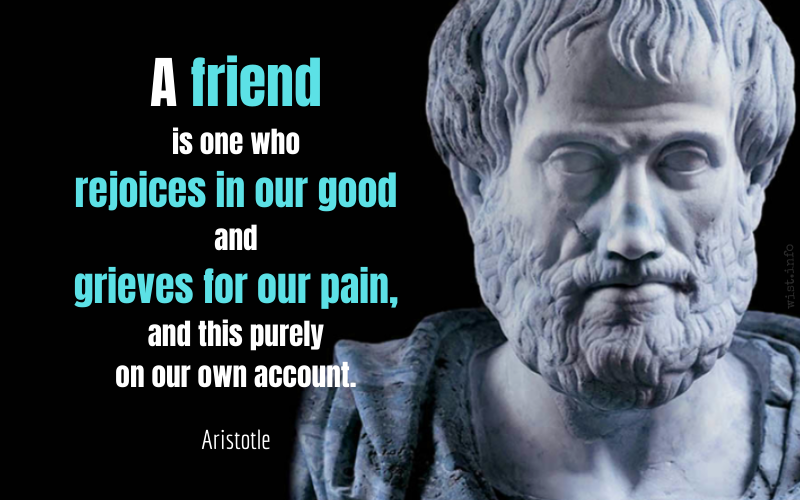
Their mistakes are always due to lack of moderation and taking things too far, contrary to Chilon’s saying. That is, they do everything to excess: they love excessively, they hate excessively, and so on and so forth.
καὶ ἅπαντα ἐπὶ τὸ μᾶλλον καὶ σφοδρότερον ἁμαρτάνουσι, παρὰ τὸ Χιλώνειον (πάντα γὰρ ἄγαν πράττουσιν: φιλοῦσι γὰρ ἄγαν καὶ μισοῦσιν ἄγαν καὶ τἆλλα πάντα ὁμοίως), καὶ εἰδέναι ἅπαντα οἴονται καὶ διισχυρίζονται (τοῦτο γὰρ αἴτιόν ἐστιν καὶ τοῦ πάντα ἄγαν)
Aristotle (384-322 BC) Greek philosopher
Rhetoric [Ῥητορική; Ars Rhetorica], Book 2, ch. 12, sec. 14 (2.12.14) / 1389b (350 BC) [tr. Waterfield (2018)]
(Source)
Speaking of youth.
Chilon was one of "the Seven Wise Men" of Greece. His maxim was "Μηδὲν ἄγαν" ["Never go to extremes."] (Diogenes Laertius, Lives of Eminent Philosophers, 1.41)
(Source (Greek)). Alternate translations:
- "And all their errors are on the side of excess, and too much zeal, contrary to Chilo's rule; for they carry every thing too far. For they are extreme in their friendships, and in their hates, and in all other their actions are similarly excessive." [Source (1847)]
- "And all their errors are on the side of excess and too great earnestness, in contravention of Chilo's rule; for the young carry everything to an excess; for their friendships are in excess, their hatreds are in excess, and they do everything else with the same degree of earnestness." [tr. Buckley (1850)]
- "All their mistakes are on the side of excess or vehemence -- against the maxim of Chilon; they do everything too much; they loe to much, hate too much, and so in all else." [tr. Jebb (1873)]
- "All their mistakes are in the direction of doing things excessively and vehemently. They disobey Chilon's precept by overdoing everything, they love too much and hate too much, and the same thing with everything else." [tr. Roberts (1924)]
- "All their errors are due to excess and vehemence and their neglect of the maxim of Chilon, for they do everything to excess, love, hate, and everything else." [tr. Freese (1926)]
- "And quite all the mistakes they make tend in the direction of excess and vehemence, in violation of the saying of Chilon, for they do all things excessively: they feel friendly affection to excess and hatred to excess, and all else similarly." [tr. Bartlett (2019)]
Wit is cultured insolence.
[ἡ γὰρ εὐτραπελία πεπαιδευμένη ὕβρις ἐστίν.]
Aristotle (384-322 BC) Greek philosopher
Rhetoric [Ῥητορική; Ars Rhetorica], Book 2, ch. 12, sec. 16 (2.12.16) / 1389b.11 (350 BC) [tr. Freese (1926)]
(Source)
(Source (Greek)). Alternate translations:
Using maxims is appropriate for those who are older in age when uttered about things for which they have some experience. Using maxims before one is this age lacks propriety as does story-telling: to speak about what one has no experience in is foolish and uneducated. A sufficient sign of this is that bumpkins especially tend to make up maxims and they easily show them off.
[ἁρμόττει δὲ γνωμολογεῖν ἡλικίᾳ μὲν πρεσβυτέροις, περὶ δὲ τούτων ὧν ἔμπειρός τις ἐστί, ὡς τὸ μὲν μὴ τηλικοῦτον ὄντα γνωμολογεῖν ἀπρεπὲς ὥσπερ καὶ τὸ μυθολογεῖν, περὶ δ᾿ ὧν ἄπειρος, ἠλίθιον καὶ ἀπαίδευτον. σημεῖον δ᾿ ἱκανόν· οἱ γὰρ ἀγροῖκοι μάλιστα γνωμοτύποι εἰσὶ καὶ ῥᾳδίως ἀποφαίνονται.]
Aristotle (384-322 BC) Greek philosopher
Rhetoric [Ῥητορική; Ars Rhetorica], Book 2, ch. 21, sec. 9 (2.21.9) / 1395a.9 (350 BC) [tr. @sentantiq (2018)]
(Source)
(Source (Greek)). Alternate translations:
In point of age, the use of maxims befit the old, and should be on those matters of which they have particular experience; so that for one who has not arrived at that stage of life, to use maxims is unbecoming; just it is for him to use fables; and if it be on matters whereof he has no experience, it is absurd, and a mark of ignorance. And the following is a sufficient proof of it, for that the rustics most of all are proverb-mongers, and are ready at uttering them.
[Source (1847)]
The employment of maxims becomes him who is rather advanced in life; and particularly as respects subjects about which each happens to be well informed. Since for one not so advanced in age to sport maxims is bad taste, just as it is for him to have recourse to fables: and the ue of them on subjects about which one is ignorant is silly, and argues a want of education. There is a sufficient sign of the truth of this; for the boors of the country are of all other people most fond of hammering out maxims, and set them forth with great volubility.
[tr. Buckley (1850)]
The use of maxims is suitable to elderly men, and in regard to subjects with which one is conversant; for sententiousness, like story-telling, is unbecoming in a younger man; while, in regard to subjects with which one is not conversant, it is stupid and shows want of culture. It is token enough of this that rustics are the greatest coiners of maxims, and the readiest to set forth their views.
[tr. Jebb (1873)]
The use of maxims is suitable for one who is advanced in years, and in regard to things in which one has experience; since the use of maxims before such an age is unseemly, as also is story-telling; and to speak about things of which one has no experience shows foolishness and lack of education. A sufficient proof of this is that rustics especially are fond of coining maxims and ready to make display of them.
[tr. Freese (1924)]
The use of Maxims is appropriate only to elderly men, and in handling subjects in which the speaker is experienced. For a young man to use them is -- like telling stories -- unbecoming; to use them in handling things in which one has no experience is silly and ill-bred: a fact sufficiently proved by the special fondness of country fellows for striking out maxims, and their readiness to air them.
[tr. Roberts (1924)]
The use of maxims is suitable for one who is advanced in years, and in regard to things in which one has experience; since the use of maxims before such an age is unseemly, as also is story-telling; and to speak about things of which one has no experience shows foolishness and lack of education. A sufficient proof of this is that rustics especially are fond of coining maxims and ready to make display of them.
[tr. Freese (1926)]
It is fitting for someone more advanced in age to speak in maxims, and about things he has experience of, since it is inappropriate for someone not of that age to speak in maxims, just as it also to tell myths, and to do so about things he is inexperienced in, this being a mark of foolishness and lack of education. There is a sufficient sign of this: country bumpkins are the ones most given to uttering maxims ....
[tr. Bartlett (2019)]
“Neither does this please me, nothing in excess;” for we ought to hate in excess those that are bad to excess.
[οὐδὲ τὸ μηδὲν ἄγαν· δεῖ γὰρ τούς γε κακοὺς ἄγαν μισεῖν.]
Aristotle (384-322 BC) Greek philosopher
Rhetoric [Ῥητορική; Ars Rhetorica], Book 2, ch. 21, sec. 14 (2.21.14) / 1395a.33 (350 BC) [Source (1847)]
(Source)
On developing one's own maxims and proverbs, and how to present them. (Source (Greek)). Alternate translations:
Nor again [does this please me], that we ought to carry nothing to excess; since 'tis our duty to hate the wicked at least to the very extreme.
[tr. Buckley (1850)]
No do I like the saying, Do nothing excessively. Bad men should be hated excessively.
[tr. Jebb (1873)]
Nor do I approve of the saying "nothing in excess": we are bound to hate bad men excessively.
[tr. Rhys Roberts (1924)]
Nor do I approve the maxim "Nothing in excess," for one cannot hate the wicked too much."
[tr. Freese (1926)]
Neither is "nothing in excess" [satisfying to me]. For one must tate to excess at least those who are evil.
[tr. Bartlett (2019)]
[I do not] commend the saying “nothing in excess” because one must hate evil men to the extreme.
[tr. @sentantiq (2019)]
We ought in fairness to fight our case with no help beyond the bare facts: nothing, therefore, should matter except the proof of those facts. Still, as has been already said, other things affect the result considerably, owing to the defects of our hearers.
[δίκαιον γὰρ αὐτοῖς ἀγωνίζεσθαι τοῖς πράγμασιν, ὥστε τἆλλα ἔξω τοῦ ἀποδεῖξαι περίεργα ἐστίν: ἀλλ᾽ ὅμως μέγα δύναται, καθάπερ εἴρηται, διὰ τὴν τοῦ ἀκροατοῦ μοχθηρίαν.]
Aristotle (384-322 BC) Greek philosopher
Rhetoric [Ῥητορική; Ars Rhetorica], Book 3, ch. 1, sec. 5 (3.1.5) / 1404a (350 BC) [tr. Roberts (1924)]
(Source)
On style vs. substance in shaping judgment. (Source (Greek)). Alternate translations:
For justice would be to contend with the facts only, so that every thing else beside the mere demonstration is superfluous; nevertheless, it [style] is of great influence, as has been said, owing to the corruption of the hearers.
[Source (1847)]
Our facts ought to be our sole weapons, making everything superfluous which is outside the proof; owing to the infirmities of the hearer, however, style, as we have said, can do much.
[tr. Jebb (1873)]
For justice should consist in fighting the case with the facts alone, so that everything else that is beside demonstration is superfluous; nevertheless, as we have just said, it [style] is of great importance owing to the corruption of the hearer.
[tr. Freese (1926)]
Although [...] in justice, litigants should appeal only to the facts to contest the case, so that everything apart from demonstration is superfluous, it remains the case, as I have aid, that, thanks to the audience's moral weakness, delivery is very effective.
[tr. Waterfield (2018)]
Being asked how the educated differ from the uneducated, “As much,” he said, “as the living from the dead.”
[ἐρωτηθεὶς τίνι διαφέρουσιν οἱ πεπαιδευμένοι τῶν ἀπαιδεύτων, “ὅσῳ,” εἶπεν, “οἱ ζῶντες τῶν τεθνεώτων.”]
Aristotle (384-322 BC) Greek philosopher
Attributed in Diogenes Laërtius, Lives and Opinions of Eminent Philosophers [Vitae Philosophorum], Book 5, sec. 11 [tr. Hicks (1925), sec. 19]
(Source)
(Source (Greek)). Alternate translations:
On one occasion he was asked how much educated men were superior to those uneducated; “As much,” said he, “as the living are to the dead.”
[tr. Yonge (1853)]
When asked what the difference was between those who were educated and those who were not, Aristotle said "as great as between the living and the dead."
[tr. @sentantiq (2016)]
When asked how the educated differ from the uneducated, he said, "as much as the living from the dead."
[tr. Mensch (2018)]
When asked to define a friend, he said, “One soul dwelling in two bodies.”
[ἐρωτηθεὶς τί ἐστι φίλος, ἔφη, “μία ψυχὴ δύο σώμασιν ἐνοικοῦσα.”]
Aristotle (384-322 BC) Greek philosopher
Attributed in Diogenes Laërtius, Lives and Opinions of Eminent Philosophers [Vitae Philosophorum], Book 5, sec. 11 [tr. Mensch (2018)]
(Source)
(Source (Greek)). Alternate translations:
He was once asked what a friend is; and his answer was, “One soul abiding in two bodies.”
[tr. Yonge (1853)]
To the query, "What is a friend?" his reply was, "A single soul dwelling in two bodies."
[tr. Hicks (1925), sec. 20]
When he was asked what a friend is, he replied “one soul occupying two bodies.”
[tr. @sentantiq (2016)]
Reproached one day because he gave alms to a good-for-nothing, he said, “It was the man that I pitied, not his conduct.”
[ὀνειδιζόμενός ποτε ὅτι πονηρῷ ἀνθρώπῳ ἐλεημοσύνην ἔδωκεν, “οὐ τὸν τρόπον,” εἶπεν, “ἀλλὰ τὸν ἄνθρωπον ἠλέησα.”]
Aristotle (384-322 BC) Greek philosopher
Attributed in Diogenes Laërtius, Lives and Opinions of Eminent Philosophers [Vitae Philosophorum], Book 5, sec. 11 [tr. Mensch (2018)]
(Source)
(Greek Source). Alternate translations:
On one occasion he was blamed for giving alms to a worthless man, and he replied, “I did not pity the man, but his condition.”
[tr. Yonge (1853)]
Being once reproached for giving alms to a bad man, he rejoined, "It was the man and not his character that I pitied."
[tr. Hicks (1925), sec. 17]
After he was reproached for giving money to a wretched man, he said, “It wasn’t the character, but the man I pitied.”
[tr. @sentantiq [2016)]
Once, he was reproached because he gave charity to a lowly person, so he said, "I gave charity to a man, not a way of life."
[Source, sec. 17]
On hearing that someone had reviled him, he said, “As long as I’m not in his presence, let him flog me as well.”
[ἀκούσας ὑπό τινος λοιδορεῖσθαι, “ἀπόντα με,” ἔφη, “καὶ μαστιγούτω.”]
Aristotle (384-322 BC) Greek philosopher
Attributed in Diogenes Laërtius, Lives and Opinions of Eminent Philosophers [Vitae Philosophorum], Book 5, sec. 11 [tr. Mensch (2018)]
(Source)
(Source (Greek)). Alternate translations:
Having heard that he was abused by some one, he said, “He may beat me too, if he likes, in my absence.”
[tr. Yonge (1853), sec. 11]
On hearing that someone abused him, he rejoined, "He may even scourge me so it be in my absence."
[tr. Hicks (1925), sec. 18]
After he heard that he was mocked by someone, he said, “Let him insult me when I am absent.”
[tr. @sentantiq (2016)]
To a talkative fellow, who poured out a torrent of words and then said, “Let’s hope I haven’t been boring you with my chatter!” he replied, “No, by Zeus, I haven’t been listening.”
[πρὸς τὸν εἰπόντα ἀδολέσχην, ἐπειδὴ αὐτοῦ πολλὰ κατήντλησε, “μήτι σου κατεφλυάρησα;” “μὰ Δί᾽,” εἶπεν: “οὐ γάρ σοι προσεῖχον.]
Aristotle (384-322 BC) Greek philosopher
Attributed in Diogenes Laërtius, Lives and Opinions of Eminent Philosophers [Vitae Philosophorum], Book 5, sec. 11 [tr. Mensch (2018)]
(Source)
(Source (Greek)). Alternate translations:
A chattering fellow, who had been abusing him, said to him, “Have not I been jeering you properly?” “Not that I know of,” said he, “for I have not been listening to you.”
[tr. Yonge (1853)]
To the chatterbox who poured out a flood of talk upon him and then inquired, "Have I bored you to death with my chatter?" he replied, "No, indeed; for I was not attending to you."
[tr. Hicks (1925), sec. 20]
To the man talking endlessly when he assailed him with words and asked “Have I worn you out with nonsense”, he said “By Zeus, no! I wasn’t listening to you.”
[tr. @sentantiq (2016)]
A man on one occasion reproached him for having given a contribution to one who was not a good man (for the story which I have mentioned before is also quoted in this way), and his answer was, “I gave not to the man, but to humanity.”
[πρὸς τὸν αἰτιασάμενον ὡς εἴη μὴ ἀγαθῷ ἔρανον δεδωκώσ–φέρεται γὰρ καὶ οὕτωσ–“οὐ τῷ ἀνθρώπῳ,” φησίν, “ἔδωκα, ἀλλὰ τῷ ἀνθρωπίνῳ.”]
Aristotle (384-322 BC) Greek philosopher
Attributed in Diogenes Laërtius, Lives and Opinions of Eminent Philosophers [Vitae Philosophorum], Book 5, sec. 11 [tr. Yonge (1853)]
(Source)
(Source (Greek)). The previously mentioned story is here. Alternate translations:
When someone accused him of having given a subscription to a dishonest man -- for the story is also told in this form -- "It was not the man," said he, "that I assisted, but humanity."
[tr. Hicks (1925), sec. 21]
When someone blamed him for giving membership to a base man, he said, “I didn’t give it to a man, but to humanity.”
[tr. @sentantiq (2016)]
To someone who faulted him for having made a loan to a dishonest man -- for the story is also told in this way -- he said, "It was not the man that I assisted, but mankind."
[tr. Mensch (2018)]
On another occasion the question was put to him, what hope is? and his answer was, “The dream of a waking man.”
[ἐρωτηθεὶς τί ἐστιν ἐλπίς, “ἐγρηγορότος,” εἶπεν, “ἐνύπνιον.”]
Aristotle (384-322 BC) Greek philosopher
Attributed in Diogenes Laërtius, Lives and Opinions of Eminent Philosophers [Vitae Philosophorum], Book 5, sec. 11 [tr. Yonge (1853)]
(Source)
(Source (Greek)). Alternate translations:
He was asked to define hope, and he replied, "It is a waking dream."
[tr. Hicks (1925), sec. 18]
When asked what hope is, he said “It is dreaming while awake.”
[tr. @sentantiq (2016), 5.21]
When asked to define hope, he said, "It is a waking dream."
[tr. Mensch (2018)]
When a man boasted in his presence that he was a native of an illustrious city, he said, “That is not what one ought to look at, but whether one is worthy of a great city.”
[πρὸς τὸν καυχώμενον ὡς ἀπὸ μεγάλης πόλεως εἴη, “οὐ τοῦτο,” ἔφη, “δεῖ σκοπεῖν, ἀλλ᾽ ὅστις μεγάλης πατρίδος ἄξιός ἐστιν.”]
Aristotle (384-322 BC) Greek philosopher
Attributed in Diogenes Laërtius, Lives and Opinions of Eminent Philosophers [Vitae Philosophorum], Book 5, sec. 11 [tr. Yonge (1853)]
(Source)
(Source (Greek)). Alternate translations:
To one who boasted that he belonged to a great city his reply was, "That is not the point to consider, but who it is that is worthy of a great country."
[tr. Hicks (1925), sec. 19]
To a man boasting that he was from a great city, he said “Don’t look at this, but instead who is worthy of a great country.”
[tr. @sentantiq (2016)]
To someone who boasted that he came from a great city, he said, "That is not what one should consider, but who it is that is worthy of a great country."
[tr. Mensch (2018)]
The question was once put to him, how we ought to behave to our friends; and the answer he gave was, “As we should wish our friends to behave to us.”
[ἐρωτηθεὶς πῶς ἂν τοῖς φίλοις προσφεροίμεθα, ἔφη, “ὡς ἂν εὐξαίμεθα αὐτοὺς ἡμῖν προσφέρεσθαι.”]
Aristotle (384-322 BC) Greek philosopher
Attributed in Diogenes Laërtius, Lives and Opinions of Eminent Philosophers [Vitae Philosophorum], Book 5, sec. 11 [tr. Yonge (1853)]
(Source)
(Source (Greek)). Alternate translations:
To the question how we should behave to friends, he answered, "As we should wish them to behave to us."
[tr. Hicks (1925), sec. 21]
When asked how we should act towards friends, he said “as we would pray they act towards us!”
[tr. @sentantiq (2016)]
When asked how we should behave to friends, he said, "As we would wish them to behave to us."
[tr. Mensch (2018)]
When asked what ages quickly, he replied, “Gratitude.”
[ἐρωτηθεὶς τί γηράσκει ταχύ, “χάρις,” ἔφη.]
Aristotle (384-322 BC) Greek philosopher
Attributed in Diogenes Laërtius, Lives and Opinions of Eminent Philosophers [Vitae Philosophorum], Book 5, sec. 18 [tr. Mensch (2018)]
(Source)
(Source (Greek)). Alternate translations:
Once he was asked what grew old most speedily, and he replied, “Gratitude.”
[tr. Yonge (1853), sec. 11]
Being asked, "What is it that soon grows old?" he answered, "Gratitude."
[tr. Hicks (1925)]
When he was asked what grows old quickly, he said "thanks."
[tr. @sentantiq (2016)]
When asked what people gain by telling likes, he replied, “That when they tell the truth they are not believed.”
[ἐρωτηθεὶς τί περιγίνεται κέρδος τοῖς ψευδομένοις, “ὅταν,” ἔφη, “λέγωσιν ἀληθῆ, μὴ πιστεύεσθαι.”]
Aristotle (384-322 BC) Greek philosopher
Attributed in Diogenes Laërtius, Lives and Opinions of Eminent Philosophers, Book 5. [tr. Mensch (2018)]
(Source)
Original Greek. Alternate translations:
He was once asked, what those who tell lies gain by it; “They gain this,” said he, “that when they speak truth they are not believed.”
[tr. Yonge (1853), sec. 11]
To the question, "What do people gain by telling lies?" his answer was, "Just this, that when they speak the truth they are not believed."
[tr. Hicks (1925), sec. 17]