

The Courage we desire and prize is not the Courage to die decently, but to live manfully.
Thomas Carlyle (1795-1881) Scottish essayist and historian
“Boswell’s Life of Johnson,” Critical and Miscellaneous Essays (1827-1855)
(Source)
Originally published in Fraser's Magazine, Vol 5, # 28 (1832). Reviewing a new 1831 edition of James Boswell, The Life of Samuel Johnson.
Quotations by:
Carlyle, Thomas
All work is as seed sown; it grows and spreads, and sows itself anew.
Thomas Carlyle (1795-1881) Scottish essayist and historian
“Boswell’s Life of Johnson,” Critical and Miscellaneous Essays (1827-1855)
(Source)
Originally published in Fraser's Magazine, Vol 5, # 28 (1832). Reviewing a new 1831 edition of James Boswell, The Life of Samuel Johnson.
His religion at best is an anxious wish, — like that of Rabelais, a great Perhaps.
Thomas Carlyle (1795-1881) Scottish essayist and historian
“Burns,” Edinburgh Review No. 96, Art. 1 (1828-12)
(Source)
A review of Lockhart, The Life of Robert Burns (1828).
Manhood begins when we have in any way made truce with Necessity; begins even when we have surrendered to Necessity, as the most part only do; but begins joyfully and hopefully only when we have reconciled ourselves to Necessity; and thus, in reality, triumphed over it, and felt that in Necessity we are free.
Thomas Carlyle (1795-1881) Scottish essayist and historian
“Burns,” Edinburgh Review No. 96, Art. 1 (1828-12)
(Source)
A review of Lockhart, The Life of Robert Burns (1828).
In every man’s writings, the character of the writer must lie recorded.
Thomas Carlyle (1795-1881) Scottish essayist and historian
“Goethe,” Foreign Review No. 3 (1828-08)
(Source)
Reviewing Goethe's Sämmtliche Werke, Vollständige Ausgabe Letzter Hand (1827). Reprinted in Carlyle, Critical and Miscellaneous Essays (1845).
Clever men are good, but they are not the best.
Thomas Carlyle (1795-1881) Scottish essayist and historian
“Goethe,” Foreign Review No. 3 (1828-08)
(Source)
Reviewing Goethe's Sämmtliche Werke, Vollständige Ausgabe Letzter Hand (1827). Reprinted in Carlyle, Critical and Miscellaneous Essays (1845).
We are firm believers in the maxim that for all right judgment of any man or thing it is useful, nay, essential, to see his good qualities before pronouncing on his bad.
Thomas Carlyle (1795-1881) Scottish essayist and historian
“Goethe,” Foreign Review No. 3 (1828-08)
(Source)
Reviewing Goethe's Sämmtliche Werke, Vollständige Ausgabe Letzter Hand (1827). Reprinted in Carlyle, Critical and Miscellaneous Essays (1845).
Rich as we are in Biography, a well-written Life is almost as rare as a well-spent one.
Thomas Carlyle (1795-1881) Scottish essayist and historian
“Jean Paul Friedrich Richter,” Edinburgh Review No. 91, Art. 7 (1827-07/10)
(Source)
A review of Heinrich Döring, Jean Paul Friedrich Richter's Life, with a Sketch of his Works (1826).
Originality is a thing we constantly clamour for, and constantly quarrel with; as if, observes our author himself, any originality but our own could be expected to content us! In fact all strange thing are apt, without fault of theirs, to estrange us at first view, and unhappily scarcely anything is perfectly plain, but what is also perfectly common.
Thomas Carlyle (1795-1881) Scottish essayist and historian
“Jean Paul Friedrich Richter,” Edinburgh Review No. 91, Art. 7 (1827-7/10)
(Source)
A review of Heinrich Döring, Jean Paul Friedrich Richter's Life, with a Sketch of his Works (1826).
No solitary miscreant, scarcely any solitary maniac, would venture on such actions and imaginations, as large communities of sane men have, in such circumstances, entertained as sound wisdom.
Thomas Carlyle (1795-1881) Scottish essayist and historian
“Signs of the Times,” Edinburgh Review No. 98, Art. 7 (1829-06)
(Source)
There is no heroic poem in the world but is at bottom a biography, the life of a man; also, it may be said, there is no life of a man, faithfully recorded, but is a heroic poem of its sort, rhymed or unrhymed.
Thomas Carlyle (1795-1881) Scottish essayist and historian
“Sir Walter Scott,” London and Westminster Review No. 12 and 55, Art. 2 (1838-01)
(Source)
A review of Scott's Memoirs of the Life of Sir Walter Scott, Baronet, Vols. 1-6 (1837). Reprinted in Carlyle, Critical and Miscellaneous Essays (1827-1855).
Under all speech that is good for anything there lies a silence that is better. Silence is deep as Eternity; speech is shallow as Time.
Thomas Carlyle (1795-1881) Scottish essayist and historian
“Sir Walter Scott,” London and Westminster Review No. 12 and 55, Art. 2 (1838-01)
(Source)
A review of Scott's Memoirs of the Life of Sir Walter Scott, Baronet, Vols. 1-6 (1837). Reprinted in Carlyle, Critical and Miscellaneous Essays (1827-1855).
No man lives without jostling and being jostled; in all ways he has to elbow himself through the world, giving and receiving offense.
Thomas Carlyle (1795-1881) Scottish essayist and historian
“Sir Walter Scott,” London and Westminster Review No. 12 and 55, Art. 2 (1838-01)
(Source)
A review of Scott's Memoirs of the Life of Sir Walter Scott, Baronet, Vols. 1-6 (1837). Reprinted in Carlyle, Critical and Miscellaneous Essays (1827-1855).
The thoughts they had were the parents of the actions they did; their feelings were the parents of their thoughts.
Thomas Carlyle (1795-1881) Scottish essayist and historian
“The Hero as Divinity,” On Heroes, Hero-Worship, and the Heroic in History (1841)
The purse is any Highwayman’s who might meet me with a loaded pistol, but the Self is mine and God my Maker’s; it is not yours; and I will resist you to the death.
Thomas Carlyle (1795-1881) Scottish essayist and historian
“The Hero as King,” On Heroes, Hero-Worship, and the Heroic in History (1841)
A man always is to be himself the judge of how much of his mind he will show to other men; even to those he would have work along with him. There are impertinent inquiries made: your rule is to leave the inquirer uninformed on that matter; not, if you can help it, misinformed; but precisely as dark as he was!
Thomas Carlyle (1795-1881) Scottish essayist and historian
“The Hero as King,” On Heroes, Hero-Worship, and the Heroic in History (1841)
Self-deception once yielded to, all other deceptions follow naturally more and more.
Thomas Carlyle (1795-1881) Scottish essayist and historian
“The Hero as King,” On Heroes, Hero-Worship, and the Heroic in History (1841)
Beautiful it is to see and understand that no worth, known or unknown, can die even in this earth. The work an unknown good man has done is like a vein of water flowing hidden underground, secretly making the ground green; it flows and flows, it joins itself with other veins and veinlets; one day, it will start forth as a visible perennial well.
Thomas Carlyle (1795-1881) Scottish essayist and historian
“Varnhagen von Ense’s Memoirs,” London and Westminster Review, No. 62 (1838-12)
(Source)
A review of three books involving Lady Rahel Varnhagen von Ense.
The tragedy of life is not so much what men suffer, but rather what they miss.
Thomas Carlyle (1795-1881) Scottish essayist and historian
(Attributed)
The block of granite which was an obstacle in the path of the weak, becomes a steppingstone in the path of the strong.
Thomas Carlyle (1795-1881) Scottish essayist and historian
(Attributed)
Our grand business is not to see what lies dimly at a distance, but to do what lies clearly at hand.
Thomas Carlyle (1795-1881) Scottish essayist and historian
(Attributed)
Make yourself an honest man, and then you may be sure that there is one rascal less in the world.
Thomas Carlyle (1795-1881) Scottish essayist and historian
(Attributed)
This can also be found quoted as "one less rascal" and "one less scoundrel." I cannot find an original source for it.
I don’t like to talk much with people who always agree with me. It is amusing to coquette with an echo for a little while, but one soon tires of it.
Thomas Carlyle (1795-1881) Scottish essayist and historian
(Attributed)
Attributed in Tryon Edwards, A Dictionary of Thoughts (1891).
The best effect of any book is that it excites the reader to self-activity.
Thomas Carlyle (1795-1881) Scottish essayist and historian
(Attributed)
Quoted in James Wood (ed.), Dictionary of Quotations from Ancient and Modern, English and Foreign Sources (1893).
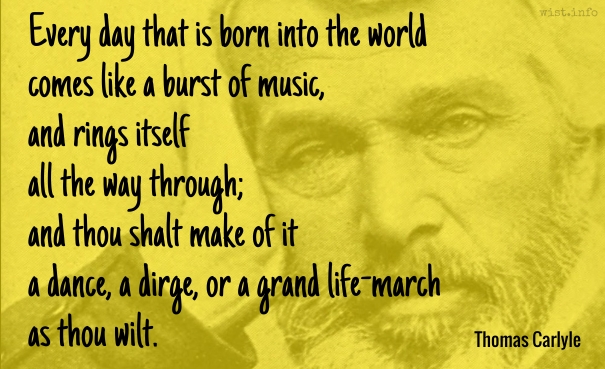
Every day that is born into the world comes like a burst of music, and rings itself all the way through; and thou shalt make of it a dance, a dirge, or a grand life-march as thou wilt.
Thomas Carlyle (1795-1881) Scottish essayist and historian
(Attributed)
Variant: "Every day that is born into the world comes like a burst of music and rings itself the way through, and you make of it a dance, a dirge, or a life-march, as thou wilt."
The earliest reference I can find to this is its quotation in (or perhaps adjacent to) Kate W. Hamilton, "Ariel Seaton's Rainy Day," The Ladies' Repository (Jan 1868).
In every object there is inexhaustible meaning; the eye sees in it what the eye brings means of seeing.
Thomas Carlyle (1795-1881) Scottish essayist and historian
(Misattributed)
Carlyle uses this phrase in his The French Revolution: A History, Part 1, Book 1, ch. 2 (1.1.2) (1837), but brackets it in quotations, and prefaces it with "For indeed it is well said ...." Nevertheless, the phrase is often misattributed directly to Carlyle.
The second half of the phrase (and sometimes the whole thing) has also been misattributed to Johann von Goethe, as "The eye sees only what the eye brings means of seeing." This is not found in Goethe's work, but may be distorted from a line in the Prologue to Goethe's Faust: "Each one sees what he carries in his heart."
The fine arts once divorcing themselves from truth are quite certain to fall mad, if they do not die.
Thomas Carlyle (1795-1881) Scottish essayist and historian
Latter Day Pamphlet, No. 8 (1850)
Every new opinion, at its starting, is precisely in a minority of one.
Thomas Carlyle (1795-1881) Scottish essayist and historian
On Heroes, Hero-Worship and the Heroic in History (1840)
The greatest of faults, I should say, is to be conscious of none.
Thomas Carlyle (1795-1881) Scottish essayist and historian
On Heroes, Hero-Worship and the Heroic in History, “The Heroic in History: (1840)
Adversity is sometimes hard upon a man; but for one man who can stand prosperity there are a hundred that will stand adversity.
Thomas Carlyle (1795-1881) Scottish essayist and historian
On Heroes, Hero-Worship and the Heroic in History, Lecture V, “The Hero as a Man of Letters” (1840)
No iron chain, or outward force of any kind, could ever compel the soul of man to believe or disbelieve.
Thomas Carlyle (1795-1881) Scottish essayist and historian
On Heroes, Hero-Worship, and the Heroic in History, “The Hero as Priest” (1841)
Democracy means despair of ever finding any heroes to govern you, and contentedly putting up with the want of them.
Thomas Carlyle (1795-1881) Scottish essayist and historian
Past and Present (1843)
Tell a man he is brave, and you help him to become so.
Thomas Carlyle (1795-1881) Scottish essayist and historian
Past and Present (1843)
Every noble work is at first impossible.
Thomas Carlyle (1795-1881) Scottish essayist and historian
Past and Present, ch. 11 “Labour” (1843)
No man who has once heartily and wholly laughed can be altogether irreclaimably bad.
Thomas Carlyle (1795-1881) Scottish essayist and historian
Sartor Resartus, Book 1, ch. 4 (1831)
(Source)
Wonder is the basis of worship.
Thomas Carlyle (1795-1881) Scottish essayist and historian
Sartor Resartus, Book 1, ch. 10 (1831)
(Source)
Hadst thou not Greek enough to understand thus much: The end of Man is an Action and not a Thought, though it were the noblest.
Thomas Carlyle (1795-1881) Scottish essayist and historian
Sartor Resartus, Book 2, ch. 6 (1831)
(Source)
From Aristotle, Nicomachean Ethics, 1.3.6 ("The end aimed at is not knowledge but action").
With Stupidity and sound Digestion man may front much.
Thomas Carlyle (1795-1881) Scottish essayist and historian
Sartor Resartus, Book 2, ch. 7 (1831)
(Source)
But indeed Conviction, were it never so excellent, is worthless till it convert itself into Conduct. Nay properly Conviction is not possible ill then.
Thomas Carlyle (1795-1881) Scottish essayist and historian
Sartor Resartus, Book 2, ch. 9 (1831)
(Source)
As the Swiss inscription says: Sprechen ist silbern, Schweigen ist golden — “Speech is silvern, Silence is golden”; or, as I might rather express it: speech is of time, silence is of eternity.
Thomas Carlyle (1795-1881) Scottish essayist and historian
Sartor Resartus, Book 3, ch. 3 (1831)
(Source)
That there should one Man die ignorant who had capacity for Knowledge, this I call a tragedy.
Thomas Carlyle (1795-1881) Scottish essayist and historian
Sartor Resartus, Book 3, ch. 4 (1831)
(Source)
Trust not the heart of that man for whom old clothes are not venerable.
Thomas Carlyle (1795-1881) Scottish essayist and historian
Sartor Resartus, Book 3, ch. 6 (1831)
(Source)
Philosophy complains that Custom has hoodwinked us, from the first; that we do everything by Custom, even Believe by it; that our very Axioms, let us boast of Free-thinking as we may, are oftenest simply such Beliefs as we have never heard questioned. Nay, what is Philosophy throughout but a continual battle against Custom; an ever-renewed effort to transcend the sphere of blind Custom, and so become Transcendental?
Thomas Carlyle (1795-1881) Scottish essayist and historian
Sartor Resartus, Book 3, ch. 8 (1831)
(Source)
Innumerable are the illusions and legerdemain-tricks of Custom: but of all these, perhaps the cleverest is her knack of persuading us that the Miraculous, by simple repetition, ceases to be Miraculous.
Thomas Carlyle (1795-1881) Scottish essayist and historian
Sartor Resartus, Book 3, ch. 8 (1831)
(Source)
I do not believe in the collective wisdom of individual ignorance.
Thomas Carlyle (1795-1881) Scottish essayist and historian
The Age of Reason, “The Author’s Profession of Faith”
France was long a “Despotism tempered by Epigrams.”
Thomas Carlyle (1795-1881) Scottish essayist and historian
The French Revolution: A History, Part 1, Book 2, ch. 4 (1.2.4) (1837)
(Source)
Though given in quotation marks, Carlyle is apparently "quoting" himself.
This quotation is commonly given on its own, though, since Carlyle's thesis at this point in his history is that the royal government had largely become irrelevant in the nation, he continues:
... and now, it would seem, the Epigrams have got the upper hand.
[Source]
This is that same Foulon named âme damnée du Parlement; a man grown gray in treachery, in griping, projecting, intriguing and iniquity: who once when it was objected, to some finance-scheme of his, “What will the people do?” — made answer, in the fire of discussion, “The people may eat grass”: hasty words, which fly abroad irrevocable, — and will send back tidings!
Thomas Carlyle (1795-1881) Scottish essayist and historian
The French Revolution: A History, Part 1, Book 3, ch. 9 (1.3.9) (1837)
(Source)
Writing of Joseph-François Foullon de Doué (1715-1789), French politician, the "damned soul of the Parliament," and a Controller-General of Finances under Louis XVI. Widely hated by "the people" for such statements and actions, he was one of the early targets of the French Revolution, as told in Dickens, A Tale of Two Cities. He was marched from his country hiding place back to Paris, with the mob shoving grass and hay into his face and mouth. He became the first recorded person to have been lynched from a lamp post. (The rope broke three times, so he was instead beheaded and his grass-stuffed head marched about on a pike.)
O poor mortals, how ye make this Earth bitter for each other; this fearful and wonderful Life fearful and horrible; and Satan has his place in all hearts! Such agonies and ragings and wailings ye have, and have had, in all times: — to be buried all, in so deep silence; and the salt sea is not swoln with your tears.
Thomas Carlyle (1795-1881) Scottish essayist and historian
The French Revolution: A History, Part 1, Book 5, ch. 5 (1.5.5) (1837)
(Source)
As the prospect of violence mounts within Paris on the night of 13 July 1789. The next day was the storming of the Bastille.
Where this will end? In the Abyss, one may prophecy; whither all Delusions are, at all moments, traveling; where this Delusion has now arrived. For if there be a Faith, from of old, it is this, as we often repeat, that no Lie can live for ever. The very Truth has to change its vesture, from time to time; and be born again. But all Lies have sentence of death written down against them, and Heaven’s Chancery itself; and, slowly or fast, advance incessantly towards their hour.
Thomas Carlyle (1795-1881) Scottish essayist and historian
The French Revolution: A History, Part 1, Book 6, ch. 3 (1.6.3) (1837)
(Source)
Carlyle is speaking of the delusion that the wealthy and land-owners of pre-Revolutionary France could forever oppress their tenants with taxes and rent without finally driving them to bloody revolution.
A core phrase here was latched onto by Martin Luther King, Jr., who incorporated it as standard fare in his speeches in the mid- and late 1960s.
We shall overcome, because Carlyle is right, "No lie can live forever."
[Examples: 1, 2, 3, 4]
Do nothing, only keep agitating, debating; and things will destroy themselves.
Thomas Carlyle (1795-1881) Scottish essayist and historian
The French Revolution: A History, Part 1, Book 6, ch. 3 (1.6.3) (1837)
(Source)
On the inactivity of the elected National Assembly leading up to the Revolution.
History is a distillation of Rumour.
Thomas Carlyle (1795-1881) Scottish essayist and historian
The French Revolution: A History, Part 1, Book 7, ch. 5 (1.7.5) (1837)
(Source)
The original is actually embedded in this sentence:
Remarkable [Usher] Maillard, if fame were not an accident, and History a distillation of Rumour, how remarkable wert thou!
There are depths in man which go down the length of the lowest Hell, as there are heights which reach the highest Heaven; — for are not both Heaven and Hell made out of him, everlasting Miracle and Mystery that he is?
Thomas Carlyle (1795-1881) Scottish essayist and historian
The French Revolution, Vol. 3, Book 1, ch. 4 (1837)
(Source)
This is often cited back to its popular attributed variant in Tryon Edwards (ed.), A Dictionary of Thoughts (1891):
There are depths in man that go to the lowest hell, and heights that reach the highest heaven, for are not both heaven and hell made out of him, everlasting miracle and mystery that he is.
Martin Luther King, Jr., used that variant in his sermon, "The Christian Doctrine of Man," Detroit Council of Churches’ Noon Lenten Services (12 Mar 1958):
And so they would cry out with Carlyle that there are depths in man which go down to the lowest hell and heights which reach the highest heaven. For are not both heaven and hell made out of Him, everlasting miracle and mystery that He is.
Can there be a more horrible object in existence than an eloquent man not speaking the truth?
Thomas Carlyle (1795-1881) Scottish essayist and historian
Address as Lord Rector of Edinburgh University (1866)
The beginning of all is to have done with falsity — to eschew falsity as death eternal.
Thomas Carlyle (1795-1881) Scottish essayist and historian
Journal (23 Jun 1870)
I grow daily to honor facts more and more, and theory less and less.
Thomas Carlyle (1795-1881) Scottish essayist and historian
Letter to Emerson (29 Apr. 1836)
The last quality, perseverance, I particularly respect: it is the very hinge of all virtues. — On looking over the world, the cause of nine parts in ten of the lamentable failures which occur in men’s undertakings & darken and degrade so much of their history, lies not in the want of talents or the will to use them, but in the vacillating and desultory mode of using them — in flying from object to object, in starting away at each little disgust, and thus applying the force which might conquer any one difficulty to a series of difficulties so large that no human force can conquer them. The smallest brook on earth, by continual running, has hollowed out for itself a considerable valley to flow in: the wildest tempest, by its occasional raging, over-turns a few cottages, uproots a few trees, and leaves after a short space no mark behind it. Commend me therefore to the Dutch virtue of perseverance! Without it all the rest are little better than fairy gold, which glitters in your purse, but when taken to the market proves to be — slate or cinders.
Thomas Carlyle (1795-1881) Scottish essayist and historian
Letter to John Carlyle (15 Mar 1822)
(Source)
If Jesus Christ were to come today, people would not even crucify Him. They would ask Him to dinner, and hear what He had to say, and make fun of it.
Thomas Carlyle (1795-1881) Scottish essayist and historian
Quoted by Joseph Neuberg in a letter to his sister (12 Jan 1850)