

Next to doing things that deserve to be written, there is nothing that gets a man more credit, or gives him more pleasure, than to write things that deserve to be read.
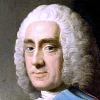
Lord Chesterfield (1694-1773) English statesman, wit [Philip Dormer Stanhope]
Letter to his son, #44 (1740?)
(Source)
Quotations by:
Chesterfield (Lord)
All you learn and all you can read will be of little use to you if you do not think and reason upon it yourself. One reads to know other people’s thoughts, but if we take them upon trust, without examining and comparing them with our own, it is really living upon other people’s scraps or retailing other people’s goods. To know the thoughts of others, is of use, because it suggests thoughts to one’s self, and helps one
to form a judgment; but to repeat other people’s thoughts, without considering whether they are right or wrong, is the talent only of a parrot, or at most a player.Lord Chesterfield (1694-1773) English statesman, wit [Philip Dormer Stanhope]
Letter to his son, #67, “Thursday” (1740-41)
(Source)
A little mind is always hurried, by twenty things at once; but a man of sense does but one thing at a time, and resolves to excel in it; for whatever is worth doing at all is worth doing well.
Lord Chesterfield (1694-1773) English statesman, wit [Philip Dormer Stanhope]
Letter to his son, #71 (10 Mar 1746)
(Source)
Be wiser than other people, if you can; but do not tell them so.
Lord Chesterfield (1694-1773) English statesman, wit [Philip Dormer Stanhope]
Letter to his son, #104 (29 Nov 1745)
(Source)

I bid you strike at the passions; and if you do, you too will prevail. If you can once engage people’s pride, love, pity, ambition (or whichever is their prevailing passion) on your side, you need not fear what their reason can do against you.
Lord Chesterfield (1694-1773) English statesman, wit [Philip Dormer Stanhope]
Letter to his son, #105 (8 Feb 1746)
(Source)
But this I will advise you to, which is, never to attack whole bodies of any kind; for, besides that all general rules have their exceptions, you unnecessarily make yourself a great number of enemies, by attacking a corps collectively. Among women, as among men, there are good as well as bad; and it may be full as many, or more, good than among men. This rule holds as to lawyers, soldiers, parsons, courtiers, citizens, &c. They are all men, subject to the same passions and sentiments, differing only in the manner, according to their several educations; and it would be as imprudent as unjust to attack any of them by the lump. Individuals forgive sometimes; but bodies and societies never do.
Lord Chesterfield (1694-1773) English statesman, wit [Philip Dormer Stanhope]
Letter to his son, #110 (5 Apr 1746)
(Source)
Do not imagine that the knowledge, which I so much recommend to you, is confined to books, pleasing, useful, and necessary as that knowledge is: but I comprehend in it the great knowledge of the world, still more necessary than that of books. In truth, they assist one another reciprocally; and no man will have either perfectly, who has not both. The knowledge of the world is only to be acquired in the world and not in a closet. Books alone will never teach it you; but they will suggest many things to your observation, which might, otherwise escape you; and your own observations upon mankind, when compared with those which you will find in books, will help you to fix the true point.
Lord Chesterfield (1694-1773) English statesman, wit [Philip Dormer Stanhope]
Letter to his son, #112 (4 Oct 1746)
(Source)
You must look into people, as well as at them. Almost all people are born with all the passions, to a certain degree; but almost every man has one prevailing one, to which the others are subordinate. Search every one for that ruling passion; pry into the recesses of his heart, and observe the different workings of the same passion in different people; and when you have found out the prevailing passion of any man, remember never to trust him where that passion is concerned. Work upon him by it, if you please; but be upon your guard yourself against it, whatever professions he may make you.
Lord Chesterfield (1694-1773) English statesman, wit [Philip Dormer Stanhope]
Letter to his son, #112 (4 Oct 1746)
(Source)
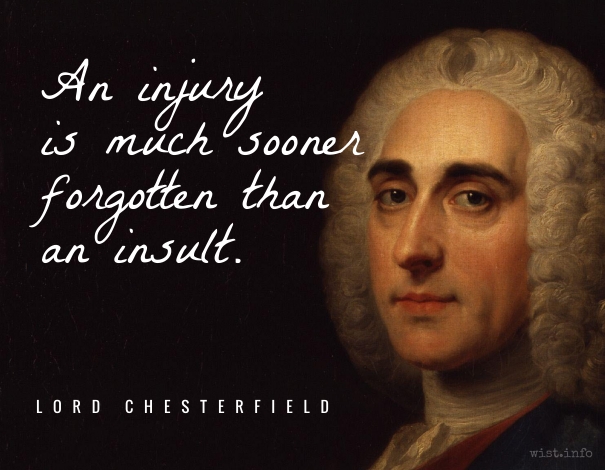
There is nothing that people bear more impatiently, or forgive less, than contempt; and an injury is much sooner forgotten than an insult.
Lord Chesterfield (1694-1773) English statesman, wit [Philip Dormer Stanhope]
Letter to his son, #112 (9 Oct 1746)
I am very sure that any man of common understanding may, by proper culture, care, attention and labor, make himself whatever he pleases, except a great poet.
Lord Chesterfield (1694-1773) English statesman, wit [Philip Dormer Stanhope]
Letter to his son, #113 (9 Oct 1746)
(Source)
Virtue and learning, like gold, have their intrinsic value: but if they are not polished, they certainly lose a great deal of their lustre; and even polished brass will pass upon more people than rough gold.
Lord Chesterfield (1694-1773) English statesman, wit [Philip Dormer Stanhope]
Letter to his son, #118 (6 Mar 1747)
(Source)
Choose your pleasures for yourself, and do not let them be imposed upon you. Follow nature, and not fashion; weigh the present enjoyment of your pleasures against the necessary consequences of them, and then let your own common-sense determine your choice.
Lord Chesterfield (1694-1773) English statesman, wit [Philip Dormer Stanhope]
Letter to his son, #119 (27 Mar 1747)
(Source)
A real man of fashion and pleasures observes decency: at least, neither borrows nor affects vices; and, if he unfortunately has any, he gratifies them with choice, delicacy, and secrecy.
Lord Chesterfield (1694-1773) English statesman, wit [Philip Dormer Stanhope]
Letter to his son, #119 (27 Mar 1747)
(Source)
A man is fit for neither business nor pleasure, who either cannot, or does not, command and direct his attenti0on to the present object, and, in some degree, banish for that time all other objects from his thoughts. If at a ball, a supper, or a party of pleasure, a man were to be solving, in his own mind, a problem in Euclid, he would be a very bad companion, and make a very poor figure in that company; or if, in studying a problem in his closet, he were to think of a minuet, I am apt to believe that he would make a very poor mathematician. There is time enough for everything in the course of the day, if you do but one thing at once; but there is not time enough in the year, if you will do two things at a time.
Lord Chesterfield (1694-1773) English statesman, wit [Philip Dormer Stanhope]
Letter to his son, #121 (14 Apr 1747)
(Source)
Every man’s reason is, and must be, his guide; and I may as well expect that every man should be of my size and complexion, as that he should reason just as I do. Every man seeks for truth; but God only knows who has found it. It is, therefore, as unjust to persecute as it is absurd to ridicule people for those several opinions which they cannot help entertaining upon the conviction of their reason.
Lord Chesterfield (1694-1773) English statesman, wit [Philip Dormer Stanhope]
Letter to his son, #126 (21 Sep 1747)
(Source)
Speaking of religious beliefs.
Errors and mistakes, however gross, in matters of opinion, if they are sincere, are to be pitied, but not punished nor laughed at. The blindness of the understanding is as much to be pitied as the blindness of the eye, and there is neither jest nor guilt in a man’s losing his way in either case. Charity bids us set him right if we can, by arguments and persuasions; but charity, at the same time, forbids, either to punish or ridicule his misfortune.
Lord Chesterfield (1694-1773) English statesman, wit [Philip Dormer Stanhope]
Letter to his son, #126 (21 Sep 1747)
(Source)
On religious tolerance.
There is another sort of lies, inoffensive enough in themselves, but wonderfully ridiculous; I mean those lies which a mistaken vanity suggests, that defeat the very end for which they are calculated, and terminate in the humiliation and confusion of their author, who is sure to be detected. These are chiefly narrative and historical lies, all intended to do infinite honor to their author. He is always the hero of his own romances; he has been in dangers from which nobody but himself ever escaped; he as seen with his own eyes, whatever other people have heard or read of; he has had more bonnes fortunes than ever he knew women; and has ridden more miles post in one day, than ever courier went in two. He is soon ridiculed, and as soon becomes the object of universal contempt and ridicule.
Lord Chesterfield (1694-1773) English statesman, wit [Philip Dormer Stanhope]
Letter to his son, #126 (21 Sep 1747)
(Source)
As I have often told you, politeness and good beeding are absolutely necessary to adorn any, or all other good qualities or talents. Without them, no knowledge, no perfection whatever, is seen in its best light. The scholar, without good breeding, is a pedant; the philosopher, a cynic; the soldier, a brute; and every man disagreeable.
Lord Chesterfield (1694-1773) English statesman, wit [Philip Dormer Stanhope]
Letter to his son, #128 (9 Oct 1747)
(Source)
Do as you would be done by, is the surest method that I know of pleasing. Observe carefully what pleases you in others, and probably the same thing in you will please others.
Lord Chesterfield (1694-1773) English statesman, wit [Philip Dormer Stanhope]
Letter to his son, #129 (16 Oct 1747)
(Source)
A common theme in Chesterfield's advice, e.g.:
Letter #144 (9 Mar 1748):
Observe carefully, then, what displeases or pleases you in others, and be persuaded, that, in general, the same things will please or displease them in you.
Letter #229 (9 Jul 1750):
Pleasure is necessarily reciprocal; no one feels, who does not at the same time give it. To be pleased, one must please. What pleases you in others, will in general please them in you.
I recommend to you to take care of the minutes; for hours will take care of themselves.
Lord Chesterfield (1694-1773) English statesman, wit [Philip Dormer Stanhope]
Letter to his son, #131 (6 Nov 1747)
(Source)
Knowledge is a comfortable and necessary retreat and shelter for us in an advanced age; and if we do not plant it while young, it will give us no shade when we grow old.
Lord Chesterfield (1694-1773) English statesman, wit [Philip Dormer Stanhope]
Letter to his son, #133 (11 Dec 1747)
(Source)
Advice is seldom welcome; and those who want it the most, always like it the least.
Lord Chesterfield (1694-1773) English statesman, wit [Philip Dormer Stanhope]
Letter to his son, #138 (29 Jan 1748)
(Source)
But when you frequent places of public worship, as I would have you go to all the different ones you meet with, remember that, however erroneous, they are none of them objects of laughter and ridicule. Honest error is to be pitied, not ridiculed. The object of all the public worships in the world is the same; it is that great eternal Being who created everything. The different manners of worship are by no means subjects of ridicule. Each sect thinks its own the best; and I know no infallible judge, in this world, to decide which is the best.
Lord Chesterfield (1694-1773) English statesman, wit [Philip Dormer Stanhope]
Letter to his son, #141 (16 Feb 1748)
(Source)
I have now but one anxiety left, which is concerning you. I would have you be, what I know nobody is, perfect. As that is impossible, I would have you as near perfection as possible. I know nobody in a fairer way toward it than yourself, if you please. Never were so much pains taken for anybody’s education as for yours; and never had anybody those opportunities of knowledge and improvement which you have had, and still have. I hope, I wish, I doubt, and I fear alternately. This only I am sure of, that you will prove either the greatest pain, or the greatest pleasure of, Yours Always Truly.
Lord Chesterfield (1694-1773) English statesman, wit [Philip Dormer Stanhope]
Letter to his son, #141 (16 Feb 1748)
(Source)
Wear your learning, like your watch, in a private pocket; and do not pull it out and strike it, merely to show that you have one. If you are asked what o’clock it is, tell it; but do not proclaim it hourly and unasked, like the watchman.
Lord Chesterfield (1694-1773) English statesman, wit [Philip Dormer Stanhope]
Letter to his son, #142 (22 Feb 1748)
(Source)
Men, as well as women, are much oftener led by their hearts than by their understandings.
Lord Chesterfield (1694-1773) English statesman, wit [Philip Dormer Stanhope]
Letter to his son, #154 (21 Jan 1748)
(Source)
But remember, that manners must adorn knowledge, and smooth its way through the world. Like a great rough diamond, it may do very well in a closet by way of curiosity, and also for its intrinsic value; but it will never be worn, nor shine, if it is not polished.
Lord Chesterfield (1694-1773) English statesman, wit [Philip Dormer Stanhope]
Letter to his son, #155 (1 Jul 1748)
(Source)
Give me but virtuous actions, and I will not quibble and chicane about the motives.
Lord Chesterfield (1694-1773) English statesman, wit [Philip Dormer Stanhope]
Letter to his son, #161 (5 Sep 1748)
(Source)
Every man is not ambitious, or courteous, or passionate; but every man has pride enough in his composition to feel and resent the least slight and contempt. Remember, therefore, most carefully to conceal your contempt, however just, wherever you would not make an implacable enemy. Men are much more unwilling to have their weaknesses and their imperfections known, than their crimes; and if you hint to a man that you think him silly, ignorant, or even ill-bred, or awkward, he will hate you more and longer, than if you tell him plainly, that you think him a rogue.
Lord Chesterfield (1694-1773) English statesman, wit [Philip Dormer Stanhope]
Letter to his son, #161 (5 Sep 1748)
(Source)
Be your character what it will, it will be known; and nobody will take it up on your own word. Never imagine that anything you can say yourself will varnish your defects or add lustre to your perfections! but, on the contrary, it may, and nine times in ten will, make the former more glaring, and the latter obscure.
Lord Chesterfield (1694-1773) English statesman, wit [Philip Dormer Stanhope]
Letter to his son, #166 (19 Oct 1748)
(Source)
Remember, that the wit, humor, and jokes of most mixed companies are local. They thrive in that particular soil, but will not often bear transplanting. Every company is differently circumstanced, has its particular cant, and jargon; which may give occasion to wit and mirth, within that circle, but would seem flat and insipid in any other, and therefore will not bear repeating.
Lord Chesterfield (1694-1773) English statesman, wit [Philip Dormer Stanhope]
Letter to his son, #167 (29 Oct 1748)
(Source)
Low people, in good circumstances, fine clothes, and equipage, will insolently show contempt for all those who cannot afford as fine clothes, as good an equipage, and who have not (as they term it) as much money in their pockets: on the other hand, they are gnawed with envy, and cannot help discovering it, of those who surpass them in any of these articles; which are far from being sure criterions of merit.
Lord Chesterfield (1694-1773) English statesman, wit [Philip Dormer Stanhope]
Letter to his son, #167 (29 Oct 1748)
(Source)
I will leave it for the present, as this letter is already pretty long. Such is my desire, my anxiety for your perfection, that I never think I have said enough, though you may possibly think I have said too much; and though, in truth, if your own good sense is not sufficient to direct you, in many of these plain points, all that I or anybody else can say will be insufficient.
Lord Chesterfield (1694-1773) English statesman, wit [Philip Dormer Stanhope]
Letter to his son, #168 (18 Nov 1748)
(Source)
Chesterfield repeats the sentiment in a later letter, #194 (22 Sep 1749):
This letter is a very long, and so possibly a very tedious one; but my anxiety for your perfection is so great, and particularly at this critical and decisive period of your life, that I am only afraid of omitting, but never of repeating or dwelling too long upon anything that I think may be of the least use to you.
A man who does not possess himself enough to hear disagreeable things without visible marks of anger and change of countenance, or agreeable ones without sudden bursts of joy and expansion of countenance, is at the mercy of every artful knave or pert coxcomb.
Lord Chesterfield (1694-1773) English statesman, wit [Philip Dormer Stanhope]
Letter to his son, #183 (22 May 1749)
Some people are to be reasoned, some flattered, some intimidated, and some teased into a thing; but, in general, all are to be brought into it at last, if skillfully applied to, properly managed, and indefatigably attacked in their several weak places.
Lord Chesterfield (1694-1773) English statesman, wit [Philip Dormer Stanhope]
Letter to his son, #183 (22 May 1749)
(Source)
Great merit, or great failings, will make you be respected or despised; but trifles, little attentions, mere nothings, either done or neglected, will make you either liked or disliked, in the general run of the world.
Lord Chesterfield (1694-1773) English statesman, wit [Philip Dormer Stanhope]
Letter to his son, #187 (20 Jul 1749)
(Source)
Business and pleasure, rightly understood, mutually assist each other, instead of being enemies, as silly or dull people often think them. No man tastes pleasures truly who does not earn them by previous business; and few people do business well who do nothing else.
Lord Chesterfield (1694-1773) English statesman, wit [Philip Dormer Stanhope]
Letter to his son, #189 (7 Aug 1749)
(Source)
Whoever is in a hurry shows that the thing he is about is too big for him.
Lord Chesterfield (1694-1773) English statesman, wit [Philip Dormer Stanhope]
Letter to his son, #190 (20 Aug 1749)
(Source)
Caesar, when embarking in a storm, said that it was not necessary he should live, but that it was absolutely necessary he should get to the place to which he was going.
Lord Chesterfield (1694-1773) English statesman, wit [Philip Dormer Stanhope]
Letter to his son, #203 (24 Nov 1749)
(Source)
People in general will much better bear being told of their vices or crimes than of their little failings or weaknesses.
Lord Chesterfield (1694-1773) English statesman, wit [Philip Dormer Stanhope]
Letter to his son, #204 (26 Nov 1749)
(Source)
Such closet politicians never fail to assign the deepest motives for the most trifling actions; instead of often ascribing the greatest actions to the most trifling causes, in which they would be much seldomer mistaken. They read and write of kings, heroes, and statesmen, as never doing any thing but upon the deepest principles of sound policy. But those who see and observe kings, heroes and statesmen, discover that they have headaches, indigestions, humours, and passions, just like other people; every one of which, in their turns, determine their wills, in defiance of their reason.
Lord Chesterfield (1694-1773) English statesman, wit [Philip Dormer Stanhope]
Letter to his son, #205 (5 Dec 1749)
(Source)
We must not suppose that, because a man is a rational animal, he will, therefore, always act rationally; or, because he has such or such a predominant passion, that he will act invariably and consequentially in the pursuit of it. No, we are complicated machines; and though we have one main spring that gives motion to the whole, we have an infinity of little wheels, which, in their turns, retard, precipitate, and sometimes stop that motion.
Lord Chesterfield (1694-1773) English statesman, wit [Philip Dormer Stanhope]
Letter to his son, #209 (19 Dec 1749)
(Source)
We are, in truth, more than half what we are by imitation. The great point is, to choose good models and to study them with care.
Lord Chesterfield (1694-1773) English statesman, wit [Philip Dormer Stanhope]
Letter to his son, #214 (18 Jan 1750)
(Source)
You will find that he takes care never to say or do anything, that can be construed into a slight, or a negligence; or that can, in any degree, mortify people’s vanity and self-love; on the contrary, you will perceive that he makes people pleased with him by making them first pleased with themselves: he shows respect, regard, esteem and attention, where they are severally proper: he sows them with care, and he reaps them in plenty.
Lord Chesterfield (1694-1773) English statesman, wit [Philip Dormer Stanhope]
Letter to his son, #214 (18 Jan 1750)
(Source)
On a proper role model to imitate.
I wish to God that you had as much pleasure in following my advice, as I have in giving it [to] you.
Lord Chesterfield (1694-1773) English statesman, wit [Philip Dormer Stanhope]
Letter to his son, #216 (5 Feb 1750)
(Source)
There is a certain dignity to be kept up in pleasures, as well as in business.
Lord Chesterfield (1694-1773) English statesman, wit [Philip Dormer Stanhope]
Letter to his son, #216 (5 Feb 1750)
(Source)
Modesty is the only sure bait when you angle for praise.
Lord Chesterfield (1694-1773) English statesman, wit [Philip Dormer Stanhope]
Letter to his son, #225 (17 May 1750)
(Source)
The heart never grows better by age; I fear rather worse; always harder. A young liar will be an old one; and a young knave will only be a greater knave as he grows older.
Lord Chesterfield (1694-1773) English statesman, wit [Philip Dormer Stanhope]
Letter to his son, #225 (17 May 1750)
(Source)
Aim at perfection in everything, though in most things it is unattainable; however, they who aim at it, and persevere, will come much nearer it than those whose laziness and despondency make them give it up as unattainable.
Lord Chesterfield (1694-1773) English statesman, wit [Philip Dormer Stanhope]
Letter to his son, #226 (24 May 1750)
(Source)
What with your exercises, some reading, and a great deal of company, your day is, I confess, extremely taken up; but the day, if well employed, is long enough for everything; and I am sure you will not slattern away one moment of it in inaction.
Lord Chesterfield (1694-1773) English statesman, wit [Philip Dormer Stanhope]
Letter to his son, #238 (8 Jan 1751)
(Source)
The greatest favors may be done so awkwardly and so bunglingly as to offend; and disagreeable things may be done so agreeably as almost to oblige.
Lord Chesterfield (1694-1773) English statesman, wit [Philip Dormer Stanhope]
Letter to his son, #249 (7 Apr 1751)
(Source)
Let the great book of the world be your principal study.
Lord Chesterfield (1694-1773) English statesman, wit [Philip Dormer Stanhope]
Letter to his son, #249 (7 Apr 1751)
(Source)
The best authors are always the severest critics of their own works; they revise, correct, file, and polish them, till they think they have brought them to perfection.
Lord Chesterfield (1694-1773) English statesman, wit [Philip Dormer Stanhope]
Letter to his son, #253 (6 May 1751)
(Source)
But this truth from long experience I assert, that he who has the most friends and the fewest enemies, is the strongest; will rise the highest with the least envy; and fall, if he does fall, the gentlest, aud the most pitied.
Lord Chesterfield (1694-1773) English statesman, wit [Philip Dormer Stanhope]
Letter to his son, #293 (11 Nov 1752)
(Source)
Young men are apt to think themselves wise enough, as drunken men are apt to think themselves sober enough. They look upon spirit to be a much better thing than experience, which they call coldness. They are but half mistaken; for though spirit without experience is dangerous, experience without spirit is languid and defective.
Lord Chesterfield (1694-1773) English statesman, wit [Philip Dormer Stanhope]
Letter to his son, #298 (15 Jan 1758)
(Source)
An able man shows his Spirit by gentle words and resolute actions.
A cheerful, easy countenance and behavior are very useful: they make fools think you a good-natured man, and they make designing men think you an undesigning one.
Good manners are the settled medium of social, as specie is of commercial, life; returns are equally expected for both.
Lord Chesterfield (1694-1773) English statesman, wit [Philip Dormer Stanhope]
Letter to his son, #304 (25 Dec 1758)
(Source)
Let this be one invariable rule of your conduct — Never to show the least symptom of resentment which you cannot to a certain degree gratify, but always to smile, where you cannot strike.
Lord Chesterfield (1694-1773) English statesman, wit [Philip Dormer Stanhope]
Letter to his son, #312 (26 Mar 1754)
God bless you, and send you health, which is the first and greatest of all blessings!
Lord Chesterfield (1694-1773) English statesman, wit [Philip Dormer Stanhope]
Letter to his son, #419 (12 Mar 1768)
(Source)
Either a good or a bad reputation outruns and gets before people wherever they go.
Lord Chesterfield (1694-1773) English statesman, wit [Philip Dormer Stanhope]
Letter to Solomon Dayrolles (23 Dec 1848)
(Source)