For us there is only the trying. The rest is not our business.
T. S. Eliot (1888-1965) American-British poet, critic, playwright [Thomas Stearns Eliot]
“East Coker” (1940), Four Quartets (1943)
Quotations by:
Eliot, T. S.

The years between 50 and 70 are the hardest. … You are always being asked to do things, and yet you are not decrepit enough to turn them down.
T. S. Eliot (1888-1965) American-British poet, critic, playwright [Thomas Stearns Eliot]
“People,” Time (23 Oct 1950)
Immature poets imitate; mature poets steal.
T. S. Eliot (1888-1965) American-British poet, critic, playwright [Thomas Stearns Eliot]
“Philip Massinger,” The Sacred Wood (1920)
Nothing dies harder than the desire to think well of oneself.
T. S. Eliot (1888-1965) American-British poet, critic, playwright [Thomas Stearns Eliot]
“Shakespeare and the Stoicism of Seneca” (1927)
The responsibility of tolerance lies in those who have the wider vision.
T. S. Eliot (1888-1965) American-British poet, critic, playwright [Thomas Stearns Eliot]
“The Cocktail Party” (1949)
Half the harm that is done in this world
Is due to people who want to feel important.
They don’t mean to do harmT. S. Eliot (1888-1965) American-British poet, critic, playwright [Thomas Stearns Eliot]
“The Cocktail Party” (1949)
What is hell? Hell is oneself.
Hell is alone, the other figures in it
Merely projections. There is nothing to escape from
And nothing to escape to. One is always alone.T. S. Eliot (1888-1965) American-British poet, critic, playwright [Thomas Stearns Eliot]
“The Cocktail Party” (1949)
Time is no healer: the patient is no longer there.
T. S. Eliot (1888-1965) American-British poet, critic, playwright [Thomas Stearns Eliot]
“The Dry Salvages,” sec. 3, l. 131 Four Quartets (1943)
(Source)
This is the way the world ends
Not with a bang but a whimper.T. S. Eliot (1888-1965) American-British poet, critic, playwright [Thomas Stearns Eliot]
“The Hollow Men” (1925)
I have measured out my life with coffee spoons.
T. S. Eliot (1888-1965) American-British poet, critic, playwright [Thomas Stearns Eliot]
“The Love Song of J. Alfred Prufrock,” l. 51 (1915)
(Source)
No! I am not Prince Hamlet, nor was meant to be;
Am an attendant lord, one that will do
To swell a progress, start a scene or two,
Advise the prince; no doubt, an easy tool,
Deferential, glad to be of use,
Politic, cautious, and meticulous;
Full of high sentence, but a bit obtuse;
At times, indeed, almost ridiculous —
Almost, at times, the Fool.T. S. Eliot (1888-1965) American-British poet, critic, playwright [Thomas Stearns Eliot]
“The Love Song of J. Alfred Prufrock” (1917)
Where is the wisdom we have lost in knowledge?
Where is the knowledge we have lost in information?T. S. Eliot (1888-1965) American-British poet, critic, playwright [Thomas Stearns Eliot]
“The Rock” (1934)
To do the useful thing, to say the courageous thing, to contemplate the beautiful thing: that is enough for one man’s life.
T. S. Eliot (1888-1965) American-British poet, critic, playwright [Thomas Stearns Eliot]
(Attributed)
If you aren’t in over your head, how do you know how tall you are?
T. S. Eliot (1888-1965) American-British poet, critic, playwright [Thomas Stearns Eliot]
(Attributed)
Most editors are failed writers — but so are most writers.
T. S. Eliot (1888-1965) American-British poet, critic, playwright [Thomas Stearns Eliot]
(Attributed) (1946)
Quoted by Robert Geroux, "A Personal Memoir," in Tate, Allen, ed. T. S. Eliot: The Man and his Work (1967) (orig. printed in the Sewanee Review, vol. 74 (1966)):
I first met T. S. Eliot in 1946, when I was an editor at Harcourt, Brace, under Frank Morley. I was just past thirty, and Eliot was in his late fifties. [...] agreed with the definition that most editors are failed writers, and he replied: `Perhaps, but so are most writers.'
Sometimes given as "Some editors ..." and prefixed with "I suppose most ..." and "I suppose some ..."
We shall not cease from exploration
And the end of all our exploring
Will be to arrive where we started
And know the place for the first time.T. S. Eliot (1888-1965) American-British poet, critic, playwright [Thomas Stearns Eliot]
Four Quartets, “Little Gidding” (1943)
The last temptation is the greatest treason:
To do the right deed for the wrong reason.T. S. Eliot (1888-1965) American-British poet, critic, playwright [Thomas Stearns Eliot]
Murder in the Cathedral, Act 1 [Thomas] (1935)
(Source)
For some are sane and some are mad
And some are good and some are bad
And some are better, some are worse —
But all may be described in verse.T. S. Eliot (1888-1965) American-British poet, critic, playwright [Thomas Stearns Eliot]
Old Possum’s Book of Practical Cats, “The Ad-dressing of Cats” (1939)
Jellicle Cats come out tonight,
Jellicle Cats come one come all:
The Jellicle Moon is shining bright —
Jellicles come to the Jellicle Ball.T. S. Eliot (1888-1965) American-British poet, critic, playwright [Thomas Stearns Eliot]
Old Possum’s Book of Practical Cats, “The Song of the Jellicles” (1939)
Macavity, Macavity, there’s no one like Macavity,
There never was a Cat of such deceitfulness and suavity.
He always has an alibi, and one or two to spare;
At whatever time the deed took place — MACAVITY WASN’T THERE!T. S. Eliot (1888-1965) American-British poet, critic, playwright [Thomas Stearns Eliot]
Old Possum’s Book of Practical Cats, “Macavity: The Mystery Cat” (1939)
Before a Cat will condescend
To treat you as a trusted friend,
Some little token of esteem
Is needed, like a dish of cream.T. S. Eliot (1888-1965) American-British poet, critic, playwright [Thomas Stearns Eliot]
Old Possum’s Book of Practical Cats, “The Ad-dressing of Cats” (1939)
(Source)
Success is relative:
It is what we can make of the mess we have made of things.T. S. Eliot (1888-1965) American-British poet, critic, playwright [Thomas Stearns Eliot]
The Family Reunion, 2.3 (1939)
Where is the wisdom we have lost in knowledge?
Where is the knowledge we have lost in information?T. S. Eliot (1888-1965) American-British poet, critic, playwright [Thomas Stearns Eliot]
The Rock, Chorus (1934)
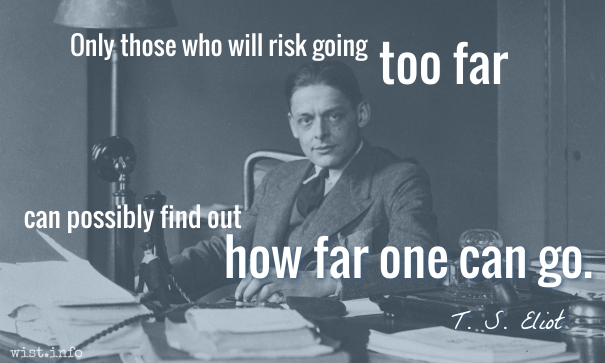
Only those who will risk going too far can possibly find out how far one can go.
T. S. Eliot (1888-1965) American-British poet, critic, playwright [Thomas Stearns Eliot]
Preface to Transit of Venus: Poems by Harry Crosby (1931)