

When you are offended at any man’s fault, turn to yourself and study your own failings. Then you will forget your anger.
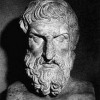
Epictetus (c.55-c.135) Greek (Phrygian) Stoic philosopher
(Attributed)
Quotations by:
Epictetus
If a man has reported to you that a certain person speaks ill of you, do not make any defense to what has been told you: but reply, The man did not know the rest of my faults, for he would not have mentioned these only.
Epictetus (c.55-c.135) Greek (Phrygian) Stoic philosopher
Enchiridion, 33 (c. AD 135) [tr. Long (1888)]
(Source)
Alt. trans.: "If anyone tells you that a certain person speaks ill of you, do not make excuses about what is said of you, but answer, 'He was ignorant of my other faults, else he would have not mentioned these alone.'" [tr. Higginson (1948)]
Appearances to the mind are of four kinds. Things either are what they appear to be; or they neither are, nor appear to be; or they are, and do not appear to be; or they are not, and yet appear to be. Rightly to aim in all these cases is the wise man’s task.
Epictetus (c.55-c.135) Greek (Phrygian) Stoic philosopher
The Discourses (c. AD 101-108)
Make the best of what is in our power, and take the rest as it naturally happens.
Epictetus (c.55-c.135) Greek (Phrygian) Stoic philosopher
The Discourses, 1.1
Difficulties are things that show what men are.
Epictetus (c.55-c.135) Greek (Phrygian) Stoic philosopher
The Discourses, Book 1, ch. 24

What is the first business of one who studies philosophy? To part with self-conceit. For it is impossible for any one to begin to learn what he thinks that he already knows.
Epictetus (c.55-c.135) Greek (Phrygian) Stoic philosopher
The Discourses, ch. 17, “How To Apply General Principles to Particular Cases” (c. AD 101-108)
Alt. trans.: "It is impossible for a man to begin to learn what he thinks he knows." [tr. Long (1890)]
If you would not be of an angry temper, then, do not feed the habit. Give it nothing to help it increase. Be quiet at first and reckon the days in which you have not been angry. I used to be angry every day; now every other day; then every third and fourth day; and if you miss it so long as thirty days, offer a of Thanksgiving to God. For habit is first weakened and then entirely destroyed.
Epictetus (c.55-c.135) Greek (Phrygian) Stoic philosopher
The Discourses, ch. 18 (c. AD 101-108)
First say to yourself what you would be; and then do what you have to do.
Epictetus (c.55-c.135) Greek (Phrygian) Stoic philosopher
The Discourses, ch. 23, “Concerning Such as Read and Dispute Ostentatiously” (c. AD 101-108)
Men are disturbed, not by things, but by the principles and notions which they form concerning things.
Epictetus (c.55-c.135) Greek (Phrygian) Stoic philosopher
The Enchiridion (c. 135)
Alt. trans.: "We suffer not from the events in our lives, but from our judgment about them."
These reasonings are unconnected: “I am richer than you, therefore I am better”; “I am more eloquent than you, therefore I am better.” The connection is rather this: “I am richer than you, therefore my property is greater than yours;” “I am more eloquent than you, therefore my style is better than yours.” But you, after all, are neither property nor style.
Epictetus (c.55-c.135) Greek (Phrygian) Stoic philosopher
The Enchiridion (c. 135)
Choose the best life; for habit will make it pleasant.
Epictetus (c.55-c.135) Greek (Phrygian) Stoic philosopher
Fragment 144
Sometimes attributed to Francis Bacon.