

It is a good thing to be rich, it is a good thing to be strong, but it is a better thing to be beloved of many friends.
Euripides (485?-406? BC) Greek tragic dramatist
(Attributed)
Quotations by:
Euripides
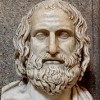
Everyone asks if a man is rich, no one if he is good.
Euripides (485?-406? BC) Greek tragic dramatist
(Attributed)
Quoted in Robert Burton, The Anatomy of Melancholia, 1.2.4.6 (1621-51).
You are neither the first nor the last of mortals
to lose a good wife. You have to learn
that death is a debt we all must pay.[οὐ γάρ τι πρῶτος οὐδὲ λοίσθιος βροτῶν
γυναικὸς ἐσθλῆς ἤμπλακες· γίγνωσκε δὲ
ὡς πᾶσιν ἡμῖν κατθανεῖν ὀφείλεται.]Euripides (485?-406? BC) Greek tragic dramatist
Alcestis [Ἄλκηστις], c. l. 415 [Chorus] (438 BC) [tr. Leuschnig]
(Source)
Alt. trans.:
Thou art by no means the first nor yet shalt be the last of men to lose a wife of worth; know this, we all of us are debtors unto death.
[tr. Coleridge (1910)]
Thou shalt not be the last, nor yet the first,
To lose a noble wife. Be brave, and know
To die is but a debt that all men owe.
[tr. Murray (1915)]
Not first of mortals thou, nor shalt be last
To lose a noble wife; and, be thou sure,
From us, from all, this debt is due -- to die.
[tr. Way (1984)]
You are neither the first nor the last mortal
Who has lost a good wife. Understand this:
Dying is a debt we all have to pay.
[tr. @sentantiq (2020)]
Waste not fresh tears over old griefs.
Euripides (485?-406? BC) Greek tragic dramatist
Alexander [Ἀλέξανδρος], Frag. 44 (TGF) [Chorus?] (415 BC) [tr. Morgan]
(Source)
Cry with me;
for sharing tears with others is relief in hardship.[συνάλγησον, ὡς ὁ κάμνων
δακρύων μεταδοὺς ἔχει
χουφότητα μόχϑων.]Euripides (485?-406? BC) Greek tragic dramatist
Andromeda [Ἀνδρομέδα], Frag. 119 (TGF) (412 BC)
(Source)
(Source (Greek)). Alternate translation.
Come, let us weep together; for the unhappy
Find social tears their poignant griefs assuage.
[tr. Wodhull (1809)]
I ne’er insulted the calamities
Of those who were unfortunate, because
I fear’d that I myself might also suffer.[μή μοι προτείνων ἐλπίδ᾽ ἐξάγου δάκρυ. γένοιτο τἂν πόλλ’ ὧν δόκησις οὐκ ἔνι.]
Euripides (485?-406? BC) Greek tragic dramatist
Andromeda [Ἀνδρομέδα], Frag. 130 (TGF) (412 BC) [tr. Wodhull (1809)]
(Source)
(Source (Greek)). Alternate translation:
I never treated the troubles of the unfortunate insultingly,
through fear of suffering them myself.
[tr. Gibert (2004)]
Sweet is the remembrance of troubles when you are in safety.
Euripides (485?-406? BC) Greek tragic dramatist
Andromeda [Ἀνδρομέδα], Frag. 131 (TGF) (412 BC)
(Source)
(Source (Greek)). Alternate translations:
'Tis sweet to recollect past toils in safety.
[tr. Wodhull (1809)]
Sweet is the memory of toils that are past.
[tr. Reid (1883), in Cicero, De Finibus, 2.105]
Sweet is the memory of sorrows past.
[tr. Rackham (1914), in Cicero, De Finibus, 2.105]
Of all treasures this is best: to find a noble-minded wife.
[τῶν γὰρ πλούτων ὅδ’ ἄριστος
γενναῖον λέχος εὑρεῖν.]Euripides (485?-406? BC) Greek tragic dramatist
Andromeda [Ἀνδρομέδα], Frag. 137 (TGF) (412 BC)
(Source)
(Source (Greek)). Alternate translations:
The best of treasures is a virtuous Wife.
[tr. Wodhull (1809)]
Best of all riches is to find a noble spouse.
[@sentantiq (2014)]
Each day, futurity our bosom fills
With constant terror, for to think of woes
That are to come, is worse than to endure them.Euripides (485?-406? BC) Greek tragic dramatist
Andromeda [Ἀνδρομέδα], Fragment (412 BC) [tr. Wodhall (1809)]
(Source)
Barnes frag. 40, Musgrave frag. 18.
I was in love, and love makes all men frantic.
[ἤρων τὸ μαίνεσθαι δ᾽ ἄρ᾽ ἦν ἔρως βροτοῖς.]
Euripides (485?-406? BC) Greek tragic dramatist
Antigone [Ἀντιγόνη], frag. 161 (TGF, Kannicht) [Haemon?] (c. 420-406 BC) [tr. Wodhall (1809)]
(Source)
Barnes frag. 18, Musgrave frag. 7. (Source (Greek)). Alternate translation:
I was in love; and love, it turns out, is madness for mortals.
[tr. Karamanou]
I was [they were?] in love: and that showed that love is madness for mortals.
[tr. Valtadorou (2020)]
Man’s best possession is a sympathetic wife.
[ἄριστον ἀνδρὶ κτῆμα συμπαθὴς γυνή]
Euripides (485?-406? BC) Greek tragic dramatist
Antigone [Ἀντιγόνη], frag. 164 (TGF) (c. 420-406 BC)
(Source)
(Source (Greek)). Alternate translation:
The best thing for a husband is an understanding wife.
[Source]
Away with empire, and oppressive laws;
None but the fool can wish for regal power,
That he may proudly lord it o’er his equals.[οὔτ᾽ εἰκὸς ἄρχειν οὔτ᾽ ἐχρὴν ἄνευ νόμου
τύραννον εἶναι” μωρία δὲ καὶ ϑέλειν
ὃς τῶν ὁμοίων βούλεται χρατεῖν μόνος.]Euripides (485?-406? BC) Greek tragic dramatist
Antigone [Ἀντιγόνη], frag. 172 (TGF, Kannicht) (c. 420-406 BC) [tr. Wodhall (1809)]
(Source)
Barnes frag. 11, Musgrave frag. 5. (Source (Greek)). Alternate translation:
It is neither reasonable to rule, nor ought there to be a king [law].
It is folly for a man even to want [...]
who wishes to hold sole power over his peers.
[Source]
‘Tis unbecoming not to shed a tear
Over the wretched; he too is devoid
Of virtue, who abounds in wealth, yet scruples
Thro’ sordid avarice to relieve their wants.Euripides (485?-406? BC) Greek tragic dramatist
Antiope [Αντιοπη], frag. (c. 410 BC) [tr. Wodhall (1809)]
(Source)
Barnes frag. 62, Musgrave frag. 40.
Whoever, in a prosperous station plac’d,
Is slothful and regardless of his household,
Intent on nought except bewitching song,
Will by his family, his friends, his country,
Be held in no esteem: for the best gifts
Of nature ineffectual prove, when pleasure,
Degrading pleasure, occupies the soul.[ἁνὴρ γὰρ ὅστις εὖ βίον κεκτηµένος
τὰ µὲν κατ’ οἴκους ἀµελίᾳ παρεὶς ἐᾷ,
µολπαῖσι δ’ ἡσθεὶς τοῦτ’ ἀεὶ θηρεύεται,
ἀγρὸς µὲν οἴκοι κἂν πόλει γενήσεται,
φίλοισι δ’οὐδείς· ἡ φύσις γὰρ οἴχεται,
ὅταν γλυκείας ἡδονῆς ἥσσων τις ᾗ.]Euripides (485?-406? BC) Greek tragic dramatist
Antiope [Αντιοπη], frag. 187 (TGF, Kannicht) [Zethus/ΖΗΘΟΣ] (c. 410 BC) [tr. Wodhall (1809)]
(Source)
(Source (Greek)). Barnes frag. 16, Musgrave frag. 29. See also frag. 200. Alternate translation:
For any man who well acquires a livelihood
and permits its decline with his indifference,
and who delights himself with song and dance
and is always chasing it, will be idle at home and in the polis,
and a nobody for his friends; for a man’s nature is lost
when he is conquered by the sweetness of pleasure.
[tr. Will (2015)]
A clever speaker can speak on any
subject, either for or against.[ἐκ παντὸς ἄν τις πράγµατος δισσῶν λόγων
ἀγῶνα θεῖτ᾽ἄν, εἰ λέγειν εἴη σοφός.]Euripides (485?-406? BC) Greek tragic dramatist
Antiope [Αντιοπη], frag. 189 (TGF, Kannicht) [Chorus] (c. 410 BC)
(Source)
Barnes frag. 79, Musgrave 39. (Source (Greek)). Alternate translations:
The skillful orator can either side
Maintain on every topic of debate.
[tr. Wodhall (1809)]
A man could make an argument for two sides of any
matter, if he were a clever speaker.
[tr. Will (2015)]
He who without necessity embarks
In many matters, is a fool for slighting
The obvious blessings of a tranquil life.[ὅστις δὲ πράσσει πολλὰ µὴ πράσσειν παρόν,
µῶρος, παρὸν ζῆν ἡδέως ἀπράγµονα.]Euripides (485?-406? BC) Greek tragic dramatist
Antiope [Αντιοπη], frag. 193 (TGF, Kannicht) [Amphion] (c. 410 BC) [tr. Wodhall (1809)]
(Source)
Barnes fragment 104, Musgrave 25. (Source (Greek)). Alternate translation:
Whoever is very active when he may be inactive, is a moron,
when he may live pleasantly keeping clear from politics.
[tr. Will (2015)]
Whoever is overactive when he could relax
is foolish, for he misses out on a pleasant life.
[Source]
Such is the life of man, nor wholly blest,
Nor wholly wretched; on her votaries Fortune
now smiles, then frowns. Since our prosperity
Is thus unstable, is not an exemption
From grief the greatest pleasure life can yield?[τοιόσδε ϑνητῶν τῶν ταλαιπώρων βίος’
οὔτ᾽ εὐτυχεῖ τὸ πάμπαν οὔτε δυστυχεῖ,
εὐδαιμονεῖ δὲ καύϑις οὐκ εὐδαιμονεῖ.
τί δῆτ᾽ ἐν ὄλβω μὴ σαφεῖ βεβηκότες
οὐ ξῶμεν ὡς ἥδιστα μὴ λυπούμενοι;]Euripides (485?-406? BC) Greek tragic dramatist
Antiope [Αντιοπη], frag. 196 (TGF, Kannicht) (c. 410 BC) (Amphion?) [tr. Wodhall (1809)]
(Source)
(Source (Greek)). Alternate translation:
Such is the life of wretched mortals;
a man is neither wholly fortunate nor unfortunate;
why then, on entering prosperity which may be insecure,
do we not live as pleasantly as possible, without distress?
[Source]
Such it is, the life of miserable mortals:
neither wholly fortunate nor unfortunate.
He is prosperous and then he is not prosperous.
Why then, when we stand in uncertain happiness,
do we not live as pleasurably as possible, without distress.
[tr. Will (2015)]
You were wrong to fault my body as weak
and effete; for if I am able to reason well,
this is superior to a muscular arm.[τὸ δ᾽ἀσθενές µου καὶ τὸ θῆλυ σώµατος
κακῶς ἐµέµφθης· εἰ γὰρ εὖ φρονεῖν ἔχω,
κρεῖσσον τόδ᾽ἐστὶ καρτεροῦ βραχίονος.]Euripides (485?-406? BC) Greek tragic dramatist
Antiope [Αντιοπη], frag. 199 (TGF, Kannicht) [Amphion/ΑΜΦΙΩΝ] (c. 410 BC) [tr. Will (2015)]
(Source)
(Source (Greek)). Barnes frag. 22, Musgrave frag. 34. Alternate translations:
No right
Hast thou to censure this my frame as weak
And womanish, for if I am endued
With wisdom, that exceeds the nervous arm.
[tr. Wodhall (1809)]
You were wrong to censure my weak and effeminate body;
for if I can think soundly, this is stronger than a sturdy arm.
[tr. Collard (2004)]
But they who only live to pamper up
Their flesh, when their possessions they have wasted,
Become bad citizens; for still unchang’d
Doth their voracious appetite remain.[καὶ µὴν ὅσοι µὲν σαρκὸς εἰς εὐεξίαν
ἀσκοῦσι βίοτον, ἢν σφαλῶσι χρηµάτων,
κακοὶ πολῖται· δεῖ γὰρ ἄνδρ᾽εἰθισµένον
ἀκόλαστον ἦθος γαστρὸς ἐν ταὐτῷ µένειν.]Euripides (485?-406? BC) Greek tragic dramatist
Antiope [Αντιοπη], frag. 201 (Kannicht) / 200 (TGF) (c. 410 BC) [tr. Wodhall (1809)]
(Source)
Barnes frag. 54, Musgrave frag. 7. (Source (Greek)). Alternate translation:
Indeed all who live life for big muscles, if their
wealth should fail, are bad citizens; for when a man becomes
accustomed to habits of gluttony, he remains in those habits.
[tr. Will (2015)]
I know that I suffer and this is no small pain:
Not to know, now that brings some pleasure to
The troubled — ignorance is an advantage amid grief.[φρονῶ δ’ ὃ πάσχω, καὶ τόδ’ οὐ σμικρὸν κακόν·
τὸ μὴ εἰδέναι γὰρ ἡδονὴν ἔχει τινὰ
νοσοῦντα, κέρδος δ’ ἐν κακοῖς ἀγνωσία.]Euripides (485?-406? BC) Greek tragic dramatist
Antiope [Αντιοπη], frag. 205 (Kannicht) (c. 410 BC) [tr. @sentantiq (2015)]
(Source)
A source for the phrase, "Ignorance is bliss." (Source (Greek); see also TGF frag 204). Alternate translation:
I understand what I endure, and this
Is no small evil; for to the diseas'd
There is a kind of pleasure in not knowing
Their malady; such ignorance is gain
To those who labor under grievous woes.
[tr. Wodhall (1809); Barnes 23, Musgrave 24]
I understand what I suffer, and this is not a small evil:
for not to know that one is ailing has some pleasure,
in misery ignorance is an advantage.
[tr. Will (2015)]
Oh child, words well spoken might be false,
and with the beauty of words, might conquer truth;
yet this is not the surest test, that is character
and right; he who conquers with his fluency,
he is clever, but I hold facts mightier than words, always.[ὦ παῖ, γένοιντ᾽ἂν εὖ λελεγµένοι λόγοι
ψευδεῖς, ἐπῶν δὲ κάλλεσιν νικῷεν ἂν
τἀληθές· ἀλλ᾽οὐ τοῦτο τἀκριβέστατον,
ἀλλ᾽ἡ φύσις καὶ τοὐρθόν· ὃς δ᾽εὐγλωσσίᾳ
νικᾷ, σοφὸς µέν, ἀλλ᾽ἐγὼ τὰ πράγµατα
κρείσσω νοµίζω τῶν λόγων ἀεί ποτε.]Euripides (485?-406? BC) Greek tragic dramatist
Antiope [Αντιοπη], frag. 206 (Kannicht) [Antiope/ΑΝΤΙΟΠΗ?] (c. 410 BC) [tr. Will (2015)]
(Source)
(Source (Greek)). TGF frag. 205.
There is surfeit in everything. I have seen
men abandon beautiful women for ugly ones,
and someone sated with rich meals return
with pleasure to inferior fare.[κόρος δὲ πάντων· καὶ γὰρ ἐκ καλλιόνων
λέκτροις ἐπ᾽αἰσχροῖς εἶδον ἐκπεπληγµένους,
δαιτὸς δὲ πληρωθείς τις ἄσµενος πάλιν
φαύλῃ διαίτῃ προσβαλὼν ἥσθη στόµα.]Euripides (485?-406? BC) Greek tragic dramatist
Antiope [Αντιοπη], frag. 213 (Kannicht) (c. 410 BC)
(Source)
(Source (Greek)). Barnes frag. 86, Musgrave frag. 27, TGF frag. 212. Alternate translations:
But all things satiate; oft have I beheld
The faithless Husband quit his beauteous Wife,
Lur'd by some vile amour: thus pall'd with dainties
The appetite regales on coarser food.
[tr. Wodhall (1809)]
There is a surfeit of all things; for I have seen men
drive away a beautiful wife for an ugly one,
and full from banquet someone glad to sit and crack
his teeth against poor fare.
[tr. Will (2015)]
Justice they call Time’s Daughter; to the world,
Because at length the wicked she displays.[τήν τοι Δίκην λέγουσι παῖδ᾽εἶναι Χρόνου,
δείκνυσι δ᾽ἡµῶν ὅστις ἐστὶ µὴ κακός]Euripides (485?-406? BC) Greek tragic dramatist
Antiope [Αντιοπη], frag. 222 (Kannicht) (c. 410 BC) [tr. Wodhall (1809)]
(Source)
(Source (Greek)). TGF frag. 223. Barnes frag. 35, Musgrave frag. 3. Alternate translation:
They say that Dike is the child of Cronos
and brings to light whichever of us is not wicked.
[Will (2015)]
Tho’ Justice, ere she come, be late,
Conceal’d by the behests of fate,
She menaces each villain’s head
For whom th’ inevitable snare is spread.[Δίκα τοι Δίκα χρόνιος ἀλλ᾽ὅµως
ἐπιπεσοῦσ᾽ἔλαθεν ἔλαβεν ὅταν ἴ[δ]ῃ
τιν᾽ἀσεβῆ βροτῶν.]Euripides (485?-406? BC) Greek tragic dramatist
Antiope [Αντιοπη], frag. 223 (Kannicht) [Chorus/ΧΟΡΟΣ] (c. 410 BC) [tr. Wodhall (1809)]
(Source)
(Source (Greek)). TGF frag. 224, Barnes frag. 31, Musgrave frag. 2. Alternate translation:
Dike, Dike dallies, but still takes and seizes
unawares when she sees him,
any impious mortals.
[tr. Will (2015)]
Who does not take pleasure in childish toys?
[τίς δ᾽ οὐχὶ χαίρει νηπίοις ἀθύρμασιν]
Euripides (485?-406? BC) Greek tragic dramatist
Auge [Αὐγῃ], fr. 272 [Heracles] (c. 408 BC) [tr. Collard/Cropp (2008)]
(Source)
Nauck frag. 272, Barnes frag. 20, Musgrave frag. 5. (Source (Greek)). Alternate translations:
Who is not pleas'd with children's harmless sports?
[tr. Wodhall (1809)]
Who does not find delight in childish amusements?
[Source]
As it is, wine drove me out of my senses. I admit I wronged you, but the wrong was not intentional.
[νοϋ δ’ οίνος έξεστησέ μ’ δμολογώ δέ σε άδίκείν, τὸ δ’ αδίκημ’ ἐγένετ’ οὐχ ἑκούδίον.]
Euripides (485?-406? BC) Greek tragic dramatist
Auge [Αὐγῃ], fr. 272b (TGF) (c. 408 BC) [tr. Collard/Cropp (2008)]
(Source)
Heracles apologizing (sort of), to Auge for raping her, one of the only such apologies in ancient Greek drama.
Nauck frag. 265, Barnes frag. 6, Musgrave frag. 8. (Source (Greek)). Alternate translation:
My senses are disorder'd by the fumes
Of wine: yet will I own that I have wrong'd thee,
Tho' this be an involuntary wrong.
[tr. Wodhall (1809)]
Perish all they who love to dwell in cities
subject to Kings, or to the mighty few,
For Freedom’s an invaluable name,
and he who hath but little, here is rich.[κακῶς δ’ ὄλοιντο πάντες οἳ τυραννίδι
χαίρουσιν ὀλίγῃ τ’ ἐν πόλει μοναρχίᾳ·
τοὐλεύθερον γὰρ ὄνομα παντὸς ἄξιον,
κἂν σμίκρ’ ἔχῃ τις, μεγάλ’ ἔχειν νομιζέτω.]Euripides (485?-406? BC) Greek tragic dramatist
Auge [Αὐγῃ], fr. 275 (TGF) (c. 408 BC) [tr. Wodhall (1809)]
(Source)
Nauck frag. 275, Barnes frag. 10, Musgrave frag. 7. (Source (Greek)). Alternate translations:
Pray that all who rejoice in tyranny,
Or in some small monarchy in their city, die terribly.
The name "freedom" is worth everything --
Even if he possesses a little, a man who has this is considered great.
[@sententiq (2015)]
Worth above all is a name fit for the free.
[Source]
Whoso pretends that Love is no great god,
The lord and master of all deities,
Is either dull of soul, or, dead to beauty,
Knows not the greatest god that governs men.
[Ἔρωτα δ᾿ ὅστις μὴ θεὸν κρίνει μέγαν
καὶ τῶν ἁπάντων δαιμόνων ὑπέρτατον,
ἢ σκαιός ἐστιν ἢ καλῶν ἄπειρος ὢν
οὐκ οἶδε τὸν μέγιστον ἀνθρώποις θεόν.]Euripides (485?-406? BC) Greek tragic dramatist
Auge [Αὐγῃ], frag. 269 (c. 408 BC) [tr. Symonds (1880)]
(Source)
The second line ("καὶ ... ὑπέρτατον" = "the highest of all deities") was apparently inserted by Stobaeus.
Nauck (TGF) frag. 269, Barnes frag. 15, Musgrave frag. 3. (Source (Greek)). Alternate translations:
He who esteems not Love a mighty God,
And to all other Deities superior,
Devoid of reason, or to beauty blind,
Knows not the ruler of this nether world.
[tr. Wodhall (1809)]
Anyone who does not count Love a great god,
and the highest of all the divine powers,
is either obtuse or, lacking experience in his benefits,
is unacquainted with human beings’ greatest god.
[tr. Collard / Cropp (2008); Funke (2013)]
Whoever does not judge Love to be a great god, and highest of all the divine powers, is either a fool or, lacking experience of his good things, is not acquainted with mankind's greatest god.
[tr. Wright (2017)]
Whoever does not think Eros a great god
is either silly or ignorant of blessings.
[Source]
We are women: in some things, we hesitate.
But in others, no one can surpass our courage.[γυναῖκές ἐσμεν: τὰ μὲν ὄκνῳ νικώμεθα,
τὰ δ᾽ οὐκ ἂν ἡμῶν θράσος ὑπερβάλοιτό τις.]Euripides (485?-406? BC) Greek tragic dramatist
Auge [Αὐγῃ], frag. 276 (c. 408 BC) [tr. @sentantiq (2014)]
(Source)
Nauck (TGF) frag. 276, Barnes frag. 18, Musgrave frag. 4. (Source (Greek)). Alternate translations:
Frail women as we are, too oft our fears
Subdue us, but at other times our courage
By none can be exceeded.
[tr. Wodhall (1809)]
We are women, sometimes defeated by fear,
sometimes unsurpassed in courage.
[Source]
The company of just and righteous men is better
than wealth and a rich estate.[κρεῖσσον δὲ πλούτου καὶ βαϑυσπόρου χϑονὸς
ἀνδρῶν δικαίων χἀγαϑῶν ὁμιλίαι]
And what is shameful if those who do it don’t think it so?
[τί δ’ αἰσχρὸν ἢν μὴ τοῖσι χρωμένοις δοκῇ]
Euripides (485?-406? BC) Greek tragic dramatist
Æolus [Αἴολος], frag. 19 (TGF) [tr. Aleator (2012)]
(Source)
This bit of moral relativism (likely coming from Macareus, the son of Aeolus, who committed incest with his sister, Canace) continues to provoke commentary, thus varied translations. Aristophanes includes a reference to this line in his The Frogs.
Nauck frag. 19, Barnes frag. 5, Musgrave frag. 1. (Source (Greek)). Alternate translations:
But what is base, if it appear not base
To those who practice what their soul approves?
[tr. Wodhull (1809)]
What is shameful, if it does not seem to be so to those who do it?
[Source]
What's wrong if they who do it think not so?
[Source (1902)]
Why shameful, if it does not seem so to those who practice it?
[Source (2018)]
Speak not of wealth; I can’t admire a god
whom even the basest man can get into his hold.Euripides (485?-406? BC) Greek tragic dramatist
Æolus [Αἴολος], frag. 20 (TGF)
(Source)
Nauck frag. 20, Barnes frag. 15, Musgrave frag. 14. (Source (Greek)). Alternate translations:
Talk not of Plutus; I despise the God
Whom every villain may with ease possess.
[tr. Wodhull (1809)]
Alas, how right the ancient saying is:
We, who are old, are nothing else but noise
And shape. Like mimicries of dreams we go,
And have no wits, although we think us wise.
[φεῦ φεῦ, παλαιὸς αἶνος ὡς καλῶς ἔχει·
γέροντες οὐδέν ἐσμεν ἄλλο πλὴν ψόφος
καὶ σχῆμ’, ὀνείρων δ’ ἕρπομεν μιμήματα·
νοῦς δ’ οὐκ ἔνεστιν, οἰόμεσθα δ’ εὖ φρονεῖν.]Euripides (485?-406? BC) Greek tragic dramatist
Æolus [Αἴολος], frag. 25 (TGF) [tr. Bowra (1938)]
(Source)
Nauck frag. 25, Barnes frag. 56, Musgrave frag. 18. (Source (Greek)). Alternate translations:
How true this antient saying; we old men
Are nought but trouble, and an empty shadow,
We crawl about, the semblances of dreams.
And of our mental faculties deprived.
Still fancy we with wisdom are endued.
[tr. Wodhull (1809)]
Oh, alas, how true the ancient saying is: we old men are nothing but noise and mere shapes, and we move as imitations of dreams; there is no intelligence in us, yet we think we have good sense.
[tr. Collard & Cropp (2008)]
Alas, the ancient proverb holds well:
We old men are nothing other than a sound
and an image, lurking imitations of dreams.
We have no mind and but we think we know how to think well.
[tr. @sentantiq (2014)]
Whoever too precipitately yields
To anger, shall find sorrow at the last:
For wrath unbridled oft deceives mankind.[Οργή γάρ όστις ευθέως χαρίζεται ,
Κακώς τελευτά πλείστα γάρ σφάλλει βρoτούς .]Euripides (485?-406? BC) Greek tragic dramatist
Æolus [Αἴολος], frag. 31 (TGF) [tr. Wodhull (1809)]
(Source)
Nauck frag. 31, Barnes frag. 62, Musgrave frag.3. (Source (Greek)). Alternate translation:
Whoever yields to anger suffers a piteous end.
[Source]
A thing I am not anxious to preserve
Is this frail life; for soon as one woe ends,
Others commence, and our weak eyes discern not
What evil fortunes yet remain behind.[αἰεὶ τὸ µὲν ζῇ, τὸ δὲ µεθίσταται κακόν,
τὸ δ’ αὖ πέφηνεν αὖθις ἐξ ἀρχῆς νέον.]Euripides (485?-406? BC) Greek tragic dramatist
Æolus [Αἴολος], frag. 35 (TGF) [tr. Wodhull (1809)]
(Source)
Nauck frag. 35, Barnes frag. 51, Musgrave frag. 15, 16. (Source (Greek)). Alternate translations:
One ill is ever clinging;
One treads upon its heels;
A third, in distance springing,
Its fearful front reveals.
[tr. Peacock (1897)]
One trouble alive and well, another gone,
as all afresh a new one comes our way.
[Source]
We alone are right-minded; everyone else is wrong.
[μόνοι γὰρ εὖ φρονοῦμεν, οἱ δ᾽ ἄλλοι κακῶς.]
Euripides (485?-406? BC) Greek tragic dramatist
Bacchæ [Βάκχαι], l. 196 [Teiresias/Τειρεσίας] (405 BC) [tr. Robinson (2014)]
(Source)
When asked by Cadmus about being the only men of Thebes attending the Bacchanal. (Source (Greek)). Alternate translation:
Because ourselves alone
Are truly wise, but others judge amiss.
[tr. Wodhull (1809)]
Yes, for we alone think rightly, the rest wrongly.
[tr. Buckley (1850)]
All else misjudge; we only are the wise.
[tr. Milman (1865)]
Alone: For we are wise, the rest are fools.
[tr. Rogers (1872), l. 179]
Yea, for we alone are wise, the rest are mad.
[tr. Coleridge (1891)]
Yea, we alone are wise; the rest be fools.
[tr. Way (1898)]
Aye, Thebes is blinded. Thou and I can see.
[tr. Murray (1902)]
They are all blind.
Only we can see.
[tr. Arrowsmith (1960)]
Yes, for only we are sane -- the rest are mad.
[tr. Kirk (1970)]
We are the only men right-minded; the rest are perverse.
[tr. Vellacott (1973)]
We alone think well, the others ill.
[tr. Neuburg (1988)]
The only ones with healthy minds. The rest are sick.
[tr. Cacoyannis (1982)]
Only we think right. The others vilely.
[tr. Blessington (1993)]
Yes, since only we reason well. The rest are fools!
[tr. Esposito (1998)]
The only ones in our right minds. The rest are mad.
[tr. Woodruff (1999)]
Yes, only we have any sense, the rest have none.
[tr. Gibbons/Segal (2000)]
Yes, we alone have sense, the others none.
[tr. Kovacs (2002)]
Yes, Kadmos because we are the only ones who can think straight. The rest of them? They are all wrong!
[tr. Theodoridis (2005)]
We alone've got it right; the others, wrongly.
[tr. Valerie (2005)]
Yes, indeed,
for we're the only ones whose minds are clear.
As for the others, well, their thinking's wrong.
[tr. Johnston (2008), l. 247ff]
The rest are blind. Only we can see.
[tr. Robertson (2014)]
We’re the only ones wise enough. The rest ... less so.
[tr. Pauly (2019)]
Of course; no one else has enough sense.
[tr. Behr/Foster (2019)]
We alone are sensible, all the others foolish.
[tr. Buckley/Sens/Nagy (2020)]
Stories of our women leaving home to frisk
in mock ecstasies among the thickets on the mountain,
dancing in honor of the latest divinity,
a certain Dionysus, whoever he may be!
In their midst stand bowls brimming with wine.
And then, one by one, the women wander off
to hidden nooks where they serve the lusts of men.
Priestesses of Bacchus they claim they are,
but it’s really Aphrodite they adore.[γυναῖκας ἡμῖν δώματ᾽ ἐκλελοιπέναι
πλασταῖσι βακχείαισιν, ἐν δὲ δασκίοις
ὄρεσι θοάζειν, τὸν νεωστὶ δαίμονα
Διόνυσον, ὅστις ἔστι, τιμώσας χοροῖς:
πλήρεις δὲ θιάσοις ἐν μέσοισιν ἑστάναι
κρατῆρας, ἄλλην δ᾽ ἄλλοσ᾽ εἰς ἐρημίαν
πτώσσουσαν εὐναῖς ἀρσένων ὑπηρετεῖν,
πρόφασιν μὲν ὡς δὴ μαινάδας θυοσκόους,
τὴν δ᾽ Ἀφροδίτην πρόσθ᾽ ἄγειν τοῦ Βακχίου.]Euripides (485?-406? BC) Greek tragic dramatist
Bacchæ [Βάκχαι], l. 217ff [Pentheus/Πενθεύς] (405 BC) [tr. Arrowsmith (1960)]
(Source)
(Source (Greek)). Alternate translations:
Their homes
Our women have deserted, on pretence
That they in mystic orgies are engaged;
On the umbrageous hills they chant the praise
Of this new God, whoe'er he be, this Bacchus;
Him in their dances they revere, and place
Amid their ranks huge goblets fraught with wine:
Some fly to pathless deserts, where they meet
Their paramours, while they in outward shew
Are Mænedes by holy rites engrossed.
Yet Venus more than Bacchus they revere.
[tr. Wodhull (1809)]
The women have left our homes in contrived Bacchic rites, and rush about in the shadowy mountains, honoring with dances this new deity Dionysus, whoever he is. I hear that mixing-bowls stand full in the midst of their assemblies, and that they each creep off different ways into secrecy to serve the beds of men, on the pretext that they are Maenads worshipping; but they consider Aphrodite before Bacchus.
[tr. Buckley (1850)]
Our women all have left their homes, to join
These fabled mysteries. On the shadowy rocks
Frequent they sit, this God of yesterday,
Dionysus, whosoe'er he be, with revels
Dishonorable honoring. In the midst
Stand the crowned goblets; and each stealing forth,
This way and that, creeps to a lawless bed;
In pretext, holy sacrificing Mænads,
But serving Aphrodite more than Bacchus.
[tr. Milman (1865)]
Our women have deserted from their homes,
Pretending Bacchic rites, and now they lurk
In the shady hill-tops reverencing forsooth
This Dionysus, this new deity.
Full bowls of wine are served out to the throng;
And scattered here and there through the glades,
The wantons hurry to licentious love.
They call themselves the priestess Mænades;
Bacchus invoke, but Aphrodite serve.
[tr. Rogers (1872), l. 200ff]
I hear that our women-folk have left their homes on pretence of Bacchic rites, and on the wooded hills rush wildly to and fro, honouring in the dance this new god Dionysus, whoe’er he is; and in the midst of each revel-rout the brimming wine-bowl stands, and one by one they steal away to lonely spots to gratify their lust, pretending forsooth that they are Mænads bent on sacrifice, though it is Aphrodite they are placing before the Bacchic god.
[tr. Coleridge (1891)]
How from their homes our women have gone forth
Feigning a Bacchic rapture, and rove wild
O'er wooded hills, in dances honouring
Dionysus, this new God -- whoe'er he be.
And midst each revel-rout the wine-bowls stand
Brimmed: and to lonely nooks, some here, some there,
They steal, to work with men the deed of shame,
In pretext Maenad priestesses, forsooth,
But honouring Aphroditê more than Bacchus.
[tr. Way (1898)]
Our own
Wives, our own sisters, from their hearths are flown
To wild and secret rites; and cluster there
High on the shadowy hills, with dance and prayer
To adore this new-made God, this Dionyse,
Whate'er he be! -- And in their companies
Deep wine-jars stand, and ever and anon
Away into the loneliness now one
Steals forth, and now a second, maid or dame,
Where love lies waiting, not of God! The flame,
They say, of Bacchios wraps them. Bacchios! Nay,
'Tis more to Aphrodite that they pray.
[tr. Murray (1902)]
That our women have abandoned their homes
in fake bacchic revels, and in the deep-shaded
mountains are roaming around, honoring with dances
the new-made god Dionysus, whoever he is;
that wine-bowls are set among the sacred companies
full to the brim, and that one by one the women go crouching
into the wilderness, to serve the lechery of men --
they profess to be maenads making sacrifice,
but actually they put Aphrodite before the Bacchic god.
[tr. Kirk (1970)]
Our women, I discover, have abandoned their homes on some pretence of Bacchic worship, and go gadding about in the woods on the mountain side, dancing in honour of this upstart god Dionysus, whoever he may be. They tell me, in the midst of each group of revellers stands a bowl full of wine; and the women go creeping off this way and that to lonely places and there give themselves to lecherous men, under the excuse that they are Maenad priestesses; though in their ritual Aphrodite comes before Bacchus.
[tr. Vellacott (1973)]
They leave their home, desert their children
Follow the new fashion and join the Bacchae
Flee the hearth to mob the mountains -- those contain
Deep shadows of course, secret caves to hide
Lewd games for this new god -- Dionysos!
That's the holy spirit newly discovered.
Dionysos! Their ecstasy is flooded down
In brimming bowls of wine -- so much for piety!
Soused, with all the senses roused, they crawl
Into the bushes and there of course a man
Awaits them. All part of the service for for this
Mysterious deity. The hypocrisy? All they care about
Is getting serviced.
[tr. Soyinka (1973)]
Our women gone, abandoning their homes,
pretending to be bacchae, massing
in the bushy mountains, this latest divinity
Dionysos (whoever he is) honouring and chorusing,
filling and setting amidst the thiasus
wine-bowls, and one by one in solitude
sneaking off to cater to male bidding, --
supposedly as sacrificial maenads,
but Aphrodite ranks before their Bacchic One.
[tr. Neuburg (1988)]
Our women, I am told, have left their homes,
in a religious trance -- what travesty! --
and scamper up and down the wooded mountains, dancing
in honor of this newfangled God, Dionysus,
whoever he might be.
In the middle of each female group
of revelers, I hear,
stands a jar of wine, brimming! And that taking turns,
they steal away, one here, one there, to shady nooks,
where they satisfy the lechery of men,
pretending to be priestesses,
performing their religious duties. Ha!
That performance reeks more of Aphrodite than of Bacchus.
[tr. Cacoyannis (1982)]
Our women have abandoned our homes
And, in a jacked-up frenzy of phony inspiration,
Riot in the dark mountains,
Honoring this upstart god, Dionysos --
Whatever he is -- dancing in his chorus.
Full jugs of wine stand in their midst
And each woman slinks off
To the wilderness to serve male lust,
Pretending they are praying priestesses,
But Aphrodite leads them, not Bacchus.
[tr. Blessington (1993)]
Our women have abandoned their homes
for the sham revelries of Bacchus
frisking about on the dark-shadowed mountains
honoring with their dances the latest god, Dionysius, whoever he is.
They've set up their mixing bowls brimming with wine
amidst their cult gatherings, and each lady slinks off in a different direction
to some secluded wilderness to service the lusts of men.
They pretend to be maenads performing sacrifices
but in reality they rank Aphrodite's pleasures before Bacchus!
[tr. Esposito (1998)]
These women of ours have left their homes
and run away to the dark mountains, pretending
to be Bacchants. It's this brand-new god,
Dionysus, whoever that is; they're dancing for him!
They gather in throngs around full bowls
of wine; then one by one they sneak away
to lonely places where they sleep with men.
Priestesses they call themselves! Maenads!
It's Aphrodite they put first, not Bacchus.
[tr. Woodruff (1999)]
Women leave
Our houses for bogus revels (“Bakkhic” indeed!),
Dashing through the dark shade of mountain forests
To honor with their dancing this new god,
Dionysos -- whoever he may be --
And right in their midst they set full bowls of wine,
And slink into the thickets to meet men there,
Saying they are maenads sacrificing
When they really rank Aphrodite first,
Over Bakkhos!
[tr. Gibbons/Segal (2000)]
The women have left our homes in fictitious ecstatic rites and flit about on the thick-shaded mountains, honoring the new god Dionysus, whoever he is, with their dancing. They set up full wine bowls in the middle of their assembles and sneak off, one here, one there, to tryst in private with men. The pretext for all of this is that they are maenads, performing their rites, but they hold Aphrodite in higher regard than the bacchic god.
[tr. Kovacs (2002)]
I hear our women have flown from their proper place in the home -- dancing about in the shadowy hills in sham ecstasy for this newfound Dionysus! And these wine-befuddled women slink into the darkness, drawn by the sirens of lust. Fine high priestesses of the new god! They seem to make more worship of Aphrodite than of Bacchus!
[tr. Rao/Wolf (2004)]
I heard that our women have left their homes and gone off to the mountains dancing the Bacchic dances! Some new, young god! Utter rubbish! There they are, placing great tubs full of wine in the centre of their group, in the middle of nowhere and off they go, one here, another there, rolling around with any man they come across and giving the excuse that they are maenads; but what are they doing? Serving Dionysos? No way! They’re serving Aphrodite!
[tr. Theodoridis (2005)]
The women have left us, abandoning their homes in
phony Bacchic worship and that they gad about on
the bushy mountaintops; that this "new" god Dio-
nysus, whoever he really is, is honoured in their dances,
and that they set the sacred wine-bowls, fill'd, in the
midst of the thiasoi, each slinking off her sep'rate
way to serve males' hot lust in the woods, pre-
tending to be Maenads sacrificing; and so
they place Aphrodite on top of Bacchus.
[tr. Valerie (2005)]
... women leaving home
to go to silly Bacchic rituals,
cavorting there in mountain shadows,
with dances honoring some upstart god,
this Dionysus, whoever he may be. Mixing bowls
in the middle of their meetings filled with wine,
they creep off one by one to lonsely spots
to have sex with men, claiming they're Maenads
busy worshipping. But they rank Aphrodite,
goddess of sexual desire, ahead of Bacchus.
[tr. Johnston (2008), l. 272ff]
Women have deserted their homes for these
fraudulent rites -- up in the woods and mountains,
dancing to celebrate some new god --
Dionysus, whoever he is.
Drink is at the bottom of it all.
Huge bowls stand in their midst, I'm told,
brimming with wine, and one by one the women
slip into the shadows to satisfy the lusts of men.
They say they are priestesses, sworn to Bacchus,
but it's clearly Aphrodite they adore.
[tr. Robertson (2014)]
Women have forsaken their homes. It’s a front, it’s a fake, a false Bacchic rite, an excuse for them to cavort in the mountain’s shade, dancing to honor this "new god" Dionysus.
Whoever that is. Whoever he really is.
I hear they’ve got casks of wine up there, full to the brim, just sitting there in the midst of their frolicking. And that they sneak off into secluded corners, servicing men, excusing it as a sacred thing, a Maenad’s ritual.
If it is a ritual, it’s to Aphrodite, not this Bacchus of theirs.
[tr. Pauly (2019)]
How our women
had run off
to celebrate
perferse rites
in the mountains,
roaming about with this
brand new god, Dionysus --
whoever he is.
Everywhere
in the midst of their revels
stand full wine bowls.
And women slink off
one by one
to copulate
with any man
who happens by.
They pretend to be Maenads, priestesses.
It's Aphrodite,
not Bacchus,
they worship.
[tr. Behr/Foster (2019)]
Our women have left our homes in contrived Bacchic rites, and rush about in the shadowy mountains, honoring with khoroi this new daimōn Dionysus, whoever he is. I hear that mixing-bowls stand full in the midst of their assemblies, and that each woman, flying to secrecy in different directions, yields to the embraces of men, on the pretext that they are Maenads worshipping. They consider Aphrodite of greater priority than Dionysus.
[tr. Buckley/Sens/Nagy (2020)]
When once you see
the glint of wine shining at the feasts of women,
then you may be sure the festival is rotten.[γυναιξὶ γὰρ
ὅπου βότρυος ἐν δαιτὶ γίγνεται γάνος,
οὐχ ὑγιὲς οὐδὲν ἔτι λέγω τῶν ὀργίων.]Euripides (485?-406? BC) Greek tragic dramatist
Bacchæ [Βάκχαι], l. 260ff [Pentheus/Πενθεύς] (405 BC) [tr. Arrowsmith (1960)]
(Source)
(Source (Greek)). Alternate translations:
For when women
Share at their feasts the grape's bewitching juice;
From their licentious orgies, I pronounce
No good results.
[tr. Wodhull (1809)]
For where women have the delight of the grape-cluster at a feast, I say that none of their rites is healthy any longer.
[tr. Buckley (1850)]
For where ’mong women
The grape’s sweet poison mingles with the feast,
Nought holy may we augur of such worship.
[tr. Milman (1865)]
When women drain the wine-cup at the feast,
Foul is the orgie, dangerous the disease.
[tr. Rogers (1872)]
For where the gladsome grape is found at women’s feasts, I deny that their rites have any longer good results.
[tr. Coleridge (1891)]
For when
In women's feasts the cluster's pride hath part,
No good, say I, comes of their revelry.
[tr. Way (1898)]
When once the gleam
Of grapes hath lit a Woman's Festival,
In all their prayers is no more health at all!
[tr. Murray (1902)]
For where women
have the sparkle of the vine in their festivities,
there, I say, nothing wholesome remains in their rituals.
[tr. Kirk (1970)]
As for women, my opinion is this: when the sparkle of sweet wine appears at their feasts, no good can be expected from their ceremonies.
[tr. Vellacott (1973)]
I tell you, when women
have the cluster’s refreshment at banquets,
there’s nothing healthy left about their orgies.
[tr. Neuburg (1988)]
Take my word,
when women are allowed to fast on wine, there is no
telling to what lengths their filthy minds will go!
[tr. Cacoyannis (1982)]
I say that feast where a woman takes
The gleaming grape is most diseased.
[tr. Blessington (1993)]
For whenever the liquid joy
of the grape comes into women's festivals, then, I assure, you,
there's nothing wholesome in their rites.
[tr. Esposito (1998)]
Because when women
get their sparkle at a feast from wine,
I say the entire ritual is corrupt.
[tr. Woodruff (1999)]
For when the women have
The bright grape-cluster gleaming at their feasts,
There’s nothing healthy in these rites, I say.
[tr. Gibbons/Segal (2000)]
Wherever women get the gleaming grape to drink in their feasts, everything about their rites is diseased.
[tr. Kovacs (2002)]
I’m telling you both, no good comes out of drunk women.
Wine wisdom and orgies are dangerous.
[tr. Theodoridis (2005)]
For whenever the pleasure of the grape's
cluster comes shimmering to women in feast, I say no-
thing is left wholesome in their orgies!
[tr. Valerie (2005)]
Whenever women at some banquet start to take pleasure in the gleaming wine, I say there's nothing healthy in their worship.
[tr. Johnston (2008)]
It's always the same: as soon as you allow drink and women at a festival, everything gets sordid.
[tr. Robertson (2014)]
When women start getting into the wine, I say it’s gone too far. It’s not healthy.
[tr. Pauly (2019)]
There is no good in these festivals where shimmering wine corrupts women.
[tr. Behr/Foster (2019)]
For where women have the delight of the grape at a feast, I say that none of their rites is healthy any longer.
[tr. Buckley/Sens/Nagy (2020)]
When a sensible man
has a good cause to defend, to be eloquent
is no great feat. Your tongue is so nimble
one might think you had some sense, but your words
contain none at all. The powerful man
who matches insolence with glibness is worst than a fool.
He is a public danger![ὅταν λάβῃ τις τῶν λόγων ἀνὴρ σοφὸς
καλὰς ἀφορμάς, οὐ μέγ᾽ ἔργον εὖ λέγειν:
σὺ δ᾽ εὔτροχον μὲν γλῶσσαν ὡς φρονῶν ἔχεις,
ἐν τοῖς λόγοισι δ᾽ οὐκ ἔνεισί σοι φρένες.
θράσει δὲ δυνατὸς καὶ λέγειν οἷός τ᾽ ἀνὴρ
κακὸς πολίτης γίγνεται νοῦν οὐκ ἔχων.]Euripides (485?-406? BC) Greek tragic dramatist
Bacchæ [Βάκχαι], l. 266ff [Tiresias/Τειρεσίας] (405 BC) [tr. Cacoyannis (1982)]
(Source)
To Pentheus. (Source (Greek)). Alternate translations:
When the wise man hath found a specious topic
On which to argue, he with ease may frame
An eloquent harangue. Your tongue indeed
Is voluble like theirs who reason well,
But in your language no discretion reigns.
He who possesses courage, sovereign power. A
And fluency of speech, if not endued
With wisdom, is an evil citizen.
[tr. Wodhull (1809)]
Whenever a wise man takes a good occasion for his speech, it is not a great task to speak well. You have a rapid tongue as though you were sensible, but there is no sense in your words. A man powerful in his boldness, one capable of speaking well, becomes a bad citizen in his lack of sense.
[tr. Buckley (1850)]
'Tis easy to be eloquent, for him
That's skilled in speech, and hath a stirring theme.
Thou hast the flowing tongue of a wise man,
But there's no wisdom in thy fluent words;
For the bold demagogue, powerful in speech,
Is but a dangerous citizen lacking sense.
[tr. Milman (1865)]
When wise men reason from sound principles,
They find it no hard task to reason well.
Thy tongue’s as fluent as the wisest man’s,
And yet thy argument is void of sense.
[tr. Rogers (1872), l. 253ff]
Whenso a man of wisdom finds a good topic for argument, it is no difficult matter to speak well; but thou, though possessing a glib tongue as if endowed with sense, art yet devoid thereof in all thou sayest. A headstrong man, if he have influence and a capacity for speaking, makes a bad citizen because he lacks sense.
[tr. Coleridge (1891)]
Whene'er a wise man finds a noble theme
For speech, 'tis easy to be eloquent.
Thou -- roundly runs thy tongue, as thou wert wise;
But in these words of thine sense is there none.
The rash man, armed with power and ready of speech,
Is a bad citizen, as void of sense.
[tr. Way (1898)]
Good words, my son, come easily, when he
That speaks is wise, and speaks but for the right.
Else come they never! Swift are thine, and bright
As though with thought, yet have no thought at all.
[tr. Murray (1902)]
Give a wise man an honest brief to plead
and his eloquence is no remarkable achievement.
But you are glib; your phrases come rolling out
smoothly on the tongue, as though your words were wise
instead of foolish. The man whose glibness flows
from his conceit of speech declares the thing he is:
a worthless and a stupid citizen.
[tr. Arrowsmith (1960)]
When a wise man chooses a sane basis
for his arguments, it is no great task to speak well;
but you have a glib tongue, as though in your right mind,
yet in your words there is no real sense.
The man who is influential by sheer aggressiveness, and knows how to speak,
proves to be a bad citizen -- for he lacks sanity.
[tr. Kirk (1970)]
When a clever man has a plausible theme to argue, to be eloquent is no great feat. But though you seem, by your glib tongue, to be intelligent, yet your words are foolish. Power and eloquence in a headstrong man can only lead to folly; and such a man is a danger to the state.
[tr. Vellacott (1973)]
Oh it's so easy for some to make speeches.
They pick a soft target and the words rush out.
Now listen you. Your tongue runs loose
Makes a plausible sound and might
Almost be taken for sense. But you have none.
Your glibness flows from sheer conceit.
Arrogant, over-confident and a gift -- yes --
A gift for phrases, and that makes you a great
Danger to your fellow men.
[tr. Soyinka (1973)]
A man who takes a fair basis for speaking,
a wise man, has no trouble speaking well;
you have a well-wheeled tongue, as though thinking,
but in the words you speak there is no thought.
A man empowered by daring and able to speak
becomes a bad citizen, devoid of reason.
[tr. Neuburg (1988)]
When some wise man has a fair cause
o present, to speak well is easy.
You have a tongue, glib like thought,
But no sense lies in your words.
The man that rashness prompts to speak
Proves an evil citizen and senseless.
[tr. Blessington (1993)]
Whenever a wise man sets out to argue an honest case
it's no great undertaking to argue well.
Your tongue runs smooth like a wheel, as if you were a man of reason,
but your words reveal no reason.
If he behaves recklessly, an able and articulate man
turns out to be a bad citizen because he lacks good sense.
[tr. Esposito (1998)]
When a prudent speaker takes up a noble cause, he’ll have no great trouble to speak well. You, on the other hand, have a tongue that runs on smoothly and sounds intelligent. But what it says is brainless. True, boldness can help a man speak powerfully, but he’ll turn out bad for the city because he'll have no sense.
[tr. Woodruff (1999)]
It's no great task to speak well, when a man's
Intelligent and starts well with good words.
But you: your tongue runs smoothly, as if you had
Some understanding. Yet your words are senseless.
A man like you, whose strength is that he's bold,
Who's good at speaking, too, can only make
a bad citizen -- for he lacks good sense.
[tr. Gibbons/Segal (2000)]
When a wise man has a good case to argue, eloquence is easy. As for you, though you think yourself clever and have a ready tongue, there is no intelligence in what you say. [A man whose power lies in brashness and who is a fluent speaker becomes a bad citizen if he lacks sense.]
[tr. Kovacs (2002)]
As for you -- your tongue is quick and your talk runs as if you had wit, but there is none in what you say. A man who confuses impudence with strength is a fool.
[tr. Rao/Wolf (2004)]
When a wise man is given the opportunity to speak, it’s no big problem to speak the truth. You, Pentheus, you are, of course an articulate man, or so you think, but your words lack logic. Audacity, strength and eloquence all on their own, make for a bad citizen -- a stupid one.
[tr. Theodoridis (2005)]
When a man who's wise in words starts his speech
from a proper course, it is no great task to speak well;
and you, spinning a tricky tongue, seem to make sense,
but there is no sense in what you are saying;
and a man who is bold, powerful and a clever speaker
makes for a bad citizen, if he has not the proper mind.
[tr. Valerie (2005)]
When a man of wisdom has good occasion to speak out and takes the opportunity, it's not that hard to give an excellent speech. You've got a quick tongue and seem intelligent, but your words don't make any sense at all. A fluent orator whose power comes from self-assurance and from nothing else makes a bad citizen, for he lacks sense.
[tr. Johnston (2008)]
When a wise man has an honest case to plead, then eloquence, I find, is very easy to achieve. You think yourself clever, and have a smooth tongue, but, your words are foolish. The man whose power lies in his conceit does not make a good citizen.
[tr. Robertson (2014)]
It’s no great task for a wise man to speak well when the time comes, if he picks it carefully. You hold yourself as if you’re one of these ready-tongued individuals. You’re not. Your words lack sense behind them. Even the boldest speaker fails as a citizen when his words lack sense.
[tr. Pauly (2019)]
Wisdom from the wise surprises no one. But your clever tongue makes yuou seem wise when you have no understanding. Rash eloquence is society's disaster.
[tr. Behr/Foster (2019)]
Whenever a sophos man takes a good occasion for his speech, it is not a great task to speak well. You have a fluent tongue as though you are sensible, but there is no sense in your words. A bold and powerful man, one capable of speaking well, becomes a kakos citizen if he lacks sense.
[tr. Buckley/Sens/Nagy (2020)]
Let me explain, young man, the two blessings of human life.
Firstly Demeter, Mother Earth — call her what you will —
sustains us mortals with the gift of grain, of solid food.
But he who came next — son of Semele —
matched her gift to man: he brought us wine.
And wine brought peace to the troubled mind,
gave an end to grief, and gave us sleep — blessed sleep —
a forgetting of our sadness.[δύο γάρ, ὦ νεανία,
τὰ πρῶτ᾽ ἐν ἀνθρώποισι: Δημήτηρ θεά —
γῆ δ᾽ ἐστίν, ὄνομα δ᾽ ὁπότερον βούλῃ κάλει:
αὕτη μὲν ἐν ξηροῖσιν ἐκτρέφει βροτούς:
ὃς δ᾽ ἦλθ᾽ ἔπειτ᾽, ἀντίπαλον ὁ Σεμέλης γόνος
βότρυος ὑγρὸν πῶμ᾽ ηὗρε κεἰσηνέγκατο
280θνητοῖς, ὃ παύει τοὺς ταλαιπώρους βροτοὺς
λύπης, ὅταν πλησθῶσιν ἀμπέλου ῥοῆς,
ὕπνον τε λήθην τῶν καθ᾽ ἡμέραν κακῶν
δίδωσιν, οὐδ᾽ ἔστ᾽ ἄλλο φάρμακον πόνων.]Euripides (485?-406? BC) Greek tragic dramatist
Bacchæ [Βάκχαι], l. 274ff [Tiresias/Τειρεσίας] (405 BC) [tr. Robertson (2014)]
(Source)
To Pentheus, discussing Dionysus. (Source (Greek)). Alternate translations:
The two chief rulers of this nether world,
Proud boy, are Ceres, Goddess most benign,
Or Earth, (distinguish her by either name)
Who nourishes mankind with solid food:
Yet hath the son of Semele discover'd,
And introduc'd, the grape's delicious draught,
Which vies with her, which causes every grief
To cease among the wretched tribes of men,
With the enlivening beverage of the vine
Whenever they are fill'd; he also gives
Sleep, sweet oblivion to our daily cares,
Than which no medicine is with greater power
Endued to heal our anguish.
[tr. Wodhull (1809)]
For two things, young man, are first among men: the goddess Demeter -- she is the earth, but call her whatever name you wish; she nourishes mortals with dry food; but he who came afterwards, the offspring of Semele, discovered a match to it, the liquid drink of the grape, and introduced it to mortals. It releases wretched mortals from grief, whenever they are filled with the stream of the vine, and gives them sleep, a means of forgetting their daily troubles, nor is there another cure for hardships.
[tr. Buckley (1850)]
Youth! there are two things
Man's primal need, Demeter, the boon Goddess
(Or rather will ye call her Mother Earth?),
With solid food maintains the race of man.
He, on the other hand, the son of Semele,
Found out the grape's rich juice, and taught us mortals
That which beguiles the miserable of mankind
Of sorrow, when they quaff the vine's rich stream.
Sleep too, and drowsy oblivion of care
He gives, all-healing medicine of our woes.
[tr. Milman (1865)]
Two names, vain youth,
Rank first among mankind : Demeter one,
And Ge the other; give which name thou willest.
She nurtures man, but quenches not his thirst;
The son of Semele has helped this want:
He finds and grants to men the grape’s rich draught;
He takes away the woe of wearied souls,
Filling sad hearts with the vine’s ruddy stream;
And gives them sleep, the cure of daily grief,
The only drug which lightens human ills.
[tr. Rogers (1872), l. 262ff]
Two things there are, young prince, that hold first rank among men, the goddess Demeter, that is, the earth, -- call her which name thou please; she it is that feedeth men with solid food; and as her counterpart came this god, the son of Semele, who discovered the juice of the grape and introduced it to mankind, stilling thereby each grief that mortals suffer from, soon as e’er they are filled with the juice of the vine; and sleep also he giveth, sleep that brings forgetfulness of daily ills, the sovereign charm for all our woe.
[tr. Coleridge (1891)]
Two chiefest Powers,
Prince, among men there are: divine Demeter --
Earth is she, name her by which name thou wilt; --
She upon dry food nurtureth mortal men:
Then followeth Semelê's Son; to match her gift
The cluster's flowing draught he found, and gave
To mortals, which gives rest from grief to men
Woe-worn, soon as the vine's stream filleth them.
And sleep, the oblivion of our daily ills,
He gives -- there is none other balm for toils.
[tr. Way (1898)]
Young Prince, that in man's world are first of worth.
Dêmêtêr one is named; she is the Earth --
Call her which name thou will! -- who feeds man's frame
With sustenance of things dry. And that which came
Her work to perfect, second, is the Power
From Semelê born. He found the liquid shower
Hid in the grape. He rests man's spirit dim
From grieving, when the vine exalteth him.
He giveth sleep to sink the fretful day
In cool forgetting. Is there any way
With man's sore heart, save only to forget?
[tr. Murray (1902)]
Mankind, young man, possesses two supreme blessings.
First of these is the goddess Demeter, or Earth
whichever name you choose to call her by.
It was she who gave to man his nourishment of grain.
But after her there came the son of Semele,
who matched her present by inventing liquid wine
as his gift to man. For filled with that good gift,
suffering mankind forgets its grief; from it
comes sleep; with it oblivion of the troubles
of the day. There is no other medicine
for misery.
[tr. Arrowsmith (1960)]
For there are two things, young man,
that are first among humans: the goddess Demeter
(she is the earth; call her which name you like) --
she nourishes men by way of dry food;
and he who filled the complementary role, Semele's offspring,
discovered the grape-cluster's liquid drink and introduced it
to mortals, that which stops wretched men
from suffering, when they are filled with the stream of the vine,
and gives sleep as oblivion of the evils that happen by day;
nor is there any other cure against distress.
[tr. Kirk (1970)]
There are two powers, young man, which are supreme in human affairs: first, the goddess Demeter, she is the Earth -- call her by what name you will; and she supplies mankind with solid food. Second, Dionysus the son of Semele; the blessing he provides is the counterpart to the blessing of bread; he discovered and bestowed on men the service of drink, the juice that streams from the vine-clusters; men have but to take their fill of wine, and the sufferings of an unhappy race are banished, each day's troubles are forgotten in sleep -- indeed this is our only cure for the weariness of life.
[tr. Vellacott (1973)]
Think of two principles, two supreme
Principles in life. First, the principle
Of earth, Demeter, goddess of sil or what you will.
That nourishes man, yields him grain. Bread. Womb-like
It earths him as it were, anchors his feet.
Second, the opposite, and complementary principle --
Ether, locked in the grape until released by man.
For after Demeter came the son of Semele
And matched her present with the juice of grapes.
Think of it as more than drug for pain
Though it is that.
We wash our souls, our parched
Aching souls in streams of wine and enter
Sleep and oblivion. Filled with this good gift
Mankind forgets its grief.
[tr. Soyinka (1973)]
Two things, my boy,
are primary for men: goddess Demeter
(that’s Earth, call her whichever name you like),
the nourisher of mortals in dry food;
next comes her rival, the child of Semele:
the cluster’s wet drink he found and introduced
to men, that stops poor mortals their distress
when they are filled to flowing with the vine,
giver of sleep, forgetfulness of daily ills,
[tr. Neuburg (1988)]
Young man,
two are the forces most precious to mankind.
The first is Demeter, the Goddess.
She is the Earth -- or any name you wish to call her --
and she sustains humanity with solid food.
Next came the son of the virgin, Dionysus,
bringing the counterpart to bread, wine
and the blessings of life's flowing juices.
His blood, the blood of the grape,
lightens the burden of our mortal misery.
When, after their daily toils, men drink their fill,
sleep comes to them, bringing release form all their troubles.
There is no other cure for sorrow.
[tr. Cacoyannis (1982)]
Two things, young man,
Are first among mankind: Demeter,
She's the Earth -- call her by either name --
Who nourishes mortals with dry food.
The other, who came after, the seed
Of Semele, discovered Demeter's wet rival,
The drink of the grap, brought it to man
To ease pain for suffering mortals,
When they are filled with the flowing vine,
And to give sleep, forgetful of daily life.
There is no other cure for pain.
[tr. Blessington (1993)]
For there are two things, young man,
that are the primary elements among humans. First there’s the goddess Demeter.
She’s the earth But you can call her by whatever name you wish.
She nourishes mortals with dry foods. But he who came afterward,
Semele’s offspring, discovered the wet drink of the grape
as a counter-balance to Demeter’s bread. He introduced it
to mortals to stop their sorrow and pain.
Whenever men are filled with the stream of the grape-vine
they can sleep and forget the evils of the day.
No other medicine alleviates human suffering.
[tr. Esposito (1998)]
Young man, there are two
first principles in human life: the goddess Demeter --
or earth -- you may use what name you like --
who nourishes us by means of the dry element;
and the second one balances her exactly, that’s
Semélê’s child, who discovered, in the wet element,
a drink from grapes, a drink he delivered to us.
This brings relief from pain for long-suffering mortals
when they are filled with the vineyard’s bounty;
it grants sleep, lets them forget the evils of the day,
and there is no other cure for trouble.
[tr. Woodruff (1999)]
Young man -- there are two great first things that we
as mortals have: the goddess of the Earth,
Deméter -- call her by whatever name
You wish -- gave us our solid food, and he
Who came next, Semélê’s child, gave us liquid --
From the grape -- as a counterpart to Deméter's bread.
The god's invention, it give sus poor mortals
Release from pain and sorrow, when we're filled
With what flows from the vine; it gives us sleep,
When we can forget the evils of the day.
Nor for us mortals can another drug
For suffering surpass it.
[tr. Gibbons/Segal (2000), l. 321]
Two things are chief among mortals, young man: the goddess Demeter -- she is Earth but call her either name you like -- nourishes mortals with dry food. But he who came next, the son of Semele, discovered as its counterpart the drink that flows from the grape cluster and introduced it to mortals. It is this that frees trouble-laden mortals from their pain -- when they fill themselves with the juice of the vine -- this that gives sleep to make one forget the day's troubles: there is no other treatment for misery.
[tr. Kovacs (2002)]
There are two things in this world, young prince, that have been gifted to mankind. The first is the goddess Demeter or the earth, if you wish to call her so, or any other name you would give her, who feeds us mortals with solid food. The second is the son of Semele, who brought us the liquid hidden in the grape. This is no small gift, for when else can mortals loose the ties of their grief? It is wine -- that slips away the ragged robes of the day, sinking us into cool forgetting.
[tr. Rao/Wolf (2004)]
There are two things, young man that are most important to people: It is goddess Demetre (call her by whatever other name you want) who feeds the folk on Earth and who IS Earth; and her counterpart, Dionysos, the son of Semele, this god, the god who discovered the juice of the grape and which he brought to us mortals. This liquid holds back the pain of the tortured soul, gives soft sleep to folk and lets them forget their daily suffering. There’s truly no better medicine for pain or fatigue.
[tr. Theodoridis (2005)]
For there are two things, young one, two, that are
first among humans: One is the goddess Demeter --
and she is earth, call her whatever you will --
it is she who nourishes mortals in corn and grain;
but he who comes after, Semele's offspring, he invented them to match
the flowing drink of the grape and introduced it to mortals;
it gives wretched humans pause from pain when-
ever they are filled with the vine's stream,
and sleep, as aids to forget the troubles of the day:
there is no other drug that cures misery.
[tr. Valerie (2005)]
Young man, among human beings two things stand out preeminent, of highest rank. Goddess Demeter is one -- she's the earth (though can call her any name you wish), and she feeds mortal people cereal grains. The other one came later, born of Semele -- he brought with him liquor from the grape, something to match the bread from Demeter. He introduced it among mortal men. When they can drink, up what streams off the vine, unhappy mortals are released from pain. It grants them sleep, allows them to forget their daily troubles. Apart from wine, there is no cure for human hardship.
[tr. Johnston (2008)]
For there are two things, young man, two that are prized above all else by men. The first is the goddess Demeter, for she is the Earth. Call her whichever you prefer. It is she who brings forth solid food from the earth. Dry goods, if you will. But her junior, Semele’s child, showed us the other side of the coin, found the nectar in a bunch of grapes and gave it to mortals, letting them be free of pain when they partake of the river-of-the-vine. He gives us sleep, to forget the evils of the day for a time, and there is no better prescription for pain.
[tr. Pauly (2019)]
But let me tell you there are two powers over us, sometimes called "the dry" and "the wet." The first is personified by the goddess Demeter or Earth -- whichever you wish to call her; she nourishes mortals with dry food, with bread. This new god, Semele's child, has come with a matching gift, a crystalline liquid from clustered grapes which he generously brought to end all human suffering. Wine fills the emptiness in the grieved heart and helps us forget in blissful sleep. Hsi is the only medicine to cure our pain.
[tr. Behr/Foster (2019)]
Two things, young man, have supremacy among humans: The goddess Demeter -- she is the earth, but call her whatever name you wish -- nourishes mortals with dry food. But he who came then, the offspring of Semele, invented a rival, the wet drink of the grape, and introduced it to mortals. It releases wretched mortals from their pains, whenever they are filled with the stream of the vine, and gives them sleep, a means of forgetting their daily woes. There is no other cure for pains [ponoi].
[tr. Buckley/Sens/Nagy (2020)]
A foolish man speaks foolishness.
[Μῶρα γὰρ μῶρος λέγει.]
Euripides (485?-406? BC) Greek tragic dramatist
Bacchæ [Βάκχαι], l. 369 [Tiresias/Τειρεσίας] (405 BC) [tr. Wodhull (1809)]
(Source)
To Cadmus, about his grandson, Pentheus. (Source (Greek)). Alternate translations:
Folly issues from the mouth of fools.
[tr. Buckley (1850)]
Fools still speak folly.
[tr. Milman (1865)]
Fools blurt their folly out.
[tr. Rogers (1872), l. 357]
The words of a fool are folly.
[tr. Coleridge (1891)]
Fools alone speak folly.
[tr. Way (1898)]
Blind words and a blind heart.
[tr. Murray (1902)]
The words of fools finish in folly.
[tr. Arrowsmith (1960)]
He who speaks folly is himself a fool.
[tr. Kirk (1970)]
The things he has said reveal the depth of his folly.
[tr. Vellacott (1973)]
It is a fool who folly speaks.
[tr. Neuburg (1988)]
You can tell a dangerous fool by his own words.
[tr. Cacoyannis (1982)]
For a fool speaks folly.
[tr. Blessington (1993)]
For Pentheus is a fool and says foolish things.
[tr. Esposito (1998)]
He who speaks foolishness is a fool.
[tr. Woodruff (1999)]
The fool speaks foolish things.
[tr. Gibbons/Segal (2000), l. 435]
His talk is folly and he's a fool.
[tr. Kovacs (2002)]
Often a fool speaks foolishly.
[tr. Valerie (2005)]
A man who's mad tends to utter madness.
[tr. Johnston (2008)]
His foolish words will end in folly.
[tr. Robertson (2014)]
A fool says foolish things.
[tr. @sentantiq (2016)]
The speech of the fool is foolish.
[tr. @sentantiq (2018)]
The tongue of a fool makes a foolish noise.
[tr. Behr/Foster (2019)]
For a foolish man says foolish things.
[tr. Buckley/Sens/Nagy (2020)]
Cleverness is not wisdom,
nor is thinking thoughts that are not mortal.
Life is short; this being so,
who would pursue great things
and not bear with what is at hand? These
are the ways of madmen and
men of evil counsel, at least
in my judgment.[τὸ σοφὸν δ’ οὐ σοφία,
τό τε μὴ θνατὰ φρονεῖν
βραχὺς αἰών· ἐπὶ τούτωι
δὲ τίς ἂν μεγάλα διώκων
τὰ παρόντ’ οὐχὶ φέροι; μαι
νομένων οἵδε τρόποι καὶ
κακοβούλων παρ’ ἔμοιγε φωτῶν.]Euripides (485?-406? BC) Greek tragic dramatist
Bacchæ [Βάκχαι], l. 395ff (Stasimon 1, Antiphon/Antistrophe 1) [Chorus/Χορός] (405 BC) [tr. Kirk (1970)]
(Source)
The chorus of Bacchantes is playing with the similarly-rooted sophon (cleverness) and sophia (wisdom). (Source (Greek)). Alternate translation:
That science which beyond the scope
Of frail humanity aspires.
Haunts not the bosom of the Sage.
Short is life, and they who follow
Ambition's splendid treacherous lure
Taste not the blessings of the present hour:
I deem their conduct frantic and unwise.
[tr. Wodhull (1809)]
But cleverness is not wisdom, nor is thinking on things unfit for mortals. Life is short, and on this account the one who pursues great things does not achieve that which is present. In my opinion, these are the ways of mad and ill-advised men.
[tr. Buckley (1850)]
Beyond the range of mortal eyes
'Tis not wisdom to be wise.
Life is brief, the present clasp,
Nor after some bright future grasp.
Such were the wisdom, as I ween,
Only of frantic and ill-counseled men.
[tr. Milman (1865)]
That wisdom is not wise Which aims beyond man’s power.
Short is our life; to grasp at much is but to lose the present good, --
And this to me seems like the deed of frenzied and of foolish men.
[tr. Rogers (1872), l. 378ff]
Ah, not with knowledge is Wisdom bought;
And the spirit that soareth too high for mortals
Shall see few days: whosoever hath caught
At the things too great for a man's attaining,
Even blessings assured shall he lose in the gaining.
Such paths as this, meseemeth, be sought
Of the witless folly that roves distraught.
[tr. Way (1898)]
But the world's Wise are not wise,
Claiming more than mortal may.
Life is such a little thing;
Lo, their present is departed,
And the dreams to which they cling
Come not. Mad imagining
Theirs, I ween, and empty-hearted!
[tr. Murray (1902)]
Sophistry is not wisdom, and to indulge in thoughts beyond man’s ken is to shorten life; and if a man on such poor terms should aim too high, he may miss the pleasures in his reach. These, to my mind, are the ways of madmen and idiots.
[tr. Coleridge (1907)]
And what passes for wisdom is not;
unwise are those who aspire,
who outrange the limits of man.
Briefly, we live. Briefly,
then die. Wherefore, I say,
he who hunts a glory, he who tracks
some boundless, superhuman dream,
may lose his harvest here and now
and garner death. Such men are mad,
their counsels evil.
[tr. Arrowsmith (1960)]
To know much is not to be wise.
Pride more than mortal hastens life to its end;
And they who in pride pretend
Beyond man's limit, will lose what lay
Close to their hand and sure.
I count it madness, and know no cure can mend
The evil man and his evil way.
[tr. Vellacott (1973)]
Wisdom is not what is wise,
nor to think non-mortal thoughts.
Life is fleeting; can it be, then, that one seeks after what is greater,
not accepting circumstance?
These are the manners of a madman and, to me, of evil counsel'd persons.
[tr. Neuburg (1988)]
A knowing mind that ignores its own limits
has a very short span. And the man
who aims too high
never reaps what lies within his grasp.
Such is the folly --
and I know none worse --
of perversely ambitious, fanatical men.
[tr. Cacoyannis (1982)]
But shallow wisdom is untrue.
To think beyond this life
Cuts short our life. He who
Pursues the great, forfeits
What lies at hand. Such temperaments
According to my thought, belong
To madmen and the ill-advised.
[tr. Blessington (1993)]
So cleverness is not wisdom
nor is it wise to think thoughts unfit for mortals.
Life is short. Given such brevity
who would pursue ambitious ends
And lose what lies at hand?
These, in my opinion at least,
are the ways of madmen and evil counsellors.
[tr. Esposito (1998)]
Wisdom? It's not wise
to lift our thoughts too high;
we are human, and our time is short.
A man who aims at greatness
will not live to own what he has now.
That, I believe, is the belief of men
whose judgment is foul.
They are insane.
[tr. Woodruff (1999)]
Intellect is not wisdom.
And to think in a manner
not right for mortals means
Life will be short. Who
Would pursue great things
If doing so meant losing what
Is already his?
That is the way, as I see it,
And bad counsel, of madmen.
[tr. Gibbons/Segal (2000), l. 469ff]
Cleverness is not wisdom
nor is it wise to think thoughts not mortal.
Our life is short: this being so,
a man who pursues great things
may miss what lies at hand. To live thus
is to be, in my judgment
a madman and a fool.
[tr. Kovacs (2002)]
The wise are not wise if they don’t consider a human’s lot.
Life is short.
He who constantly pursues great achievements in this life, won’t have time to enjoy those he already has achieved.
So far as I can tell, these are the doings of madmen and evil minds.
[tr. Theodoridis (2005)]
Cleverness is not wisdom;
Thinking heavenly
Thoughts, short life; in that case,
Who, in hunting greater things,
Would not be content with present fortune?
These are ways of men insane, with-
out understanding, so it seems to me.
[tr. Valerie (2005)]
But being clever isn't wisdom.
And thinking deeply about things
isn't suitable for mortal men.
Our life is brief -- that's why
the man who chases greatness
fails to grasp what's near at hand.
That's what madmen do,
men who've lost their wits.
That's what I believe.
[tr. Johnston (2008), l. 497ff]
Cleverness is not wisdom,
that over-reaching mortals
simply shorten their lives.
Life is brief enough as it is,
so hold it all to hand.
Wild ambition is a kind of madness:
stretch too hard for the summit
and you will fail and fall
and plummet back to land.
[tr. Robertson (2014)]
Cleverness is not wisdom,
and neither is reaching beyond thoughts meant for mortals.
Our lives are short.
Spend all your time reaching
and you miss what’s in front of you.
This is the madman’s way.
Or at least the ill-counseled.
But that’s just my opinion.
[tr. Pauly (2019)]
Cleverness is not wisdom, and those who'd seem wise as the gods -- their live will be short. Those who seek greatness will not see the snake at their feet. Mad ways set all on the road to disaster.
[tr. Behr/Foster (2019)]
It is not wisdom [sophiā] to be overly sophos, and to think things unbefitting mortal men. Life is short, and in it he who pursues great things does not achieve that which is present. In my opinion, these are the ways of mad and ill-counseling men.
[tr. Buckley/Sens/Nagy (2020)]
Wisdom is not wit;
Nor is thinking thoughts which belong not to mortals.
Life is brief. And because of this
Whoever seeks out great accomplishments
May not grasp the things at hand.
These are the ways of madmen
And wicked fools, I think.
[tr. @sentantiq (2021)]
Talk sense to a fool
and he calls you foolish.[δόξει τις ἀμαθεῖ σοφὰ λέγων οὐκ εὖ φρονεῖν.]
Euripides (485?-406? BC) Greek tragic dramatist
Bacchæ [Βάκχαι], l. 480 [Dionysus/Διόνυσος] (405 BC) [tr. Arrowsmith (1960)]
(Source)
Replying to Pentheus' charge that he's being foolishly evasive.
(Source (Greek)). Alternate translations:
He must seem devoid
Of reason, who mysterious truths unfolds
To those who lack discretion.
tr. Wodhull (1809)]
One will seem to be foolish if he speaks wisely to an ignorant man.
[tr. Buckley (1850)]
Who wiseliest speaks, to the fool speaks foolishness.
[tr. Milman (1865)]
Boors think a wise man’s words devoid of sense.
[tr. Rogers (1872), l. 457]
He were a fool, methinks, who would utter wisdom to a fool.
[tr. Coleridge (1891)]
Wise answers seem but folly to a fool.
[tr. Way (1898)]
Wise words being brought
To blinded eyes will seem as things of nought.
[tr. Murray (1902)]
He who talks wisdom to an ignorant man will seem out of his senses.
[tr. Kirk (1970)]
A wise speech sleeps in a foolish ear.
[tr. Vellacott (1973)]
Talk truth to a deaf man and he
Begs your pardon.
[tr. Soyinka (1973)]
Wise speech seems thoughtless to the ignorant.
[tr. Neuburg (1988)]
What makes no sense is talking sense to a fool.
[tr. Cacoyannis (1982)]
To the ignorant, wisdom will seem folly.
[tr. Blessington (1993)]
To the ignorant man, any speaker of wisdom will seem foolish.
[tr. Esposito (1998)]
Speak wisdom to a fool and he'll think you have no sense at all.
[tr. Woodruff (1999)]
Wise things to the ignorant will sound like nonsense.
[tr. Gibbons/Segal (2000)]
Speak wisdom to a fool and he will think you foolish.
[tr. Kovacs (2002)]
Wise words spoken in the ear of a fool turn into nothingness.
[tr. Rao/Wolf (2004)]
It is not wise for someone to say anything wise to the ignorant.
[tr. Theodoridis (2005)]
Wise words will appear foolishness -- to an idiot.
[tr. Valerie (2005)]
Yes, but, then,
a man can seem really ignorant
when speaking to a fool.
[tr. Johnston (2008)]
Sense is nonsense to a fool.
[tr. Robertson (2014)]
Wisdom always sounds silly to the unwise.
[tr. Pauly (2019)]
Only a fool takes a warning for an insult.
[tr. Behr/Foster (2019)]
One will seem to be foolish if he speaks wise things [sopha] to a senseless man.
[tr. Buckley/Sens/Nagy (2020)]
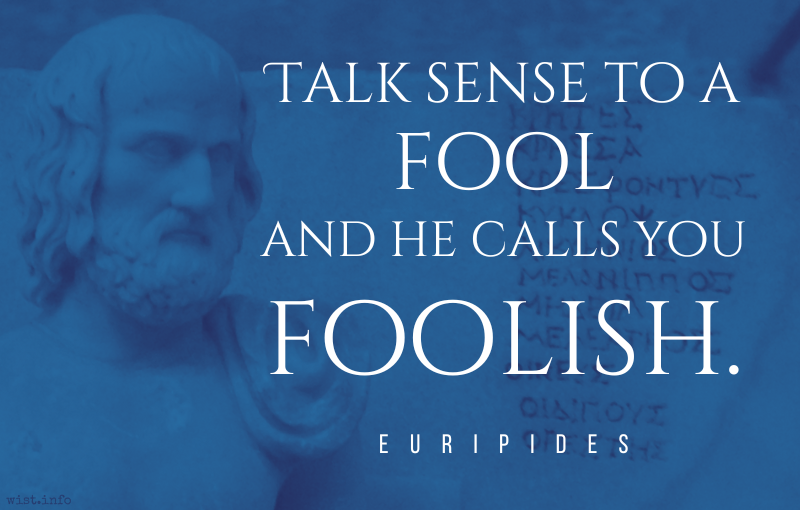
PENTHEUS: Do you hold your rites
during the day or night?
DIONYSUS: Mostly by night.
The darkness is well suited to devotion.
PENTHEUS: Better suited to lechery and seducing women.
DIONYSUS: You can find debauchery by daylight too.[Πενθεύς: τὰ δ᾽ ἱερὰ νύκτωρ ἢ μεθ᾽ ἡμέραν τελεῖς;
Διόνυσος: νύκτωρ τὰ πολλά: σεμνότητ᾽ ἔχει σκότος.
Πενθεύς: τοῦτ᾽ ἐς γυναῖκας δόλιόν ἐστι καὶ σαθρόν.
Διόνυσος: κἀν ἡμέρᾳ τό γ᾽ αἰσχρὸν ἐξεύροι τις ἄν.]Euripides (485?-406? BC) Greek tragic dramatist
Bacchæ [Βάκχαι], l. 485ff (405 BC) [tr. Arrowsmith (1960)]
(Source)
(Source (Greek)). Alternate translations:
PENTHEUS: By night or day these sacred rites perform'st thou ?
BACCHUS: Mostly by nighty for venerable is darkness.
PENTHEUS: To women this is treacherous and unsafe.
BACCHUS: E'en in the broadest day may shame be found.
[tr. Wodhull (1809)]
PENTHEUS: Do you perform the rites by night or by day?
DIONYSUS: Mostly by night; darkness conveys awe.
PENTHEUS: This is treacherous towards women, and unsound.
DIONYSUS: Even during the day someone may devise what is shameful.
[tr. Buckley (1850)]
PENTHEUS: Performest thou these rites by night or day?
DIONYSUS: Most part by night -- night hath more solemn awe.
PENTHEUS: A crafty rotten plot to catch our women.
DIONYSUS: Even in the day bad men can do bad deeds.
[tr. Milman (1865)]
PENTHEUS: Dost thou perform thy rites by day; or night?
DIONYSUS: Chiefly by night; darkness gives dignity.
PENTHEUS: Craft rather and seduction it denotes.
DIONYSUS: Base acts are oft made manifest by day.
[tr. Rogers (1872), l. 462ff]
PENTHEUS: Is it by night or day thou performest these devotions?
DIONYSUS: By night mostly; darkness lends solemnity.
PENTHEUS: Calculated to entrap and corrupt women.
DIONYSUS: Day too for that matter may discover shame.
[tr. Coleridge (1891)]
PENTHEUS: By night or day dost thou perform his rites?
DIONYSUS: Chiefly by night: gloom lends solemnity.
PENTHEUS: Ay -- and for women snares of lewdness too.
DIONYSUS: In the day too may lewdness be devised.
[tr. Way (1898)]
PENTHEUS: How is thy worship held, by night or day?
DIONYSUS: Most oft by night; 'tis a majestic thing,
The darkness.
PENTHEUS: Ha! with women worshipping?
'Tis craft and rottenness!
DIONYSUS: By day no less,
Whoso will seek may find unholiness.
[tr. Murray (1902)]
PENTHEUS: Do you celebrate your sacred acts at night or by day?
DIONYSUS: At night for the most party. Darkness possesses solemnity.
PENTHEUS: Darkness for women is deceitful and corrupt!
DIONYSUS: Even in daytime one could discover disgraceful behavior.
[tr. Kirk (1970)]
PENTHEUS: Do you celebrate your mysteries by night or by day?
DIONYSUS: Chiefly by night. Darkness induces religious awe.
PENTHEUS: For women darkness is treacherous and impure.
DIONYSUS: Impurity can be practiced by daylight too.
[tr. Vellacott (1973)]
PENTHEUS: These sacred practices of your god, the worship,
The rites of great devotion, do they
Hold at night, or in the day.
DIONYSUS: [...] We hold our rites mostly at night
Because it is cooler. And the lamps
Lend atmosphere and feeling to the heart in worship.
[...]
PENTHEUS: And I say night hours are dangerous
Lascivious hours, lechery ....
DIONYSUS: You'll find debauchery in daylight, too.
[tr. Soyinka (1973)]
PENTHEUS: The rites -- at night or by day you perform them?
DIONYSUS: At night, mostly; there’s majesty in darkness.
PENTHEUS: And for women there’s trickery and smut.
DIONYSUS: Even by day one may discover shame.
[tr. Neuburg (1988)]
PENTHEUS: Do you perform your mysteries
during the day or by night?
DIONYSUS: Mostly at night.
The dark is more conducive to worship.
PENTHEUS: You mean to lechery and bringing out the filth in women.
DIONYSUS: Those who look for filth, can find it at the height of noon.
[tr. Cacoyannis (1982)]
PENTHEUS: Do you worship in daylight or at night?
DIONYSUS: Mostly at night. Darkness is most sacred.
PENTHEUS: That is treacherous and unwholesome for women.
DIONYSUS: Some find shame even in daylight.
[tr. Blessington (1993)]
PENTHEUS: Do you celebrate these sacred rites at night or in the day?
THE STRANGER: At night mostly, since darkness induces devotion.
PENTHEUS: No, darkness is devious and corrupts women.
THE STRANGER: Even in the day someone could devise shameful deeds.
[tr. Esposito (1998)]
PENTHEUS: You practice this cult by night or by day?
DIONYSUS: Mostly at night. Darkness lends solemnity.
PENTHEUS: Darkness is just a filthy trap for women.
DIONYSUS: Some people can dig up dirt in daytime, too.
[tr. Woodruff (1999)]
PENTHEUS: Do you perform the rites by day? -- or night?
DIONYSUS: Mostly at night -- because the darkness has its holiness.
PENTHEUS: It's treacherous, for women, and corrupts them.
DIONYSUS: What's shameful can be found even by light of day.
[tr. Gibbons/Segal (2000), l. 571ff]
PENTHEUS: Do you practice your rites at night or by day?
DIONYSUS: Mostly at night: darkness lends solemnity.
PENTHEUS: This is an immoral trick aimed at women.
DIONYSUS: Someone could engage in shameful deeds even by day.
[tr. Kovacs (2002)]
PENTHEUS: And you perform these practices at night?
DIONYSUS: Man's true nature's seen in darkness not in light.
PENTHEUS: While darkness shrouds a woman's true duplicity.
DIONYSUS: Duplicity's not found in night exclusively.
[tr. Teevan (2002)]
PENTHEUS: Tell me, when do you hold your worship? By clear day, or dark night?
DIONYSUS: Mostly by night -- it is a majestic time.
PENTHEUS: Indeed! A majestic time to take advantage of women. Shameful!
DIONYSUS: There are enough shameful things done by day. And enough shameful thoughts in your head, I am sure!
[tr. Rao/Wolf (2004)]
PENTHEUS: These ... holy orgies of yours… do you perform them during the day or in the night?
DIONYSUS: Most of them during the night. Darkness adds a certain modesty.
PENTHEUS: That’s quite a dubious thing for the women… and rather lecherous, I’d say.
DIONYSUS: Shame, of course can be seen during the day, too, if it exists and if one were to look for it.
[tr. Theodoridis (2005)]
PENTHEUS: Do you conduct the mysteries in the night or by day?
DIONYSUS: Us'ally by night, for darkness holds reverence.
PENTHEUS: Is this thing deceitful or unwholesome towards women?
DIONYSUS: One might also uncover shameful things i' the day.
[tr. Valerie (2005)]
PENTHEUS: When you dance these rites,
is it at night or during daylight hours?
DIONYSUS: Mainly at night. Shadows confer solemnity.
PENTHEUS: And deceive the women. It's all corrupt!
DIONYSUS: One can do shameful things in daylight, too.
[tr. Johnston (2008), l. 604ff]
PENTHEUS: These mysteries. Do you practise them by day, or night?
DIONYSUS: Mostly by night. Dark is better for devotion.
PENTHEUS: Better for lechery and the taking of women.
DIONYSUS: That happens in daylight too.
[tr. Robertson (2014)]
PENTHEUS: And are these rites conducted by day or by night?
DIONYSUS: Night, for the most part. It’s so much more ... spiritual. Good for devotion.
PENTHEUS: The night’s a trap for women’s virtue.
DIONYSUS: And the day isn’t? You don’t get out much, do you?
[tr. Pauly (2019)]
PENTHEUS: Do you perform your rituals by day or night?
DIONYSUS: By night. We believe that darkness is holy.
PENTHEUS: It's a cunning time to force filth upon women.
DIONYSUS: Vice thrives in daylight, too.
[tr. Behr/Foster (2019)]
PENTHEUS: Do you perform the sacred rites [hiera] by night or by day?
DIONYSUS: Mostly by night; darkness conveys awe.
PENTHEUS: This is treacherous towards women, and unsound.
DIONYSUS: Even during the day you can find what is shameful.
[tr. Buckley/Sens/Nagy (2020)]
The wise man preserves a smooth-tempered self-control.
[πρὸς σοφοῦ γὰρ ἀνδρὸς ἀσκεῖν σώφρον᾽ εὐοργησίαν.]
Euripides (485?-406? BC) Greek tragic dramatist
Bacchæ [Βάκχαι], l. 641ff [Dionysus/Διόνυσος] (405 BC) [tr. Vellacott (1973)]
(Source)
An ironic statement from Dionysus, of how he will keep his calm and temper in the face of Pentheus' disrespectful fury. In very short order, Dionysus is (calmly) setting up Pentheus' self-destruction through the Bacchantes' frenzy.
(Source (Greek)). Alternate translations:
For it behoves the wise
To curb the sallies of outrageous ire.
[tr. Wodhull (1809)]
For it is the part of a wise man to practice restrained good temper.
[tr. Buckley (1850)]
’Tis easy to a wise man To practise self-command.
[tr. Milman (1865)]
For a wise man ever knoweth how to keep his passion down.
[tr. Rogers (1872)]
For ’tis a wise man’s way to school his temper into due control.
[tr. Coleridge (1891)]
For it is the wise man's part to rein his wrath in soberness.
[tr. Way (1898)]
For still are the ways of Wisdom, and her temper trembleth not!
[tr. Murray (1902)]
Wise men know constraint: our passions are controlled.
[tr. Arrowsmith (1960)]
For it is the quality of a wise man to exercise restrained good temper.
[tr. Kirk (1970)]
The secret of life is
Balance, tolerance.
[tr. Soyinka (1973)]
A wise man should practice pure thought and good temper.
[tr. Neuburg (1988)]
A wise man knows restraint. His strength is his detachment.
[tr. Cacoyannis (1982)]
For the wise know gentleness is wisdom.
[tr. Blessington (1993)]
For it is the part of a wise man to employ a controlled and gentle temper.
[tr. Esposito (1998)]
A wise man trains his temper to be good and calm.
[tr. Woodruff (1999)]
Because a man
Who is wise has self-control and gentleness of temper.
[tr. Gibbons/Segal (2000)]
It is a wise man's part to practice gentleness and self-control.
[tr. Kovacs (2002)]
He who would be wise will keep his self-control.
[tr. Teevan (2002)]
That is how wise people work, calmly.
[tr. Theodoridis (2005)]
A wise man is able to hold his good-nature well tempered.
[tr. Valerie (2005)]
After all, a wise man ought to keep his temper.
[tr. Johnston (2008)]
He should learn from me the ways of self-control.
[tr. Robertson (2014)]
Keep calm and carry on, as the wisest say.
[tr. Pauly (2019)]
The wise man has a reasonable temper.
[tr. Behr/Foster (2019)]
A sophos man must practice good temper that is moderate [sōphrōn].
[tr. Buckley/Sens/Nagy (2020)]
Only by fleeing did we avoid
being torn to pieces by the Bacchae,
but they attacked our grazing calves and not with swords in their hands.
You could have seen one of them, apart from the others, mauling with both hands
a young heifer with swelling udders, bellowing all the while;
and other women were ripping apart mature cows, shredding them up.
You could have seen ribs or a cleft hoof
being tossed up and down. Hanging from the fir trees
the ribs and hooves dripped bloody gore.
Bulls previously aggressive and tossing their horns in rage
now tumbled to the ground, their bodies dragged down
by the myriad hands of young women.
Their garments of flesh were ripped off
faster than you could have winked your royal eyes.[ἡμεῖς μὲν οὖν φεύγοντες ἐξηλύξαμεν
βακχῶν σπαραγμόν, αἳ δὲ νεμομέναις χλόην
μόσχοις ἐπῆλθον χειρὸς ἀσιδήρου μέτα.
καὶ τὴν μὲν ἂν προσεῖδες εὔθηλον πόριν
μυκωμένην ἔχουσαν ἐν χεροῖν δίχα,
ἄλλαι δὲ δαμάλας διεφόρουν σπαράγμασιν.
εἶδες δ᾽ ἂν ἢ πλεύρ᾽ ἢ δίχηλον ἔμβασιν
ῥιπτόμεν᾽ ἄνω τε καὶ κάτω: κρεμαστὰ δὲ
ἔσταζ᾽ ὑπ᾽ ἐλάταις ἀναπεφυρμέν᾽ αἵματι.
ταῦροι δ᾽ ὑβρισταὶ κἀς κέρας θυμούμενοι
τὸ πρόσθεν ἐσφάλλοντο πρὸς γαῖαν δέμας,
μυριάσι χειρῶν ἀγόμενοι νεανίδων.
θᾶσσον δὲ διεφοροῦντο σαρκὸς ἐνδυτὰ
ἢ σὲ ξυνάψαι βλέφαρα βασιλείοις κόραις.]Euripides (485?-406? BC) Greek tragic dramatist
Bacchæ [Βάκχαι], l. 734ff [Messenger/Ἄγγελος] (405 BC) [tr. Esposito (1998)]
(Source)
Telling Pentheus of how the Bacchantes, led by his mother, Agave, slew a herd of cattle. (Source (Greek)). Alternate translations:
By hasty flight
From these infuriate Bacchanalian dames
We scap'd; but they our grazing herds invaded,
Tho' in their hands no steely weapon gleam'd:
You might have seen one seize and firmly hold
A fatted heifer, others rent the limbs
Of steers asunder; ribs and cloven hoofs
Were toss'd around, from branching pine distill'd
Morsels of flesh and intermingled gore.
The raging bulls , who menac'd with their horns,
Were in a moment stretch'd upon the ground
Assail'd by many a blooming maid: the Daughters
Of royal Cadmus from the flesh tore off
The hides, ere you could close your eyes.
[tr. Wodhull (1809)]
We fled and escaped from being torn apart by the Bacchae, but they, with unarmed hands, sprang on the heifers browsing the grass. and you might see one rending asunder a fatted lowing calf, while others tore apart cows. You might see ribs or cloven hooves tossed here and there; caught in the trees they dripped, dabbled in gore. Bulls who before were fierce, and showed their fury with their horns, stumbled to the ground, dragged down by countless young hands. The garment of flesh was torn apart faster then you could blink your royal eyes.
[tr. Buckley (1850)]
We fled amain, or by the Bacchanals
We had been torn in pieces. They, with hands
Unarmed with iron, rushed on the browsing steers.
One ye might see a young and vigorous heifer
Hold, lowing in her grasp, like prize of war.
And some were tearing asunder the young calves;
And ye might see the ribs or cloven hoofs
Hurled wildly up and down, and mangled skins
Were hanging from the ash boughs, dropping blood.
The wanton bulls, proud of their tossing horns
Of yore, fell stumbling, staggering to the ground,
Dragged down by the strong hands of thousand maidens.
And swifter were the entrails torn away
Than drop the lids over your royal eyeballs.
[tr. Milman (1865)]
In hurried flight we hardly could escape
The Bacchants' clutch. and then they wreaked their rage
Albeit unarmed, upon the browsing herds.
Here might one see the fatling heifer seized,
And lowing, torn to pieces in their hands,
While others rent the kids to fragments there.
There hurled about, the ribs and cloven hoofs
Lay scattered; others cast into the pines
The gory gobbets dripping down with blood.
The wanton bulls, striving in vain to butt,
Were thrust perforce and headlong on the ground,
Driven by the myriad force of girling hands.
More quickly they tore off the flesh than though
Could'st close thine eyelids on thy royal eyes.
[tr. Rogers (1872), l. 694ff]
Thereat we fled, to escape being torn in pieces by the Bacchantes; but they, with hands that bore no weapon of steel, attacked our cattle as they browsed. Then wouldst thou have seen Agave mastering some sleek lowing calf, while others rent the heifers limb from limb. Before thy eyes there would have been hurling of ribs and hoofs this way and that; and strips of flesh, all blood-bedabbled, dripped as they hung from the pine-branches. Wild bulls, that glared but now with rage along their horns, found themselves tripped up, dragged down to earth by countless maidens’ hands. The flesh upon their limbs was stripped therefrom quicker than thou couldst have closed thy royal eye-lids.
[tr. Coleridge (1891)]
O then we fled, and fleeing scantly 'scaped
The Bacchanals' rending grasp. Down swooped they then
Upon our pasturing kine with swordless hand.
Then hadst thou seen thy mother in her grip
Clutch a deep-uddered heifer bellowing loud:
And others rent the calves in crimson shreds.
Ribs hadst thou seen and cloven hoofs far hurled
This way and that, and flakes of flesh that hung
And dripped all blood-bedabbled 'neath the pines.
Bulls, chafing, lowering fiercely along the horn
Erewhile, were tripped and hurled unto the earth,
Dragged down by countless-clutching maiden hands.
More swiftly was the flesh that lapped their bones
Stripped, than thou couldst have closed thy kingly eyes.
[tr. Way (1898)]
Thereat, for fear they tear us, all we fled
Amazed; and on, with hand unweaponèd
They swept toward our herds that browsed the green
Hill grass. Great uddered kine then hadst thou seen
Bellowing in sword-like hands that cleave and tear,
A live steer riven asunder, and the air
Tossed with rent ribs or limbs of cloven tread,
And flesh upon the branches, and a red
Rain from the deep green pines. Yea, bulls of pride,
Horns swift to rage, were fronted and aside
Flung stumbling, by those multitudinous hands
Dragged pitilessly. And swifter were the bands
Of garbèd flesh and bone unbound withal
Than on thy royal eyes the lids may fall.
[tr. Murray (1902)]
At this we fled
and barely missed being torn to pieces by the women.
Unarmed, they swooped down, upon the herds of cattle
grazing there on the green of the meadow. And then
you could have seen a single woman with bare hands
tear a fat calf, still bellowing with fright,
in two, while others clawed the heifers to pieces.
There were ribs and cloven hooves scattered everywhere,
and scraps smeared with blood hung from the fir trees.
And bulls, their raging fury gathered in their horns,
lowered their heads to charge, then fell, stumbling
to the earth, pulled down by hordes of women
and stripped of flesh and skin more quickly, sire,
than you could blink your royal eyes.
[tr. Arrowsmith (1960)]
So we took to our heels and escaped
being torn to pieces by the bacchants; but they attacked the grazing
heifers, with hands that bore no steel.
And one you could have seen holding asunder in her hands
a tight-uddered, young, bellowing heifer;
while others were tearing full-grown cows to pieces.
You could have seen ribs, or a cloven hoof,
being hurled to and fro; and these hung
dripping under the fir trees, all mixed with blood.
Bulls that were arrogant before, with rage
in their horns, stumbled to the ground,
borne down by the countless hands of girls.
The garments of flesh were drawn apart more quickly
than you could close the lids over your royal eyes.
[tr. Kirk (1970)]
So we fled, and escaped being torn in pieces by these possessed women. But our cattle were feeding there on the fresh grass; and the Bacchae attacked them, with their bare hands. You could see Agauë take up a bellowing young heifer with full udders, and hold it by the legs with her two arms stretched wide. Others were tearing our cows limb from limb, and you could see perhaps some ribs or a cleft hoof being tossed high and low; and pieces of bloody flesh hung dripping on the pine-branches. And bulls, which one moment were savagely looking along their horns, the next were thrown bodily to the ground, dragged down by the soft hands of girls -- thousands of them; and they stripped the flesh off their bodies faster than you could wink your royal eyes.
[tr. Vellacott (1973)]
We changed roles and became the hunted,
Fleeing for sweet life. Another moment and
We would have been shredded like chaff.
Balked of their prey, the Maenads turned upon our herd.
Unarmed, they swooped down on our heifers grazing
In the meadows, nothing in their hands, nothing.
Their bare arms sufficed. They rent young, stocky
Heifers in two - you should have heard their death bellows,
Seen these frail-built creatures wrench
Full-grown cattle limb from limb, ribs, hooves
Spiral into he air, fall in torrents of blood,
Seen our dismembered livestock hang from branches
Blood spattering the leaves, seen wild bulls
With surging horns, unapproachable till now
Tripped, sprawled, full-length on the ground
Bellow in unaccustomed terror as girlish limbs
Tore them apart, flayed them living.
[tr. Soyinka (1973)]
Well, we escaped, and managed to avoid
the bacchae’s mangling; but the cattle grazing
in the grass they set upon with their bare hands:
one could be seen to take a well-uddered heifer
and pull it apart mooing in her hands;
others carried off calves and mangled them;
you might have seen a rib or cloven hoof
hurled helter-skelter; things hung
and dripped beneath the firs, befouled with blood;
bulls, violent and raging in their horns
before, were stumbling their forms upon the earth,
driven by thousands of maidenly hands,
that swifter stripped the garment of their flesh
than you could close your lids on kingly eyes.
[tr. Neuburg (1988)]
At this we fled
and barely escaped being torn to pieces
by these God-struck maenads.
But our cattle --
our herds grazing on the grassy slopes -- oh!
They fell upon them with their naked hands.
You could see a woman sink her nails into a cow,
with its udders full, and left it, bellowing, high above her head.
Others dragged young heifers, ripping them apart.
Everywhere you looked,
ribs and cloven hooves
were flying through the air.
And from the pine branches
dangled lumps of flesh that dripped with blood. Majestic bulls
one minute aiming their horns with all their furious pride,
the next were stumbling to the ground,
overwhelmed by the swarming hands of girls,
their bones stripped clean of all their flesh,
faster than you could blink your royal eyes.
[tr. Cacoyannis (1982)]
Then we fled to escape being torn
To pieces by them. Barehanded,
They attacked cattle grazing grass.
You could see one woman drawing
Apart a heifer, fat and bellowing,
Others tore and mangled grown heifers.
You could see ribs or a cloven hoof
Thrown up and down and, suspended
From fir trees, drip defiled, with blood.
Arrogant bulls too, rage once filling
Their horns, were tripped bodily to the ground
Ravaged by hundreds of young hands,
And were stripped of their garment of flesh
Before you could blink your royal eyes.
[tr. Blessington (1993)]
So we were the ones who ran away, to escape
being torn apart by the Bacchae. And they attacked
our livestock as they were grazing on new grass.
No sharp weapons, but you'd have seen one woman
tear apart a young cow with her bare hands --
it was bellowing, its udder was swollen with milk. Others
ripped grown cows to pieces. You'd see ribs and feet
hurled every which way, hooves flying, pieces hanging
in the pine trees, smeared with blood and ripping.
Bulls in all their pride stumbled headlong:
They once had rage tossing on their long horns;
now more hands than you can count pull
them down -- young girls' hands. And strip off the flesh
that covered them, faster than a king could wink one eye.
[tr. Woodruff (1999)]
We ran away from them -- to escape being torn
Apart by the maenads. But with their bare hands,
Not with weapons of iron, then they began
To attack the grazing herds. You would have seen
One woman by herself with just her hands
Pulling in two a big young heifer that
Had swelling udders and was bellowing,
And meanwhile others were dismembering
The full-grown cattle, flaying them to shreds.
You would have seen the ribs and hooves hurled up,
Thrown down, flying through the air, and pieces
Hanging from the trees, still dripping blood.
Even arrogant bulls were stumbling, forced
To the ground, the anger in their horns outweighed
By the countless hands of girls -- their rags of flesh
Were torn from them much faster than you could
Have blinked your royal eyes.
[tr. Gibbons/Segal (2000), l. 842ff]
We ran away and thereby escaped being torn to pieces by the bacchants. But they, with n iron weapons in their hands, attacked some grazing cattle. You could have seen one of the women tearing asunder a bellowing fatted calf with her hands, while others tore heifers to pieces. You could have seen their flanks and cloven hooves hurled this way and that: pieces, drenched with blood, hung dripping from the fir trees. Bulls that till then were violent, with anger in their horns, were thrown to earth, dragged by countless female hands: their covering of flesh was torn in pieces faster than your majesty could blink your royal eyes.
[tr. Kovacs (2002)]
We turned and ran for it, for we have heard
How the Bacchai, when their god is with them,
Will eat raw the flesh from still-living beasts.
We escaped but they found our grazing herds.
They slaughtered them with nothing but their hands.
One dragged a calf form its own mother's teat
And tore it, as it bellowed, clean in two,
While others pulled apart whole heifers.
The woods soon seemed a bloody abattoir.
Even one proud-horned bull was dragged to earth,
His flesh, by fingernails, scratched from his bones
And the scrag ends hurled high into the trees.
All done by the hands of girls and women,
And quicker than a wink from a royal eye.
[tr. Teevan (2002)]
Then seeing we had run out of reach, they fell in fury upon our flocks, tearing the heifers apart with bear hands. Great, large beasts ripped into little shreds of blood and gristle faster than the lids can fall over your royal eyes.
[tr. Rao/Wolf (2004)]
We just managed to run away and escape the slaughter but they threw themselves, with no spear nor sword, at the calves that were quietly grazing nearby. One of those women tore a poor, tiny calf away from its mother’s udder and others ripped calves to bloody pieces with their bare hands and then they began eating them raw. My Lord, you could see bits of flesh strewn all around the place. Whole sides of animals, legs, other chunks of animal flesh hanging from the fir trees, dripping blood. Huge bulls, my Lord which only a few minutes earlier stood tall and proud, the sort that if one got them angry they’d tear everything apart with their massive horns, well, now they dropped their bodies to the ground and straightaway countless girls dragged them about with their bare hands and ... and by the time you blinked your royal eye, my Lord, they’d have the skin torn off those massive carcasses of them bulls.
[tr. Theodoridis (2005)]
And so we ran away in fear and avoided being torn to
bits and eaten like deer by the bacchants; but they
attacked our cattle, barehanded, as they grazed
in the field, and you could see one grab and stretch
the legs of a young, pink-uddered calf, bellowing, as other
Maenads pulled and tore a full-grown heifer apart.
And you'd have seen ribs or cloven hooves thrown
up and down as they dripped, hanging from
fir tree branches, cover'd in blood.
The proud bulls, which moments before had been fully
ready to charge, dropped their body down to earth,
brought down by countless maidens' hands as they
stripped the poor beast's flesh right off like clothes
in the time it'd take you to blink your highness' eye.
[tr. Valerie (2005)]
We ran off, and so escaped being torn apart. But then those Bacchic women, all unarmed, went at the heifers browsing on the turf, using their bear hands. You should have seen one ripping a fat, young, lowing calf apart -- others tearing cows in pieces with their hands. You could've seen ribs and cloven hooves tossed everywhere -- some hung up in branches dripping blood and gore. And bulls, proud beasts till then, with angry horns, collapsed there on the ground, dragged down by the hands of a thousand girls. Hides covering their bodies were stripped off faster than you could wink your royal eye.
[tr. Johnston (2008)]
We fled.
They would have torn us to pieces, those Bacchae.
Instead, they turned -- bare-handed --
on our herd of grazing cattle.
A single woman pulled a mewling calf in two,
while others clawed apart a full-grown heifer.
There were spread ribs and broken hooves
flung everywhere,
and pieces of flesh hung
dripping from the trees.
Great bulls, their power and fury tightening in their horns,
lowered their heads to charge
but were wrestled to the ground
by countless female hands and flayed alive --
faster, sire, than a blink of your royal eyes.
[tr. Robertson (2014)]
We ran. And just avoided a shredding by the Bacchae.
And since they couldn’t have us ...
They got the grazing cows instead. Attacked them with nothing but their hands.
You’d have seen them tearing a fat calf in two, screaming in their grasp. Look another way and there they were, rending pieces off a heifer.
You would have seen ribs and cloven hooves thrown all over the place, blood-drenched ribbons hanging from the trees, still dripping. Proud bulls, tossing their horns in defiant rage, were driven to the ground, torn down by more women’s hands than I could count. Their hides were ripped from the meat in the blink of an eye, even your kingly eyes.
[tr. Pauly (2019)]
We fled and escaped being torn apart by the Bacchants, but they, unarmed, sprang on the heifers browsing the grass. You could have seen one rending asunder a fatted lowing calf, while others tore apart cows. You could have seen ribs or cloven hooves tossed all about; caught in the trees they dripped, dabbled in gore. Bulls who formerly with hubris showed their fury with their horns had their bodies cut to the ground, dragged down by the countless hands of young girls. The garment of flesh was torn apart faster then you could blink your royal eyes.
[tr. Buckley/Sens/Nagy (2020)]
He’s the one who gives us wine to ease our pain.
If you take wine away, love will die, and
every other source of human joy will follow.[τὴν παυσίλυπον ἄμπελον δοῦναι βροτοῖς.
οἴνου δὲ μηκέτ᾽ ὄντος οὐκ ἔστιν Κύπρις
οὐδ᾽ ἄλλο τερπνὸν οὐδὲν ἀνθρώποις ἔτι.]Euripides (485?-406? BC) Greek tragic dramatist
Bacchæ [Βάκχαι], l. 772ff [First Messenger/Ἄγγελος] (405 BC) [tr. Woodruff (1999)]
(Source)
Speaking of Dionysus. (Source (Greek)). Alternate translations:
He, the grape, that med'cine for our cares,
Bestow'd on favour'd mortals. Take away
The sparkling Wine, fair Venus smiles no more
And every pleasure quits the human race.
[tr. Wodhull (1809)]
He gives to mortals the vine that puts an end to grief. Without wine there is no longer Aphrodite or any other pleasant thing for men.
[tr. Buckley (1850)]
He hath given the sorrow-soothing vine to man
For where wine is not love will never be,
Nor any other joy of human life.
[tr. Milman (1865)]
He gives the soothing vine
Which stills the sorrow of the human heart;
Where wine is absent, love can never be;
Where wine is absent, other joys are gone.
[tr. Rogers (1872), l. 732ff]
’Twas he that gave the vine to man, sorrow’s antidote. Take wine away and Cypris flies, and every other human joy is dead.
[tr. Coleridge (1891)]
He gave men the grief-assuaging vine.
When wine is no more found, then Love is not,
Nor any joy beside is left to men.
[tr. Way (1898)]
This is he who first to man did give
The grief-assuaging vine. Oh, let him live;
For if he die, then Love herself is slain,
And nothing joyous in the world again!
[tr. Murray (1902)]
It was he,
or so they say, who gave to mortal men
the gift of lovely wine by which our suffering
is stopped. And if there is no god of wine,
there is no love, no Aphrodite either,
nor other pleasures left to men.
[tr. Arrowsmith (1960)]
They say that he
has given to men the vine that ends pain.
If wine were no more, then Cypris is no more
nor anything else delighted for mankind.
[tr. Kirk (1970)]
It was he who gave men the gift of the vine as a cure for sorrow. And if there were no more wine, why, there's an end of love, and of every other pleasure in life.
[tr. Vellacott (1973)]
Didn't he make us
Mortal men the gift of wine? If that is true
You have much to thank him for -- wine makes
Our labors bearable. Take wine away
And the world is without joy, tolerance, or love.
[tr. Soyinka (1973)]
The sorrow-ceasing vine he gives to mortals.
Without wine there is no Aphrodite,
nor longer any other delight for men.
[tr. Neuburg (1988)]
It was he,
so they say, who gave to us, poor mortals, the gift of wine,
that numbs all sorrows.
If wine should ever cease to be,
then so will love.
No pleasures left for men.
[tr. Cacoyannis (1982)]
He himself, I hear them say,
Gave the pain-killing vine to men.
When wine is no more, neither is love.
Nor any other pleasure for mankind.
[tr. Blessington (1993)]
He gave to mortals the vine that stops pain.
If there were no more wine, then there is no more Aphrodite
nor any other pleasure for mankind.
[tr. Esposito (1998)]
It's he who gave
To mortals the vine that stops all suffering.
Adn if wine were to exist no longer, then
Neither would the goddess Aphrodite,
Nor anything of pleasure for us mortals.
[tr. Gibbons/Segal (2000), l. 885ff]
He gave to mortals the vine that puts an end to pain. If there is no wine, there is no Aphrodite or any other pleasure for mortals.
[tr. Kovacs (2002)]
Besides, he's given us the gift of wine,
Without which man desires nor endures not.
[tr. Teevan (2002)]
He’s the god who brought the wine to the mortals. Great stuff that. It stops all sadness. Truth is, my Lord, when the wine is missing so does love and then… well, then there’s nothing sweet left for us mortals.
[tr. Theodoridis (2005)]
He is the one who gave us the vine that gives
pause from pain; and if there is no wine, there'll be no more
Aphrodite, & there is no other gift to give such pleasure to us mortals.
[tr. Valerie (2005)]
He gives to mortal human beings that vine which puts an end to human grief. Without wine, there's no more Aphrodite -- or any other pleasure left for men.
[tr. Johnston (2008)]
He is great in so many ways -- not least, I hear say,
for his gift of wine to mortal men.
Wine, which puts an end to sorrow and to pain.
And if there is no wine, there is no Aphrodite,
And without her no pleasure left at all.
[tr. Robertson (2014)]
When wine is gone, there is no more Cypris,
nor anything else to delight a mortal heart.
[tr. @sentantiq/Robinson (2015)]
He gave mortals the pain-pausing vine.
When there is no wine, Cypris is absent,
And human beings have no other pleasure.
[tr. @sentantiq (2015)]
I’ve heard he gave the grapevine to us mortals, as an end to pain.
And without wine, we’ve got no chance with Aphrodite. Or anything else good, for that matter.
[tr. Pauly (2019)]
He even gives to mortals the grape that brings relief from cares. Without wine there is no longer Kypris or any other delightful thing for humans.
[tr. Buckley/Sens/Nagy (2020)]
He gave mortals the pain-relieving vine.
But when there is no more wine, there is no Aphrodite
Nor any other pleasure left for human beings.
[tr. @sentantiq (2021)]
He shall come to know
Dionysus, son of Zeus, consummate god,
most terrible, and yet most gentle, to mankind.[γνώσεται δὲ τὸν Διὸς
Διόνυσον, ὃς πέφυκεν ἐν τέλει θεός,
δεινότατος, ἀνθρώποισι δ᾽ ἠπιώτατος.]Euripides (485?-406? BC) Greek tragic dramatist
Bacchæ [Βάκχαι], l. 859ff [Dionysus/Διόνυσος] (405 BC) [tr. Arrowsmith (1960)]
(Source)
Speaking of King Pentheus. (Source (Greek)). Alternate translations:
Thus he shall know dread Bacchus, son of Jove,
A god most terrible when he asserts
His slighted power: but gracious to mankind.
[tr. Wodhull (1809)]
He will recognize the son of Zeus, Dionysus, who is in fact a god, the most terrible and yet most mild to men.
[tr. Buckley (1850)]
Know he must
Dionysus, son of Jove, among the gods
Mightiest, yet mildest to the sons of men.
[tr. Milman (1865)]
There belike to tell
That Dionysus, son to Zeus, is god,
Most terrible, most gracious unto men.
[tr. Rogers (1872), l. 820ff]
So shall he recognize Dionysus, the son of Zeus, who proves himself at last a god most terrible, for all his gentleness to man.
[tr. Coleridge (1891)]
And he shall know Zeus' son
Dionysus, who hath risen at last a God
Most terrible, yet kindest unto men.
[tr. Way (1898)]
So shall he learn and mark
God's true Son, Dionyse, in fulness God,
Most fearful, yet to man most soft of mood.
[tr. Murray (1902)]
And he shall recognize the son of Zeus,
Dionysus, as a god in perfect essence:
a terrible one, but to men most gentle.
[tr. Kirk (1970)]
And he shall know the son of Zeus, Dionysus; who, those most gentle to mankind, can prove a god of terror irresistible.
[tr. Vellacott (1973)]
Consummate god, most terrible, most gentle
To mankind.
[tr. Soyinka (1973), Bacchante speaking]
He shall know Zeus’ son
Dionysos, that he is in his fullness a god
most dreadful, and to men most mild.
[tr. Neuburg (1988)]
So shall Pentheus come to know Dionysus, son of Zeus,
a God sprung from nature, like nature most cruel,
and, yet, most gentle to mankind.
[tr. Cacoyannis (1982)]
And he'll know
Zeus-born Dionysos is a true divinity,
Most terrifying to men, and most kind.
[tr. Blessington (1993)]
He will come to know Dionysus, the son of Zeus,
that he is, in the ritual of initiation, a god most terrifying,
but for mankind a god most gentle.
[tr. Esposito (1998)]
Then he will know the son of Zeus,
Dionysus, and realize that he was born a god, bringing
terrors for initiation, and to the people, gentle grace.
[tr. Woodruff (1999)]
And he will know that Dionysos, son
Of Zeus, was born a god in full, and is
Most terrible to mortals and most gentle.
[tr. Gibbons/Segal (2000)]
He will learn that Dionysus is in the full sense a god, a god most dreadful to morals -- but also most gentle!
[tr. Kovacs (2002)]
He'll learn the nature of this son of Zeus:
The sweetest and most fearsome of the gods.
[tr. Teevan (2002)]
Only then will he learn that the son of Zeus, Dionysos, is a god of peace for the good folk but he is also a fearsome god who those who don’t respect him.
[tr. Theodoridis (2005)]
He will recognize Zeus' son Dionysus, born in ritual,
The most terrible god -- and kindest to humans.
[tr. Valerie (2005)]
He'll come to acknowledge
Dionysus, son of Zeus, born in full divinity,
most fearful, yet most kind to human beings.
[tr. Johnston (2008)]
And he shall finally know Dionysus, son of Zeus,
a god both terrible and gentle to the world of man.
[tr. Robertson (2014)]
He will know Dionysus. He will know the son of Zeus to be true-god-born, to be the greatest horror to mortal kind.
And the greatest helper.
[tr. Pauly (2019)]
He shall learn that Dionysus is the son of Zeuis, a god with the power of a god, a god most fearful and most gentle.
[tr. Behr/Foster (2019)]
And he will come to know the son of Zeus,
Dionysus, the one who is by his own nature a god in the end [telos],
the one who is most terrifying [deinos], but, for humans, also most gentle [ēpios ].
[tr. Buckley/Sens/Nagy (2020)]
What prayer should we call wise?
What gift of Heaven should man
Count a more noble prize,
A prayer more prudent, than
To stretch a conquering arm
Over the fallen crest
Of those who wished us harm?
And what is noble every heart loves best.[τί τὸ σοφόν; ἢ τί τὸ κάλλιον
παρὰ θεῶν γέρας ἐν βροτοῖς
ἢ χεῖρ᾽ ὑπὲρ κορυφᾶς
880τῶν ἐχθρῶν κρείσσω κατέχειν;
ὅ τι καλὸν φίλον ἀεί.]Euripides (485?-406? BC) Greek tragic dramatist
Bacchæ [Βάκχαι], l. 877ff, Stasimon 3 (Ode 4), Refrain [Chorus/Χορός] (405 BC) [tr. Vellacott (1973)]
(Source)
While the passage seems to praise the putting down of one's enemies as the greatest gift of the gods, some modern scholars suggest the final line raises doubts or disagrees with that conclusion.
(Source (Greek)). Alternate translations:
What greater privilege 'midst the fell debate
Can sage or chieftain from the Gods request
Than that of ever fast'ning on the crest
Of the miscreant whom we hate?
Pleasure with unsullied fame
Ever must alliance claim.
[tr. Wodhull (1809)]
What is wisdom? Or what greater honor do the gods give to mortals than to hold one's hand in strength over the head of enemies? What is good is always dear.
[tr. Buckley (1850)]
What is wisest? what is fairest,
Of god's boons to man the rarest?
With the conscious conquering hand
Above the foeman's head to stand.
What is fairest still is dearest.
[tr. Milman (1865)]
What wiser and what nobler gift
Can the good gods bestow on man,
Than when his hands they strengthen, till
He conquers o’er his foeman’s head:
That which is noble, ever is dear.
[tr. Rogers (1872)]
What is true wisdom, or what fairer boon has heaven placed in mortals’ reach, than to gain the mastery o’er a fallen foe? What is fair is dear for aye.
[tr. Coleridge (1891)]
What wisdom's crown, what guerdon, shines more glorious
That Gods can give the sons of men, than this --
O'er crests of foes to stretch the hand victorious?
Honour is precious evermore, I wis.
[tr. Way (1898)]
What else is Wisdom? What of man's endeavour
Or God's high grace, so lovely and so great?
To stand from fear set free, to breathe and wait;
To hold a hand uplifted over Hate;
And shall not Loveliness be loved for ever?
[tr. Murray (1902)]
What is wisdom? What gift of the gods
is held in honor like this:
to hold your hand victorious
over the heads of those you hate?
Honor is precious forever.
[tr. Arrowsmith (1960)]
What is wisdom? Or what fairer
gift from the gods in men's eyes
than to hold the hand of power
over the head of one's enemies?
And "what is fair is always followed."
[tr. Kirk (1970)]
What is wisdom, ah! what fairer thing
to mortal men can the gods bestow
than holding high overhead
a firmer first over the foe?
The fair is dear, and forever.
[tr. Neuburg (1988)]
What is wisdom? Which
of all the God-given gifts
is more beneficial to man
than the power to hold
an enemy powerless at bay?
That which is good is welcome forever.
[tr. Cacoyannis (1982)]
What is wisdom? Or what lovelier gift
From the gods, in moral eyes
Than to hold a stronger hand
Over enemy heads:
Honor is dear -- always.
[tr. Blessington (1993)]
What good is mere cleverness?
Or rather, what god-given gifts
bring more honor to mortals
than to hold the hand of mastery
over the head of the enemy?
Whatever is honorable is dear always.
[tr. Esposito (1998)]
What is wise? What is the finest gift
that gods can give to mortals?
A hand on the heads
of their enemies, pushing down?
[No.] What is fine is loved always.
[tr. Woodruff (1999)]
What is wise? What fit from the gods
Do mortals judge more beautiful
Than to hold our outstretched
Strong hand over an enemy's head?
What is beautiful is what is always loved.
[tr. Gibbons/Segal (2000)]
What good is cleverness? Is there any god-given privilege
nobler than the sight of men
than to hold one's hand in triumph
over the heads of foes?
What is noble is always loved.
[tr. Kovacs (2002)]
What is true wisdom?
What is beauty?
What could be better
Than in your hand to hold
Your enemy's fate?
Beauty is always truth;
And truth beauty.
[tr. Teevan (2002)]
What better, what wiser gift a god could give to men than to hold their hand high above their head as a sign of victory over their enemy?
I always admire the good.
[tr. Theodoridis (2005)]
What is it to be wise? And what gift of the
Immortals is more gracious in humans?
Is it holding your hand over
Your enemies’ head?
What's right is always welcome.
[tr. Valerie (2005)]
What is wisdom? What is finer than the rights
men get from gods -- to hold their powerful hands
over the heads of their enemies?
Ah yes, what's good is always loved.
[tr. Johnston (2008), l. 1079ff]
What is wisdom?
The greatest gift of the gods is honour:
to reach your hand in triumph up
over the heads of the enemy.
Honour is everything.
[tr. Robertson (2014)]
What is wisdom? Here, now?
What is the highest blessing of gods to mortals?
It is to stretch out your hand
over the head of the one you hate,
the one that hates you,
and know your strength is greater.
Doesn’t that always feel good?
[tr. Pauly (2019)]
What wisdom should guide us? What gift of the gods do people prize more than a strong hand to hold over an enemy's head? Honor is always loved.
[tr. Behr/Foster (2019)]
What is wisdom [sophon]? Or what finer prize
do the gods give to mortals than to hold one’s hand
in victory over the head of one’s enemies?
Whatever is beautiful [kalon] is near and dear [philon] forever.
[tr. Buckley/Sens/Nagy (2020)]
It is slow to stir, but nonetheless
it never fails, the strength
of gods.[ὁρμᾶται μόλις, ἀλλ᾽ ὅμως
πιστόν τι τὸ θεῖον
σθένος]Euripides (485?-406? BC) Greek tragic dramatist
Bacchæ [Βάκχαι], l. 882ff (Stasimon 3 (Ode 4), Antistrophe 1) [Chorus/Χορός] (405 BC) [tr. Kirk (1970)]
(Source)
(Source (Greek)). Alternate translations:
The tardy God arrives at length
His steadfast promise to fulfil,
Exulting in immortal strength.
Tremble, ye ministers of ill!
[tr. Wodhull (1809)]
Divine strength is roused with difficulty, but still is sure.
[tr. Buckley (1850)]
Slow come, but come at length,
In their majestic strength
Faithful and true, the avenging deities.
[tr. Milman (1865)]
Although he slowly shews his might,
God ever steadfast is and sure.
[tr. Rogers (1872), ll. 844-45]
Though slow be its advance, yet surely moves the power of the gods.
[tr. Coleridge (1891)]
Slowly on-sweepeth, but unerringly,
The might of Heaven.
[tr. Way (1898)]
O Strength of God, slow art thou and still,
Yet failest never!
[tr. Murray (1902)]
Slow but unmistakable
the might of the gods moves on.
[tr. Arrowsmith (1960)]
Slow, yet unfailing, move the Powers
of heaven with the moving hours
[tr. Vellacott (1973)]
Scarcely speeding, but all the same
the strength of the gods is certain.
[tr. Neuburg (1988)]
Slowly but implacably,
divine power moves.
[tr. Cacoyannis (1982)]
Scarcely it has started,
Yet still god's might is trust-
Worthy.
[tr. Blessington (1993)]
It starts out slowly
but still the strength of the gods
is trustworthy.
[tr. Esposito (1998)]
Never hurried, never
failing, a god's
fist.
[tr. Woodruff (1999)]
The unremitting power
Of the divine begins only
Slowly to move, but
Always moves.
[tr. Gibbons/Segal (2000)]
Slowly does heaven move, but still
its strength is [something] sure.
[tr. Kovacs (2002)]
Slow but unerring move the gods
Against the heedless man.
[tr. Teevan (2002)]
God’s justice might be late arriving but it does arrive.
[tr. Theodoridis (2005)]
Th'heavens might is scarcely set in
Motion, but it is not to be
doubted, a beacon to humans.
[tr. Valerie (2005)]
The power of the gods is difficult to stir -- but it's a power we can count on.
[tr. Johnston (2008)]
The might of heaven moves slowly, inexorably.
[tr. Robertson (2014)]
The strength of a god is not roused without need,
But when it is roused, it comes down.
Implacably.
[tr. Pauly (2019)]
Slowly they begin, but always the powers of heaven punish ....
[tr. Behr/Foster (2019)]
Divine strength is roused with difficulty, but is trustworthy nevertheless.
[tr. Buckley/Sens/Nagy (2020)]
Slow but sure moves the might of the gods.
[Bartlett's]
Blest is the man who cheats the stormy sea
And safely moors beside the sheltering quay;
So, blest is he who triumphs over trial.
One man, by various means, in wealth or strength
Outdoes his neighbour; hope in a thousand hearts
Colours a thousand different dreams; at length
Some find a dear fulfilment, some denial.
But this I say,
That he who best
Enjoys each passing day
Is truly blest.[εὐδαίμων μὲν ὃς ἐκ θαλάσσας
ἔφυγε χεῖμα, λιμένα δ᾽ ἔκιχεν:
εὐδαίμων δ᾽ ὃς ὕπερθε μόχθων
ἐγένεθ᾽: ἑτέρᾳ δ᾽ ἕτερος ἕτερον
ὄλβῳ καὶ δυνάμει παρῆλθεν.
μυρίαι δ᾽ ἔτι μυρίοις
εἰσὶν ἐλπίδες: αἳ μὲν
τελευτῶσιν ἐν ὄλβῳ
βροτοῖς, αἳ δ᾽ ἀπέβησαν:
τὸ δὲ κατ᾽ ἦμαρ ὅτῳ βίοτος
εὐδαίμων, μακαρίζω.]Euripides (485?-406? BC) Greek tragic dramatist
Bacchæ [Βάκχαι], l. 902ff (Stasimon 3, Epode) [Chorus/Χορός] (405 BC) [tr. Vellacott (1973)]
(Source)
(Source (Greek)). Alternate translations:
Blest is the man who 'scapes the stormy wave.
And in the harbour finds repose:
He too is blest, 'midst dangers brave,
Who soars above the malice of his foes:
And now these, now those possess
Superior talents or success;
Distinct their aims; but hope each bosom fires.
There are, a rich encrease who find,
The vows of some are scatter'd in the wind:
But in my judgement blest are they
Who taste, tho' only for the day.
The joys their soul desires.
[tr. Wodhull (1809)]
Happy is he who has fled a storm on the sea, and reached harbor. Happy too is he who has overcome his hardships. One surpass another in different ways, in wealth or power. There are innumerable hopes to innumerable men, and some result in wealth to mortals, while others fail. But I call him blessed whose life is happy day today.
[tr. Buckley (1850)]
Who hath 'scaped the turbulent sea,
And reached the haven, happy he!
Happy he whose toils are o'er
In the race of wealth and power!
This one her, and that one there,
Passes by, and everywhere
Still expectant thousands over
Thousands hopes are seen to hover,
Some to mortals end in bliss;
Some have already fled away:
Happiness alone is his
That happy is to-day.
[tr. Milman (1865)]
Happy he, who from the storm,
Has the breaker escaped, and the harbour has reached;
Happy he who after toil
Is the victor, for many the ways in which man
Wins him power, and wins him wealth.
Thousand-fold ever to thousands of men,
Hope follows upon hope,
With some it grows unceasingly,
With some it wastes to nothingness.
But he whose life is ever fresh,
Lives in unbroken happiness.
[tr. Rogers (1872), l. 865ff.]
Happy is he who hath escaped the wave from out the sea, and reached the haven; and happy he who hath triumphed o’er his troubles; though one surpasses another in wealth and power; yet there be myriad hopes for all the myriad minds; some end in happiness for man, and others come to naught; but him, whose life from day to day is blest, I deem a happy man.
[tr. Coleridge (1891)]
Blest who from ravening seas
Hath 'scaped to haven-peace,
Blest who hath triumphed in endeavour's toil and throe.
This man to higher height
Attains, of wealth, of might,
Than that; yet myriad hopes in myriad hearts still glow:
To fair fruition brought
Are some, some come to nought:
Happy is he whose bliss from day to day doth grow.
[tr. Way (1898)]
Happy he, on the weary sea
Who hath fled the tempest and won the haven.
Happy whoso hath risen, free,
Above his striving. For strangely graven
Is the orb of life, that one and another
In gold and power may outpass his brother.
And men in their millions float and flow
And seethe with a million hopes as leaven;
And they win their Will, or they miss their Will,
And the hopes are dead or are pined for still;
But whoe'er can know,
As the long days go,
That To Live is happy, hath found his Heaven!
[tr. Murray (1902)]
-- Blessèd is he who escapes the storm at sea,
who comes home to his harbor.
-- Blessèd is he who emerges from under affliction.
-- In various ways one man outraces another in the race for wealth and power.
-- Ten thousand men possess ten thousand hopes.
-- A few bear fruit in happiness; the others go awry.
-- But he who garners day by day the good of life, he is happiest. Blessèd is he.
[tr. Arrowsmith (1960)]
Happy the man who from the sea
escapes the storm and finds harbor;
happy he who has surmounted
toils; and in different ways one surpasses another
in prosperity and power.
Besides this, for countless men there are countless
hopes -- some of them
reach to the end in prosperity
for mortals, and others depart;
but him whose life day by day
is happy do I count blessed.
[tr. Kirk (1970)]
Happy he from the sea escaping
out of the storm, arriving at anchorage;
happy he fleeing labour's straining;
in many manners may men surpass other men
in prosperity and in power.
Thousand-fold upon thousand-fold
hopes come crowding upon us,
and some finally prosper
for mortals, some are vanish'd:
who day by day has a livelihood of happiness, he is blessed
[tr. Neuburg (1988)]
Happy the man who withstands
life's assaults.
Somehow, in some way, some man surpasses some other
in position and fortune.
For millions of men there are millions of hopes.
For some, these ripen into happiness,
for others into nothing.
Count lucky the man who is happy on this one day.
[tr. Cacoyannis (1982)]
That man is blessed who fled the storm
At sea and reached the bay.
And he is blessed who rose above
His toil. In various ways
One man outstrips in wealth and power
Another: countless men
Have countless hopes: some end in joy,
But others drift way.
The man who day to day has luck
In life -- that man I bless.
[tr. Blessington (1993)]
Happy the man who escapes
the storm at sea and reaches harbor.
Happy, too, is he who overcomes
his toils. And in different ways one man
surpasses another in prosperity and power.
Besides, countless are the hopes
of countless men, Some of those hopes
end in prosperity for mortals, others vanish.
But I count him blessed whose life,
from day to day, is happy.
[tr. Esposito (1998)]
Happy the man who has come away
safe on the beach from a storm at sea,
happy the man who has risen above
trouble and toil. Many are the ways
one man may surpass another
in wealth or power,
and beyond each hope there beckons another
hope without number.
Hope may lead a man to wealth,
hope may pass away;
but I admire a man when he
is happy in an ordinary life.
[tr. Woodruff (1999)]
Happy is he who escapes
A storm at sea and finds safe harbor.
Happy is he who has risen above
Great toils. In different ways,
Some persons outdo others
In their wealth and power.
And hopes are as many as those who hope --
Some will end in rich reward, others in nothing.
But those whose lives are happy
Day by day -- those
I call the blesséd.
[tr. Gibbons/Segal (2000)]
Blessed is he that out of the sea
escapes the storm and wins the harbor;
blessed he who triumphs over
trouble: one man surpasses another
in respect to wealth or power.
Furthermore, in countless hearts
there live countless hopes, some
ending in good fortune,
though some vanish away.
But the man whose life today is happy,
him I count blessed.
[tr. Kovacs (2002)]
Joy of the storm endured,
And the harbour safely reached.
Joy of hardship overcome.
Joy of striving for wealth and power.
Joy of hope. Joy of dreams,
Fulfilled or unfulfilled.
And most blessed they who takes their joy
In the simple detail of the day by day --
[tr. Teevan (2002)]
Happy is the man who has escaped the storms of life’s angry seas and found a harbour; and happy is the man who have endured those storms.
Men are infinite in number and their hopes have no end and some of these hopes bring joy to some and nothing to others.
I say blessed is the man whose life has been happy -- so far.
These are useful pieces of advice. True wisdom.
[tr. Theodoridis (2005)]
Blessed is the one who's fled the
Storm at sea and come to harbour;
And happy is he who rises above
Hardships; for one may sur-
Pass another in wealth or in power,
But these are a lot hopes to a lot of
Different people; and many end in
Happiness while others fail mis’rably
But the one who's happy day-to-day,
Is the one who's truly blessed.
[tr. Valerie (2005)]
Whoever has escaped a storm at sea
is a happy man in harbour,
whoever overcomes great hardship
is likewise another happy man.
Various men outdo each other
in wealth, in power,
in all sorts of ways.
The hopes of countless men
are infinite in number.
Some make men rich;
some come to nothing,
So I consider that man blessed
who lives a happy life
existing day by day.
[tr. Johnston (2008), l. 1106ff]
Lucky is the man who escapes a storm at sea
and finds his way home to safe harbour --
the man delivered from hardship.
We all compete for wealth and power,
and for every thousand hearts a thousand hopes.
Some wither, some bear fruit.
But the one who lives from day to day,
finding good where he can:
he is happy --
he is a lucky man.
[tr. Robertson (2014)]
Fortunate is the one who flees
The swell of the sea and returns to harbor.
Fortunate is the one who survives through troubles.
One is greater than another in different things,
He surpasses in fortune and power --
But in numberless hearts still
Are numberless hopes: some result
In good fortune, but other mortal dreams
Just disappear.
Whoever has a happy life to-day,
I consider fortunate.
[tr. @sentantiq (2018)]
Happy is the one who escapes a sea-storm
and comes home to the harbor.
And happy is the one who stands against their hardships.
Happy are they who endure.
One man may exceed another, in his own way.
In wealth.
In power.
Countless hopes for yet-more-countless people.
Sometimes hope wins out, gives us riches --
And sometimes it doesn’t. Sometimes we fail.
But the one who can live in spite of this,
who is happy day to day.
That one is blessed.
[tr. Pauly (2019)]
Blessed is the one who finds a harbour safe from the winter sea. Blessed is the one who travels beyond affliction. Blessed is the one who wins great joy. Numberless more have their dreams. Some hopes are fulfilled, some vanish. Whoever lives happily from day to day I bless.
[tr. Behr/Foster (2019)]
Fortunate [eudaimōn] is he who has fled a storm on the sea and reached harbor. Eudaimōn too is he who has overcome his toils. Different people surpass others in various ways, be it in wealth [olbos] or in power. Mortals have innumerable hopes, and some come to telos in prosperity [olbos], while others fail. I deem him blessed whose life is eudaimōn day by day.
[tr. Buckley/Sens/Nagy (2020)]
His mother was the high priestess. It was her right to go first. To begin the killing, and so she threw herself at him.
He tore the headband from his head so that she would recognize him — oh, poor Agave — to stop her from killing him.
He touched her face and said:
It’s me, mother.
It’s me. Your son, it’s Pentheus.
You had me in Echion’s house.
Mercy, mother, please. I know I messed up, please, please don’t kill me, don’t kill your son —[πρώτη δὲ μήτηρ ἦρξεν ἱερέα φόνου
καὶ προσπίτνει νιν: ὃ δὲ μίτραν κόμης ἄπο
ἔρριψεν, ὥς νιν γνωρίσασα μὴ κτάνοι
τλήμων Ἀγαύη, καὶ λέγει, παρηίδος
ψαύων: Ἐγώ τοι, μῆτερ, εἰμί, παῖς σέθεν
Πενθεύς, ὃν ἔτεκες ἐν δόμοις Ἐχίονος:
οἴκτιρε δ᾽ ὦ μῆτέρ με, μηδὲ ταῖς ἐμαῖς
ἁμαρτίαισι παῖδα σὸν κατακτάνῃς.]Euripides (485?-406? BC) Greek tragic dramatist
Bacchæ [Βάκχαι], l. 1114ff [Messenger/Ἄγγελος] (405 BC) [tr. Pauly (2019)]
(Source)
Pentheus' servant, describing how the Bacchantes, led by King Pentheus' mother, Agave, turned on the king after discovering him, disguised, watching them. (Source (Greek)). Alternate translations:
His wretched Mother, like a Priestess,
Began the sacrifice; he threw the cawl
From his dishevel'd hair, that she her Son
Might recognise, nor in his gore imbrue
Her ruthless hands: he touch'd her cheeks and cried;
"I am, I am, O Mother, your own Son,
That Pentheus whom beneath Echion's roof
You bore, take pity on me then, nor slay
Your guilty child."
[tr. Wodhull (1809)]
His mother, as priestess, began the slaughter, and fell upon him. He threw the headband from his head so that the wretched Agave might recognize and not kill him. Touching her cheek, he said: “It is I, mother, your son, Pentheus, whom you bore in the house of Echion. Pity me, mother, and do not kill me, your child, for my sins.”
[tr. Buckley (1850)]
His mother first began the sacrifice,
And fell on him. His bonnet from his hair
He threw, that she might know and so not slay him,
The sad Agave. And he said, her cheek
Fondling, "I am thy child, thine own, my mother!
Pentheus, whom in Echion's house you bare.
Have mercy on me, mother! For his sins,
Whatever be his sins, kill not thy son."
[tr. Milman (1865)]
His mother first essayed the sacrifice
And fell on him: then from his hair he tore
The Phrygian bonnet, that Agave might
Know him and slay him not. Fondling her cheek
He said, I, mother, look, I am thy child,
Pentheus, born from thee in Echion's house;
Alas! my mother, do not kill thy son
For his transgression, pity take on me.
[tr. Rogers (1872), l. 1070ff]
His mother first, a priestess for the nonce, began the bloody deed and fell upon him; whereon he tore the snood from off his hair, that hapless Agave might recognize and spare him, crying as he touched her cheek, “O mother! it is I, thy own son Pentheus, the child thou didst bear in Echion’s halls; have pity on me, mother dear! oh! do not for any sin of mine slay thy own son.”
[tr. Coleridge (1891)]
His mother first, priest-like, began the slaughter,
And fell on him: but from his hair the coif
He tore, that she might know and slay him not, --
Hapless Agavê! -- and he touched her cheek,
Crying, "'Tis I -- O mother! -- thine own son
Pentheus -- thou bar'st me in Echion's halls!
Have mercy, O my mother! -- for my sin
Murder not thou thy son -- thy very son!"
[tr. Way (1898)]
'Twas his mother stood
O'er him, first priestess of those rites of blood.
He tore the coif, and from his head away
Flung it, that she might know him, and not slay
To her own misery. He touched the wild
Cheek, crying: "Mother, it is I, thy child,
Thy Pentheus, born thee in Echion's hall!
Have mercy, Mother! Let it not befall
Through sin of mine, that thou shouldst slay thy son!"
[tr. Murray (1902)]
His own mother,
like a priestess with her victim, fell upon him
first. But snatching off his wig and snood
so she would recognize his face, he touched her cheeks,
screaming, "No, no, Mother! I am Pentheus,
your own son, the child you bore to Echion!
Pity me, spare me, Mother! I have done a wrong,
but do not kill your own son for my offense."
[tr. Arrowsmith (1960)]
First his mother started the slaughter as priestess
and falls upon him; he hurled away the snood
from his hair, for the wretched Agaue to recognize
and not kill him -- and says, touching
her cheek, “Look, it is I, mother, your child
Pentheus, whom you bore in the house of Echion!
Take pity on me, mother, and do not by reason of my
errors murder your own child!”
[tr. Kirk (1970)]
First his mother, as priestess, began the ritual of death, and fell upon him. He tore off the headband from his hair, that his wretched mother might recognize him and not kill him. "Mother!" he cried, touching her cheek, "it is I, your son, Pentheus, whom you bore to Echion. O mother, have mercy on me; I have sinned, but I am your son: do not kill me!"
[tr. Vellacott (1973)]
His mother
First at the sacrifice of her own son
Fell upon him, angry priestess at the rites of death.
Pentheus, still miraculously alive, tore off wig
And snood, touched her face and hoped for recognition.
He mouthed a last despairing plea in silence, his voice
Broken from the fall.
[tr. Soyinka (1973)]
First came his mother, high priestess of the murder,
and fell upon him, while he threw the ribbon
from his hair so she might recognize him and not kill him,
poor Agave, touching her cheek and saying:
It’s me, mother, me, your son
Pentheus, whom you gave birth to in Echion’s house;
take pity on me, mother, and for my
trespassing do not kill your own son.
[tr. Neuburg (1988)]
His mother,
as priestess of the ritual killing,
was first to fall upon him.
He stripped his head, tore everything away,
hoping that Agave, wretched woman,
would know him and not kill him.
He touched her cheeks and cried:
"No, Mother, no, it is I,
your child, your Pentheus, born to you in Echion's house!
Have pity on me, Mother, I have wronged
but do not kill your son for my offense, not me, your son!"
[tr. Cacoyannis (1982)]
First Agaue, priestess of the kill, began
And fell upon him. He stripped his mitre
From his head, so poor Agaue would know
And not kill him, and said touching
Her cheek, “It’s me, mother, your child
Pentheus, whom you bore in Echion’s house.
Pity me, mother, don’t murder
Me, your son, for my sins!”
[tr. Blessington (1993)]
It was his own mother who first, as sacred priestess, began the slaughter
and falls upon him. He threw the headband from his hair
hoping that the wretched Agae, recognizing her son, might not kill him.
Touching her cheek, he spoke:
"It is I, mother, your son
Pentheus to whom you gave birth in the house of Echion.
Take pity, mother, and do not,
Because of my errors, kill your son."
[tr. Esposito (1998)]
His mother was the first at the killing. She was priestess,
and she rushed to attack him. He tore off his headband
in hopes she would recognize him, not kill him.
He reached out to her cheek, miserable Agavê’s,
and said, “I am yours, Mother, your child Pentheus.
You gave me birth in the house of Echion.
Pity me, Mother. I have made mistakes.
But do not kill your own son because of them.”
[tr. Woodruff (1999)]
As priestess, to begin the slaughter. She
Falls on him and he tears the headband from
His hair so that wretched Agaué will
Recognize him, not kill him, and he touches
Her cheek as he begins to say to her,
“Mother, it’s Pentheus, your child! It’s me!
You gave birth to me in Ekhion’s house.
Have pity on me, Mother! Don’t kill me
For my wrongdoing!”
[tr. Gibbons/Segal (2000), l. 1262ff]
His mother was the priestess and began the killing, hurling herself upon him. He, however, wrenched the headdress from his hair so that poor Agave would recognize him and not kill him. He put his hand to her cheek and said, "It's me, mother, Pentheus, the son you bore in Echion's house! Have pity on me, mother! I have sinned, but do not kill your own son!"
[tr. Kovacs (2002)]
His mother was the first to fall on him,
Frantically, from his face, he pulled his shawl
So that she might recognize him,
He touched her cheek, he implored her,
"It is me, mother, your son, Pentheus,
Pentheus whom you bore to Echion.
Have mercy, mother, do not kill me,
For all that I've done wrong, I'm still your son."
[tr. Teevan (2002)]
The first to fall on him was his own mother! [...] Pentheus pulled his robe aside so that she could see his face, and cried, "Mother! It is I, your Pentheus, born from your own womb! Have mercy, mother. Let it not come to pass that my sins cause you to slay your son!"
[tr. Rao/Wolf (2004)]
First it was his mother, Dionysos’ priestess. She started the slaughter. She jumped upon him with anger and he took the ribbon from his head so that his mother would recognize him and spare him and patted her cheek softly. “It’s me, mother,” he said, “your son, Pentheus. You gave birth to me, mother, in Echion’s palace! Have pity on me, mother! Don’t kill me, don’t kill your son just because he’s made a mistake.”
[tr. Theodoridis (2005)]
His own mother presided as priestess of the
slaughter and started first by falling upon him; and he threw his
sash from off of his hair so that poor, wretched Agave might
recognize, instead of kill, him.
And he says to her, reaching out for her cheek, "It's me mother, your son
Pentheus, who you bore to Echion.
Have mercy on me mother please: don't kill your own son
because of his mistakes."
[tr. Valerie (2005)]
She hurled herself at him. Pentheus tore off
his headband, untying it from his head,
so wretched Agave would recognize him,
so she wouldn't kill him. Touching he cheek,
he cried out, "It's me, mother, Pentheus,
your child. You gave birth to me at home,
in Echion's house. Pity me, mother --
Don't kill your child because I've made mistakes."
[tr. Johnston (2008), l. 1383ff]
His own mother,
like a priestess with her sacrifice, fell on him first.
But he snatched off his head-dress and wig
so she could see who he was.
He reached out his hand to touch her cheek
And cried out: "Mother! Mother! Look!
It's me, Pentheus, your own son!
The son you bore to Echion!
Spare me, Mother, I beg you!
I have done wrong, perhaps,
but you cannot kill your son!"
[tr. Robertson (2014)]
Like a priestess at the sacrificial altar, his mother began the slaughter. Poor Agave. He loosened the band from his hair that she might know him. He touched her cheek, saying, "I am your son, Pentheus, whom you bore in Echion's house -- have pity on me, mother, though I have sinned. Do not kill your son."
[tr. Behr/Foster (2019)]
His own mother, as priestess, began the slaughter, and fell upon him. He threw the miter from his head so that wretched Agaue might recognize and not kill him. Touching her cheek, he said: “It is I, mother, your son Pentheus, whom you bore in the house of Ekhion. Pity me, mother! Do not kill me, your child, for my errors!”
[tr. Buckley/Sens/Nagy (2020)]
His priestess-mother got the killing going,
attacking him. He tore off his headdress
so she would know him and not kill him,
poor Agave. Touching her face, he said:
“It’s me, mother. Your son, Pentheus.
You bore me in Echion’s house.
O mother, have mercy on me.
Don’t kill your son over his mistake.”
[tr. Benn (2022)]
Ignoring his cries of pity,
she seized his left arm at the wrist; then, planting
her foot upon his chest, she pulled, wrenching away
the arm at the shoulder — not by her own strength,
for the god had put inhuman power in her hands.
Ino, meanwhile, on the other side, was scratching off
his flesh. Then Autonoe and the whole horde
of Bacchae swarmed upon him. Shouts everywhere,
he screaming with what little breath was left,
they shrieking in triumph. One tore off an arm,
another a foot still warm in its shoe. His ribs
were clawed clean of flesh and every hand
was smeared with blood as they played ball with scraps
of Pentheus’ body.[λαβοῦσα δ᾽ ὠλένης ἀριστερὰν χέρα,
πλευραῖσιν ἀντιβᾶσα τοῦ δυσδαίμονος
ἀπεσπάραξεν ὦμον, οὐχ ὑπὸ σθένους,
ἀλλ᾽ ὁ θεὸς εὐμάρειαν ἐπεδίδου χεροῖν:
Ἰνὼ δὲ τἀπὶ θάτερ᾽ ἐξειργάζετο,
ῥηγνῦσα σάρκας, Αὐτονόη τ᾽ ὄχλος τε πᾶς
ἐπεῖχε βακχῶν: ἦν δὲ πᾶσ᾽ ὁμοῦ βοή,
ὃ μὲν στενάζων ὅσον ἐτύγχαν᾽ ἐμπνέων,
αἳ δ᾽ ἠλάλαζον. ἔφερε δ᾽ ἣ μὲν ὠλένην,
ἣ δ᾽ ἴχνος αὐταῖς ἀρβύλαις: γυμνοῦντο δὲ
πλευραὶ σπαραγμοῖς: πᾶσα δ᾽ ᾑματωμένη
χεῖρας διεσφαίριζε σάρκα Πενθέως.]Euripides (485?-406? BC) Greek tragic dramatist
Bacchæ [Βάκχαι], l. 1125ff [Messenger/Ἄγγελος] (405 BC) [tr. Arrowsmith (1960)]
(Source)
Agave and the Bacchantes, seized by the spirit of Dionysus, attack the disrespectful King Pentheus, Agave's son.
(Source (Greek)). Alternate translations:
Then with both hands
Seiz'd his left arm, and stamping on the ribs
Of this unhappy victim, tore away
His shoulder, nor appeared th' exertion great,
For by the God, with ease was she enabled
Her bloody purpose to effect: but Ino,
On his right side, full many a ghastly wound
Inflicted; with Autonoë, the whole Choir
Of Bacchanalian Dames press'd on, and join'd
In one tremendous shout: his groans continued
Till he had breath'd his last. They howl'd, one rent
His arm away, another with his foot
The sandal; they laid bare his ribs, and scatter'd,
Like balls, the mangled morsels of his flesh.
[tr. Wodhull (1809)]
Seizing his left arm at the elbow and propping her foot against the unfortunate man's side, she tore out his shoulder, not by her own strength, but the god gave facility to her hands. Ino began to work on the other side, tearing his flesh, while Autonoe and the whole crowd of the Bacchae pressed on. All were making noise together, he groaning as much as he had life left in him, while they shouted in victory. One of them bore his arm, another a foot, boot and all. His ribs were stripped bare from their tearings. The whole band, hands bloodied, were playing a game of catch with Pentheus' flesh.
[tr. Buckley (1850)]
She caught him in her arms, seized his right hand,
And, with her feet set on his shrinking side,
Tore out the shoulder -- not with her own strength:
The god made easy that too cruel deed.
And ino laboured on the other side,
Rending the flesh: Autonoe, all the rest,
Pressed fiercely on, and there was one wild din --
He groaning deep, while he had breath to grown,
They shouting triumph; and one bore an arm,
One a still-sandled foot, and both his sides
Lay open, rent. Each in her bloody hand
Tossed wildly to and fro lost Pentheus' limbs.
[tr. Milman (1865)]
[Agave] seized his left arm, then, grappling with her hands,
Planted her foot upon the wretch’s breast,
And tore it from the shoulder. It was not
Her strength, but the god’s might which did the deed.
Ino assailed the other side, and rent
His flesh. Autonoe and the gathered crowd
Of Bacchants aided, and a cry arose;
He groaning, while the breath remained in him,
They shouting shrilly. This one bears an arm
That one a booted foot. To shreds they tore
His mangled body, and with bloody hands
All tossed his flesh about exultingly.
[tr. Rogers (1872), l. 1081ff]
And she caught his left hand in her grip, and planting her foot upon her victim’s trunk she tore the shoulder from its socket, not of her own strength, but the god made it an easy task to her hands; and Ino set to work upon the other side, rending the flesh with Autonoe and all the eager host of Bacchanals; and one united cry arose, the victim’s groans while yet he breathed, and their triumphant shouts. One would make an arm her prey, another a foot with the sandal on it; and his ribs were stripped of flesh by their rending nails; and each one with blood-dabbled hands was tossing Pentheus’ limbs about.
[tr. Coleridge (1891)]
But his left arm she clutched in both her hands,
And set against the wretch's ribs her foot,
And tore his shoulder out -- not by her strength,
But the God made it easy to her hands.
And Ino laboured on the other side,
Rending his flesh: Autonoë pressed on -- all
The Bacchanal throng. One awful blended cry
Rose -- the king's screams while life was yet in him,
And triumph-yells from them. One bare an arm,
One a foot sandal-shod. His ribs were stripped
In mangled shreds: with blood-bedabbled hands
Each to and fro was tossing Pentheus' flesh.
[tr. Way (1898)]
Round his left arm she put
Both hands, set hard against his side her foot,
Drew ... and the shoulder severed! -- Not by might
Of arm, but easily, as the God made light
Her hand's essay. And at the other side
Was Ino rending; and the torn flesh cried,
And on Autonoë pressed, and all the crowd
Of ravening arms. Yea, all the air was loud
With groans that faded into sobbing breath,
Dim shrieks, and joy, and triumph-cries of death.
And here was borne a severed arm, and there
A hunter's booted foot; white bones lay bare
With rending; and swift hands ensanguinèd
Tossed as in sport the flesh of Pentheus dead.
[tr. Murray (1902)]
Grasping his left arm below the elbow
and setting her foot against the unhappy man’s ribs,
she tore his shoulder out, not by her normal strength,
but the god gave a special ease to her hands.
Ino was wrecking the other side of him,
breaking his flesh, and Autonoe and the whole mob
of bacchants laid hold on him; all gave voice at once --
he moaning with what breath was left in him,
they screaming in triumph. One was carrying a forearm,
another a foot with the boot still on; his ribs
were being laid bare by the tearing; and each of the women, with hands
all bloody, was playing ball with Pentheus' flesh.
[tr. Kirk (1970)]
She gripped his right arm between wrist and elbow; she set her foot against his ribs; and she tore his arm off by the shoulder. It was no strength of hers that did it; the god was in her fingers and made it easy. Ino was at him on the other side, tearing his flesh; and now Autonoe joined them, and the whole pack of raving women. There was a single continuous yell -- Pentheus shrieking as long as life was left in him, the women howling in triumph. One of them was carrying an arm, another had a food with the shoe still on it; the ribs were stripped -- clawed clean. Every hand was thick red with blood; and they were tossing and catching, to and fro, like a ball, the flesh of Pentheus.
[tr. Vellacott (1973)]
She seized the waving arm by the wrist, then
Planted her foot upon his chest and pulled,
Tore the arm clean off the shoulder. The tongue
Of Pentheus stretched out in agony, his mouth ran blood
But no sound came. Ino, on the other side of him
Began to peel his flesh. Then Autonoe, the swarming
Horde of Maenads homed on him, his other arm
Was torn, a foot flew up in the air, still encased
Within his sandals, the last I saw, his rib-case
Dragged, clawed clean of flesh. They played
With lumps of flesh, tossed from hand to blood-stained
Hand ....
[tr. Soyinka (1973)]
She took hold of his left arm below the elbow
and braced her foot against his ribs, poor man,
and ripped the shoulder out -- and with no effort;
the god had made it easy for her hands.
Then Ino set to work on the other side,
rending his flesh, and Autonoe and all the throng
of bacchae set on him, shouting together,
he groaning out whatever breath he had left
while they were cheering. One carried off an arm
and one a foot, shoes and all; the ribs
lay naked through the mangling, and all the women
bloodied their hands, playing with Pentheus’ flesh,
[tr. Neuburg (1988)]
Seizing his left arm just above the wrist,
and pushing with her foot against his chest
she wrenched his arm clean out of the shoulder.
It was not her strength that did it
but the God's power racing in her blood.
Ino, her sister, was working the other side,
tearing off his flesh. And now Autonoe
pounced upon him, followed by the whole rabid pack.
The mountains boomed with shrill confusion --
Pentheus wailing while there was still a gasp left in him,
the women howling in their triumph.
One carried off an arm,
another a foot with the boot still on it.
They laid his ribs bare -- clawed them clean.
His blood still warm on their hands,
they tossed the flesh of Pentheus back and forth
like children playing games.
[tr. Cacoyannis (1982)]
Seizing his left forearm, bracing
Her foot in the ribs of the doomed man,
She ripped out the shoulder. Not by her strength,
But the god put skill in her hands
Ino ruined the other side,
Breaking the flesh, and Autonoe and the whole mob
Of Bacchants attacked, all one shout;
While he groaned with all his breath,
They screamed triumph. One carried off a forearm,
Another a foot still booted. His ribs
Were raked bare. Each bloodied her hands
Playing catch with Pentheus' flesh.
[tr. Blessington (1993)]
Seizing his left arm with her forearms,
and pressing her foot against the doomed man's ribs,
she tore off his shoulder, not by her own strength --
no, the god gave a special ease to her hands.
Ino completed the job, tearing off his other shoulder,
ripping pieces of flesh while Autonoe and the entire mob of Bacchae
continued to press upon him. Every kind of shout was mingled together,
and for as long as he had breath he screamed in pain
while the maenads were crying out in triumph. One was carrying an arm,
another a foot still in its hunting boot. The ribs were laid bare
by the tearing apart. All the women, with blood-spattered hands,
were playing ball with Pentheus' flesh.
[tr. Esposito (1998)]
Grabbing his left wrist with her hands, she braced
her foot against his ribs -- what a horrible fate for him --
and tore off his shoulder -- but not by brute strength.
The god made it come off easily in her hands.
On the other side Inô was taking him apart,
breaking off bits of meat. Autonoê and the mob of Bacchae
all went after him then. Then there was screaming everywhere.
He kept crying in pain as long as he had breath; they
were howling in triumph. Off went one with a forearm,
another took his foot -- with its hunting boot. And his ribs
were stripped, flesh torn away. They all had blood on their
hands. They tossed Pentheus’ meat like balls in a game of catch.
[tr. Woodruff (1999)]
Taking with both her hands
His left forearm and setting her foot hard
Against the ribs of this ill-fated man,
She tore his shoulder out -- not by her strength
But by the ease the god gave to her hands.
And Ino had destroyed his other side,
Breaking up his flesh, and Autonoé
And the Bakkhai mobbed him and everyone was screaming
At the same time -- he groaning his last breath,
And they raising the war cry of their triumph.
One of them was flaunting a severed arm,
Another held a foot still shod for hunting,
His ribs were being bared by clawing nails,
And all with bloodied hands were playing games
By tossing hunks of the flesh of Pentheus.
[tr. Gibbons/Segal (2000), l. 1274ff]
Taking his right hand in her grip and planting her foot against the poor man's flank, she tore out his arm at the shoulder, using a strength not her own but put in her hands by the god. Ino was destroying his other side, tearing his flesh, and Autonoe and the rest of the bacchic throng attacked him. The air was filled with cries: Pentheus moaned with all the breath he had in him, and the women raised a sacrificial shout. One woman was carrying an arm, another a good still in its boot, his flanks were stripped bare, the flesh torn from them, and every woman, hands red with blood, hurled Pentheus' flesh about like a ball.
[tr. Kovacs (2002)]
She placed her hands around his upper arm,
Put her foot upon his chest, and twisted
Off his arm as one might a chicken's wing.
The God must have given her the strength. Then
Ino, like a scavenger, was at him,
Scratching at his flesh, soon too Autonoe,
Then the whole marauding horde of Bacchai,
His dying death's howl joining with their shout
To form one long single ululation.
One carried an arm, another a foot
Which still wore a bloodstained shoe.
They tossed his flesh into the air for joy,
His ribs picked clean, were used to beat the drum,
The women danced wild and wet with the blood
Of my master ....
[tr. Teevan (2002)]
She then grabbed her son’s arm, stepped on his shoulder blade and ripped his arm clean off his body. The strength was not her own but her god’s. On the other side Ino was doing her part, tearing his flesh. So did Autonoe. The whole population of Maenads stopped and gazed at the spectacle. The whole place echoed with screams and he was groaning with pain while he was still alive. Then the Maenads began a war cry and each carried some part of Pentheus’ body. One carried a hand another a foot with its shoe still attached on it, others tore at his ribs showing them bare and others with bloody hands tossed parts of his flesh to each other.
[tr. Theodoridis (2005)]
Taking his left arm in her hands, and
wrenching her foot to the poor man's
ribcage, she ripped it right off his shoulder; not by her own
strength, but because the God made it come off in her hands.
And Ino was tearing into his other side as Autonoe and the entire
crowd of Bacchae had at him, and they shouted as one, he
holding himself up by the hand with his last few gasps of breath as they
started their call: "a-lululu..." One of them carried his forearm, an-
other, a foot still in its sandal, as his body's ripped
open and bare ribs uncovered; and each one, with blood dripping
hands, plays catch with Pentheus' flesh.
[tr. Valerie (2005)]
She seized his left arm, below the elbow,
pushed her foot against the poor man's ribs,
then tore his shoulder out. The strength she had --
it was not her own. The god put power
into those hands of hers. Meanwhile Ino,
her sister, went at the other side,
ripping off chunks of Pentheus's flesh,
while Autonoe and all the Bacchae,
the whole crowd of them, attacked as well,
all of them howling out together.
As long as Pentheus was still alive,
he kept on screaming. The women cried in triumph --
one brandished an arm, another held a foot --
complete with hunting boot -- the women's nails
tore his ribs apart. Their hands grew bloody,
tossing bits of flesh back and forth, for fun.
[tr. Johnston (2008), l. 1395ff]
Grabbing his left hand at the wrist,
she planted her foot against his flank and wrenched,
pulling his arm straight out of his shoulder --
not with her own strength, but the strength of the god.
Ino worked on the other side,
tearing off handfuls of skin,
while Autonoe and all the other Bacchae came, engulfing him.
The air was full of yelps and cries
and he heard what must have been his last scream,
delivered to his world with his last breath.
A shriek of triumph. One woman cradled an arm;
another had a foot still warm in its shoe.
His ribs were clawed down to the white,
and every woman's hands were daubed with blood
as they tossed chunks of him
back and forth like a game of ball.
[tr. Robertson (2014), l. 1128ff]
She grabbed his left hand in her arms
As she tread onto the ribs of that unlucky man
And then ripped his arm from his shoulder, not with her own strength
But the power which the god placed in her hands.
Ino was working through his other side,
Breaking apart his flesh, and Autonoê and the whole mob
Of the Bacchae was attacking -- there was just a single cry everywhere.
He was moaning out as much of the breath he happened to have,
And they were exulting. One woman was holding an arm;
Another had a foot still in its shoes; his sides were stripped
Nude, with flesh gone. Every woman’s hands were bloodied
As they played a ball game with Pentheus’ body’s parts.
[tr. @sentantiq (2018)]
Grabbing his left forearm in her hands, she braced her foot against his bruised ribs and tore the arm from his shoulder.
It wasn’t her own strength that did it, the god had given her hands some of his own.
Ino went to work on the other side, tearing the flesh from the bones, and Autonoë and the rest of the Bacchae fell on him.
There was so much noise, all of them together, him groaning with all the breath he could get and them raising their victory-cry.
One carried off an arm, another a foot, still shod.
His ribs were stripped bare and with bloody hands they threw what was left of Pentheus around like they were playing catch.
[tr. Pauly (2019)]
Seizing his left arm at the elbow and propping her foot against the unfortunate man’s side, she tore out his shoulder, not by her own strength, but with the god providing assistance to her hands. Ino began to work on the other side, tearing his flesh, while Autonoe and the rest of the crowd pressed on. All were making noise together, and he groaned to the extent that he had life left in him, while they shouted in victory. One of them started to carry an arm, another a leg, boots and all. His ribs were stripped bare by their tearings. The whole band, hands bloodied, started playing a game of catch with Pentheus’ flesh.
[tr. Buckley/Sens/Nagy (2020)]
She gripped his left arm below the elbow,
jammed her foot against the poor man’s ribs,
then ripped arm from shoulder with strength not her own.
The god had made it easy for her hands.
Ino all the while worked his other arm,
ripping flesh. Autonoe and the Bacchic pack
grabbed at him too, screaming in unison.
While he groaned (all that his breathing allowed)
theirs were shouts of joy. One left with his arm;
one his foot, the shoe still on. The mauling
exposed his ribs. And then, with hands blood stained,
as they would a ball, they tossed around his flesh.
[tr. Benn (2022)]
Temperance.
Temperance and honoring the gods. It’s the best we can do.
The smartest thing mortals can choose to do.[τὸ σωφρονεῖν δὲ καὶ σέβειν τὰ τῶν θεῶν
κάλλιστον: οἶμαι δ᾽ αὐτὸ καὶ σοφώτατον
θνητοῖσιν εἶναι κτῆμα τοῖσι χρωμένοις.]Euripides (485?-406? BC) Greek tragic dramatist
Bacchæ [Βάκχαι], l. 1150ff [Messenger/Ἄγγελος] (405 BC) [tr. Pauly (2019)]
(Source)
After recounting the brutal murder and dismemberment of Pentheus by the Bacchantes in punishment of his disrespect to Dionysus.
(Source (Greek)). Alternate translations:
For modest worth, and reverence for the Gods,
Are, in my judgement, the most certain marks
Of glory and of wisdom in mankind.
[tr. Wodhull (1809)]
Soundness of mind and reverence for the affairs of the gods is best; and this, I think, is the wisest possession for those mortals who adopt it.
[tr. Buckley (1850)]
Oh! to be reverent, to adore the gods,
This is the noblest, wisest course of man,
Taking dread warning from this dire event.
[tr. Milman (1865)]
For soberness and reverence for the gods
I deem the wisest and the best of things
To all such men as learn this lesson well.
[tr. Rogers (1872)]
To my mind self-restraint and reverence for the things of God point alike the best and wisest course for all mortals who pursue them.
[tr. Coleridge (1891)]
Ay, self-restraint, and reverence for the Gods
Are best, I ween; 'tis wisest far for men
To get these in possession, and cleave thereto.
[tr. Way (1898)]
Oh, to fulfil
God's laws, and have no thought beyond His will,
Is man's best treasure. Aye, and wisdom true,
Methinks, for things of dust to cleave unto!
[tr. Murray (1902)]
Humility,
a sense of reverence before the sons of heaven --
of all the prizes that a mortal man might win,
these, I say, are wisest; these are best.
[tr. Arrowsmith (1960)]
To be of sound mind and reverence the things divine
is finest -- and I think it is also the wisest
practice for mortal men to follow.
[tr. Kirk (1970)]
The noblest thing a man can have is a humble and quiet heart that reveres the gods. I think that is also the wisest thing for a man to possess, if he will be use it.
[tr. Vellacott (1973)]
Pure thought, and reverence for what is god’s --
this is the fairest and, I think, the wisest
possession mortals can employ.
[tr. Neuburg (1988)]
I am but a simple man, yet to me
reverence and humility before the Gods
is best for all men. It is also the only wisdom.
If only men would use it. So I think.
[tr. Cacoyannis (1982)]
To be moderate and honor godly things
Is best. I think it the wisest possession
For mortal men, if they use it well.
[tr. Blessington (1993)]
Moderation and reverence for things divine,
this is the best course. And it is also, I think,
the wisest possession for those mortals who use it.
[tr. Esposito (1998)]
But this is the highest glory: have a sound mind and reverence for
whatever belongs to the gods. This too is the most wise
of all pursuits a human being can follow.
[tr. Woodruff (1999)]
Wise moderation and a reverence
For what is of the gods -- this is what’s best.
And this, I think, of all possessions owned
By mortals, is the wisest one to use.
[tr. Gibbons/Segal (2000)]
The best thing of all is to practice moderation and worship the gods. That is also, I think, the wisest possession a mortal can make use of.
[tr. Kovacs (2002)]
The greatest wisdom is humility,
It is the greatest gift the gods give us;
Most wise the man who uses it.
[tr. Teevan (2002)]
Wisdom and respect for the gods is a great virtue and a possession most worthy for the mortals to have.
[tr. Theodoridis (2005)]
For having a mind that respects the affairs of divine ones
is the most beautiful thing on earth, and I think
it is the wisest thing someone could do.
[tr. Valerie (2005)]
The best thing is to keep one's mind controlled,
and worship all that comes down from the gods.
That, in my view, is the wisest custom,
for those who can conduct their lives that way.
[tr. Johnston (2008), l. 1428ff]
This is another lesson:
that moderation and reverence for the gods
are a mortal's best possession.
[tr. Robertson (2014), l. 1149ff]
For I believe
that our most beautiful possessions are sanity and a love of the gods.
The wise are those who use wisdom.
[tr. Behr/Foster (2019)]
Balance [sōphroneîn] and reverence for the affairs of the gods is best. I think this is the most sophon possession for mortals’ use.
[tr. Buckley/Sens/Nagy (2020)]
Humility, a sense of reverence before the sons of heaven --
of all the prizes that a mortal man might win
these, I say, are wisest; these are best.
[Bartlett's]
If there be any man who derides the unseen world, let him consider the death of Pentheus, and acknowledge the gods.
[εἰ δ᾽ ἔστιν ὅστις δαιμόνων ὑπερφρονεῖ,
ἐς τοῦδ᾽ ἀθρήσας θάνατον ἡγείσθω θεούς.]Euripides (485?-406? BC) Greek tragic dramatist
Bacchæ [Βάκχαι], l. 1325ff [Cadmus/κάδμος] (405 BC) [tr. Vellacott (1973)]
(Source)
(Source (Greek)). Alternate translations:
If any impious mortal yet contemns
The Powers celestial, let him view the death
Of Pentheus, to convince him there are Gods.
[tr. Wodhull (1809)]
If anyone scorns the gods, let him look to the death of this man and acknowledge them.
[tr. Buckley (1850)]
O if there be he who scorneth the great gods,
Gaze on this death, and know that there are gods.
[tr. Milman (1865)]
If there be one who still disdains the gods,
Let him behold this corpse and reverence them.
[tr. Rogers (1872), l. 1293ff]
Ah! if there be any man that scorns the gods, let him well mark this prince’s death and then believe in them.
[tr. Coleridge (1891)]
If any man there be that scorns the Gods,
This man's death let him note, and so believe.
[tr. Way (1898)]
Oh, whoso walketh not in dread
Of Gods, let him but look on this man dead!
[tr. Murray (1902)]
If there is still any mortal man
who despises or defies the gods, let him look
on this boy's death and believe in the gods.
[tr. Arrowsmith (1960)]
If there is any man who despises deity
let him look on Pentheus’ death, and judge that gods exist!
[tr. Kirk (1970)]
If any man thinks light of the divine ones,
let him consider this man’s death, and believe in gods.
[tr. Neuburg (1988)]
If there be any man who challenges or scorns
the unseen powers,
let him look on this boy's death and accept
that which is God.
[tr. Cacoyannis (1982)]
If there is anyone who despises the gods,
Looking on this death, let him believe.
[tr. Blessington (1993)]
So if there is anyone who disdains the gods
let him look at the death of this man here and let him believe that gods exist.
[tr. Esposito (1998)]
If there is anyone who despises the divine,
he should look at this man's death and believe in gods.
[tr. Woodruff (1999)]
Anyone who feels
Superior to the gods should study this:
Pentheus is dead -- believe in the gods!
[tr. Gibbons/Segal (2000)]
If there is anyone who thinks nothing of heaven's power, let him look at this man's death and believe that the gods exist.
[tr. Kovacs (2002)]
Let he who would defy the gods’ demands
Look at this piteous death and believe.
[tr. Teevan (2002)]
If there’s anyone who insults the gods let him turn his eyes to this and let him believe.
[tr. Theodoridis (2005)]
If there is anyone here who casts a disparaging eye
Upon the Divine, look now on this and know the Gods exist.
[tr. Valerie (2005)]
If there's a man who disrespects the gods,
let him think about how this man perished --
then he should develop faith in them.
[tr. Johnston (2008)]
If anyone still disputes the power of heaven,
let them look at this boy's death
and they will see that the gods live.
[tr. Robertson (2014)]
If there are any left who would look down on the gods, let them see this.
This death.
And let them know the gods.
[tr. Pauly (2019)]
If anyone, anywhere, denies the gods,
seeing this death, let him belisve in them.
[tr. Behr/Foster (2019)]
If anyone scorns the daimones, let him look to the death of this man and acknowledge them.
[tr. Buckley/Sens/Nagy (2020)]
There be many shapes of mystery.
And many things God makes to be,
Past hope or fear.
And the end men looked for cometh not,
And a path is there where no man thought.
So hath it fallen here.[πολλαὶ μορφαὶ τῶν δαιμονίων,
πολλὰ δ᾿ ἀέλπτως κραίνουσι θεοί·
καὶ τὰ δοκηθέντ᾿ οὐκ ἐτελέσθη,
τῶν δ᾿ ἀδοκήτων πόρον ηὗρε θεός.
τοιόνδ᾿ ἀπέβη τόδε πρᾶγμα.]Euripides (485?-406? BC) Greek tragic dramatist
Bacchæ [Βάκχαι], l. 1388ff, final lines [Chorus/Χορός] (405 BC) [tr. Murray (1902)]
(Source)
This sort of exit coda, as the Chorus exits, was apparently normal with Euripides. In fact this same text shows up in five of his plays (Bacchae, Alcestis, Andromache, Helen, and slightly modified, Medea), all of which have to do with reversals of fortune. Still, the identical text has some scholars debating whether one or more might later additions. See Kirk, Esposito, Gibbons / Segal for more discussion.
(Source (Greek)). Alternate translations:
A thousand shapes our varying Fates assume,
The Gods perform what least we could expect,
And oft the things for which we fondly hop'd
Come not to pass: Heaven finds a clue to guide
Our steps thro' the perplexing maze of life,
And thus doth this important business end.
[tr. Wodhull (1809)]
Many are the forms of divine things, and the gods bring to pass many things unexpectedly; what is expected has not been accomplished, but the god has found out a means for doing things unthought of. So too has this event turned out.
[tr. Buckley (1850)]
Many the forms in which God is made manifest,
Often He orders what seemed unexpected,
Much men resolve on remains uneffected,
Such men can not do God finds a way for;
Such is the meaning of what ye see.
[tr. Rogers (1872), l. 1358ff]
Many are the forms the heavenly will assumes, and many a thing the gods fulfil contrary to all hope; that which was expected is not brought to pass, while for the unlooked-for Heaven finds out a way. E’en such hath been the issue here.
[tr. Coleridge (1891)]
O the works of the Gods -- in manifold wise they reveal them:
Manifold things unhoped-for the Gods to accomplishment bring.
And the things that we looked for, the Gods deign not to fulfil them;
And the paths undiscerned of our eyes, the Gods unseal them.
So fell this marvelous thing.
[tr. Way (1898)]
The gods have many shapes.
The gods bring many things
to their accomplishment.
And what was most expected
has not been accomplished.
But god has found his way
for what no man expected.
So ends the play.
[tr. Arrowsmith (1960)]
Many are the shapes of things divine;
much the gods achieve beyond expectation;
and what seems probable is not accomplished,
whereas for the improbable, god finds a way.
Such was the result of this affair.
[tr. Kirk (1970)]
Gods manifest themselves in many forms,
Bring many matters to surprising ends;
The things we thought would happen do not happen;
The unexpected God makes possible:
And that is what has happened here to-day.
[tr. Vellacott (1973)]
Many the guises of the divine ones,
many surprises gods may accomplish'
and the expected finds no fruition,
all unexpected god finds a pathway.
Such was the outcome in this, our play.
[tr. Neuburg (1988)]
The Gods take many forms.
They manifest themselves in unpredictable ways.
What we most expect
does not happen.
And for the least expected
God finds a way.
This is what happened here today.
[tr. Cacoyannis (1982)]
Divinity takes many forms.
The gods accomplish many things beyond all hope.
What is expected is not brought to pass.
But god discovers means
To bring about the unexpected.
Such was the outcome here.
[tr. Blessington (1993)]
Many are the shapes of divinity,
many the things the gods accomplish against our expectation.
What seems proper is not brought to pass,
whereas for the improbable god finds a way.
Such was the outcome of this story.
[tr. Esposito (1998)]
Many are the shapes the gods will take,
many the surprises they perform.
What was thought likely did not transpire,
and what was unlikely the god made easy.
That is how this matter ended.
[tr. Woodruff (1999)]
Many are the shapes of what's divine.
Many unforeseen events the gods design.
What seemed most likely was not fulfilled;
What was unlikely, the god has willed.
Such were the things that end in this decline.
[tr. Gibbons/Segal (2000), l. 1609ff]
What heaven sends has many shapes, and many things the gods accomplish against our expectations. What men look for is not brought to pass, but a god finds a way to achieve the unexpected. Such was the outcome of this story.
[tr. Kovacs (2002)]
The gods take many forms,
The gods move in strange ways,
That which seemed, does not transpire
And that which did not, does.
That is what transpired here.
Turn out the lights.
[tr. Teevan (2002)]
That which was expected in this story did not come to pass, and for that which was expected, the god found a way. Perhaps mortals can never really grasp the workings of gods, for they do not follow a human design. They are a power of life we do not know, nor can fully understand.
[tr. Rao/Wolf (2004)]
The Fates have many guises and the gods bring about many things unexpected by mortals.
Those things we expect do not necessarily happen.
So ends this play.
[tr. Theodoridis (2005)]
Many are the forms of the Divine
And the gods brought to pass much unexpected,
And what was expected, not brought to pass;
And they did make possible th’impossible:
Thus did the affair turn out.
[tr. Valerie (2005)]
The gods appear in many forms,
carrying with them unwelcome things.
What people thought would happen never did.
What they did not expect, the gods made happen.
That's what this story revealed.
[tr. Johnston (2008)]
The gods take many shapes,
accomplish many things beyond our expectations.
What we look for does not come to pass;
what we least expect is fashioned by the gods.
And that is what has happened here today.
[tr. Robertson (2014)]
The shapes of god shift through many forms,
and lives are changed more than we could dream.
What we thought would happen did not,
but we have seen the god reveal
the true order of the world.
[tr. Behr/Foster (2019)]
Many are the forms of divine powers
Many are the acts the gods unexpectedly make.
The very things which seemed likely did not happen
but for the unlikely, some god found a way.
This turned out to be that kind of story.
[tr. @sentantiq (2019)]
Many are the forms of things of the daimones, and the gods bring many things to pass unexpectedly. What is expected does not come to telos, and a god finds a way for the unexpected. So too has this affair turned out.
[tr. Buckley/Sens/Nagy (2020)]
Call me a scoundrel, only call me rich!
All ask how great my riches are, but none
Whether my soul is good.[ἔα με κερδαίνοντα κεκλῆσθαι κακόν]
Euripides (485?-406? BC) Greek tragic dramatist
Bellerophon [Βελλεροφῶν], frag. 181 (Nauck, TGF) (c. 430 BC) [tr. Gummere (1925)]
(Source)
Barnes frag. 65. Found (in Latin) in Seneca, Epistulae morales ad Lucilium, 115.14:
Sine me vocari pessimum, ut dives vocer.
An dives, omnes quaerimus, nemo, an bonus.
(Source (Greek)). Alternate translations:
If any gain ensue, I am content.
To be term'd wicked. We all ask this question,
Whether a man be rich, not whether virtuous.
[tr. Wodhull (1809)]
Let me be called a scoundrel, but a rich one.
We all ask if he’s rich, not if he’s good.
[Source]
Doth any man assert that there are Gods
In Heaven? I answer there are none: let him
Who contradicts me like a fool, no longer
Quote ancient fables; but observe the fact,
Nor to my words give credence. Kings, I say.
Kill many, but rob more of their possessions.
And violating every sacred oath,
Lay waste whole cities; yet, tho’ they act thus,
Are more successful far than they who lead
In constant piety a tranquil life.[φησίν τις εἶναι δῆτ’ ἐν οὐρανῷ θεούς;
οὐκ εἰσίν, οὐκ εἴσ’, εἴ τις ἀνθρώπων θέλει
μὴ τῷ παλαιῷ μῶρος ὢν χρῆσθαι λόγῳ.
σκέψασθε δ’ αὐτοί, μὴ ἐπὶ τοῖς ἐμοῖς λόγοις
γνώμην ἔχοντες. φήμ’ ἐγὼ τυραννίδα
κτείνειν τε πλείστους κτημάτων τ’ ἀποστερεῖν
ὅρκους τε παραβαίνοντας ἐκπορθεῖν πόλεις·
καὶ ταῦτα δρῶντες μᾶλλόν εἰσ’ εὐδαίμονες
τῶν εὐσεβούντων ἡσυχῇ καθ’ ἡμέραν]Euripides (485?-406? BC) Greek tragic dramatist
Bellerophon [Βελλεροφῶν], frag. 286 (TGF) (c. 430 BC) [tr. Wodhull (1809)]
(Source)
Nauck (TGF) frag. 286, Barnes frag. 8, Musgrave frag. 25. (Source (Greek)). Alternate translations:
Doth some one say that there be gods above?
There are not; no, there are not. Let no fool,
Led by the old false fable, thus deceive you.
Look at the facts themselves, yielding my words
No undue credence: for I say that kings
Kill, rob, break oaths, lay cities waste by fraud,
And doing thus are happier than those
Who live calm pious lives day after day. All divinity
Is built-up from our good and evil luck.
[tr. Symonds (1876)]
Does someone say there are indeed gods in heaven? There are not, there are not, if a man is willing not to rely foolishly on the antiquated reasoning. Consider for yourselves, do not base your opinion on words of mine. I say myself that tyranny kills very many men and dprives them of their possessions; and that tyrants break their oaths to ransack cities, and in doing this they are more prosperous under heaven than men who live quietly in reverence.
[tr. Collard, Hargreaves, Cropp (1995)]
Does anyone assert that there are gods in heaven? There are not, no, there are not, if a man is ready not to swallow whole the old tales. Think it through yourselves, do not make my words the foundation of your opinion. I declare that tyranny kills many, robs them, that tyrants break their oaths to plunder cities, yet in this they prosper more than those whose unassuming habit is true piety.
[tr. Stevens (2012)]
Does anyone say there are gods in heaven? There are not, there are not, unless one wishes to follow ancient wisdom like a fool. [...] I say that tyranny kills many people, deprives possessions, circumvents oaths, and plunders cities. And even though they do these things, they are more fortunate than those living piously day to day in peace.
[tr. Dixon (2014)]
Is there anyone who thinks there are gods in heaven?
There are not. There are not, for any man who wishes
Not to be a fool and trust some ancient story.
Look at it yourselves, don’t make up your mind
Because of my words. I think that tyranny
Kills so many men and steals their possessions
And that men break their oaths by sacking cities.
But the men who do such things are more fortunate
Than those who live each day piously, at peace.
[tr. @sentantiq (2015)]
People ask: Do gods really exist in heaven? No, they do not exist, they really don’t; if any of mankind wishes to avoid being the sort of fool who follows the ancient story. Consider it for yourselves, don’t take my word for it. I say that tyranny destroys multitudes and confiscates their possessions; oath-breakers sack cities; and yet, those who do such things are far more prosperous than those who, day by day, live devoutly and in peace.
[tr. Emerson]
And I have known small cities, who revere
The Gods, made subject to unrighteous power,
Vanquish’d by spears more numerous.[πόλεις τε μικρὰς οἶδα τιμώσας θεούς,
αἳ μειζόνων κλύουσι δυσσεβεστέρων
λόγχης ἀριθμῷ πλείονος κρατούμεναι.]Euripides (485?-406? BC) Greek tragic dramatist
Bellerophon [Βελλεροφῶν], frag. 286 (TGF) (c. 430 BC) [tr. Wodhull (1809)]
(Source)
Nauck (TGF) frag. 286, Barnes frag. 8, Musgrave frag. 25. (Source (Greek)). Alternate translations:
I know too of small cities doing honour to the gods which are subject to larger, more impious ones, because they are overcome by a more numerous army.
[tr. Collard, Hargreaves, Cropp (1995)]
I see minor states that honor gods subject to greater ones that revere none, for ‘might is right’.
[tr. Stevens (2012)]
I know small cities honouring the gods that obey larger and more impious ones since they are outnumbered in spearmen.
[tr. Dixon (2014)]
I know that small cities honor the gods,
Cities that obey stronger more impious men
Because they are overpowered by the strength of their arms.
[tr. @sentantiq (2015)]
I know of small cities where the gods are honored: yet these same cities are forced to comply with the demands of impious men in larger cities, overpowered by the sheer magnitude of their armament.
[tr. Emerson]
Let not these things thy least concern engage;
For though thou fret, they will not mind thy rage.
Him only good and happy we may call
Who rightly useth what doth him befall.
[τοῖς πράγμασιν γὰρ οὐχὶ θυμοῦσθαι χρεών:
μέλει γὰρ αὐτοῖς οὐδέν: ἀλλ᾽ οὑντυγχάνων
τὰ πράγματ᾽ ὀρθῶς ἂν τιθῇ, πράσσει καλῶς]Euripides (485?-406? BC) Greek tragic dramatist
Bellerophon [Βελλεροφῶν], frag. 287 (TGF) (c. 430 BC) [Morgan (1718)]
(Source)
Quoted in Plutarch, "De Tranquilitate Animi [On the Contentedness of the Mind]," sec. 4. (467a). Nauck frag. 287, Barnes frag. 132, Musgrave frag. 24.
(Source (Greek)). Alternate translations:
Nor ought we to be angry at Events;
For they our anger heed not: but the man
Who best to each emergency adapts
His conduct, will assuredly act right.
[tr. Wodhull (1809)]
Events will take their course, it is no good
Our being angry at them; he is happiest
Who wisely turns them to the best account.
[tr. Shilleto (1888), frag. 298]
It does no good to rage at circumstance;
Events will take their course with no regard
For us. but he who makes the best of those
Events he lights upon will not fare ill.
[tr. Helmbold (1939)]
There is no point in getting angry at circumstances. They are uncaring, utterly unconcerned.
But a man who responds to them in the right way, he fares well.
[tr. Stevens (2012)]
One should not get angry with affairs, for they show no concern; but if a man handles affairs correctly as he encounters them, he fares well.
[tr. Collard, Hargreaves, Cropp (1995)]
Dark stratagems, and treachery, to relieve
The coward’s wants, were by mankind devis’d.[δόλοι δὲ καὶ σκοτεινὰ μηχανήματα
χρείας ἀνάνδρου φάρμαχ᾽ εὕρηται βροτοῖς.]Euripides (485?-406? BC) Greek tragic dramatist
Bellerophon [Βελλεροφῶν], frag. 288 (TGF) (c. 430 BC) [tr. Wodhull (1809)]
(Source)
Nauck frag. 290, Barnes frag. 42, Musgrave frag. 8. (Source (Greek)). Alternate translations:
Tricks and dark schemes are mankind's invention as
cowardly remedies against need.
[tr. Collard, Hargreaves, Cropp (1995)]
Trickery and devious devices are man’s unmanly means to meet his needs.
[tr. Stevens (2012)]
I always fear less a dull man who is naturally strong
Than someone who is weak and clever.
[ἀεὶ γὰρ ἄνδρα σκαιὸν ἰσχυρὸν φύσει
ἧσσον δέδοικα τἀσθενοῦς τε καὶ σοφοῦ.]Euripides (485?-406? BC) Greek tragic dramatist
Bellerophon [Βελλεροφῶν], frag. 290 (TGF) (c. 430 BC) [tr. @sentantiq (2015)]
(Source)
Barnes frag. 51, Musgrave frag. 11. (Source (Greek)). Alternate translations:
By far less dangerous I esteem the fool
Endued with strength of body, than the man
Who's feeble and yet wise.
[tr. Wodhull (1809)]
I always fear a stupid if bodily powerful man less than one who is both weak and clever.
[tr. Collard, Hargreaves, Cropp (1995)]
Always I fear an unintelligent but naturally strong man less than a weak and clever one.
[tr. Stevens (2012)]
I fear less the powerful but stupid
than the weak and cunning.
[Source]
My son, young men’s arms are indeed taut for action, but old men’s counsels are better; for time teaches the most subtle lessons.
Euripides (485?-406? BC) Greek tragic dramatist
Bellerophon [Βελλεροφῶν], frag. 291 (TGF) (c. 430 BC) [tr. Collard, Hargreaves, Cropp (1995)]
(Source)
Alternate translation:
Son, the hands of young men always itch for action, but the
judgment of the old is sounder.
Time teaches discrimination
[tr. Stevens (2012)]
If the gods do a shameful thing, they are not gods.
[εἰ θεοί τι δρῶσιν αἰσχρόν, οὐκ εἰσὶν θεοί.]
Euripides (485?-406? BC) Greek tragic dramatist
Bellerophon [Βελλεροφῶν], frag. 292, l. 7 (TGF) (c. 430 BC) [tr. @sentantiq (2014)]
(Source)
Barnes frag. 112, Musgrave frag. 19. (Source (Greek)). Alternate translations:
But to thee
This I maintain, that if the Gods commit
Aught that is base, they are no longer Gods.
[tr. Wodhull (1809)]
If gods do anything shameful, they are not gods.
[tr. Collard, Hargreaves, Cropp (1995)]
If gods do what is shameful, they are not gods.
[tr. Stevens (2012), frag. 286b]
If the gods do anything base, they are not gods.
[tr. Dixon (2014)]
It is not worth living,
when we see bad men unjustly honored.
[ου γαρ άξιον λεύσσειν φάος κακούς ορώντας εκδίκως τιμωμένους.]Euripides (485?-406? BC) Greek tragic dramatist
Bellerophon [Βελλεροφῶν], frag. 293 (c. 430 BC) [tr. Collard (1997)]
(Source)
Nauck (TGF) frag. 293, Barnes frag. 129, Musgrave frag. 23. (Source (Greek)). Alternate translations:
For life's not worth retaining when we see
The wicked crown'd with undeserv'd applause.
[tr. Wodhull (1809)]
It is not worth living, if people see bad men unjustly honored.
[tr. Collard, Hargreaves, Cropp (1995)]
Life has no value when the bad are seen to thrive unjustly.
[tr. Stevens (2012)]
How deep is evil rooted in the breasts
Of all men! tho’ our pardon we extend not
To him, who, grasping at some great reward,
Becomes a sinner: yet since, in proportion
As he grows boldly profligate, he reaps
Greater advantages, he with more ease
The world’s reproachful language may sustain.[ὡς ἔμφυτος μὲν πᾶσιν ἀνθρώποις κάκη”
ὅστις δὲ πλεῖστον μισϑὸν εἰς χεῖρας λαβὼν
κακὸς γένηται, τῷδε συγγνώμη μὲν οὔ,
πλείω δὲ μισϑὸν μείζονος τόλμης ἔχων
τὸν τῶν λεγόντων ῥᾷον ἂν φέροι Ῥόγον.]Euripides (485?-406? BC) Greek tragic dramatist
Bellerophon [Βελλεροφῶν], frag. 297 (TGF) (c. 430 BC) [tr. Wodhull (1809)]
(Source)
Nauck frag. 299. Barnes frag. 44, Musgrave frag. 9. (Source (Greek)). Alternate translations:
All men have badness in their natures! The one who takes most pay into his hands, and proves bad, gets no pardon; but if he has more pay for greater audacity, he'll endure censorious talk more easily.
[tr. Collard, Hargreaves, Cropp (1995)]
There is evil in all men. Whoever gets his hands on good money and is seen to be wicked, he is roundly condemned. But if he were yet more daring, gaining even greater reward, he would have less of a problem enduring being criticized by others.
[tr. Stevens (2012)]
The prosperous fortunes, and the haughty wealth
Of an unrighteous man, we never ought
To deem establish’d on a solid base,
Or that the children of th’ unjust can prosper:
For Time, who from no Father springs, applies
His levell’d line, and shews man’s foul misdeeds.
[οὐδέποτ᾽ εὐτυχίαν κακοῦ ἀνδρὸς ὑπέρφρονά τ᾽ ὄλβον
βέβαιον εἰκάσαι χρεών,
οὐδ᾽ ἀδίκων γενεάν” ὁ γὰρ οὐδενὸς ἐχφὺς
χρόνος δικαίους ἐπάγων κανόνας
δείκνυσιν ἀνθρώπων καχότητας ἐμοί.]Euripides (485?-406? BC) Greek tragic dramatist
Bellerophon [Βελλεροφῶν], frag. 303 (c. 430 BC) [tr. Wodhull (1809)]
(Source)
Nauck (TGF) frag. 305, Barnes frag. 33, Musgrave frag. 6.
(Source (Greek)). Alternate translations:
Think not that the prosperity and riches of the wicked can endure, nor yet the generation of the bad; for Time, sprung from eternity, having a just rule in his hand, shows the wickedness of men.
[Source (1878)]
One ought never to imagine the success of a bad man, and his proud wealth, as secure, nor the lineage of unjust men; for time, which was born from nothing, adduces standards which are just and shows the wickedness of men in spite of all.
[tr. Collard, Hargreaves, Cropp (1995)]
It must not be believed
that the wicked thrive securely
though puffed-up-proud in their prosperity
nor the long line of injustices go on and on
uninterrupted -- Self-generating Time
(slowly -- slowly) lays
the yardstick of justice --
into the open (at least) brings
all iniquities of men.
For all that. For all that.
[tr. Stevens (2012)]
But what is there in man’s precarious life
To be relied on? o’er the foamy deep
Rides the swift vessel by the wind impell’d:
But as to human fortunes, Time reduces
The great to nothing, and augments the small.Euripides (485?-406? BC) Greek tragic dramatist
Bellerophon [Βελλεροφῶν], frag. 304 (TGF) (c. 430 BC) [tr. Wodhull (1809)]
(Source)
Barnes frag. 117, Musgrave frag. 20. Alternate translations:
Where indeed is there sureness in man's life? For swift ships the winds drive a straight path on the ocean deep, but men's fortunes are changed by the largeness of time, their greatness to nothing, while with increase for the lesser ....
[tr. Collard, Hargreaves, Cropp (1995)]
Where -- where --
for those that die
life’s sure foundation? If we were ships
over the depths of ocean
winds would drive us
straight.
But those that die
their fortune shifts, it veers
in twists of fate -- as Time
(slowly --– slowly) generates itself
at its own leisure
reducing what was great
to nothing – raising up
another ....
[tr. Stevens (2012)]
I care for riches, to make gifts
To friends, or lead a sick man back to health
With ease and plenty. Else small aid is wealth
For daily gladness; once a man be done
With hunger, rich and poor are all as one.Euripides (485?-406? BC) Greek tragic dramatist
Electra (413 BC)
Neither earth nor ocean
produces a creature as savage and monstrous
as woman.Euripides (485?-406? BC) Greek tragic dramatist
Hecuba, l. 1180 [tr. Arrowsmith (1956)]
Those whose cause is just will never lack good arguments.
Euripides (485?-406? BC) Greek tragic dramatist
Hecuba, l. 1235 (trans. W. Arrowsmith (1956))
No man on earth is truly free,
All are slaves of money or necessity.
Public opinion or fear of prosecution
forces each one, against his conscience,
to conform.Euripides (485?-406? BC) Greek tragic dramatist
Hecuba, l. 860 [tr. W.Arrowsmith (1956)]
The common interests
of states and individuals alike demand
that good and evil receive their just rewards.Euripides (485?-406? BC) Greek tragic dramatist
Hecuba, l. 900 [tr. Arrowsmith (1964)]
A man’s most valuable trait is a judicious sense of what not to believe.
Euripides (485?-406? BC) Greek tragic dramatist
Helen (412 BC)
All is change; all yields its place and goes.
Euripides (485?-406? BC) Greek tragic dramatist
Heracles (421-416 B.C.)
To persevere, trusting in what hopes he has,
Is courage in a man. The coward despairs.Euripides (485?-406? BC) Greek tragic dramatist
Heracles, l. 100 [tr. W. Arrowsmith (1956)]
Courage: to bear unflinchingly what heaven sends.
Euripides (485?-406? BC) Greek tragic dramatist
Heracles, l. 1225 [tr. W. Arrowsmith (1956)]
ORESTES: A terrible thing is the mob, whenever it has villains to lead it.
PYLADES: But with honest leaders its counsels are always honest.[Ὀρέστης: δεινὸν οἱ πολλοί, κακούργους ὅταν ἔχωσι προστάτας.
Πυλάδης: ἀλλ᾽ ὅταν χρηστοὺς λάβωσι, χρηστὰ βουλεύουσ᾽ ἀεί.]Euripides (485?-406? BC) Greek tragic dramatist
Orestes, ll. 772-773 [Orestes] (408 BC) [tr. Coleridge (1938)]
(Source)
Original Greek. Alt. trans.:
ORESTES: Ah, my friend! When mobs have rotten leaders they are likely to do all sorts of nasty things.
PYLADES: It's a very different story when their leaders are wise, though ....
[tr. Theodoridis (2010)]
ORESTES: The mob is frightening when their leaders are criminal.
PYLADES: But when they have good one, their decisions are good.
[tr. Luschnig (2013)]
ORESTES:
The mob is nasty, when it has leaders
bent on doing wrong.
PYLADES:
But when it’s controlled
by decent men, the decisions they make
are always good.
[tr. Johnston (2020), ll. 938-940]
The masses are terrible whenever they have scoundrels as leaders.
[tr. @sententiq (2020)]
Where two discourse, if the one’s anger rise,
The man who lets the contest fall is wise.Euripides (485?-406? BC) Greek tragic dramatist
Protesilaus, fragment 656
Also attributed to Plutarch.
Slight not what’s near through aiming at what’s far.
Euripides (485?-406? BC) Greek tragic dramatist
Rhesus, 482
But this is slavery, not to speak one’s thought.
Euripides (485?-406? BC) Greek tragic dramatist
The Phoenician Women, l. 392
Ah, shall my white feet in the dances gleam
The livelong night again? Ah, shall I there
Float through the Bacchanal’s ecstatic dream,
Tossing my neck into the dewy air? —
Like to a fawn that gambols mid delight
Of pastures green.[ἆρ᾽ ἐν παννυχίοις χοροῖς
θήσω ποτὲ λευκὸν
πόδ᾽ ἀναβακχεύουσα, δέραν
865εἰς αἰθέρα δροσερὸν ῥίπτουσ᾽,
ὡς νεβρὸς χλοεραῖς ἐμπαί-
ζουσα λείμακος ἡδοναῖς]Euripides (485?-406? BC) Greek tragic dramatist
he 1 [Chorus/Χορός] (405 BC) [tr. Way (1898)]
(Source)
(Source (Greek)). Alternate translations:
When shall I join the midnight dance,
With agile step my comrades lead,
And as our festive choirs advance
Triumphant over enaml'd mead,
My heaving bosom to the dewy gale
Expand, high bounding like a fawn
Who gambols o'er the verdant lawn.
[tr. Wodhull (1809)]
Shall I move my white foot in the night-long dance, aroused to a frenzy, throwing my head to the dewy air, like a fawn sporting in the green pleasures of the meadow.
[tr. Buckley (1850)]
O when, through the long night,
With fleet foot glancing white,
Shall I go dancing in my revelry,
My neck cast back, and bare
Unto the dewy air,
Like sportive fawn in the green meadow's glee?
[tr. Milman (1865)]
Then shall it be that all night long
My feet shall hurry through the dance,
Then shall I in new jollity
Toss to the dewy breeze my neck,
As jocund as the tender fawn
Who sports athwart the grassy mead.
[tr. Rogers (1872), l. 823ff]
Will this white foot e’er join the night-long dance? what time in Bacchic ecstasy I toss my neck to heaven’s dewy breath, like a fawn, that gambols ’mid the meadow’s green delights.
[tr. Coleridge (1891)]
Will they ever come to me, ever again,
The long long dances,
On through the dark till the dim stars wane?
Shall I feel the dew on my throat, and the stream
Of wind in my hair? Shall our white feet gleam
In the dim expanses?
Oh, feet of a fawn to the greenwood fled,
Alone in the grass and the loveliness.
[tr. Murray (1902)]
When shall I dance once more
with bare feet the all-night dances,
tossing my head for joy
in the damp air, in the dew,
as a running fawn might frisk
for the green joy of the wide fields.
[tr. Arrowsmith (1960)]
Shall I in night-long dances
ever set white
foot in bacchic celebration, hurling
my throat to the dewy air of heaven,
like a fawn playing in the green
pleasures of a meadow?
[tr. Kirk (1970)]
O for long nights of worship, gay
With the pale gleam of dancing feet,
With head tossed high to the dewy air --
Pleasure mysterious and sweet!
O for the joy of a fawn at play
In the fragrant meadow's green delight.
[tr. Vellacott (1973)]
I seek release to as calm
of green hills, white thighs
Flashing in the grass
The dew-soaked air kissing my throat.
[...]
But gently, as the dance of the young deer, swathed
In emerald meadow.
[tr. Soyinka (1973)]
In the nocturnal choruses
shall I ever set my stepping
in bacchanti sing, to toss my throat into the dewy sky?
like a frolicking fawn in the greening joy of the meadowland?
[tr. Neuburg (1988)]
When, oh when,
in an all-night trance
shall I dance again,
bare feet flashing, head rushing
through the coolness of leaves,
like a fawn that frolics
in the green delights of the forest.
[tr. Cacoyannis (1982)]
Will I set my bare foot
Then in dancing vigils
Rousing bacchic frenzy,
Shake my throat in the dewy air,
Like a fawn in green joy
Sporting in a meadow?
[tr. Blessington (1993)]
Shall I ever move
my white feet in the all-night dances
breaking forth into Bacchic frenzy
tossing my neck back
into the dewy air
like a fawn sporting amid the green delights of the meadow?
[tr. Esposito (1998)]
To dance the long night!
Shall I ever set my white foot
so, to worship Bacchus?
Toss my neck to the dewy skies
as a young fawn frisks
in green delight of pasture?
[tr. Woodruff (1999)]
Will I ever celebrate
All night with white foot
Flashing in the Bakkhic dance?
Well I ever fling back
My head and let the air
Of heaven touch my throat
With dew, like a fawn at play
In the green joy of meadows?
[tr. Gibbons/Segal (2000), l. 884ff]
Shall I ever in the nightlong dances
move my white feet
in ecstasy? Shall I toss
my head to the dewy heaven
like a fawn that plays
amid green meadow delights?
[tr. Kovacs (2002)]
Soon shall we know again
The night-long dance,
Silver moonlit feet,
Head, in bliss, flung back
To the icy air.
A fawn at play in meadows.
[tr. Teevan (2002)]
I wish!
I wish that one day I’d be able to take part in the Bacchic dances, those all night dances of joy!
I wish that one day I’d be able to see my white feet kick high to the rhythm of those dances!
And
I wish that one day I could rush with my fawn skin through the cool breeze like a fawn does.
[tr. Theodoridis (2005)]
Shall I ever in nightlong dances
Shake my fair white foot
in Bacchus' madness, tossing my
Hair to the nightwind of heav'n?
Like a fawn frolicking races
through green meadow pastures ....
[tr. Valerie (2005)]
O when will I be dancing,
leaping barefoot through the night,
flinging back my head in ecstasy,
in the clear, cold, dew-fresh air --
like a playful fawn celebrating
its green joy across the meadows.
[tr. Johnston (2008), l. 1060ff]
Shall I dance them again, the nightlong dances?
Dance again with bare feet in the dew?
Shall I toss my head and skip through the open fields
as a fawn slipped free ...?
[tr. Robertson (2014)]
Am I to dance?
To lift my feet the whole night through
with the frenzy of a god inside me?
Shall I bare my throat to the dewy air
like a fawn at play in the meadow,
where joy is green and wide?
[tr. Pauly (2019)]
Shall I soon be free again to dance, to toss my head all night in the dew-filled air? Like a fawn [...] playing in the green joy of a meadow.
[tr. Behr/Foster (2019)]
Shall I ever, in choruses that last all night long,
set in motion my gleaming white
foot in a Bacchic revel as I thrust my throat
toward the upper air wet with dew, yes, thrusting it forward.
-- just like a fawn playfully
skipping around in the green delights of a meadow
[tr. Buckley/Sens/Nagy (2020)]