

In the real dark night of the soul it is always three o’clock in the morning, day after day.
F. Scott Fitzgerald (1896-1940) American writer [Francis Scott Key Fitzgerald]
“Handle with Care,” Esquire (Mar 1936)
Quotations by:
Fitzgerald, F. Scott
Action is character.
F. Scott Fitzgerald (1896-1940) American writer [Francis Scott Key Fitzgerald]
“Notes for The Last Tycoon” (1941)
(Source)
The test of a first-rate intelligence is the ability to hold two opposed ideas in mind at the same time and still retain the ability to function. One should, for example, be able to see that things are hopeless and yet be determined to make them otherwise.
F. Scott Fitzgerald (1896-1940) American writer [Francis Scott Key Fitzgerald]
“The Crack-Up,” Esquire (Feb 1936)
Show me a hero and I will write you a tragedy.
F. Scott Fitzgerald (1896-1940) American writer [Francis Scott Key Fitzgerald]
“The Notebooks” (E), The Crack-Up [ed. Edmund Wilson (1945)]
Let me tell you about the very rich. They are different from you and me. They possess and enjoy early, and it does something to them, makes them soft where we are hard, and cynical where we are trustful, in a way that, unless you were born rich, it is very difficult to understand. They think, deep in their hearts, that they are better than we are because we had to discover the compensations and refuges of life for ourselves.
F. Scott Fitzgerald (1896-1940) American writer [Francis Scott Key Fitzgerald]
“The Rich Boy,” Part 1, Red Book (Jan-Feb 1926)
(Source)
Reprinted in All the Sad Young Men (1926). Sometimes incorrectly cited to The Great Gatsby (1925).
First you take a drink, then the drink takes a drink, then the drink takes you.
F. Scott Fitzgerald (1896-1940) American writer [Francis Scott Key Fitzgerald]
(Attributed)
Sometimes cited to Fitzgerald's The Great Gatsby, but not found there. See also Hokekyo-Sho, Piper, and this Spanish Proverb.
To be kind is more important than to be right. Many times, what people need is not a brilliant mind that speaks but a special heart that listens.
F. Scott Fitzgerald (1896-1940) American writer [Francis Scott Key Fitzgerald]
(Attributed)
No actual citation found. Also often attributed (also without citation) to Menachem Mendel Schneerson.
One writes of scars healed, a loose parallel to the pathology of the skin, but there is no such thing in the life of an individual. There open wounds, shrunk sometimes to the size of a pinprick, but wounds still. The marks of suffering are more comparable to the loss of a finger, or of the sight of an eye. We may not miss them, either, for one minute in a year, but if we should there is nothing to be done about it.
F. Scott Fitzgerald (1896-1940) American writer [Francis Scott Key Fitzgerald]
Tender Is the Night, Bk. 3, ch. 13 (1934)
The victor belongs to the spoils.
F. Scott Fitzgerald (1896-1940) American writer [Francis Scott Key Fitzgerald]
The Beautiful and Damned (1922)
In a real dark night of the soul it is always three o’clock in the morning, day after day.
F. Scott Fitzgerald (1896-1940) American writer [Francis Scott Key Fitzgerald]
The Crack-Up (1936)
If you’re strong enough, there are no precedents.
F. Scott Fitzgerald (1896-1940) American writer [Francis Scott Key Fitzgerald]
The Crack-Up, “The Note-Books,” ed. Edmund Wilson (1945)
Thirty — the promise of a decade of loneliness, a thinning list of single men to know, a thinning brief-case of enthusiasm, thinning hair.
F. Scott Fitzgerald (1896-1940) American writer [Francis Scott Key Fitzgerald]
The Great Gatsby, ch. 7 (1925)
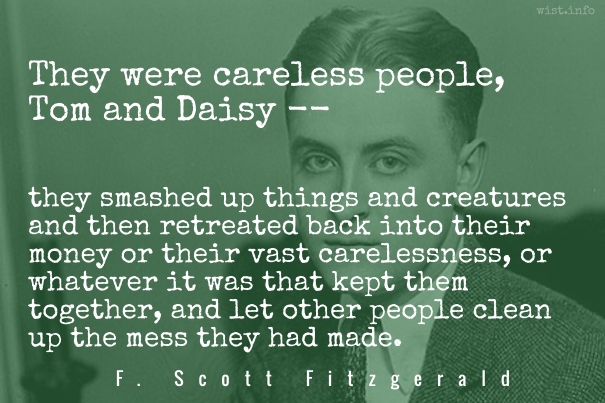
They were careless people, Tom and Daisy — they smashed up things and creatures and then retreated back into their money or their vast carelessness, or whatever it was that kept them together, and let other people clean up the mess they had made.
F. Scott Fitzgerald (1896-1940) American writer [Francis Scott Key Fitzgerald]
The Great Gatsby, ch. 9 (1925)
At fifteen you had the radiance of early morning, at twenty you will begin to have the melancholy brilliance of the moon, and when you are my age you will give out, as I do, the genial golden warmth of 4 P.M.
F. Scott Fitzgerald (1896-1940) American writer [Francis Scott Key Fitzgerald]
This Side of Paradise, Book 1, ch. 3 [Darcy] (1920)
(Source)
That is part of the beauty of all literature. You discover that your longings are universal longings, that you’re not lonely and isolated from anyone. You belong.
F. Scott Fitzgerald (1896-1940) American writer [Francis Scott Key Fitzgerald]
Comment to Sheilah Graham (c. 1938)
Quoted in her book, Beloved Infidel: The Education of a Woman, ch. 22 (1958). Variant, in the 1959 film adaptation of the book:
The beauty of literature is that it’s ageless. You discover that your longings are universal longings, that you’re not lonely and isolated from anyone. You belong.
See also Baldwin.
More discussion of this quotation: That Is Part of the Beauty of All Literature. You Discover that Your Longings Are Universal Longings – Quote Investigator.
How strange to have failed as a social creature — even criminals do not fail that way — they are the law’s “Loyal Opposition,” so to speak. But the insane are always mere guests on earth, eternal strangers carrying around broken decalogues that they cannot read.
F. Scott Fitzgerald (1896-1940) American writer [Francis Scott Key Fitzgerald]
Letter to daughter, Frances “Scottie” Fitzgerald (Dec 1940)
My generation of radicals and breakers-down never found anything to take the place of the old virtues of work and courage and the old graces of courtesy and politeness.
F. Scott Fitzgerald (1896-1940) American writer [Francis Scott Key Fitzgerald]
Letter to his daughter Frances Scott Fitzgerald (Jul 1938)
I never blame failure — there are too many complicated situations in life — but I am absolutely merciless toward lack of effort.
F. Scott Fitzgerald (1896-1940) American writer [Francis Scott Key Fitzgerald]
Letter, The Crack-Up, ed. Edmund Wilson (1945) p.302
Source text
About adjectives: all fine prose is based on the verbs carrying the sentences. They make sentences move.
F. Scott Fitzgerald (1896-1940) American writer [Francis Scott Key Fitzgerald]
Letter, The Crack-Up, ed. Edmund Wilson (1945) p.303
Source text
The kiss originated when the first male reptile licked the first female reptile, implying in a subtle, complimentary way that she was as succulent as the small reptile he had for dinner the night before.
F. Scott Fitzgerald (1896-1940) American writer [Francis Scott Key Fitzgerald]
Notebook E “Epigrams, Wisecracks and Jokes,” § 436 (1932-1940)
Originally collected in Edmund Wilson, ed., The Crack-Up (1945), then in the unexpurgated Matthew Bruccoli, ed., Notebooks of F. Scott Fitzgerald (1978).