

To have doubted one’s own first principles is the work of a civilized man.
Oliver Wendell Holmes, Jr. (1841-1935) American jurist, Supreme Court Justice
“Ideals and Doubts,” Illinois Law Review (May 1915)
Quotations by:
Holmes, Oliver Wendell, Jr.
To have doubted one’s own first principles is the mark of a civilized man.
Oliver Wendell Holmes, Jr. (1841-1935) American jurist, Supreme Court Justice
“Ideals and Doubts,” Illinois Law Review, Vol. X (1915)
Full text.
As life is action and passion, it is required of a man that he should share the passion and action of his time at peril of being judged not to have lived.
Oliver Wendell Holmes, Jr. (1841-1935) American jurist, Supreme Court Justice
“In Our Youth Our Hearts Were Touched With Fire,” Memorial Day address, Keene, New Hampshire (30 May 1884)
Full text.
It is now the moment when by common consent we pause to become conscious of our national life and to rejoice in it, to recall what our country has done for each of us, and to ask ourselves what we can do for our country in return.
Oliver Wendell Holmes, Jr. (1841-1935) American jurist, Supreme Court Justice
“In Our Youth Our Hearts Were Touched With Fire,” Memorial Day address, Keene, New Hampshire (30 May 1884)
(Source)
I think that, as life is action and passion, it is required of a man that he should share the passion and action of his time at peril of being judged not to have lived.
Oliver Wendell Holmes, Jr. (1841-1935) American jurist, Supreme Court Justice
“In Our Youth Our Hearts Were Touched With Fire,” Memorial Day speech, Keene, New Hampshire (30 May 1884)
Full text.
Judges are commonly elderly men, and are more likely to hate at sight any analysis to which they are not accustomed, and which disturbs repose of mind, than to fall in love with novelties.
Oliver Wendell Holmes, Jr. (1841-1935) American jurist, Supreme Court Justice
“Law in Science and Science in Law,” Harvard Law Review (1899)
Deep-seated preferences cannot be argued about — you cannot argue a man into liking a glass of beer — and therefore, when differences are sufficiently far reaching, we try to kill the other man rather than let him have his way. But that is perfectly consistent with admitting that, so far as appears, his grounds are just as good as ours.
Oliver Wendell Holmes, Jr. (1841-1935) American jurist, Supreme Court Justice
“Natural Law,” Collected Legal Papers (1921)
Certitude is not the test of certainty. We have been cocksure of many things that were not so.
Oliver Wendell Holmes, Jr. (1841-1935) American jurist, Supreme Court Justice
“Natural Law,” Harvard Law Review (1918-11)
(Source)
Legal citation: 32 Harvard Law Review 40, 41 (1918).
The object of philosophy is to prove that you are right in doing what you want.
Oliver Wendell Holmes, Jr. (1841-1935) American jurist, Supreme Court Justice
“Reminiscences of a Holmes Secretary” (W. Barton Leach) (16 Oct 1935)
To act is to affirm the worth of an end.
Oliver Wendell Holmes, Jr. (1841-1935) American jurist, Supreme Court Justice
“The Class of ’61,” speech on 50th anniversary of graduating from Harvard (28 Jun 1911)
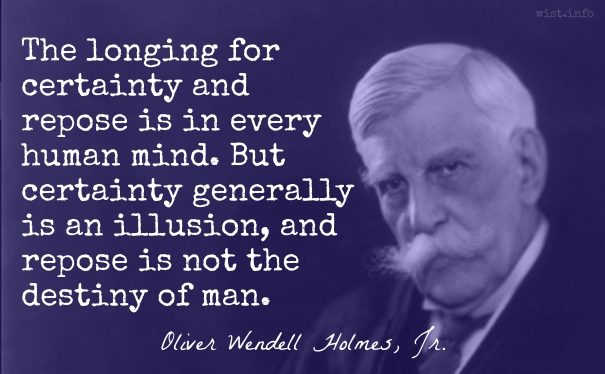
… [L]onging for certainty and for repose [is] in every human mind. But certainty generally is an illusion, and repose is not the destiny of man.
Oliver Wendell Holmes, Jr. (1841-1935) American jurist, Supreme Court Justice
“The Path of the Law,” Harvard Law Review (Feb 1897)
(Source)
Citation 10 Harvard Law Review 457 (1897).
It is revolting to have no better reason for a rule of law than that so it was laid down in the time of Henry IV.
Oliver Wendell Holmes, Jr. (1841-1935) American jurist, Supreme Court Justice
“The Path of the Law,” Speech to the Supreme Judicial Court of Massachusetts (8 Jan 1897)
(Source)
Most of the things we do, we do for no better reason than that our fathers have done them or our neighbors do them, and the same is true of a larger part than what we suspect of what we think.
Oliver Wendell Holmes, Jr. (1841-1935) American jurist, Supreme Court Justice
“The Path of the Law,” speech, Boston University School of Law on (8 Jan 1897)
It is revolting to have no better reason for a rule of law than that so it was laid down in the time of Henry IV. It is still more revolting if the grounds upon which it was laid down have vanished long since, and the rule simply persists from blind imitation of the past.
Oliver Wendell Holmes, Jr. (1841-1935) American jurist, Supreme Court Justice
“The Path of the Law”, 10 Harvard Law Review 457 (1897)
Full text.
Oh, to be seventy again.
Oliver Wendell Holmes, Jr. (1841-1935) American jurist, Supreme Court Justice
(Attributed (1931))
On seeing an attractive lady on his 95th birthday. Also given as "sixty" and "eighty, and attributed to others as well. Alternate: "What I wouldn't give to be seventy again."
Many people die with their music still in them. Why is this so? Too often it is because they are always getting ready to live. Before they know it, time runs out.
Oliver Wendell Holmes, Jr. (1841-1935) American jurist, Supreme Court Justice
(Attributed)
If I had a formula for bypassing trouble, I would not pass it around. Trouble creates a capacity to handle it. I don’t embrace trouble; that’s as bad as treating it as an enemy. But I do say: meet it as a friend, for you’ll see a lot of it, and had better be on speaking terms with it.
Oliver Wendell Holmes, Jr. (1841-1935) American jurist, Supreme Court Justice
(Attributed)
Lawyers spend a great deal of their time shoveling smoke.
Oliver Wendell Holmes, Jr. (1841-1935) American jurist, Supreme Court Justice
(Attributed)
I happen to prefer champagne to ditchwater, but there is no reason to suppose that the cosmos does.
Oliver Wendell Holmes, Jr. (1841-1935) American jurist, Supreme Court Justice
(Attributed)
Quoted by William F Buckley, Jr., in The National Review, "Publisher's Statement" (first issue, 19 Nov 1955)
Your right to swing your arms ends just where the other man’s nose begins.
Oliver Wendell Holmes, Jr. (1841-1935) American jurist, Supreme Court Justice
(Spurious)
Usually attributed to Holmes (or Abraham Lincoln, or John Stuart Mill), but actually first raised in legal commentary by Zechariah Chafee, "Freedom of Speech in Wartime", 32 Harvard Law Review 932, 957 (Jun 1919):Each side takes the position of the man who was arrested for swinging his arms and hitting another in the nose, and asked the judge if he did not have a right to swing his arms in a free country. “Your right to swing your arms ends just where the other man’s nose begins.”
There are earlier versions in non-legal contexts dating back decades earlier, often in arguments for Temperance and Prohibition. See here for more background.
Variants:
- "The right to swing my fist ends where the other man’s nose begins."
- "The right to swing my arms in any direction ends where your nose begins."
- "My right to swing my fist ends where your nose begins."
Persecution for the expression of opinions seems to me perfectly logical. If you have no doubt of your premises or your power, and want a certain result with all your heart, you naturally express your wishes in law, and sweep away all opposition. To allow opposition by speech seems to indicate that you think the speech impotent, as when a man says that he has squared the circle, or that you do not care wholeheartedly for the result, or that you doubt either your power or your premises.
But when men have realized that time has upset many fighting faiths, they may come to believe even more than they believe the very foundations of their own conduct that the ultimate good desired is better reached by free trade in ideas — that the best test of truth is the power of the thought to get itself accepted in the competition of the market, and that truth is the only ground upon which their wishes safely can be carried out.
That, at any rate, is the theory of our Constitution. It is an experiment, as all life is an experiment. Every year, if not every day, we have to wager our salvation upon some prophecy based upon imperfect knowledge. While that experiment is part of our system, I think that we should be eternally vigilant against attempts to check the expression of opinions that we loathe and believe to be fraught with death, unless they so imminently threaten immediate interference with the lawful and pressing purposes of the law that an immediate check is required to save the country.
Oliver Wendell Holmes, Jr. (1841-1935) American jurist, Supreme Court Justice
Abrams v. United States, 250 U.S. 616 (1919) [dissent]
(Source)
When men have realized that time has upset many fighting faiths, they may come to believe even more than they believe the very foundations of their own conduct that the ultimate good desired is better reached by free trade in ideas — that the best test of truth is the power of the thought to get itself accepted in the competition of the market.
Oliver Wendell Holmes, Jr. (1841-1935) American jurist, Supreme Court Justice
Abrams v. United States, 250 U.S. 616, 630 (1919) [Dissent]
I think that we should be eternally vigilant against attempts to check the expression of opinions that we loathe and believe to be fraught with death, unless they so imminently threaten immediate interference with the lawful and pressing purposes of the law that an immediate check is required to save the country.
Oliver Wendell Holmes, Jr. (1841-1935) American jurist, Supreme Court Justice
Abrams v. United States, 250 U.S. 616, 630 (1919) [Dissent]
Detached reflection cannot be demanded in the presence of an uplifted knife.
Oliver Wendell Holmes, Jr. (1841-1935) American jurist, Supreme Court Justice
Brown v. United States, 256 U.S. 335, 343 (1921)
The aim of the law is not to punish sins, but is to prevent certain external results.
Oliver Wendell Holmes, Jr. (1841-1935) American jurist, Supreme Court Justice
Commonwealth v. Kennedy, 170 Mass. 18, 20 (1897)
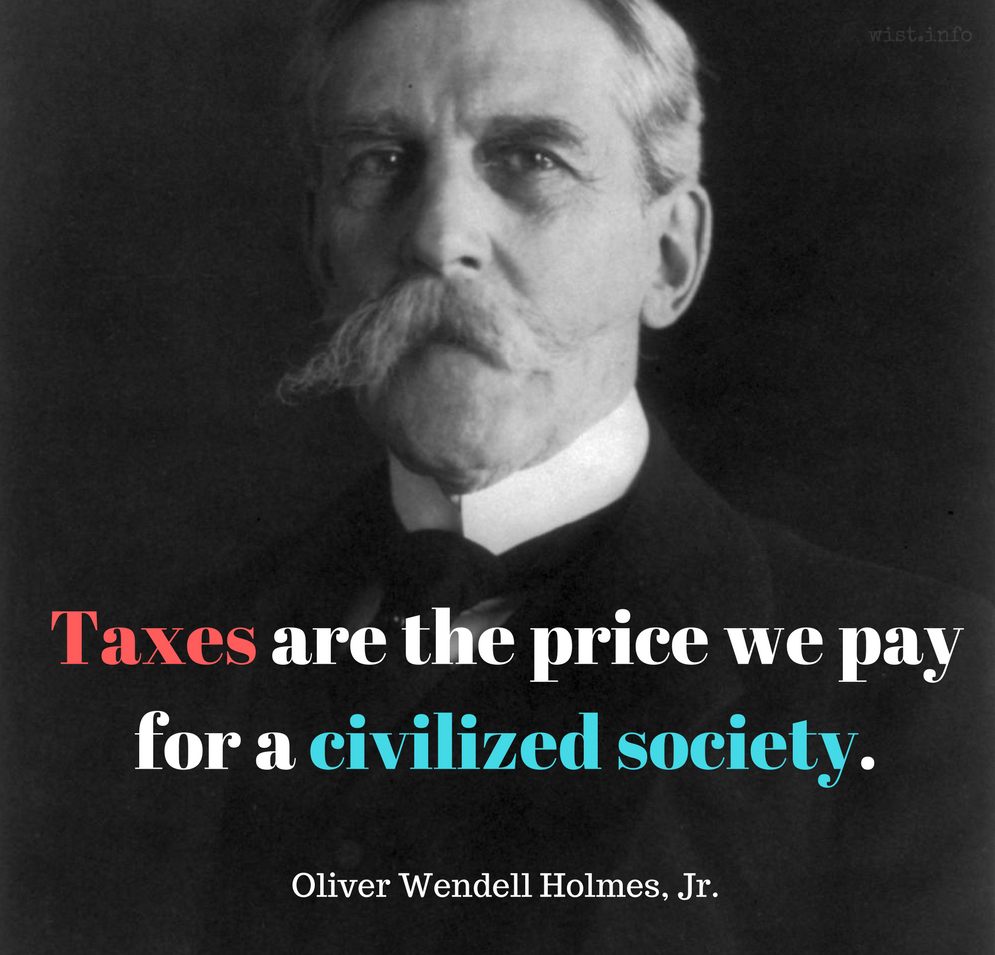
Taxes are what we pay for civilized society.
Oliver Wendell Holmes, Jr. (1841-1935) American jurist, Supreme Court Justice
Compania General De Tabacos De Filipinas v. Collector of Internal Revenue, 275 U.S. 87, 100 (1927) [Dissent]
(Source)
Full text is "Taxes are what we pay for civilized society, including the chance to insure.
References are also found (without citation) to a 1904 speech, "Taxes are the price we pay for a civilized society" (this variation is quoted by the IRS above the entrance of their headquarters). Bartlett's (1980) cites the above wording, but incorrectly claims it was in 1904.
In Felix Frankfurter, Mr. Justice Holmes and the Supreme Court (1938), Holmes is quoted as rebuking a secretary's query about hating to pay taxes: "No, young feller. I like to pay taxes. With them I buy civilization."
More information here.
The accident of our finding certain opinions natural and familiar, or novel, and even shocking, ought not to conclude our judgment upon the question whether statutes embodying them conflict with the Constitution of the United States.
Oliver Wendell Holmes, Jr. (1841-1935) American jurist, Supreme Court Justice
Lochner v. New York, 198 U.S. 45, 76 (1905) [Dissent]
[A] page of history is worth a volume of logic.
Oliver Wendell Holmes, Jr. (1841-1935) American jurist, Supreme Court Justice
New York Trust Co. v. Eisner, 256 U.S. 345, 349 (1921)
Full text.
The character of every act depends upon the circumstances in which it is done.
Oliver Wendell Holmes, Jr. (1841-1935) American jurist, Supreme Court Justice
Schenck v. United States (1919)
The most stringent protection of free speech would not protect a man in falsely shouting fire in a theatre and causing a panic.
Oliver Wendell Holmes, Jr. (1841-1935) American jurist, Supreme Court Justice
Schenck v. United States (3 Mar 1919)
(Source)
People who honestly mean to be true really contradict themselves much more than those who try to be “consistent.”
Oliver Wendell Holmes, Jr. (1841-1935) American jurist, Supreme Court Justice
The Professor at the Breakfast Table
A word is not a crystal, transparent and unchanged, it is the skin of a living thought and may vary greatly in color and content according to the circumstances and the time in which it is used.
Oliver Wendell Holmes, Jr. (1841-1935) American jurist, Supreme Court Justice
Towne v. Eisner, 245 U.S. 425 (1918)
If there is any principle of the Constitution that more imperatively calls for attachment than any other, it is the principle of free thought — not free thought for those who agree with us but freedom for the thought that we hate.
Oliver Wendell Holmes, Jr. (1841-1935) American jurist, Supreme Court Justice
United States v. Schwimmer, 279 U.S. 644 (1929) [Dissent]
(Source)
Some of her answers might excite popular prejudice, but if there is any principle of the Constitution that more imperatively calls for attachment than any other it is the principle of free thought — not free thought for those who agree with us but freedom for the thought that we hate. I think we should adhere to that principle with regard to admission into, as well as life within, this country.
Oliver Wendell Holmes, Jr. (1841-1935) American jurist, Supreme Court Justice
United States v. Schwimmer, 279 U.S. 644, 654-55 (1929)
Free competition is worth more to society than it costs.
Oliver Wendell Holmes, Jr. (1841-1935) American jurist, Supreme Court Justice
Vegelahn v. Guntner, 167 Mass. 92, 44 N.E. 1077, 1080 (1896)
Young man, the secret of my success is that at an early age I discovered I was not God.
Oliver Wendell Holmes, Jr. (1841-1935) American jurist, Supreme Court Justice
Comment (8 Mar 1931)
When asked by a reporter on his 90th birthday.
The great act of faith is when man decides that he is not God.
Oliver Wendell Holmes, Jr. (1841-1935) American jurist, Supreme Court Justice
Letter to William James (24 Mar 1907)