

No-one is so savage that he cannot soften.
[Nemo adeo ferus est ut non mitescere possit.]
Horace (65-8 BC) Roman poet and satirist [Quintus Horacius Flaccus]
(Attributed)
Quotations by:
Horace
To know all things is not permitted.
Horace (65-8 BC) Roman poet and satirist [Quintus Horacius Flaccus]
(Attributed)
Adversity has the effect of eliciting talents, which in prosperous circumstances would have lain dormant.
Horace (65-8 BC) Roman poet and satirist [Quintus Horacius Flaccus]
(Attributed)
A jest often decides matters of importance more effectively and happily than seriousness.
Horace (65-8 BC) Roman poet and satirist [Quintus Horacius Flaccus]
(Attributed)
It is sweet to let the mind unbend on occasion.
Horace (65-8 BC) Roman poet and satirist [Quintus Horacius Flaccus]
(Attributed)
He will always be a slave who does not know how to live upon a little.
Horace (65-8 BC) Roman poet and satirist [Quintus Horacius Flaccus]
(Attributed)
Whatever advice you give, be short.
Horace (65-8 BC) Roman poet and satirist [Quintus Horacius Flaccus]
Ars Poetica (c. 18 BC)
Struggling to be brief
I become obscure.[Brevis esse laboro,
obscurus fio.]Horace (65-8 BC) Roman poet and satirist [Quintus Horacius Flaccus]
Ars Poetica, l. 25 (c. 18 BC)
Alt. trans.: "Aiming at brevity, I become obscure."
I am displeased when sometimes even the worthy Homer nods
[Indignor quandoque bonus dormitat Homerus]
Horace (65-8 BC) Roman poet and satirist [Quintus Horacius Flaccus]
Ars Poetica, l. 359 (c. 18 BC)
Source of the expression, "Even Homer nods" (i.e., nobody one is perfect, even the wisest make mistakes).
You may drive out Nature with a pitchfork, yet she wil still hurry back.
Horace (65-8 BC) Roman poet and satirist [Quintus Horacius Flaccus]
Epistles, 1.10
One overmuch elated with success
A change of fortune plunges in distress.Horace (65-8 BC) Roman poet and satirist [Quintus Horacius Flaccus]
Epistles, 1.10 [ed. Kraemer, Jr (1936)]
To flee vice is the beginning of virtue, and to have got rid of folly is the beginning of wisdom.
[Virtus est vitium fugere et sapientia prima stultitia caruisse.]
Horace (65-8 BC) Roman poet and satirist [Quintus Horacius Flaccus]
Epistles, Book 1, Epistle 1, l. 41 (c. 20 BC and 14 BC)
He ’s armed without that’s innocent within.
Horace (65-8 BC) Roman poet and satirist [Quintus Horacius Flaccus]
Epistles, Book 1, Epistle 1, l. 94 (c. 20 BC and 14 BC) [tr. Pope]
He is not poor who has enough of things to use.
If it is well with your belly, chest and feet,
the wealth of kings can give you nothing more.[Pauper enim non est, cui rerum suppetit usus.
si ventri bene, si lateri est pedibusque tuis, nil
divitiae poterunt regales addere maius.]Horace (65-8 BC) Roman poet and satirist [Quintus Horacius Flaccus]
Epistles, Book 1, Epistle 12, l. 4 (c. 20 BC and 14 BC)
He who feared that he would not succeed sat still.
[Sedit qui timuit ne non succederet.]
Horace (65-8 BC) Roman poet and satirist [Quintus Horacius Flaccus]
Epistles, Book 1, Epistle 17, l. 37 (c. 20 BC and 14 BC)
And, once sent out, a word takes wing beyond recall.
Horace (65-8 BC) Roman poet and satirist [Quintus Horacius Flaccus]
Epistles, Book 1, Epistle 18, l. 71 (c. 20 BC and 14 BC)
When your neighbor’s wall is on fire, it becomes your business.
[Num tua res agitur paries cum proximus ardet.]
Horace (65-8 BC) Roman poet and satirist [Quintus Horacius Flaccus]
Epistles, Book 1, Epistle 18, l. 84 (c. 20 BC and 14 BC)
Alt trans.: "It is your concern when your neighbor's wall is on fire."
The covetous man is ever in want.
[Semper avarus eget.]
Horace (65-8 BC) Roman poet and satirist [Quintus Horacius Flaccus]
Epistles, Book 1, Epistle 2, l. 56 (c. 20 BC and 14 BC)
Anger is momentary madness, so control your passion or it will control you.
[Ira furor brevis est: animum rege: qui nisi paret imperat.]
Horace (65-8 BC) Roman poet and satirist [Quintus Horacius Flaccus]
Epistles, Book 1, Epistle 2, l. 62 (c. 20 BC and 14 BC)
Alt. trans.: "Anger is a short madness." "Anger is a short-lived madness." "Anger is a brief lunacy."
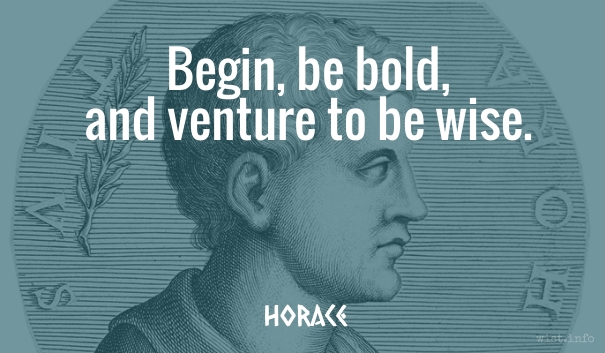
Begin, be bold, and venture to be wise.
[Dimidium facti qui coepit habet; sapere aude; incipe!]
Horace (65-8 BC) Roman poet and satirist [Quintus Horacius Flaccus]
Epistles, Book 1, Epistle 2, ll. 39-40 [tr. Cowley]
Alt. trans.: "He who has begun has half done. Dare to be wise; begin!"
The years as they pass plunder us of one thing after another.
[Singula de nobis anni praedantur euntes.]
Horace (65-8 BC) Roman poet and satirist [Quintus Horacius Flaccus]
Epistles, Book 2, ep. 2, l. 56 (c. 20-14 BC)
Alt. trans.: "The passing years steal one thing after another"
Pope's translation: "Years following years steal something every day; / At last they steal us from ourselves away."
He will through life be master of himself and a happy man who from day to day can have said, “I have lived: tomorrow the Father may fill the sky with black clouds or with cloudless sunshine.”
[Ille potens sui
laetusque deget, cui licet in diem
dixisse “vixi: cras vel atra
nube polum pater occupato
vel sole puro.”]Horace (65-8 BC) Roman poet and satirist [Quintus Horacius Flaccus]
Odes [Carmina] Book 3, Ode 24, l. 41 (c. 23 BC and 13 BC)
As we speak, cruel time is fleeing. Seize the day, leave as little as possible to tomorrow.
[… dum loquimur, fugerit invida
aetas: carpe diem, quam minimum credula postero.]Horace (65-8 BC) Roman poet and satirist [Quintus Horacius Flaccus]
Odes [Carmina], Book 1, Ode 11, l. 8 (c. 23 BC)
Alt trans. "... believing as little as possible in the morrow."
Now is the time for drinking, now is the time to beat the earth with unfettered foot.
[Nunc est bibendum, nunc pede libero
pulsanda tellus.]Horace (65-8 BC) Roman poet and satirist [Quintus Horacius Flaccus]
Odes [Carmina], Book 1, Ode 37, l. 1 (c. 23 BC)
Cease to inquire what the future has in store, and to take as a gift whatever the day brings forth.
Horace (65-8 BC) Roman poet and satirist [Quintus Horacius Flaccus]
Odes [Carmina], Book 1, Ode 9, l. 13 (c. 23 BC)
He that holds fast the golden mean,
And lives contentedly between
The little and the great,
Feels not the wants that pinch the poor,
Nor plagues that haunt the rich man’s door.[Auream quisquis mediocritatem diligit, tutus caret obsoleti sordibus tecti, caret invidenda sobrius aula.]
Horace (65-8 BC) Roman poet and satirist [Quintus Horacius Flaccus]
Odes [Carmina], Book 2, Ode 10, l.5 [tr. Cowper]
Alt trans.: "Whoever cultivates the golden mean avoids both the poverty of a hovel and the envy of a palace."
In adversity, remember to keep an even mind.
[Aequam memento rebus in arduis servare mentem.]
Horace (65-8 BC) Roman poet and satirist [Quintus Horacius Flaccus]
Odes [Carmina], Book 2, Ode 3, l. 1 (13 BC)
For country ’tis a sweet and seemly thing
To die.[Dulce et decorum est pro patria mori.]
Horace (65-8 BC) Roman poet and satirist [Quintus Horacius Flaccus]
Odes [Carmina], Book 3, Ode 2, l. 13
Alt trans:
- "Sweet and glorious it is to die for our country." [J. C. Elgood, The Works of Horace]
Many brave men lived before Agamemnon, but all unwept and unknown they sleep in endless night, for they had no poets to sound their praises.
Horace (65-8 BC) Roman poet and satirist [Quintus Horacius Flaccus]
Odes [Carmina], Book 4, Ode 9, l. 25
Alt. trans.: "Brave men were living before Agamemnon."
We rarely find anyone who can say he has lived a happy life, and who, content with his life, can retire from the world like a satisfied guest.
[Inde fit ut raro, qui se vixisse beatum
dicat et exacto contentus tempore vita
cedat uti conviva satur, reperire queamus.]Horace (65-8 BC) Roman poet and satirist [Quintus Horacius Flaccus]
Satires, Book 1, Satire 1, l. 117 (c. 35 BC)
Life grants nothing to us mortals without hard work.
[Nil sine magno vita labore dedit mortalibus.]
Horace (65-8 BC) Roman poet and satirist [Quintus Horacius Flaccus]
Satires, Book 1, Satire 9, l. 59 (c. 35 BC)
In peace, as a wise man, he should make suitable preparation for war.
[In pace, ut sapiens, aptarit idonea bello.]
Horace (65-8 BC) Roman poet and satirist [Quintus Horacius Flaccus]
Satires, Book 2, Satire 2
A host is like a general. It takes a mishap to reveal his genius.
Horace (65-8 BC) Roman poet and satirist [Quintus Horacius Flaccus]
Satires, Book II, Satire 8 (35 BC)
Why are you laughing? Just change the name, and the story could be told of you.
[Quid rides? Mutato nomine de te / fabula narratur.]
Horace (65-8 BC) Roman poet and satirist [Quintus Horacius Flaccus]
Sermonum, I.1.69
Sometimes "... fabula de te narratur."
Alternate translations:
- "Do you but change the name / Of you is saide the same."
- "Change but the name, of you the tale is told."
- "Change only the name and this story is also about you."
- "Change but the name, and the tale is told of you."
- "What are you laughing at? Just change the name and the joke's on you."
- "You laugh? Well, just change the name and you'll find that this story, / as a matter of fact, means YOU." (tr. S.P. Bovie (2002))