

We are the manger in which the Lord is born.
Carl Jung (1875-1961) Swiss psychologist
“A Psychological Approach to the Dogma of the Trinity,” 5.1 (1942) [tr. Hull (1958)]
Quotations by:
Jung, Carl
Always behind what we imagine are our best deeds stands the devil, patting us paternally on the shoulder and whispering, “Well done!”
Carl Jung (1875-1961) Swiss psychologist
“A Psychological View of Conscience” (1958)
As any change must begin somewhere, it is the single individual who will experience it and carry it through. The change must indeed begin with an individual; it might be any one of us. Nobody can afford to look around and to wait for somebody else to do what he is loath to do himself.
Carl Jung (1875-1961) Swiss psychologist
“Approaching the Unconscious: Healing the Split,” Man and His Symbols (1964)
The real existence of an enemy upon whom one can foist off everything evil is an enormous relief to one’s conscience. You can then at least say, without hesitation, who the devil is; you are quite certain that the cause of your misfortune is outside, and not your own attitude.
Carl Jung (1875-1961) Swiss psychologist
“General Aspects of Dream Psychology” (1916) [tr. R. Hull (1960)]
Deep down, below the surface of the average man’s conscience, he hears a voice whispering, “There is something not right,” no matter how much his rightness is supported by public opinion or by the moral code.
Carl Jung (1875-1961) Swiss psychologist
“Introduction to Wickes’s Analyse der Kinderseele” (1931), The Development of Personality [tr. R. Hull (1954)]
Anyone who wants to know the human psyche will learn next to nothing from experimental psychology. He would be better advised to [abandon exact science] put away his scholar’s gown, bid farewell to his study, and wander with human heart throughout the world. There in the horrors of prisons, lunatic asylums and hospitals, in drab suburban pubs, in brothels and gambling-hells, in the salons of the elegant, the Stock Exchanges, Socialist meetings, churches, revivalist gatherings and ecstatic sects, through love and hate, through the experience of passion in every form in his own body, he would reap richer stores of knowledge than text-books a foot thick could give him and he will know how to doctor the sick with a real knowledge of the human soul.
The greater the tension, the greater is the potential. Great energy springs from a correspondingly great tension of opposites.
Carl Jung (1875-1961) Swiss psychologist
“Paracelsus as a Spiritual Phenomenon,” introduction (1942), Alchemical Studies [tr. R. Hull (1967)]
If there is anything we wish to change in our children, we should first examine it and see whether it is not something that could better be changed in ourselves.
Carl Jung (1875-1961) Swiss psychologist
“The Development of Personality” (1934) [tr. Hull (1954)]
One looks back with appreciation to the brilliant teachers, but with gratitude to those who touched our human feelings. The curriculum is so much necessary raw material, but warmth is the vital element for the growing plant and for the soul of the child.
Carl Jung (1875-1961) Swiss psychologist
“The Gifted Child” (1942), The Development of Personality, sec. 250 (1954) [tr. Hull]
(Source)
Translated from "Der Begabte," Psychologie und Erziehung (1946).
Without freedom there can be no morality.
Carl Jung (1875-1961) Swiss psychologist
“The Relations between the Ego and the Unconscious,” 1.2 (1928)
His uncertainty forces the enthusiast to puff up his truths, of which he feels none too sure, and to win proselytes to his side in order that his followers may prove to himself the value and trustworthiness of his own convictions. … Only when convincing someone else does he feel safe from gnawing doubts.
Carl Jung (1875-1961) Swiss psychologist
“The Relations between the Ego and the Unconscious” (1.2) (1928) [tr. Hull (1953)]
Whereas I formerly believed it to be my bounden duty to call others to order, I must now admit that I need calling to order myself, and that I would do better to set my own house to rights first.
Carl Jung (1875-1961) Swiss psychologist
“The Spiritual Problem of Modern Man,” ¶ 162 (1928)
(Source)
Everything that irritates us about others can lead us to an understanding of ourselves.
Carl Jung (1875-1961) Swiss psychologist
(Attributed)
The meeting of two personalities is like the contact of two chemical substances; if there is any reaction, both are transformed.
Carl Jung (1875-1961) Swiss psychologist
(Attributed)
Nothing has a stronger influence psychologically on their environment, and especially on their children, than the unlived lives of the parents.
Carl Jung (1875-1961) Swiss psychologist
(Attributed)
Science is the tool of the Western mind and with it more doors can be opened than with bare hands. It is part and parcel of our knowledge and obscures our insight only when it holds that the understanding given by it is the only kind there is.
Carl Jung (1875-1961) Swiss psychologist
(Attributed)
Mistakes are, after all, the foundations of truth, and if a man does not know what a thing is, it is at least an increase in knowledge if he knows what it is not.
Carl Jung (1875-1961) Swiss psychologist
Aion (1951)
To ask the right question is already half the solution of a problem.
Carl Jung (1875-1961) Swiss psychologist
Archetypes of the Collective Unconscious (1934) [tr. Hull (1959)]
Science is not […] a perfect instrument, but it is superb and invaluable tool that works harm only when taken as an end in itself.
Carl Jung (1875-1961) Swiss psychologist
Commentary (on The Secret of the Golden Flower), Introduction (1) (1929) [tr. Baynes (1961)]
Thinking is difficult, therefore let the herd pronounce judgment!
Carl Jung (1875-1961) Swiss psychologist
Flying Saucers: A Modern Myth of Things Seen in the Skies, ch. 2 (1959) [tr. Hull]
(Source)
The motto of the "relatively unconscious man" who "clings to the commonplace, the obvious, the probable, the collectively valid." Reprinted in the The Collected Works of C.G. Jung - Civilization in Transition, vol. 10, ¶ 653.
Probable source of the frequently-attributed (but unfound) "Thinking is difficult. That's why most people judge."
As far as we can discern, the sole purpose of human existence is to kindle a light in the darkness of mere being.
Carl Jung (1875-1961) Swiss psychologist
Memories, Dreams, Reflections [Erinnerungen, Träume, Gedanken] [ed. A. Jaffe (1962)]
My interests drew me in different directions. On the one hand I was powerfully attracted by science, with its truths based on facts; on the other hand I was fascinated by everything to do with comparative religion. […] In science I missed the factor of meaning; and in religion, that of empiricism.
Carl Jung (1875-1961) Swiss psychologist
Memories, Dreams, Reflections [Erinnerungen, Träume, Gedanken] [ed. A. Jaffe (1962)]
As far as we can discern, the sole purpose of human existence is to kindle a light of meaning in the darkness of mere being.
Carl Jung (1875-1961) Swiss psychologist
Memories, Dreams, Reflections [Erinnerungen, Träume, Gedanken] [ed. A. Jaffe (1962)]
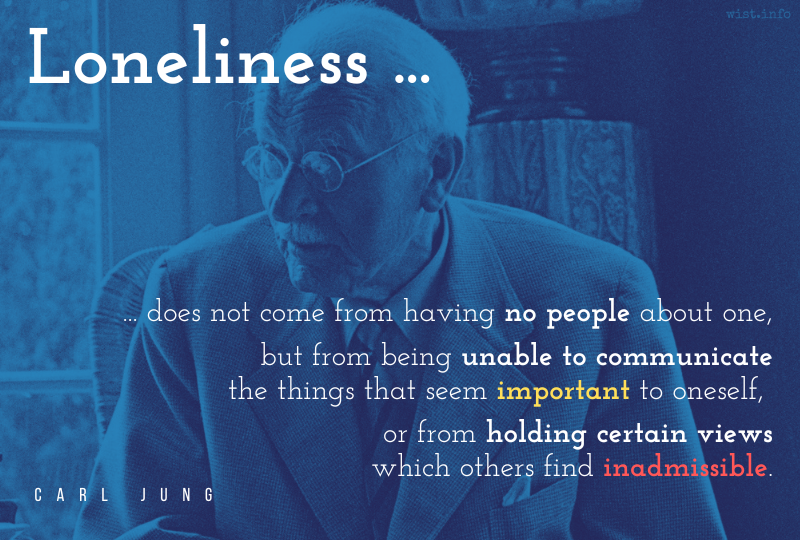
Loneliness does not come from having no people about one, but from being unable to communicate the things that seem important to oneself, or from holding certain views which others find inadmissible.
Carl Jung (1875-1961) Swiss psychologist
Memories, Dreams, Reflections [Erinnerungen, Träume, Gedanken], “Retrospect” (1962) [with Aniela Jaffé; tr. Winston (1963)]
(Source)
As far as we can discern, the sole purpose of human existence is to kindle a light in the darkness of mere being.
Carl Jung (1875-1961) Swiss psychologist
Memories, Dreams, Reflections [Erinnerungen, Träume, Gedanken], ch. 11 [ed. A.Jaffe (1962)]
Every form of addiction is bad, no matter whether the narcotic be alcohol or morphine or idealism.
Carl Jung (1875-1961) Swiss psychologist
Memories, Dreams, Reflections [Erinnerungen, Träume, Gedanken], ch. 12 [ed. A. Jaffe (1962)]
Man always has some mental reservation, even in the face of divine decrees. Otherwise, where would be his freedom? And what would be the use of that freedom if it could not threaten Him who threatens it?
Carl Jung (1875-1961) Swiss psychologist
Memories, Dreams, Reflections [Erinnerungen, Träume, Gedanken], ch. 7 [ed. A Jaffe (1962)]
Everything that irritates us about others can lead us to an understanding of ourselves.
Carl Jung (1875-1961) Swiss psychologist
Memories, Dreams, Reflections [Erinnerungen, Träume, Gedanken], ch. 9 “Travels,” sec. 2 (1961; 1973 ed.) [with Aniela Jaffé] [tr. Winton/Winton (1963)]
(Source)

We cannot change anything unless we accept it. Condemnation does not liberate, it oppresses. I am the oppressor of the person I condemn, not his friend and fellow-sufferer. I do not in the least mean to say that we must never pass judgment in the case of persons whom we desire to help and improve. But if the doctor wishes to help a human being he must be able to accept him as he is. And he can do this in reality only when he has already seen and accepted himself as he is.
Carl Jung (1875-1961) Swiss psychologist
Modern Man In Search of a Soul (1933)
We are susceptible only to those suggestions with which we are already secretly in accord.
Carl Jung (1875-1961) Swiss psychologist
Modern Man in Search of a Soul, ch. 3 [tr. Dell & Baynes (1933)]
A special ability means a heavy expenditure of energy in a particular direction, with a consequent drain from some other side of life.
Carl Jung (1875-1961) Swiss psychologist
Modern Man in Search of a Soul, ch. 8 (1933) (trans. Dell & Baynes)
If people can be educated to see the lowly side of their own natures, it may be hoped that they will also learn to understand and to love their fellow men better. A little less hypocrisy and a little more tolerance toward oneself can only have good results in respect for our neighbors, for we are all too prone to transfer to our fellows the injustice and violence we inflict upon our own natures.
Carl Jung (1875-1961) Swiss psychologist
New Paths in Psychology, Appendix I (1912)
We should not pretend to understand the world only by the intellect; we apprehend it just as much by feeling. Therefore, the judgment of the intellect is, at best, only the half of truth, and must, if it be honest, also come to an understanding of its inadequacy.
Carl Jung (1875-1961) Swiss psychologist
Psychological Types, “Conclusion” (1921)
Religious experience is absolute: it cannot be disputed. You can only say that you have never had such an experience, whereupon your opponent will reply: “Sorry, I have.” And there the discussion will end.
Carl Jung (1875-1961) Swiss psychologist
Psychology and Religion, ch. 3 (1938)
Naturally, every age thinks that all ages before it were prejudiced, and today we think this more then ever and are just as wrong as all previous ages that thought so.
Carl Jung (1875-1961) Swiss psychologist
Synchronicity: An Acausal Connecting Principle (1960)
Without necessity, nothing budges, the human personality least of all. It is tremendously conservative, not to say torpid. Only acute necessity is able to rouse it. The developing personality obeys no caprice, no command, no insight, only brute necessity.
Carl Jung (1875-1961) Swiss psychologist
The Development of Personality, Title Essay (1934) [tr. Hull (1954)]
It is only our deeds that reveal who we are.
Carl Jung (1875-1961) Swiss psychologist
The Development of Personality, Title Essay (1934) [tr. R. F. C. Hull (1954)]
Where love rules, there is no will to power; and where power predominates, there love is lacking. The one is the shadow of the other.
Carl Jung (1875-1961) Swiss psychologist
The Psychology of the Unconscious (1943)
The erotic instinct is something questionable, and will always be so whatever a future set of laws may have to say on the matter. It belongs, on the one hand, to the original animal nature of man, which will exist as long as man has an animal body. On the other hand, it is connected with the highest forms of the spirit. But it blooms only when the spirit and instinct are in true harmony. If one or the other aspect is missing, then an injury occurs, or at least there is a one-sided lack of balance which easily slips into the pathological. Too much of the animal disfigures the civilized human being, too much culture makes a sick animal.
Carl Jung (1875-1961) Swiss psychologist
The Psychology of the Unconscious (1943)
Our blight is ideologies — they are the long-expected Antichrist!
Carl Jung (1875-1961) Swiss psychologist
The Tibetan Book of the Dead, introduction (1938)
You can take away a man’s gods, but only to give him others in return.