

Comfort and habits let us be ready to forgo, but I am not ready for a creed which does not care how much it destroys the liberty and security of daily life, which uses deliberately the weapons of persecution, destruction and international strife. How can I admire a policy which finds a characteristic expression in spending millions to suborn spies in every family and group at home, and to stir up trouble abroad?
John Maynard Keynes (1883-1946) English economist
“A Short View of Russia” (1925)
Quotations by:
Keynes, John Maynard
There is no harm in being sometimes wrong — especially if one is promptly found out.
John Maynard Keynes (1883-1946) English economist
“Alfred Marshall,” The Economic Journal (Sep 1924)
Most men love money and security more, and creation and construction less, as they get older.
John Maynard Keynes (1883-1946) English economist
“Clissold” (1927)
When the accumulation of wealth is no longer of high social importance, there will be great changes in the code of morals. We shall be able to rid ourselves of many of the pseudo-moral principles which have hag-ridden us for two hundred years, by which we have exalted some of the most distasteful of human qualities into the position of the highest virtues. We shall be able to afford to dare to assess the money-motive at its true value. The love of money as a possession — as distinguished from the love of money as a means to the enjoyment and realities of life — will be recognized for what it is, a somewhat disgusting morbidity, one of those semi-criminal, semi-pathological propensities which one hands over with a shudder to the specialists in mental disease.
John Maynard Keynes (1883-1946) English economist
“Economic Possibilities for our Grandchildren,” Nation and Athenaeum (1930-10-11)
(Source)
Originally a society talk in 1920, expanded to a lecture given in Madrid (1930-06). Reprinted in Essays in Persuasion, Part 5, ch. 2 (1931).
The old saying holds. Owe your banker £1000 and you are at his mercy; owe him £1 million and the position is reversed.
John Maynard Keynes (1883-1946) English economist
“Overseas Financial Policy in Stage III” (15 May 1945)
Unpublished memo distributed to the British Cabinet. Variant: "If you owe your bank a hundred pounds, you have a problem. But if you owe a million, it has."
For my part I think that capitalism, wisely managed, can probably be made more efficient for attaining economic ends than any alternative system yet in sight, but that in itself it is in many ways extremely objectionable.
John Maynard Keynes (1883-1946) English economist
“The End of Laissez-faire,” sec. 5 (1926)
(Source)
It is not sufficient that the state of affairs which we seek to promote should be better than the state of affairs which preceded it; it must be sufficiently better to make up for the evils of the transition.
John Maynard Keynes (1883-1946) English economist
“The Political Doctrines of Edmund Burke” (1904)
(Source)
When my information changes, I alter my conclusions. What do you do, sir?
John Maynard Keynes (1883-1946) English economist
(Attributed)
Reply to a criticism of having changed his position on monetary policy. Quoted in Paul Samuelson, "The Keynes Centenary" The Economist, Vol. 287 (1983), but possibly apocryphal (see here).
Variants:
- "When events change, I change my mind. What do you do?"
- "When the facts change, I change my mind. What do you do, sir?"
- "When someone persuades me that I am wrong, I change my mind. What do you do?"
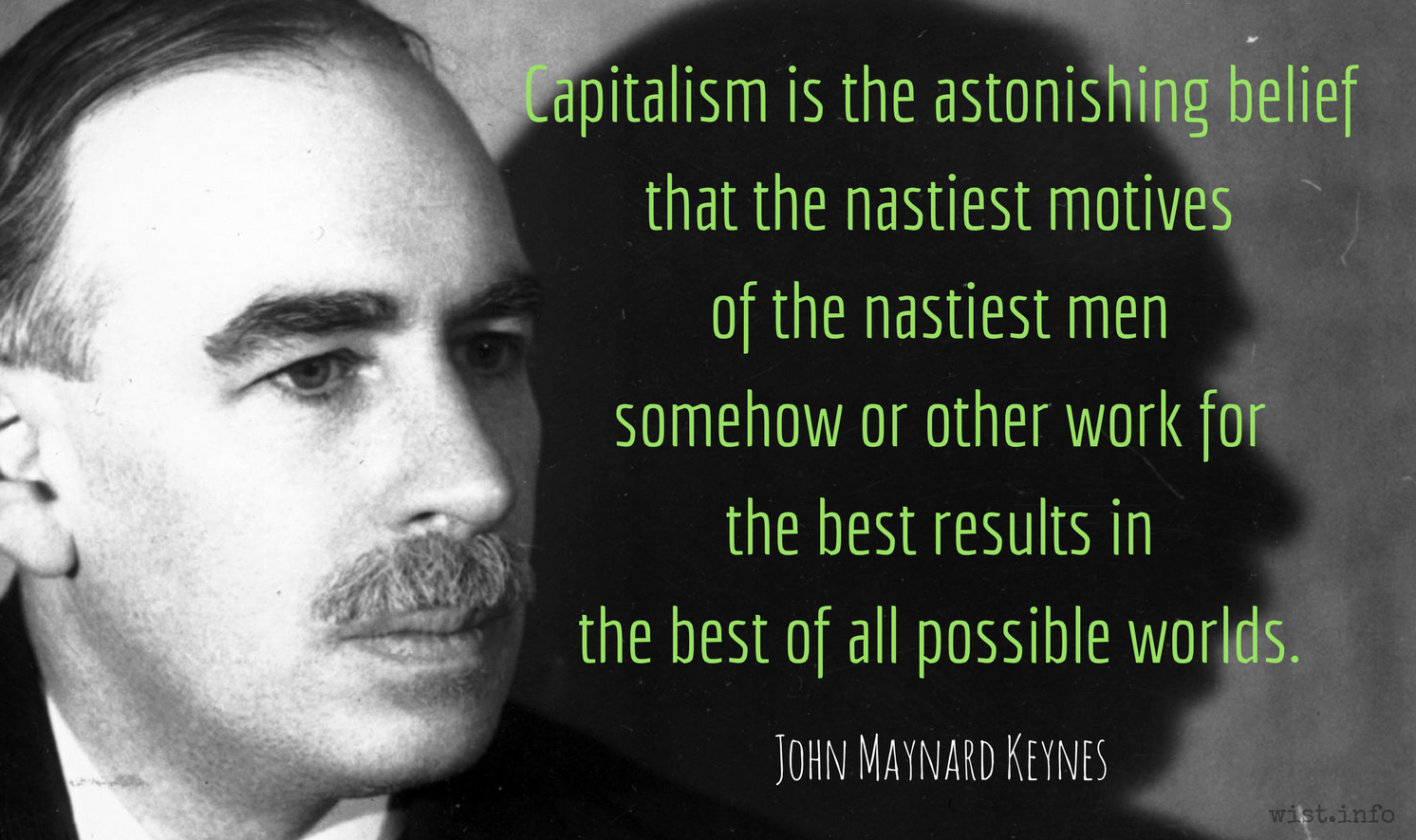
[Capitalism is] the astonishing belief that the nastiest motives of the nastiest men somehow or other work for the best results in the best of all possible worlds.
John Maynard Keynes (1883-1946) English economist
(Attributed)
Attributed by Sir George Schuster, Christianity and Human Relations in Industry (1951). Frequently quoted, but no direct citation found. More information here.
Variations:
- "... the extraordinary belief that the nastiest of men for the nastiest of motives will somehow work for the benefit of all."
- "... the astounding belief that the most wickedest of men will do the most wickedest of things for the greatest good of everyone."
- "The great merit of the capitalist system, it has been said, is that it succeeds in using the nastiest motives of nasty people for the ultimate benefit of society." (written by E. A. G. Robinson, Monopoly (1941). (Robinson was a colleague of Keynes.)
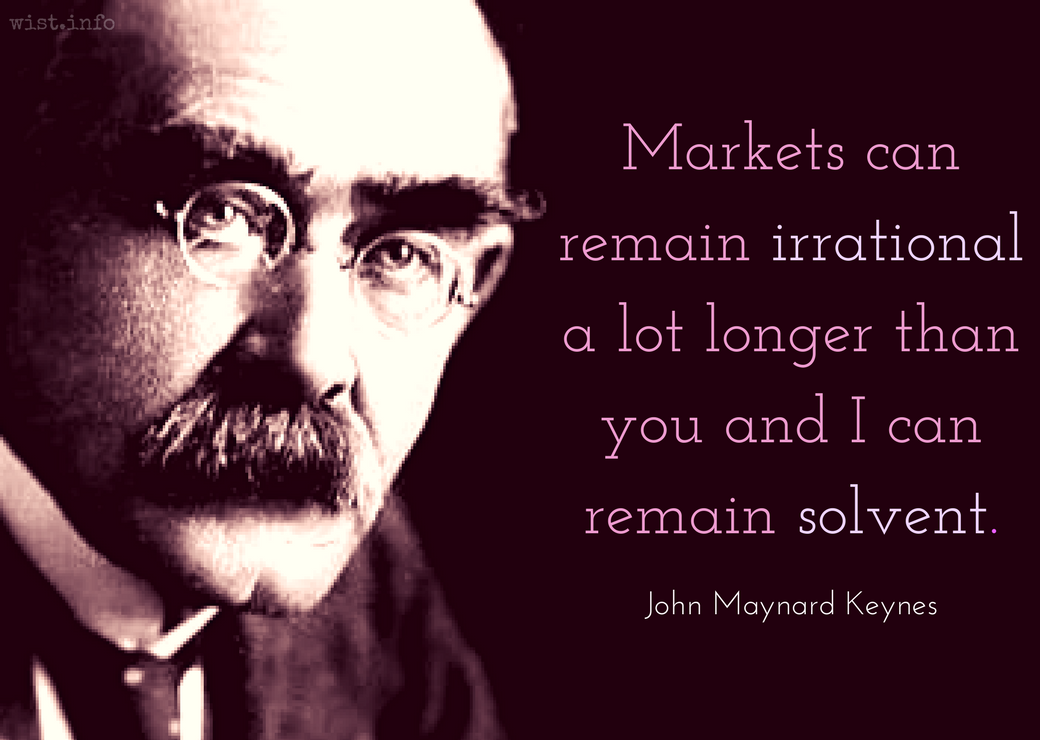
Markets can remain irrational a lot longer than you and I can remain solvent.
John Maynard Keynes (1883-1946) English economist
(Attributed)
Generally credited to Keynes, but the earliest reference found is by financial analyst A. Gary Shilling, "Scoreboard," Forbes (15 Feb 1993). More discussion here.
Sometimes given as "Markets can remain irrational longer than you can remain solvent" or "Markets can stay irrational longer than you can stay solvent."
Capitalism is the astounding belief that the most wickedest of men will do the most wickedest of things for the greatest good of everyone.
John Maynard Keynes (1883-1946) English economist
(Attributed)
Commonly attributed to Keynes, it is not found in his works. A more likely variant is "Capitalism is the extraordinary belief that the nastiest of men for the nastiest of motives will somehow work for the benefit of all," but this, too, is not established in Keynes' works. Also sometimes found attributed (without citation) to John Kenneth Galbraith.
George Schuster, Christianity and Human Relations in Industry (1951) quotes (uncited) Keynes referring to capitalism as "the astonishing belief that the nastiest motives of the nastiest men somehow or other work for the best results in the best of all possible worlds."
E. A. G. Robinson was a close colleague of Galbraith, and in his book Monopoly (1941), he said, "The great merit of the capitalist system, it has been said, is that it succeeds in using the nastiest motives of nasty people for the ultimate benefit of society." Robinson may be quoting Galbraith, or Galbraith may have anecdotally quoted Robinson.
More detailed discussion of this here, here, and here.
It is better to be roughly right than to be precisely wrong.
John Maynard Keynes (1883-1946) English economist
(Misttributed)
Not attributed to Keynes until after his death. Actually from Carveth Read, Logic, deductive and inductive (1898): "It is better to be vaguely right than exactly wrong."
But this long run is a misleading guide to current affairs. In the long run we are all dead. Economists set themselves too easy, too useless a task, if in tempestuous seasons they can only tell us, that when the storm is long past, the ocean is flat again.
The engine which drives Enterprise is not Thrift, but Profit.
John Maynard Keynes (1883-1946) English economist
A Treatise on Money, ch. 3 (1930)
The ignorance of even the best-informed investor about the more remote future is much greater than his knowledge, and he cannot but be influenced to a degree which would seem wildly disproportionate to anyone who really knew the future, and be forced to seek a clue mainly here to trends further ahead. But if this is true of the best-informed, the vast majority of those who are concerned with the buying and selling of securities know almost nothing whatever about what they are doing. They do not possess even the rudiments of what is required for a valid judgement, and are the prey of hopes and fears easily aroused by transient events and as easily dispelled.
John Maynard Keynes (1883-1946) English economist
A Treatise on Money, Vol. 2 (1930)
The political problem of mankind is to combine three things: Economic Efficiency, Social Justice, and Individual Liberty.
John Maynard Keynes (1883-1946) English economist
Liberalism and Labour (1926)
Words ought to be a little wild, for they are the assault of thoughts on the unthinking.
John Maynard Keynes (1883-1946) English economist
New Statesman and Nation (15 Jul 1933)
The power to become habituated to his surroundings is a marked characteristic of mankind.
John Maynard Keynes (1883-1946) English economist
The Economic Consequences of the Peace, ch. 1 (1919)
(Source)
Economic privation proceeds by easy stages, and so long as men suffer it patiently the outside world cares little.
John Maynard Keynes (1883-1946) English economist
The Economic Consequences of the Peace, ch. 6 (1919)
(Source)
Material Poverty provides the incentive to change precisely in situations where there is little margin for experiments. Material Prosperity removes the incentive just when it might be safe to take a chance.
John Maynard Keynes (1883-1946) English economist
The End of Laissez-Faire, ch. 5 (1926)
The important thing for Government is not to do things which individuals are doing already, and to do them a little better or a little worse; but to do those things which at present are not done at all.
The difficulty lies, not in the new ideas, but in escaping from the old ones, which ramify, for those brought up as most of us have been, into every corner of our minds.
John Maynard Keynes (1883-1946) English economist
The General Theory of Employment, Interest and Money, Preface (1936)
The ideas of economists and political philosophers, both when they are right and when they are wrong, are more powerful than is commonly understood. Indeed the world is ruled by little else. Practical men, who believe themselves to be quite exempt from any intellectual influence, are usually the slaves of some defunct economist. Madmen in authority, who hear voices in the air, are distilling their frenzy from some academic scribbler of a few years back.
John Maynard Keynes (1883-1946) English economist
The General Theory of Employment, Interest and Money, ch. 24 (1936)
The ideas of economists and political philosophers, both when they are right and when they are wrong, are more powerful than is commonly understood. Indeed the world is ruled by little else. Practical men, who believe themselves to be quite exempt from any intellectual influence, are usually the slaves of some defunct economist.
John Maynard Keynes (1883-1946) English economist
The General Theory of Employment, Interest and Money, ch. 24 (1936)
It is astonishing what foolish things one can temporarily believe if one thinks too long alone, particularly in economics (along with the other moral sciences), where it is often impossible to bring one’s ideas to a conclusive test either formal or experimental.
John Maynard Keynes (1883-1946) English economist
The General Theory of Employment, Interest and Money, Preface (1936)
The composition of this book has been for the author a long struggle of escape, and so must the reading of it be for most readers if the author’s assault upon them is to be successful, — a struggle of escape from habitual modes of thought and expression. The ideas which are here expressed so laboriously are extremely simple and should be obvious. The difficulty lies, not in the new ideas, but in escaping from the old ones, which ramify, for those brought up as most of us have been, into every corner of our minds.
John Maynard Keynes (1883-1946) English economist
The General Theory of Employment, Interest and Money, Preface (1936)
The difficulty lies, not in the new ideas, but in escaping from the old ones, which ramify, for those brought up as most of us have been, into every corner of our minds.
John Maynard Keynes (1883-1946) English economist
The General Theory of Employment, Interest and Money, Preface (1936)
(Source)
The engine which drives Enterprise is not Thrift, but Profit.
John Maynard Keynes (1883-1946) English economist
The Treatise on Money (1930)