

The most dangerous error is failure to recognize our own tendency to error.
B. H. Liddell Hart (1895-1970) English soldier, military historian (Basil Henry Liddell Hart)
“Blindfolded Authority,” Why Don’t We Learn from History? (1944)
Quotations by:
Liddell Hart, B. H.

International relations are governed by interests, and not by moral principles.
B. H. Liddell Hart (1895-1970) English soldier, military historian (Basil Henry Liddell Hart)
“The Illusion of Treaties,” Why Don’t We Learn from History? (1944)
Keep strong, if possible. In any case, keep cool. Have unlimited patience. Never corner an opponent, and always assist him to save face. Put yourself in his shoes — so as to see things through his eyes. Avoid self-righteousness like the devil — nothing is so self-blinding.
B. H. Liddell Hart (1895-1970) English soldier, military historian (Basil Henry Liddell Hart)
Deterrent or Defense (1960)
Advice to statesmen.
A strategist should think in terms of paralyzing, not of killing. Even on the lower plane of warfare, a man killed is merely one man less, whereas a man unnerved is a highly infectious carrier of fear, capable of spreading an epidemic of panic. … The sword drops from a paralyzed hand.
B. H. Liddell Hart (1895-1970) English soldier, military historian (Basil Henry Liddell Hart)
Strategy, ch. 15 (1954)
Ensure that both plan and dispositions are flexible — adaptable to circumstances. Your plan should foresee and provide for a next step in case of success or failure.
B. H. Liddell Hart (1895-1970) English soldier, military historian (Basil Henry Liddell Hart)
Strategy, ch. 20 (1954)
Various fresh ideas gained acceptance … when they could be presented not as something radically new, but as the revival in modern terms of a time-honored principle or practice that had been forgotten.
B. H. Liddell Hart (1895-1970) English soldier, military historian (Basil Henry Liddell Hart)
Strategy, Preface (1954)
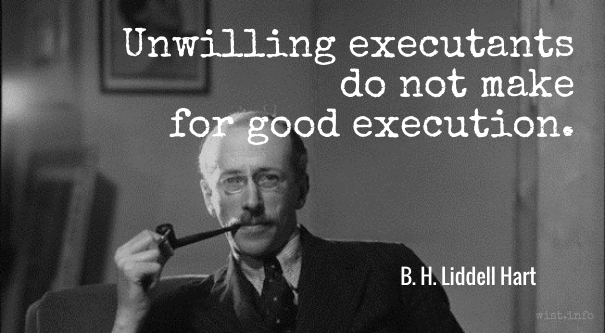
Unwilling executants do not make for good execution.
B. H. Liddell Hart (1895-1970) English soldier, military historian (Basil Henry Liddell Hart)
The German Generals Talk, ch. 4 (1948)
Be very careful never to show your own bias to anyone who is giving you information, or passing it on to you. Once he sees that you have a particular inclination he will instinctively tend to tell you what he thinks will suit you, and enhance your opinion of him.
B. H. Liddell Hart (1895-1970) English soldier, military historian (Basil Henry Liddell Hart)
This Expanding War, “Intelligence Problems” (1942)
There are over two thousand years of experience to tell us that the only thing harder than getting a new idea into the military mind is to get an old one out.
B. H. Liddell Hart (1895-1970) English soldier, military historian (Basil Henry Liddell Hart)
Thoughts on War, 5.6 “March 1936” (1944)
Men are more ready to sacrifice their lives than their livelihood: and to sacrifice their own importance often comes hardest of all.
B. H. Liddell Hart (1895-1970) English soldier, military historian (Basil Henry Liddell Hart)
Thoughts on War, ch. 10 (1944)
The search for truth for truth’s sake is the mark of the historian.
B. H. Liddell Hart (1895-1970) English soldier, military historian (Basil Henry Liddell Hart)
Why Don’t We Learn from History?, “Blinding Loyalties” (1944)
Loyalty is a noble quality, so long as it is not blind and does not exclude the higher loyalty to truth and decency.
B. H. Liddell Hart (1895-1970) English soldier, military historian (Basil Henry Liddell Hart)
Why Don’t We Learn from History?, “Blinding Loyalties” (1944)
A sound rule of historical evidences is that while assertions should be treated with critical doubt, admissions are likely to be reliable.
B. H. Liddell Hart (1895-1970) English soldier, military historian (Basil Henry Liddell Hart)
Why Don’t We Learn from History?, “The Exploration of History” (1944)
History marches on the stomachs of statesmen.
B. H. Liddell Hart (1895-1970) English soldier, military historian (Basil Henry Liddell Hart)
Why Don’t We Learn from History?, “The Exploration of History” (1944)
The vital influences are to be detected, not in the formal documents compiled by rulers, ministers and generals, but in their marginal notes and verbal asides.
B. H. Liddell Hart (1895-1970) English soldier, military historian (Basil Henry Liddell Hart)
Why Don’t We Learn from History?, “The Germs of War” (1944)