

Doubtless he had an ideal, but it was the ideal of a practical statesman, — to aim at the best, and to take the next best, if he is lucky enough to get even that.
James Russell Lowell (1819-1891) American diplomat, essayist, poet
“Abraham Lincoln, 1864-1865” (1869)
(Source)
Printed in The North American Review, #222 (Jan 1869) under the title "Before and After." Sometimes given as "The idea of a practical statesman is to aim ...."
Quotations by:
Lowell, James Russell
It is by presence of mind in untried emergencies that the native metal of a man is tested.
James Russell Lowell (1819-1891) American diplomat, essayist, poet
“Abraham Lincoln,” The North American Review (Jan 1864)
(Source)
Undoubtedly the highest function of statesmanship is by degrees to accommodate the conduct of communities to ethical laws, and to subordinate the conflicting self-interests of the day to higher and more permanent concerns.
James Russell Lowell (1819-1891) American diplomat, essayist, poet
“Abraham Lincoln” (1864)
This imputation of inconsistency is one to which every sound politician and every honest thinker must sooner or later subject himself. The foolish and the dead alone never change their opinions.
James Russell Lowell (1819-1891) American diplomat, essayist, poet
“Abraham Lincoln” (1864), My Study Windows (1871)
(Source)
It is loyalty to great ends, even though forced to combine the small and opposing motives of selfish men to accomplish them; it is the anchored cling to solid principles of duty and action, which knows how to swing with the tide, but is never carried away by it — that we demand in public men, and not sameness of policy, or a conscientious persistency in what is impracticable.
James Russell Lowell (1819-1891) American diplomat, essayist, poet
“Abraham Lincoln” (1864), My Study Windows (1871)
Among the lessons taught by the French Revolution, there is none sadder or more striking than this — that you may make everything else out of the passions of men except a political system that will work, and that there is nothing so pitilessly and unconsciously cruel as sincerity formulated into dogma.
James Russell Lowell (1819-1891) American diplomat, essayist, poet
“Abraham Lincoln” (1864), My Study Windows (1871)
(Source)
We learned once for all that compromise makes a good umbrella, but a poor roof. It is a temporary expedient, often wise in party politics, almost sure to be unwise in statesmanship.
James Russell Lowell (1819-1891) American diplomat, essayist, poet
“Democracy,” speech, Birmingham, England (6 Oct 1884)
(Source)
On becoming President of the Birmingham and Midland Institute. Speaking of the years leading up to the US Civil War, with the unsuccessful application of compromise "to a question of fundamental morals" (slavery).
Though old the thought and oft exprest,
‘Tis his at last who says it best.James Russell Lowell (1819-1891) American diplomat, essayist, poet
“For an Autograph,” Under the Willows and Other Poems (1868)
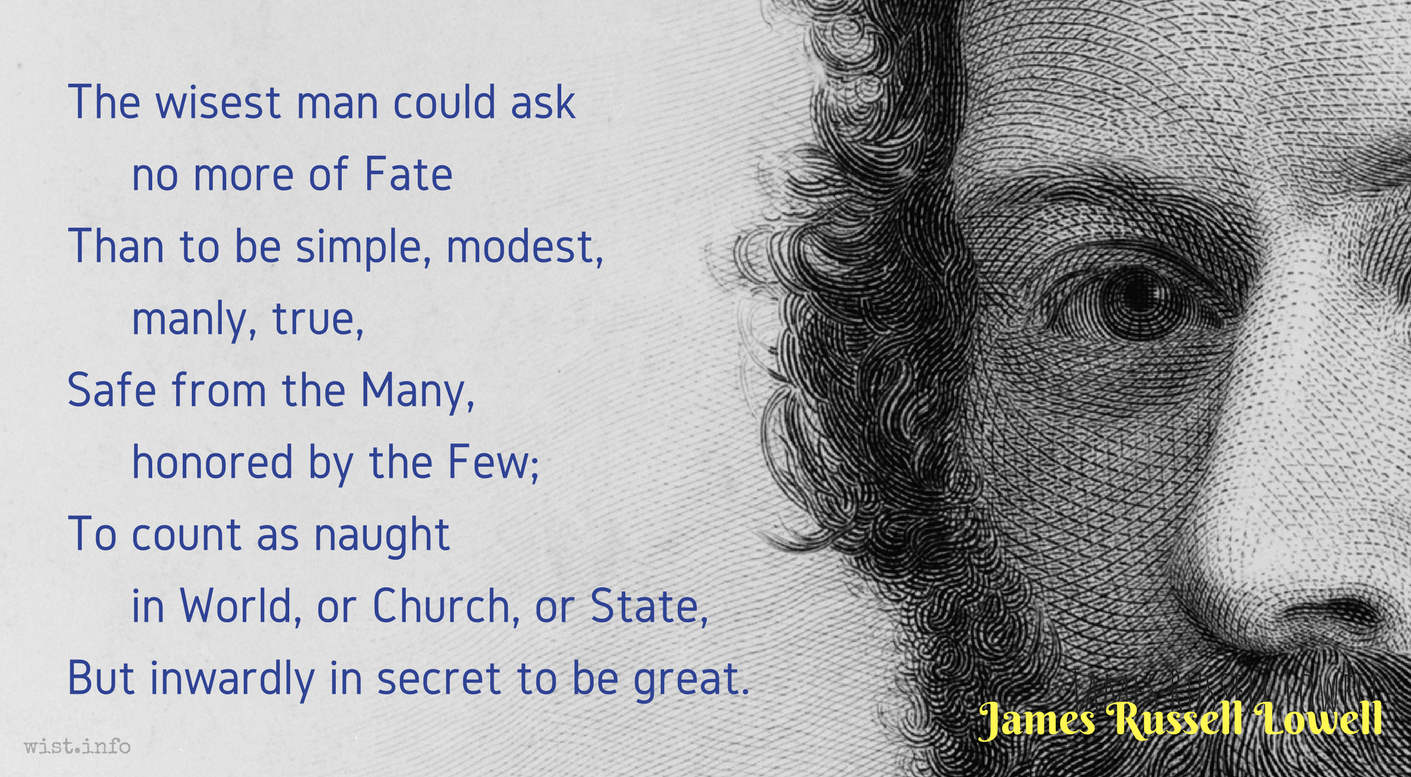
The wisest man could ask no more of Fate
Than to be simple, modest, manly, true,
Safe from the Many, honored by the Few;
To count as naught in World, or Church, or State,
But inwardly in secret to be great.
James Russell Lowell (1819-1891) American diplomat, essayist, poet
“Jeffries Wyman,” The Nation #484 (8 Oct 1874)
(Source)
There is no good in arguing with the inevitable. The only argument available with an east wind is to put on your overcoat.
James Russell Lowell (1819-1891) American diplomat, essayist, poet
“On Democracy,” Presidential Inaugural Address, Birmingham and Midland Institute (6 Oct 1884)
(Source)
It is when the sentimentalist turns preacher of morals that we investigate his character, and are justified in so doing. He may express as many and as delicate shades of feeling as he likes, — for this the sensibility of his organization perfectly fits him, no other person could do it so well, — but the moment he undertakes to establish his feeling as a rule of conduct, we ask at once how far are his own life and deed in accordance with what he preaches? For every man feels instinctively that all the beautiful sentiments in the world weigh less than a single lovely action; and that while tenderness of feeling and susceptibility to generous emotions are accidents of temperament, goodness is an achievement of the will and a quality of the life. Fine words, says our homely old proverb, butter no parsnips; and if the question be how to render those vegetables palatable, an ounce of butter would be worth more than all the orations of Cicero. The only conclusive evidence of a man’s sincerity is that he give himself for a principle. Words, money, all things else, are comparatively easy to give away; but when a man makes a gift of his daily life and practice, it is plain that the truth, whatever it may be, has taken possession of him.
James Russell Lowell (1819-1891) American diplomat, essayist, poet
“Rousseau And The Sentimentalists,” North American Review (Jul 1867)
(Source)
All the beautiful sentiments in the world weigh less than a single thought.
James Russell Lowell (1819-1891) American diplomat, essayist, poet
“Rousseau and the Sentimentalists” (1867)
Talent is that which is in a man’s power; genius is that in whose power a man is.
James Russell Lowell (1819-1891) American diplomat, essayist, poet
“Rousseau and the Sentimentalists” (1867)
Be noble! And the nobleness that lies
In other men, sleeping, but never dead,
Will rise in majesty to meet thine own.James Russell Lowell (1819-1891) American diplomat, essayist, poet
“Sonnet 4” (1840)
(Source)
Often presented as a simple sentence, rather than lines within a larger poem.
The Holy Supper is kept, indeed,
In whatso we share with another’s need;
Not what we give, but what we share, —
For the gift without the giver is bare;
Who gives himself with his alms feeds three, —
Himself, his hungering neighbor, and me.James Russell Lowell (1819-1891) American diplomat, essayist, poet
“The Vision of Sir Launfal,” Part 2, st. 8 (1848)
(Source)
Christ / the Holy Grail speaking to Sir Launfal. See Matthew 25:31-46.
Not failure, but low aim, is crime.
James Russell Lowell (1819-1891) American diplomat, essayist, poet
“For an Autograph,” st. 5 (1868)
(Source)
Whatever you may be sure of, be sure of this, that you are dreadfully like other people.
James Russell Lowell (1819-1891) American diplomat, essayist, poet
(Attributed)
In creating, the only hard thing’s to begin; a grass-blade’s no easier to make than an oak.
James Russell Lowell (1819-1891) American diplomat, essayist, poet
A Fable for Critics (1848)
Toward no crime have men shown themselves so cold-bloodedly cruel as in punishing differences of belief.
James Russell Lowell (1819-1891) American diplomat, essayist, poet
Among My Books (1870)
Solitude is as needful to the imagination as society is wholesome for the character.
James Russell Lowell (1819-1891) American diplomat, essayist, poet
Among My Books, “Dryden” (1870)
He who is firmly seated in authority soon learns to think security, and not progress, the highest lesson of statecraft.
James Russell Lowell (1819-1891) American diplomat, essayist, poet
New England Two Centuries Ago (1865)
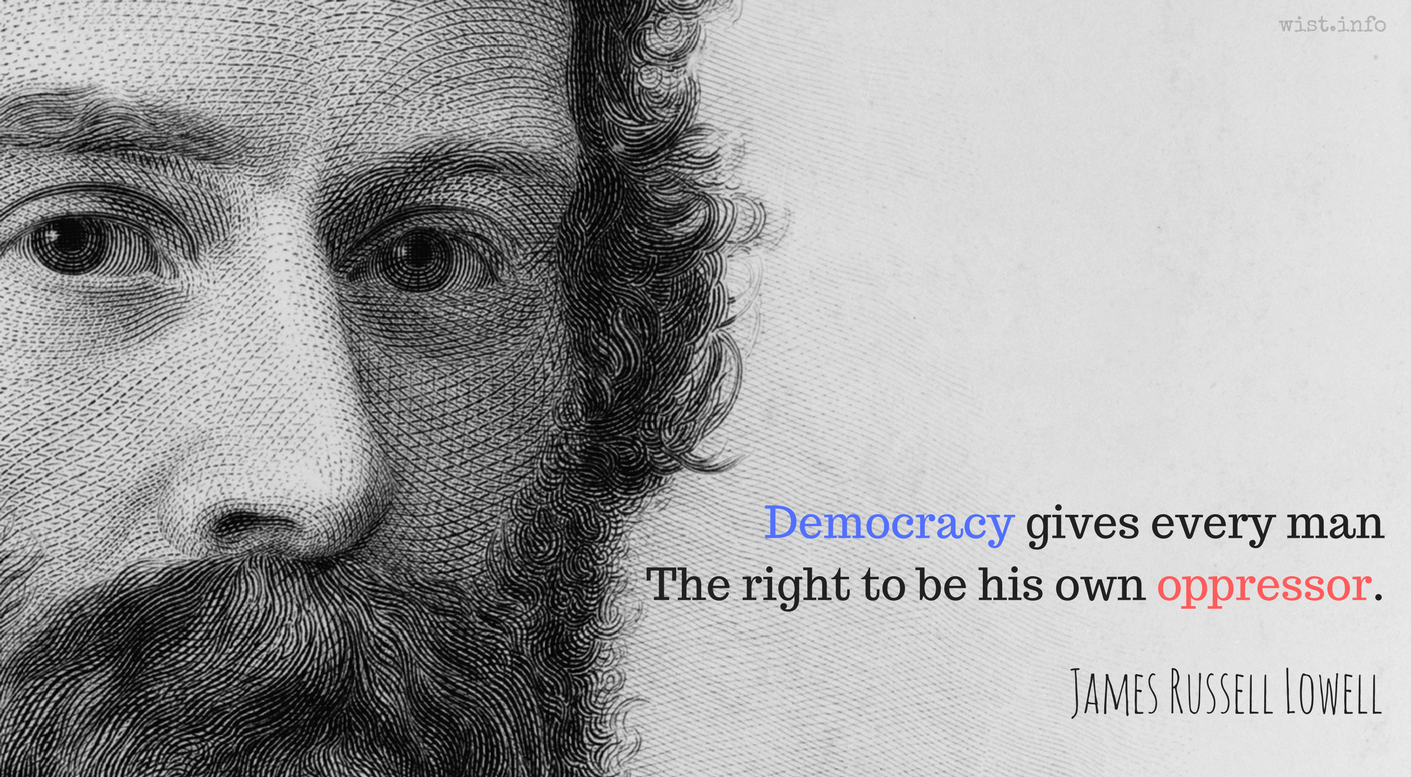
Democ’acy gives every man
The right to be his own oppressor.
James Russell Lowell (1819-1891) American diplomat, essayist, poet
The Bigalow Papers, Second Series, “Ef I a song or two could make,” l. 97 (1867)
A ginooine statesman should be on his guard,
Ef he must hev beliefs, nut to b’lieve ’em tu hard.[A genuine statesman should be on his guard,
If he must have beliefs, not to believe them too hard.]James Russell Lowell (1819-1891) American diplomat, essayist, poet
The Bigelow Papers: Second Series, ch. 5 (1867)