

God is merciful. He will not do everything and thus take away our free will and that share of glory that belongs to us.
Niccolò Machiavelli (1469-1527) Italian politician, philosopher, political scientist
(Attributed)
Quotations by:
Machiavelli, Niccolo

People are fickle by nature; and it is simple to convince them of something, but difficult to hold them in that conviction.
Niccolò Machiavelli (1469-1527) Italian politician, philosopher, political scientist
(Attributed)
Men are very apt to deceive themselves in generals, less so than in particulars.
Niccolò Machiavelli (1469-1527) Italian politician, philosopher, political scientist
(Attributed)
Wars begin when you will, but they do not end when you please.
Niccolò Machiavelli (1469-1527) Italian politician, philosopher, political scientist
Florentine Histories, Book 3, ch. 2 (1521-5)
As commonly given, specific translation unknown. Alt. trans.:
- "It is in the power of any man to begin a war, but he cannot end it when he pleases." [tr. Lester (1843)]
- "People may go to war when they will, but cannot always withdraw when they like." [Bohn's Standard Library (1891)]
- "Wars begin at the will of anyone, but they do not end at anyone's will." [tr. Banield and Mansfield (1988), Book 3, ch. 7]

When the act accuses him, the result should excuse him.
Niccolò Machiavelli (1469-1527) Italian politician, philosopher, political scientist
The Discourses on Livy, Book 1, ch. 19 (1517) [tr. Detmold (1882)]
For the great majority of mankind are satisfied with appearance, as though they were realities, and are often more influenced by the things that seem than by those that are.
Niccolò Machiavelli (1469-1527) Italian politician, philosopher, political scientist
The Discourses on Livy, Book 1, ch. 25 (1517)
Whenever men cease fighting through necessity, they go to fighting through ambition, which is so powerful in human breasts that, whatever high rank men climb to, never does ambition abandon them.
Niccolò Machiavelli (1469-1527) Italian politician, philosopher, political scientist
The Discourses on Livy, Book 1, ch. 37 (1517) [tr. Gilbert (1958)]
(Source)
Alt. trans.:
- "[Ambition] is so powerful a passion in the human breast, that however high we reach we are never satisfied."
- "For when no longer urged to war on one another by necessity, they are urged by ambition, which has such dominion in their hearts that it never leaves them to whatsoever heights they climb." [tr. Thomson (1883)]
- "Whenever the necessity for fighting is taken away from them, they fight for the same of ambition, which is so powerful a passion in the human breast that, no matter the rank to which a man may rise, he never abandons it." [tr. Bondanella (1997)]
Whoever desires to found a state and give it laws must start with assuming that all men are bad and ever ready to display their vicious nature, whenever they may find occasion for it.
Niccolò Machiavelli (1469-1527) Italian politician, philosopher, political scientist
The Discourses on Livy, Book 1, Introduction (1517) [tr. Detmold (1882)]
Alt. trans.: "It is necessary for him who lays out a state and arranges laws for it to presuppose that all men are evil and that they are always going to act according to the wickedness of their spirits whenever they have free scope." [Discourse upon the First Ten Books of Livy, Book 1, ch. 3 (1513-18) [tr. Gilbert]]
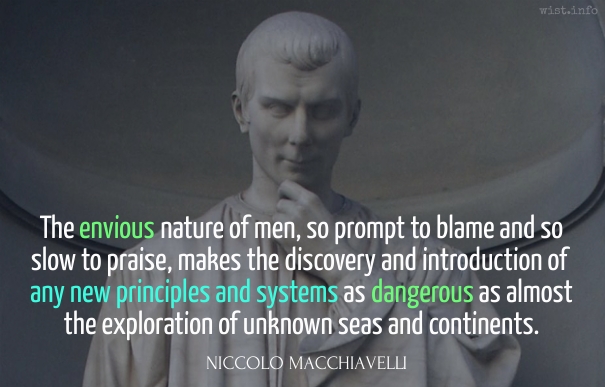
The envious nature of men, so prompt to blame and so slow to praise, makes the discovery and introduction of any new principles and systems as dangerous as almost the exploration of unknown seas and continents.
Niccolò Machiavelli (1469-1527) Italian politician, philosopher, political scientist
The Discourses on Livy, Book 1, Introduction (1517) [tr. Detmold (1882)]
Necessity may force you to do unto the prince that which you see the prince about to do to you.
Niccolò Machiavelli (1469-1527) Italian politician, philosopher, political scientist
The Discourses on Livy, Book 3, ch. 6 (1517) [tr. Detmold (1882)]
See Matthew 7:12.
Bad rulers … are in constant fear lest others are conspiring to inflict upon them the punishment which they are conscious of deserving.
Niccolò Machiavelli (1469-1527) Italian politician, philosopher, political scientist
The Discourses on Livy, Book 3, ch. 6 (1517) [tr. Detmold (1882)]
There is no better indication of a man’s character than the company he keeps.
Niccolò Machiavelli (1469-1527) Italian politician, philosopher, political scientist
The Discourses on Livy, Book 3, ch. 34 (1517) [tr. Detmold (1882)]
We can have no better clue to a man’s character than the company he keeps.
Niccolò Machiavelli (1469-1527) Italian politician, philosopher, political scientist
The Discourses on Livy, Book 3, ch. 34 (1517) [tr. Thomson (1883)]
(Source)
Alt. trans.: "There is no better indication of a man's character than the company which he keeps."

It is not titles that honor men, but men honor the titles.
Niccolò Machiavelli (1469-1527) Italian politician, philosopher, political scientist
The Discourses on Livy, Book 3, ch. 38 (1517) [tr. Detmold (1882)]
Where the very safety of the country depends upon the resolution to be taken, no considerations of justice or injustice, humanity or cruelty, nor of glory or shame, should be allowed to prevail. But putting all other considerations aside, the only question should be, “What course will save the life and liberty of the country?”
Niccolò Machiavelli (1469-1527) Italian politician, philosopher, political scientist
The Discourses on Livy, Book 3, ch. 41 (1517) [tr. Detmold (1882)]
Prudent men are in the habit of saying — and not by chance or without basis — that he who wishes to see what is to come should observe what has already happened, because all the affairs of the world, in every age, have their individual counterparts in ancient times. The reason for this is that since they are carried on by men, who have and always have had the same passions, of necessity the same results appear.
Niccolò Machiavelli (1469-1527) Italian politician, philosopher, political scientist
The Discourses on Livy, Book 3, ch. 43 (1517) [tr. Gilbert (1958)]
(Source)
Alt. trans.: "The wise are wont to say, and not without reason or at random, that he who would forecast what is about to happen should look to what has been; since all human events, whether present or to come, have their exact counterpart in the past. And this, because these events are brought about by men, whose passions and dispositions remaining in all ages the same naturally give rise to the same effects." [tr. Thomson]
Any manifest error on the part of an enemy should make us suspect some stratagem.
Niccolò Machiavelli (1469-1527) Italian politician, philosopher, political scientist
The Discourses on Livy, Book 3, ch. 48 (1517) [tr. Detmold (1882)]
Men are so simple and so ready to obey present necessities, that one who deceives will always find those who allow themselves to be deceived.
Niccolò Machiavelli (1469-1527) Italian politician, philosopher, political scientist
The Prince, “In What Way Princes Must Keep Faith”
One ought to be both feared and loved, but as it is difficult for the two to go together it is much safer to be feared than loved, if one of the two has to be wanting. … And men have less scruple in offending one who makes himself loved than one who makes himself feared; for love is held by a chain of obligation, which men being selfish, is broken whenever it serves their purpose, but fear is maintained by a dread of punishment which never fails.
Niccolò Machiavelli (1469-1527) Italian politician, philosopher, political scientist
The Prince, ch. 17 (1513) [tr. Ricci (1903)]
(Source)
Alt. trans.: "Is it better to be loved than feared, or the reverse? The answer is that it is desirable to be both, but because it is difficult to join them together, it is much safer for a prince to be feared than loved, if he is to fail in one of the two. ... Men have less hesitation in injuring one who makes himself loved than one who makes himself feared, for love is held by a chain of duty which, since men are bad, they break at every chance for their own profit; but fear is held by a dread of punishment that never fails you." [tr. Gilbert (1958)]
Men are so simple and so ready to obey present necessities, that one who deceives will always find those who allow themselves to be deceived.
Niccolò Machiavelli (1469-1527) Italian politician, philosopher, political scientist
The Prince, ch. 18 (1513) [tr. L. Ricci (1903)]
Every one sees what you appear to be, few really know what you are, and those few dare not oppose themselves to the opinion of the many, who have the majesty of the state to defend them; and in the actions of all men, and especially of princes, which it is not prudent to challenge, one judges by the result. For that reason, let a prince have the credit of conquering and holding his state, the means will always be considered honest, and he will be praised by everybody because the vulgar are always taken by what a thing seems to be and by what comes of it.
Niccolò Machiavelli (1469-1527) Italian politician, philosopher, political scientist
The Prince, ch. 18 (1513) [tr. Marriott (1908)]
(Source)
Origin of the paraphrase "The ends justify the means," which is generally attributed to Machiavelli.
It is well to seem merciful, faithful, humane, sincere, religious, and also to be so; but you must have the mind so disposed so that when it is needful to be otherwise you may be able to change to the opposite qualities.
Niccolò Machiavelli (1469-1527) Italian politician, philosopher, political scientist
The Prince, ch. 18 (1513) [tr. Ricci (1903)]
The first impression that one gets of a ruler and of his brains is from seeing the men that he has about him.
Niccolò Machiavelli (1469-1527) Italian politician, philosopher, political scientist
The Prince, ch. 22 (1513) [tr. Ricci (1903)]
We observe that men should be either treated generously or destroyed, because they take revenge for slight injuries — for heavy ones they cannot; hence an injury done to a man should be such that it does not fear revenge.
Niccolò Machiavelli (1469-1527) Italian politician, philosopher, political scientist
The Prince, ch. 3 (1513) [tr. Gilbert (1959)]
(Source)
Men must be either caressed or annihilated; they will revenge themselves for small injuries, but cannot do so for great ones; the injury therefore that we do to a man must be such that we need not fear his vengeance.
Niccolò Machiavelli (1469-1527) Italian politician, philosopher, political scientist
The Prince, ch. 3 (1513) [tr. Ricci (1903)]
There is nothing more difficult to carry out, nor more doubtful of success, nor more dangerous to handle, than to initiate a new order of things. For the reformer has enemies in all those who profit by the old order, and only lukewarm defenders in all those who would profit by the new order, this lukewarmness arising partly from fear of their adversaries, who have the laws in their favor; and partly from the incredulity of mankind, who do not truly believe in anything new until they have actual experience of it.
Niccolò Machiavelli (1469-1527) Italian politician, philosopher, political scientist
The Prince, ch. 6 (1513) [tr. Ricci (1903)]
Alt. trans.: "Nothing is more difficult to transact, nor more dubious to succeed, nor more dangerous to manage, than to make oneself chief to introduce new orders. Because the introducer has for enemies all those whom the old orders benefit, and has for lukewarm defenders all those who might benefit from the new orders. [tr. Codevilla]