

When I play with my cat, who can say that it is not she amusing herself with me more than I with her?
[Quand je me jouë à ma chatte, qui sçait, si elle passe son temps de moy plus que je ne fay d’elle?]
Michel de Montaigne (1533-1592) French essayist
“Apology for Raymond Sebond [Apologie de Raimond de Sebonde]” (1588–1592), Essays, Book 2, ch. 12 (1595) [tr. Ives (1925)]
(Source)
(Source (French)). Alternate translations:
When I am playing with my Cat, who knowes whether she have more sporte in dallying with me, then I have in gaming with hir?
[tr. Florio (1603)]
When I play with my cat, who knows whether puss is not more diverted with me than I am with puss?
[tr. Cotton (1686)]
When I play with my cat who knows whether I do not make her more sport than she makes me?
[tr. Cotton/Hazlitt (1877)]
When I play with my cat, who knows if I am not a pastime to her more than she is to me.
[tr. Frame (1943)]
When I play with my cat, how do I know that she is not passing time with me rather than I with her?
[tr. Screech (1987)]
Quotations by:
Montaigne, Michel de

Especially in an age as corrupt and ignorant as this, the good opinion of the people is a dishonor.
Michel de Montaigne (1533-1592) French essayist
“Of Repentance,” Essays (1588) [tr. Frame (1958)]
There is a sort of gratification in doing good which makes us rejoice in ourselves.
Michel de Montaigne (1533-1592) French essayist
“Of Repentance,” Essays (1588) [tr. Frame (1958)]
The eloquence that diverts us to itself harms its content.
Michel de Montaigne (1533-1592) French essayist
“Of the Education of Children,” Essays (1588) [Tr. D. Frame (1958)]
There is no man so good that if he placed all his actions and thoughts under the scrutiny of the laws, he would not deserve hanging ten times in his life.
Michel de Montaigne (1533-1592) French essayist
“Of Vanity,” Essays (1588) [tr. Frame (1958)]
Alt. trans.: "No man is so exquisitely honest or upright in living but that ten times in his life he might not lawfully be hanged."
There can be no pleasure to me without communication: there is not so much as a sprightly thought comes into my mind, that it does not grieve me to have produced alone, and that I have no one to communicate it to.
Michel de Montaigne (1533-1592) French essayist
“Of Vanity,” Essays, Book 3, ch. 9 (1588) [tr. Cotton/Hazlitt (1877)]
(Source)
Alternate translations:
With me no pleasure is fully delightsome without communication and no delight absolute except imparted. I doe not so much as apprehend one rare conceipt, or conceive one excellent good thought in my minde, but me thinks I am much grieved and grievously perplexed to have produced the same alone and that I have no sympathizing companion to impart it unto.
[tr. Florio (1603), "Of Vanitie"]
No pleasure has any taste for me when not shared with another: no happy thought occurs to me without my being irritated at bringing it forth alone with no one to offer it to.
[tr. Screech (1987)]
I want death to find me planting my cabbages.
Michel de Montaigne (1533-1592) French essayist
“That to Philosophize Is to Learn to Die,” Essays (1588) [tr. D. Frame (1958)]
The perpetual work of your life is but to lay the foundation of death.
But when all is summed up, a man never speaks of himself without loss; his accusations of himself are always believed; his praises never.
Michel de Montaigne (1533-1592) French essayist
“The Art of Conversation,” Essays, Vol. 3, ch. 8 (1588) [tr. Cotton (1877)]
(Source)
We cannot do without it, and yet we disgrace and vilify the same. It may be compared to a cage, the birds without despair to get in, and those within despair to get out.
[Il en advient ce qui se veiod aux cages: les oyseaux qui en sont dehors, desperent d’y entrer: et d’un pareil soing en sortir, ceuix qui sont au dedans.]
Michel de Montaigne (1533-1592) French essayist
“Upon Some Verses of Virgil,” Essays (1580-88)
On marriage. For more discussion of others who have used this metaphor, see here.
Alt. trans.: "We cannot live without it, and yet we do nothing but decry it. It happens, as with cages, the birds without despair to get in, and those within despair of getting out." [tr. Cotton (1877)]
Alt. trans.: "Though we cannot live without it, yet we do nothing but decry it. We see the same with birdcages: the birds outside despair to get in, and those within despair to get out. [Autobiography, ch. 6 "This Discreet Business of Marriage," tr. Lowenthal (1935)]
There never were in the world two opinions alike, no more than two hairs or two grains; the most universal quality is diversity.
Michel de Montaigne (1533-1592) French essayist
(Attributed)
If you don’t know how to die, don’t worry; Nature will tell you what to do on the spot, fully and adequately. She will do this job perfectly for you; don’t bother your head about it.
Michel de Montaigne (1533-1592) French essayist
(Attributed)
Nothing is as firmly held as what man knows least.
Michel de Montaigne (1533-1592) French essayist
(Attributed)
Confidence in others’ honesty is no light testimony of one’s own integrity.
Michel de Montaigne (1533-1592) French essayist
(Attributed)
Whosoever lies shows that he despises God and fears men.
Michel de Montaigne (1533-1592) French essayist
(Attributed)
Hath God obliged himself not to exceed the bounds of our knowledge?
Michel de Montaigne (1533-1592) French essayist
(Attributed)
Necessity is a violent school-mistress and teacheth strange lessons.
Michel de Montaigne (1533-1592) French essayist
(Attributed)
There is no conversation more boring than the one where everybody agrees.
Michel de Montaigne (1533-1592) French essayist
(Attributed)
Don’t discuss yourself, for you are bound to lose; if you belittle yourself, you are believed; if you praise yourself, you are disbelieved.
Michel de Montaigne (1533-1592) French essayist
(Attributed)
A man who fears suffering is already suffering from what he fears.
Michel de Montaigne (1533-1592) French essayist
(Attributed)
When all is summed up, a man never speaks of himself without loss; his accusations of himself are always believed, his praises never.
Michel de Montaigne (1533-1592) French essayist
(Attributed)
I, who am a very earthy person, loathe that inhuman teaching which would make us despise and dislike the care of the body. I consider it just as wrong to reject natural pleasures as to set too much store by them.
Michel de Montaigne (1533-1592) French essayist
Essays
No man is exempt from saying silly things; the mischief is to say them deliberately.
Michel de Montaigne (1533-1592) French essayist
Essays (1580-1588)
If falsehood, like truth, had but one face, we should be better off, for we should take for certain the contrary of what the liar said. But the opposite of truth has a hundred thousand shapes and a limitless field.
[Si comme la verité, le mensonge n’avoit qu’un visage, nous serions en meilleurs termes : car nous prendrions pour certain l’opposé de ce que diroit le menteur. Mais le revers de la verité a cent mille figures, et un champ indefiny.]
Michel de Montaigne (1533-1592) French essayist
Essays, Book 1, ch. 9 “On Liars [Des Menteurs]” (1572) (1.9) (1595) [tr. Ives (1925)]
(Source)
(Source (French)). Alternate translations:
If a lie had no more faces but one, as truth hath; we should be in farre better termes then we are: For, whatsoever a lier should say, we would take it in a contrarie sense. But the opposite of truth hath many-many shapes, and an undefinite field.
[tr. Florio (1603)]
If Falshood had, like Truth, but one Face only, we should be upon better Terms; for we should then take the contrary to what the Lyer says for certain Truth; but the Reverse of Truth has a hundred thousand Figures, and a Field indefinite without Bound or Limit.
[tr. Cotton (1686)]
If Falsehood had, like Truth, only one face, we should be upon better terms; for we should then take the contrary of what the liar should say for certain truth; but the reverse of truth has a hundred thousand forms, and a field without limits.
[tr. Friswell (1868)]
If falsehood had, like truth, but one face only, we should be upon better terms; for we should then take for certain the contrary to what the liar says: but the reverse of truth has a hundred thousand forms, and a field indefinite, without bound or limit.
[tr. Cotton/Hazlitt (1877)]
If falsehood, like truth, had only one face, we would be in better shape. For we would take as certain the opposite of what the liar said. But the reverse of truth has a hundred thousand shapes and a limitless field.
[tr. Frame (1943)]
If a lie, like truth, had only one face we could be on better terms, for certainty would be the reverse of what the liar said. But the reverse side of truth has a hundred thousand shapes and no defined limits.
[tr. Screech (1987)]
If, like truth, falsehood had only one face, we would be better off. We could trust that the opposite of whatever a liar says is true. But the flip side of the truth is endless and has a hundred thousand faces.
[tr. HyperEssays (2023)]
In truth, it is not want, but rather abundance, that breeds avarice.
[De vray, ce n’est pas la disette, c’est plustost l’abondance qui produict l’avarice.]
Michel de Montaigne (1533-1592) French essayist
Essays, Book 1, ch. 14 “The Taste of Good and Bad Things Depends Mostly on the Opinion We Have of Them [Que le goust des biens et des maux despend en bonne partie de l’opinion que nous en avons]” (1572) (1.14) (1595) [tr. Frame (1943)]
(Source)
Though this chapter was written around 1572 for the 1580 edition, this text was added for the 1588 edition. The chapter as a whole was numbered ch. 14 in the 1580 and 1588 editions, moved to ch. 40 for the 1595 ed. Most modern translations use the original numbering.
(Source (French)). Alternate translations:
Verily, it is not want, but rather plenty that causeth avarice.
[tr. Florio (1603), ch. 40]
In plain truth, it is not Want, but rather Abundance, that Creates Avarice.
[tr. Cotton (1686), ch. 40]
In truth, it is not want, but rather abundance, that creates avarice.
[tr. Cotton/Hazlitt (1877), ch. 40]
In truth, it is not want, but rather abundance, which gives birth to avarice.
[tr. Ives (1925)]
And truly it is not want that produces avarice but plenty.
[tr. Screech (1987)]
Truly, abundance rather than want causes stinginess.
[tr. HyperEssays (2023)]
There is nothing I hate more than haggling. It is simply a petty and brazen business: Two parties will negotiate and argue for an hour only to walk away from what they have solemnly agreed to over five pennies’ worth of overcharge.
[Il n’est rien que je haysse comme à marchander : c’est un pur commerce de trichoterie et d’impudence. Apres une heure de debat et de barguignage, l’un et l’autre abandonne sa parolle et ses sermens pour cinq sous d’amendement.]
Michel de Montaigne (1533-1592) French essayist
Essays, Book 1, ch. 14 “The Taste of Good and Bad Things Depends Mostly on the Opinion We Have of Them [Que le goust des biens et des maux despend en bonne partie de l’opinion que nous en avons]” (1572) (1.14) (1595) [tr. HyperEssays (2023)]
(Source)
Though this chapter was written around 1572 for the 1580 edition, this text was added for the 1588 edition. The chapter as a whole was numbered ch. 14 in the 1580 and 1588 editions, moved to ch. 40 for the 1595 ed. Most modern translations use the original numbering.
(Source (French)). Alternate translations:
There is nothing I hate more then driving of bargains: It is a meere commerce of dodging and impudencie. After an houres debating and paltring, both parties will goe from their wordes and oathes for the getting or saving of a shilling.
[tr. Florio (1603), ch. 40]
There is nothing I hate so much, as driving a Bargain; ’tis a meer Traffick of Couzenage and Impudence; where after an Hours cheapning and dogding, both Parties abandon their Word and Oath for Five Sols profit, or abatement.
[tr. Cotton (1686), ch. 40]
There is nothing I hate so much as driving a bargain; 'tis a mere traffic of cozenage and impudence, where, after an hour's cheapening and hesitating, both parties abandon their word and oath for five sols' abatement.
[tr. Cotton/Hazlitt (1877), ch. 40]
There is nothing that I hate so much as haggling; it is a mere interchange of cheating and impudence. Afer an hour of wrangling and chaffering, one and the other side sacrifices his word and his oaths for a charge of five sous.
[tr. Ives (1925)]
There is nothing I hate like bargaining. It is a pure interchange of trickery and shamelessness: after an hour of disputing and haggling both men go back on their word and their oath for a gain of five sous.
[tr. Frame (1943)]
There is nothing I hate more than bargaining. It is a pure exchange of trickery and effrontery: after hours of arguing and haggling both sides go back on their pledged word to gain a few pence more.
[tr. Screech (1987)]
We must take note that the games of children are not games in their eyes; and we must regard these as their most serious actions.
Michel de Montaigne (1533-1592) French essayist
Essays, Book 1, ch. 22 (1580-88)
Miracles arise from our ignorance of nature, not from nature itself.
[Les miracles sont, selon l’ignorance en quoy nous sommes de la nature, non selon l’estre de la nature.]
Michel de Montaigne (1533-1592) French essayist
Essays, Book 1, ch. 23 “On Custom and Not Easily Changing an Accepted Law [De la Coustume et de Ne Changer Aisément une Loy Receüe]” (1588-1592) (1.23) (1595) [tr. Lowenthal (1935)]
(Source)
The original essay is from 1572; this passage was added in the "C" period, prior to Montaigne's death and the final 1595 edition. The Lowenthal translation is from an edited autobiography, drawing from the Essays and other sources.
(Source (French)). Alternate translations:
Miracles are according to the ignorance wherein we are by nature, and not according to nature's essence.
[tr. Florio (1603), ch. 22]
Miracles appear such, according to our ignorance of nature, and not according to the real essence of nature.
[tr. Cotton (1686), ch. 22]
Miracles appear to be so, according to our ignorance of nature, and not according to the essence of nature.
[tr. Cotton/Hazlitt (1877), ch. 22]
Miracles exist from our ignorance of nature, not in nature herself.
[tr. Ives (1925)]
Miracles arise from our ignorance of nature, not from the essence of nature.
[tr. Frame (1943)]
Miraculous wonders depend on our ignorance of Nature, not on the essence of Nature.
[tr. Screech (1987)]
All other knowledge is hurtful to him who has not the science of goodness.
[Toute autre science, est dommageable à celuy qui n’a la science de la bonté.]
Michel de Montaigne (1533-1592) French essayist
Essays, Book 1, ch. 24 “Of Pedantry” (1580) [tr. Cotton (1686), rev Hazlitt (1877)]
(Source)
(Source (French)). Alternate translations:
- "Each other science is prejudciall unto him that hath not the science of goodnesse." [tr. Florio (1603)]
- "All other knowledge is detrimental to him who has not the science of becoming a good man." [tr. Friswell (1868)]
- "All other learning is hurtful to him who has not the knowledge of honesty and goodness." [tr. Rector (1899)]
Nothing is so firmly believed, as what we least know.
[Qu’il faut sobrement se mêler de juger des ordonnances divines.]
Michel de Montaigne (1533-1592) French essayist
Essays, Book 1, ch. 31, “That a Man must not be too hasty in judging of Divine Ordinances” (1580) [tr. Cotton (1686), Hazlitt (1877)]
(Source)
Alt. trans.:
- "Nothing is so firmly believed, as that which a man knoweth least." [tr. Florio (1603)]
- "Nothing is so firmly believed as what is least known."
The soul that has no fixed goal loses itself; for as they say, to be everywhere is to be nowhere.
[L’âme qui n’a point de but établi, elle se perd: car comme on dit, c;est n’ètre en aucun lieu que d’être partout.]
Michel de Montaigne (1533-1592) French essayist
Essays, Book 1, ch. 8 “Of Idleness” (1580-88) [tr. Frame (1943)]
(Source)
Alt. trans.: "The soul that has no established aim loses itself, for, as it is said, 'He who lives everywhere, lives nowhere.'" [tr. Cotton (1877)]
Alt. trans.: "When the soul is without a definite aim, she gets lost; for, as they say, if you are everywhere you are nowhere." [tr. Screech (1987)]
The proverb referenced is Martial.
History is crowded with the persons who have exchanged a life of dismay for death. Lucius Aruntius killed himself, he said, to escape from both the future and the past.
[L’Histoire est toute pleine de ceux qui en mille façons ont changé à la mort une vie peneuse. Lucius Aruntius se tua, pour, disoit-il, fuir et l’advenir et le passé.]
Michel de Montaigne (1533-1592) French essayist
Essays, Book 2, ch. 3 “A Custom of the Island of Cea [Coustume de l’Isle de Cea]” (c. 1573) (2.3) (1595) [tr. Ives (1925)]
(Source)
The reference to Lucius Aruntius, who killed himself during the waning days of Tiberius' reign before he could, like other enemies of Tiberius, be imprisoned and executed, was added in the 1588 edition. The event is described in Tacitus, Annals, Book 6, sec. 48.
(Source (French)). Alternate translations:
The historie is very full of such, who a thousand wayes have changed a lingering-toylsome life with death. Lucius Aruntius killed himselfe (as he saide) to avoyde what was past, and eschew what was to come.
[tr. Florio (1603)]
History abounds with instances of persons that have in a thousand forms, exchanged a melancholy life for death. Lucius Aruntius killed himself for the sake, as he said, of flying from deeds past and to come.
[tr. Cotton (1686), Vol. 1, ch. 60]
History is everywhere full of those who by a thousand ways have exchanged a painful and irksome life for death. Lucius Aruntius killed himself, to fly, he said, both the future and the past.
[tr. Cotton/Hazlitt (1877)]
History is chock full of those who in a thousand ways have changed a painful life for death. Lucius Arruntius killed himself, he said, to escape both the future and the past.
[tr. Frame (1943)]
History is full of people who have, in thousands of ways, exchanged a pain-filled life for death. Lucius Aruntius killed himself, "to escape," he said, "from the future and the past."
[tr. Screech (1987)]
Age imprints more wrinkles in the mind than it does on the face; and souls are never, or very rarely seen, that, in growing old, do not smell sour and musty.
[Elle nous attache plus de rides en l’esprit qu’au visage : et ne se void point d’ames, ou fort rares, qui en vieillissant ne sentent l’aigre et le moisi.]Michel de Montaigne (1533-1592) French essayist
Essays, Book 3, ch. 2 “Of Repentance [Du Repentir]” (1586) (3.2) (1595) [tr. Cotton/Hazlitt (1877)]
(Source)
Montaigne wrote this around age 60.
(Source (French)). Alternate translations:
[Age] sets more wrinckles in our mindes, then on our foreheads: nor are there any spirits, or very rare ones, which in growing olde taste not sowrelie and mustilie.
[tr. Florio (1603)]
Age imprints more wrinkles in the Mind, than it does in the Face, and Souls are never, or very rarely seen, that in growing old do not smell sour and musty.
[tr. Cotton (1686)]
[Old age] imprints more wrinkles in our mind than on our face; and there are to be seen few souls which, as they grow old, do not become sour and peevish.
[tr. Ives (1925)]
Old age puts more wrinkles in our minds than on our faces; and we never, or rarely, see a soul that in growing old does not come to smell sour and musty.
[tr. Frame (1943)]
Age sets more wrinkles on our minds than on our faces. You can find no souls -- or very few -- which as they grow old do not stink of rankness and of rot.
[tr. Screech (1987)]
The poverty of goods is easily cured; the poverty of the soul is irreparable.
Michel de Montaigne (1533-1592) French essayist
Essays, Book 3, ch. 10 “Of Managing the Will” (1588) [tr. Cotton (1877)]
(Source)
Alt. trans.: "Poverty of possessions may easily be cured, but poverty of soul never."
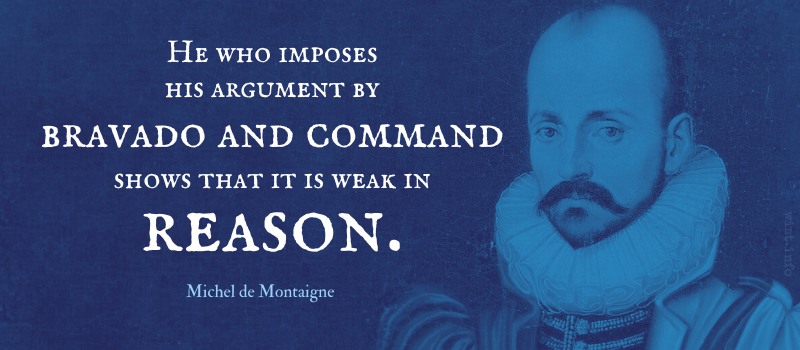
He who imposes his argument by bravado and command shows that it is weak in reason.
[Qui establit son discours par braverie et commandement, montre que la raison y est foible.]
Michel de Montaigne (1533-1592) French essayist
Essays, Book 3, ch. 11 “Of Cripples [Des Boyteux]” (1587) (3.11) (1595) [tr. Frame (1943)]
(Source)
(Source (French)). Alternate translations:
He that with braverie and by comaundement will establish his discourse, declareth his reason to be weake.
[tr. Florio (1603), "Of the Lame or Cripple"]
Who will establish his Discourse by Authority and Huffing, discovers his Reason to be very weak.
[tr. Cotton (1686)]
He who will establish this proposition by authority and huffing discovers his reason to be very weak.
[tr. Cotton/Hazlitt (1877), "On the Lame"]
He who establishes his argument by defiance and by command shews that his reasoning is weak.
[tr. Ives (1925)]
Any man who supports his opinion with challenges and commands demonstrates that his reasons for it are weak.
[tr. Screech (1987), "On the Lame"]
He who establishes his argument by noise and command shows that his reason is weak.
[Source]
Few men are admired by their servants.
Michel de Montaigne (1533-1592) French essayist
Essays, Book 3, ch. 11 (1580-1588)
‘Tis for little Souls, that truckle under the Weight of Affairs, not to know how clearly to disengage themselves, and not to know how to lay them aside, and take them up again.
[C’est aux petites ames ensevelies du poix des affaires, de ne s’en sçavoir purement desmesler : de ne les sçavoir et laisser et reprendre.]Michel de Montaigne (1533-1592) French essayist
Essays, Book 3, ch. 13 “On Experience [De l’Experience]” (1588) (3.13) (1595) [tr. Cotton (1686)]
(Source)
(Source (French)). Alternate translations:
It is for base and pettie mindes, dulled and overwhelmed with the weight of affaires, to be ignorant how to leave them, and not to know how to free themselves from them; nor how to leave and take them againe.
[tr. Florio (1603)]
’Tis for little souls, that truckle under the weight of affairs, not from them to know how clearly to disengage themselves, not to know how to lay them aside and take them up again.
[tr. Cotton/Hazlitt (1877)]
It is for small souls, buried under the weight of affairs, not to know how to free themselves therefrom entirely; not to know how to leave them and return to them.
[tr. Ives (1925)]
It is for little souls, buried under the weight of business, to be unable to detach themselves cleanly from it or to leave it and pick it up again.
[tr. Frame (1943)]
It is for petty souls overwhelmed by the weight of affairs to be unable to disentangle themselves for them completely, not knowing how to drop them and then take them up again.
[tr. Screech (1987)]
No desire is more natural than the desire for knowledge. We assay all the means that can lead us to it. When reason fails us we make use of experience. Experience is a weaker and less dignified means: but truth is so great a matter that we must not disdain any method that leads us to it.
[Il n’est desir plus naturel que le desir de cognoissance. Nous essayons tous les moyens qui nous y peuvent mener. Quand la raison nous faut, nous y employons l’experience. Qui est un moyen de beaucoup plus foible et plus vil. Mais la verité est chose si grande, que nous ne devons desdaigner aucune entremise qui nous y conduise.]
Michel de Montaigne (1533-1592) French essayist
Essays, Book 3, ch. 13 “On Experience [De l’Experience]” (1588) (3.13) (1595) [tr. Screech (1987)]
(Source)
Aristotle's Metaphysics opens with the phrase "All men by nature desire knowledge."
The 1595 edition included a quotation from Manilius inserted after the word "experience" (omitted here). It also added the second descriptor (after "weaker") of how experience compares to reason.
(Source (French)). Alternate translations:
There is no desire more naturall, then that of knowledge. We attempt all meanes that may bring us unto it. When reason failes us, we employ experience. Which is a meane by much more, weake and vile. But trueth is of so great consequence, that wee ought not disdaine any induction, that may bring us unto it.
[tr. Florio (1603)]
There is no Desire more natural than that of Knowledge: We try all Ways that can lead us to it; where Reason is wanting, we therein employ Experience which is a Means much more weak and cheap. But Truth is so great a thing, that we ought not to disdain any Mediation that will guide us to it.
[tr. Cotton (1686)]
There is no desire more natural than that of knowledge. We try all ways that can lead us to it; where reason is wanting, we therein employ experience which is a means much more weak and cheap; but truth is so great a thing, that we ought not to disdain any mediation that will guide us to it.
[tr. Cotton/Hazlitt (1877)]
There is no desire more natural than the desire for knowledge. We make trial of all means that can lead us to it. When reasoning fails us, we then make use of experience, which is a much feebler and lower means; but truth is so great a thing that we must not disdain any medium that leads us to it.
[tr. Ives (1925)]
There is no desire more natural than the desire for knowledge. We try all the ways that can lead us to it. When reason fails us, we use experience, which is a weaker and less dignified means. But truth is so great a thing that we must not disdain any medium that will lead us to it.
[tr. Frame (1943)]
The great and glorious masterpiece of man is to know how to live to purpose; all other things, to reign, to lay up treasure, to build, are, at most, but little appendices and props.
[Le glorieux chef-d’oeuvre de l’homme, c’est vivre à propos. Toutes autres choses ; regner, thesauriser, bastir, n’en sont qu’appendicules et adminicules, pour le plus.]
Michel de Montaigne (1533-1592) French essayist
Essays, Book 3, ch. 13 “On Experience [De l’Experience]” (after 1588) (3.13) (1595) [tr. Cotton/Hazlitt (1877)]
(Source)
This passage was added to the original version of the essay, published 1588, for the 1595 edition.
(Source (French)). Alternate translations:
The glorious master-piece of man, is, to live to the purpose. All other things, as to raigne, to governe, to hoarde up treasure, to thrive and to build, are for the most part but appendixes and supportes thereunto.
[tr. Florio (1603)]
The glorious Master-piece of Man is to know how to live to purpose; all other things, to reign, to lay up Treasure, and to build, are at the most but little Appendixes, and little Props.
[tr. Cotton (1686)]
Man's great and glorious master-work is to live befittingly; all other things -- to reign, to lay up treasure, to build -- are at the best mere accessories and aids.
[tr. Ives (1925)]
Our great and glorious masterpiece is to live appropriately. All other things, ruling, hoarding, building, are only little appendages and props, at most.
[tr. Frame (1943)]
Our most great and glorious achievement is to live our life fittingly. Everything else -- reigning, building, laying up treasure -- are at most tiny props and small accessories.
[tr. Screech (1987)]
No matter that we may mount on stilts, we still must walk on our own legs. And on the highest throne in the world, we still sit only on our own bottom.
[Si, avons nous beau monter sur des échasses, car sur des échasses encore faut-il marcher de nos jambes. Et au plus élevé trône du monde, si ne sommes assis que sur notre cul.]
Michel de Montaigne (1533-1592) French essayist
Essays, Book 3, ch. 13 (1580) [tr. Zeitlin (1936)]
Alt. trans.: "Even on the most exalted throne in the world we are only sitting on our own bottom." [Jacob Zeitlin (1936)]
We must learn to suffer whatever we cannot avoid. Our life is composed, like the harmony of the world, of discords as well as of different tones, sweet and harsh, sharp and flat, soft and loud. If a musician liked only some of them, what could he sing? He has got to know how to use all of them and blend them together. So too must we with good and ill, which are of one substance with our life. Without such blending our being cannot be: one category is no less necessary than the other.
Michel de Montaigne (1533-1592) French essayist
Essays, Book 3, Essay 13 “On Experience” (1587-88) [tr. Screech (1987)]
(Source)
Alt. trans.
- [Frame (1943)] "We must learn to endure what we cannot avoid. Our life is composed, like the harmony of the world, of contrary things, also of different tones, sweet and harsh, sharp and flat, soft and loud. If a musician liked only one kind, what would he have to say? He must know how to use them together and blend them. And so must we do with good and evil, which are consubstantial with our life. Our existence is impossible without this mixture, and one element is no less necessary for it than the other."
- [Source] "We must learn to suffer what we cannot evade; our life, like the harmony of the world, is composed of contrary things -- of diverse tones, sweet and harsh, sharp and flat, sprightly and solemn: the musician who should only affect some of these, what would he be able to do? He must know how to make use of them all, and to mix them; and so we should mingle the goods and evils which are consubstantial with our life; our being cannot subsist without this mixture, and the one part is no less necessary to it than the other."
- [Florio (1603)] A man must learne to endure that patiently which he cannot avoyde conveniently. Our life is composed, as is the harmony of the world, of contrary things: so of divers tunes, some pleasant, some harsh, some sharpe, some flat, some low, and some high. What would that musitian say that should love but some one of them? He ought to know how to use them severally and how to entermingle them. So should we both of goods and evils which art consubstnatiall to our life; our being cannot subsist without this commixture, whereto one side is no lesse necessary than the other."
It is not want, but rather abundance, that creates avarice.
Michel de Montaigne (1533-1592) French essayist
Essays, ch. 40 (1588)
The man who makes it his business to please the multitude is never done.
Michel de Montaigne (1533-1592) French essayist
The Autobiography of Michel de Montaigne, ch. 34 [ed. Marven Lowenthal (1935)]
We readily inquire, “Does he know Greek or Latin?” “Can he write poetry and prose?” But what matters most is what we put last: “Has he become better and wiser?” We ought to find out not who understands most but who understands best.
[Nous nous enquerons volontiers: “Sçait-il du Gre ou du Latin? Estriil en vers ou en prose?” Mais sìl est devenu ou plus advisé, c’estoit le principal, et c’est ce qui demeure derrier. Il falloit sènquerir qui est mieux sçavant, non qui est plus sçavant.]
Michel de Montaigne (1533-1592) French essayist
The Complete Essays, I:25 “On Schoolmasters [Du pédantisme]”
(Source)
Just as birds sometimes go in search of grain, carrying it in their beaks without tasting it to stuff it down the beaks of their young, so too do our schoolmasters go foraging for learning in their books and merely lodge it on the tip of their lips, only to spew it out and scatter it on the wind.
Michel de Montaigne (1533-1592) French essayist
The Complete Essays, I:25 “On Schoolmasters [Du pédantisme]”
(Source)
I gladly come back to the theme of the absurdity of our education: its end has not been to make us good and wise but learned. And it has succeeded. It has not taught us to seek virtue and to embrace wisdom: it has impressed upon us their derivation and their etymology. We know how to decline the Latin word for virtue: we do not know how to love virtue. Though we do not know what wisdom is in practice or from experience we do know the jargon off by heart.
Michel de Montaigne (1533-1592) French essayist
The Complete Essays, II:17 “On Presumption” [tr. Screech (1987)]
(Source)