

Happy is he who dares courageously to defend what he loves.
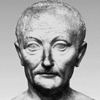
Ovid (43 BC-AD 17) Roman poet [Publius Ovidius Naso]
Amores, II.5
Quotations by:
Ovid
Nocte latent mendae, vitioque ignoscitur omni, Horaque formosam quamlibet illa facit.
[Blemishes are hidden by night and every fault forgiven; darkness makes any woman fair.]Ovid (43 BC-AD 17) Roman poet [Publius Ovidius Naso]
Ars Amatoria I.249-250
Expedit esse deos et ut expedit esse putemus.
[We need to think there to be gods and, since it is expedient, let us think that there are gods.]Ovid (43 BC-AD 17) Roman poet [Publius Ovidius Naso]
Ars Amatoria I.637
If you want to be loved, be lovable.
Ovid (43 BC-AD 17) Roman poet [Publius Ovidius Naso]
Ars Amatoria II.107
Prisca juvent alios; ego me nunc denique natum Gratulor.
[Let others praise ancient times; I am glad I was born in these.]Ovid (43 BC-AD 17) Roman poet [Publius Ovidius Naso]
Ars Amatoria III.121
Trans. by Sydney Smith: "The good of other times let people state; I think it lucky I was born so late."
Gratis paenitet esse probum
[A man is sorry to be honest for nothing.]Ovid (43 BC-AD 17) Roman poet [Publius Ovidius Naso]
Ex Ponto, Bk 2, ch 3
Trans. Henry T. Riley. Alt. translation (Bartlett): "It is annoying to be honest to no purpose."
Thy lot is mortal, but thy wishes fly
Beyond the province of mortality.Ovid (43 BC-AD 17) Roman poet [Publius Ovidius Naso]
Metamorphoses, I.69-70, “The Story of Phaeton”
Garth trans. Alternate translation: "Thy destiny is only that of man, but thy aspirations may be those of a god."
Medio tutissimis ibis.
[You will go most safely by the middle way.]Ovid (43 BC-AD 17) Roman poet [Publius Ovidius Naso]
Metamorphoses, II.137 “The Story of Phaeton”
Ill Habits gather by unseen Degrees —
As Brooks make Rivers, Rivers run to Seas.Ovid (43 BC-AD 17) Roman poet [Publius Ovidius Naso]
Metamorphosis, Book 15 “The Worship of Aesculapius,” l. 155 [tr. Dryden]
(Source)
Sometimes cited as Dryden's Abslolam and Achitophel (1681)
If Jupiter hurled his thunderbolt as often as men sinned, he would soon be out of thunderbolts.
Ovid (43 BC-AD 17) Roman poet [Publius Ovidius Naso]
Tristia, 2.33-34