

It has pleased God that divine verities should not enter the heart through the understanding, but the understanding through the heart.
Blaise Pascal (1623-1662) French scientist and philosopher
(Attributed)
Quotations by:
Pascal, Blaise
It appears from this, that whatever it may be of which we wish to persuade men, it is necessary to have regard to the person whom we wish to persuade, of whom we must know the mind and the heart, what principles he acknowledges, what things he loves
Blaise Pascal (1623-1662) French scientist and philosopher
(Attributed)
We sometimes learn more from the sight of evil than from an example of good; and it is well to accustom ourselves to profit by the evil which is so common, while that which is good is so rare.
Blaise Pascal (1623-1662) French scientist and philosopher
(Attributed)
Experience makes us see an enormous difference between piety and goodness.
Blaise Pascal (1623-1662) French scientist and philosopher
(Attributed)
If all men knew what others say of them, there would not be four friends in the world.
Blaise Pascal (1623-1662) French scientist and philosopher
(Attributed)
Kind words also produce their own image in men’s souls; and a beautiful image it is. They soothe and quiet and comfort the hearer. They shame him out of his sour, morose, unkind feelings. We have not yet begun to use kind words in such abundance as they ought to be used.
Blaise Pascal (1623-1662) French scientist and philosopher
(Attributed)
(Source)
Often attributed without citation in 19th Century works, e.g., The Golden Rule and Odd-Fellows' Family Companion, Vol. 7 (1847).
I have only made this [letter] longer, because I have not had the time to make it shorter.
[Je n’ai fait celle-ci plus longue que parce que je n’ai pas eu le loisir de la faire plus courte.]
Blaise Pascal (1623-1662) French scientist and philosopher
Lettres provinciales, #16 (1657)
Alt. trans.: "The present letter is a very long one, simply because I had no leisure to make it shorter." Sometimes attributed to Ben Franklin or Mark Twain. For more information see here.
People are generally better persuaded by the reasons which they have themselves discovered than by those which have come into the mind of others.
Blaise Pascal (1623-1662) French scientist and philosopher
On Mind and On Style
The heart has its reasons, which reason does not know. We feel it in a thousand things. It is the heart which experiences God, and not the reason. This, then, is faith: God felt by the heart, not by the reason.
[Le coeur a ses raisons, que la raison ne connaît point. On le sent en mille choses. C’est le cœur qui sent Dieu, et non la raison. Voilà ce que c’est que la foi parfaite, Dieu sensible au cœur.]
Blaise Pascal (1623-1662) French scientist and philosopher
Pensées (1670)
What use is it to us to hear it said of a man that he has thrown off the yoke, that he does not believe there is a God to watch over his actions, that he reckons himself the sole master of his behavior, and that he does not intend to give an account of it to anyone but himself? Does he think that in that way he will have straightway persuaded us to have complete confidence in him, to look to him for consolation, for advice, and for help, in the vicissitudes of life? Do such men think that they have delighted us by telling us that they hold our souls to be nothing but a little wind and smoke — and by saying it in conceited and complacent tones? Is that a thing to say blithely? Is it not rather a thing to say sadly — as if it were the saddest thing in the world?
Blaise Pascal (1623-1662) French scientist and philosopher
Pensées (1670)
When I have occasionally set myself to consider the different distractions of men, the pains and perils to which they expose themselves at court or in war, whence arise so many quarrels, passions, bold and often bad ventures, etc., I have discovered that all the unhappiness of men arises from one single fact, that they cannot stay quietly in their own chamber.
Blaise Pascal (1623-1662) French scientist and philosopher
Pensées #139 “Diversion” (1670)
(Source)
Alt. trans.: "I have often said that man's unhappiness springs from one thing alone, his incapacity to stay quietly in one room."
Alt. trans.: "All the trouble in the world is due to the fact that a man cannot sit still in a room."
Do you wish people to think well of you? Don’t speak well of your-self.
[Voulez-vous qu’on croie du bien de vous? N’en dites point.]
Blaise Pascal (1623-1662) French scientist and philosopher
Pensées, # 4 (1670)
Alt. trans.:
- "If you want people to think well of you, do not speak well of yourself."
- "Do you want people to think well of you? Don't say a word about it."
The multitude which is not brought to act as a unity is confusion. That unity which has not its origin in the multitude is tyranny.
Blaise Pascal (1623-1662) French scientist and philosopher
Pensées, # 77 (1670)
(Source)
Alt. trans.: "The multitude which is not reduced to the unity is confusion; the unity which does not depend on the multitude is tyranny."
It is natural for the mind to believe, and for the will to love; so that, for want of true objects, they must attach themselves to false.
Blaise Pascal (1623-1662) French scientist and philosopher
Pensées, # 81 (1670) [tr. W. Totter (1931)]
The most powerful cause of error is the war existing between the senses and reason.
Blaise Pascal (1623-1662) French scientist and philosopher
Pensées, # 82 (1670) [tr. Trotter (1931)]
Justice without might is helpless; might without justice is tyrannical.
Blaise Pascal (1623-1662) French scientist and philosopher
Pensées, #298 (1670) [tr. Trotter (1931)]
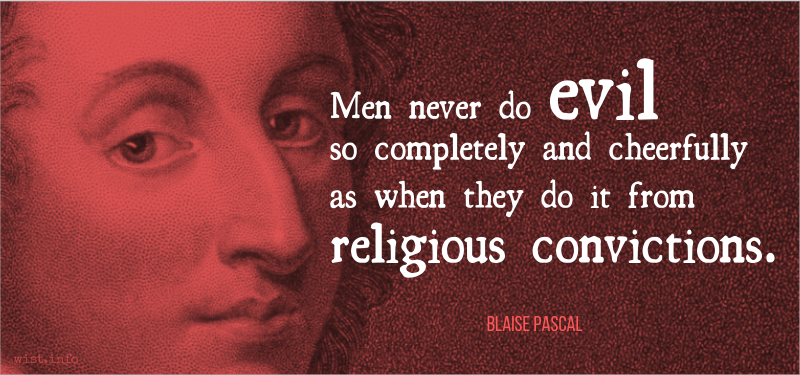
Men never do evil so completely and cheerfully as when they do it from religious convictions.
[Jamais on ne fait le mal si pleinement et si gaiement, que quand on le fait par un faux principe de conscience.]
Blaise Pascal (1623-1662) French scientist and philosopher
Pensées, ch. 14, Appendix: Polemical Fragments #895 (1669) [tr. Trotter (1910)]
(Source)
Also labeled as Part 2, Article 17, # 53. Sometimes also shown in slightly shorter French as "Jamais on ne fait le mal si pleinement et si gaiement que quand on le fait par conscience."
(Source (French)). Alternate translations:
- "We never do evil so fully and cheerfully as when we do it out of conscience." [#813 (#895), tr. Krailsheimer]
- "We never do evil so completely and cheerfully as when we do it out of conscience." [Miscellaneous Thoughts 7: Sellier #658/Lafuma #813, tr. Ariew]
- "Men never do evil so completely and cheerfully as when they do it conscientiously."
To ridicule philosophy, that is really to act the philosopher.
[Se moquer de la philosophie c’est vraiment philosophe.]
Blaise Pascal (1623-1662) French scientist and philosopher
Thoughts [Pensées], Article 7, #35 (1670)
Pascal's works are sorted and classified by translators in a variety of ways, so numbering is inconsistent. Alternate translations:
- "To have no time for philosophy is to be a true philosopher." [tr. Krailsheimer (2003); Series 22, #513]
- "To make light of philosophy is to be a true philosopher." [tr. Paul (1885), "Various Thoughts"; also Trotter (1958), Sec. 1, #4]
- "To ridicule philosophy is really to philosophize." [#430]
- "To ridicule philosophy is truly philosophical."
- "To mock philosophy is to philosophize truly"
- "To mock philosophy is to be a true philosopher."