

Philosophy, brought afresh to repute by Kant […] had soon become a tool of interests; of state interests […] The driving forces of this movement are, contrary to all these solemn airs and assertions, not ideal […] Party interests are vehemently agitating the pens of so many purer lovers of wisdom […] truth is certainly the last thing they have in mind […] Philosophy is misused, from the side of the state as tool, from the other side as means of gain […] Governments make of philosophy a means of serving their state interests, and scholars make of it a trade.
Arthur Schopenhauer (1788-1860) German philosopher
(Attributed)
(Source)
Criticizing Hegel and Hegelianism, and the latter's state-philosophy alliance. Attributed in Karl Popper, The Open Society and Its Enemies, ch. 12 (1945).
Quotations by:
Schopenhauer, Arthur

Life […] is really a constant suffering, or, at any rate, […] a business that does not cover the costs.
[Da das Leben […] eigentlich ein stetes Leiden, oder wenigstens, […] ein Geschäft ist, welches die Kosten nicht deckt.]
Arthur Schopenhauer (1788-1860) German philosopher
Die Welt als Wille und Vorstellung [The World as Will and Representation], Vol. 2, ch. 19 “Vom Primat des Willens im Selbstbewußtseyn [On the primacy of the Will in Self-Consciousness],” § 11 (1844 ed.) [tr. Payne (1958)]
(Source)
(Source (German)). Usually paraphrased: "Life is a business that does not cover the costs."
Talent is able to achieve what is beyond other people’s capacity to achieve, yet not what is beyond their capacity of apprehension; therefore it at once finds its appreciators. The achievement of genius, on the other hand, transcends not only others’ capacity of achievement, but also their capacity of apprehension; therefore they do not become immediately aware of it. Talent is like the marksman who hits a target which others cannot reach; genius is like the marksman who hits a target, as far as which others cannot even see.
[Das Talent vermag zu leisten was die Leistungsfähigkeit, jedoch nicht die Apprehensionsfähigkeit der Uebrigen überschreitet: daher findet es sogleich seine Schätzer. Hingegen geht die Leistung des Genies nicht nur über die Leistungs, sondern auch über die Apprehensionsfähigkeit der Andern hinaus: daher werden Diese seiner nicht unmittelbar inne. Das Talent gleicht dem Schützen, der ein Ziel trifft, welches die Uebrigen nicht erreichen können; das Genie dem, der eines trifft, bis zu welchem sie nicht ein Mal zu sehn vermögen.]
Arthur Schopenhauer (1788-1860) German philosopher
Die Welt als Wille und Vorstellung [The World as Will and Representation], Vol. 2, ch. 31 “Vom Genie [On Genius]” (1844 ed.) [tr. Payne (1958)]
(Source)
(Source (German)). Referencing Vol. 1, sec. 36.
Commonly paraphrased: "Talent hits a target no-one else can hit; genius hits targets no-one else can see."
Boundless compassion for all living things is the firmest and surest guarantee of pure moral conduct, and needs no casuistry. Whoever is inspired with it will assuredly injure no one, will wrong no one, will encroach on no one’s rights; on the contrary, he will be lenient and patient with everyone, will forgive everyone, will help everyone as much as he can, and all his actions will bear the stamp of justice, philanthropy, and loving-kindness. On the other hand, if we attempt to say, “This man is virtuous but knows no compassion,” or “He is an unjust and malicious man yet he is very compassionate,” the contradiction is obvious.
[Denn gränzenloses Mitleid mit allen lebenden Wesen ist der festeste und sicherste Bürge für das sittliche Wohlverhalten und bedarf keiner Kasuistik. Wer davon erfüllt ist, wird zuverlässig Keinen verletzen, Keinen beeinträchtigen, Keinem wehe thun, vielmehr mit Jedem Nachsicht haben, Jedem verzeihen, Jedem helfen, so viel er vermag, und alle seine Handlungen werden das Gepräge der Gerechtigkeit und Menschenliebe tragen. Hingegen versuche man ein Mal zu sagen: „dieser Mensch ist tugendhaft, aber er kennt kein Mitleid.” oder: „es ist ein ungerechter und boshafter Mensch; jedod, ist er sehr mitleidig;” so wird der Widerspruch fühlbar.]
Arthur Schopenhauer (1788-1860) German philosopher
On the Basis of Morality [Über die Grundlage der Moral], § 19.4 (Part 3, ch. 8.4) (1840) [tr. Saunders (1965)]
(Source)
(Source (German)). Alternate translation:
Boundless compassion for all living beings is the surest and most certain guarantee of pure moral conduct, and needs no casuistry. Whoever is filled with it will assuredly injure no one, do harm to no one, encroach on no man's rights ; he will rather have regard for every one, forgive every one, help every one as far as he can, and all his actions will bear the stamp of justice and loving-kindness. On the other hand, if we try to say: "This man is virtuous, but he is a stranger to Compassion"; or: "he is an unjust and malicious man, yet very compassionate;" the contradiction at once leaps to light.
[tr. Bullock (1903)]
Tastes differ, but I know of no finer prayer than the one which ends old Indian dramas (just as in former times English plays ended with a prayer for the King). It runs: “May all living beings remain free from pain.”
[Der Geschmack ist verschieden; aber ich weiß mir kein schöneres Gebet, als Das, womit die Alt-Indischen Schauspiele (wie in früheren Zeiten die Englischen mit dem für den König) schließen. Es lautet: „Mögen alle lebenden Wesen von Schmerzen frei bleiben.”]
Arthur Schopenhauer (1788-1860) German philosopher
On the Basis of Morality [Über die Grundlage der Moral], § 19.4 (Part 3, ch. 8.4) (1840) [tr. Saunders (1965)]
(Source)
(Source (German)). Alternate translation:
In former times the English plays used to finish with a petition for the King. The old Indian dramas close with these words: "May all living beings be delivered from pain." Tastes differ; but in my opinion there is no more beautiful prayer than this.
[tr. Bullock (1903)]
Ordinary men are intent merely on how to spend their time; a man with any talent is interested in how to use his time.
[Die gewöhnlichen Leute sind bloß darauf bedacht, die Zeit zuzubringen; wer irgend ein Talent hat, — sie zu benutzen.]
Arthur Schopenhauer (1788-1860) German philosopher
Parerga and Paralipomena, Vol. 1, “Aphorisms on the Wisdom of Life [Aphorismen zur Lebensweisheit],” ch. 2 “Of What One Is” [Von dem, was einer ist]” (1851) [tr. Payne (1974)]
(Source)
(Source (German)). Alternate translation:
Ordinary people think merely how they shall spend their time; a man of any talent tries to use it.
[tr. Saunders (1890)]
The most general survey shows us that the two foes of human happiness are pain and boredom.
[Der allgemeinste Überblick zeigt uns, als die beiden Feinde des menschlichen Glückes, den Schmerz und die Langeweile.]
Arthur Schopenhauer (1788-1860) German philosopher
Parerga and Paralipomena, Vol. 1, “Aphorisms on the Wisdom of Life [Aphorismen zur Lebensweisheit],” ch. 2 “Of What One Is” [Von dem, was einer ist]” (1851) [tr. Saunders (1890)]
(Source)
(Source (German)). Alternate translation:
The most general survey shows that pain and boredom are the two foes of human happiness.
[tr. Payne (1974)]
It is a great piece of folly to sacrifice the inner for the outer man, to give the whole or the greater part of one’s quiet, leisure, and independence for splendor, rank, pomp, titles and honor.
[Es ist eine große Thorheit, um nach Außen zu gewinnen, nach Innen zu verlieren, d. h. für Glanz, Rang, Prunk, Titel und Ehre, seine Ruhe, Muße und Unabhängingkeit ganz oder großen Theils hinzurgeben.]
Arthur Schopenhauer (1788-1860) German philosopher
Parerga and Paralipomena, Vol. 1, “Aphorisms on the Wisdom of Life [Aphorismen zur Lebensweisheit],” ch. 2 “Personality, or What Man Is [Von dem, was einer ist]” (1851) [tr. Saunders (1890)]
(Source)
(Source (German)). Alternate translation:
It is a great folly to lose the inner man in order to gain the outer, that is, to give up the whole or the greater part of one's quiet, leisure, and independence for splendor, rank, pomp, titles and honors.
[tr. Payne (1974)]
With health, everything is a source of pleasure; without it, nothing else, whatever it may be, is enjoyable; even the other personal blessings, — a great mind, a happy temperament — are degraded and dwarfed for want of it. So it is really with good reason that, when two people meet, the first thing they do is to inquire after each other’s health, and to express the hope that it is good; for good health is by far the most important element in human happiness.
[Mit ihr wird alles eine Quelle des Genusses: hingegen ist ohne sie kein äußeres Gut, welcher Art es auch sei, genießbar, und selbst die übrigen subjektiven Güter, die Eigenschaften des Geistes, Gemütes, Temperaments, werden durch Kränklichkeit herabgestimmt und sehr verkümmert. Demnach geschieht es nicht ohne Grund, daß man vor allen Dingen sich gegenseitig nach dem Gesundheitszustande befragt und einander sich wohlzubefinden wünscht: denn wirklich ist dieses bei weitem die Hauptsache zum menschlichen Glück.]
Arthur Schopenhauer (1788-1860) German philosopher
Parerga and Paralipomena, Vol. 1, “Aphorisms on the Wisdom of Life [Aphorismen zur Lebensweisheit],” ch. 2 “What a Man Is [Von dem, was einer ist]” (1851) [tr. Saunders (1890)]
(Source)
(Source (German)). Alternate translation:
In general, however, nine-tenths of our happiness depends on health alone. With it everything becomes a source of pleasure, whereas without it nothing, whatever it may be, can be enjoyed, and even the other subjective blessings, such as mental qualities, disposition, and temperament, are depressed and dwarfed by ill-health. Accordingly, it is not without reason that, when two people meet, they first ask about the state of each other's health and hope that it is good; for this really is for human happiness by far the most important thing.
[tr. Payne (1974)]
Precisely in trifles, wherein a man is off his guard, does he show his character, and then we are often able at our leisure to observe in small actions or mere mannerisms the boundless egoism which has not the slightest regard for others and in matters of importance does not afterwards deny itself, although it is disguised. We should never miss such an opportunity. If in the petty affairs and circumstances of everyday life, in the things to which the de minimis lex non curat applies, a man acts inconsiderately, seeking merely his own advantage or convenience to the disadvantage of others; if he appropriates that which exists for everybody; then we may be sure that there is no justice in his heart, but that he would be a scoundrel even on a large scale if his hands were not tied by law and authority; we should not trust him across our threshold. Indeed, whoever boldly breaks the laws of his own circle will also break those of the State whenever he can do so without risk.
[Gerade in Kleinigkeiten, als bei welchen der Mensch sich nicht zusammennimmt, zeigt er seinen Charakter, und da kann man oft, an geringfügigen Handlungen, an bloßen Manieren, den gränzenlosen, nicht die mindeste Rücksicht auf Andere kennenden Egoismus bequem beobachten, der sich nachher im Großen nicht verleugnet, wiewohl verlarvt. Und man versäume solche Gelegenheit nicht. Wenn Einer in dem kleinen täglichen Vorgängen und Verhältnissen des Lebens, in den Dingen, von welchen das de minimis lex non curat gilt, rücksichtslos verfährt, bloß seinen Vertheil oder seine Bequemlichkeit, zum Nachtheil Andere, sucht; wenn er sich angeignet was für Alle da ist u. s. w.; da sei man überzeugt, daß in seinem Herzen keine Gerechtigkeit wohnt, sondern er auch im Großen ein Schuft sein wird, sobald das Gesetz und die Gewalt ihm nicht die Hände binden, und traue ihm nicht über die Schwelle. Ja, wer ohne Scheu die Gesetze seines Klubs bricht, wird auch die des Staates brechen, sobald er es ohne Gefahr kann.]
Arthur Schopenhauer (1788-1860) German philosopher
Parerga and Paralipomena, Vol. 1, “Aphorisms on the Wisdom of Life [Aphorismen zur Lebensweisheit],” ch. 4 “Counsels and Maxims [Paränesen und Maximen],” § 3.29 (1851) [tr. Payne (1974)]
(Source)
The Latin means, "The law is not concerned with trifles." (Source (German)) Alternate translations:
A man shows his character just in the way in which he deals with trifles, -- for then he is off his guard. This will often afford a good opportunity of observing the boundless egoism of man's nature, and his total lack of consideration for others; and if these defects show themselves in small things, or merely in his general demeanor, you will find that they also underlie his action in matters of importance, although he may disguise the fact. This is an opportunity which should not be missed. If in the little affairs of every day, -- the trifles of life, those matters to which the rule de minimis non applies, -- a man is inconsiderate and seeks only what is advantageous or convenient to himself, to the prejudice of others' rights; if he appropriates to himself that which belongs to all alike, you may be sure there is no justice in his heart, and that he would be a scoundrel on a wholesale scale, only that law and compulsion bind his hands. Do not trust him beyond your door. He who is not afraid to break the laws of his own private circle, will break those of the State when he can do so with impunity.
[tr. Saunders (1890)]
Men best show their character in trifles, where they are not on their guard. It is in insignificant matters, and in the simplest habits, that we often see the boundless egotism which pays no regard to the feeling of others, and denies nothing to itself.
[In Tryon Edwards, A Dictionary of Thoughts, "Character" (1891); this is the version quoted most often.]
On the other hand, the cheapest form of pride is national pride; for the man affected therewith betrays a want of individual qualities of which he might be proud, since he would not otherwise resort to that which he shares with so many millions. The man who possesses outstanding personal qualities will rather see most clearly the faults of his own nation, for he has them constantly before his eyes. But every miserable fool, who has nothing in the world whereof he could be proud, resorts finally to being proud of the very nation to which he belongs. In this he finds compensation and is now ready and thankful to defend, “tooth and nail,” all the faults and follies peculiar to it.
[Die wohlfeilste Art des Stolzes hingegen ist der Nationalstolz. Denn er verrät in dem damit Behafteten den Mangel an individuellen Eigenschaften, auf die er stolz sein könnte, indem er sonst nicht zu dem greifen würde, was er mit so vielen Millionen teilt. Wer bedeutende persönliche Vorzüge besitzt, wird vielmehr die Fehler seiner eigenen Nation, da er sie beständig vor Augen hat, am deutlichsten erkennen. Aber jeder erbärmliche Tropf, der nichts in der Welt hat, darauf er stolz sein könnte, ergreift das letzte Mittel, auf die Nation, der er gerade angehört, stolz zu sein. Hieran erholt er sich und ist nun dankbarlich bereit, alle Fehler und Torheiten, die ihr eigen sind, mit Händen und Füßen zu verteidigen.]
Arthur Schopenhauer (1788-1860) German philosopher
Parerga and Paralipomena, Vol. 1, “Aphorisms on the Wisdom of Life [Aphorismen zur Lebensweisheit],” ch. 4 “From What One Imagines [Von dem, was einer vorstellt]” (1851) [tr. Payne (1974)]
(Source)
(Source (German)). Alternate translation:
The cheapest sort of pride is national pride; for if a man is proud of his own nation, it argues that he has no qualities of his own of which he can be proud; otherwise he would not have recourse to those which he shares with so many millions of his fellowmen. The man who is endowed with important personal qualities will be only too ready to see clearly in what respects his own nation falls short, since their failings will be constantly before his eyes. But every miserable fool who has nothing at all of which he can be proud adopts, as a last resource, pride in the nation to which he belongs; he is ready and glad to defend all its faults and follies tooth and nail, thus reimbursing himself for his own inferiority.
[tr. Saunders (1890)]
The cheapest form of pride however is national pride. For it betrays in the one thus afflicted the lack of individual qualities of which he could be proud, while he would not otherwise reach for what he shares with so many millions. He who possesses significant personal merits will rather recognise the defects of his own nation, as he has them constantly before his eyes, most clearly. But that poor beggar who has nothing in the world of which he can be proud, latches onto the last means of being proud, the nation to which he belongs to. Thus he recovers and is now in gratitude ready to defend with hands and feet all errors and follies which are its own.
[Source]
National character is only another name for the particular form which the littleness, perversity, and baseness of mankind take in every country. If we become disgusted with one, we praise another, until we get disgusted with this too. Every nation mocks at other nations, and all are right.
[Dem Nationalcharakter wird, da er von der Menge redet, nie viel Gutes ehrlicherweise nachzurühmen sein. Vielmehr erscheint nur die menschliche Beschränktheit, Verkehrtheit und Schlechtigkeit in jedem Lande in einer andern Form und diese nennt man den Nationalcharakter. Von einem derselben degoutirt loben wir den andern, bis es uns mit ihm eben so ergangen ist. — Jede Nation spottet über die andere, und alle haben recht.]
Arthur Schopenhauer (1788-1860) German philosopher
Parerga and Paralipomena, Vol. 1, “Aphorisms on the Wisdom of Life [Aphorismen zur Lebensweisheit],” ch. 4 “Position, or a Man’s Place in the Estimation of Others [Von dem, was einer vorstellt]” (1851) [tr. Saunders (1890), 4.2]
(Source)
(Source (German)). Alternate translation:
Since national character speaks of the crowd, not much good will ever be honestly said in its favour. On the contrary, we see in a different form in each country only human meanness, perversity, and depravity, and this is called national character. Having become disgusted with one of them, we praise another until we become just as disgusted with it. Every nation ridicules the rest and all are right.
[tr. Payne (1974), ch. 4 "What a Man Represents"]
Further, a little self-control at the right moment may prevent much subsequent compulsion at the hands of others.
[Daß jedoch ein kleiner, an der rechten Stelle angebrachter Selbstzwang nachmals vielem Zwange von außen vorbeugt.]
Arthur Schopenhauer (1788-1860) German philosopher
Parerga and Paralipomena, Vol. 1, “Aphorisms on the Wisdom of Life [Aphorismen zur Lebensweisheit],” ch. 5 “Counsels and Maxims [Paränesen und Maximen],” § 2.15 (1851) [tr. Saunders (1890)]
(Source)
Source (German). Alternate translation:
Nevertheless, a little self-restraint applied at the right place afterwards prevents much restraint from without.
[tr. Payne (1974), 2.15]
Let everyone, then, do something, according to the measure of his capacities. To have no regular work, no set sphere of activity — what a miserable thing it is! How often long travels undertaken for pleasure make a man downright unhappy; because the absence of anything that can be called occupation forces him, as it were, out of his right element. Effort, struggles with difficulties! that is as natural to a man as grubbing in the ground is to a mole. To have all his wants satisfied is something intolerable — the feeling of stagnation which comes from pleasures that last too long. To overcome difficulties is to experience the full delight of existence.
[Inzwischen treibe jeder etwas, nach Maßgabe seiner Fähigkeiten. Denn wie nachteilig der Mangel an planmäßiger Tätigkeit, an irgend einer Arbeit, auf uns wirke, merkt man auf langen Vergnügungsreisen, als wo man, dann und wann, sich recht unglücklich fühlt; weil man, ohne eigentliche Beschäftigung, gleichsam aus seinem natürlichen Elemente gerissen ist. Sich zu mühen und mit dem Widerstande zu kämpfen ist dem Menschen Bedürfnis, wie dem Maulwurf das Graben. Der Stillstand, den die Allgenugsamkeit eines bleibenden Genusses herbeiführte, wäre ihm unerträglich. Hindernisse überwinden ist der Vollgenuß seines Daseins.]
Arthur Schopenhauer (1788-1860) German philosopher
Parerga and Paralipomena, Vol. 1, “Aphorisms on the Wisdom of Life [Aphorismen zur Lebensweisheit],” ch. 5 “Counsels and Maxims [Paränesen und Maximen],” § 2.17 (1851) [tr. Saunders (1890)]
(Source)
(Source (German)). Alternate translation:
Nevertheless, everyone should do something according to the measure of his abilities. For on long pleasure-trips we see how pernicious is the effect on us of not having any systematic activity or work. On such trips we feel positively unhappy because we are without any proper occupation and are, so to speak, torn from our natural element. Effort, trouble, and struggle with opposition are as necessary to man as grubbing in the ground is to a mole. The stagnation that results from being wholly contented with a lasting pleasure would be for him intolerable. The full pleasure of his existence is in overcoming obstacles.
[tr. Payne (1974)]
There is always something pleasurable in the struggle and the victory. And if a man has no opportunity to excite himself, he will do what he can to create one, and according to his individual bent, he will hunt or play Cup and Ball: or led on by this unsuspected element in his nature, he will pick a quarrel with someone, or hatch a plot or intrigue, or take to swindling and rascally courses generally — all to put an end to a state of repose which is intolerable.
[Der Kampf mit ihnen und der Sieg beglückt. Fehlt ihm die Gelegenheit dazu, so macht er sie sich, wie er kann: je nachdem seine Individualität es mit sich bringt, wird er jagen, oder Bilboquet spielen, oder, vom unbewußten Zuge seiner Natur geleitet, Händel suchen, oder Intriguen anspinnen, oder sich auf Betrügereien und allerlei Schlechtigkeiten einlassen, um nur dem ihm unerträglichen Zustande der Ruhe ein Ende zu machen.]
Arthur Schopenhauer (1788-1860) German philosopher
Parerga and Paralipomena, Vol. 1, “Aphorisms on the Wisdom of Life [Aphorismen zur Lebensweisheit],” ch. 5 “Counsels and Maxims [Paränesen und Maximen],” § 2.17 (1851) [tr. Saunders (1890)]
(Source)
(Source (German)). Alternate translation:
The struggle with [obstacles] and the triumph make him happy. If he lacks the opportunity for this, he creates it as best he can; according to the nature of his individuality, he will hunt or play cup and ball; or, guided by the unconscious urge of his nature, he will pick a quarrel, hatch a plot, or be involved in fraud and all kinds of wickedness, merely in order to put an end to an intolerable state of repose.
[tr. Payne (1974)]
But we live through the fine days without noticing them; only when we fall on evil ones do we wish to have back the former. With sour faces we let a thousand bright and pleasant hours slip by unenjoyed and afterwards vainly sigh for their return when times are trying and depressing. Instead of this, we should cherish every present moment that is bearable, even the most ordinary, which with such indifference we now let slip by, and even with impatience push on.
[Aber wir verleben unsre schönen Tage, ohne sie zu bemerken: erst wann die schlimmen kommen, wünschen wir jene zurück. Tausend heitere, angenehme Stunden lassen wir, mit verdrießlichem Gesicht, ungenossen an uns vorüberziehn, um nachher, zur trüben Zeit, mit vergeblicher Sehnsucht ihnen nachzuseufzen. Statt dessen sollten wir jede erträgliche Gegenwart, auch die alltägliche, welche wir jetzt so gleichgültig vorüberziehn lassen, und wohl gar noch ungeduldig nachschieben.]
Arthur Schopenhauer (1788-1860) German philosopher
Parerga and Paralipomena, Vol. 1, “Aphorisms on the Wisdom of Life [Aphorismen zur Lebensweisheit],” ch. 5 “Counsels and Maxims [Paränesen und Maximen],” § 2.5 (1851) [tr. Payne (1974)]
(Source)
(Source (German)). Alternate translation:
But we live through our days of happiness without noticing them; it is only when evil comes upon us that we wish them back. A thousand gay and pleasant hours are wasted in ill-humor; we let them slip by unenjoyed, and sigh for them in vain when the sky is overcast. Those present moments that are bearable, be they never so trite and common, -- passed by in indifference, or, it may be, impatiently pushed away.
[tr. Saunders (1890)]
Experience of the world may be looked upon as a kind of text, to which reflection and knowledge form the commentary. Where there is great deal of reflection and intellectual knowledge, and very little experience, the result is like those books which have on each page two lines of text to forty lines of commentary. A great deal of experience with little reflection and scant knowledge, gives us books like those of the editio Bipontina where there are no notes and much that is unintelligible.
[Auch läßt die eigene Erfahrung sich ansehn als der Text; Nachdenken und Kenntnisse als der Kommentar dazu. Viel Nachdenken und Kenntnisse, bei wenig Erfahrung, gleicht den Ausgaben, deren Seiten zwei Zeilen Text und vierzig Zeilen Kommentar darbieten. Viel Erfahrung, bei wenig Nachdenken und geringen Kenntnissen, gleicht den bipontinischen Ausgaben, ohne Noten, welche Vieles unverstanden lassen.]
Arthur Schopenhauer (1788-1860) German philosopher
Parerga and Paralipomena, Vol. 1, “Aphorisms on the Wisdom of Life [Aphorismen zur Lebensweisheit],” ch. 5 “Counsels and Maxims [Paränesen und Maximen],” § 2.8 (1851) [tr. Saunders (1890)]
(Source)
Saunders notes that the editiones Bipontinae were "a series of Greek, Latin and French classics published at Zweibraecken in the Palatinate, from and after the year 1779."
Source (German). Alternate translation:
Our own experience may be regarded as the text, and reflection and knowledge as the commentary thereto. Much reflection and knowledge with little experience resemble those editions whose pages present us with two lines of text and forty lines of commentary. Much experience with little reflection and scanty knowledge is like the editiones Bipontinae which are without notes and contain much that is unintelligible.
[tr. Payne (1974)]
The worst of what is called good society is not only that it offers us the companionship of people who are unable to win either our praise or our affection, but that it does not allow of our being that which we naturally are; it compels us, for the sake of harmony, to shrivel up, or even alter our shape altogether. Intellectual conversation, whether grave or humorous, is only fit for intellectual society; it is downright abhorrent to ordinary people, to please whom it is absolutely necessary to be commonplace and dull. This demands an act of severe self-denial; we have to forfeit three-fourths of ourselves in order to become like other people.
[Demnach hat die Gesellschaft, welche man die gute nennt, nicht nur den Nachtheil, daß sie uns Menschen darbietet, die wir nicht loben und lieben können, sondern sie läßt auch nicht zu, daß wir selbst seien, wie es unsrer Natur angemessen ist; vielmehr nöthigt sie uns, des Einklanges mit den Anderen wegen, einzuschrumpfen, oder gar uns selbst zu verunstalten. Geistreiche Reden oder Einfälle gehören nur vor geistreiche Gesellschaft: in der gewönlichen sind sie geradezu verhaßt; denn um in diser zu gefallen, ist durchaus notwendig, daß man platt und bornirt sei. In solcher Gesellschaft wir daher, mit schwerer Selbstverleugnung, 3/4 unsrer selbst aufgeben, um uns den Andern zu verähnlichen.]
Arthur Schopenhauer (1788-1860) German philosopher
Parerga and Paralipomena, Vol. 1, “Aphorisms on the Wisdom of Life [Aphorismen zur Lebensweisheit],” ch. 5 “Counsels and Maxims [Paränesen und Maximen],” § 2.9 (1851) [tr. Saunders (1890)]
(Source)
(Source (German)). Alternate translation:
Accordingly, society that is called good not only has the drawback of offering us men whom we cannot praise and like, but also it will not allow us to be ourselves in harmony with our nature. On the contrary, it compels us, for the sake of agreeing with others, to shrivel up and even alter our shape. Intellectual talking and ideas are fit only for intellectual society; in ordinary society they are positively loathed, for here in order to go down well it is absolutely necessary to be dull and narrow-minded. In such society, therefore, we must practise great self-denial and give up three-quarters of our own individuality in order to become like other people.
[tr. Payne (1974)]
Politeness is prudence and consequently rudeness is folly. To make enemies by being wantonly and unnecessarily rude is as crazy as setting one’s house on fire.
[Höflichkeit ist Klugheit; folglich ist Unhöflichkeit Dummheit: sich mittelst ihrer unnötiger und mutwilliger Weise Feinde machen ist Raserei, wie wenn man sein Haus in Brand steckt.]
Arthur Schopenhauer (1788-1860) German philosopher
Parerga and Paralipomena, Vol. 1, “Aphorisms on the Wisdom of Life [Aphorismen zur Lebensweisheit],” ch. 5 “Counsels and Maxims [Paränesen und Maximen],” § 3.36 (1851) [tr. Payne (1974)]
(Source)
Source (German). Alternate translation:
It is a wise thing to be polite; consequently, it is a stupid thing to be rude. To make enemies by unnecessary and willful incivility, is just as insane a proceeding as to set your house on fire.
[tr. Saunders (1890)]
Politeness is a tacit agreement that people’s miserable defects, whether moral or intellectual, shall on either side be ignored and not made the subject of reproach; and since these defects are thus rendered somewhat less obtrusive, the result is mutually advantageous.
[Sie ist eine stillschweigende Übereinkunft, gegenseitig die moralisch und intellektuell elende Beschaffenheit von einander zu ignoriren und sie sich nicht vorzurücken; – wodurch diese, zu beiderseitigem Vorteil, etwas weniger leicht zutage kommt.]
Arthur Schopenhauer (1788-1860) German philosopher
Parerga and Paralipomena, Vol. 1, “Aphorisms on the Wisdom of Life [Aphorismen zur Lebensweisheit],” ch. 5 “Counsels and Maxims [Paränesen und Maximen],” § 3.36 (1851) [tr. Saunders (1890)]
(Source)
Source (German). Alternate translation:
Politeness is a tacit agreement that we shall mutually ignore and refrain from reproaching one another's miserable defects, both moral and intellectual. In this way, they do not so readily come to light, to the advantage of both sides.
[tr. Payne (1974)]
Every good human quality is related to a bad one into which it threatens to pass over; and every bad quality is similarly related to a good one. The reason we so often misunderstand people is that when we first make their acquaintance we mistake their bad qualities for the related good ones, or vice versa: thus a prudent man will seem cowardly, a thrifty one avaricious; or a spendthrift will seem liberal, a boor frank and straightforward, an impudent fellow full of noble self-confidence, and so on.
[Jede menschliche Vollkommenheit ist einem Fehler verwandt, in welchen überzugehn sie droht; jedoch auch, umgekehrt, jeder Fehler, einer Vollkommenheit. Daher beruht der Irrthum, in welchen wir, hinsichtlich eines Menschen, gerathen, oft darauf, daß wir, im Anfang der Bekanntschaft, seine Fehler mit den ihnen verwandten Vollkommenheiten verwechseln, oder auch umgekehrt: da scheint uns dann der Vorsichtige feige, der Sparsame geizig; oder auch der Verschwender liberal, der Grobian gerade und aufrichtig, der Dummdreiste als mit edelem Selbstvertrauen auftretend, u. dgl. m]
Arthur Schopenhauer (1788-1860) German philosopher
Parerga and Paralipomena, Vol. 2, ch. 8 “On Ethics [Zur Ethik],” § 113 (1851) [tr. Hollingdale (1970)]
(Source)
(Source (German)). Alternate translation:
Every human perfection is allied to a defect into which it threatens to pass; but it is also true that every defect is allied to a perfection. Hence it is that if, as often happens, we make a mistake about a man, it is because at the beginning of our acquaintance with him we confound his defects with the kinds of perfection to which the are allied. The cautious man seems to us a coward; the economical man, a miser; the spendthrift seems liberal; the rude fellow, downright and sincere; the foolhardy person looks as if he were going to work with a noble self-confidence, and so on in many other case.
[tr. Saunders (1890), "On Human Nature"]
Every human perfection is akin to a fault into which it threatens to pass; conversely, however, every fault is akin to a perfection. And so the error into which we fall in respect of a man is often due to the fact that, at the beginning of our acquaintance, we confuse his faults with the perfections akin to them, or vice versa. The cautious man then seems to us to be cowardly, the thrifty to be avaricious; or again, the spendthrift appears to be liberal, the lout straightforward and sincere, the foolhardy to be endowed with noble self-confidence, and so on.
[tr. Payne (1974)]
Every human perfection is linked to an error which it threatens to turn into.
[Source]
In this respect, the freedom of the press is certainly for the state machine what the safety-valve is for the steam-engine. For by means of it, every dissatisfaction is at once ventilated in words and such grievance is soon exhausted if in it there is not very much substance. If, however, there is, then such ventilation is a good thing and enables the matter to be known in time and to be put right. This is very much better than forcing down the grievance so that it simmers, ferments, expands, and finally ends in an explosion.
[In dieser Hinsicht ist allerdings für die Staatsmaschine die Preßfreiheit Das, was für die Dampfmaschine die Sicherheitsvalve: denn mittelst derselben macht jede Unzufriedenheit sich alsbald durch Worte Luft, ja wird sich, wenn sie nicht sehr viel Stoff. hat, an ihnen erschöpfen. Hat sie jedoch diesen, so ist es gut, daß man ihn bei Zeiten erkenne, um abzuhelfen sehr viel besser, als wenn die Unzufriedenheit eingezwängt bleibt, brütet, gährt, kocht und anwächst, bis sie endlich zur Explosion gelangt.]
Arthur Schopenhauer (1788-1860) German philosopher
Parerga and Paralipomena, Vol. 2, ch. 9 “On Jurisprudence and Politics [Zur Rechtslehre und Politik],” § 127 (1851) [tr. Payne (1974)]
(Source)
(Source (German)). Alternate translation:
Freedom of the press is to the machinery of the state what the safety-valve is to the steam engine: every discontent is by means of it immediately relieved in words -- indeed, unless this discontent is very considerable, it exhausts itself in this way. If, however, it is very considerable, it is as well to know of it in time, so as to redress it.
[tr. Hollingdale (1970)]
Human life must be some kind of mistake. The truth of this will be sufficiently obvious if we only remember that man is a compound of needs and necessities hard to satisfy; and that even when they are satisfied, all he obtains is a state of painlessness, where nothing remains to him but abandonment to boredom. This is direct proof that existence has no real value in itself; for what is boredom but the feeling of the emptiness of life? If life — the craving for which is the very essence of our being — were possessed of any positive intrinsic value, there would be no such thing as boredom at all: mere existence would satisfy us in itself, and we should want for nothing. But as it is, we take no delight in existence except when we are struggling for something; and then distance and difficulties to be overcome make our goal look as though it would satisfy us — an illusion which vanishes when we reach it; or else when we are occupied with some purely intellectual interest — when in reality we have stepped forth from life to look upon it from the outside, much after the manner of spectators at a play. And even sensual pleasure itself means nothing but a struggle and aspiration, ceasing the moment its aim is attained. Whenever we are not occupied in one of these ways, but cast upon existence itself, its vain and worthless nature is brought home to us; and this is what we mean by boredom. The hankering after what is strange and uncommon — an innate and ineradicable tendency of human nature — shows how glad we are at any interruption of that natural course of affairs which is so very tedious.
[Daß das menschliche Daseyn eine Art Verirrung seyn müsse, geht zur Genüge aus der einfachen Bemerkung hervor, daß der Mensch ein Konkrement von Bedürfnissen ist, deren schwer zu erlangende Befriedigung ihm doch nichts gewährt, als einen schmerzlosen Zustand, in welchem er nur noch der Langenweile Preis gegeben ist, welche dann geradezu beweist, daß das Daseyn an sich selbst keinen Werth hat: denn sie ist eben nur die Empfindung der Leerheit desselben. Wenn nämlich das Leben, in dem Verlangen nach welchem unser Wesen und Daseyn besteht, einen positiven Werth und realen Gehalt in sich selbst hätte; so könnte es gar keine Langeweile geben: sondern das bloße Daseyn, an sich selbst, müßte uns erfüllen und befriedigen. Nun aber werden wir unsers Daseyns nicht anders froh, als entweder im Streben, wo die Ferne und die Hindernisse das Ziel als befriedigend uns vorspiegeln, welche Illusion nach der Erreichung verschwindet; oder aber in einer rein intellektuellen Beschäftigung, in welcher wir jedoch eigentlich aus dem Leben heraustreten, um es von außen zu betrachten, gleich Zuschauern in den Logen. Sogar der Sinnengenuß selbst besteht in einem fortwährenden Streben und hört auf, sobald sein Ziel erreicht ist. So oft wir nun nicht in einem jener beiden Fälle begriffen, sondern auf das Daseyn selbst zurückgewiesen sind, werden wir von der Gehaltlosigkeit und Nichtigkeit desselben überführt, und Das ist die Langeweile. Sogar das uns inwohnende und unvertilgbare, begierige Haschen nach dem Wunderbaren zeigt an, wie gern wir die so langweilige, natürliche Ordnung des Verlaufs der Dinge unterbrochen sähen.]
Arthur Schopenhauer (1788-1860) German philosopher
Parerga and Paralipomena, Vol. 2, ch. 11 “The Vanity of Existence [Der Nichtigkeit des Daseins],” § 146 (1851)
(Source)
(Source (German)). Alternate translation:
That human life must be a kind of mistake is sufficiently clear from the fact that man is a compound of needs, which are difficult to satisfy; moreover, if they are satisfied, all he is granted is a state of painlessness, in which he can only give himself up to boredom. This is a precise proof that existence in itself has no value, since boredom is merely the feeling of the emptiness of life. If, for instance, life, the longing for which constitutes our very being, had in itself any positive and real value, boredom could not exist; mere existence in itself would supply us with everything, and therefore satisfy us. But our existence would not be a joyous thing unless we were striving after something; distance and obstacles to be overcome then represent our aim as something that would satisfy us -- an illusion which vanishes when our aim has been attained; or when we are engaged in something that is of a purely intellectual nature, when, in reality, we have retired from the world, so that we may observe it from the outside, like spectators at a theatre. Even sensual pleasure itself is nothing but a continual striving, which ceases directly its aim is attained. As soon as we are not engaged in one of these two ways, but thrown back on existence itself, we are convinced of the emptiness and worthlessness of it; and this it is we call boredom. That innate and ineradicable craving for what is out of the common proves how glad we are to have the natural and tedious course of things interrupted.
[tr. Dircks]
That human existence must be some kind of error, is sufficiently clear from the simple observation that man is a concretion of needs and wants. Their satisfaction is hard to attain and yet affords him nothing but a painless state in which he is still abandoned to boredom. This, then, is a positive proof that, in itself, existence has no value; for boredom is just that feeling of its emptiness. Thus if life, in the craving for which our very essence and existence consist, had a positive value and in itself a real intrinsic worth, there could not possibly be any boredom. On the contrary, mere existence in itself would necessarily fill our hearts and satisfy us. Now we take no delight in our existence except in striving for something when the distance and obstacles make us think that the goal will be satisfactory, an illusion that vanishes when it is reached; or else in a purely intellectual occupation where we really step out of life in order to contemplate it from without, like spectators in the boxes. Even sensual pleasure itself consists in a constant striving and ceases as soon as its goal is attained. Now whenever we are not striving for something or are not intellectually occupied, but are thrown back on existence itself, its worthlessness and vanity are brought home to us; and this is what is meant by boredom. Even our inherent and ineradicable tendency to run after what is strange and extraordinary shows how glad we are to see an interruption in the natural course of things which is so tedious.
[tr. Payne (1974)]
Of course it is quite a different matter if we consider the utility of religion as a prop of thrones; for where these are held “by the grace of God,” throne and altar are intimately associated; and every wise prince who loves his throne and his family will appear at the head of his people as an exemplar of true religion.
[Anders freilich stellt sich die Sache, wenn wir den Nutzen der Religionen als Stützen der Throne in Erwägung ziehen: denn sofern diese von Gottes Gnaden verliehen sind, stehn Altar und Thron in genauer Verwandtschaft. Auch wird demnach jeder weise Fürst, der seinen Thron und seine Familie liebt, stets als ein Muster wahrer Religiosität seinem Volke vorangehn.]
Arthur Schopenhauer (1788-1860) German philosopher
Parerga and Paralipomena, Vol. 2, ch. 15 “On Religion [Ueber Religion],” § 174 “A Dialogue [Ein Dialog]” (1851) [tr. Saunders (1890)]
(Source)
(Source (German)). Alternate translation:
Of course the matter becomes quite different if we consider the utility of religion as a mainstay of thrones; for in so far as these are bestowed "by the grace of God," altar and throne are closely related. Accordingly, every wise prince who loves his throne and his family will walk before his people as a type of true religion.
[tr. Dircks]
Of course, it is quite a different matter if we take into consideration the use of religions as supports to thrones; for in so far as these are granted by the grace of God, throne and altar are intimately associated. Accordingly, every wise prince who loves his throne and family, will always appear at the head of his people as a paragon of true religious feeling.
[tr. Payne (1974)]
You are certainly right in insisting on the strong metaphysical needs of mankind; but religion appears to me to be not so much a satisfaction as an abuse of those needs. At any rate we have seen that in regard to the furtherance of morality, its utility is, for the most part, problematical, its disadvantages, and especially the atrocities which have followed in its train, are patent to the light of day.
[So hast du gewiß Recht, das starke metaphysische Bedürfniß des Menschen zu urgiren: aber die Religionen scheinen mir nicht sowohl die Befriedigung, als der Mißbrauch desselben zu seyn. Wenigstens haben wir gesehn, daß in Hinsicht auf Beförderung der Moralität ihr Nutzen großentheils problematisch ist, ihre Nachtheile hingegen und zumal die Gräuelthaten, welche in ihrem Gefolge sich eingestellt haben, am Tage liegen.]
Arthur Schopenhauer (1788-1860) German philosopher
Parerga and Paralipomena, Vol. 2, ch. 15 “On Religion [Ueber Religion],” § 174 “A Dialogue [Ein Dialog]” (1851) [tr. Saunders (1890)]
(Source)
(Source (German)). Alternate translation:
You are certainly right in advocating the strong metaphysical needs of mankind; but religions appear to me to be not so much a satisfaction as an abuse of those needs. At any rate we have seen that, in view of the progress of morality, its advantages are for the most part problematical, while its disadvantages, and especially the enormities which have appeared in its train, are obvious.
[tr. Dircks]
You are certainly right in insisting on man's strong metaphysical need. Religions, however, seem to me to be not so much a satisfaction but an abuse thereof. at any rate, we have seen that, as regards the encouragement of morality, their use is to a great extent problematical, whereas their disadvantages, and especially the atrocities that have followed in their train, are as clear as the light of day.
[tr. Payne (1974)]
It can truly be said: Men are the devils of the earth, and the animals are the tormented souls.
[Man möchte wahrlich sagen: die Menschen sind die Teufel der Erde und die Tiere die geplagten Seelen]
Arthur Schopenhauer (1788-1860) German philosopher
Parerga and Paralipomena, Vol. 2, ch. 15 “On Religion [Ueber Religion], § 179 “The Christian System [Über das Christenthum]” (1851) [tr. Hollingdale (1970)]
(Source)
(Source (German)). Alternate translation:
One might say with truth, Mankind are the devils of the earth, and the animals the souls they torment.
[tr. Saunders (1890)]
Great minds are related to the short span of time wherein they live as are large buildings to the narrow plot of ground on which they stand. Thus large buildings are not seen to their full extent because we are too close to them.
[Zu der kurzen Spanne Zeit, in der sie leben, verhalten sich die großen Geister wie große Gebäude zu einem engen Plage, auf dem sie stehn. Man sieht nämlich diese nicht in ihrer Größe, weil man zu nahe davor steht.]
Arthur Schopenhauer (1788-1860) German philosopher
Parerga and Paralipomena, Vol. 2, ch. 20 “On Judgement, Criticism, Approbation, and Fame [Über Urtheil, Kritik, Beifall und Ruhm],” § 242 (1851) [tr. Payne (1974)]
(Source)
(Source (German)). Alternate translation:
Compared with the short span of time they live, men of great intellect are like huge buildings, standing on a small plot of ground. The size of the building cannot be seen by anyone, just in front of it.
[tr. Saunders (1890)]
Great minds are related to the brief span of time during which they live as great buildings are to a little square in which they stand: you cannot see them in all their magnitude because you are standing too close to them.
[tr. Hollingdale (1970)]
When one sees the number and variety of institutions which exist for the purposes of education, and the vast throng of scholars and masters, one might fancy the human race to be very much concerned about truth and wisdom. But here, too, appearances are deceptive. The masters teach in order to gain money, and strive, not after wisdom, but the outward show and reputation of it; and the scholars learn, not for the sake of knowledge and insight, but to be able to chatter and give themselves airs.
[Wenn man die Vielen und Mannigfaltigen Anstalten zum Lehren und Lernen un das so große Gedränge von Schülern und Meistern sieht, könnte man glauben, daß es dem Menschengeschlechte gar sehr um Einsicht und Wahrheit zu thun sei. Aber auch hier trügt der Schein. Jene lehren, um Geld zu verdienen und streben nicht nach Weisheit, sondern nach dem Schein und Kredit derselben: und Diese lernen nicht, um Kenntniß und Einsicht zu erlangen; sondern um schwätzen zu können nd sich ein Ansehn zu geben Alle dreißig Jahre nämlich tritt so ein sondern um schwätzen zu können und sich ein Ansehn zu geben.]
Arthur Schopenhauer (1788-1860) German philosopher
Parerga and Paralipomena, Vol. 2, ch. 21 “On Learning and the Learned [Über Gelehrsamkeit und Gelehrte],” § 244 (1851) [tr. Saunders (1890)]
(Source)
(Source (German)). Alternate translation:
When we see the different institutions for teaching and learning and the vast throng of pupil and masters, we might imagine that the human race was very much bent on insight and truth; but here appearances are deceptive. The masters teach in order to earn money and aspire not to wisdom, but to the semblance and reputation thereof; the pupils learn not to acquire knowledge and insight, but to be able to talk and chat and to give themselves airs.
[tr. Payne (1974)]
Of human knowledge as a whole and in every branch of it, by far the largest part exists nowhere but on paper, — I mean, in books, that paper memory of mankind.
[Von dem menschlichen Wissen überhaupt, in jeder Art, existirt der allergrößte Theil stets nur auf dem Papier, in den Büchern, diesem papiernen Gedächtniß der Menschheit.]
Arthur Schopenhauer (1788-1860) German philosopher
Parerga and Paralipomena, Vol. 2, ch. 21 “On Learning and the Learned [Über Gelehrsamkeit und Gelharte],” § 254 (1851) [tr. Saunders (1890)]
(Source)
(Source (German)). Alternate translation:
Of human knowledge in general and in every branch thereof, by far the greatest part exists always only on paper, in books, this paper-memory of mankind.
[tr. Payne (1974)]
Truth that has been merely learned is like an artificial limb, a false tooth, a waxen nose; at best, like a nose made out of another’s flesh; it adheres to us only because it is put on. But truth acquired by thinking of our own is like a natural limb; it alone really belongs to us. This is the fundamental difference between the thinker and the mere man of learning.
[Hingegen klebt die bloß erlernte Wahrheit uns nur an, wie ein angeseßtes Glied, ein falscher Zahn, eine wächserne Nase, oder höchstens wie eine rhinoplastische aus fremdem Fleische. Die durch eigenes Denken erworbene Wahrheit aber gleicht dem natürlichen Gliede: fie allein gehört uns wirklich an. Darauf beruht der Unterschied zwischen dem Denker und dem bloßen Gelehrten.]Arthur Schopenhauer (1788-1860) German philosopher
Parerga and Paralipomena, Vol. 2, ch. 22 “On Thinking for Oneself [Selbstdenken],” § 260 (1851) [tr. Saunders (1890)]
(Source)
Source (German). Alternate translations:
Truth that has been merely learned adheres to us like an artificial limb, a false tooth, a waxen nose, or at best like one made out of another's flesh; truth which is acquired by thinking for oneself is like a natural member: it alone really belongs to us. Here we touch upon the difference between the thinking man and the mere man of learning.
[tr. Dircks (1897)]
Truth that has merely been learnt adheres to us only as an artificial limb, a false tooth, a was nose does, or at most like transplanted skin; but a truth won by thinking for ourself is like a natural limb: it alone really belongs to us. This is what determines the difference between a thinker and a mere scholar.
[tr. Hollingdale (1970)]
... other hand, the truth acquired through our own thinking is like the natural limb; it alone really belongs to us. On this rests the distinction between the thinker and the mere scholar.
[tr. Payne (1974)]
No one shows himself as he is, but wears his mask and plays his part. Indeed, the whole of our social arrangements may be likened to a perpetual comedy; and this is why a man who is worth anything finds society so insipid, while a blockhead is quite at home in it.
[Allerdings zeigt Keiner sich wie er ist, sondern Jeder trägt eine Maske und spielt eine Rolle. — Ueber haupt ist das ganze gesellschaftliche Leben ein fortwährendes Komödienspielen. Dies macht es gehaltvollen Leuten insipid; während Plattköpfe sich so recht darin gefallen.]
Arthur Schopenhauer (1788-1860) German philosopher
Parerga and Paralipomena, Vol. 2, ch. 26 “Psychological Observations [Psychologische Bemerkungen],” § 315 (1851) [tr. Saunders (1890)]
(Source)
(Source (German)). Alternate translation:
It is quite certain that no one shows himself as he is, but that each wears a mask and plays a role. In general, the whole of social life is a continual comedy, which the worthy find insipid, whilst the stupid delight in it greatly.
[tr. Dircks (1897)]
No one reveals himself as he is; we all wear a mask and play a role.
[tr. Hollingdale (1970)]
It is certain that no one shows himself as he is, but everyone wears a mask and plays a part. Generally speaking, the whole of our social life is the continuous performance of a comedy. This renders it insipid for men of substances and merit, whereas blockheads take a real delight in it.
[tr. Payne (1974)]
What makes people hard-hearted is this, that each man has, or thinks he has, as much as he can bear in his own troubles.
[Was die Menschen hartherzig macht, is Dieses, daß jeder an seinen eigenen Plagen genug zu tragen hat, oder doch es meint.]
Arthur Schopenhauer (1788-1860) German philosopher
Parerga and Paralipomena, Vol. 2, ch. 26 “Psychological Observations [Psychologische Bemerkungen],” § 325 (1851) [tr. Saunders (1890)]
(Source)
(Source (German)). Alternate translation:
What makes a man hard-hearted is this, that each man has, or fancies he has, sufficient in his own troubles to bear.
[tr. Dircks]
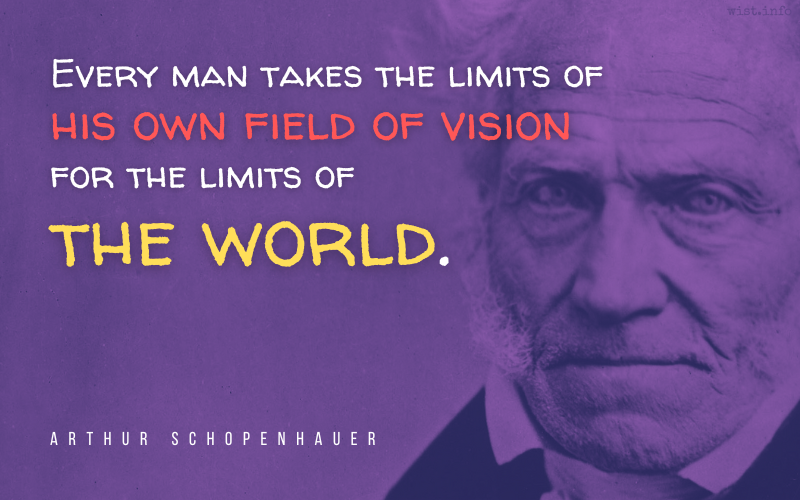
Every man takes the limits of his own field of vision for the limits of the world.
[Jeder hält das Ende seines Gesichtskreises für das der Welt.]
Arthur Schopenhauer (1788-1860) German philosopher
Parerga and Paralipomena, Vol. 2, ch. 26 “Psychological Observations [Psychologische Bemerkungen],” § 338 (1851) [tr. Saunders (1890)]
(Source)
(Source (German)). Alternate translation:
Everyone regards the limits of his field of vision as those of the world.
[tr. Payne (1974)]
There is no absurdity, however palpable, which cannot be firmly implanted in the minds of all, if only one begins to inculcate it before the early age of six by constantly repeating it to them with an air of great solemnity.
[Es giebt keine Absurdität , die so handgreiflich wäre , daß man sie nicht allen Menden fest in den Kopf regen könnte, wenn man nur schon vor ihrem sechsten Jahre anfienge, sie ihnen einzuprägen, indem manunabläffig und mit feierlichstem Ernst sie ihnen vorsagte.]
Arthur Schopenhauer (1788-1860) German philosopher
Parerga and Paralipomena, Vol. 2, ch. 26 “Psychological Observations [Psychologische Bemerkungen],” § 344 (1851) [tr. Payne (1974)]
(Source)
(Source (German)). Alternate translations:
There is no absurdity so palpable but that it may be firmly planted in the human head if you only begin to inculcate it before the age of five, by constantly repeating it with an air of great solemnity.
[tr. Saunders (1851)]
There is no absurdity, however palpable it may be, which may not be fixed in the minds of all men, if it is inculcated before they are six years old by continual and earnest repetition.
[tr. Dircks(1897)]
In my head there is a permanent opposition-party; and whenever I take any step or come to any decision — though I may have given the matter mature consideration — it afterward attacks what I have done, without, however, being each time necessarily in the right. This is, I suppose, only a form of rectification on the part of the spirit of scrutiny; but it often reproaches me when I do not deserve it.
[In meinem Kopfe giebt es eine stehende Oppositionspartei, die gegen Alles, was ich, wenn auch mit reiflicher Überlegung, gethan, oder beschlossen habe, nachträglich polemisirt, ohne jedoch darum jedesmal Recht zu haben. Sie ist wohl nur eine Form des berichtigenden Prüfungsgeistes, macht mir aber oft unverdiente Vorwürfe.]
Arthur Schopenhauer (1788-1860) German philosopher
Parerga and Paralipomena, Vol. 2, ch. 26 “Psychological Observations [Psychologische Bemerkungen],” § 345 (1851) [tr. Saunders (1890)]
(Source)
(Source (German)). Alternate translation:
There is in my mind a standing opposition party which subsequently attacks everything I have done or decided, even after mature consideration, yet without its always being right on that account. It is, I suppose, only a form of the corrective spirit of investigation; but it often casts an unmerited slur on me.
[tr. Payne (1974)]