

Nothing discloses real character like the use of power. It is easy for the weak to be gentle. Most people can bear adversity. But if you wish to know what a man really is, give him power. This is the supreme test. It is the glory of Lincoln that, having almost absolute power, he never abused it, except upon the side of mercy.
Robert Green Ingersoll (1833-1899) American lawyer, agnostic, orator
“Abraham Lincoln,” Lecture (1894)
(Source)
Ingersoll used the final phrase here frequently about Lincoln, e.g., in The Liberty of Man, Woman, and Child, an 1877 lecture, he wrote: "Abraham Lincoln was, in my judgment, in many respects, the grandest man ever president of the United States. Upon his monument these words should be written: 'Here sleeps the only man in the history of the world, who, having been clothed with almost absolute power, never abused it, except on the side of mercy.'"
The phrase "But if you wish to know what a man really is, give him power" is often attributed, without citation, to Lincoln.
Quotations by:
Ingersoll, Robert Green
And then, do you know, I like to think that love is eternal; that if you really love the woman, for her sake, you will love her no matter what she may do; that if she really loves you, for your sake, the same; that love does not look at alterations, through the wrinkles of time, through the mask of years — if you really love her you will always see the face you loved and won. And I like to think of it. If a man loves a woman she does not ever grow old to him. And the woman who really loves a man does not see that he is growing older. He is not decrepit to her. He is not tremulous. He is not old. He is not bowed. She always sees the same gallant fellow that won her hand and heart. I like to think of it in that way, and as Shakespeare says: “Let Time reach with his sickle as far as ever he can; although he can reach ruddy cheeks and ripe lips, and flashing eyes, he can not quite reach love.” I like to think of it. We will go down the hill of life together, and enter the shadow one with the other, and as we go down we may hear the ripple of the laughter of our grandchildren, and the birds, and spring, and youth, and love will sing once more upon the leafless branches of the tree of age. I love to think of it in that way — absolute equals, happy, happy, and free, all our own.
The superior man is the providence of the inferior. He is eyes for the blind, strength for the weak, and a shield for the defenseless. He stands erect by bending above the fallen. He rises by lifting others.
Robert Green Ingersoll (1833-1899) American lawyer, agnostic, orator
“Liberty”
He rises by lifting others.
Robert Green Ingersoll (1833-1899) American lawyer, agnostic, orator
“Liberty”
Love is the magician, the enchanter, that changes worthless things to joy, and makes right royal kings and queens of common clay. It is the perfume of that wondrous flower, the heart, and without that sacred passion, that divine swoon, we are less than beasts; but with it, earth is heaven, and we are gods.
They say that God says to me, “Forgive your enemies.” I say, “I do”; but he says, “I will damn mine.” God should be consistent. If he wants me to forgive my enemies he should forgive his.
It is an old habit with theologians to beat the living with the bones of the dead.
Robert Green Ingersoll (1833-1899) American lawyer, agnostic, orator
“Reply to Archdeacon Farrar” (1890)
(Source)
I have no reverence for any book that teaches a doctrine contrary to my reason; no reverence for any book that teaches a doctrine contrary to my heart; and, no matter how old it is, no matter how many have believed it, no matter how many have died on account of it, no matter how many live for it, I have no reverence for that book, and I am glad of it.
Robert Green Ingersoll (1833-1899) American lawyer, agnostic, orator
“Reply to Rev. Drs. Thomas and Lorimer,” speech, Chicago (26 Nov 1882)
(Source)
I attacked the doctrine of eternal pain. I hold it in infinite and utter abhorrence. And if there be a God in this universe who made a hell; if there be a God in this universe who denies to any human being the right of reformation, then that God is not good, that God is not just, and the future of man is infinitely dark. I despise that doctrine, and I have done what little I could to get that horror from the cradle, that horror from the hearts of mothers, that horror from the hearts of husbands and fathers, and sons, and brothers, and sisters. It is a doctrine that turns to ashes all the humanities of life and all the hopes of mankind. I despise it.
Robert Green Ingersoll (1833-1899) American lawyer, agnostic, orator
“Reply to Rev. Drs. Thomas and Lorimer,” speech, Chicago (26 Nov 1882)
(Source)
Anger blows out the lamp of the mind. In the examination of a great and important question, every one should be serene, slow-pulsed and calm.
Robert Green Ingersoll (1833-1899) American lawyer, agnostic, orator
“The Christian Religion,” Article 3, The North American Review (1881)
(Source)
Happiness is not a reward — it is a consequence. Suffering is not a punishment — it is a result.
Robert Green Ingersoll (1833-1899) American lawyer, agnostic, orator
“The Christian Religion,” Part 2, The North American Review (Nov 1881)
(Source)
There are in nature neither rewards nor punishments — there are consequences.
Robert Green Ingersoll (1833-1899) American lawyer, agnostic, orator
“The Christian Religion” (1881)
(Source)
I will not attack your doctrines nor your creeds if they accord liberty to me. If they hold thought to be dangerous — if they aver that doubt is a crime, then I attack them one and all, because they enslave the minds of men.
All the martyrs in the history of the world are not sufficient to establish the correctness of an opinion. Martyrdom, as a rule, establishes the sincerity of the martyr, — never the correctness of his thought. Things are true or false in themselves. Truth cannot be affected by opinions; it cannot be changed, established, or affected by martyrdom. An error cannot be believed sincerely enough to make it a truth.
Robert Green Ingersoll (1833-1899) American lawyer, agnostic, orator
“The Great Infidels” (1881)
(Source)
Great virtues may draw attention from defects, they cannot sanctify them. A pebble surrounded by diamonds remains a common stone, and a diamond surrounded by pebbles is still a gem. No one should attempt to refute an argument by pronouncing the name of some man, unless he is willing to adopt all the ideas and beliefs of that man. It is better to give reasons and facts than names. An argument should not depend for its force upon the name of its author. Facts need no pedigree, logic has no heraldry, and the living should not awed by the mistakes of the dead.
Robert Green Ingersoll (1833-1899) American lawyer, agnostic, orator
“The Great Infidels” (1881)
(Source)
Is it necessary that Heaven should borrow its light from the glare of Hell? Infinite punishment is infinite cruelty, endless injustice, immortal meanness. To worship an eternal gaoler hardens, debases, and pollutes even the vilest soul. While there is one sad and breaking heart in the universe, no good being can be perfectly happy.
Robert Green Ingersoll (1833-1899) American lawyer, agnostic, orator
“The Great Infidels” (1881)
(Source)
The God of Hell should be held in loathing, contempt and scorn. A God who threatens eternal pain should be hated, not loved — cursed, not worshiped. A heaven presided over by such a God must be below the lowest hell. I want no part in any heaven in which the saved, the ransomed and redeemed will drown with shouts of joy the cries and sobs of hell — in which happiness will forget misery, where the tears of the lost only increase laughter and double bliss.
Robert Green Ingersoll (1833-1899) American lawyer, agnostic, orator
“The Great Infidels” (1881)
(Source)
The man who does not do his own thinking is a slave, and is a traitor to himself and to his fellow-men.
Robert Green Ingersoll (1833-1899) American lawyer, agnostic, orator
“The Liberty of Man, Woman, and Child” (1877)
(Source)
You cannot change the conclusion of the brain by torture; nor by social ostracism. But I will tell you what you can do by these, and what you have done. You can make hypocrites by the million. You can make a man say that he has changed his mind; but he remains of the same opinion still. Put fetters all over him; crush his feet in iron boots; stretch him to the last gasp upon the holy rack; burn him, if you please, but his ashes will be of the same opinion still.
Robert Green Ingersoll (1833-1899) American lawyer, agnostic, orator
“The Liberty of Man, Woman, and Child” (1877)
(Source)
If there is a God who will damn his children forever, I would rather go to hell than to go to heaven and keep the society of such an infamous tyrant. I make my choice now. I despise that doctrine. It has covered the cheeks of this world with tears. It has polluted the hearts of children, and poisoned the imaginations of men.
Robert Green Ingersoll (1833-1899) American lawyer, agnostic, orator
“The Liberty of Man, Woman, and Child” (1877)
(Source)
And do you know, it is a splendid thing to think that the woman you really love will never grow old to you. Through the wrinkles of time, through the mask of years, if you really love her, you will always see the face you loved and won. And a woman who really loves a man does not see that he grows old; he is not decrepit to her; he does not tremble; he is not old; she always sees the same gallant gentleman who won her hand and heart. I like to think of it in that way; I like to think that love is eternal. And to love in that way and then go down the hill of life together, and as you go down, hear, perhaps, the laughter of grandchildren, while the birds of joy and love sing once more in the leafless branches of the tree of age.
Standing in the presence of the Unknown, all have the same right to think, and all are equally interested in the great question of origin and destiny. All I claim, all I plead for, is liberty of thought and expression. That is all.
Robert Green Ingersoll (1833-1899) American lawyer, agnostic, orator
“The Liberty of Man, Woman, and Child” (1877)
You had better be the emperor of one loving and tender heart, and she the empress of yours, than to be king of the world. The man who has really won the love of one good woman in this world, I do not care if he dies in the ditch a beggar, his life has been a success.
Robert Green Ingersoll (1833-1899) American lawyer, agnostic, orator
“The Liberty of Man, Woman, and Child” (1877)
(Source)
It is not necessary to be great to be happy; it is not necessary to be rich to be just and generous and to have a heart filled with divine affection. No matter whether you are rich or poor, treat your wife as though she were a splendid flower, and she will fill your life with perfume and with joy.
Robert Green Ingersoll (1833-1899) American lawyer, agnostic, orator
“The Liberty of Man, Woman, and Child” (1877)
(Source)
No day can be so sacred but that the laugh of a little child will make it holier still.
Robert Green Ingersoll (1833-1899) American lawyer, agnostic, orator
“The Liberty of Man, Woman, and Child” (1877)
(Source)
So then, I am simply in favor of intellectual hospitality — that is all. You come to me with a new idea. I invite you into the house. Let us see what you have. Let us talk it over. If I do not like your thought, I will bid it a polite “good day.” If I do like it, I will say: “Sit down; stay with me, and become a part of the intellectual wealth of my world.” That is all.
Robert Green Ingersoll (1833-1899) American lawyer, agnostic, orator
“The Limits of Toleration,” debate at the Nineteenth Century Club, New York (8 May 1888)
(Source)
The only reason why we wish to exchange thoughts is that we are different. If we were all the same, we would die dumb. No thought would be expressed after we found that our thoughts were precisely alike. We differ — our thoughts are different. Therefore the commerce that we call conversation.
Robert Green Ingersoll (1833-1899) American lawyer, agnostic, orator
“The Limits of Toleration,” Speech, Nineteenth Century Club of New York (8 May 1888)
(Source)
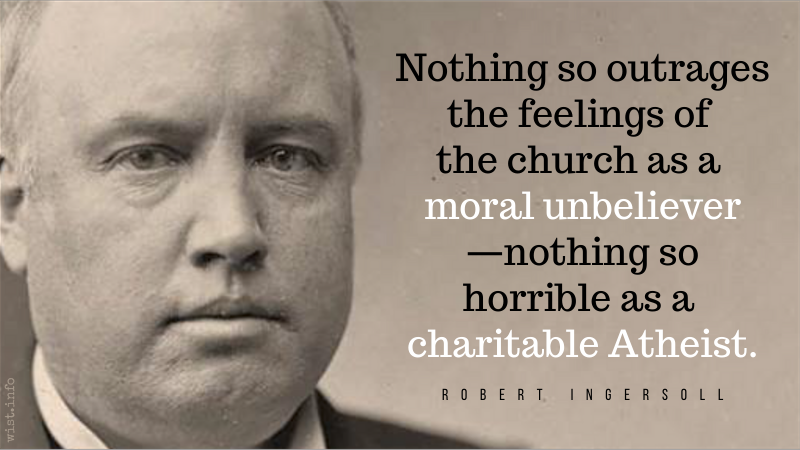
Nothing so outrages the feelings of the church as a moral unbeliever — nothing so horrible as a charitable Atheist.
The question is: Bad as I am, have I the right to think? And I think I have for two reasons: First, I cannot help it. And secondly, I like it.
Robert Green Ingersoll (1833-1899) American lawyer, agnostic, orator
“What Must We Do To Be Saved?” Sec. 1 (1880)
(Source)
If God made us, he will not destroy us. Infinite wisdom never made a poor investment, Upon all the works of an infinite God, a dividend must finally be declared. Why should God make failures? Why should he waste material? Why should he not correct his mistakes, instead of damning them? The pulpit has cast a shadow over even the cradle. The doctrine of endless punishment has covered the cheeks of this world with tears. I despise it, and I deny it.
Robert Green Ingersoll (1833-1899) American lawyer, agnostic, orator
“What Must We Do To Be Saved?” Sec. 1 (1880)
(Source)
It is far more important to love your wife than to love God, and I will tell you why. You cannot help him, but you can help her. You can fill her life with the perfume of perpetual joy. It is far more important that you love your children than that you love Jesus Christ. And why? If he is God you cannot help him, but you can plant a little flower of happiness in every footstep of the child, from the cradle until you die in that child’s arms. Let me tell you to-day it is far more important to build a home than to erect a church. The holiest temple beneath the stars is a home that love has built. And the holiest altar in all the wide world is the fireside around which gather father and mother and the sweet babes.
Robert Green Ingersoll (1833-1899) American lawyer, agnostic, orator
“What Must We Do to Be Saved?” Sec. 2 (1880)
In this country the Episcopalians have done some good, and I want to thank that church. Having on an average less religion than the others — on an average you have done more good to mankind. You preserved some of the humanities. You did not hate music; you did not absolutely despise painting, and you did not altogether abhor architecture, and you finally admitted that it was no worse to keep time with your feet than with your hands. And some went so far as to say that people could play cards, and that God would overlook it, or would look the other way. For all these things accept my thanks.
Robert Green Ingersoll (1833-1899) American lawyer, agnostic, orator
“What Must We Do to Be Saved?” Sec. 7 (1880)
(Source)
Heaven is where those are we love, and those who love us. And I wish to go to no world unless I can be accompanied by those who love me here. Talk about the consolations of this infamous doctrine. The consolations of a doctrine that makes a father say, “I can be happy with my daughter in hell;” that makes a mother say, “I can be happy with my generous, brave boy in hell;” that makes a boy say, “I can enjoy the glory of heaven with the woman who bore me, the woman who would have died for me, in eternal agony.” And they call that tidings of great joy.
Robert Green Ingersoll (1833-1899) American lawyer, agnostic, orator
“What Must We Do To Be Saved?” Sec. 9 (1880)
(Source)
I have made up my mind that if there is a God, he will be merciful to the merciful.
Upon that rock I stand.
That he will not torture the forgiving.
Upon that rock I stand.
That every man should be true to himself, and that there is no world, no star, in which honesty is a crime.
Upon that rock I stand.
The honest man, the good woman, the happy child, have nothing to fear, either in this world or the world to come.
Upon that rock I stand.Robert Green Ingersoll (1833-1899) American lawyer, agnostic, orator
“What Must We Do to Be Saved?” Sec. 11 (1880)
(Source)
I believe in the gospel of Good Living. You can not make any god happy by fasting. Let us have good food, and let us have it well cooked — and it is a thousand times better to know how to cook than it is to understand any theology in the world.
Robert Green Ingersoll (1833-1899) American lawyer, agnostic, orator
“What Must We Do to Be Saved?” Sec. 11 (1880)
(Source)
As long as we love we will hope to live, and when the one dies that we love we will say: “Oh, that we could meet again,” and whether we do or not it will not be the work of theology. It will be a fact in nature. I would not for my life destroy one star of human hope, but I want it so that when a poor woman rocks the cradle and sings a lullaby to the dimpled darling, she will not be compelled to believe that ninety-nine chances in a hundred she is raising kindling wood for hell.
Robert Green Ingersoll (1833-1899) American lawyer, agnostic, orator
“What Must We Do to Be Saved?” Sec. 11 (1880)
(Source)
I propose good fellowship — good friends all around. No matter what we believe, shake hands and let it go. That is your opinion; this is mine: let us be friends. Science makes friends; religion, superstition, makes enemies. They say: Belief is important. I say: No, actions are important. Judge by deed, not by creed. Good fellowship — good friends — sincere men and women — mutual forbearance, born of mutual respect.
Robert Green Ingersoll (1833-1899) American lawyer, agnostic, orator
“What Must We Do To Be Saved?” sec. 11 (1880)
(Source)
We have had too many of these solemn people. Whenever I see an exceedingly solemn man, I know he is an exceedingly stupid man. No man of any humor ever founded a religion — never. Humor sees both sides. While reason is the holy light, humor carries the lantern, and the man with a keen sense of humor is preserved from the solemn stupidities of superstition.
Robert Green Ingersoll (1833-1899) American lawyer, agnostic, orator
“What Must We Do To Be Saved?” Sec. 11 (1880)
(Source)
And I believe, too, in the gospel of Liberty, in giving to others what we claim for ourselves. I believe there is room everywhere for thought, and the more liberty you give away, the more you will have. In liberty extravagance is economy. Let us be just. Let us be generous to each other.
Robert Green Ingersoll (1833-1899) American lawyer, agnostic, orator
“What Must We Do To Be Saved?” Sec. 11 (1880)
(Source)
As long as we love we will hope to live, and when the one dies that we love we will say: “Oh, that we could meet again,” and whether we do or not it will not be the work of theology. It will be a fact in nature. I would not for my life destroy one star of human hope, but I want it so that when a poor woman rocks the cradle and sings a lullaby to the dimpled darling, she will not be compelled to believe that ninety-nine chances in a hundred she is raising kindling wood for hell.
Robert Green Ingersoll (1833-1899) American lawyer, agnostic, orator
“What Must We Do To Be Saved?” Sec. 11 (1880)
(Source)
An infinite God ought to be able to protect himself, without going in partnership with State Legislatures. Certainly he ought not so to act that laws become necessary to keep him from being laughed at.
Robert Green Ingersoll (1833-1899) American lawyer, agnostic, orator
Some Mistakes of Moses, Sec. 3 “The Politicians” (1879)
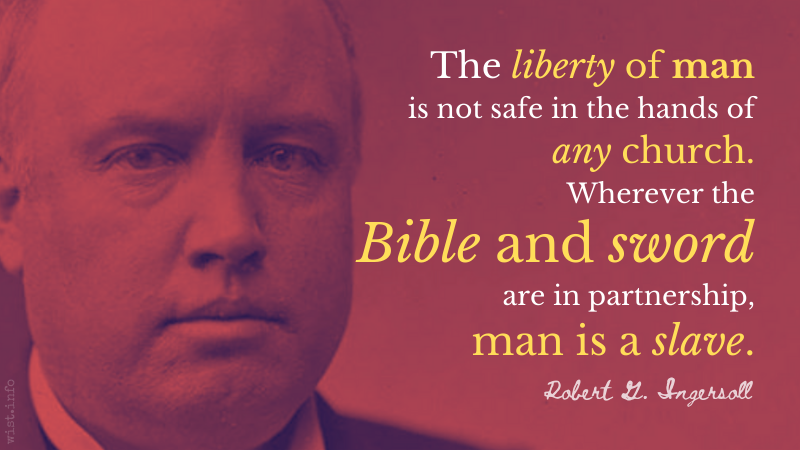
The liberty of man is not safe in the hands of any church. Wherever the Bible and sword are in partnership, man is a slave.
Robert Green Ingersoll (1833-1899) American lawyer, agnostic, orator
Some Mistakes of Moses, ch. 3 “The Politicians” (1879)
(Source)
Churches are becoming political organizations … It probably will not be long until the churches will divide as sharply upon political, as upon theological questions; and when that day comes, if there are not liberals enough to hold the balance of power, this Government will be destroyed.
Robert Green Ingersoll (1833-1899) American lawyer, agnostic, orator
Some Mistakes of Moses, Sec. 3 “The Politicians” (1879)
(Source)
And why does this same God tell me how to raise my children when he had to drown his?
Robert Green Ingersoll (1833-1899) American lawyer, agnostic, orator
Some Mistakes of Moses, Sec. 18 “Dampness” (1879)
(Source)
All laws for the purpose of making man worship God, are born of the same spirit that kindled the fires of the auto da fe, and lovingly built the dungeons of the Inquisition. All laws defining and punishing blasphemy — making it a crime to give your honest ideas about the Bible, or to laugh at the ignorance of the ancient Jews, or to enjoy yourself on the Sabbath, or to give your opinion of Jehovah, were passed by impudent bigots, and should be at once repealed by honest men.
Robert Green Ingersoll (1833-1899) American lawyer, agnostic, orator
Some Mistakes of Moses, Sec. 3 “The Politicians” (1879)
(Source)
He who endeavors to control the mind by force is a tyrant, and he who submits is a slave.
Robert Green Ingersoll (1833-1899) American lawyer, agnostic, orator
The Philosophy of Ingersoll, “Fragments” (1906) [ed. Goldthwaite]
Courage without conscience is a wild beast.
Robert Green Ingersoll (1833-1899) American lawyer, agnostic, orator
Decoration Day Speech, Academy of Music, New York City (29 May 1882)
(Source)
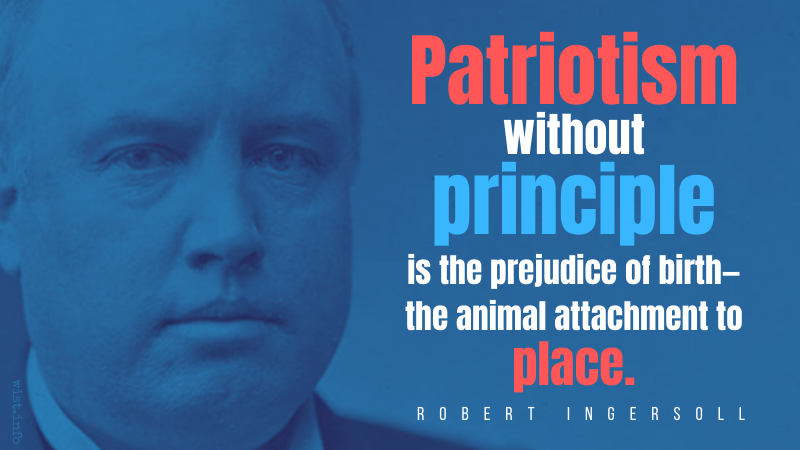
Patriotism without principle is the prejudice of birth — the animal attachment to place.
Robert Green Ingersoll (1833-1899) American lawyer, agnostic, orator
Decoration Day Speech, Academy of Music, New York City (29 May 1882)
(Source)
A good deed is the best prayer. A loving life is the best religion.
If a man really believes that God once upheld slavery; that he commanded soldiers to kill women and babes; that he believed in polygamy; that he persecuted for opinion’s sake; that he will punish forever, and that he hates an unbeliever, the effect in my judgment will be bad. It always has been bad. This belief built the dungeons of the Inquisition. This belief made the Puritan murder the Quaker.
Robert Green Ingersoll (1833-1899) American lawyer, agnostic, orator
Interview, The Sunday Union, New Haven, Conn. (10 Apr 1881)
(Source)
After all, the true civilization is where every man gives to every other, every right that he claims for himself.
Robert Green Ingersoll (1833-1899) American lawyer, agnostic, orator
Interview, Washington Post (14 Nov 1880)
(Source)
Reprinted in The Works of Robert G. Ingersoll, Vol. 8 "Interviews" (1900).
An honest God is the noblest work of man.
While utterly discarding all creeds, and denying the truth of all religions, there is neither in my heart nor upon my lips a sneer for the hopeful, loving and tender souls who believe that from all this discord will result a perfect harmony, that every evil will in some mysterious way become a good, and that above and over all there is a being who, in some way, will reclaim and glorify every one of the children of men.
But for those who heartlessly try to prove that salvation is almost impossible, that damnation is almost certain, that the highway of the universe leads to hell, who fill life with fear and death with horror, who curse the cradle and mock the tomb, it is impossible to entertain other than feelings of pity, contempt and scorn.
Reason, Observation and Experience — the Holy Trinity of Science — have taught us that happiness is the only good; that the time to be happy is now, and the way to be happy is to make others so. This is enough for us. In this belief we are content to live and die. If by any possibility the existence of a power superior to, and independent of, nature shall be demonstrated, there will then be time enough to kneel. Until then, let us stand erect.
Each nation has created a god, and the god has always resembled his creators. He hated and loved what they hated and loved, and he was invariably found on the side of those in power. Each god was intensely patriotic, and detested all nations but his own. All these gods demanded praise, flattery, and worship. Most of them were pleased with sacrifice, and the smell of innocent blood has ever been considered a divine perfume. All these gods have insisted upon having a vast number of priests, and the priests have always insisted upon being supported by the people, and the principal business of these priests has been to boast about their god, and to insist that he could easily vanquish all the other gods put together.
Robert Green Ingersoll (1833-1899) American lawyer, agnostic, orator
Lecture (1872-01-29), “The Gods,” Fairbury Hall, Fairbury, Illinois
(Source)
Nothing is so pleasing to these gods as the butchery of unbelievers. Nothing so enrages them, even now, as to have some one deny their existence.
Strange! that no one has ever been persecuted by the church for believing God bad, while hundreds of millions have been destroyed for thinking him good. The orthodox church never will forgive the Universalist for saying “God is love.” It has always been considered as one of the very highest evidences of true and undefiled religion to insist that all men, women and children deserve eternal damnation. It has always been heresy to say, “God will at last save all.”
The instant we admit that a book is too sacred to be doubted, or even reasoned about, we are mental serfs. It is infinitely absurd to suppose that a god would address a communication to intelligent beings, and yet make it a crime, to be punished in eternal flames, for them to use their intelligence for the purpose of understanding his communication. If we have the right to use our reason, we certainly have the right to act in accordance with it, and no god can have the right to punish us for such action.
One of these gods, according to the account, drowned an entire world, with the exception of eight persons. The old, the young, the beautiful and the helpless were remorsely devoured by the shoreless sea. This, the most fearful tragedy that the imagination of ignorant priests ever conceived, was the act, not of a devil, but of a god, so-called, whom men ignorantly worship unto this day.
The Declaration of Independence announces the sublime truth, that all power comes from the people. This was a denial, and the first denial of a nation, of the infamous dogma that God confers the right upon one man to govern others. It was the first grand assertion of the dignity of the human race. It declared the governed to be the source of power, and in fact denied the authority of any and all gods. Through the ages of slavery — through the weary centuries of the lash and chain, God was the acknowledged ruler of the world. To enthrone man, was to dethrone God.
To Paine, Jefferson, and Franklin, are we indebted, more than to all others, for a human government, and for a Constitution in which no God is recognized superior to the legally expressed will of the people.Robert Green Ingersoll (1833-1899) American lawyer, agnostic, orator
Lecture (1873-12) “Individuality,” Chicago Free Religious Society
(Source)
Full title "Arraignment of the Church and a Plea for Individuality." Collected in The Gods and Other Lectures (1876)
On every hand are the enemies of individuality and mental freedom. Custom meets us at the cradle and leaves us only at the tomb. Our first questions are answered by ignorance, and our last by superstition. We are pushed and dragged by countless hands along the beaten track, and our entire training can be summed up in the word –suppression. Our desire to have a thing or to do a thing is considered as conclusive evidence that we ought not to have it, and ought not to do it. At every turn we run against cherubim and a flaming sword guarding some entrance to the Eden of our desire. We are allowed to investigate all subjects in which we feel no particular interest, and to express the opinions of the majority with the utmost freedom. We are taught that liberty of speech should never be carried to the extent of contradicting the dead witnesses of a popular superstition. Society offers continual rewards for self-betrayal, and they are nearly all earned and claimed, and some are paid.
Robert Green Ingersoll (1833-1899) American lawyer, agnostic, orator
Lecture (1873-12) “Individuality,” Chicago Free Religious Society
(Source)
Full title "Arraignment of the Church and a Plea for Individuality." Collected in The Gods and Other Lectures (1876).
To Paine, Jefferson, and Franklin, are we indebted, more than to all others, for a human government, and for a Constitution in which no God is recognized superior to the legally expressed will of the people.
They knew that to put God in the Constitution was to put man out. They knew that the recognition of a Deity would be seized upon by fanatics and zealots as a pretext for destroying the liberty of thought. They knew the terrible history of the church too well to place in her keeping, or in the keeping of her God, the sacred rights of man. They intended that all should have the right to worship, or not to worship; that our laws should make no distinction on account of creed. They intended to found and frame a government for man, and for man alone. They wished to preserve the individuality and liberty of all; to prevent the few from governing the many, and the many from persecuting and destroying the few.Robert Green Ingersoll (1833-1899) American lawyer, agnostic, orator
Lecture (1873-12) “Individuality,” Chicago Free Religious Society
(Source)
Full title "Arraignment of the Church and a Plea for Individuality." Collected in The Gods and Other Lectures (1876).
There can be nothing more utterly subversive of all that is really valuable than the suppression of honest thought. No man, worthy of the form he bears, will at the command of church or state solemnly repeat a creed his reason scorns.
Robert Green Ingersoll (1833-1899) American lawyer, agnostic, orator
Lecture (1873-12) “Individuality,” Chicago Free Religious Society
(Source)
Full title "Arraignment of the Church and a Plea for Individuality." Collected in The Gods and Other Lectures (1876)
The Church hates a thinker precisely for the same reason a robber dislikes a sheriff, or a thief despises the prosecuting witness. Tyranny likes courtiers, flatterers, followers, fawners, and superstition wants believers, disciples, zealots, hypocrites, and subscribers.
Robert Green Ingersoll (1833-1899) American lawyer, agnostic, orator
Lecture (1873-12) “Individuality,” Chicago Free Religious Society
(Source)
Full title "Arraignment of the Church and a Plea for Individuality." Collected in The Gods and Other Lectures (1876).
Whoever worships, abdicates. Whoever believes at the command of power, tramples his own individuality beneath his feet, and voluntarily robs himself of all that renders man superior to the brute.
Robert Green Ingersoll (1833-1899) American lawyer, agnostic, orator
Lecture (1873-12) “Individuality,” Chicago Free Religious Society
(Source)
Full title "Arraignment of the Church and a Plea for Individuality." Collected in The Gods and Other Lectures (1876).
When a fact can be demonstrated, force is unnecessary; when it cannot be demonstrated, an appeal to force is infamous. In the presence of the unknown all have an equal right to think.
Robert Green Ingersoll (1833-1899) American lawyer, agnostic, orator
Lecture (1873-12) “Individuality,” Chicago Free Religious Society
(Source)
Full title "Arraignment of the Church and a Plea for Individuality." Collected in The Gods and Other Lectures (1876).
Is it desirable that all should be exactly alike in their religious convictions? Is any such thing possible? Do we not know that there are no two persons alike in the whole world? No two, trees, no two leaves, no two anythings that are alike? Infinite diversity is the law. Religion tries to force all minds into one mould. Knowing that all cannot believe, the church endeavors to make all say they believe. She longs for the unity of hypocrisy, and detests the splendid diversity of individuality and freedom.
Robert Green Ingersoll (1833-1899) American lawyer, agnostic, orator
Lecture (1873-12) “Individuality,” Chicago Free Religious Society
(Source)
Full title "Arraignment of the Church and a Plea for Individuality." Collected in The Gods and Other Lectures (1876).
It has always seemed absurd to suppose that a god would choose for his companions, during all eternity, the dear souls whose highest and only ambition is to obey.
Robert Green Ingersoll (1833-1899) American lawyer, agnostic, orator
Lecture (1873-12) “Individuality,” Chicago Free Religious Society
(Source)
Full title "Arraignment of the Church and a Plea for Individuality." Collected in The Gods and Other Lectures (1876).
It is contended by many that ours is a Christian government, founded upon the Bible, and that all who look upon the book as false or foolish are destroying the foundation of our country. The truth is, our government is not founded upon the rights of gods, but upon the rights of men. Our Constitution was framed, not to declare and uphold the deity of Christ, but the sacredness of humanity. Ours is the first government made by the people and for the people. It is the only nation with which the gods have had nothing to do. And yet there are some judges dishonest and cowardly enough to solemnly decide that this is a Christian country, and that our free institutions are based upon the infamous laws of Jehovah.
Robert Green Ingersoll (1833-1899) American lawyer, agnostic, orator
Lecture (1873-12), “Individuality,” Chicago Free Religious Society
(Source)
Full title "Arraignment of the Church and a Plea for Individuality." Collected in The Gods and Other Lectures (1876)
Men and women have been burned for thinking there is but one God; that there was none; that the Holy Ghost is younger than God; that God was somewhat older than his son; for insisting that good works will save a man without faith; that faith will do without good works; for declaring that a sweet babe will not be burned eternally, because its parents failed to have its head wet by a priest; for speaking of God as though he had a nose; for denying that Christ was his own father; for contending that three persons, rightly added together, make more than one; for believing in purgatory; for denying the reality of hell; for pretending that priests can forgive sins; for preaching that God is an essence; for denying that witches rode through the air on sticks; for doubting the total depravity of the human heart; for laughing at irresistible grace, predestination and particular redemption; for denying that good bread could be made of the body of a dead man; for pretending that the pope was not managing this world for God, and in the place of God; for disputing the efficacy of a vicarious atonement; for thinking the Virgin Mary was born like other people; for thinking that a man’s rib was hardly sufficient to make a good-sized woman; for denying that God used his finger for a pen; for asserting that prayers are not answered, that diseases are not sent to punish unbelief; for denying the authority of the Bible; for having a Bible in their possession; for attending mass, and for refusing to attend; for wearing a surplice; for carrying a cross, and for refusing; for being a Catholic, and for being a Protestant; for being an Episcopalian, a Presbyterian, a Baptist, and for being a Quaker. In short, every virtue has been a crime, and every crime a virtue. The church has burned honesty and rewarded hypocrisy. And all this, because it was commanded by a book.
Robert Green Ingersoll (1833-1899) American lawyer, agnostic, orator
Lecture (1874-05-03), “Heretics and Heresies,” Free Religious Society, Kingsbury Hall, Chicago
(Source)
Collected in The Gods and Other Lectures (1876).
Is it possible that an infinite Deity is unwilling that a man should investigate the phenomena by which he is surrounded? Is it possible that a god delights in threatening and terrifying men? What glory, what honor and renown a god must win on such a field! The ocean raving at a drop; a star envious of a candle; the sun jealous of a fire-fly.
Robert Green Ingersoll (1833-1899) American lawyer, agnostic, orator
Lecture (1874-05-03), “Heretics and Heresies,” Free Religious Society, Kingsbury Hall, Chicago
(Source)
Collected in The Gods and Other Lectures (1876).
Give any orthodox church the power, and to-day they would punish heresy with whip, and chain, and fire. As long as a church deems a certain belief essential to salvation, just so long it will kill and burn if it has the power. Why should the church pity a man whom her God hates? Why should she show mercy to a kind and noble heretic whom her God will burn in eternal fire? Why should a Christian be better than his God?
Robert Green Ingersoll (1833-1899) American lawyer, agnostic, orator
Lecture (1874-05-03), “Heretics and Heresies,” Free Religious Society, Kingsbury Hall, Chicago
(Source)
Collected in The Gods and Other Lectures (1876).
I do not say, and I do not believe, that Christians are as bad as their creeds. In spite of church and dogma, there have been millions and millions of men and women true to the loftiest and most generous promptings of the human heart. They have been true to their convictions, and, with a self-denial and fortitude excelled by none, have labored and suffered for the salvation of men. Imbued with the spirit of self-sacrifice, believing that by personal effort they could rescue at least a few souls from the infinite shadow of hell, they have cheerfully endured every hardship and scorned every danger.
And yet, notwithstanding all this, they believed that honest error was a crime. They knew that the Bible so declared, and they believed that all unbelievers would be eternally lost. They believed that religion was of God, and all heresy of the devil. They killed heretics in defense of their own souls and the souls of their children. They killed them because, according to their idea, they were the enemies of God, and because the Bible teaches that the blood of the unbeliever is a most acceptable sacrifice to heaven.Robert Green Ingersoll (1833-1899) American lawyer, agnostic, orator
Lecture (1874-05-03), “Heretics and Heresies,” Free Religious Society, Kingsbury Hall, Chicago
(Source)
Collected in The Gods and Other Lectures (1876).
Whoever has an opinion of his own, and honestly expresses it, will be guilty of heresy. Heresy is what the minority believe; it is the name given by the powerful to the doctrine of the weak.
Robert Green Ingersoll (1833-1899) American lawyer, agnostic, orator
Lecture (1874-05-03), “Heretics and Heresies,” Free Religious Society, Kingsbury Hall, Chicago
(Source)
Collected in The Gods and Other Lectures (1876).
According to the theologians, God, the Father of us all, wrote a letter to his children. The children have always differed somewhat as to the meaning of this letter. In consequence of these honest differences, these brothers began to cut out each other’s hearts.
In every land, where this letter from God has been read, the children to whom and for whom it was written have been filled with hatred and malice. They have imprisoned and murdered each other, and the wives and children of each other. In the name of God every possible crime has been committed, every conceivable outrage has been perpetrated. Brave men, tender and loving women, beautiful girls, and prattling babes have been exterminated in the name of Jesus Christ.Robert Green Ingersoll (1833-1899) American lawyer, agnostic, orator
Lecture (1874-05-03), “Heretics and Heresies,” Free Religious Society, Kingsbury Hall, Chicago
(Source)
Collected in Ingersoll, The Gods and Other Lectures (1876).
Millions upon millions were sacrificed upon the altars of bigotry. The Catholic burned the Lutheran, the Lutheran burned the Catholic, the Episcopalian tortured the Presbyterian, the Presbyterian tortured the Episcopalian. Every denomination killed all it could of every other; and each Christian felt in duty bound to exterminate every other Christian who denied the smallest fraction of his creed.
Robert Green Ingersoll (1833-1899) American lawyer, agnostic, orator
Lecture (1874-05-03), “Heretics and Heresies,” Free Religious Society, Kingsbury Hall, Chicago
(Source)
Collected in The Gods and Other Lectures (1876).
Who can estimate the misery that has been caused by this most infamous doctrine of eternal punishment? Think of the lives it has blighted — of the tears it has caused — of the agony it has produced. Think of the millions who have been driven to insanity by this most terrible of dogmas. This doctrine renders God the basest and most cruel being in the universe. Compared with him, the most frightful deities of the most barbarous and degraded tribes are miracles of goodness and mercy. There is nothing more degrading than to worship such a god. Lower than this the soul can never sink. If the doctrine of eternal damnation is true, let me share the fate of the unconverted; let me have my portion in hell, rather than in heaven with a god infamous enough to inflict eternal misery upon any of the sons of men.
Robert Green Ingersoll (1833-1899) American lawyer, agnostic, orator
Lecture (1874-05-03), “Heretics and Heresies,” Free Religious Society, Kingsbury Hall, Chicago
(Source)
Collected in The Gods and Other Lectures (1876).
A trial for heresy means that the spirit of persecution still lingers in the church; that it still denies the right of private judgment; that it still thinks more of creed than truth, and that it is still determined to prevent the intellectual growth of man. It means that churches are shambles in which are bought and sold the souls of men. It means that the church is still guilty of the barbarity of opposing thought with force. It means that if it had the power, the mental horizon would be bounded by a creed; that it would bring again the whips and chains and dungeon keys, the rack and fagot of the past.
Robert Green Ingersoll (1833-1899) American lawyer, agnostic, orator
Lecture (1874-05-03), “Heretics and Heresies,” Free Religious Society, Kingsbury Hall, Chicago
(Source)
Collected in The Gods and Other Lectures (1876).
The real Bible is not the work of inspired men, nor prophets, nor apostles, nor evangelists, nor of Christs. Every man who finds a fact, adds, as it were, a word to this great book. It is not attested by prophecy, by miracles or signs. It makes no appeal to faith, to ignorance, to credulity or fear. It has no punishment for unbelief, and no reward for hypocrisy. It appeals to man in the name of demonstration. It has nothing to conceal. It has no fear of being read, of being contradicted, of being investigated and understood. It does not pretend to be holy, or sacred; it simply claims to be true. It challenges the scrutiny of all, and implores every reader to verify every line for himself. It is incapable of being blasphemed.
Robert Green Ingersoll (1833-1899) American lawyer, agnostic, orator
Lecture (1874-05-03), “Heretics and Heresies,” Free Religious Society, Kingsbury Hall, Chicago
(Source)
Collected in The Gods and Other Lectures (1876).
The idea of immortality, that like a sea has ebbed and flowed in the human heart, with its countless waves of hope and fear, beating against the shores and rocks of time and fate, was not born of any book, nor of any creed, nor of any religion. It was born of human affection, and it will continue to ebb and flow beneath the mists and clouds of doubt and darkness as long as love kisses the lips of death. It is the rainbow — Hope shining upon the tears of grief.
Education is the most radical thing in the world.
To teach the alphabet is to inaugurate a revolution.
To build a schoolhouse is to construct a fort.
Every library is an arsenal filled with the weapons and ammunition of Progress, and every fact is a monitor with sides of iron and a turret of steel.
I thank Luther for protesting against the abuses of the church, and I denounce him because he was the enemy of liberty. I thank Calvin for writing a book in favor of religious freedom, and I abhor him because he burned Servetus. I thank Knox for resisting Episcopal persecution, and I hate him because he persecuted in his turn. I thank the Puritans for saying “Resistance to tyrants is obedience to God,” and yet I am compelled to say that they were tyrants themselves.

There is but one blasphemy, and that is injustice.
Robert Green Ingersoll (1833-1899) American lawyer, agnostic, orator
Lecture, Chicago (20 Sep 1880)
I have little confidence in any enterprise or business or investment that promises dividends only after the death of the stockholders.
Robert Green Ingersoll (1833-1899) American lawyer, agnostic, orator
Letter to the Chicago Times (27 Mar 1890)
Happiness is the only good.
The place to be happy is here.
The time to be happy is now.
The way to be happy is to make others so.Robert Green Ingersoll (1833-1899) American lawyer, agnostic, orator
Note to a fan (26 Mar 1897)
The greatest test of courage is to bear defeat without losing heart.
Robert Green Ingersoll (1833-1899) American lawyer, agnostic, orator
Speech (1876-07-04), “Centennial Oration [The Declaration of Independence],” Peoria, Illinois
(Source)
Seven long years of war — fighting for what? For the principle that all men are created equal — a truth that nobody ever disputed except a scoundrel; nobody, nobody in the entire history of this world. No man ever denied that truth who was not a rascal, and at heart a thief; never, never, and never will. What else were they fighting for? Simply that in America every man should have a right to life, liberty, and the pursuit of happiness. Nobody ever denied that except a villain; never, never. It has been denied by kings — they were thieves. It has been denied by statesmen — they were liars. It has been denied by priests, by clergymen, by cardinals, by bishops, and by popes — they were hypocrites.
Robert Green Ingersoll (1833-1899) American lawyer, agnostic, orator
Speech (1876-07-04), “Centennial Oration [The Declaration of Independence],” Peoria, Illinois
(Source)
They had the courage not only, but they had the almost infinite wisdom, to declare that all men are created equal. Such things had occasionally been said by some political enthusiast in the olden time, but, for the first time in the history of the world, the representatives of a nation, the representatives of a real, living, breathing, hoping people, declared that all men are created equal. With one blow, with one stroke of the pen, they struck down all the cruel, heartless barriers that aristocracy, that priestcraft, that kingcraft had raised between man and man. They struck down with one immortal blow that infamous spirit of caste that makes a god almost a beast, and a beast almost a god. With one word, with one blow, they wiped away and utterly destroyed, all that had been done by centuries of war — centuries of hypocrisy — centuries of injustice.
One hundred years ago our fathers retired the gods from politics.Robert Green Ingersoll (1833-1899) American lawyer, agnostic, orator
Speech (1876-07-04), “Centennial Oration [The Declaration of Independence],” Peoria, Illinois
(Source)
In quotation collections, this last phrase is often concatenated with the first sentence of the speech:One hundred years ago, our fathers retired the gods from politics. The Declaration of Independence is the grandest, the bravest, and the profoundest political document that was ever signed by the representatives of a people. It is the embodiment of physical and moral courage and of political wisdom.
Our fathers founded the first secular government that was ever founded in this world. Recollect that. The first secular government; the first government that said every church has exactly the same rights and no more; every religion has the same rights, and no more. In other words, our fathers were the first men who had the sense, had the genius, to know that no church should be allowed to have a sword; that it should be allowed only to exert its moral influence.
Robert Green Ingersoll (1833-1899) American lawyer, agnostic, orator
Speech (1876-07-04), “Centennial Oration [The Declaration of Independence],” Peoria, Illinois
(Source)
The religion that has to be supported by law is without value, not only, but a fraud and curse. The religious argument that has to be supported by a musket, is hardly worth making. A prayer that must have a cannon behind it, better never be uttered. Forgiveness ought not to go in partnership with shot and shell. Love need not carry knives and revolvers.
Robert Green Ingersoll (1833-1899) American lawyer, agnostic, orator
Speech (1876-07-04), “Centennial Oration [The Declaration of Independence],” Peoria, Illinois
(Source)
So our fathers said: “We will form a secular government, and under the flag with which we are going to enrich the air, we will allow every man to worship God as he thinks best.” They said: “Religion is an individual thing between each man and his creator, and he can worship as he pleases and as he desires.” And why did they do this? The history of the world warned them that the liberty of man was not safe in the clutch and grasp of any church. They had read of and seen the thumbscrews, the racks, and the dungeons of the Inquisition. They knew all about the hypocrisy of the olden time. They knew that the church had stood side by side with the throne; that the high priests were hypocrites, and that the kings were robbers. They also knew that if they gave power to any church, it would corrupt the best church in the world. And so they said that power must not reside in a church, or in a sect, but power must be wherever humanity is — in the great body of the people.
Robert Green Ingersoll (1833-1899) American lawyer, agnostic, orator
Speech (1876-07-04), “Centennial Oration [The Declaration of Independence],” Peoria, Illinois
(Source)
It is not possible for the human imagination to conceive of the horrors of slavery. It has left no possible crime uncommitted, no possible cruelty unperpetrated. It has been practiced and defended by all nations in some form. It has been upheld by all religions. It has been defended by nearly every pulpit. From the profits derived from the slave trade churches have been built, cathedrals reared and priests paid. Slavery has been blessed by bishop, by cardinal, and by pope. It has received the sanction of statesmen, of kings, and of queens. It has been defended by the throne, the pulpit and the bench. Monarchs have shared in the profits. Clergymen have taken their part of the spoils, reciting passages of Scripture in its defence at the same time, and judges have taken their portion in the name of equity and law.
Robert Green Ingersoll (1833-1899) American lawyer, agnostic, orator
Speech (1876-07-04), “Centennial Oration [The Declaration of Independence],” Peoria, Illinois
(Source)
What we want to-day is what our fathers wrote down. They did not attain to their ideal; we approach it nearer, but have not reached it yet. We want, not only the independence of a State, not only the independence of a nation, but something far more glorious — the absolute independence of the individual. That is what we want. I want it so that I, one of the children of Nature, can stand on an equality with the rest; that I can say this is my air, my sunshine, my earth, and I have a right to live, and hope, and aspire, and labor, and enjoy the fruit of that labor, as much as any individual or any nation on the face of the globe.
Robert Green Ingersoll (1833-1899) American lawyer, agnostic, orator
Speech (1876-07-04), “Centennial Oration [The Declaration of Independence],” Peoria, Illinois
(Source)
The dead do not suffer. And if they live again, their lives will surely be as good as ours. We have no fear. We are all children of the same mother, and the same fate awaits us all. We, too, have our religion, and it is this: Help for the living, Hope for the dead.
Robert Green Ingersoll (1833-1899) American lawyer, agnostic, orator
Speech (1882-01-08), “At a Child’s Grave,” Congressional Cemetery, Washington, D. C.
(Source)
Eulogy at the burial of Harry Miller.
Why should we fear that which will come to all that is? We cannot tell, we do not know, which is the greater blessing — life or death. We do not know whether the grave is the end of this life, or the door of another, or whether the night here is not somewhere else at dawn. Neither can we tell which is the more fortunate — the child dying in its mother’s arms, before its lips have learned to form a word, or he who journeys all the length of life’s uneven road, painfully taking the last slow steps with staff and crutch.
Robert Green Ingersoll (1833-1899) American lawyer, agnostic, orator
Speech (1882-01-08), “At a Child’s Grave,” Congressional Cemetery, Washington, D. C.
(Source)
Eulogy at the burial of Harry Miller.
I had rather live and love where death is king, than have eternal life where love is not. Another life is nought, unless we know and love again the ones who love us here.
Robert Green Ingersoll (1833-1899) American lawyer, agnostic, orator
Speech (1882-01-08), “At a Child’s Grave,” Congressional Cemetery, Washington, D. C.
(Source)
Eulogy at the burial of Harry Miller.
There is something wrong in a government where they who do the most have the least. There is something wrong when honesty wears a rag, and rascality a robe; when the loving, the tender, eat a crust, while the infamous sit at banquets.
Robert Green Ingersoll (1833-1899) American lawyer, agnostic, orator
Speech (1886-11-14), “A Lay Sermon,” American Secular Union annual congress, Chickering Hall, New York City
(Source)
Most people imagine that the rich are in heaven, but, as a rule, it is only a gilded hell. There is not a man in the city of New York with genius enough, with brains enough, to own five millions of dollars. Why? The money will own him. He becomes the key to a safe. That money will get him up at daylight; that money will separate him from his friends; that money will fill his heart with fear; that money will rob his days of sunshine and his nights of pleasant dreams. He cannot own it. He becomes the property of that money. And he goes right on making more. What for? He does not know. It becomes a kind of insanity.
Robert Green Ingersoll (1833-1899) American lawyer, agnostic, orator
Speech (1886-11-14), “A Lay Sermon,” American Secular Union annual congress, Chickering Hall, New York City
(Source)
Wealth is not a crime; poverty is not a virtue — although the virtuous have generally been poor. There is only one good, and that is human happiness; and he only is a wise man who makes himself and others happy.
Robert Green Ingersoll (1833-1899) American lawyer, agnostic, orator
Speech (1886-11-14), “A Lay Sermon,” American Secular Union annual congress, Chickering Hall, New York City
(Source)
It is an insanity to get more than you want. Imagine a man in this city, an intelligent man, say with two or three millions of coats, eight or ten millions of hats, vast warehouses full of shoes, billions of neckties, and imagine that man getting up at four o’clock in the morning, in the rain and snow and sleet, working like a dog all day to get another necktie! Is not that exactly what the man of twenty or thirty millions, or of five millions, does to-day? Wearing his life out that somebody may say, “How rich he is!”
Robert Green Ingersoll (1833-1899) American lawyer, agnostic, orator
Speech (1886-11-14), “A Lay Sermon,” American Secular Union annual congress, Chickering Hall, New York City
(Source)
So this idea of doing good to others only for their sake is absurd. You want to do it, not simply for their sake, but for your own; because a perfectly civilized man can never be perfectly happy while there is one unhappy being in this universe.
Robert Green Ingersoll (1833-1899) American lawyer, agnostic, orator
Speech (1886-11-14), “A Lay Sermon,” American Secular Union annual congress, Chickering Hall, New York City
(Source)
The barbaric world was to be rewarded in some other world for acting sensibly in this. They were promised rewards in another world, if they would only have self-denial enough to be virtuous in this. If they would forego the pleasures of larceny and murder; if they would forego the thrill and bliss of meanness here, they would be rewarded hereafter for that self-denial. I have exactly the opposite idea. Do right, not to deny yourself, but because you love yourself and because you love others. Be generous, because it is better for you. Be just, because any other course is the suicide of the soul. Whoever does wrong plagues himself, and when he reaps that harvest, he will find that he was not practicing self-denial when he did right.
Robert Green Ingersoll (1833-1899) American lawyer, agnostic, orator
Speech (1886-11-14), “A Lay Sermon,” American Secular Union annual congress, Chickering Hall, New York City
(Source)
If you want to be happy yourself, if you are truly civilized, you want others to be happy. Every man ought, to the extent of his ability, to increase the happiness of mankind, for the reason that that will increase his own. No one can be really prosperous unless those with whom he lives share the sunshine and the joy.
Robert Green Ingersoll (1833-1899) American lawyer, agnostic, orator
Speech (1886-11-14), “A Lay Sermon,” American Secular Union annual congress, Chickering Hall, New York City
(Source)
I know a great many rich men and I have read about a great many others, and I do not envy them. They are no happier than I am. You see, after all, few rich men own their property. The property owns them. It gets them up early in the morning. It will not let them sleep; it makes them suspect their friends. Sometimes they think their children would like to attend a first-class funeral. Why should we envy the rich?
Robert Green Ingersoll (1833-1899) American lawyer, agnostic, orator
Speech (1896-10-29), “The Chicago and New York Gold Speech,” McKinley League, Carnegie Hall, New York City
Now we have come to the conclusion that every man has a right to think. Would God give a bird wings and make it a crime to fly? Would he give me brains and make it a crime to think? Any God that would damn one of his children for the expression of his honest thought wouldn’t make a decent thief. When I read a book and don’t believe it, I ought to say so. I will do so and take the consequences like a man.
Robert Green Ingersoll (1833-1899) American lawyer, agnostic, orator
Speech on Religious Intolerance, Pittsburgh Opera House (14 Oct 1879)
They say the religion of your fathers is good enough. Why should a father object to your inventing a better plow than he had?
Robert Green Ingersoll (1833-1899) American lawyer, agnostic, orator
Speech on Religious Intolerance, Pittsburgh Opera House (14 Oct 1879)
For thousands of years people have been trying to force other people to think their way. Did they succeed? No. Will they succeed? No. Why? Because brute force is not an argument.
Robert Green Ingersoll (1833-1899) American lawyer, agnostic, orator
Speech to the Jury, Trial of C. B. Reynolds for Blasphemy, Morristown, New Jersey (May 1887)
(Source)
You can stand with the lash over a man, or you can stand by the prison door, or beneath the gallows, or by the stake, and say to this man: “Recant, or the lash descends, the prison door is locked upon you, the rope is put about your neck, or the torch is given to the fagot.” And so the man recants. Is he convinced? Not at all. Have you produced a new argument? Not the slightest. And yet the ignorant bigots of this world have been trying for thousands of years to rule the minds of men by brute force. They have endeavored to improve the mind by torturing the flesh — to spread religion with the sword and torch. They have tried to convince their brothers by putting their feet in iron boots, by putting fathers, mothers, patriots, philosophers and philanthropists in dungeons. And what has been the result? Are we any nearer thinking alike to-day than we were then?
Robert Green Ingersoll (1833-1899) American lawyer, agnostic, orator
Speech to the Jury, Trial of C. B. Reynolds for Blasphemy, Morristown, New Jersey (May 1887)
(Source)
It seems to me that if there is some infinite being who wants us to think alike, he would have made us alike.
Robert Green Ingersoll (1833-1899) American lawyer, agnostic, orator
Speech to the Jury, Trial of C. B. Reynolds for Blasphemy, Morristown, New Jersey (May 1887)
(Source)
By force you can make hypocrites — men who will agree with you from the teeth out, and in their hearts hate you. We want no more hypocrites. We have enough in every community. And how are you going to keep from having more? By having the air free, — by wiping from your statute books such miserable and infamous laws as this.
Robert Green Ingersoll (1833-1899) American lawyer, agnostic, orator
Speech to the Jury, Trial of C. B. Reynolds for Blasphemy, Morristown, New Jersey (May 1887)
(Source)
There are thousands of things in the Scriptures that everybody believes. Everybody believes the Scriptures are right when they say, “Thou shalt not steal” — everybody. And when they say “Give good measure, heaped up and running over,” everybody says, “Good!” So when they say “Love your neighbor,” everybody applauds that.
Suppose a man believes that, and practices it, does it make any difference whether he believes in the flood or not? Is that of any importance? Whether a man built an ark or not — does that make the slightest difference? A man might deny it and yet be a very good man. Another might believe it and be a very mean man. Could it now, by any possibility, make a man a good father, a good husband, a good citizen? Does it make any difference whether you believe it or not?
Does it make any difference whether or not you believe that a man was going through town and his hair was a little short, like mine, and some little children laughed at him, and thereupon two bears from the woods came down and tore to pieces about forty of these children? Is it necessary to believe that? Suppose a man should say, “I guess that is a mistake. They did not copy that right. I guess the man that reported that was a little dull of hearing and did not get the story exactly right.” Any harm in saying that? Is a man to be sent to the penitentiary for that? Can you imagine an infinitely good God sending a man to hell because he did not believe the bear story?
Robert Green Ingersoll (1833-1899) American lawyer, agnostic, orator
Speech to the Jury, Trial of C. B. Reynolds for Blasphemy, Morristown, New Jersey (May 1887)
(Source)
Blasphemy is what an old mistake says of a newly discovered truth.
Blasphemy is what a withered last year’s leaf says to a this year’s bud.
Blasphemy is the bulwark of religious prejudice.
Blasphemy is the breastplate of the heartless.
And let me say now, that the crime of blasphemy, as set out in this statute, is impossible. No man can blaspheme a book. No man can commit blasphemy by telling his honest thought. No man can blaspheme a God, or a Holy Ghost, or a Son of God. The Infinite cannot be blasphemed.Robert Green Ingersoll (1833-1899) American lawyer, agnostic, orator
Speech to the Jury, Trial of C. B. Reynolds for Blasphemy, Morristown, New Jersey (May 1887)
(Source)
What is blasphemy? I will give you a definition; I will give you my thought upon this subject. What is real blasphemy?
To live on the unpaid labor of other men — that is blasphemy.
To enslave your fellow-man, to put chains upon his body — that is blasphemy.
To enslave the minds of men, to put manacles upon the brain, padlocks upon the lips — that is blasphemy.
To deny what you believe to be true, to admit to be true what you believe to be a lie — that is blasphemy.
To strike the weak and unprotected, in order that you may gain the applause of the ignorant and superstitious mob — that is blasphemy.
To persecute the intelligent few, at the command of the ignorant many — that is blasphemy.
To forge chains, to build dungeons, for your honest fellow-men — that is blasphemy.
To pollute the souls of children with the dogma of eternal pain — that is blasphemy.
To violate your conscience — that is blasphemy.
The jury that gives an unjust verdict, and the judge who pronounces an unjust sentence, are blasphemers.
The man who bows to public opinion against his better judgment and against his honest conviction, is a blasphemer.
Robert Green Ingersoll (1833-1899) American lawyer, agnostic, orator
Speech to the Jury, Trial of C. B. Reynolds for Blasphemy, Morristown, New Jersey (May 1887)
(Source)
Whoever increases the sum of human joy, is a worshipper.
He who adds to the sum of human misery, is a blasphemer.
Robert Green Ingersoll (1833-1899) American lawyer, agnostic, orator
Speech to the Jury, Trial of C. B. Reynolds for Blasphemy, Morristown, New Jersey (May 1887)
(Source)
How has the church in every age, when in authority, defended itself? Always by a statute against blasphemy, against argument, against free speech. And there never was such a statute that did not stain the book that it was in and that did not certify to the savagery of the men who passed it.
Robert Green Ingersoll (1833-1899) American lawyer, agnostic, orator
Trial of C.B. Reynolds for blasphemy (May 1887)
(Source)
No orthodox church ever had power that it did not endeavor to make people think its way by force and flame.
Robert Green Ingersoll (1833-1899) American lawyer, agnostic, orator
Trial of C.B. Reynolds for blasphemy (May 1887)
(Source)
What is blasphemy? I will give you a definition; I will give you my thought upon this subject. What is real blasphemy?
To live on the unpaid labor of other men — that is blasphemy.
To enslave your fellow-man, to put chains upon his body — that is blasphemy.
To enslave the minds of men, to put manacles upon the brain, padlocks upon the lips — that is blasphemy.
To deny what you believe to be true, to admit to be true what you believe to be a lie — that is blasphemy.
To strike the weak and unprotected, in order that you may gain the applause of the ignorant and superstitious mob — that is blasphemy.
To persecute the intelligent few, at the command of the ignorant many — that is blasphemy.
To forge chains, to build dungeons, for your honest fellow-men — that is blasphemy.
To pollute the souls of children with the dogma of eternal pain — that is blasphemy.
To violate your conscience — that is blasphemy.
The jury that gives an unjust verdict, and the judge who pronounces an unjust sentence, are blasphemers.
The man who bows to public opinion against his better judgment and against his honest conviction, is a blasphemer.Robert Green Ingersoll (1833-1899) American lawyer, agnostic, orator
Trial of C.B. Reynolds for blasphemy (May 1887)
(Source)
Gentlemen, you can never make me believe — no statute can ever convince me, that there is any infinite Being in this universe who hates an honest man. It is impossible to satisfy me that there is any God, or can be any God, who holds in abhorrence a soul that has the courage to express his thought. Neither can the whole world convince me that any man should be punished, either in this world or in the next, for being candid with his fellow-men. If you send men to the penitentiary for speaking their thoughts, for endeavoring to enlighten their fellows, then the penitentiary will become a place of honor, and the victim will step from it — not stained, not disgraced, but clad in robes of glory.
Robert Green Ingersoll (1833-1899) American lawyer, agnostic, orator
Trial of C.B. Reynolds for blasphemy (May 1887)
(Source)