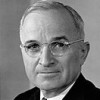
When I am dead, I hope it may be said:
“His sins were scarlet, but his books were read.”Hilaire Belloc (1870–1953) Franco-British writer, historian [Joseph Hilaire Pierre René Belloc]
Poem (1923), “Epigram 1: On His Books,” Sonnets and Verse
(Source)
Sometimes called "An Author's Hope."
Quotations about:
epitaph
Note not all quotations have been tagged, so Search may find additional quotes on this topic.
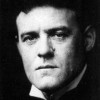
O eloquent, just, and mighty Death! whom none could advise, thou hast persuaded; what none hath dared, thou hast done; and whom all the world hath flattered, thou only hast cast out of the world and despised: thou hast drawn together all the far stretchèd greatness, all the pride, cruelty and ambition of man, and covered it all over with those two narrow words, Hic jacet!
Walter Raleigh (c. 1552–1618) English statesman, soldier, writer, explorer
The Historie of the World, in Five Bookes, Book 5, ch. 6, sec. 12 (1614)
(Source)
Penultimate paragraph of the work. The Latin hic jacet means "here lies," as in an tomb's epitaph.

It’s a bit embarrassing to have been concerned with the human problem all one’s life and find at the end that one has no more to offer by way of advice than “Try to be a little kinder.”
Aldous Huxley (1894–1963) English novelist, essayist and critic
(Attributed)
(Source)
Quoted in Huston Smith, "Aldous Huxley -- A Tribute," The Psychedelic Review, Vol. 1, No. 3 (1964) (the Aldous Huxley Memorial Issue).
A variant is in Laura Huxley's biography of her husband, This Timeless Moment: A Personal View of Aldous Huxley, "One Never Loves Enough" (1968). She identified it as coming from a "public talk" not long before his death:It is a little embarrassing that, after forty-five years of research and study, the best advice I can give to people is to be a little kinder to each other.

He is asleep. Though his mettle was sorely tried,
He lived, and when he lost his angel, died.
It happened calmly, on its own,
The way night comes when day is done.[Il dort. Quoique le sort fût pour lui bien étrange,
Il vivait. Il mourut quand il n’eut plus son ange,
La chose simplement d’elle-même arriva,
Comme la nuit se fait lorsque le jour s’en va.]Victor Hugo (1802–1885) French writer, journalist, human rights activist, politician
Les Misérables, Part 5 “Jean Valjean,” Book 9 “Supreme Shadow, Surpreme Dawn,” ch. 6 (5.9.6) (1862) [tr. Wilbour/Fahnestock/MacAfee (1987)]
(Source)
These final lines of the book are an epitaph once penciled on the stone over Valjean's unmarked grave. Wilbour and Wraxall leave the lines in French.
(Source (French)). Alternate translations:He sleeps. Although his fate was very strange, he lived. He died when he had no longer his angel. The thing came to pass simply, of itself, as the night comes when day is gone.
[tr. Hapgood (1887)]He sleeps; although so much he was denied,
He lived. And when his dear love left him, died.
It happened of itself, in the calm way
That in the evening night-time follows day.
[tr. Denny (1976)]He sleeps. Though fate dealt with him strangely,
He lived. Bereft of his angel, he died.
It came about simplly, of itself,
As night follows when the day is ended.
[tr. Donougher (2013)]

If there’s another world, he lives in bliss;
If there is none, he made the best of this.Robert Burns (1759–1796) Scottish national poet
“Epitaph on My Own Friend and My Father’s Friend, William Muir in Tarbolton,” ll. 7-8 (1784-04), First Commonplace Book (1785).
(Source)
A mock epitaph for William Muir (1745-1793), a miller in Tarbolton and good friend to Burns' family.

Life’s race well run,
Life’s work well done,
Life’s crown well won,
Now comes rest.Edward H. Parker (1823–1896) American physician, poet
Epitaph of President James Garfield (1881)
(Source)
The phrase was engraved on a tablet placed at the head of his coffin while he lay in state at Cleveland's Memorial Park.
The passage was selected by a committee without a clear source of the material, but it appears to be a loose transcription of the first stanza of a poem Parker wrote for his mother-in-law's funeral:Life's race well run,
Life's work all done,
Life's victory won,
Now cometh rest.
The differences may be because the Garfield epitaph was back-translated from a Latin translation of Parker's original.
Much more discussion here.
Here lies the noble warrior that never blunted sword;
Here lies the noble courtier that never kept his word;
Here lies his excellency that governed all the state;
Here lies the L. of Leicester that all the world did hate.Walter Raleigh (c. 1552–1618) English statesman, soldier, writer, explorer
“Epitaph on the Earl of Leicester, died September 4, 1588”
(Source)
Near this spot
are deposited the Remains of one
who possessed Beauty without Vanity,
Strength without Insolence,
Courage without Ferocity,
and all the Virtues of Man without his Vices.
This Praise, which would be unmeaning Flattery
if inscribed over human Ashes,
is but a just tribute to the Memory of
BOATSWAIN, a DOGGeorge Gordon, Lord Byron (1788–1824) English poet
“Epitaph to a Dog” (1808)
(Source)
Carved on the headstone over Boatswain's grave at Newstead Abbey, the family's ancestral home. Byron acquired the dog at age fifteen; Boatswain died of rabies, an endemic disease in England at the time, five years later. Byron wanted to be buried beside him, but the sale of the property made that impossible.
While the rest of the poem is considered Byron's, the first lines may have been written by his friend, John Cam Hobhouse. More discussion here.
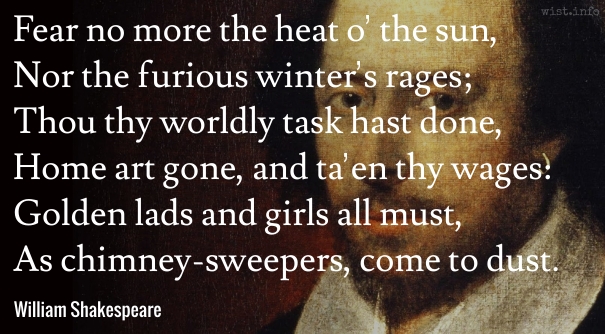
GUIDERIUS: Fear no more the heat o’ the sun,
Nor the furious winter’s rages;
Thou thy worldly task hast done,
Home art gone, and ta’en thy wages:
Golden lads and girls all must,
As chimney-sweepers, come to dust.
William Shakespeare (1564–1616) English dramatist and poet
Cymbeline, Act 3, sc. 2, l. 331ff (3.2.331-336) (1611)
(Source)

“Gun-wielding recluse gunned down by local police” isn’t the epitaph I want. I am hoping for “Witnesses reported the sound up to two hundred kilometers away” or “Last body part finally located”.
James Nicoll (b. 1961) Canadian reviewer, editor
Usenet (2005)

If, after I depart this vale, you ever remember me and have thought to please my ghost, forgive some sinner and wink your eye at some homely girl.
H. L. Mencken (1880–1956) American writer and journalist [Henry Lewis Mencken]
“Epitaph,” Smart Set (3 Dec 1921)
Something about the fact that I made some contribution to either my country, or those who were less well off. I think back to what Camus wrote about the fact that perhaps this world is a world in which children suffer, but we can lessen the number of suffering children, and if you do not do this, then who will do this? I’d like to feel that I’d done something to lessen that suffering.
Robert Francis Kennedy (1925–1968) American politician
Interview with David Frost (1968)
In an interview a month before he was assassinated, about how his obituary should read. See Camus.

For I know not why we should delay our tokens of respect to those who deserve them, until the heart that our sympathy could have gladdened has ceased to beat. As men cannot read the epitaphs inscribed upon the marble that covers them, so the tombs that we erect to virtue often only prove our repentance that we neglected it when with us.
Edward George Bulwer-Lytton (1803–1873) English novelist and politician
Letter to F. T. Mappin (25 Sep 1855)
(Source)
Quoted in The Illustrated London News, Vol. 27 (6 Oct 1855)

And were an epitaph to be my story,
I’d have a short one ready for my own.
I would have written of me on my stone:
I had a lover’s quarrel with the world.
Robert Frost (1874–1963) American poet
“The Lesson for Today,” A Witness Tree (1942)
Initially read before the Phi Beta Kappa Society, Harvard (20 Jun 1941)

Life is not designed to minister to a man’s vanity. He goes upon his long business most of the time with a hanging head, and all the time like a blind child. Full of rewards and pleasures as it is — so that to see the day break or the moon rise, or to meet a friend, or to hear the dinner-call when he is hungry, fills him with surprising joys — this world is yet for him no abiding city. Friendships fall through, health fails, weariness assails him; year after year, he must thumb the hardly varying record of his own weakness and folly. It is a friendly process of detachment. When the time comes that he should go, there need be few illusions left. Here lies one who meant well, tried a little, failed much: — surely that may be his epitaph, of which he need not be ashamed.
Robert Louis Stevenson (1850–1894) Scottish essayist, novelist, poet
Essay (1888-12), “A Christmas Sermon,” sec. 4, Scribner’s Magazine, Vol. 4
(Source)
Originally written in the winter of 1887-88. Collected in Across the Plains, ch. 12 (1892).
I have tried my best to give the nation everything I had in me. There are probably a million people who could have done the job better than I did it, but I had the job and I had to do it, and I always quote an epitaph on a tombstone in Tombstone, Ariz.: “Here lies Jack Williams. He done his damnedest.”
Harry S Truman (1884–1972) US President (1945–1953)
Time, “The Presidency: The Answer Man” (28 Apr. 1952)
Speaking in Winslow, AZ (15 Jun 1948), Truman said, "You know, the greatest epitaph in the country is here in Arizona. It’s in Tombstone, Ariz., and this epitaph says, 'Here lies Jack Williams. He done his damndest.' I think that is the greatest epitaph a man could have."