As I brew, so must I drink.
James Howell (c. 1594–1666) Welsh historian, writer, aphorist
Paroimiographia [Παροιμιογραφία]: Proverbs, or, Old Sayed Sawes & Adages, “English Proverbs” (1659) [compiler]
(Source)
Quotations about:
proverb
Note not all quotations have been tagged, so Search may find additional quotes on this topic.
He who will thrive, must rise at five;
He who hath thriven, may sleep till seven;
Who will not thrive at all, may sleep till eleven.James Howell (c. 1594–1666) Welsh historian, writer, aphorist
Paroimiographia [Παροιμιογραφία]: Proverbs, or, Old Sayed Sawes & Adages, “English Proverbs” (1659) [compiler]
(Source)
When thou dost hear a toul or knell,
Then think upon thy passing-bel.James Howell (c. 1594–1666) Welsh historian, writer, aphorist
Paroimiographia [Παροιμιογραφία]: Proverbs, or, Old Sayed Sawes & Adages, “English Proverbs” (1659) [compiler]
(Source)
Better half a loaf then no bread.
James Howell (c. 1594–1666) Welsh historian, writer, aphorist
Paroimiographia [Παροιμιογραφία]: Proverbs, or, Old Sayed Sawes & Adages, “English Proverbs” (1659) [compiler]
(Source)
Howell also lists this proverb on an earlier page. A similar proverb, "Better half a loaf than none at all," appears on two pages as well, the second showing how to render the phrase in French, Italian, and Spanish.
One may live and learn, and be hang’d and forget all.
James Howell (c. 1594–1666) Welsh historian, writer, aphorist
Paroimiographia [Παροιμιογραφία]: Proverbs, or, Old Sayed Sawes & Adages, “English Proverbs” (1659) [compiler]
(Source)
Little difference twixt a feast and a belly-ful.
James Howell (c. 1594–1666) Welsh historian, writer, aphorist
Paroimiographia [Παροιμιογραφία]: Proverbs, or, Old Sayed Sawes & Adages, “English Proverbs” (1659) [compiler]
(Source)
If the Sky fall we shall have Larks.
Too much money makes one madd.
James Howell (c. 1594–1666) Welsh historian, writer, aphorist
Paroimiographia [Παροιμιογραφία]: Proverbs, or, Old Sayed Sawes & Adages, “English Proverbs” (1659) [compiler]
(Source)
ADAGE, n. A hoary-headed platitude that is kicked along the centuries until nothing is left of it but its clothes. A “saw” which has worn out its teeth on the human understanding.
Ambrose Bierce (1842-1914?) American writer and journalist
“Adage,” “Devil’s Dictionary” column, San Francisco Wasp (1881-03-05)
(Source)
Not collected in later books. Instead, in The Cynic's Word Book (1906), he changed it to "Boned wisdom for weak teeth."

There is a strong feeling in favour of cowardly and prudential proverbs. The sentiments of a man while he is full of ardour and hope are to be received, it is supposed, with some qualification. But when the same person has ignominiously failed and begins to eat up his words, he should be listened to like an oracle. Most of our pocket wisdom is conceived for the use of mediocre people, to discourage them from ambitious attempts, and generally console them in their mediocrity. And since mediocre people constitute the bulk of humanity, this is no doubt very properly so. But it does not follow that the one sort of proposition is any less true than the other, or that Icarus is not to be more praised, and perhaps more envied, than Mr. Samuel Budgett the Successful Merchant.
The supposed wisdom of proverbs is mainly imaginary. As a rule, proverbs go in pairs which say opposite things. The opposite of “More haste, less speed” is “A stitch in time saves nine.” The opposite of “Take care of the pence and the pounds will take care of themselves,” “Penny wise, pound foolish.” The opposite of “Two heads are better than one,” is “Too many cooks spoil the broth.” And so on. The great advantage of a proverb in argument is that it is supposed to be incontrovertible, as embodying the quintessential sagacity of our ancestors. But when once you have realised that proverbs go in pairs which say opposite things you can never again be downed by a proverb; you merely quote the opposite.
The aphorism is a personal observation inflated into a universal truth, a private posing as a general. A proverb is anonymous human history compressed to the size of a seed.
Stefan Kanfer (1933-2018) American writer, editor, journalist
“Proverbs or Aphorisms,” Time (11 Jun 1983)
(Source)

The best aphorisms are pointed expressions of the results of observation, experience, and reflection. They are portable wisdom, the quintessential extracts of thought and feeling. They furnish the largest amount of intellectual stimulus and nutriment in the smallest compass. About every weak point in human nature, or vicious spot in human life, there is deposited a crystallization of warning and protective proverbs.
William Rounseville Alger (1822-1905) American writer, minister, translator
“The Utility and the Futility of Aphorisms,” Atlantic Monthly (Feb 1863)
(Source)
Often paraphrased, "Aphorisms are portable wisdom."
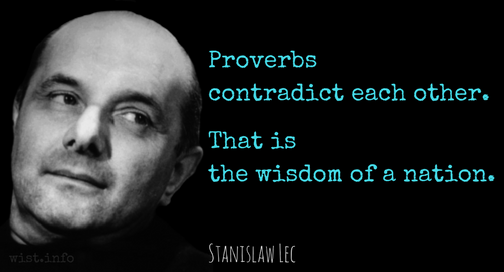
Proverbs contradict each other. That is the wisdom of a nation.
Stanislaw Lec (1909-1966) Polish aphorist, poet, satirist
Unkempt Thoughts [Myśli nieuczesane] (1957) [tr. Gałązka (1962)]
(Source)

King David and King Solomon
Led merry merry lives,
With many, many lady friends,
And many many wives;
But when old age crept over them —
With many, many qualms! —
King Solomon wrote the Proverbs
And King David wrote the Psalms.James Ball Naylor (1860-1945) American physician, writer, poet, politician
“King David and King Solomon” (1935)

Poets are like proverbs: you can always find one to contradict another.
[Les poëtes sont comme les proverbes : l’un est toujours là pour contredire l’autre.]
Jules Verne (1828-1905) French novelist, poet, playwright
The Survivors of the Chancellor, ch. 5 “An Unusual Route” (1875)
(Source)
A proverb is a short sentence based on long experience.
Miguel de Cervantes (1547-1616) Spanish novelist
Don Quixote, Part 2 (1615)

Men’s maxims reveal their characters.
Luc de Clapiers, Marquis de Vauvenargues (1715-1747) French moralist, essayist, soldier
Reflections and Maxims [Réflexions et maximes], #107 (1746) [tr Stevens (1940)]
Alt. trans.: "The maxims of men reveal their hearts."