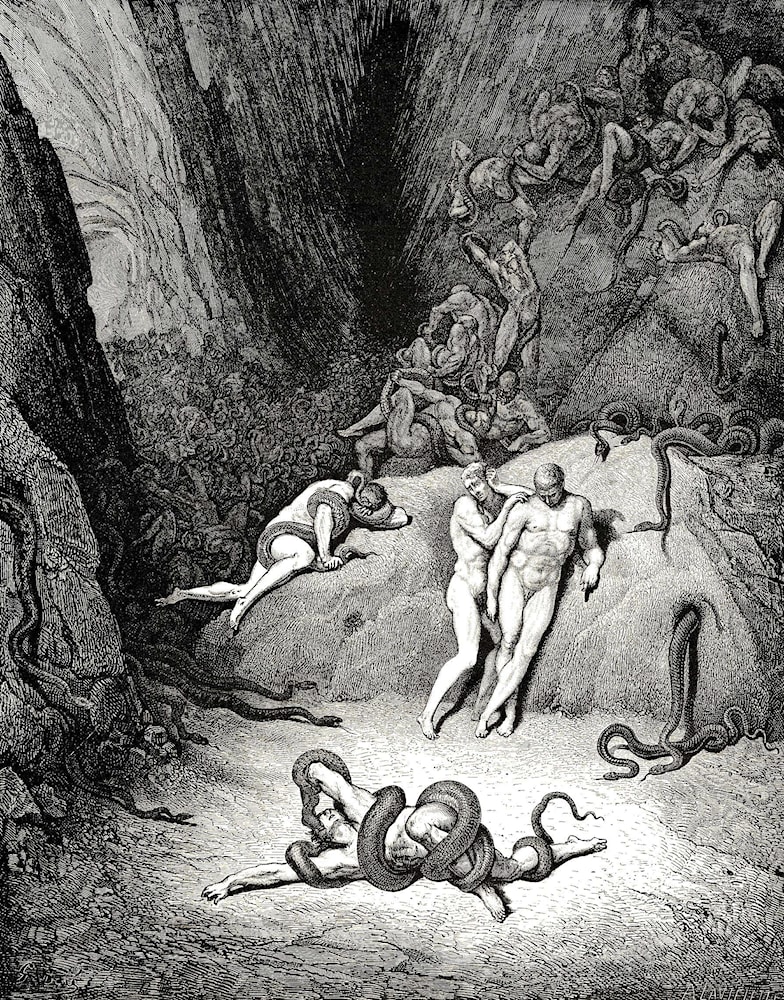
Dore – Inferno, Canto 25 – Agnello being transformed to a serpent
If, dear Reader, what I tell you throws you into disbelief, it’s no surprise — I scarcely credit it myself, God knows,
and I was there.
[Se tu se’ or, lettore, a creder lento ciò ch’io dirò, non sarà maraviglia, ché io che ’l vidi, a pena il mi consento.]
Dante Alighieri (1265–1321) Italian poet The Divine Comedy [Divina Commedia], Book 1 “Inferno,” Canto 25, l. 46ff (25.46-48) (1309) [tr. Carson (2002)]
(Source)
Dante is gobsmacked over a serpent/lizard biting a thief, and each of their bodies changing into the other. He spends the rest of the canto in detailed description of the transformation.
If, Reader, you are tardy to believe
What I shall say, it will no wonder raise;
For I who saw it scarcely give assent.
[tr. Rogers (1782), l. 42ff]
Nor marvel, ye that hear the wondrous tale!
If doubts, arising oft, your minds assail! Those eyes, that saw them, scarce believ'd the sight.
[tr. Boyd (1802), st. 8]
O reader! now
Thou be not apt to credit what I tell,
No marvel; for myself do scarce allow
The witness of mine eyes.
[tr. Cary (1814)]
If, reader, thou should'st tardily receive What now I tell, it might not much surprise, When I, who saw it, scarce myself believe.
[tr. Dayman (1843)]
If thou art now, O Reader, slow to credit what I have to tell, it will be no wonder: for I who saw it, scare allow it to myself.
[tr. Carlyle (1849)]
And if thou, reader, to believe art slow, What I shall tell, 'twill be by no means strange, For I who saw it must suspect the change.
[tr. Bannerman (1850)]
If, reader, thou art backward to believe What I shall say, no wonder thou shouldst doubt, For I myself who saw can scarce believe.
[tr. Johnston (1867)]
If thou art, Reader, slow now to believe What I shall say, it will no marvel be, For I who saw it hardly can admit it.
[tr. Longfellow (1867)]
If thou art now, reader, slow to believe that which I am going to say, it will be no marvel, for I who saw it hardly allow it to myself.
[tr. Butler (1885)]
If now, O reader, thou shouldst scarce be bent To trust my speech no marvel it will be, Since I who saw it scarcely can consent.
[tr. Minchin (1885)]
If thou art now, Reader, slow to credit that which I shall tell, it will not be a marvel, for I who saw it hardly admit it to myself.
[tr. Norton (1892)]
If, Reader, thou art now slow to believe what I shall tell thee, it were no thing to wonder at, for I that saw it can scarce admit its truth.
[tr. Sullivan (1893)]
If thou art slow, now, reader, at believing What I shall say, it will not be a marvel, For I, who saw it, scarcely do accept it.
[tr. Griffith (1908)]
If, reader, thou art now slow to credit what I shall tell, it will be no wonder, for I who saw it scarcely admit it to myself.
[tr. Sinclair (1939)]
If thou art slow of faith, thou who dost read What I shall tell, 'tis nothing for surprise. Since half I doubt, I who witnessed it indeed.
[tr. Binyon (1943)]
Reader, if thou discredit what is here Set down, no wonder; for I hesitate Myself, who saw it all as clear as clear.
[tr. Sayers (1949)]
Reader, should you doubt what next I tell, it will be no wonder, for though I saw it happen, I can scarce believe it possible, even in Hell.
[tr. Ciardi (1954)]
If, reader, you are now slow to credit that which I shall tell, it will be no wonder, for I who saw it do scarcely admit it to myself.
[tr. Singleton (1970)]
Now if, my reader, you should hesitate to believe what I shall say, there's little wonder, for I, the witness, scarcely can believe it.
[tr. Musa (1971)]
If, reader, you are slow now to believe what I shall tell, that is no cause for wonder, for I who saw it hardly can accept it.
[tr. Mandelbaum (1980)]
If you now, reader, are slow to believe What I shall tell you, it will be no wonder For I who saw it can scarcely credit it!
[tr. Sisson (1981)]
Reader, if you are slow To credit what I tell you next, it should
Be little wonder, for I who saw it know
That I myself can hardly acknowledge it
[tr. Pinsky (1994), l. 44ff]
If now, reader, you are slow to believe what I say, that will be no marvel, for I, who saw it, hardly allow it.
[tr. Durling (1996)]
Reader, if you are slow to credit, now, what I have to tell, it will be no wonder, since I who saw it, scarcely credit it myself.
[tr. Kline (2002)]
If you are slow, my reader, to receive, in faith, what I'll say now -- no miracle. I saw it all, and yet can scarce believe.
[tr. Kirkpatrick (2006)]
If, reader, you are slow to credit what I'm about to tell you, it's no wonder: I saw it, and I myself can scarce believe it.
[tr. Hollander/Hollander (2007)]
Now, readers all,
If you cannot quite believe my story, I find it hard, and I'm the one who saw it.
[tr. Raffel (2010)]
If you are slow
To credit, reader, what I tell you now,
No wonder. I, who saw it to be so,
Scarcely believe it still.
[tr. James (2013)]