He is asleep. Though his mettle was sorely tried,
He lived, and when he lost his angel, died.
It happened calmly, on its own,
The way night comes when day is done.[Il dort. Quoique le sort fût pour lui bien étrange,
Il vivait. Il mourut quand il n’eut plus son ange,
La chose simplement d’elle-même arriva,
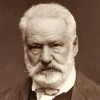
Comme la nuit se fait lorsque le jour s’en va.]Victor Hugo (1802-1885) French writer
Les Misérables, Part 5 “Jean Valjean,” Book 9 “Supreme Shadow, Surpreme Dawn,” ch. 6 (5.9.6) (1862) [tr. Wilbour/Fahnestock/MacAfee (1987)]
(Source)
These final lines of the book are an epitaph once penciled on the stone over Valjean's unmarked grave. Wilbour and Wraxall leave the lines in French.
(Source (French)). Alternate translations:He sleeps. Although his fate was very strange, he lived. He died when he had no longer his angel. The thing came to pass simply, of itself, as the night comes when day is gone.
[tr. Hapgood (1887)]He sleeps; although so much he was denied,
He lived. And when his dear love left him, died.
It happened of itself, in the calm way
That in the evening night-time follows day.
[tr. Denny (1976)]He sleeps. Though fate dealt with him strangely,
He lived. Bereft of his angel, he died.
It came about simplly, of itself,
As night follows when the day is ended.
[tr. Donougher (2013)]