

A little bit of agitation gives motivation to the soul, and what really makes the species prosper is not peace so much as freedom.
Jean-Jacques Rousseau (1712–1778) French philosopher and writer
(Attributed)
Quotations by:
Rousseau, Jean-Jacques
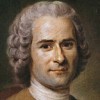
It is not hard to confess our criminal acts, but our ridiculous and shameful acts.
Jean-Jacques Rousseau (1712–1778) French philosopher and writer
Confessions (1731-32)
She had some experience of the world, and the capacity for reflection that makes such experience profitable.
Jean-Jacques Rousseau (1712–1778) French philosopher and writer
Confessions, ch. 3 “1731-1732” (1781) [tr. Cohen (1953)]
One advantage resulting form virtuous actions is that they elevate the mind and dispose it to attempt others more virtuous still.
Jean-Jacques Rousseau (1712–1778) French philosopher and writer
Confessions, ch. 3 (1731-32)
tr. J. M. Cohen, 1953
I remembered the way out suggested by a great princess when told that the peasants had no bread: “Well, let them eat cake.”
Jean-Jacques Rousseau (1712–1778) French philosopher and writer
Confessions, ch. 6 (1781) [tr. Cohen (1953)]
The only moral lesson which is suited for a child — the most important lesson for every time of life — is this: “Never hurt anybody.”
Jean-Jacques Rousseau (1712–1778) French philosopher and writer
Emile (1762)
The risk is not in what he does not know, but in what he thinks he knows.
Jean-Jacques Rousseau (1712–1778) French philosopher and writer
Emile, ch. 3 (1762) [tr. Foxley (1911)]
The first reward of justice is the consciousness that we are acting justly.
Jean-Jacques Rousseau (1712–1778) French philosopher and writer
Emile, ch. 4 “The Creed of a Savoyard Priest” (1762) [tr. Foley (1911)]
The God whom I adore is not the God of darkness, he has not given me understanding in order to forbid me to use it; to tell me to submit my reason
is to insult the giver of reason.Jean-Jacques Rousseau (1712–1778) French philosopher and writer
Emile, ch. 4 “The Creed of a Savoyard Priest” (1762) [tr. Foxley (1911)]
(Source)
Those who desire to treat politics and morals apart from one another will never understand either.
Jean-Jacques Rousseau (1712–1778) French philosopher and writer
Emile, ch. 4 (1762) [tr. Foxley (1911)]
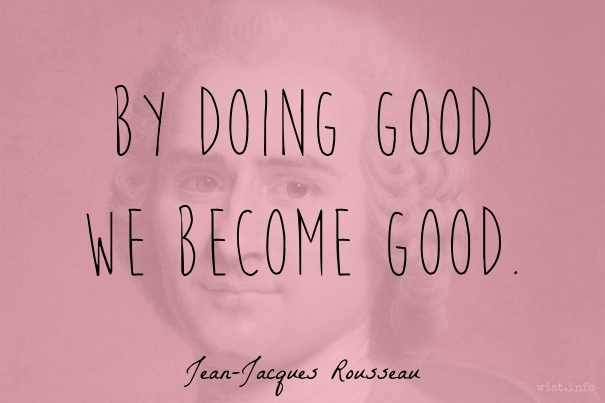
By doing good we become good.
Jean-Jacques Rousseau (1712–1778) French philosopher and writer
Emile, ch. 4 (1762) [tr. Foxley (1911)]
Patience is bitter, but its fruit is sweet.
[La patience est amère, mais son fruit est doux.]
Jean-Jacques Rousseau (1712–1778) French philosopher and writer
Julie, or the New Heloise [Julie ou la Nouvelle Héloïse], Part 1, Letter 46 (from Julie) (1761) [tr. Stewart / Vaché]
(Source)
Sometimes mis-cited to his Émile (1762). The sentiment is not necessarily original to Rousseau; the line is also credited to Aristotle, an ancient Chinese proverb, an ancient Persian proverb, etc.
The cited translation is from a newer source, but that way of wording it is extant by 1873. Another translation:Patience is exceeding bitter; but its fruits are most delightfully sweet.
[tr. Kenrick (1784)]
In all the ills which befall us, we look more at the intention than the effect. A tile which falls from the house may hurt more, but does not vex us so much as a stone thrown designedly by an ill-natured hand.
Jean-Jacques Rousseau (1712–1778) French philosopher and writer
Reveries of a Solitary Walker (1782)
Man was born free; and everywhere he is in chains. One thinks himself the master of others, and still remains a greater slave than they.
Jean-Jacques Rousseau (1712–1778) French philosopher and writer
The Social Contract, 1.1 (1762) [tr. Cole (1950)]
Tranquility is found also in dungeons; but is that enough to make them desirable places to live in?
Jean-Jacques Rousseau (1712–1778) French philosopher and writer
The Social Contract, ch. 4 “Slavery” (1761)
Trans. G.D.H. Cole (1913). Full text.
Good laws lead to the making of better ones; bad ones bring about worse.
Jean-Jacques Rousseau (1712–1778) French philosopher and writer
The Social Contract, pt. III, ch. 15 (1762)
trans. G.D.H. Cole (1913)