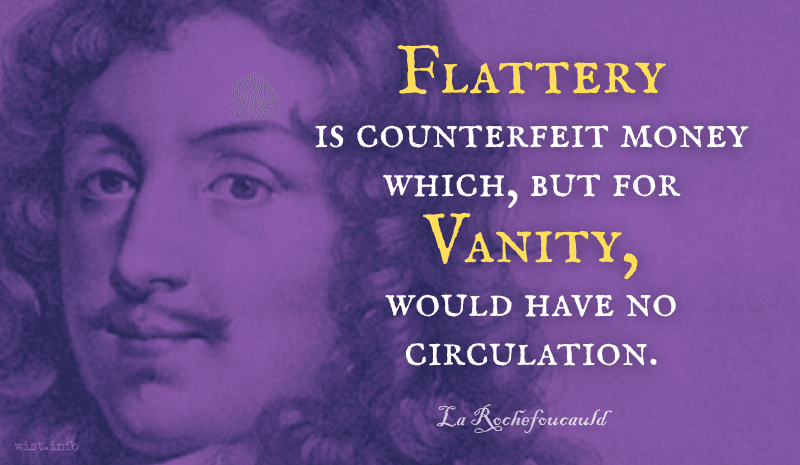
Flattery is counterfeit money which, but for vanity, would have no circulation.
[La flatterie est une fausse monnaie qui n’a de cours que par notre vanité]
François VI, duc de La Rochefoucauld (1613-1680) French epigrammatist, memoirist, noble
Réflexions ou sentences et maximes morales [Reflections; or Sentences and Moral Maxims], ¶158 (1665-1678) [tr. Kronenberger (1959)]
(Source)
First present in the 5th ed. (1678).
(Source (French)). Other translations:Flattery is like false Money, and if it were not for our own Vanity could never pass in Payment.
[tr. Stanhope (1694), Book 2, ¶104; Stanhope (1706 ed.), ¶517]Flattery is a sort of bad money, to which our vanity gives currency.
[pub. Donaldson (1783), ¶145; ed. Lepoittevin-Lacroix (1797), ¶152]Flattery may be considered as a sort of bad money, to which our vanity gives currency.
[ed. Carvill (1835), ¶128]Flattery is a false coin, which only derives its currency from our vanity.
[ed. Gowens (1851), ¶270]Flattery is base coin to which only our vanity gives currency.
[tr. Bund/Friswell (1871), ¶158]Flattery is a counterfeit coinage, current only because our vanity accepts it.
[tr. Heard (1917), ¶266]Flattery is a counterfeit coinage to which our vanity alone gives currency.
[tr. Stevens (1939), ¶158; tr. FitzGibbon (1957), ¶158]Flattery is a spurious coinage only made current by our vanity.
[tr. Tancock (1959), ¶158]Flattery is a kind of counterfeit currency, which is put in circulation only by our vanity.
[tr. Whichello (2016) ¶158]