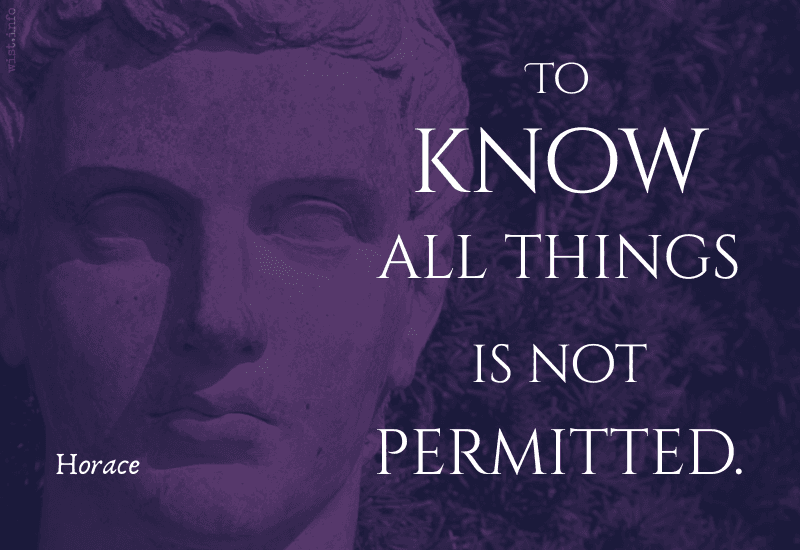
To know all things is not permitted.
[Nec scire fas est omnia.]
Horace (65–8 BC) Roman poet, satirist, soldier, politician [Quintus Horatius Flaccus]
Odes [Carmina], Book 4, # 4, l. 22 (4.4.22) (23 BC)
(Source)
Common English translation, dating back to at least the late 19th Century.
In a number of translations, this phrase is elided or blurred into the surrounding text. Only distinct expressions of the sentiment are given below.
(Source (Latin)). Other translations:Not all of truth
We seekers find.
[tr. Conington (1872)]Neither is it possible to discover everything.
[tr. Smart/Buckley (1853)]Nor everything to know, may any mortal dare.
[tr. Martin (1864)]Nor is the lore
Of all things lore allowed.
[tr. Bulwer-Lytton (1870)]Neither is it lawful to know all things.
[tr. Elgood (1893)]For us to know
All things is not heaven's will.
[tr. Garnsey (1907)]All things man may not learn.
[tr. Marshall (1908)]Nor is it vouchsafed to know all things.
[tr. Bennett (Loeb) (1912)]Not all things may one know.
[tr. Mills (1924)]Nor should men sound all knowledge.
[tr. Michie (1963)]It is not lawful to know all things.
[tr. Alexander (1999)]It’s not right to know everything.
[tr. Kline (2015)]