

You see, I consider that a man’s brain originally is like a little empty attic, and you have to stock it with such furniture as you choose. A fool takes in all the lumber of every sort that he comes across, so that the knowledge which might be useful to him gets crowded out, or at best is jumbled up with a lot of other things, so that he has a difficulty in laying his hands upon it. Now the skilful workman is very careful indeed as to what he takes into his brain-attic. He will have nothing but the tools which may help him in doing his work, but of these he has a large assortment, and all in the most perfect order. It is a mistake to think that that little room has elastic walls and can distend to any extent. Depend upon it there comes a time when for every addition of knowledge you forget something that you knew before. It is of the highest importance, therefore, not to have useless facts elbowing out the useful ones.
Arthur Conan Doyle (1859–1930) British writer and physician
Story (1886-04), “A Study in Scarlet,” Part 1, ch. 2 [Holmes], Beeton’s Christmas Annual, Vol. 28 (1887-11-21)
(Source)
Connected to this passage.
Published in novel form 1888-07. See also "The Five Orange Pips."
In the Sherlock TV episode 01x03 "The Great Game" (w. Mark Gatiss) (2010-08-08), this explanation is reworked:SHERLOCK: Listen: (points to his head) This is my hard-drive, and it only makes sense to put things in there that are useful. Really useful. Ordinary people fill their heads with all kinds of rubbish, and that makes it hard to get at the stuff that matters! Do you see?
Quotations about:
information
Note not all quotations have been tagged, so Search may find additional quotes on this topic.
In the democracies of the world, the passion for freedom of speech and of thought is always accentuated when there is an effort anywhere to keep ideas away from people and to prevent them from making their own decisions. One of the best ways of enslaving a people is to keep them from education and thus make it impossible for them to understand what is going on in the world as a whole. […] The second way of enslaving a people is to suppress the sources of information, not only by burning books, but by controlling all the other ways in which ideas are transmitted.
Eleanor Roosevelt (1884–1962) First Lady of the US (1933–1945), politician, diplomat, activist
Column (1943-05-11), “My Day”
(Source)
You have to study a long time to know anything at all.
[Il fout avoir beaucoup étudié pour savoir peu.]
Charles-Lewis de Secondat, Baron de Montesquieu (1689–1755) French political philosopher
Pensées Diverses [Assorted Thoughts] (1720-1755) [ed. Guterman (1963)]
(Source)
(Source (French)). Other translations:In order to know nothing, it is necessary that a man should have studied a great deal.
[tr. Dale (1882)]It is necessary to study much in order to know little.
[E.g.]You have to study a great deal to know a little.
[E.g.]
The effect of continually reading inferior newspapers, or hearing trivial sermons, is not so mischievous by its direct influence upon our thoughts, as it is by gradually making us fancy that the poorest thoughts may be worth public expression.
John Frederick Boyes (1811–1879) English scholar, classicist
Lacon in Council, “Literature, Poetry, Oratory, Genius, &c.” (1865)
(Source)

You can never be too cautious in your prognosis, in the view of the great uncertainty of the course of any disease not long watched, and the many unexpected turns it may take.
I think I am not the first to utter the following caution : —
Beware how you take away hope from any human being. Nothing is clearer than that the merciful Creator intends to blind most people as they pass down into the dark valley. Without very good reasons, temporal or spiritual, we should not interfere with his kind arrangements. It is the height of cruelty and the extreme of impertinence to tell your patient he must die, except you are sure that he wishes to know it, or that there is some particular cause for his knowing it. I should be especially unwilling to tell a child that it could not recover; if the theologians think it necessary, let them take the responsibility. God leads it by the hand to the edge of the precipice in happy unconsciousness, and I would not open its eyes to what he wisely conceals.Oliver Wendell Holmes, Sr. (1809–1894) American poet, essayist, scholar
Speech (1859-03-10), Valedictory Address, Harvard University School of Medicine
(Source)
Sometimes paraphrased, "Beware how you take away hope from another human being."
Collected in The Boston Medical and Surgical Journal, Vol. 58, No. 8 (1858-03-25).
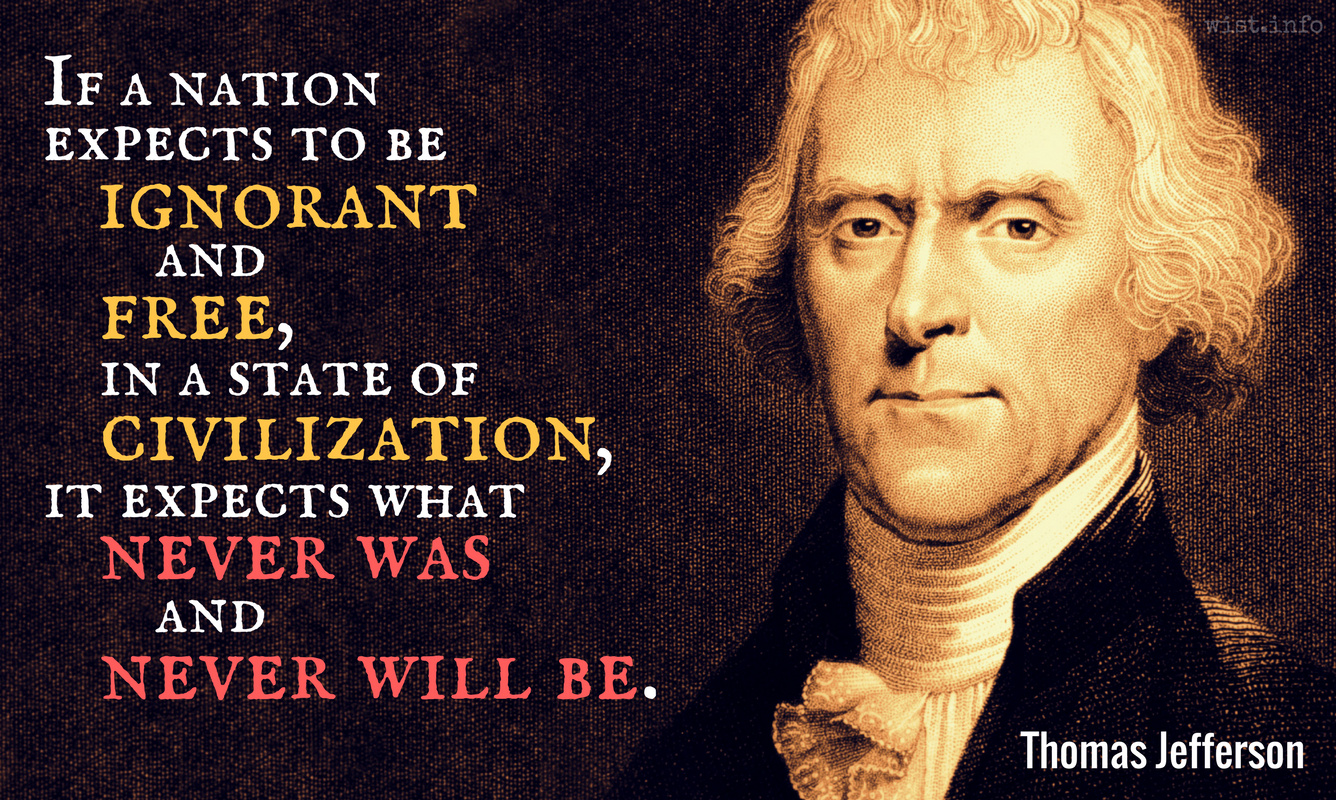
If a nation expects to be ignorant and free, in a state of civilization, it expects what never was and never will be. The functionaries of every government have propensities to command at will the liberty and property of their constituents. There is no safe deposit for these but with the people themselves; nor can they be safe with them without information. Where the press is free, and every man able to read, all is safe.
Thomas Jefferson (1743–1826) American political philosopher, polymath, statesman, US President (1801–09)
Letter (1816-01-06) to Charles Yancey
(Source)
The original, non-orthographic version of this reads:if a nation expects to be ignorant & free, in a state of civilisation, it expects what never was & never will be. the functionaries of every government have propensities to command at will the liberty & property of their constituents. there is no safe deposit for these but with the people themselves; nor can they be safe with them without information. where the press is free and every man able to read, all is safe.
There is a spurious variant on part of this quotation that reads:If a nation expects to be ignorant and free, in a state of civilization, it expects what never was and never will be. If we are to guard against ignorance and remain free, it is the responsibility of every American to be informed.
While the first sentence (as above) is legitimate, the second is not. It appears to be a paraphrase of Jefferson used by Ronald Reagan in 1981.
Because our minds need to reduce information, we are more likely to try to squeeze a phenomenon into the Procrustean bed of a crisp and known category (amputating the unknown), rather than suspend categorization, and make it tangible. Thanks to our detections of false patterns, along with real ones, what is random will appear less random and more certain — our overactive brains are more likely to impose the wrong, simplistic, narrative than no narrative at all.
Nassim Nicholas Taleb (b. 1960) Lebanese-American essayist, statistician, risk analyst, aphorist
The Bed of Procrustes: Philosophical and Practical Aphorisms, “Postface” (2010)
(Source)

Knowledge is subtractive, not additive — what we subtract (reduction by what does not work, what not to do), not what we add (what to do).
Nassim Nicholas Taleb (b. 1960) Lebanese-American essayist, statistician, risk analyst, aphorist
The Bed of Procrustes: Philosophical and Practical Aphorisms, “Epistomology and Subtractive Knowledge” (2010)
(Source)
To say this is also to say that the age of ready reference is one in which knowledge inevitably declines into information. The master of so much packaged stuff has less need to grasp context or meaning than his forbears: he can always look it up. His active memory is otherwise engaged anyway, full of the arbitrary names, initials, and code figures essential to carrying on daily life. He can be vague about the rest: he can always check it out.
Jacques Barzun (1907–2012) French-American historian, educator, polymath
Essay (1989), “Look It Up! Check It Out!” The Culture We Deserve
(Source)
An earlier version of this essay was published in The American Scholar (1986, Autumn).
Mistakes are, after all, the foundation of truth, and if a man does not know what a thing is, it is at least an increase in knowledge if he knows what it is not.
Carl Jung (1875–1961) Swiss psychologist
Aion: Researches into the Phenomenology of the Self, ch. 15 “Conclusion,” ¶ 429 (1959; 1968 ed.) [tr. Hull]
Final words.
We’ve tried ignorance for a thousand years. It’s time we try education.
Joycelyn Elders (b. 1933) American pediatrician, public health administrator, academic
Penn & Teller: Bullshit!, s. 4, ep. 6 “Abstinence” (2006-06-05)
(Source)
On sex education for kids.
Real education precisely consists in the fact that we see beyond the symbols and the mere machinery of the age in which we find ourselves: education precisely consists in the realization of a permanent simplicity that abides behind all civilizations, the life that is more than meat, the body that is more than raiment. The only object of education is to make us ignore mere schemes of education. Without education, we are in a horrible and deadly danger of taking educated people seriously.
Gilbert Keith Chesterton (1874–1936) English journalist and writer
“Our Note Book,” The Illustrated London News (1905-12-02)
(Source)
A reference or teaching book is only as good as its index.
Why do people read? The answer, as regards the great majority, is: “They don’t.”
Bertrand Russell (1872–1970) English mathematician and philosopher
“Flight from Reality,” New York American (1932-03-02)
(Source)
The mind is formed by the knowledge and the direction of ideas it receives and the guidance it is given. Great things alone can make a great mind, and petty things will make a petty mind unless a man rejects them as completely alien.
[Weil der menschliche Geist durch die ihm mitgetheilten Kenntnisse und Ideenrichtungen erzogen wild. Nor das Grosse kann ihn grostartig, das Kleine nur kleinlich machen, wenn er et nicht wie elwas ganz Fremdes ganz von sich stösst.]
Karl von Clausewitz (1780–1831) Prussian soldier, historian, military theorist
On War [Vom Kriege], Book 2, ch. 2 “On the Theory of War [Über die Theorie des Krieges],” § 40 (2.2.40) (1832) [tr. Howard & Paret (1976)]
(Source)
(Source (German)). Other translations:The human mind is trained by the knowledge imparted to it, and the direction given to its ideas. Only what is great can make it great; the little can only make it little, if the mind itself does not reject it as something repugnant.
[tr. Graham (1873)]The human mind is formed by the kinds of knowledge imparted to it and the direction given to its ideas. Only what is great can make it great; the little can only make it little, if the mind itself does not reject it as something repugnant to it.
[tr. Jolles (1943)]
It is a melancholy truth that a suppression of the press could not more compleatly deprive the nation of its benefits, than is done by its abandoned prostitution to falsehood. Nothing can now be believed which is seen in a newspaper. Truth itself becomes suspicious by being put into that polluted vehicle. […] I will add that the man who never looks into a newspaper is better informed than he who reads them; inasmuch as he who knows nothing is nearer to truth than he whose mind is filled with falsehoods & errors. He who reads nothing will still learn the great facts, and the details are all false.
Thomas Jefferson (1743–1826) American political philosopher, polymath, statesman, US President (1801–09)
Letter (1807-06-11) to John Norvell
(Source)
What happens when conspiracy theories become the coin of politics, and mainstream media and educational institutions are discredited, is that citizens no longer have a common reality that can serve as background for democratic deliberation. In such a situation, citizens have no choice but to look for markers to follow other than truth or reliability. What happens in such cases, as we see across the world, is that citizens look to politics for tribal identifications, for addressing personal grievances, and for entertainment. When news becomes sports, the strongman achieves a certain measure of popularity. Fascist politics transforms the news from a conduit of information and reasoned debate into a spectacle with the strongman as the star.
Jason Stanley (b. 1969) American philosopher, epistemologist, academic
How Fascism Works: The Politics of Us and Them, ch. 4 (2018)
(Source)

If I had omitted setting down something of that which has appeared to me as clear, so that the knowledge would perish when I perish, as is inevitable, I should have considered that conduct as extremely cowardly with regard to you and everyone who is perplexed. It would have been, as it were, robbing one who deserves the truth of the truth, or grudging an heir his inheritance. And both those traits are blameworthy.
Maimonides (1135–1204) Spanish Jewish philosopher, scholar, astronomer, physician [Moses ben Maimon, Rambam, רמב״ם]
Guide for the Perplexed, Part 3, Introduction (c. 1190) [tr. Pines (1963)]
(Source)
Another translation:But if, on the other hand, I were to abstain from writing on this subject, according to my knowledge of it, when I die, as I shall inevitably do, that knowledge would die with me, and I would thus inflict great injury on you and all those who are perplexed. I would then be guilty of withholding the truth from those to whom it ought to be communicated, and of jealously depriving the heir of his inheritance. I should in either case be guilty of gross misconduct.
[tr. Friedlander (1885)]

Such is the privilege of genius; it perceives, it seizes relations where vulgar eyes see only isolated facts.
[Tel est le privilége du génie: il aperçoit, il saisit des rapports, là où des yeux vulgaires lie voient que des faits isolés.]
François Arago (1786–1853) French Catalan mathematician, physicist, astronomer, politician
Biographies of Distinguished Scientific Men, “Joseph Fourier” (1859) [tr. Smyth, Powell, Grant]
(Source)
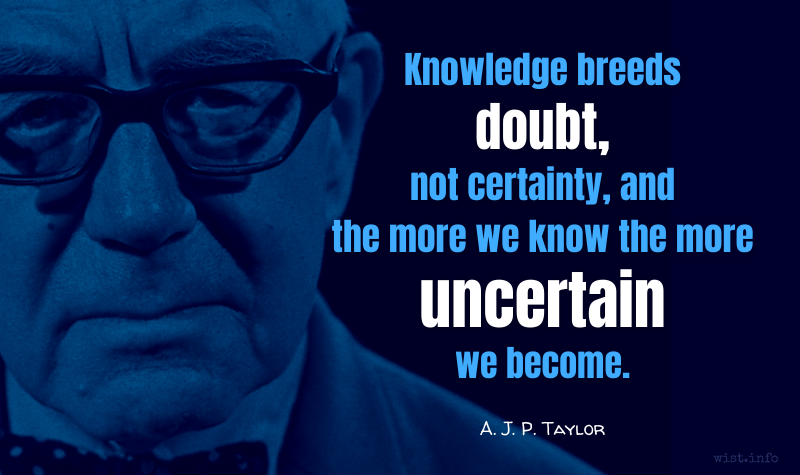
Knowledge breeds doubt, not certainty, and the more we know the more uncertain we become.
A. J. P. Taylor (1906–1990) British historian, journalist, broadcaster [Alan John Percivale Taylor]
“What Else Indeed?” New York Review of Books (5 Aug 1965)
(Source)
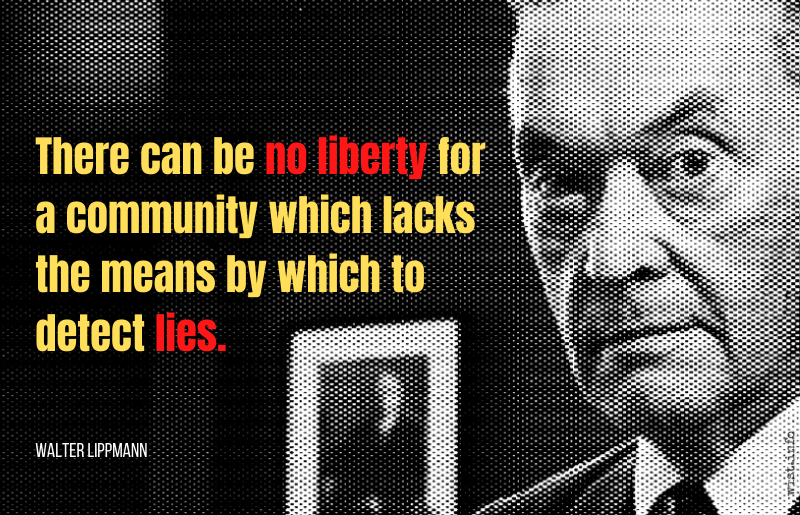
There can be no liberty for a community which lacks the means by which to detect lies.
Walter Lippmann (1889–1974) American journalist and author
“What Modern Liberty Means,” Liberty and the News (1920)
(Source)
The whole truth would be an infinite concatenation of mostly irrelevant facts, with an occasional dose of, in textspeak, “TMI,” too much information — when, for example, you ruin the case you were making against factory farming by going into such detail about how painful de-beaking is for chickens that your listener shuts you out and struggles to think about something else. So we do not tell the whole truth; we tell carefully crafted stories, and we do this even when our moral purpose is to tell the truth.
Justin E. H. Smith (b. 1972) American-Canadian professor of history and philosophy of science
Irrationality: A History of the Dark Side of Reason, ch. 8 (2019)
(Source)

When I hear scientists say, “The data speak for themselves,” I cringe. Data never speak.
Andrew J. Hoffman (b. 1961) American environmental scientist, sustainable enterprise scholar
“Taking On Climate Skepticism as a Field of Study,” Interview by Felicity Barringer, New York Times (9 Apr 2011)
(Source)

There is no case where ignorance should be preferred to knowledge — especially if the knowledge is terrible.
Edward Teller (1908–2003) Hungarian-American theoretical physicist
Interview (1994)
Recalling the debate over the development of the hydrogen bomb. Quoted in Roger Shattuck, Forbidden Knowledge (1996).
But everyone assumes causation when they should be thinking coincidence, and correlation when they should be asking whether Twitter is really a reliable source of information.

The moment we no longer have a free press, anything can happen. What makes it possible for a totalitarian or any other dictatorship to rule is that people are not informed; how can you have an opinion if you are not informed?
Hannah Arendt (1906–1975) German-American philosopher, political theorist
Interview (1973-10) with Roger Errera, Office de Radiodiffusion-Télévision Française (ORTF)
(Source)
Other parts of this interview were turned into an episode of the French TV series "Un certain regard," directed by Jean-Claude Lubtchansky, first broadcast 1974-07-06.
This portion of the interview was published in The New York Review of Books (1978-10-26).
Decisions are always made with insufficient information. If you really knew what was going on, the decision would make itself.

“We canna just rush in, ye ken.”
A big bearded Feegle raised his hand. “Point ‘o order, Big Man. Ye can just rush in. We always just rush in.”
“Aye, Big Yan, point well made. But ye gotta know where ye’re just gonna rush in. Ye cannae just rush in anywhere. It looks bad, havin’ to rush oout again straight awa’.”Terry Pratchett (1948–2015) English author
Discworld No. 30, The Wee Free Men, ch. 5 (2003)
(Source)
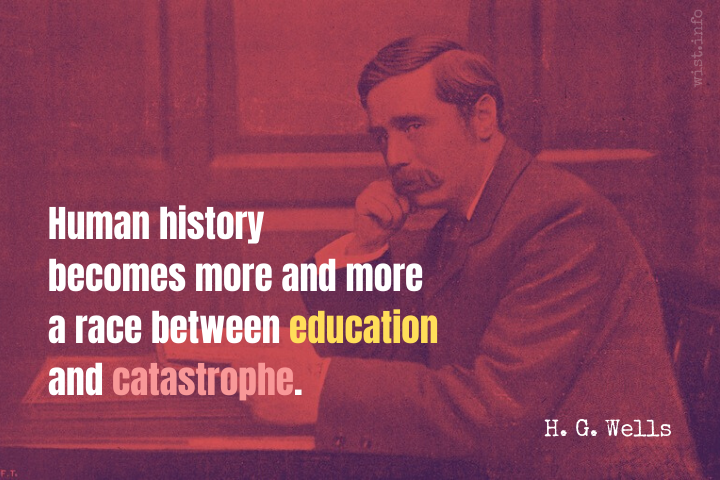
Human history becomes more and more a race between education and catastrophe.
H. G. Wells (1866–1946) British writer [Herbert George Wells]
The Outline of History, Vol. 2, ch. 41, sec. 4 (1921)
(Source)
Also attributed to Wells: "Civilization is in a race between education and catastrophe. Let us learn the truth and spread it as far and wide as our circumstances allow. For the truth is the greatest weapon we have."
Although endlessly brooding on power, victory, defeat, revenge, the nationalist is often somewhat uninterested in what happens in the real world. What he wants is to feel that his own unit is getting the better of some other unit, and he can more easily do this by scoring off an adversary than by examining the facts to see whether they support him.
George Orwell (1903–1950) English journalist, essayist, writer [pseud. of Eric Arthur Blair]
Essay (1945-05), “Notes on Nationalism,” Polemic Magazine (1945-10)
(Source)
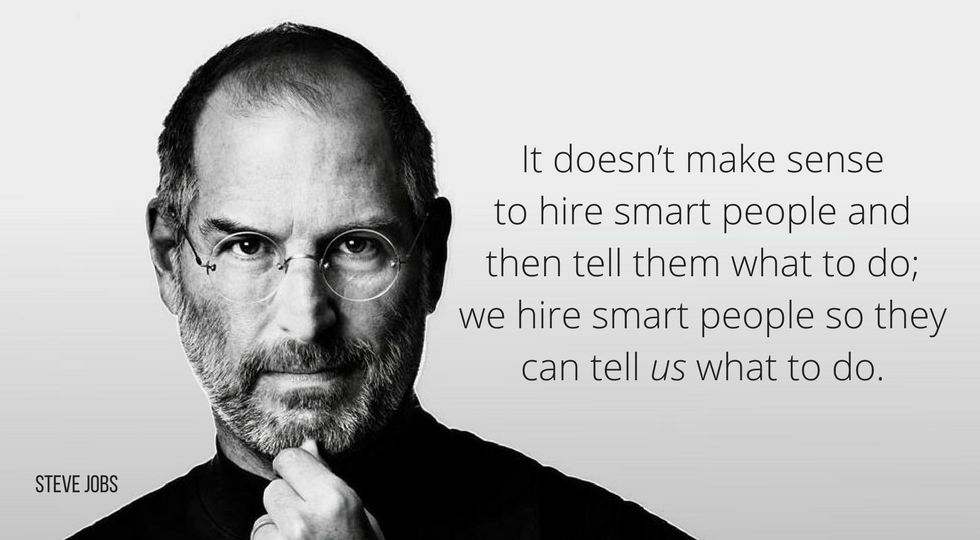
A lot of companies — I know it sounds crazy — but a lot of companies … hire people to tell them what to do. We hire people to tell us what to do. We figure we’re paying them all this money; their job is to figure out what to do and tell us.
Steve Jobs (1955–2011) American computer inventor, entrepreneur
“Steve Jobs: ‘Computer Science Is A Liberal Art’,” interview with Terry Gross, Fresh Air, NPR (1996)
(Source)
There are a number of variants on this quotation. A common one: "It doesn't make sense to hire smart people and then tell them what to do; we hire smart people so they can tell us what to do."

When action grows unprofitable, gather information; when information grows unprofitable, sleep.


As great minds can express much in a few words, so small minds have the contrary talent of talking a great deal without saying anything at all.
[Comme c’est le caractère des grands esprits de faire entendre en peu de paroles beaucoup de choses, les petits esprits, au contraire, ont le don de beaucoup parler, et de ne rien dire.]
François VI, duc de La Rochefoucauld (1613–1680) French epigrammatist, memoirist, noble
Réflexions ou sentences et maximes morales [Reflections; or Sentences and Moral Maxims], ¶142 (1665-1678) [tr. FitzGibbon (1957)]
(Source)
Present in the 1st (1665) ed. A 1665 variant:[Comme c’est le caractère des grands esprits de faire entendre avec peu de paroles beaucoup de choses, les petits esprits, en revanche, ont le don de beaucoup parler, et de ne dire rien.]
(Source (French)). Other translations:As great Wits have a peculiar Faculty of saying a great deal in a little; so half witted Fellows have a Talent of talking much, and yet saying nothing.
[tr. Stanhope (1694), ¶143]As it is the characteristic of great wits to say much in few words, so small wits seem to have the gift of speaking much and saying nothing.
[pub. Donaldson (1783), ¶414; ed. Lepoittevin-Lacroix (1797), ¶137]It is the characteristic of great wits to say much in a few words; small wits seem to have the gift of speaking much and saying nothing.
[ed. Carvill (1835), ¶419]As it is the characteristic of great wits; to convey a great deal in a few words, so, on the contrary, small wits have the gift of speaking much and saying nothing.
[ed. Gowens (1851), ¶145]As it is the mark of great minds to say many things in a few words, so it is that of little minds to use many words to say nothing.
[tr. Bund/Friswell (1871), ¶142]As it is a trait of powerful intellects to express much in a few words; inversely, small minds talk much and say little.
[tr. Heard (1917), ¶142]It is a mark of great minds to say much in a few words. On the other hand, small minds possess the gift of talking much and saying nothing.
[tr. Stevens (1939), ¶142]As it is the mark of great minds to convey much in few words, so small minds are skilled at talking at length and saying little.
[tr. Kronenberger (1959), ¶142]As the stamp of great minds is to suggest much in a few words, so, contrariwise, little minds have the gift of talking a great deal and saying nothing.
[tr. Tancock (1959), ¶142]As it is the character of great minds to make many things understood in few words; so small minds, on the contrary, have the gift of speaking much, and saying nothing.
[tr. Siniscalchi (1994)]Just as great spirits make much understood with few words, small ones have the gift of speaking very much without saying anything.
[tr. Whichello (2016)]

No fact in the world is instant, infinitesimal and ultimate, a single mark. There are, I hold, no atomic facts. In the language of science, every fact is a field — a crisscross of implications, those that lead to it and those that lead from it. We condense the laws around concepts. Science takes its coherence, its intellectual and imaginative strength together, from the concepts at which its laws cross, like knots in a mesh.
Jacob Bronowski (1908–1974) Polish-English humanist and mathematician
Science and Human Values, Part 3: “The Sense of Human Dignity”, §1 (1956)
SIR BEDEVERE: How do know so much about swallows?
KING ARTHUR: Well, you have to know these things when you’re a king, you know.Monty Python (b. 1969) British comedy troupe [Graham Chapman, John Cleese, Terry Gilliam, Eric Idle, Terry Jones, Michael Palin]
Monty Python and the Holy Grail (1975)
There are persons who honestly do not see the use of books in the home, either for information — have they not radio and even television? — or for decoration — is there not the wallpaper?
Pearl S. Buck (1892–1973) American writer
“In Search of Readers,” in Helen Hull, The Writer’s Book (1950)
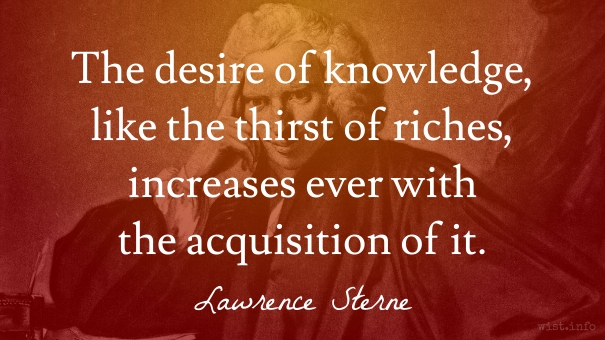
The desire of knowledge, like the thirst of riches, increases ever with the acquisition of it.
Laurence Sterne (1713–1786) Anglo-Irish novelist, Anglican clergyman
Tristam Shandy, Book 1, ch. 3 (1760-1767)
It’s easy to think that as a result of the extinction of the dodo, we are now sadder and wiser, but there’s a lot of evidence to suggest that we are merely sadder and better informed.
Douglas Adams (1952–2001) English author, humorist, screenwriter
Last Chance to See, ch. 6 (1990)
(Source)
My experience indicates that most managers receive much more data (if not information) than they can possibly absorb even if they spend all of their time trying to do so. Hence they already suffer from an information overload. They must spend a great deal of time separating the relevant documents. For example, I have found that I receive an average of 43 hours of unsolicited reading material each week. The solicited material is usually half again this amount. Most MIS designers “determine” what information is needed by asking managers what information they would like to have. This is based on the assumption that managers know what information they need and want.
Russell L. Ackoff (1919–2009) American organizational theorist, consultant, management scientist
“Management Misinformation Systems,” Management Sciences (Dec 1967)
I do not deny that most managers lack a good deal of information that they should have, but I do deny that this is the most important informational deficiency from which they suffer. It seems to me that they suffer more from an overabundance of irrelevant information.
Russell L. Ackoff (1919–2009) American organizational theorist, consultant, management scientist
“Management Misinformation Systems,” Management Sciences (Dec 1967)
Everybody gets so much information all day long that they lose their common sense.
Gertrude Stein (1874–1946) American expatriate author, feminist
“Reflection on the Atomic Bomb” (1946), Yale Poetry Review (Dec 1947)
(Source)

Having gradually (and perhaps painfully) accumulated information to support a decision people become progressively loath to accept contrary evidence.
Norman F. Dixon (1922–2013) British cognitive psychologist, author, military engineer
On the Psychology of Military Incompetence, Part 1, ch. 2 “Generalship” (1976)
(Source)
Wherever the people are well informed they can be trusted with their own government; that whenever things get so far wrong as to attract their notice, they may be relied on to set them to rights.
Thomas Jefferson (1743–1826) American political philosopher, polymath, statesman, US President (1801–09)
Letter (1789-01-08) to Richard Price
(Source)
Men more frequently require to be reminded than informed.
Samuel Johnson (1709–1784) English writer, lexicographer, critic
Essay (1750-03-24), The Rambler, No. 2
(Source)
If at first you don’t succeed, that’s one data point.
Randall Munroe (b. 1984) American webcomic writer, roboticist, programmer
XKCD, #1154 “Resolution” [rollover] (31 Dec 2012)
(Source)

I believe that ignorance is the root of all evil. And that no one knows the truth. I believe that the people is not dumb. Ignorant, bigoted, and mean-minded, maybe, but not stupid. I just think it helps, anything and everything, if the people know. Know what the hell is going on. What they do about it once they know is not my problem.
Molly Ivins (1944–2007) American writer, political columnist [Mary Tyler Ivins]
Essay (1973-01), “Pitfalls of Reporting in the Lone Star State,” Houston Journalism Review
(Source)
Her journalistic credo. Collected in Molly Ivins Can't Say That, Can She? (1991).

I hold it, therefore, certain, that to open the doors of truth, and to fortify the habit of testing everything by reason, are the most effectual manacles we can rivet on the hands of our successors to prevent their manacling the people with their own consent.
Thomas Jefferson (1743–1826) American political philosopher, polymath, statesman, US President (1801–09)
Letter (1804-06-28) to John Tyler
(Source)
Far more crucial than what we know or do not know is what we do not want to know.
Eric Hoffer (1902–1983) American writer, philosopher, longshoreman
Passionate State of Mind, Aphorism 58 (1955)
(Source)
No experiment can be more interesting than that we are now trying, and which we trust will end in establishing the fact, that man may be governed by reason and truth. Our first object should therefore be, to leave open to him all the avenues to truth. The most effectual hitherto found, is the freedom of the press. It is therefore, the first shut up by those who fear the investigation of their actions.
Thomas Jefferson (1743–1826) American political philosopher, polymath, statesman, US President (1801–09)
Letter (1804-06-28) to John Tyler
(Source)
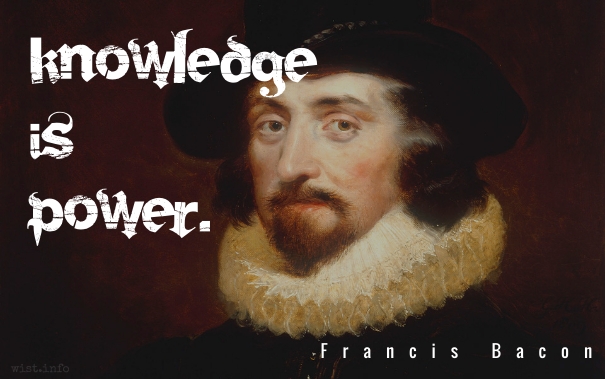
Knowledge is power.
[Nam et ipsa scientia potestas est.]
Francis Bacon (1561–1626) English philosopher, scientist, author, statesman
Sacred Meditations [Meditationes Sacræ], “Of Heresies [De Hæresibus]” (1597)
Alt. trans.: "Knowledge itself is power."
A popular government without popular information, or the means of acquiring it, is but a prologue to a farce or a tragedy; or, perhaps, both. Knowledge will forever govern ignorance. And a people who mean to be their own governors must arm themselves with the power which knowledge gives.
James Madison (1751–1836) American statesman, political theorist, US President (1809–17)
Letter to W. T. Barry (4 Aug 1822)
Always use the chain of command to issue orders, but if you use the chain of command for information, you’re dead.
Hyman Rickover (1900–1986) Polish-American naval engineer, admiral [b. Chaim Gdala Rykower]
(Attributed)
(Source)
Recalled by James Woolsey, at the time CIA Director (1993-1995), as something said to him by Rickover; in "You've Got To Talk To The Smokers," Newsweek (1994-10-09).
Though this is the form and citation most usually given for this quote, Woolsey had previously attributed a lengthier version to Rickover, though it was not recorded with quotation marks. After having served as Under Secretary of the Navy (1977-1979, during which he presumably interacted with Rickover, who retired in 1983), Woolsey spoke at the "Creativity and Innovation in Bureaucracy" symposium at the National Defense University, Washington, DC, in the panel "Creative Approaches to National Security" (1983-10-27):Hyman G. Rickover used to say, when you give an order in any military circumstance, make sure you use the chain of command. But if you rely on the chain of command for information, you're dead. I think there's a great deal of truth in that.
I have no data yet. It is a capital mistake to theorize before one has data. Insensibly one begins to twist facts to suit theories, instead of theories to suit facts.
Arthur Conan Doyle (1859–1930) British writer and physician
Story (1891-07), “A Scandal in Bohemia,” ch. 1 [Holmes], The Strand Magazine, Vol. 2, No. 1
(Source)
Collected in The Adventures of Sherlock Holmes, No. 1, ch. 1 (1892).
Holmes uses a similar phrase in The Sign of the Four (1890).
He who knows only his own side of the case, knows little of that. His reasons may be good, and no one may have been able to refute them. But if he is equally unable to refute the reasons on the opposite side; if he does not so much as know what they are, he has no ground for preferring either opinion. The rational position for him would be suspension of judgment, and unless he contents himself with that, he is either led by authority, or adopts, like the generality of the world, the side to which he feels most inclination.
John Stuart Mill (1806–1873) English philosopher and economist
On Liberty, ch. 2 “Of the Liberty of Thought and Discussion” (1859)
(Source)
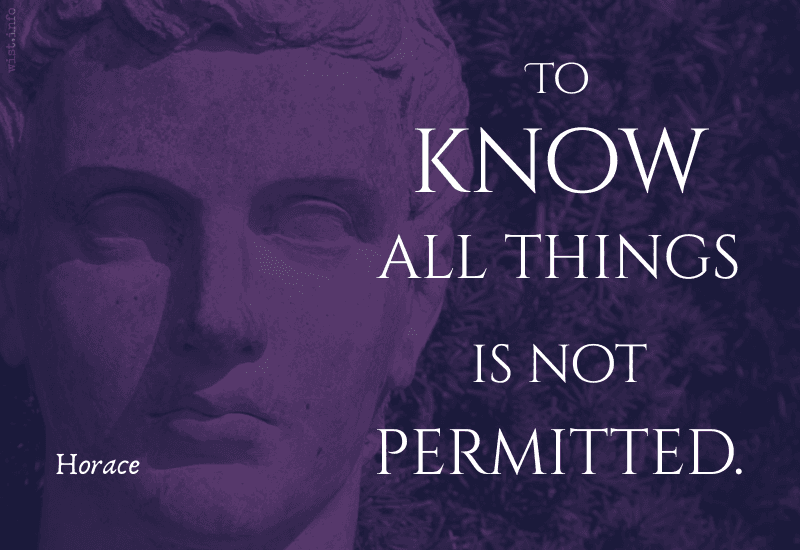
To know all things is not permitted.
[Nec scire fas est omnia.]
Horace (65–8 BC) Roman poet, satirist, soldier, politician [Quintus Horatius Flaccus]
Odes [Carmina], Book 4, # 4, l. 22 (4.4.22) (23 BC)
(Source)
Common English translation, dating back to at least the late 19th Century.
In a number of translations, this phrase is elided or blurred into the surrounding text. Only distinct expressions of the sentiment are given below.
(Source (Latin)). Other translations:Not all of truth
We seekers find.
[tr. Conington (1872)]Neither is it possible to discover everything.
[tr. Smart/Buckley (1853)]Nor everything to know, may any mortal dare.
[tr. Martin (1864)]Nor is the lore
Of all things lore allowed.
[tr. Bulwer-Lytton (1870)]Neither is it lawful to know all things.
[tr. Elgood (1893)]For us to know
All things is not heaven's will.
[tr. Garnsey (1907)]All things man may not learn.
[tr. Marshall (1908)]Nor is it vouchsafed to know all things.
[tr. Bennett (Loeb) (1912)]Not all things may one know.
[tr. Mills (1924)]Nor should men sound all knowledge.
[tr. Michie (1963)]It is not lawful to know all things.
[tr. Alexander (1999)]It’s not right to know everything.
[tr. Kline (2015)]
To paraphrase Oedipus, Hamlet, Lear, and all those guys, I wish I had known this some time ago.
Get your facts first, and then you can distort them as much as you please.
Mark Twain (1835–1910) American writer [pseud. of Samuel Clemens]
Interview (1889) by Rudyard Kipling, Elmira, New York, From Sea to Sea, Part 2, ch. 37 “An Interview with Mark Twain” (1899)
(Source)
Broader context:"Personally I never care for fiction or story-books. What I like to read about are facts and statistics of any kind. If they are only facts about the raising of radishes, they interest me. Just now, for instance, before you came in" -- he pointed to an encyclopædia on the shelves -- "I was reading an article about 'Mathematics.' Perfectly pure mathematics.
"My own knowledge of mathematics stops at 'twelve times twelve,' but I enjoyed that article immensely. I didn't understand a word of it: but facts, or what a man believes to be facts, are always delightful. That mathematical fellow believed in his facts. So do I. Get your facts first, and" -- the voice dies away to an almost inaudible drone -- "then you can distort 'em as much as you please."
Variant: "Get the facts first. You can distort them later."
For more discussion of this quotation, see "Get your facts first, and then you can distort them… (Barry Popik).
If you must play, decide on three things at the start: the rules of the game, the stakes, and the quitting time.
Proverbs, Sayings, and Adages
Chinese proverb

The opinion of ten thousand men is of no value if none of them know anything about the subject.
Marcus Aurelius (AD 121–180) Roman emperor (161–180), Stoic philosopher
(Attributed)
Often attributed to Marcus Aurelius, but I can find no primary source for it, or references to a more complex thought that was paraphrased down to this.
The degree of one’s emotions varies inversely with one’s knowledge of the facts — the less you know the hotter you get.
Bertrand Russell (1872–1970) English mathematician and philosopher
(Attributed)
Widely attributed to Russell, but not found in any of his online published works or cited to any source.