

The senate has a standing rule never to discuss a matter on the same day when it was first introduced; all new business is deferred to the next meeting. They do this so that a man will not blurt out the first thought that occurs to him, and then devote all his energies to defending those foolish impulses, instead of considering impartially the public good. They know that some men would rather jeopardize the welfare of the state than admit to having been heedless and shortsighted — so perverse and preposterous is their sense of pride. They should have had enough foresight at the beginning to speak with prudence rather than haste.
[Quin id quoque moris habet senatus, ut nihil, quo die primum proponitur, eodem disputetur. sed in sequentem senatum differatur, ne quis ubi quod in buccam primum uenerit, temere effutierit, ea potius excogitet postea, quibus decreta tueatur sua, quam quae ex reipublicae usu sint. malitque salutis publicae, quam opinionis de se iacturam facere, peruerso quodam ac praepostero pudore, ne initio parum prospexisse uideatur. Cui prospiciendum initio fuit, ut consulto potius, quam cito loqueretur.]
Thomas More (1478–1535) English lawyer, social philosopher, statesman, humanist, Christian martyr
Utopia, Book 2, ch. 3 “Of Their Magistrates” (1518 ed.) [tr. Adams (1992 ed.)]
(Source)
(Source (Latin)). Other translations:Furthermore this custome also the counsel useth, to dispute or reason of no matter the same daye that it is firste proposed or put furthe, but to defferre it to the nexte syttinge of the counsell. Because that no man when he hath rashely there spoken that commeth to his tonges ende, shall then afterwarde rather studye for reasons wherwith to defende and mainteine his first folish sentence, than for the commoditie of the common welath: as one rather willing the harme or hindraunce of the weale publike then any losse or diminution of his owne existimation. And as one that would be ashamed (which is a verie folishe shame) to be counted anye thing at the first oversene in the matter. Who at the first ought to have spoken rather wyselye, then hastely, or rashlye.
[tr. Robynson (1551)]One Rule observed in their Council, is, never to debate a thing on the same day in which it is first proposed; for that is always referred to the next meeting, that so Men may not rashly, and in the heat of Discourse, engage themselves too soon, which may bias them so much, that instead of considering the Good of the Publick, they will rather study to maintain their own Notions; and by a perverse and preposterous sort of shame, hazard their Country, rather than endanger their own Reputation, or venture the being suspected to have wanted foresight in the Expedients that they proposed at first. and therefore to prevent this, they take care that they may rather be deliberate, than sudden in their motions.
[tr. Burnet (1684)]One rule observed in their council is, never to debate a, subject on the day on which it is proposed. It is ever referred to the next meeting, for fear of rashness and the heat of argument; which might lead them, instead of consulting the public good, to support their first opinions, and hazard their country rather than endanger their own reputation. To prevent this, they are made deliberate rather than expeditious.
[tr. Cayley (1808)]One rule observed in their council is, never to debate a thing on the same day in which it is first proposed; for that is always referred to the next meeting, that so men may not rashly and in the heat of discourse engage themselves too soon, which might bias them so much that, instead of consulting the good of the public, they might rather study to support their first opinions, and by a perverse and preposterous sort of shame hazard their country rather than endanger their own reputation, or venture the being suspected to have wanted foresight in the expedients that they at first proposed; and therefore, to prevent this, they take care that they may rather be deliberate than sudden in their motions.
[tr. Burnet/Morley (1901)]Furthermore this custom also the council useth, to dispute or reason of no matter the same day that it is first proposed or put forth, but to defer it to the next sitting of the council. Because that no man when he hath rashly there spoken that cometh first to his tongue’s end, shall then afterward rather study for reasons wherewith to defend and confirm his first foolish sentence, than for the commodity of the commonwealth: as one rather willing the harm or hindrance of the weal public than any loss or diminution of his own existimation. And as one that would not for shame (which is a very foolish shame) be counted anything overseen in the matter at the first. Who at the first ought to have spoken rather wisely, than hastily, or rashly.
[tr. Robinson (1909 ed)]Moreover the Senate has this custom, that nothing is decided on the same day on which it is first propounded, but that it is put off till the next meeting, and this lest anyone after hastily uttering the idea that first came into his mouth, should afterwards think more of how to defend his opinion than of supporting what is for the good of the commonwealth, and should prefer to jeopardise the public weal rather than risk his reputation through a wrongheaded and misplaced shame, fearing he may be thought to have shown too little foresight at the first, though he should have taken care to speak with wisdom rather than with haste in the first instance.
[tr. Richards (1923)]There's also a rule in the Council that no resolution can be debated on the day that it's first proposed. All discussion is posponed until the next well-attended meeting. Otherwise someone’s liable to say the first thing that comes into his head, -- and then start thinking up arguments to justify what he has said, instead of trying to decide what’s best for the community. That type of person is quite prepared to sacrifice the public to his own prestige, just because, absurd as it may sound, he’s ashamed to admit that his first idea might have been wrong -- when his first idea should have been to think before he spoke.
[tr. Turner (1965 ed.); (2003 ed.)]In addition, the senate has the custom of debating nothing on the same day on which it is first proposed but of putting it off till the next meeting. This is their rule lest anyone, after hastily blurting out the first thought that popped into his head, should afterwards give more thought to defending his opinion than to supporting what is for the good of the commonwealth, and should prefer to jeopardize the public welfare rather than to risk his reputation through a wrongheaded and misplaced shame, fearing he might be thought to have shown too little foresight at the first -- though he should have been enough foresighted at the first to speak with prudence rather than with haste!
[tr. Richards/Surtz (1964)]The Council of Tranibors also follows the practice of never debating a proposition on the day it’s first put forward, but of deferring it to the next meeting. Otherwise someone who has heedlessly blurted out the first idea to come into their mouth may later give more thought to defending their own position than to the country’s interests. Indeed, they may choose to sacrifice the public well-being to their own reputation out of a mistaken and misplaced sense of embarrassment at not having been clear-minded enough at the start — though being clear-minded at the start should have meant speaking thoughtfully rather than in haste.
[tr. Clarke (2017)]
Quotations about:
position
Note not all quotations have been tagged, so Search may find additional quotes on this topic.

Take heed not to be transformed into a Caesar, not to be dipped in the purple dye; for it does happen.
[Ὅρα μὴ ἀποκαισαρωθῇς, μὴ βαφῇς: γίνεται γάρ.]
Marcus Aurelius (AD 121–180) Roman emperor (161–180), Stoic philosopher
Meditations [To Himself; Τὰ εἰς ἑαυτόν], Book 6, ch. 30 (6.30.1) (AD 161-180) [tr. Farquharson (1944)]
(Source)
Advising himself on the dangers of becoming emperor. Marcus coined a new Greek verb here (ἀποκαισαρόομαι), "to become like Caesar" (more broadly, "to assume the monarchy").
(Source (Greek)). Other translations:Take heed, lest of a philosopher thou become a mere Caesar in time, and receive a new tincture from the court. For it may happen if thou dost not take heed.
[tr. Casaubon (1634), 6.27]Have a care you han't too much of an Emperour in you, and that you don't fall into the liberties and Pride of your Predecessors. These Humours are easily learn'd, therefore guard against the Infection.
[tr. Collier (1701)]Take care you don’t degenerate into the manners of the Cesars, or be tinctured by them.
[tr. Hutcheson/Moor (1742)]Beware, when you take the title of Cæsar, that you do not insensibly assume too much of the Emperor; nor be infected with the haughty manners of some of your predecessors; for there is a possibility of such an event.
[tr. Graves (1792), 6.27]Take care that thou art not made into a Caesar, that thou art not dyed with this dye; for such things happen.
[tr. Long (1862)]Have care that you have not too much of a Cæsar in you, and that you are not dyed with that dye. This is easily learned, therefore guard against the infection.
[tr. Collier/Zimmern (1887)]See that you be not be-Cæsared, steeped in that dye, as too often happens.
[tr. Rendall (1898)]See to it that you fall not into Caesarism: avoid that stain, for it may come to you.
[tr. Hutcheson/Chrystal (1902)]See thou be not Caesarified, nor take that dye, for there is the possibility.
[tr. Haines (Loeb) (1916)]Be careful not to affect the monarch too much, or to be too deeply dyed with the purple; for this can well happen.
[tr. Staniforth (1964)]Take care that you are not turned into a Caesar, that you are not stained with the purple; for such things do come about.
[tr. Hard (1997 ed.; 2011 ed.)]To escape imperialization -- that indelible stain. It happens.
[tr. Hays (2003)]Take care not to be Caesarified, or dyed in purple: it happens.
[tr. Hammond (2006)]Take care you are not turned into a Caesar, or stained with the purple; these things do happen.
[tr. Gill (2013)]Beware of being Caesarified, be not stained by desire for power.
[ed. Taplin (2016)]
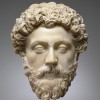
If men of eminence are exposed to censure on one hand, they are as much liable to flattery on the other. If they receive reproaches which are not due to them, they likewise receive praises which they do not deserve. In a word, the man in a high post is never regarded with an indifferent eye, but always considered as a friend or an enemy.
Joseph Addison (1672–1719) English essayist, poet, statesman
Essay (1711-06-26), The Spectator, No. 101
(Source)

Censure is the tax a man pays to the public for being eminent.
Jonathan Swift (1667–1745) English writer and churchman
Essay (1706-10), “Thoughts on Various Subjects”
(Source)
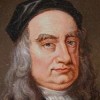
It is not the desire for true riches that depraves man, but the desire for those that are false. A people never became corrupted for having grain, fruits, a pure air, better waters, more perfect arts, but for having gold, jewelry, subjects, power, a false renown, and an unjust superiority.
[Ce n’est pas le désir des vrais biens qui déprave l’homme, mais le désir de ceux qui sont faux. Jamais un peuple ne s’est corrompu, pour avoir du blé, des fruits, un air pur, des eaux meilleures, des arts plus parfaits, des femmes plus belles; mais pour avoir de l’or, des pierreries, des sujets, de la puissance, un faux renom et une injuste supériorité.]
Joseph Joubert (1754–1824) French moralist, philosopher, essayist, poet
Pensées [Thoughts], ch. 16 “Des Mœurs publiques et privées; du Caractère des Nations [On Morality and the Character of Nations],” ¶ 39 (1850 ed.) [tr. Calvert (1866), ch. 12]
(Source)
(Source (French)). This "thought" is not included in other translations I could find.
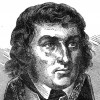
The difficult part of an argument is not to defend one’s opinion, but rather to know it.
André Maurois (1885–1967) French author [b. Émile Salomon Wilhelm Herzog]
Conversation, “Action in Conversation” (1930)
(Source)
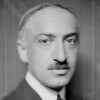
Nothing more clearly shows how little God esteems his gift to men of wealth, money, position and other worldly goods, than the way he distributes these, and the sort of men who are most amply provided with them.
[Rien ne fait mieux comprendre le peu de chose que Dieu croit donner aux hommes, en leur abandonnant les richesses, l’argent, les grands établissements et les autres biens, que la dispensation qu’il en fait, et le genre d’hommes qui en sont le mieux pourvus.]
Jean de La Bruyère (1645–1696) French essayist, moralist
The Characters [Les Caractères], ch. 6 “Of Gifts of Fortune [Des Biens de Fortune],” § 24 (6.24) (1688) [tr. Stewart (1970)]
(Source)
See Alexander Pope.
(Source (French)). Other translations:Nothing makes us better comprehend what little things God thinks he bestows on Mankind, when he suffers 'em to abound in Riches, Gold, Settlements, Stations, and other advantages, than the dispensations he makes of them, and the sort of men who are best provided.
[Bullord ed. (1696)]Nothing makes us better comprehend what little things God thinks he bestows on Mankind, in suffering 'em to abound in Riches, Mony, great Preferments, and other Advantages, than the Distribution he makes of 'em, and the sort of Men who are best provided.
[Curll ed. (1713)]Nothing makes us better understand what trifling things Providence thinks He bestows on men in granting them wealth, money, dignities, and other advantages, than the manner in which they are distributed and the kind of men who have the largest share.
[tr. Van Laun (1885)]

Nothing is meaner, and more typical of the mob, than to speak in glowing terms of those whom one held in little account before their rise to eminence.
[Il n’y a rien de plus bas, et qui convienne mieux au peuple, que de parler en des termes magnifiques de ceux mêmes dont l’on pensait très modestement avant leur élévation.]
Jean de La Bruyère (1645–1696) French essayist, moralist
The Characters [Les Caractères], ch. 12 “Of Opinions [Des Jugements],” § 5 (12.5) (1688) [tr. Stewart (1970)]
(Source)
(Source (French)). Other translations:There's nothing so mean, and so like the Mob, as to talk much in the praise of those very persons, of whom we thought indifferently before their promotion.
[Bullord ed. (1696)]There is nothing so mean and so like the Vulgar, as to talk much in praise of those very Persons, of whom we thought indifferently before their promotion.
[Curll ed. (1713)]There's nothing so mean, and so truly vulgar, as to sound the Praise of those very Persons, of whom we thought but indifferently before their Promotion.
[Browne ed. (1752)]There is nothing so mean and so truly vulgar as extravagantly to praise those very persons of whom we had but very indifferent opinions before their promotion.
[tr. Van Laun (1885)]
The vulgar ignorance of stubborn people makes them prefer contention to truth and utility. Prudent people are on the side of reason, not passion, whether because they foresaw it from the first, or because they improved their position later.
[Vulgaridad de temáticos, no reparar en la verdad, por contradecir, ni en la utilidad, por litigar. El atento siempre está de parte de la razón, no de la pasión, o anticipándose antes o mejorándose después.]
Baltasar Gracián y Morales (1601–1658) Spanish Jesuit priest, writer, philosopher
The Art of Worldly Wisdom [Oráculo Manual y Arte de Prudencia], § 142 (1647) [tr. Maurer (1992)]
(Source)
(Source (Spanish)). Other translations:It is the custome of the head strong to regard neither truth in contradicting; nor profit in disputing. A wise man hath always reason on his side, and never falls into passion. He either prevents or retreats.
[Flesher ed. (1685)]'Tis the common failing of the obstinate that they lose the true by contradicting it, and the useful by quarrelling with it. The sage never places himself on the side of passion but espouses the cause of right, either discovering it first or improving it later.
[tr. Jacobs (1892)]The vulgarity of these clowns, that they observe not the truth, because they lie, nor yet their own interest, because on the wrong side. A heedful man stands always on the side of reason, and never that of passion, either because he foresaw it from the first, or found it better afterwards.
[tr. Fischer (1937)]

Never from Obstinacy take the Wrong Side because your Opponent has anticipated you in taking the Right One.
[Nunca por tema seguir el peor partido, porque el contrario se adelantó y escogió el mejor.]Baltasar Gracián y Morales (1601–1658) Spanish Jesuit priest, writer, philosopher
The Art of Worldly Wisdom [Oráculo Manual y Arte de Prudencia], § 142 (1647) [tr. Jacobs (1892)]
(Source)
(Source (Spanish)). Other translations:Never to espouse a bad party in spight to an Adversary, who hath taken the better.
[Flesher ed. (1685)]Never out of obstinancy take the wrong side, because your opponent has got before you and taken the right one.
[tr. Duff (1877)]Never out of stubbornness hold to the wrong side, just because your adversary anticipated you, and chose the right.
[tr. Fischer (1937)]Don’t defend the wrong side out of stubbornness, just because your opponent happened to arrive first and choose the right side.
[tr. Maurer (1992)]
Owners of dogs will have noticed that, if you provide them with food and water and shelter and affection, they will think you are god. Whereas owners of cats are compelled to realize that, if you provide them with food and water and shelter and affection, they draw the conclusion that they are god.
Christopher Hitchens (1949–2011) English intellectual, polemicist, socio-political critic
The Portable Atheist, Introduction (2007)
(Source)

Anxiety is the handmaiden of contemporary ambition.
Ambition is but Avarice on stilts and masked.
Walter Savage Landor (1775–1864) English writer and poet
Imaginary Conversations, Third Series, “Lord Brooke and Sir Philip Sidney” (1828)
If I know your sect, I anticipate your argument.
Ralph Waldo Emerson (1803–1882) American essayist, lecturer, poet
“Self-Reliance,” Essays: First Series (1841)
(Source)
You see the thing you have to remember. When you get to be President, there are all those things, the honors, the twenty-one-gun salutes, all those things. You have to remember it isn’t for you. It’s for the Presidency, and you’ve got to keep yourself separate from that in your mind. If you can’t keep the two separate, yourself and the Presidency, you’re in all kinds of trouble.
Harry S Truman (1884–1972) US President (1945–1953)
In Merle Miller, Plain Speaking: An Oral Biography of Harry S. Truman, ch. 15 (1973)
(Source)
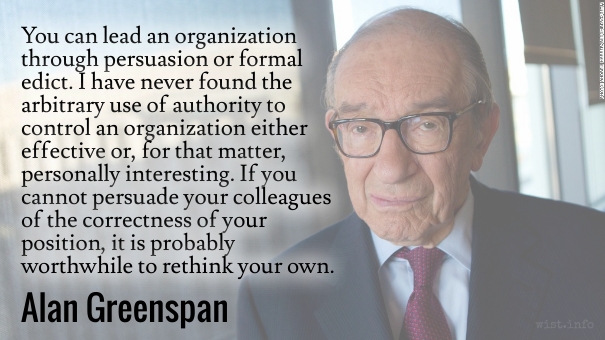
You can lead an organization through persuasion or formal edict. I have never found the arbitrary use of authority to control an organization either effective or, for that matter, personally interesting. If you cannot persuade your colleagues of the correctness of your position, it is probably worthwhile to rethink your own.
Alan Greenspan (b. 1926) American economist, bureaucrat
“Federal Reserve’s Chairman Blends Eye for Politics with Economic Skills,” New York Times (26 Jul 1990)

It is easy to be brave from a safe distance.
In disputes upon moral or scientific points, ever let your aim be to come at truth, not to conquer your opponent: so you never shall be at a loss in losing the argument, and gaining a new discovery.
James Burgh (1714–1775) British politician and writer
The Dignity of Human Nature, Sec. 5 “Miscellaneous Thoughts on Prudence in Conversation” (1754)
(Source)
It is not titles that honor men, but men honor the titles.
Niccolò Machiavelli (1469–1527) Italian politician, philosopher, political scientist
The Discourses on Livy, Book 3, ch. 38 (1517) [tr. Detmold (1882)]
Few things are so immutable as the addiction of political groups to the ideas by which they have once won office.
John Kenneth Galbraith (1908–2006) Canadian-American economist, diplomat, author
The Affluent Society, ch. 13, sec. 4 (1958)
On some positions, Cowardice asks the question, “Is it safe?” Expediency asks the question, “Is it is politic?” Vanity asks the question, “Is it is popular?” But Conscience asks the question, “Is it right?” There comes a time when one must take a position that is neither safe, nor politic, nor popular, but he must do it because Conscience tells him it is right.
Martin Luther King, Jr. (1929–1968) American clergyman, civil rights leader, social activist, preacher
Speech, Santa Rita, Calif., (14 Jan 1968)
Recording (at 10:22). King reused speech elements frequently. The same passage can be found in "Remaining Awake Through a Great Revolution", sermon at the National Cathedral, Washington, DC (31 Mar 1968).
Do not worry if you are without a position; worry lest you do not deserve a position. Do not worry if you are not famous; worry lest you do not deserve to be famous.
[不患無位、患所以立、不患莫己知、求爲可知也]
Confucius (c. 551- c. 479 BC) Chinese philosopher, sage, politician [孔夫子 (Kǒng Fūzǐ, K'ung Fu-tzu, K'ung Fu Tse), 孔子 (Kǒngzǐ, Chungni), 孔丘 (Kǒng Qiū, K'ung Ch'iu)]
The Analects [論語, 论语, Lúnyǔ], Book 4, verse 14 (4.14) (6th C. BC – AD 3rd C.) [tr. Leys (1997)]
(Source)
(Source (Chinese)). See also 1.16, 14.30, 15.19. Other translations:A man should say, I am not concerned that I have no place, I am concerned how I may fit myself for one. I am not concerned that I am not known, I seek to be worthy to be known.
[tr. Legge (1861)]One should not be greatly concerned at not being in office; but rather about the requirements in oneself for such a standing. Neither should one be so much concerned at being unknown; but rather with seeking to become worthy of being known.
[tr. Jennings (1895)]Be not concerned for want of a position; be concerned how to fit yourself for a position. Be not concerned that you are not known, but seek to do something to deserve a reputation.
[tr. Ku Hung-Ming (1898)]One should not be concerned at lack of position; but should be concerned about what will fit him to occupy it. One should not be concerned at being unknown; he should seek to be worthy of being known.
[tr. Soothill (1910)]Not worried at being out of a job, but about being fit for one; not worried about being unknown but about doing something knowable.
[tr. Pound (1933)]He does not mind not being in office; all he minds about is whether he has qualities that entitle him to office. He does not mind failing to get recognition; he is too busy doing the things that entitle him to recognition.
[tr. Waley (1938)]Do not worry about not holding high position; worry rather about playing your proper role. Worry not that no one knows of you; seek to be worth knowing.
[tr. Ware (1950)]Do not worry because you have no official position. Worry about your qualifications. Do not worry because no one appreciates your abilities. Seek to be worthy of appreciation.
[tr. Lau (1979)]One is not worried about not holding position; one is worried about how one may fit oneself for appointment. One is not worried that nobody knows one; one seeks to become fit to be known.
[tr. Dawson (1993)]Do not worry about having no office; rather, worry about whether you deserve to stand in that office. Do not worry about nobody knowing you; rather, seek to be worth knowing.
[tr. Huang (1997)]Do not worry about not being on the position, just worry about my quality on the position. Do not worry about that nobody understand me, just seek I can be understood.
[tr. Cai/Yu (1998), #81]Do not worry over not having an official position; worry about what it takes to have one. Do not worry that no one acknowledges you; seek to do what will earn you acknowledgment.
[tr. Ames/Rosemont (1998)]He does not worry that he has no position; he worries about whether he is qualified to hold one. He does not worry that no one recognizes his worth; he seeks to become worthy to be recognized.
[tr. Brooks/Brooks (1998)]Don't worry if you have no position: worry about making yourself worthy of one. Don't worry if you aren't known and admired: devote yourself to a life that deserves admiration.
[tr. Hinton (1998)]Do not be concerned that you lack an official position, but rather concern yourself with the means by which you might become established. Do not be concerned that no one has heard of you, but rather strive to become a person worthy of being known.
[tr. Slingerland (2003)]Don’t worry that you have no position -- worry about how you can qualify for one. Don’t worry that people don’t know you -- look for some reason to become known.
[tr. Watson (2007)]Do not worry that you have no official position. Worry about tnot having the qualifications to deserve a position. Do not worry that others do not know you. Seek to be worthy of being known.
[tr. Annping Chin (2014)]You should not worry about not getting an official appointment. You should instead worry about whether you have the capability to take that assignment. You should not worry that people do not know you. You should instead strive for remarkable achievement.
[tr. Li (2020)]
Nothing so sharpens the thought process as writing down one’s arguments. Weaknesses overlooked in oral discussion become painfully obvious on the written page.
Hyman Rickover (1900–1986) Polish-American naval engineer, admiral [b. Chaim Gdala Rykower]
Speech (1981-11-05), “Doing a Job,” Egleston Medal Award Dinner, Columbia School of Engineering and Applied Science, New York
(Source)
Give to us clear vision that we may know where to stand and what to stand for — because unless we stand for something, we shall fall for anything.
Peter Marshall (1902–1949) Scottish-American preacher, author, US Senate chaplain
Prayer at opening of US Senate session (1947-04-18)
(Source)
This phrase has a significant history prior to Marshall's use of it; see Quote Origin: If You Don’t Stand for Something, You’ll Fall for Anything – Quote Investigator®.
He who knows only his own side of the case, knows little of that. His reasons may be good, and no one may have been able to refute them. But if he is equally unable to refute the reasons on the opposite side; if he does not so much as know what they are, he has no ground for preferring either opinion. The rational position for him would be suspension of judgment, and unless he contents himself with that, he is either led by authority, or adopts, like the generality of the world, the side to which he feels most inclination.
John Stuart Mill (1806–1873) English philosopher and economist
On Liberty, ch. 2 “Of the Liberty of Thought and Discussion” (1859)
(Source)
Avoid having your ego so close to your position that when your position falls, your ego goes with it.
Colin Powell (1937–2021) American military leader, politician, diplomat
My American Journey (1995)
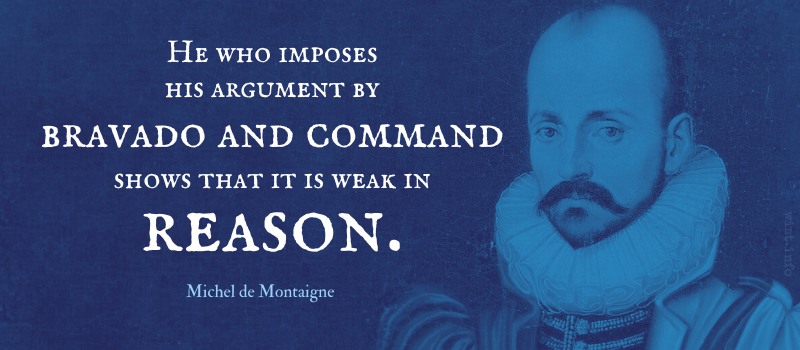
He who imposes his argument by bravado and command shows that it is weak in reason.
[Qui establit son discours par braverie et commandement, montre que la raison y est foible.]
Michel de Montaigne (1533–1592) French essayist
Essays, Book 3, ch. 11 (3.11), “Of Cripples [Des Boyteux]” (1587) [tr. Frame (1943)]
(Source)
(Source (French)). Other translations:He that with braverie and by comaundement will establish his discourse, declareth his reason to be weake.
[tr. Florio (1603), "Of the Lame or Cripple"]Who will establish his Discourse by Authority and Huffing, discovers his Reason to be very weak.
[tr. Cotton (1686)]He who will establish this proposition by authority and huffing discovers his reason to be very weak.
[tr. Cotton/Hazlitt (1877), "On the Lame"]He who establishes his argument by defiance and by command shews that his reasoning is weak.
[tr. Ives (1925)]Any man who supports his opinion with challenges and commands demonstrates that his reasons for it are weak.
[tr. Screech (1987), "On the Lame"]He who establishes his argument by noise and command shows that his reason is weak.
[Source]
There is no good cause for religious persecution. No convert is true who comes to the faith through pain and fear. All persecution does is plant seeds of doubt amongst the hearts of the faithful as to the truth of their cause.
Graham Ericsson (b. 1961) American technologist, writer, aphorist
Journal (undated)
