A hasty quarrel sparks a fire,
and hasty conflict sheds blood.
If you blow on a spark, it will flame up,
and if you spit on it, it will go out;
nonetheless, both come out
of your mouth.[ἔρις κατασπευδομένη ἐκκαίει πῦρ,
καὶ μάχη κατασπεύδουσα ἐκχέει αἷμα.
ἐὰν φυσήσῃς εἰς σπινθῆρα, ἐκκαήσεται,
καὶ ἐὰν πτύσῃς ἐπ᾽ αὐτόν, σβεσθήσεται·
καὶ ἀμφότερα ἐκ τοῦ στόματός σου ἐκπορεύεται.]The Bible (The Old Testament) (14th - 2nd C BC) Judeo-Christian sacred scripture [Tanakh, Hebrew Bible], incl. the Apocrypha (Deuterocanonicals)
Book 22b. Sirach (Ecclesiasticus) 28:11ff (Sir 28:11–12) [tr. CEB (2011)]
(Source)
More on the history and acceptance of this Apocryphal book here and here.
(Source (Greek)). Alternate translations:An hasty contention kindleth a fire: and an hasty fighting sheddeth blood.
If thou blow the spark, it shall burn: if thou spit upon it, it shall be quenched: and both these come out of thy mouth.
[tr. KJV (1611)]A hasty contention kindleth a fire: and a hasty quarrel sheddeth blood: and a tongue that beareth witness bringeth death.
If thou blow the spark, it shall burn as a fire: and if thou spit upon it, it shall be quenched: both come out of the mouth.
[tr. DRA (1899), 28:13–14]A sudden quarrel kindles fire,
a hasty dispute leads to bloodshed.
Blow on a spark and up it flares,
spit on it and out it goes;
both are the effects of your mouth.
[tr. JB (1966); NJB (1985)]An argument that blazes out suddenly can lead to violence. You can blow on a spark to make it glow, or you can spit on it to put it out. Either way, you do it with your mouth.
[tr. GNT (1992 ed.)]A hasty quarrel kindles a fire,
and a hasty dispute sheds blood.
If you blow on a spark, it will glow;
if you spit on it, it will be put out,
yet both come out of your mouth.
[tr. NRSV (2021 ed.)]
Quotations about:
dispute
Note not all quotations have been tagged, so Search may find additional quotes on this topic.

No great advance has been made in science, religion, or politics, without controversy.
Lyman Beecher (1775–1863) American minister, preacher, abolitionist
Sermon (1823-10-15), “The Faith Once Delivered to the Saints,” Worcester, Massachusetts
(Source)
A sermon on Jude 3, given at the ordination of Rev. Loammi Ives Hoadly, to the Pastoral Office over the Calvinistic Church and Society. Collected in Beecher, Sermons Delivered on Various Occasions (1828) [ed. Theophilus Marvin].
This is nearly always rendered:No great advance has ever been made in science, politics, or religion, without controversy.
That is the form recorded in Josiah Gilbert's inaugural Burning Words of Brilliant Writers (1883), from which it was endlessly copied to similar collections.


For years I have hoped that we could stop war as an instrument for settling any national and international difficulties. I have worked for it and shall continue to work for it. However, one has to face the world as it is and, without discarding one’s ideals, meet the realities of the day and keep on working for what one hopes will be a better future.
Eleanor Roosevelt (1884–1962) American politician, diplomat, activist; First Lady of the US (1933–45)
Column (1940-05-17), “My Day”
(Source)

If I solve my dispute with my neighbor by killing him, I have certainly solved the immediate dispute. If my neighbor was a scoundrel, then the world is no doubt better for his absence. But in killing my neighbor, though he may have been a terrible man who did not deserve to live, I have made myself a killer — and the life of my next neighbor is in greater peril than the life of the last.
Wendell Berry (b. 1934) American farmer, educator, poet, conservationist
Speech (1968-02-10), “A Statement Against the War in Vietnam,” Kentucky Conference on the War and the Draft, University of Kentucky
(Source)
Collected in The Long-Legged House, Part 2 (1969).

But you were so utterly devoid of sense, that throughout the whole of your speech you were disputing with yourself, saying things which not only were inconsistent with each other, but involved direct contradiction and opposition, so that the contest was not so much between you and me as between Antonius and Antonius.
[Tam autem eras excors, ut tota in oratione tua tecum ipse pugnares, non modo non cohaerentia inter se diceres, sed maxime disiuncta atque contraria, ut non tanta mecum quanta tibi tecum esset contentio.]
Marcus Tullius Cicero (106–43 BC) Roman orator, statesman, philosopher
Philippics [Philippicae; Antonian Orations], No. 2, ch. 8 / sec. 18 (2.8/2.18.7) (44-10-24 BC) [tr. King (1877)]
(Source)
Addressing Mark Antony (Marcus Antonius).
(Source (Latin)). Other translations:But you are so senseless that throughout the whole of your speech you were at variance with yourself; so that you said things which had not only no coherence with each other, but which were most inconsistent with and contradictory to one another; so that there was not so much opposition between you and me as there was between you and yourself.
[tr. Yonge (1903)]And so void of sense were you that throughout your speech you were at war with yourself, were making not only inconsistent statements, but statements so entirely disjointed and contrary to one another that the contest was not so much with me as with yourself.
[tr. Ker (Loeb) (1926)]Really, your speech was demented, it was so full of inconsistencies. From beginning to end, you were not merely incoherent but glaringly self-contradictory: indeed you contradicted yourself more often than you contradicted me.
[tr. Grant (1971 ed.)]So obtuse were you that throughout your entire speech you were at issue with yourself, making statements that were not merely incoherent but actually inconsistent and incompatible: the result was that you seemed to be not so much in dispute with me as with yourself.
[tr. Berry (2006)]But your speech was so senseless that throughout it you struggled only against yourself and said things that not only made no internal sense but were self-contradictory and inconsistent; in the end it was not so much a clash with me as with yourself.
[tr. McElduff (2011)]But you were so stupid that in your whole speech you were fighting yourself; not only were your statements inconsistent, but so extremely disjoint and contrary that the argument was not so much with me as with yourself, against yourself.
[tr. Wiseman]
CHORUS: Fools who fain would carve a name
Of honour in the fields of fame,
Valiant in the press of war,
Men and fighters — fools they are!
How shall death and wounds and shame
Heal the world’s distrated life?
Vain endeavour! Strife of strife
Misbegotten bringeth no release,
Nor by conquest shall man conquer peace.[ΧΟΡΟΣ: ἄφρονες ὅσοι τὰς ἀρετὰς πολέμῳ
λόγχαισί τ᾽ ἀλκαίου δορὸς
κτᾶσθε, πόνους ἀμαθῶς θνα-
τῶν καταπαυόμενοι:
εἰ γὰρ ἅμιλλα κρινεῖ νιν
αἵματος, οὔποτ᾽ ἔρις
λείψει κατ᾽ ἀνθρώπων πόλεις]Euripides (485?-406? BC) Greek tragic dramatist
Helen [Ἑλένη], l. 1151ff, Stasimon 1, Antistrophe 2 (412 BC) [tr. Sheppard (1925)]
(Source)
(Source (Greek)). Other translations:Think you, fond men, whose martial pride
Glows 'midst the bleeding ranks of war,
By the couragous spear
The strife of mortals to decide?
Vain are your thoughts: should rage abhor'd
That glories in the purple flood,
The contest only end with blood,
Unsheath'd through angry states would flame the sword.
[tr. Potter (1783)]Frantic are ye who seek renown
Amid the horrors of th' embattled field,
Who masking guile beneath a laurel crown
With nervous arm the falchion wield,
Not slaughtered thousands can your fury state.
If still success the judgment guide,
If bloody battle right and wrong decide,
Incessant strive must vex each rival state.
[tr. Wodhull (1809)]Foolish ye, as many as obtain [the renown of] valor by war, foolishly resting form the toils of mortals in the spears of valiant war. For if the contest of blood is to determine [men's quarrels], never will strife leave the cities of men.
[tr. Buckley (1850)]You are fools, who try to win a reputation for virtue through war and marshalled lines of spears, senselessly putting an end to mortal troubles; for if a bloody quarrel is to decide it, strife will never leave off in the towns of men.
[tr. Coleridge (1891)]O fools! all ye who try to win the meed of valour through war and serried ranks of chivalry, seeking thus to still this mortal coil, in senselessness; for if bloody contests are to decide, there will never be any lack of strife in the towns of men.
[tr. Coleridge (alt.)]Madmen, all ye who strive for manhood's guerdons
Battling with shock of lances, seeking ease
Senselessly so from galling of life's burdens!
Never, if blood be arbitress of peace,
Strife between towns of men shall find an ending.
[tr. Way (Loeb) (1912)]Madness it is to attempt to find virtue in war
and the blades of the spear in the fight,
so ignorantly to relieve the misfortunes of men.
For if a contest of blood is the arbiter, then there will always
be strife in the cities of men.
[tr. Warner (1951)]You who in earnest ignorance
Would check the deeds of lawless men,
And in the clash of spear on spear
Gain honour -- you are all stark mad!
If men, to settle each dispute
Must needs compete in bloodshed, when
Shall violence vanish, hate be soothed,
Or men and cities live in peace?
[tr. Vellacott (1954), Strophe 2]Mindless, all of you, who in the strength of spears
and the tearing edge win your valors
by war, thus stupidly trying
to halt the grief of the world.
For if bloody debate shall settle
the issue, never again
shall hate be gone out of the cities of men.
[tr. Lattimore (1956)]What fools you are, all who seek to gain honour in war and the clash of spear on spear, stupidly trying to solve men’s troubles by death! If they are to be settled by contest of blood, never will strife end among the cities of men.
[tr. Davie (2002)]You are mad,
You men
Who think that war's
The proof of manhood,
Squabbling with spears and lances --
A futile way
To solve man's problems.
If we settle things
By seeing who can bleed the most,
War will always
Haunt our cities.
[tr. A. Wilson (2007)]Men! What fools they are when they look for glory with spears on the harsh battlefield!
How foolish your efforts to end men’s pains through slaughter!
If it is blood you wish to be the judge of right or wrong in the arguments between men, then war will never leave the cities.
[tr. Theodoridis (2011)]You are fools who would acquire virtue in war
and sharpened point of mighty spear --
stupidly coming to terms with toil -- but your death is the price.
And if a conflict of blood decide, then the strife never will
forsake the cities of mankind.
[tr. Ambrose et al. (2018)]You are fools, who try to win a reputation for virtue [aretē] through war and marshalled lines of spears, senselessly putting an end to mortal troubles [ponos]; for if a bloody quarrel is to decide [krinein] it, strife [eris] will never leave off in the cities [polis] of men
[tr. Coleridge / Helen Heroization Team]
Arguments are like fire-arms, which a man may keep at home but should not carry about with him.
Samuel Butler (1835–1902) English novelist, satirist, scholar
Note-books, ch. 10 “The Position of a Homo Unius Libri,” “The Art of Propagating Opinion” [ed. Jones (1912)]
(Source)
Although we have already spoken in the First Part touching the utility of the definition of terms, it is nevertheless so important, that we cannot have it too much impressed on our minds, since we may by it clear up a number of disputes, which have as their subject often only the ambiguity of terms, which one takes in one sense, and another in another. So that some of the greatest controversies would cease in a moment, if one or the other of the disputants took care to make out precisely, and in a few words, what he understands by the terms which are the subject of dispute.
Antoine Arnauld (1612–1694) French theologian, philosopher, mathematician
Logic, or the Art of Thinking [La Logique ou l’art de penser; The Port-Royal Logic], Part 4, ch. 4 (1662) [with Pierre Nicole] [tr. Baynes (1850)]
(Source)
Alternate translation:Although we have already spoken in Part I about the usefulness of defining one's terms, this is, however, so important that we cannot bear it too much in mind, since this is how countless disputes are cleared up whose cause is often merely an ambiguity in terms that one person takes one way and another person another way. Accordingly, some very serious arguments would cease in an instant if either of the disputants took the care to indicate clearly, in a few words, the meanings of the terms that are the subject of dispute.
[tr. Buroker (1996)]
Maturity begins when we’re content to feel we’re right about something without feeling the necessity to prove someone else wrong.
Sydney J. Harris (1917–1986) Anglo-American columnist, journalist, author
(Attributed)
Frequently attributed to Harris, but the original source has not been found. Earliest citation I could find was in Reader's Digest (1973), where it is further credited to the Publishers-Hall Syndicate.
When blithe to argument I come,
Though armed with facts, and merry,
May Providence protect me from
The fool as adversary,
Whose mind to him a kingdom is
Where reason lacks dominion,
Who calls conviction prejudice
And prejudice opinion.Phyllis McGinley (1905–1978) American author, poet
“Moody Reflections,” The New Yorker (13 Feb 1954)
(Source)

Method is not less requisite in ordinary conversation than in writing, provided a man would talk to make himself understood. I who hear a thousand coffee-house debates every day, am very sensible of this want of method in the thoughts of my honest countrymen. There is not one dispute in ten which is managed in those schools of politics, where, after the first three sentences, the question is not entirely lost. Our disputants put me in mind of the scuttle-fish, that when he is unable to extricate himself, blackens all the water about him, till he becomes invisible.
Joseph Addison (1672–1719) English essayist, poet, statesman
Essay (1712-09-05), The Spectator, No. 476
(Source)

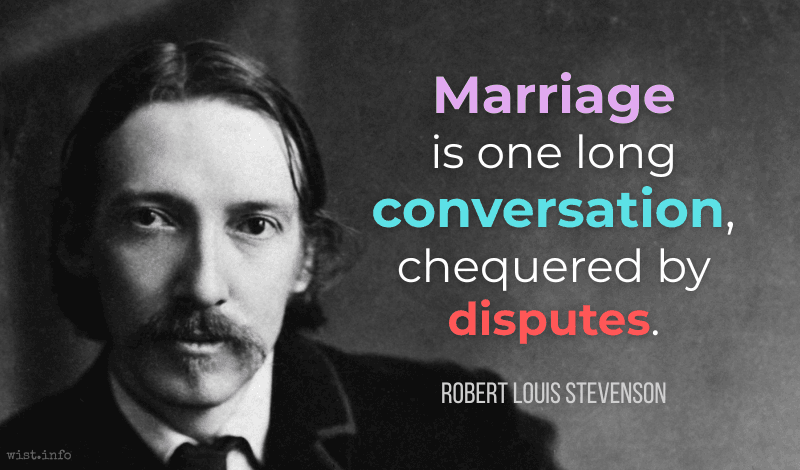
Marriage is one long conversation, chequered by disputes.
If you are threatened or offended by people disagreeing, challenging or even ridiculing your faith, your faith can’t be that strong.

The test of a man or woman’s breeding is how they behave in a quarrel.
George Bernard Shaw (1856–1950) Irish playwright and critic
The Philanderer, Act 4 (1893)

If a couple could see themselves twenty years later they might not recognize their love, but they would recognize their argument.
James Richardson (b. 1950) American poet
Vectors: Aphorisms and Ten-Second Essays, # 20 (2001)
(Source)

Of all the animosities which have existed among mankind, those which are caused by a difference of sentiments in religion appear to be the most inveterate and distressing, and ought to be deprecated. I was in hopes that the enlightened and liberal policy, which has marked the present age, would at least have reconciled Christians of every denomination so far that we should never again see the religious disputes carried to such a pitch as to endanger the peace of society.
George Washington (1732–1799) American military leader, Founding Father, US President (1789–1797)
Letter to Edward Newenham (30 Oct 1792)
Waste no more time arguing what a good man should be. Be one.
[Μηκέθ̓ ὅλως περὶ τοῦ οἷόν τινα εἶναι τὸν ἀγαθὸν ἄνδρα διαλέγεσθαι, ἀλλὰ εἶναι τοιοῦτον.]
Marcus Aurelius (AD 121–180) Roman emperor (161–180), Stoic philosopher
Meditations [To Himself; Τὰ εἰς ἑαυτόν], Book 10, ch. 16 (10.16) (AD 161-180) [tr. Staniforth (1964)]
(Source)
(Source (Greek)). Other translations:Make it not any longer a matter of dispute or discourse, what are the signs and proprieties of a good man, but really and actually to be such.
[tr. Casaubon (1634), 10.18]Notion without Practice is Impertinence; spend no more time then in stating the Qualifications of a Man of Virtue, but endeavour to get them.
[tr. Collier (1701)]Spend your time no longer, in discoursing on what are the qualities of the good-man; but in actually being such.
[tr. Hutcheson/Moor (1742)]Lose no more time in disputing about the definition of a good man, but endeavour yourself to be one.
[tr. Graves (1792)]No longer talk at all about the kind of man that a good man ought to be, but be such.
[tr. Long (1862)]Spend no more time in stating the qualifications of a man of virtue, but endeavour to get them.
[tr. Collier/Zimmern (1887)]No more mere talk of what the good man should be. Be it!
[tr. Rendall (1898)]Discourse no more of what a good man should be; but be one.
[tr. Hutcheson/Chrystal (1902)]Put an end once for all to this discussion of what a good man should be, and be one.
[tr. Haines (Loeb) (1916)]Don't any more discuss at large what the good man is like, but be good.
[tr. Farquharson (1944)]No more of all this talk about what a good man should be, but simply be one!
[tr. Hard (1997 ed.)]To stop talking about what the good man is like, and just be one.
[tr. Hays (2003)]No more roundabout discussion of what makes a good man. Be one!
[tr. Hammond (2006)]Stop philosophizing about what a good man is and be one.
[tr. Needleman/Piazza (2008)]No more of all this talk about what a good man should be, but simply be one!
[tr. Hard (2011 ed.)]


This is the character of truth: it is of all time, it is for all men, it has only to show itself to be recognized, and one cannot argue against it. A long dispute means that both parties are wrong.
Voltaire (1694–1778) French writer [pseud. of Francois-Marie Arouet]
Philosophical Dictionary, “Sect” (1764) [tr. Gay (1962)]
(Source)

It would be almost unbelievable, if history did not record the tragic fact that men have gone to war and cut each other’s throat because they could not agree as to what was to become of them after their throats were cut. Many sins have been committed in the name of religion. Alas! the spirit of proscription is never kind. It is the unhappy quality of religious disputes that they are always bitter. For some reason, too deep to fathom, men contend more furiously over the road to heaven, which they cannot see, than over their visible walks on earth.
In disputes upon moral or scientific points, ever let your aim be to come at truth, not to conquer your opponent: so you never shall be at a loss in losing the argument, and gaining a new discovery.
James Burgh (1714–1775) British politician and writer
The Dignity of Human Nature, Sec. 5 “Miscellaneous Thoughts on Prudence in Conversation” (1754)
(Source)

An eagerness and zeal for dispute on every subject, and with every one, shows great self-sufficiency, that never-failing sign of great self-ignorance.
William Pitt the Elder (1708–1778) British statesman, orator [Lord Chatham, 1st Earl of Chatham]
Correspondence of William Pitt, vol 4 (1840) [ed. Taylor and Pringle]

What Tully said of war may be applied to disputing: “It should be always so managed as to remember that the only true end of it is peace.” But generally true disputants are like true sportsmen, — their whole delight is in the pursuit; and the disputant no more cares for the truth than the sportsman for the hare.

Lower your voice and strengthen your argument.
Proverbs, Sayings, and Adages
Lebanese proverb

An association of men who will not quarrel with one another is a thing which never yet existed, from the greatest confederacy of nations down to a town meeting or a vestry.
Thomas Jefferson (1743–1826) American political philosopher, polymath, statesman, US President (1801–09)
Letter (1798-06-04) to John Taylor
(Source)

Never argue with a fool; onlookers may not be able to tell the difference.
Mark Twain (1835–1910) American writer [pseud. of Samuel Clemens]
(Spurious)
Frequently attributed to Twain and also to Immanuel Kant (but never, in either case, with any citation). The phrase first makes recognizable (if anonymous) appearance in the late 19th Century; attributions to Twain begin in the late 1990s. See also Proverbs 26:4. For more discussion (and a shout-out to WIST) see here.
Most Mens Anger about Religion is as if two Men should quarrel for a Lady they neither of them care for.
George Savile, Marquis of Halifax (1633–1695) English politician and essayist
“Religion,” Political, Moral, and Miscellaneous Thoughts and Reflections (1750)
(Source)

On the dogmas of religion as distinguished from moral principles, all mankind, from the beginning of the world to this day, have been quarrelling, fighting, burning and torturing one another, for abstractions unintelligible to themselves and to all others, and absolutely beyond the comprehension of the human mind. Were I to enter on that arena, I should only add an unit to the number of Bedlamites.
Thomas Jefferson (1743–1826) American political philosopher, polymath, statesman, US President (1801–09)
Letter (1816-11-11) to Matthew Carey
(Source)
Mistakenly identified in some sources as Archibald Carey.
Where two discourse, if the one’s anger rise,
The man who lets the contest fall is wise.Euripides (485?-406? BC) Greek tragic dramatist
Protesilaus, fragment 656
Also attributed to Plutarch.
Do not think of knocking out another person’s brains because he differs in opinion from you. It would be as rational to knock yourself on the head because you differ from yourself ten years ago.
Horace Mann (1796–1859) American politician, abolitionist, education reformer
Thoughts (1867)
(Source)
That was excellently observed, say I, when I read a passage in an author, where his opinion agrees with mine. When we differ, there I pronounce him to be mistaken.
Jonathan Swift (1667–1745) English writer and churchman
“Thoughts on Various Subjects” (1706)
(Source)

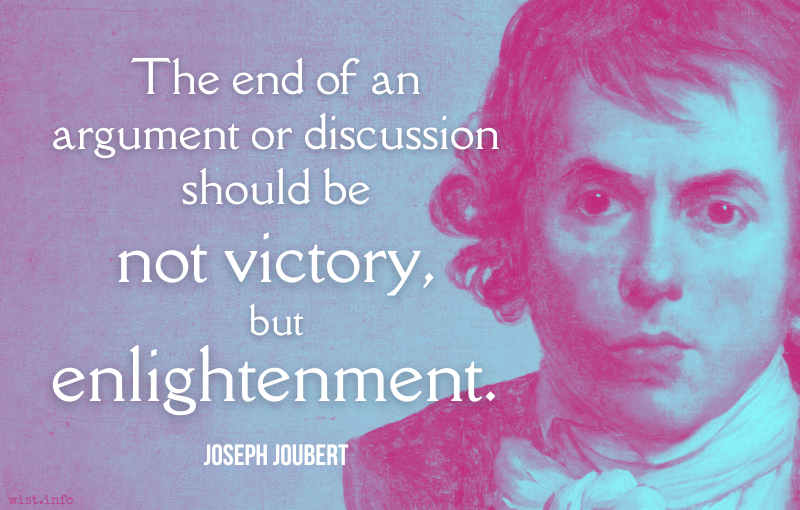
The end of an argument or discussion should be, not victory, but enlightenment.
[Le but de la dispute ou de la discussion ne doit pas être la victoire, mais l’amélioration.]
Joseph Joubert (1754–1824) French moralist, philosopher, essayist, poet
Pensées [Thoughts], “De la Famille et de la Société, etc. [On the Family and Society],” ¶ 41 (1850 ed.) [tr. Collins (1928), ch. 7]
(Source)
(Source (French)). Other translations:The aim of disputation and discussion should not be victory, but improvement.
[tr. Calvert (1866), ch. 8]The aim of argument, or of discussion, should not be victory, but progress.
[tr. Lyttelton (1899), ch. 7, ¶ 31]

There is no conversation more boring than the one where everybody agrees.
[Il n’y a pas de conversation plus ennuyeuse que celle où tout le monde est d’accord.]
Michel de Montaigne (1533–1592) French essayist
(Attributed)
Widely quoted, but never with any citation. Probably from the Essays, but I was unable to find it (or variants) there or elsewhere online.

Matters of religion should never be matters of controversy. We neither argue with a lover about his taste, not condemn him, if we are just, for knowing so human a passion.
George Santayana (1863–1952) Spanish-American poet and philosopher [Jorge Agustín Nicolás Ruíz de Santayana y Borrás]
The Life of Reason or The Phases of Human Progress, Vol. 3 “Reason in Religion,” ch. 6 “The Christian Epic” (1905-06)
(Source)