

A strange temptation attends upon man: to keep his eye on pleasures, even when he will not share in them; to aim all his morals against them. This very year a lady (singular iconoclast!) proclaimed a crusade against dolls; and the racy sermon against lust is a feature of the age. I venture to call such moralists insincere. At any excess or perversion of a natural appetite, their lyre sounds of itself with relishing denunciations; but for all displays of the truly diabolic — envy, malice, the mean lie, the mean silence, the calumnious truth, the back-biter, the petty tyrant, the peevish poisoner of family life — their standard is quite different. These are wrong, they will admit, yet somehow not so wrong; there is no zeal in their assault on them, no secret element of gusto warms up the sermon; it is for things not wrong in themselves that they reserve the choicest of their indignation.
Robert Louis Stevenson (1850–1894) Scottish essayist, novelist, poet
“A Christmas Sermon” (2), Across the Plains, ch. 12 (1880)
(Source)
Quotations by:
Stevenson, Robert Louis
My body which my dungeon is,
And yet my parks and palaces.Robert Louis Stevenson (1850–1894) Scottish essayist, novelist, poet
“My Body Which My Dungeon Is,” Underwoods (1887)
It is the mark of a good action that it appears inevitable in retrospect.
Robert Louis Stevenson (1850–1894) Scottish essayist, novelist, poet
“Reflections and Remarks on Human Life,” #6 (1878)
(Source)
Under the wide and starry sky,
Dig the grave and let me lie.
Glad did I live and gladly die,
And I laid me down with a will.This be the verse you grave for me:
Here he lies where he longed to be;
Home is the sailor, home from sea,
And the hunter home from the hill.Robert Louis Stevenson (1850–1894) Scottish essayist, novelist, poet
“Requiem,” Underwoods, Bk. 1 (1887)
Is there anything in life so disenchanting as attainment?
Robert Louis Stevenson (1850–1894) Scottish essayist, novelist, poet
“The Adventure of the Hansom Cabs” (1878)
(Source)
Anyone can carry his burden, however hard, until nightfall. Anyone can do his work, however hard, for one day. Anyone can live sweetly, patiently, lovingly, purely, till the sun goes down. And this is all that life really means.
Robert Louis Stevenson (1850–1894) Scottish essayist, novelist, poet
(Attributed)
Attributed by Senator Sam Ervin in his last newsletter, Senator Sam Ervin Says (2 Jan 1975). Unverified.
Don’t judge each day by the harvest you reap, but by the seeds you plant.
Robert Louis Stevenson (1850–1894) Scottish essayist, novelist, poet
(Spurious)
(Source)
Frequently attributed to Stevenson, but not found in his works.
Every man is his own doctor of divinity, in the last resort.
Robert Louis Stevenson (1850–1894) Scottish essayist, novelist, poet
An Inland Voyage (1878)
I find I never weary of great churches. It is my favorite kind of mountain scenery. Mankind was never so happily inspired as when it made a cathedral: a thing as single and specious as a statue at first glance, and yet, on examination, as lively and interesting as a forest in detail.
Robert Louis Stevenson (1850–1894) Scottish essayist, novelist, poet
An Inland Voyage, “Noyon Cathedral” (1878)
(Source)
To know what you prefer instead of humbly saying Amen to what the world tells you ought to prefer, is to have kept your soul alive.
Robert Louis Stevenson (1850–1894) Scottish essayist, novelist, poet
An Inland Voyage, ch. 3 “The Royal Sport Nautique” (1878)
Full text.
It is a mere illusion that, above a certain income, the personal desires will be satisfied and leave a wider margin for the generous impulse.
Robert Louis Stevenson (1850–1894) Scottish essayist, novelist, poet
Familiar Studies of Men and Books, “Henry David Thoreau,” § 2 (1882)
(Source)
The price we have to pay for money is paid in liberty.
Robert Louis Stevenson (1850–1894) Scottish essayist, novelist, poet
Familiar Studies of Men and Books, “Henry David Thoreau” (2) (1882)
(Source)
To be what we are, and to become what we are capable of becoming, is the only end of life.
Robert Louis Stevenson (1850–1894) Scottish essayist, novelist, poet
Familiar Studies of Men and Books, “Henry David Thoreau” (5) (1882)
(Source)
Politics is perhaps the only profession for which no preparation is thought necessary.
Robert Louis Stevenson (1850–1894) Scottish essayist, novelist, poet
Familiar Studies of Men and Books, “Yoshida-Torajiro,” (1882)
So long as we love we serve; so long as we are loved by others, I would almost say that we are indispensable; and no man is useless while he has a friend.
Robert Louis Stevenson (1850–1894) Scottish essayist, novelist, poet
Lay Morals and Other Essays, ch. 4 “Lay Morals” (1911)
(Source)
And perhaps, after all, it is better that the lad should break his neck than that you should break his spirit.
Robert Louis Stevenson (1850–1894) Scottish essayist, novelist, poet
The Amateur Emigrant (1880)
An aim in life is the only fortune worth the finding; and it is not to be found in foreign lands, but in the heart itself.
Robert Louis Stevenson (1850–1894) Scottish essayist, novelist, poet
The Amateur Emigrant, ch. 4 “Steerage Types” (1895)
(Source)
You cannot run away from weakness; you must some time fight it out or perish; and if that be so, why not now, and where you stand?
Robert Louis Stevenson (1850–1894) Scottish essayist, novelist, poet
The Amateur Immigrant, ch. 4 “Steerage Types (1895)
(Source)
Criticizing immigrant passengers he'd met who had left their homeland because of alcohol problems.
Not every man is so great a coward as he thinks he is — nor yet so good a Christian.
Robert Louis Stevenson (1850–1894) Scottish essayist, novelist, poet
The Master of Ballantrae, “Mr. Mackellar’s Journey” (1889)
There is no foreign land; it is the traveller only that is foreign, and again, by a flash of recollection, lights up the contrasts of the earth.
Robert Louis Stevenson (1850–1894) Scottish essayist, novelist, poet
The Silverado Squatters, “With the Children of Israel,” sec. 3 (1883)
(Source)
Fifteen men on the dead man’s chest
Yo-ho-ho, and a bottle of rum!
Drink and the devil had done for the rest —
Yo-ho-ho, and a bottle of rum!Robert Louis Stevenson (1850–1894) Scottish essayist, novelist, poet
Treasure Island, ch. 1 (1883)
Many’s a long night I’ve dreamed of cheese — toasted mostly.
Robert Louis Stevenson (1850–1894) Scottish essayist, novelist, poet
Treasure Island, ch. 15 “The Man of the Island” (1883)
Many’s the long night I’ve dreamed of cheese — toasted, mostly.
Robert Louis Stevenson (1850–1894) Scottish essayist, novelist, poet
Treasure Island, ch. 15 (1883)
The world has no room for cowards. We must all be ready somehow to toil, to suffer, to die. And yours is not the less noble because no drum beats before you when you go out into your daily battlefields, and no crowds shout about your coming when you return from your daily victory or defeat.
Robert Louis Stevenson (1850–1894) Scottish essayist, novelist, poet
Address to the Samoan Students, Malua (Jan 1890)Full text.
Marriage is a step so grave and decisive that it attracts light-headed, variable men by its very awfulness. They have been so tried among the inconstant squalls and currents, so often sailed for islands in the air or lain becalmed with burning heart, that they will risk all for solid ground below their feet. Desperate pilots, they run their sea-sick, weary bark upon the dashing rocks. It seems as if marriage were the royal road through life, and realised, on the instant, what we have all dreamed on summer Sundays when the bells ring, or at night when we cannot sleep for the desire of living. They think it will sober and change them. Like those who join a brotherhood, they fancy it needs but an act to be out of the coil and clamour for ever. But this is a wile of the devil’s. To the end, spring winds will sow disquietude, passing faces leave a regret behind them, and the whole world keep calling and calling in their ears. For marriage is like life in this — that it is a field of battle, and not a bed of roses.
Robert Louis Stevenson (1850–1894) Scottish essayist, novelist, poet
Essay (1876-08), “Virginibus Puerisque, Part 1,” Cornhill Magazine, Vol. 34
(Source)
Collected in Virginibus Puerisque and Other Papers, ch. 1, part 1 (1881).
Life as a "bed of roses" is an old phrase, originating in 13th Century French literature, and popularized in English in Christopher Marlowe's poem (pub. 1599)), "The Passionate Shepherd to His Love."
You could read Kant by yourself, if you wanted; but you must share a joke with someone else.
Falling in love is the one illogical adventure, the one thing of which we are tempted to think as supernatural, in our trite and reasonable world. The effect is out of all proportion with the cause. Two persons, neither of them, it may be, very amiable or very beautiful, meet, speak a little, and look a little into each other’s eyes. That has been done a dozen or so of times in the experience of either with no great result. But on this occasion all is different. They fall at once into that state in which another person becomes to us the very gist and centrepoint of God’s creation, and demolishes our laborious theories with a smile; in which our ideas are so bound up with the one master-thought that even the trivial cares of our own person become so many acts of devotion, and the love of life itself is translated into a wish to remain in the same world with so precious and desirable a fellow-creature.
Robert Louis Stevenson (1850–1894) Scottish essayist, novelist, poet
Essay (1877-02), “On Falling in Love,” Cornhill Magazine, Vol. 35
(Source)
Collected as "Virginibus Puerisque, Part 3" in Virginibus Puerisque and Other Papers, ch. 1 (1881).
There is no duty we so much underrate as the duty of being happy. By being happy, we sow anonymous benefits upon the world, which remain unknown even to ourselves, or when they are disclosed, surprise nobody so much as the benefactor.

A happy man or woman is a better thing to find than a five-pound note. He or she is a radiating focus of goodwill; and their entrance into a room is as though another candle had been lighted. We need not care whether they could prove the forty-seventh proposition; they do a better thing than that, they practically demonstrate the great Theorem of the Liveableness of Life.
Robert Louis Stevenson (1850–1894) Scottish essayist, novelist, poet
Essay (1877-07), “An Apology for Idlers,” Cornhill Magazine, Vol. 36
(Source)
Euclid's 47th Proposition (in his Elements, Book 1) is the Pythagorean Theorem.Collected in Virginibus Puerisque and Other Papers, ch. 3 (1881).
Perpetual devotion to what a man calls his business, is only to be sustained by perpetual neglect of many other things.
Books are good enough in their own way, but they are a mighty bloodless substitute for life. It seems a pity to sit, like the Lady of Shalott, peering into a mirror, with your back turned on all the bustle and glamour of reality.
Look at one of your industrious fellows for a moment, I beseech you. He sows hurry and reaps indigestion; he puts a vast deal of activity out to interest, and receives a large measure of nervous derangement in return. Either he absents himself entirely from all fellowship, and lives a recluse in a garret, with carpet slippers and a leaden inkpot; or he comes among people swiftly and bitterly, in a contraction of his whole nervous system, to discharge some temper before he returns to work. I do not care how much or how well he works, this fellow is an evil feature in other people’s lives. They would be happier if he were dead. They could easier do without his services in the Circumlocution Office, than they can tolerate his fractious spirits. He poisons life at the well-head. It is better to be beggared out of hand by a scapegrace nephew, than daily hag-ridden by a peevish uncle.
To an impartial estimate it will seem clear that many of the wisest, most virtuous, and most beneficent parts that are to be played upon the Theatre of Life are filled by gratuitous performers, and pass, among the world at large, as phases of idleness. For in that Theatre, not only the walking gentlemen, singing chambermaids, and diligent fiddlers in the orchestra, but those who look on and clap their hands from the benches, do really play a part and fulfil important offices towards the general result. You are no doubt very dependent on the care of your lawyer and stockbroker, of the guards and signalmen who convey you rapidly from place to place, and the policemen who walk the streets for your protection; but is there not a thought of gratitude in your heart for certain other benefactors who set you smiling when they fall in your way, or season your dinner with good company?
Just now, when every one is bound, under pain of a decree in absence convicting them of lèse-respectability, to enter on some lucrative profession, and labour therein with something not far short of enthusiasm, a cry from the opposite party, who are content when they have enough, and like to look on and enjoy in the meanwhile, savours a little of bravado and gasconade. And yet this should not be. Idleness so called, which does not consist in doing nothing, but in doing a great deal not recognized in the dogmatic formularies of the ruling class, has as good a right to state its position as industry itself.
All error, not merely verbal, is a strong way of stating that the current truth is incomplete. The follies of youth have a basis in sound reason, just as much as the embarrassing questions put by babes and sucklings. Their most antisocial acts indicate the defects of our society. When the torrent sweeps the man against a boulder, you must expect him to scream, and you need not be surprised if the scream is sometimes a theory.
To hold the same views at forty as we held at twenty is to have been stupefied for a score of years, and take rank, not as a prophet, but as an unteachable brat, well birched and none the wiser. It is as if a ship captain should sail to India from the Port of London; and having brought a chart of the Thames on deck at his first setting out, should obstinately use no other for the whole voyage.
Robert Louis Stevenson (1850–1894) Scottish essayist, novelist, poet
Essay (1878-03), “Crabbed Age and Youth,” Cornhill Magazine, Vol. 37
(Source)
Collected in Virginibus Puerisque and Other Papers, ch. 2 (1881).
When the torrent sweeps the man against a boulder, you must expect him to scream, and you need not be surprised if the scream is sometimes a theory. Shelley, chafing at the Church of England, discovered the cure of all evils in universal atheism. Generous lads irritated at the injustices of society, see nothing for it but the abolishment of everything and Kingdom Come of anarchy. Shelley was a young fool; so are these cocksparrow revolutionaries. But it is better to be a fool than to be dead. It is better to emit a scream in the shape of a theory than to be entirely insensible to the jars and incongruities of life and take everything as it comes in a forlorn stupidity.
It is as natural and as right for a young man to be imprudent and exaggerated, to live in swoops and circles, and beat about his cage like any other wild thing newly captured, as it is for old men to turn grey, or mothers to love their offspring, or heroes to die for something more valuable than their lives.
Some people swallow the universe like a pill; they travel on through the world, like smiling images pushed from behind. For God’s sake give me the young man who has brains enough to make a fool of himself!
Because I have reached Paris, I am not ashamed of having passed through Newhaven and Dieppe. They were very good places to pass through, and I am none the less at my destination. All my old opinions were only stages on the way to the one I now hold, as itself is only a stage on the way to something else.
As we go catching and catching at this or that corner of knowledge, now getting a foresight of generous possibilities, now chilled with a glimpse of prudence, we may compare the headlong course of our years to a swift torrent in which a man is carried away; now he is dashed against a boulder, now he grapples for a moment to a trailing spray; at the end, he is hurled out and overwhelmed in a dark and bottomless ocean. We have no more than glimpses and touches; we are torn away from our theories; we are spun round and round and shown this or the other view of life, until only fools or knaves can hold to their opinions.
There is something irreverent in the speculation, but perhaps the want of power has more to do with the wise resolutions of age than we are always willing to admit. It would be an instructive experiment to make an old man young again and leave him all his savoir. I scarcely think he would put his money in the Savings Bank after all; I doubt if he would be such an admirable son as we are led to expect; and as for his conduct in love, I believe firmly he would out-Herod Herod, and put the whole of his new compeers to the blush.
To be suddenly snuffed out in the middle of ambitious schemes, is tragical enough at best; but when a man has been grudging himself his own life in the meanwhile, and saving up everything for the festival that was never to be, it becomes that hysterically moving sort of tragedy which lies on the confines of farce.
Old and young, we are all on our last cruise. If there is a fill of tobacco among the crew, for God’s sake pass it round, and let us have a pipe before we go!

You need repent none of your youthful vagaries. They may have been over the score on one side, just as those of age are probably over the score on the other. But they had a point; they not only befitted your age and expressed its attitude and passions, but they had a relation to what was outside of you, and implied criticisms on the existing state of things, which you need not allow to have been undeserved, because you now see that they were partial.
In short, if youth is not quite right in its opinions, there is a strong probability that age is not much more so.
Undying hope is co-ruler of the human bosom with infallible credulity. A man finds he has been wrong at every preceding stage of his career, only to deduce the astonishing conclusion that he is at last entirely right.
Since we have explored the maze so long without result, it follows, for poor human reason, that we cannot have to explore much longer; close by must be the centre, with a champagne luncheon and a piece of ornamental water. How if there were no centre at all, but just one alley after another, and the whole world a labyrinth without end or issue?
Old people have faults of their own; they tend to become cowardly, niggardly, and suspicious. Whether from the growth of experience or the decline of animal heat, I see that age leads to these and certain other faults; and it follows, of course, that while in one sense I hope I am journeying towards the truth, in another I am indubitably posting towards these forms and sources of error.
Age may have one side, but assuredly Youth has the other. There is nothing more certain than that both are right, except perhaps that both are wrong. Let them agree to differ; for who knows but what agreeing to differ may not be a form of agreement rather than a form of difference?
Now I know that in thus turning Conservative with years, I am going through the normal cycle of change and travelling in the common orbit of men’s opinions. I submit to this, as I would submit to gout or grey hair, as a concomitant of growing age or else of failing animal heat; but I do not acknowledge that it is necessarily a change for the better — I dare say it is deplorably for the worse.
There is a strong feeling in favour of cowardly and prudential proverbs. The sentiments of a man while he is full of ardour and hope are to be received, it is supposed, with some qualification. But when the same person has ignominiously failed and begins to eat up his words, he should be listened to like an oracle. Most of our pocket wisdom is conceived for the use of mediocre people, to discourage them from ambitious attempts, and generally console them in their mediocrity. And since mediocre people constitute the bulk of humanity, this is no doubt very properly so. But it does not follow that the one sort of proposition is any less true than the other, or that Icarus is not to be more praised, and perhaps more envied, than Mr. Samuel Budgett the Successful Merchant.
The true wisdom is to be always seasonable, and to change with a good grace in changing circumstances. To love playthings well as a child, to lead an adventurous and honourable youth, and to settle when the time arrives, into a green and smiling age, is to be a good artist in life and deserve well of yourself and your neighbour.
If we are indeed here to perfect and complete our own natures, and grow larger, stronger, and more sympathetic against some nobler career in the future, we had all best bestir ourselves to the utmost while we have the time. To equip a dull, respectable person with wings would be but to make a parody of an angel.
All who have meant good work with their whole hearts, have done good work, although they may die before they have the time to sign it. Every heart that has beat strong and cheerfully has left a hopeful impulse behind it in the world, and bettered the tradition of mankind. And even if death catch people, like an open pitfall, and in mid-career, laying out vast projects, and planning monstrous foundations, flushed with hope, and their mouths full of boastful language, they should be at once tripped up and silenced: is there not something brave and spirited in such a termination? And does not life go down with a better grace, foaming in full body over a precipice, than miserably straggling to an end in sandy deltas?
By all means begin your folio; even if the doctor does not give you a year, even if he hesitates about a month, make one brave push and see what can be accomplished in a week. It is not only in finished undertakings that we ought to honour useful labour.
It is better to lose health like a spendthrift than to waste it like a miser. It is better to live and be done with it, then to die daily in the sick-room.
We do not go to cowards for tender dealing; there is nothing so cruel as panic; the man who has least fear for his own carcase, has most time to consider others.
The cruelest lies are often told in silence. A man may have sat in a room for hours and not opened his teeth, and yet come out of that room a disloyal friend or a vile calumniator.
The difficulty of literature is not to write, but to write what you mean; not to affect your reader, but to affect him precisely as you wish.
The cruellest lies are often told in silence. A man may have sat in a room for hours and not opened his teeth, and yet come out of that room a disloyal friend or a vile calumniator.
And how many loves have perished because, from pride, or spite, or diffidence, or that unmanly shame which withholds a man from daring to betray emotion, a lover, at the critical point of the relation, has but hung his head and held his tongue?
It is the business of this life to make excuses for others, but none for ourselves. We should be clearly persuaded of our own misconduct, for that is the part of knowledge in which we are most apt to be defective.
Robert Louis Stevenson (1850–1894) Scottish essayist, novelist, poet
Essay (1880-01/02?), “Reflections and Remarks on Human Life,” § 1.1 “Justice and Justification”
(Source)
A collection of aphorisms and musings, first published in the Edinburgh Edition of his Works, vol. 28 (1898).
What do we owe our parents? No man can owe love; none can owe obedience. We owe, I think, chiefly pity; for we are the pledge of their dear and joyful union, we have been the solicitude of their days and the anxiety of their nights, we have made them, though by no will of ours, to carry the burthen of our sins, sorrows, and physical infirmities; and too many of us grow up at length to disappoint the purpose of their lives and requite their care and piety with cruel pangs.
Robert Louis Stevenson (1850–1894) Scottish essayist, novelist, poet
Essay (1880-01/02?), “Reflections and Remarks on Human Life,” § 2.2 “Parent and Child”
(Source)
A collection of aphorisms and musings, first published in the Edinburgh Edition of his Works, vol. 28 (1898).
But solitude for its own sake should surely never be preferred. We are bound by the strongest obligations to busy ourselves amid the world of men, if it be only to crack jokes.
Robert Louis Stevenson (1850–1894) Scottish essayist, novelist, poet
Essay (1880-01/02?), “Reflections and Remarks on Human Life,” § 4.3 “Solitude and Society”
(Source)
A collection of aphorisms and musings, first published in the Edinburgh Edition of his Works, vol. 28 (1898).
Solitude is the climax of the negative virtues. When we go to bed after a solitary day we can tell ourselves that we have not been unkind nor dishonest nor untruthful; and the negative virtues are agreeable to that dangerous faculty we call the conscience. That they should ever be admitted for a part of virtue is what I cannot explain. I do not care two straws for all the nots.
Robert Louis Stevenson (1850–1894) Scottish essayist, novelist, poet
Essay (1880-01/02?), “Reflections and Remarks on Human Life,” § 4.6 “Solitude and Society”
(Source)
A collection of aphorisms and musings, first published in the Edinburgh Edition of his Works, vol. 28 (1898).
An unconscious, easy, selfish person shocks less, and is more easily loved, than one who is laboriously and egotistically unselfish. There is at least no fuss about the first; but the other parades his sacrifices, and so sells his favours too dear.
Robert Louis Stevenson (1850–1894) Scottish essayist, novelist, poet
Essay (1880-01/02?), “Reflections and Remarks on Human Life,” § 5 “Selfishness and Egoism”
(Source)
A collection of aphorisms and musings, first published in the Edinburgh Edition of his Works, vol. 28 (1898).
It is the mark of a good action that it appears inevitable in the retrospect. We should have been cut-throats to do otherwise. And there’s an end. We ought to know distinctly that we are damned for what we do wrong; but when we have done right, we have only been gentlemen, after all. There is nothing to make a work about.
Robert Louis Stevenson (1850–1894) Scottish essayist, novelist, poet
Essay (1880-01/02?), “Reflections and Remarks on Human Life,” § 6 “Right and Wrong”
(Source)
A collection of aphorisms and musings, first published in the Edinburgh Edition of his Works, vol. 28 (1898).
Never allow your mind to dwell on your own misconduct: that is ruin. The conscience has morbid sensibilities; it must be employed but not indulged, like the imagination or the stomach.
Robert Louis Stevenson (1850–1894) Scottish essayist, novelist, poet
Essay (1880-01/02?), “Reflections and Remarks on Human Life,” § 7.1 “Discipline of Conscience”
(Source)
A collection of aphorisms and musings, first published in the Edinburgh Edition of his Works, vol. 28 (1898).
Our business in this world is not to succeed, but to continue to fail, in good spirits.
Robert Louis Stevenson (1850–1894) Scottish essayist, novelist, poet
Essay (1880-01/02?), “Reflections and Remarks on Human Life,” § 7.4 “Discipline of Conscience”
(Source)
A collection of aphorisms and musings, first published in the Edinburgh Edition of his Works, vol. 28 (1898).
I cannot forgive God for the suffering of others; when I look abroad upon His world and behold its cruel destinies, I turn from Him with disaffection; nor do I conceive that He will blame me for the impulse. But when I consider my own fates, I grow conscious of His gentle dealing: I see Him chastise with helpful blows, I feel His stripes to be caresses; and this knowledge is my comfort that reconciles me to the world.
Robert Louis Stevenson (1850–1894) Scottish essayist, novelist, poet
Essay (1880-01/02?), “Reflections and Remarks on Human Life,” § 8.2 “Gratitude to God”
(Source)
A collection of aphorisms and musings, first published in the Edinburgh Edition of his Works, vol. 28 (1898).
No considerate man can approach marriage without deep concern. I, he will think, who have made hitherto so poor a business of my own life, am now about to embrace the responsibility of another’s. Henceforth, there shall be two to suffer from my faults; and that other is the one whom I most desire to shield from suffering.
Robert Louis Stevenson (1850–1894) Scottish essayist, novelist, poet
Essay (1880-01/02?), “Reflections and Remarks on Human Life,” § 10.1 “Marriage”
(Source)
A collection of aphorisms and musings, first published in the Edinburgh Edition of his Works, vol. 28 (1898).
Courage is the principal virtue, for all the others presuppose it. If you are afraid, you may do anything.
Robert Louis Stevenson (1850–1894) Scottish essayist, novelist, poet
Essay (1880-01/02?), “Reflections and Remarks on Human Life,” § 12 “Courage”
(Source)
A collection of aphorisms and musings, first published in the Edinburgh Edition of his Works, vol. 28 (1898).
See Johnson (1775), Barrie (1922), Lewis (1942).
Man is a creature who lives not upon bread alone, but principally by catchwords; and the little rift between the sexes is astonishingly widened by simply teaching one set of catchwords to the girls and another to the boys.
Robert Louis Stevenson (1850–1894) Scottish essayist, novelist, poet
Essay (1881), “Virginibus Puerisque, Part 2”
(Source)
Playing off of the Biblical passages Luke 4:4 and Matthew 4:4, in turn from Deuteronomy 8:3.
First published in Virginibus Puerisque and Other Papers, ch. 1, part 2 (1881)
Hope is the boy, a blind, headlong, pleasant fellow, good to chase swallows with the salt; Faith is the grave, experienced, yet smiling man. Hope lives on ignorance; open-eyed Faith is built upon a knowledge of our life, of the tyranny of circumstance and the frailty of human resolution. Hope looks for unqualified success; but Faith counts certainly on failure, and takes honourable defeat to be a form of victory. Hope is a kind old pagan; but Faith grew up in Christian days, and early learnt humility.
Robert Louis Stevenson (1850–1894) Scottish essayist, novelist, poet
Essay (1881), “Virginibus Puerisque, Part 2”
(Source)
First published in Virginibus Puerisque and Other Papers, ch. 1, part 2 (1881).
Hope is the boy, a blind, headlong, pleasant fellow, good to chase swallows with the salt; Faith is the grave, experienced, yet smiling man. Hope lives on ignorance; open-eyed Faith is built upon a knowledge of our life, of the tyranny of circumstance and the frailty of human resolution. Hope looks for unqualified success; but Faith counts certainly on failure, and takes honourable defeat to be a form of victory. Hope is a kind old pagan; but Faith grew up in Christian days, and early learnt humility.
In the one temper, a man is indignant that he cannot spring up in a clap to heights of elegance and virtue; in the other, out of a sense of his infirmities, he is filled with confidence because a year has come and gone, and he has still preserved some rags of honour. In the first, he expects an angel for a wife; in the last, he knows that she is like himself — erring, thoughtless, and untrue; but like himself also, filled with a struggling radiancy of better things, and adorned with ineffective qualities.Robert Louis Stevenson (1850–1894) Scottish essayist, novelist, poet
Essay (1881), “Virginibus Puerisque, Part 2”
(Source)
First published in Virginibus Puerisque and Other Papers, ch. 1, part 2 (1881).
You may safely go to school with hope; but ere you marry, should have learned the mingled lesson of the world: that dolls are stuffed with sawdust, and yet are excellent play-things; that hope and love address themselves to a perfection never realised, and yet, firmly held, become the salt and staff of life; that you yourself are compacted of infirmities, perfect, you might say, in imperfection, and yet you have a something in you lovable and worth preserving; and that, while the mass of mankind lies under this scurvy condemnation, you will scarce find one but, by some generous reading, will become to you a lesson, a model, and a noble spouse through life. So thinking, you will constantly support your own unworthiness, and easily forgive the failings of your friend.
Robert Louis Stevenson (1850–1894) Scottish essayist, novelist, poet
Essay (1881), “Virginibus Puerisque, Part 2”
(Source)
First published in Virginibus Puerisque and Other Papers, ch. 1, part 2 (1881).
Times are changed with him who marries; there are no more by-path meadows, where you may innocently linger, but the road lies long and straight and dusty to the grave. Idleness, which is often becoming and even wise in the bachelor, begins to wear a different aspect when you have a wife to support.
Robert Louis Stevenson (1850–1894) Scottish essayist, novelist, poet
Essay (1881), “Virginibus Puerisque, Part 2”
(Source)
First published in Virginibus Puerisque and Other Papers, ch. 1, part 2 (1881).
The correction of silence is what kills; when you know you have transgressed, and your friend says nothing and avoids your eye.
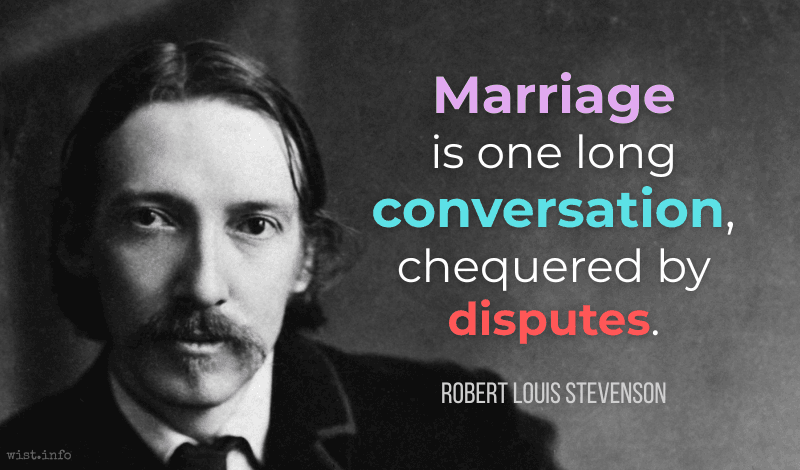
Marriage is one long conversation, chequered by disputes.
In anything fit to be called by the name of reading, the process itself should be absorbing and voluptuous; we should gloat over a book, be rapt clean out of ourselves, and rise from the perusal, our mind filled with the busiest, kaleidoscopic dance of images, incapable of sleep or of continuous thought. The words, if the book be eloquent, should run thenceforward in our ears like the noise of breakers, and the story, if it be a story, repeat itself in a thousand coloured pictures to the eye.
Robert Louis Stevenson (1850–1894) Scottish essayist, novelist, poet
Essay (1882-11), “A Gossip on Romance,” Longman’s Magazine, Vol. 1, No. 1
(Source)
Collected in Memories and Portraits, ch. 15 (1887).
Books were the proper remedy: books of vivid human import, forcing upon their minds the issues, pleasures, busyness, importance and immediacy of that life in which they stand; books of smiling or heroic temper, to excite or to console; books of a large design, shadowing the complexity of that game of consequences to which we all sit down, the hanger-back not least.
Robert Louis Stevenson (1850–1894) Scottish essayist, novelist, poet
Essay (1884-05), “Old Mortality,” ch. 1, Longman’s Magazine, Vol. 4, No. 19
(Source)
Collected in Memories and Portraits, ch. 3 (1887).
This appears to be the source of the otherwise-spurious Stevenson quotes referring to sitting down "at a banquet of consequences."
No man lives in the external truth among salts and acids, but in the warm, phantasmagoric chamber of his brain, with the painted windows and the storied wall.
Robert Louis Stevenson (1850–1894) Scottish essayist, novelist, poet
Essay (1888-02), “The Lantern-Bearers,” sec. 3 Scribner’s Magazine, Vol. 3, No. 2
(Source)
Collected in Across the Plains, ch. 7 (1892).
What an art it is, to give, even to our nearest friends! and what a test of manners to receive! How, upon either side, we smuggle away the obligation, blushing for each other; how bluff and dull we make the giver; how hasty, how falsely cheerful, the receiver! and yet an act of such difficulty and distress between near friends, it is supposed we can perform to a total stranger and leave the man transfixed with grateful emotions. The last thing you can do to a man is to burthen him with an obligation, and it is what we propose to begin with! But let us not be deceived: unless he is totally degraded to his trade, anger jars in his inside, and he grates his teeth at our gratuity.
We should wipe two words from our vocabulary: gratitude and charity. In real life, help is given out of friendship, or it is not valued; it is received from the hand of friendship, or it is resented.Robert Louis Stevenson (1850–1894) Scottish essayist, novelist, poet
Essay (1888-03), “Beggars,” sec. 4 Scribner’s Magazine, Vol. 3, No. 3
(Source)
Collected in Across the Plains, ch. 9 (1892).
Gratitude without familiarity, gratitude otherwise than as a nameless element in a friendship, is a thing so near to hatred that I do not care to split the difference. Until I find a man who is pleased to receive obligations, I shall continue to question the tact of those who are eager to confer them.
Robert Louis Stevenson (1850–1894) Scottish essayist, novelist, poet
Essay (1888-03), “Beggars,” sec. 4 Scribner’s Magazine, Vol. 3, No. 3
(Source)
Collected in Across the Plains, ch. 9 (1892).
Here, then, is the pitiful fix of the rich man; here is that needle’s eye in which he stuck already in the days of Christ, and still sticks to-day, firmer, if possible, than ever: that he has the money and lacks the love which should make his money acceptable. Here and now, just as of old in Palestine, he has the rich to dinner, it is with the rich that he takes his pleasure: and when his turn comes to be charitable, he looks in vain for a recipient. His friends are not poor, they do not want; the poor are not his friends, they will not take. To whom is he to give?
Robert Louis Stevenson (1850–1894) Scottish essayist, novelist, poet
Essay (1888-03), “Beggars,” sec. 4, Scribner’s Magazine, Vol. 3, No. 3
(Source)
Collected in Across the Plains, ch. 9 (1892).
To know what you like is the beginning of wisdom and of old age. Youth is wholly experimental. The essence and charm of that unquiet and delightful epoch is ignorance of self as well as ignorance of life. These two unknowns the young man brings together again and again, now in the airiest touch, now with a bitter hug; now with exquisite pleasure, now with cutting pain; but never with indifference, to which he is a total stranger, and never with that near kinsman of indifference, contentment.
The book, the statue, the sonata, must be gone upon with the unreasoning good faith and the unflagging spirit of children at their play. Is it worth doing? — when it shall have occurred to any artist to ask himself that question, it is implicitly answered in the negative. It does not occur to the child as he plays at being a pirate on the dining-room sofa, nor to the hunter as he pursues his quarry; and the candour of the one and the ardour of the other should be united in the bosom of the artist.
In the life of the artist there need be no hour without its pleasure. I take the author, with whose career I am best acquainted; and it is true he works in a rebellious material, and that the act of writing is cramped and trying both to the eyes and the temper; but remark him in his study, when matter crowds upon him and words are not wanting — in what a continual series of small successes time flows by; with what a sense of power as of one moving mountains, he marshals his petty characters; with what pleasures, both of the ear and eye, he sees his airy structure growing on the page; and how he labours in a craft to which the whole material of his life is tributary, and which opens a door to all his tastes, his loves, his hatreds, and his convictions, so that what he writes is only what he longed to utter. He may have enjoyed many things in this big, tragic playground of the world; but what shall he have enjoyed more fully than a morning of successful work? Suppose it ill paid: the wonder is it should be paid at all. Other men pay, and pay dearly, for pleasures less desirable.
To give the public what they do not want, and yet expect to be supported: we have there a strange pretension, and yet not uncommon, above all with painters. The first duty in this world is for a man to pay his way; when that is quite accomplished, he may plunge into what eccentricity he likes; but emphatically not till then.
If you adopt an art to be your trade, weed your mind at the outset of all desire of money. What you may decently expect, if you have some talent and much industry, is such an income as a clerk will earn with a tenth or perhaps a twentieth of your nervous output. Nor have you the right to look for more; in the wages of the life, not in the wages of the trade, lies your reward; the work is here the wages.
To make our idea of morality centre on forbidden acts is to defile the imagination and to introduce into our judgments of our fellow-men a secret element of gusto.
Robert Louis Stevenson (1850–1894) Scottish essayist, novelist, poet
Essay (1888-12), “A Christmas Sermon,” sec. 1, Scribner’s Magazine, Vol. 4
(Source)
Originally written in the winter of 1887-88. Collected in Across the Plains, ch. 12 (1892).
To be honest, to be kind — to earn a little and to spend a little less, to make upon the whole a family happier for his presence, to renounce when that shall be necessary and not be embittered, to keep a few friends, but these without capitulation — above all, on the same grim condition, to keep friends with himself — here is a task for all that a man has of fortitude and delicacy. He has an ambitious soul who would ask more; he has a hopeful spirit who should look in such an enterprise to be successful.
Robert Louis Stevenson (1850–1894) Scottish essayist, novelist, poet
Essay (1888-12), “A Christmas Sermon,” sec. 1, Scribner’s Magazine, Vol. 4
(Source)
Originally written in the winter of 1887-88. Collected in Across the Plains, ch. 12 (1892).
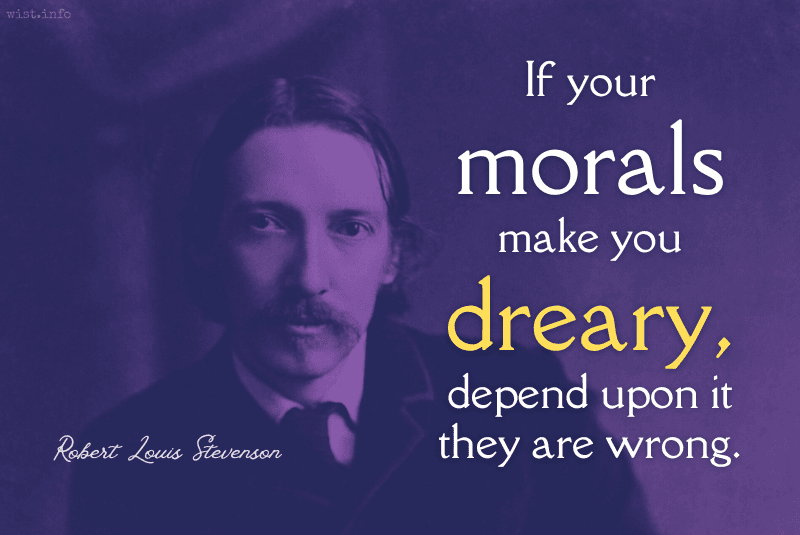
If your morals make you dreary, depend upon it they are wrong. I do not say “give them up,” for they may be all you have; but conceal them like a vice, lest they should spoil the lives of better and simpler people.
Robert Louis Stevenson (1850–1894) Scottish essayist, novelist, poet
Essay (1888-12), “A Christmas Sermon,” sec. 2, Scribner’s Magazine, Vol. 4
(Source)
Originally written in the winter of 1887-88. Collected in Across the Plains, ch. 12 (1892).
Gentleness and cheerfulness, these come before all morality; they are the perfect duties.
Robert Louis Stevenson (1850–1894) Scottish essayist, novelist, poet
Essay (1888-12), “A Christmas Sermon,” sec. 2, Scribner’s Magazine, Vol. 4
(Source)
In context, Stevenson is using "morality" in terms of legalistic religion.
Originally written in the winter of 1887-88. Collected in Across the Plains, ch. 12 (1892).
There is an idea abroad among moral people that they should make their neighbors good. One person I have to make good: myself.
Robert Louis Stevenson (1850–1894) Scottish essayist, novelist, poet
Essay (1888-12), “A Christmas Sermon,” sec. 2, Scribner’s Magazine, Vol. 4
(Source)
Originally written in the winter of 1887-88. Collected in Across the Plains, ch. 12 (1892).
Life is not designed to minister to a man’s vanity. He goes upon his long business most of the time with a hanging head, and all the time like a blind child. Full of rewards and pleasures as it is — so that to see the day break or the moon rise, or to meet a friend, or to hear the dinner-call when he is hungry, fills him with surprising joys — this world is yet for him no abiding city. Friendships fall through, health fails, weariness assails him; year after year, he must thumb the hardly varying record of his own weakness and folly. It is a friendly process of detachment. When the time comes that he should go, there need be few illusions left. Here lies one who meant well, tried a little, failed much: — surely that may be his epitaph, of which he need not be ashamed.
Robert Louis Stevenson (1850–1894) Scottish essayist, novelist, poet
Essay (1888-12), “A Christmas Sermon,” sec. 4, Scribner’s Magazine, Vol. 4
(Source)
Originally written in the winter of 1887-88. Collected in Across the Plains, ch. 12 (1892).
They were a rough lot indeed, as sailors mostly are: being men rooted out of all the kindly parts of life, and condemned to toss together on the rough seas, with masters no less cruel.
Robert Louis Stevenson (1850–1894) Scottish essayist, novelist, poet
Novel (1886), Kidnapped, ch. 7 “I Go to Sea in the Brig Covenant of Dysart”
(Source)
This chapter was originally published in Young Folks Paper, Vol. 28, No. 807 (1886-05-15).
No class of man is altogether bad, but each has its own faults and virtues.
Robert Louis Stevenson (1850–1894) Scottish essayist, novelist, poet
Novel (1886), Kidnapped, ch. 7 “I Go to Sea in the Brig Covenant of Dysart”
(Source)
David reconsidering his first disdainful reactions to the sailors on the ship he's a prisoner of.
This chapter was originally published in Young Folks Paper, Vol. 28, No. 807 (1886-05-15)
Call up your vermin to your back, sir, and fall on! The sooner the clash begins, the sooner ye’ll taste this steel throughout your vitals.
Robert Louis Stevenson (1850–1894) Scottish essayist, novelist, poet
Novel (1886), Kidnapped, ch. 10 “The Siege of the Round-House” [Alan]
(Source)
This chapter was originally published in Young Folks Paper, Vol. 28, No. 808 (1886-05-22).
I have seen wicked men and fools, a great many of both; and I believe they both get paid in the end; but the fools first.
Robert Louis Stevenson (1850–1894) Scottish essayist, novelist, poet
Novel (1886), Kidnapped, ch. 14 “The Islet”
(Source)
This chapter was originally published in Young Folks Paper, Vol. 28, No. 810 (1886-06-05)
There are two things that men should never weary of, goodness and humility; we get none too much of them in this rough world among cold, proud people.
Robert Louis Stevenson (1850–1894) Scottish essayist, novelist, poet
Novel (1886), Kidnapped, ch. 16 “The Lad with the Silver Button: Across Morven”
(Source)
This chapter was originally published in Young Folks Paper, Vol. 28, No. 811 (1886-06-12).
The inn at Kinlochaline was the most beggarly vile place that ever pigs were styed in, full of smoke, vermin, and silent Highlanders.
Robert Louis Stevenson (1850–1894) Scottish essayist, novelist, poet
Novel (1886), Kidnapped, ch. 16 “The Lad with the Silver Button: Across Morven”
(Source)
This chapter was originally published in Young Folks Paper, Vol. 28, No. 811 (1886-06-12).
I’ve a grand memory for forgetting, David.
Robert Louis Stevenson (1850–1894) Scottish essayist, novelist, poet
Novel (1886), Kidnapped, ch. 18 “I Talk with Alan in the Wood of Lettermore” [Alan]
(Source)
Suggesting he will soon "forget" the name of the murderer of a Campbell.
This chapter was originally published in Young Folks Paper, Vol. 28, No. 812 (1886-06-19)
Them that havenae dipped their hands in any little difficulty, should be very mindful of the case of them that have. And that is the good Christianity.
Robert Louis Stevenson (1850–1894) Scottish essayist, novelist, poet
Novel (1886), Kidnapped, ch. 18 “I Talk with Alan in the Wood of Lettermore” [Alan]
(Source)
This chapter was originally published in Young Folks Paper, Vol. 28, No. 812 (1886-06-19).
The friendly cow all red and white,
I love with all my heart:
She gives me cream with all her might,
To eat with apple-tart.
In winter I get up at night
And dress by yellow candle-light.
In summer quite the other way,
I have to go to bed by day.Robert Louis Stevenson (1850–1894) Scottish essayist, novelist, poet
Poem (1885), “Bed in Summer,” st. 1, A Child’s Garden of Verses
(Source)
The world is so full of a number of things,
I’m sure we should all be as happy as kings.Robert Louis Stevenson (1850–1894) Scottish essayist, novelist, poet
Poem (1885), “Happy Thought,” A Child’s Garden of Verses
(Source)
I have a little shadow that goes in and out with me,
And what can be the use of him is more than I can see.
He is very, very like me from the heels up to the head;
And I see him jump before me, when I jump into my bed.Robert Louis Stevenson (1850–1894) Scottish essayist, novelist, poet
Poem (1885), “My Shadow,” st. 1, A Child’s Garden of Verses
(Source)
A child should always say what’s true
And speak when he is spoken to,
And behave mannerly at table;
At least as far as he is able.Robert Louis Stevenson (1850–1894) Scottish essayist, novelist, poet
Poem (1885), “Whole Duty of Children,” A Child’s Garden of Verses
(Source)
Give us grace and strength to forbear and to persevere. Give us courage and gaiety and the quiet mind, spare to us our friends, soften to us our enemies.
Robert Louis Stevenson (1850–1894) Scottish essayist, novelist, poet
Prayer, Stevenson Memorial, St. Giles Cathedral, Edinburgh
A generous prayer is never presented in vain; the petition may be refused, but the petitioner is always, I believe, rewarded by some gracious visitation.