I have seen wicked men and fools, a great many of both; and I believe they both get paid in the end; but the fools first.
Robert Louis Stevenson (1850–1894) Scottish essayist, novelist, poet
Novel (1886), Kidnapped, ch. 14 “The Islet”
(Source)
This chapter was originally published in Young Folks Paper, Vol. 28, No. 810 (1886-06-05)
Quotations about:
fool
Note not all quotations have been tagged, so Search may find additional quotes on this topic.
Talk not much with a fool, and go not to him that hath no understanding: beware of him, lest thou have trouble, and thou shalt never be defiled with his fooleries: depart from him, and thou shalt find rest, and never be disquieted with madness.
[μετὰ ἄφρονος μὴ πληθύνῃς λόγον
καὶ πρὸς ἀσύνετον μὴ πορεύου·
φύλαξαι ἀπ᾽ αὐτοῦ, ἵνα μὴ κόπον ἔχῃς
καὶ οὐ μὴ μολυνθῇς ἐν τῷ ἐντιναγμῷ αὐτοῦ·
ἔκκλινον ἀπ᾽ αὐτοῦ καὶ εὑρήσεις ἀνάπαυσιν
καὶ οὐ μὴ ἀκηδιάσῃς ἐν τῇ ἀπονοίᾳ αὐτοῦ.]The Bible (The Old Testament) (14th - 2nd C BC) Judeo-Christian sacred scripture [Tanakh, Hebrew Bible], incl. the Apocrypha (Deuterocanonicals)
Book 22b. Sirach (Ecclesiasticus) 22:13 (Sir 22:13) [tr. KJV (1611)]
(Source)
Some translations note that the Septuagent includes, after the first sentence, e.g., "When people are senseless, they will bring everything of yours to nothing" or "For being without sense he will despise everything about you."
More on the history and acceptance of this Apocryphal book here and here.
(Source (Greek)). Alternate translations:Talk not much with a fool, and go not with him that hath no sense.
Keep thyself from him, that thou mayst not have trouble, and thou shalt not be defiled with his sin.
Turn away from him, and thou shalt find rest, and shalt not be wearied out with his folly.
[tr. DRA (1899), 22:14-16]Do not waste many words on a stupid man,
do not go near a dolt.
Beware of him, or he will give you trouble;
and will leave you soiled by contact with him.
Avoid him, and you will find rest
and not be exasperated by his folly.
[tr. JB (1966)]Do not waste many words on the stupid,
do not go near a dolt.
Beware of him, or you will have trouble
and be soiled by contact with him;
keep away from him, and you will have peace of mind
and not be exasperated by his folly.
[tr. NJB (1985)]Don't visit stupid people or spend a lot of time talking with them. Avoid them; then they can't contaminate you, and you can live in peace without being troubled or worn down by their foolishness.
[tr. GNT (1992 ed.)]Don’t talk a lot with fools,
and don’t go to the unintelligent.
Be on guard against them
so that you don’t have trouble
and don’t get dirty
when they shake themselves off.
Stay away from them
and you will find rest,
and their senselessness
class="tab">won’t make you weary.[tr. CEB (2011)]Do not talk much with senseless people
or visit unintelligent people.
Stay clear of them, or you may have trouble
and be spattered when they shake themselves off.
Avoid them and you will find rest,
and you will never be wearied by their lack of sense.
[tr. NRSV (2021 ed.)]

FOOL: Good madonna, why mourn’st thou?
OLIVIA: Good Fool, for my brother’s death.
FOOL: I think his soul is in hell, madonna.
OLIVIA: I know his soul is in heaven, Fool.
FOOL: The more fool, madonna, to mourn for your brother’s soul, being in heaven. Take away the fool, gentlemen.
William Shakespeare (1564–1616) English dramatist and poet
Twelfth Night, Act 1, sc. 5, l. 64ff (1.5 64-70) (1601)
(Source)
Whiskey makes a grate menny wize men to day, and phools tommorow.
[Whiskey makes a great many wise men today, and fools tomorrow.]
Josh Billings (1818–1885) American humorist, aphorist [pseud. of Henry Wheeler Shaw]
Josh Billings’ Farmer’s Allminax, 1876-12 (1876 ed.)
(Source)
Some people are thought to be wise because they don’t talk much; others are disliked because they talk too much. Some people keep quiet because they don’t have anything to say; others keep quiet because they know the right time to speak. A wise person will not speak until the right moment, but a bragging fool doesn’t know when that time is.
[ἔστιν σιωπῶν εὑρισκόμενος σοφός,
καὶ ἔστιν μισητὸς ἀπὸ πολλῆς λαλιᾶς.
ἔστιν σιωπῶν, οὐ γὰρ ἔχει ἀπόκρισιν,
καὶ ἔστιν σιωπῶν εἰδὼς καιρόν.
ἄνθρωπος σοφὸς σιγήσει ἕως καιροῦ,
ὁ δὲ λαπιστὴς καὶ ἄφρων ὑπερβήσεται καιρόν.]The Bible (The Old Testament) (14th - 2nd C BC) Judeo-Christian sacred scripture [Tanakh, Hebrew Bible], incl. the Apocrypha (Deuterocanonicals)
Book 22b. Sirach (Ecclesiasticus) 20: 5ff (Sir 20:5–7) [tr. GNT (1992 ed.)]
(Source)
More on the history and acceptance of this Apocryphal book here and here.
(Source (Greek)). Alternate translations:There is one that keepeth silence, and is found wise: and another by much babbling becometh hateful.
Some man holdeth his tongue, because he hath not to answer: and some keepeth silence, knowing his time.
wise man will hold his tongue till he see opportunity: but a babbler and a fool will regard no time.
[tr. KJV (1611)]There is one that holdeth his peace, that is found wise: and there is another that is hateful, that is bold in speech.
There is one that holdeth his peace, because he knoweth not what to say: and there is another that holdeth his peace, knowing the proper time.
A wise man will hold his peace till he see opportunity: but a babbler, and a fool, will regard no time.
[tr. DRA (1899)]There is the man who keeps quiet and is considered wise,
another incurs hatred for talking too much.
There is the man who keeps quiet, not knowing how to answer,
another keeps quiet, because he knows when to speak.
A wise man will keep quiet till the right moment,
but a garrulous fool will always misjudge it.
[tr. JB (1966); NJB (1985)]There are people who are silent
and are found to be wise,
and there are those who are hated
because they talk a lot.
There are those who keep silent
because they have nothing to say
in response,
and there are those who keep silent
because they know the right time.
Wise people keep silent
until the proper moment,
but those who swagger and are senseless will miss the right moment.
[tr. CEB (2011)]Some people keep silent and are found to be wise,
while others are detested for being talkative.
Some people keep silent because they have nothing to say,
while others keep silent because they know when to speak.
The wise remain silent until the right moment,
but the arrogant and the fool miss the right moment.
[tr. NRSV (2021 ed.)]
I dont kno which iz the biggest phool, the man who kan spend two hours bragging about himself, or the one who kan sit pashuntly and listen to him.
[I don’t know which is the biggest fool, the man who can spend two hours bragging about himself, or the one who can sit patiently and listen to him.]
Josh Billings (1818–1885) American humorist, aphorist [pseud. of Henry Wheeler Shaw]
Josh Billings’ Farmer’s Allminax, 1876-04 (1876 ed.)
(Source)
Convince a phool ov hiz errors, and you make him yure enemy.
[Convince a fool of his errors, and you make him your enemy.]
Josh Billings (1818–1885) American humorist, aphorist [pseud. of Henry Wheeler Shaw]
Josh Billings’ Farmer’s Allminax, 1872-07 (1872 ed.)
(Source)
Dupes indeed are many: but, of all dupes, there is none so fatally situated as he who lives in undue terror of being duped.
Thomas Carlyle (1795–1881) Scottish essayist and historian
Lecture (1840-05-22), “The Hero as King,” Home House, Portman Square, London
(Source)
The lecture notes were collected by Carlyle into On Heroes, Hero-Worship, & the Heroic in History, Lecture 6 (1841).
I have often thought if the minds of men were laid open, we should see but little difference between that of the wise man and that of the fool. There are infinite reveries, numberless extravagances, and a perpetual train of vanities which pass through both. The great difference is, that the first knows how to pick and cull his thoughts for conversation, by suppressing some, and communicating others; whereas the other lets them all indifferently fly out in words.
Joseph Addison (1672–1719) English essayist, poet, statesman
Essay (1711-11-17), The Spectator, No. 225
(Source)

If the weakness of the head were an admissible excuse for the malevolence of the heart, the one-half of mankind would be occupied in aggression, and the other half in forgiveness; but the interests of society peremptorily demand that things should not be so; for a fool is often as dangerous to deal with as a knave, and always more incorrigible.
A man who does not see this is senseless; he who does see it, and still advocates such a measure, is impious.
[Hoc qui non videt, excors; qui, cum videt, decernit, impius est.]
Marcus Tullius Cicero (106–43 BC) Roman orator, statesman, philosopher
Philippics [Philippicae; Antonian Orations], No. 5, ch. 2 / sec. 5 (5.2/5.5) (43-01-01 BC) [tr. Yonge (1903)]
(Source)
On the suggestion that Mark Antony be bought off by giving him governorship of Transalpine Gaul, and how that would merely give him more troops and power to move against Rome.
(Source (Latin)). Other translations:He that does not see this is a fool; he that sees it, and proposes it, is disloyal.
[tr. Ker (Loeb) (1926)]Anyone who does not see this is a fool; anyone who does and makes the proposal all the same is treacherous.
[tr. Manuwald (2007)]Who does not see this is senseless; who sees and still approves is ungodly.
[E.g.]
I have always observed that to succeed in the world one should appear like a fool but be wise.
[J’ai toujours vu que, pour réussir parfaitement bien dans le monde, il alloit avoir l’air fou et être sage.]
Charles-Lewis de Secondat, Baron de Montesquieu (1689–1755) French political philosopher
Pensées Diverses [Assorted Thoughts], # 1004 / 1013 (1720-1755)
This a common English translation since at least 1896 (original source unknown).
(Source (French)). Other translations:To succeed perfectly well in the world, I have always seen that you have to appear mad while being wise.
[tr. Clark (2012)]
Solemnity is the fool’s shield and buckler.
[La gravité est la bouclier des sots.]
Charles-Lewis de Secondat, Baron de Montesquieu (1689–1755) French political philosopher
Pensées Diverses [Assorted Thoughts], # 1637 / 1051 (1720-1755) [ed. Guterman (1963)]
(Source)
(Source (French), # 1051). Other translations:Gravity is the shield of fools.
[tr. Clark (2012), # 1637]Solemnity is the shield of idiots.
[E.g.]
Now listen while I show you, how the rest
Who call you madman, are themselves possessed.
Just as in woods, when travellers step aside
From the true path for want of some good guide,
This to the right, that to the left hand strays,
And all are wrong, but wrong in different ways,
So, though you’re mad, yet he who banters you
Is not more wise, but wears his pigtail too.[Nunc accipe, quare
desipiant omnes aeque ac tu, qui tibi nomen
insano posuere. Velut silvis, ubi passim
palantis error certo de tramite pellit,
ille sinistrorsum, hic dextrorsum abit, unus utrique
error, sed variis inludit partibus: hoc te
crede modo insanum, nihilo ut sapientior ille
qui te deridet caudam trahat.]Horace (65–8 BC) Roman poet, satirist, soldier, politician [Quintus Horatius Flaccus]
Satires [Saturae, Sermones], Book 2, # 3 “Si raro scribes,” l. 46ff (2.3.46-53) (30 BC) [tr. Conington (1874)]
(Source)
Horace may be quoting or paraphrasing Stertinus here.
The odd "tail" metaphor was a proverbial expression for unknowingly being a fool. Apparently Roman children would tie sheep or other animal tails to the backs of innocent passers-by, then laugh at them.
(Source (Latin)). Other translations:Now leane thyne eares, and listen well, perceave howe all be mad,
Yea those who earste to make the woorse, such mockeries have had.
Admit there be through darkesum wood a speedie footepathe way,
On ryghte syde sum, on lefte syde sum, and all do go a stray
Through wilsumnes of wildernes: the error is all one,
Though through miswandringe diverslye, they diverslye have gone.
Thou maist be mad, frend Damasipp, thou maiste be muche unwyse,
Thy mockers staringe mad also, though in an other guyse.
[tr. Drant (1567)]Nay give me leave, and I'le demonstrate how
He who calls thee fool's as much fool as thou.
Like Trav'lers passing through a Wood, when they
Range up and down missing their ready way,
This to the right that to the left hand strayes,
One error fools them both, though several wayes.
And tho thou think'st thou'rt mad, yet even he
Is not a jot less mad that laughs at thee,
Both to Fool-coats have like propriety.
[tr. "A. B."; ed. Brome (1666)]Some call Thee mad, but those that call Thee so,
Observe, I'll prove them quite as mad as You:
As Men that lose their ways in Woods, divide;
Some go on this, and some on t'other side,
The Error is the same, all miss the Road,
Altho in different Quarters of the Wood.
Thus as they call thee, think that thou art mad;
But those that call thee so are quite as bad.
[tr. Creech (1684)]And they who call you fool, with equal claim
May plead an ample title to the name.
When in a wood we leave the certain way
One error fools us, though we various stray:
Some to the left, some turn to t'other side:
So he, who dares thy madness to deride,
Though you may frankly own yourself a fool,
Behind him trails his mark of ridicule.
[tr. Francis (1747)]Hear now why those who proudly call you mad,
In reason's view are every whit as bad.
As, when bewilder'd in a wood by night
This trav'ller takes the left and that the right,
Each strays, though in a different path he strays,
Mock'd by the self-same error various ways, --
So is it here; and he that laughs at you
May wear the cap; for he is crack-brain'd too.
[tr. Howes (1845)]Now learn, why all those, who have fixed the name of madman upon you, are as senseless as yourself. As in the woods, where a mistake makes people wander about from the proper path; one goes out of the way to the right, another to the left; there is the same blunder on both sides, only the illusion is in different directions: in this manner imagine yourself mad; so that he, who derides you, hangs his tail not one jot wiser than yourself.
[tr. Smart/Buckley (1853)]Now listen to the reason why all those who've called you "madman" are as mad as you. As in the woods, when some mistake drives from the beaten track men vaguely wandering, one goes off to the right, another to the left, -- they make the same mistake, but in quite opposite directions; -- so think that you're mad, and that the man who mocks you is no saner than yourself, and a fit laughingstock for boys.
[tr. Millington (1870)]Now let me show you why all who have dubbed you "madman" are quite as crazy as you. When men miss the path in a forest and go astray in every direction, all miss it equally, though one is led wrong on the right side of the road and one on the left. So for yourself, believe that if you are mad it is only in such a sense that the man who is laughing at you drags his tail also.
[tr. Wickham (1903)]Now learn why all, who have given you the name of madman, are quite as crazy as yourself. Just as in a forest, where some error drives men to wander to and fro from the proper path, and this one goes off to the left and that one to the right: both are under the same error, but are led astray in different ways: so believe yourself to be insane only so far that he who laughs at you drags a tail behind him, no whit the wiser man.
[tr. Fairclough (Loeb) (1926)]Now learn
Why it is that all who have fastened the name on you
Are quite as crazy as you. Just as men in a forest,
Whom confusion forces to wander away from the right path,
Will veer off, one to the left, the other to the right,
Misled by the same mistake but misled in different
Directions, so you may consider yourself deluded
To the exact degree of the man who makes fun of you,
Who is dragging a tail behind himself all unawares.
[tr. Palmer Bovie (1959)]Now, hear why you're no madder
than all those others, who bestowed on you the name
‘insane.’ Think of travelers in a forest who get lost
and leave the proper path: one might wander over
to the left, the other to the right. They're deceived
in different ways, but it's the same mistake. Similarly,
you think you're insane, but who is any wiser
among those tail-draggers who make fun of you?
[tr. Fuchs (1977)]Listen: here is why everyone
Who calls you mad is just as senseless himself.
It's like a forest, where people wander this way and that,
Hunting the path and never finding it, not right, or left,
Or center, all confused, all equally lost, but all
Lost in different directions. Believe yourself mad,
If you like, but as sane as the man who laughs at you
And never sees the tail tied behind him.
[tr. Raffel (1983)]Now hear me: why all those who have
called you crazy are brainless like yourself.
As in the woods folk wander off
the true path in error and scatter
here and there, this one to the left,
this one to the right, both of them in
different directions; in the same way
you may consider yourself insane.
Yet you know full well that he who
derides you is no wiser than you
but drags a tail behind him.
[tr. Alexander (1999)]Now, here’s how
those who call you mad are mad. In a wood,
error diverts men from the strict path, some
left, some right. They’re all wrong, each in his
way. Who says he’s right is of course wrong —
is he the one you’ll let pronounce you wrong?
[tr. Matthews (2002)]Now this is the reason
why those who call you mad are every bit as crazy
as you are: You know how people lose their way in the woods --
one goes wandering off to the left, another to the right;
both are equally wrong, though each has strayed in a different
direction. So you may rest assured that if you're to be counted
mad the fellow who laughs at you is no saner himself.
He too has straw in his hair.
[tr. Rudd (2005 ed.)]Now learn why all those who call
You insane, are every bit as foolish themselves.
It’s like a wood, where error leads men to wander
Here and there, from the true path, one off to the left,
Another off to the right, the same error both times,
But leading them in different directions: so know
You’re only as mad as the man no wiser than you
Who laughs at you, but still has a tail pinned behind.
[tr. Kline (2015)]
If thou trustest every one, thou wilt be known to be a Fool; if thou trustest none, thou wilt be suspected to be a Knave.
Thomas Fuller (1654–1734) English physician, preacher, aphorist, writer
Introductio ad Prudentiam, Vol. 2, # 1989 (1727)
(Source)
Nature meant there to be illusions for the wise as well as the foolish, so that the wise should not be made too unhappy by their wisdom.
[La Nature a voulu que les illusions fussent pour les sages comme pour les fous, afin que les premiers ne fussent pas trop malheureux par leur propre sagesse.]
Nicolas Chamfort (1741–1794) French writer, epigrammist (b. Nicolas-Sébastien Roch)
Products of Perfected Civilization [Produits de la Civilisation Perfectionée], Part 1 “Maxims and Thoughts [Maximes et Pensées],” ch. 1, ¶ 76 (1795) [tr. Mathers (1926)]
(Source)
(Source (French)). Alternate translations:It is nature’s will that wise men have their illusions as well as fools, to the end that they be not made too unhappy by their own wisdom.
[tr. Hutchinson (1902)]Nature intended illusions for the wise as well as for fools, lest the former should be rendered too miserable by their wisdom.
[tr. Merwin (1969)]Nature wanted wise men to have as many illusions as fools, so that they wouldn't become too unhappy through their wisdom.
[tr. Siniscalchi (1994)]Nature has decreed that wise men and fools both have illusions; this is to prevent the wise man from becoming too unhappy as a result of his wisdom.
[tr. Parmée (2003), ¶62]
There are more fools than wise men, and even in the wise there is more folly than wisdom.
[Il y a plus de fous que de sages, et dans le sage même, il y a plus de folie que de sagesse.]
Nicolas Chamfort (1741–1794) French writer, epigrammist (b. Nicolas-Sébastien Roch)
Products of Perfected Civilization [Produits de la Civilisation Perfectionée], Part 1 “Maxims and Thoughts [Maximes et Pensées],” ch. 2, ¶ 149 (1795) [tr. Merwin (1969)]
(Source)
(Source (French)). Alternate translations:There are more fools than wise men, and even in the wise man himself there is more folly than wisdom.
[tr. Hutchinson (1902)]There are more fools than wise men, and even in a wise man there is more folly than wisdom.
[tr. Mathers (1926)]There are more fools than wise people, and in wise people themselves there is more folly than wisdom.
[tr. Siniscalchi (1994)]
WOLSEY: You opposed me in the Council this morning, Thomas.
MORE: Yes, Your Grace.
WOLSEY: You were the only one.
MORE: Yes, Your Grace.
WOLSEY: You’re a fool.
MORE: Thank God there is only one fool on the Council.
Natur seldum makes a phool, she simply furnishes the raw materials, and lets the fellow finish the job to suit himself.
[Nature seldom makes a fool, she simply furnishes the raw materials and lets the fellow finish the job to suit himself.]
I post no possible objection to a man being a fool, if he so desires, but I do protest against his asking me to wear cap and bells in his company.
Minna Antrim (1861–1950) American epigrammatist, writer
Naked Truth and Veiled Allusions (1902)
(Source)
A phool seems tew be a person who haz more will than judgment, and more vanity than either.
[A fool seems to be a person who has more will than judgment, and more vanity than either.]
Josh Billings (1818–1885) American humorist, aphorist [pseud. of Henry Wheeler Shaw]
Everybody’s Friend, Or; Josh Billing’s Encyclopedia and Proverbial Philosophy of Wit and Humor, ch. 155 “Affurisms: Ink Lings” (1874)
(Source)
A foole may throw a stone into a well, which a hundred wise men cannot pull out.
George Herbert (1593–1633) Welsh priest, orator, poet.
Jacula Prudentum, or Outlandish Proverbs, Sentences, &c. (compiler), # 527 (1640 ed.)
(Source)
People will tell us that without the consolations of religion they would be intolerably unhappy. So far as this is true, it is a coward’s argument. Nobody but a coward would consciously choose to live in a fool’s paradise. When a man suspects his wife of infidelity, he is not thought the better of for shutting his eyes to the evidence. And I cannot see why ignoring evidence should be contemptible in one case and admirable in the other.
Bertrand Russell (1872–1970) English mathematician and philosopher
“Is There a God?” (1952)
(Source)
Essay commissioned by Illustrated magazine in 1952, but never published there. First publication in Russell, Last Philosophical Testament, 1943-68 (1997) [ed. Slater/Köllner].
It seems to be a wise provision of nature that the follies of men should be short-lived; but books interfere and immortalize them. A fool, not content with having bored all those who have lived with him, insists on tormenting generations to come; he would have his folly triumph over oblivion, which should have been as welcome to him as death; he wishes posterity to be informed of his existence, and he would have it remember for ever that he was fool.
[La nature sembloit avoir sagement pourvu à ce que les sottises des hommes fussent passagères, et les livres les immortalisent. Un sot devroit être content d’avoir ennuyé tous ceux qui ont vécu avec lui : il veut encore tourmenter les races futures, il veut que sa sottise triomphe de l’oubli, dont il auroit pu jouir comme du tombeau; il veut que la postérité soit informée qu’il a vécu, et qu’elle sache à jamais qu’il a été un sot.]
Charles-Lewis de Secondat, Baron de Montesquieu (1689–1755) French political philosopher
Persian Letters [Lettres Persanes], Letter 66, Rica to *** (1721) [tr. Davidson (1891)]
(Source)
Commonly paraphrased as "An author is a fool who, not content with having bored those who have lived with him, insists on boring future generations."
(Source (French)). Other translations:Nature seems wisely to have provided that the Follies of Men shou'd pass away, but Books perpetuate them. A Fool ought to be satisfy'd with having teaz'd those who liv'd at the same Time with him: but he is for going further, and is resolved to plague the Generations to come he is resolv'd to make his Impertinence triumph over Oblivion, which he might have enjoy'd as well as his Grave: he will have Posterity know that such a one liv'd, and all future Ages be inform'd that he was a Fool.
[tr. Ozell (1736 ed.), Letter 64]Nature seems to have provided, that the follies of men should be transient, but they by writing books render them permanent. A fool ought to content himself with having wearied those who lived with him: but he is for tormenting future generations; he is desirous that his folly should triumph over oblivion, which he ought to have enjoyed as well as his grave; he is desirous that posterity should be informed that he lived, and that it should be known for ever that he was a fool.
[tr. Floyd (1762)]Nature has wisely provided that the follies of men should be ephemeral; but, unhappily, these very follies are immortalised in books. A fool ought to have been satisfied with boring all those who have lived with him; yet he insists on torturing future races; he is determined that his folly shall triumph over the oblivion in which he ought to have been able to find as much enjoyment as he does in his last slumber; he wishes posterity to know that he has lived, and remember forever that he was a fool.
[tr. Betts (1897)]While nature seems wisely to have provided that the stupidities of men should be transient, books immortalize them. A fool should be content with boring everyone who has lived with him, but he further undertakes to torment future generations. He wants his folly to triumph over the oblivion which he should welcome like the sleep of the tomb; he wants to inform posterity that he has lived, and to have it forever remembered that he was a fool.
[tr. Healy (1964)]Nature in her wisdom seems to have arranged for man's follies to be short-lived, and books render them immortal. A fool ought to be satisfied with having bored all his own contemporaries, but he also seeks to torment those as yet unborn; he wants his stupidity to triumph over oblivion, which he might, like the tomb, have enjoyed; but no, he wants posterity to be notified that he has lived, and he wants her to know, for all eternity, that he was an idiot.
[tr. Mauldon (2008), Letter 64]Nature has so arranged things that the absurdities men say are passing things, but books give them immortal life. A fool ought to have been content to have annoyed those who live near him, but instead he wants the chance to torment future generations. He wants his absurdities to triumph over the complete oblivion that he really ought to have welcomed and enjoyed like a tomb. He wants posterity to be informed that he lived, and he wants it known for all time that he was a fool.
[tr. MacKenzie (2014), Letter 64]
CAMILLO:My gracious lord,
I may be negligent, foolish, and fearful.
In every one of these no man is free,
But that his negligence, his folly, fear,
Among the infinite doings of the world,
Sometime puts forth. In your affairs, my lord,
If ever I were willful-negligent,
It was my folly; if industriously
I played the fool, it was my negligence,
Not weighing well the end; if ever fearful
To do a thing where I the issue doubted,
Whereof the execution did cry out
Against the non-performance, ’twas a fear
Which oft infects the wisest. These, my lord,
Are such allowed infirmities that honesty
Is never free of.William Shakespeare (1564–1616) English dramatist and poet
Winter’s Tale, Act 1, sc. 2, l. 310ff (1.2.310-325) (1611)
(Source)
FOOL: That sir which serves and seeks for gain,
And follows but for form,
Will pack when it begins to rain
And leave thee in the storm.
But I will tarry; the Fool will stay,
And let the wise man fly.
The knave turns fool that runs away;
The Fool, no knave, perdy.William Shakespeare (1564–1616) English dramatist and poet
King Lear, Act 2, sc. 4, l. 84ff (2.4.84-91) (1606)
(Source)
Perdie, perdy: "by God" (from the French par Dieu].
More undertakings fail for want of spirit than for want of sense. Confidence gives a fool the advantage over a wise man.
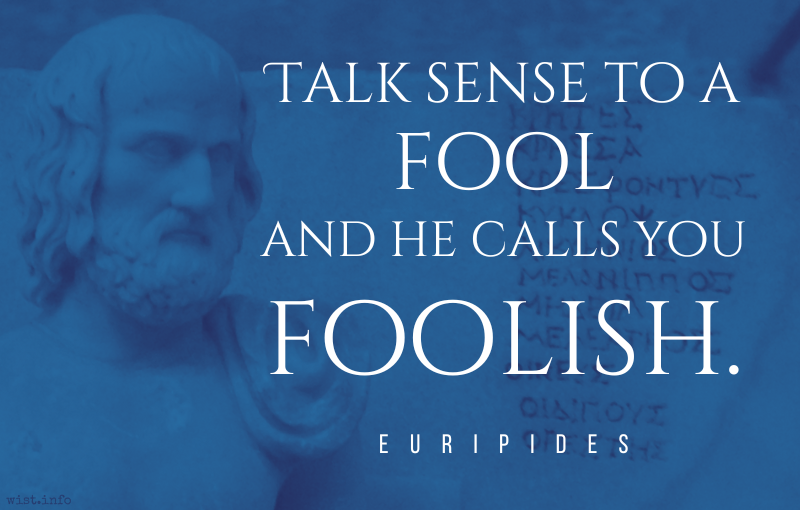
Talk sense to a fool
and he calls you foolish.[δόξει τις ἀμαθεῖ σοφὰ λέγων οὐκ εὖ φρονεῖν.]
Euripides (485?-406? BC) Greek tragic dramatist
Bacchæ [Βάκχαι], l. 480 [Dionysus/Διόνυσος] (405 BC) [tr. Arrowsmith (1960)]
(Source)
Replying to Pentheus' charge that he's being foolishly evasive.
(Source (Greek)). Other translations:He must seem devoid
Of reason, who mysterious truths unfolds
To those who lack discretion.
tr. Wodhull (1809)]One will seem to be foolish if he speaks wisely to an ignorant man.
[tr. Buckley (1850)]Who wiseliest speaks, to the fool speaks foolishness.
[tr. Milman (1865)]Boors think a wise man’s words devoid of sense.
[tr. Rogers (1872), l. 457]He were a fool, methinks, who would utter wisdom to a fool.
[tr. Coleridge (1891)]Wise answers seem but folly to a fool.
[tr. Way (1898)]Wise words being brought
To blinded eyes will seem as things of nought.
[tr. Murray (1902)]He who talks wisdom to an ignorant man will seem out of his senses.
[tr. Kirk (1970)]A wise speech sleeps in a foolish ear.
[tr. Vellacott (1973)]Talk truth to a deaf man and he
Begs your pardon.
[tr. Soyinka (1973)]Wise speech seems thoughtless to the ignorant.
[tr. Neuburg (1988)]What makes no sense is talking sense to a fool.
[tr. Cacoyannis (1982)]To the ignorant, wisdom will seem folly.
[tr. Blessington (1993)]To the ignorant man, any speaker of wisdom will seem foolish.
[tr. Esposito (1998)]Speak wisdom to a fool and he'll think you have no sense at all.
[tr. Woodruff (1999)]Wise things to the ignorant will sound like nonsense.
[tr. Gibbons/Segal (2000)]Speak wisdom to a fool and he will think you foolish.
[tr. Kovacs (2002)]Wise words spoken in the ear of a fool turn into nothingness.
[tr. Rao/Wolf (2004)]It is not wise for someone to say anything wise to the ignorant.
[tr. Theodoridis (2005)]Wise words will appear foolishness -- to an idiot.
[tr. Valerie (2005)]Yes, but, then,
a man can seem really ignorant
when speaking to a fool.
[tr. Johnston (2008)]Sense is nonsense to a fool.
[tr. Robertson (2014)]Wisdom always sounds silly to the unwise.
[tr. Pauly (2019)]Only a fool takes a warning for an insult.
[tr. Behr/Foster (2019)]One will seem to be foolish if he speaks wise things [sopha] to a senseless man.
[tr. Buckley/Sens/Nagy (2020)]
A foolish man speaks foolishness.
[Μῶρα γὰρ μῶρος λέγει.]
Euripides (485?-406? BC) Greek tragic dramatist
Bacchæ [Βάκχαι], l. 369 [Tiresias/Τειρεσίας] (405 BC) [tr. Wodhull (1809)]
(Source)
To Cadmus, about his grandson, Pentheus. (Source (Greek)). Other translations:Folly issues from the mouth of fools.
[tr. Buckley (1850)]Fools still speak folly.
[tr. Milman (1865)]Fools blurt their folly out.
[tr. Rogers (1872), l. 357]The words of a fool are folly.
[tr. Coleridge (1891)]Fools alone speak folly.
[tr. Way (1898)]Blind words and a blind heart.
[tr. Murray (1902)]The words of fools finish in folly.
[tr. Arrowsmith (1960)]He who speaks folly is himself a fool.
[tr. Kirk (1970)]The things he has said reveal the depth of his folly.
[tr. Vellacott (1973)]It is a fool who folly speaks.
[tr. Neuburg (1988)]You can tell a dangerous fool by his own words.
[tr. Cacoyannis (1982)]For a fool speaks folly.
[tr. Blessington (1993)]For Pentheus is a fool and says foolish things.
[tr. Esposito (1998)]He who speaks foolishness is a fool.
[tr. Woodruff (1999)]The fool speaks foolish things.
[tr. Gibbons/Segal (2000), l. 435]His talk is folly and he's a fool.
[tr. Kovacs (2002)]Often a fool speaks foolishly.
[tr. Valerie (2005)]A man who's mad tends to utter madness.
[tr. Johnston (2008)]His foolish words will end in folly.
[tr. Robertson (2014)]A fool says foolish things.
[tr. @sentantiq (2016)]The speech of the fool is foolish.
[tr. @sentantiq (2018)]The tongue of a fool makes a foolish noise.
[tr. Behr/Foster (2019)]For a foolish man says foolish things.
[tr. Buckley/Sens/Nagy (2020)]
One half of the world laughs at the other, and fools are they all.
[La mitad del mundo se está riendo de la otra mitad, con necedad de todos.]
Baltasar Gracián y Morales (1601–1658) Spanish Jesuit priest, writer, philosopher
The Art of Worldly Wisdom [Oráculo Manual y Arte de Prudencia], § 101 (1647) [tr. Jacobs (1892)]
(Source)
(Source (Spanish)). Other translations:One part of the world laughs at the other, and both laugh at their common folly.
[Flescher ed. (1685)]One half of the world laughs at the other, and fools are they all.
[tr. Duff (1877)]Half the world laughs at the other half, even though the lot are fools.
[tr. Fischer (1937)]Half the world is laughing at the other half, and folly rules over all.
[tr. Maurer (1992)]
Every fool stands convinced; and everyone convinced is a fool; and the faultier a man’s judgment, the firmer his conviction.
[Todo necio es persuadido, y todo persuadido necio; y quanto mas erroneo su dictamen, es mayor su tenacidad.]
Baltasar Gracián y Morales (1601–1658) Spanish Jesuit priest, writer, philosopher
The Art of Worldly Wisdom [Oráculo Manual y Arte de Prudencia], § 183 (1647) [tr. Fischer (1937)]
(Source)
(Source (Spanish)). Another translation:All Fools are Opiniatours, and all Opiniatours are Fools. The more Erroneous their Opinions are, the more they hug them.
[Flesher ed. (1685)]Every blockhead is thoroughly persuaded that he is in the right, and every one who is all to firmly persuaded is a blockhead, and the more erroneous is his judgment the greater is the tenacity with which he holds it.
[tr. Duff (1877)]Every fool is fully convinced, and every one fully persuaded is a fool: the more erroneous his judgment the more firmly he holds it.
[tr. Jacobs (1892)]Fools are stubborn, and the stubborn are fools, and the more erroneous their judgment is, the more they hold onto it.
[tr. Maurer (1992)]
I have always been among those who believed that the greatest freedom of speech was the greatest safety, because if a man is a fool, the best thing to do is to encourage him to advertise the fact by speaking. It cannot be so easily discovered if you allow him to remain silent and look wise, but if you let him speak, the secret is out, and the world knows that he is a fool. So it is by the exposure of folly that it is defeated, not by the seclusion of folly, and, in this free air of free speech, men get into that sort of communication with one another which constitutes the basis of all common achievement.
Woodrow Wilson (1856–1924) US President (1913–20), educator, political scientist
Speech, Institute of France, Paris (10 May 1919)
(Source)
Choose your leaders
with wisdom and forethought.
To be led by a coward
is to be controlled
by all that the coward fears.
To be led by a fool
is to be led
by the opportunists
who control the fool.
To be led by a thief
is to offer up
your most precious treasures
to be stolen.
To be led by a liar
is to ask
to be lied to.
To be led by a tyrant
is to sell yourself
and those you love
into slavery.Octavia Butler (1947–2006) American writer
Parable of the Talents, ch. 11, epigraph (1998)
(Source)
The epigraph is cited to the in-fiction Earthseed: The Books of the Living.

I must learn to love the fool in me, the one who feels too much, talks too much, takes too many chances, wins sometimes and loses often, lacks self-control, loves and hates, hurts and gets hurt, promises and breaks promises, laughs and cries. It alone protects me against that utterly self-controlled, masterful tyrant whom I also harbor and who would rob me of human aliveness, humility, and dignity, but for my fool.
Theodore Isaac Rubin (1923–2019) American psychiatrist and author
Love Me, Love My Fool (1976)
Sometimes quoted in the second person.
For thee — if this my deed seems foolishness,
The fool has caught the foolish in her folly.[σοὶ δ᾽ εἰ δοκῶ νῦν μῶρα δρῶσα τυγχάνειν,
σχεδόν τι μώρῳ μωρίαν ὀφλισκάνω.]Sophocles (496–406 BC) Greek tragic playwright
Antigone, l. 469ff [Antigone] (441 BC) [tr. Donaldson (1848)]
(Source)
Other translations:And if my present actions are foolish in your sight, it may be that it is a fool who accuses me of folly.
[tr. Jebb (1891)]And if in this thou judgest me a fool,
Methinks the judge of folly's not acquit.
[tr. Storr (1859)]This to thee may seem
Madness and folly; if it be, 'tis fit
I should act thus; it but resembles thee.
[tr. Werner (1892)]But you! You think
I've been a fool? It takes a fool to think that.
[tr. Woodruff (2001)]If you think I’m a mindless woman then perhaps it's a mindless man who recognises a mindless woman.
[tr. Theodoridis (2004)]If you think what I’m doing now is stupid,
perhaps I’m being charged with foolishness
by someone who’s a fool.
[tr. Johnston (2005), ll. 531-33]And if you think my acts are foolishness
the foolishness may be in a fool's eye.
[tr. Wyckoff]
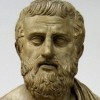
He used to say that states fail when they cannot distinguish fools from serious men.
[τότ’ ἔφη τὰς πόλεις ἀπόλλυσθαι, ὅταν μὴ δύνωνται τοὺς φαύλους ἀπὸ τῶν σπουδαίων διακρίνειν.]
Antisthenes (c. 445 - c. 365 BC) Greek Cynic philosopher
Fragment 103, in Diogenes Laertius, Lives of Eminent Philosophers, Book 6, sec. 11 [tr. @sentantiq]
(Source)
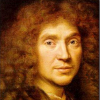
CLITANDRE: A learned fool is more foolish than an ignorant fool.
[Un sot savant est sot plus qu’un sot ignorant.]
Molière (1622–1673) French playwright, actor [stage name for Jean-Baptiste Poquelin]
Les Femmes Savantes [The Learned Ladies], Act 4, sc. 3 (1692) [tr. Van Laun (1876)]
(Source)
(Source (French)). Other translations:A learned Fool is more foolish than an ignorant Fool.
[tr. Clitandre (1739)]A learned fool is more of a fool than an ignorant one.
[tr. Wall (1879), The Learned Women]A learned fool is more foolish than an ignorant one.
[tr. Matthew (1890), The Blue-Stockings]The learned fool is a far greater fool than the fool of ignorance.
[tr. Wormeley (1895), The Female Pedants]A learned fool is a bigger fool than an ignorant one.
[tr. Waller (1903)]There's no fool like a learned fool.
[tr. Page (1908)]A learned fool is more foolish than an ignorant fool.
[tr. Marks (2018)]
When blithe to argument I come,
Though armed with facts, and merry,
May Providence protect me from
The fool as adversary,
Whose mind to him a kingdom is
Where reason lacks dominion,
Who calls conviction prejudice
And prejudice opinion.Phyllis McGinley (1905–1978) American author, poet
“Moody Reflections,” The New Yorker (13 Feb 1954)
(Source)

The ratio of damn fools to villains is high.
The silliest woman can manage a clever man; but it needs a very clever woman to manage a fool!
Rudyard Kipling (1865–1936) English writer
Plain Tales from the Hills, “Three and — an Extra” (1888)
Every man is a divinity in disguise, a god playing the fool. It seems as if heaven had sent its insane angels into our world as to an asylum, and here they will break out into their native music and utter at intervals the words they have heard in heaven; and then the mad fit returns, and they mope and wallow like dogs.
Ralph Waldo Emerson (1803–1882) American essayist, lecturer, poet
Essay (1841), “History,” Essays: First Series, No. 1
(Source)
This essay was a combination of three separate lectures on "English Literature" (1835-1836), "The Philosophy of History" (1836-1837), and "Human Life" (1837-1838).
Note this passage is missing from the University of Michigan online collection.
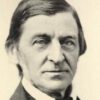
The certain way to be cheated is to fancy one’s self more cunning than others.
Pierre Charron (1541–1603) French Catholic theologian and philosopher
(Attributed)
Quoted in John Timbs, Laconics: Or, The Best Words of the Best Authors, vol. 3, #308 (1829)
Of all the creatures that creep, swim, or fly,
Peopling the earth, the waters, and the sky,
From Rome to Iceland, Paris to Japan,
I really think the greatest fool is man.[De tous les animaux qui s’élèvent dans l’air,
Qui marchent sur la terre, ou nagent dans la mer,
De Paris au Pérou, du Japon jusqu’à Rome,
Le plus sot animal, à mon avis, c’est l’homme.]Nicolas Boileau-Despréaux (1636–1711) French poet and critic
Satires, Satire 8, l. 1 (1716)
A fool always finds one still more foolish to admire him.
[Un sot trouve toujours un plus sot qui l’admire.]
Nicolas Boileau-Despréaux (1636–1711) French poet and critic
The Art of Poetry [L’Art Poétique], Canto 1, l. 232 (1674)
Alt. trans.: "A fool always finds a greater fool to admire him."
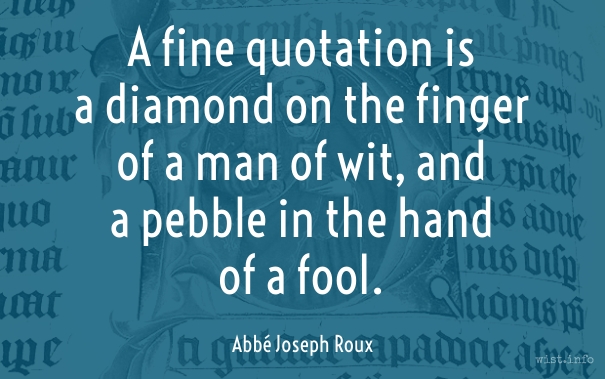
A fine quotation is a diamond on the finger of a man of wit, and a pebble in the hand of a fool.
Joseph Roux (1834–1886) French Catholic priest
Meditations of a Parish Priest: Thoughts, Part 1, #74 (1886)
(Source)
For as blushing will sometimes make a whore pass for a virtuous woman, so modesty may make a fool seem a man of sense.
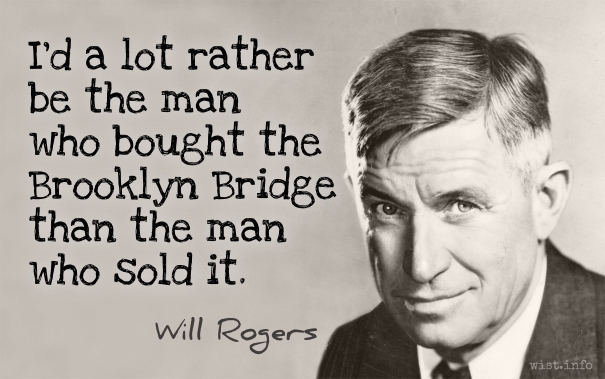
Call me a “rube” and a “hick,” but I’d a lot rather be the man who bought the Brooklyn Bridge than the man who sold it.
Will Rogers (1879–1935) American humorist
(Attributed)
Widely attributed to Rogers, though I cannot find a primary source for it.
Variants:
- "They may call me a rube and a hick ..."
- "Call me a rube ..."
- "You could call me a hick or call me a rube ..."
It’s easier to fool people than to convince them that they have been fooled.
Mark Twain (1835–1910) American writer [pseud. of Samuel Clemens]
(Spurious)
Not found in Twain's writings. The earliest attribution to him appears to be in 2011. The connection to Twain may be his (authentic) comment, "How easy it is to make people believe a lie, and how hard it is to undo that work again!"
For more discussion of this quotation, see Quote Origin: It’s Easier To Fool People Than To Convince Them That They’ve Been Fooled – Quote Investigator®.
The trouble with this country is that there are too many politicians who believe, with a conviction based on experience, that you can fool all of the people all of the time.
Franklin Pierce Adams (1881–1960) American journalist and humorist ["F. P. A."]
Nods and Becks (1944)
See Lincoln.
Nearly always, the best deception trades on the enemy’s own preconceptions. If he already believes what you want him to believe, you have merely to confirm his own ideas rather than to undertake the more difficult task of inserting new ones into his mind.
Ronald Lewin (1914–1984) British military historian, radio producer publishing editor
Ultra Goes to War, ch. 10 (1978)

You philosophers are sages in your maxims, and fools in your conduct.
Benjamin Franklin (1706–1790) American statesman, scientist, philosopher, aphorist
“Dialogue Between Franklin and the Gout” (22 Oct 1780)
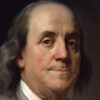
Many talk like Philosophers, and live like Fools.
Thomas Fuller (1654–1734) English physician, preacher, aphorist, writer
Gnomologia: Adages and Proverbs (compiler), # 3358 (1732)
(Source)
EDDIE: Kid, life’s hard. But it’s a lot harder if you’re stupid.
Paul Monash (1917–2003) American producer and screenwriter
The Friends of Eddie Coyle (movie) (1973)
Screenplay based on the novel by George V. Higgins (though the line is not in the book). Played in the movie by Robert Mitchum, to whom the quote is often attributed.

It is so pleasant to come across people more stupid than ourselves. We love them at once for being so.
Jerome K. Jerome (1859–1927) English writer, humorist [Jerome Klapka Jerome]
Idle Thoughts of an Idle Fellow, “On Cats and Dogs” (1889)
(Source)

Even fools who keep silent are considered wise;
when they close their lips, they are deemed intelligent.חוֹשֵׂ֣ךְ אֲ֭מָרָיו יוֹדֵ֣עַ דָּ֑עַת (וקר) [יְקַר־]ר֝֗וּחַ אִ֣ישׁ תְּבוּנָֽה׃
The Bible (The Old Testament) (14th - 2nd C BC) Judeo-Christian sacred scripture [Tanakh, Hebrew Bible], incl. the Apocrypha (Deuterocanonicals)
Book 20. Proverbs 17:28 (Prov 17:28) [tr. NRSV (2021 ed.)]
(Source)
See Twain.
(Source (Hebrew)). Other translations:Even a fool, when he holdeth his peace, is counted wise: and he that shutteth his lips is esteemed a man of understanding.
[KJV (1611)]If a fool can hold his tongue, even he can pass for wise, and pass for clever if he keeps his lips tight shut.
[JB (1966)]After all, even fools may be thought wise and intelligent if they stay quiet and keep their mouths shut.
[GNT (1976)]If the fool holds his tongue, he may pass for wise; if he seals his lips, he may pass for intelligent.
[NJB (1985)]Fools who keep quiet are deemed wise;
those who shut their lips are smart.
[CEB (2011)]Even fools who keep silent are deemed wise;
Intelligent, while their mouth is shut.
[RJPS (2023 ed.)]
It’s better to keep your mouth shut and appear stupid, than to open it and remove all doubt.
Mark Twain (1835–1910) American writer [pseud. of Samuel Clemens]
(Spurious)
This quotation, and close variants, are frequently attributed to Twain or Abraham Lincoln, but appears to have first been phrased this way by Maurice Switzer, Mrs. Goose, Her Book (1906):It is better to remain silent at the risk of being thought a fool, than to talk and remove all doubt of it.
Another point of origin is in the Bible, Proverbs 17:28:Even a fool, when he holdeth his peace, is counted wise: and he that shutteth his lips is esteemed a man of understanding.
In short, the sentiment is not new. See also See also Fuller, Franklin, Thomas a Kempis, and Wilson. For more discussion, see:
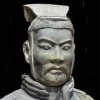
When capable, feign incapacity; when active, inactivity.
Sun-Tzu (fl. 6th C. AD) Chinese general and philosopher [a.k.a. Sun Wu]
The Art of War, “Estimates” (18) [tr. Griffith (1963)]
There is no crime in the cynical American calendar more humiliating than to be a sucker.
Maxwell "Max" Lerner (1902–1992) American journalist, columnist, educator
Actions and Passions: Notes on the Multiple Revolution of Our Time (1949)
Don’t argue with idiots because they will drag you down to their level and then beat you with experience.
Greg King (b. 1964) American author and biographer
(Attributed)
Often attributed to Twain (compare to this), Bob Smith, George Carlin, and John Guerrero, all without citation. See also Proverbs 26:4.

Never argue with a fool; onlookers may not be able to tell the difference.
Mark Twain (1835–1910) American writer [pseud. of Samuel Clemens]
(Spurious)
Frequently attributed to Twain and also to Immanuel Kant (but never, in either case, with any citation). The phrase first makes recognizable (if anonymous) appearance in the late 19th Century; attributions to Twain begin in the late 1990s. See also Proverbs 26:4. For more discussion (and a shout-out to WIST) see here.
I never make the mistake of arguing with people for whose opinions I have no respect.
Edward Gibbon (1737–1794) English historian
(Attributed)
Answer not a fool according to his folly, lest thou also be like unto him.
אַל־תַּ֣עַן כְּ֭סִיל כְּאִוַּלְתּ֑וֹ פֶּֽן־תִּשְׁוֶה־לּ֥וֹ גַם־אָֽתָּה׃
The Bible (The Old Testament) (14th - 2nd C BC) Judeo-Christian sacred scripture [Tanakh, Hebrew Bible], incl. the Apocrypha (Deuterocanonicals)
Book 20. Proverbs 26: 4 (Prov 24:6) [KJV (1611)]
(Source)
(Source (Hebrew)). Other translations:Do not answer a fool in the terms of his folly for fear you grow like him yourself.
[JB (1966)]If you answer a silly question, you are just as silly as the person who asked it.
[GNT (1976)]Do not answer a fool in the terms of his folly for fear you grow like him yourself.
[NJB (1985)]Don’t answer fools according to their folly,
or you will become like them yourself.
[CEB (2011)]Do not answer fools according to their folly,
lest you be a fool yourself.
[NRSV (2021 ed.)]Do not answer a dullard in accord with his folly,
Else you will become like him.
[RJPS (2023 ed.)]
April 1. This is the day upon which we are reminded of what we are on the other three hundred and sixty-four.
Mark Twain (1835–1910) American writer [pseud. of Samuel Clemens]
The Tragedy of Pudd’nhead Wilson, ch. 21 epigraph: “Pudd’nhead Wilson’s Calendar” (1894)
Nor can a man dupe others long, who has not duped himself first.
Ralph Waldo Emerson (1803–1882) American essayist, lecturer, poet
Journal (1852)
(Source)
Often rendered: "A man cannot dupe others long, who has not duped himself first."
The trouble ain’t that there is too many fools, but that the lightning ain’t distributed right.
Mark Twain (1835–1910) American writer [pseud. of Samuel Clemens]
Quoted in Merle Johnson, ed., More Maxims of Mark (1927)
(Source)
Not found in a primary source. Johnson was a rare book collector who published the first thorough bibilography of Twain's works in 1910. His 1927 work is a 15-page pamphlet, generally considered authentic by scholars, but it provides no other context for the saying.
For more information on the history of this quotation, see Quote Origin: The Trouble Ain’t That There Is Too Many Fools, But That the Lightning Ain’t Distributed Right – Quote Investigator®.
Variant: "The trouble isn’t that there are too many fools, but that the lightning isn’t distributed right."
No occurrences are so unfortunate that the shrewd cannot turn them to some advantage, nor so fortunate that the imprudent cannot turn them to their own disadvantage.
[Il n’y a point d’accidents si malheureux dont les habiles gens ne tirent quelque avantage, ni de si heureux que les imprudents ne puissent tourner à leur préjudice.]François VI, duc de La Rochefoucauld (1613–1680) French epigrammatist, memoirist, noble
Réflexions ou sentences et maximes morales [Reflections; or Sentences and Moral Maxims], ¶59 (1665-1678) [tr. Tancock (1959)]
(Source)
Present in the original 1665 edition. In manuscript, this was originally drafted as:One could say that there are no lucky or unfortunate accidents, because clever people know how to take advantage of bad ones, and the imprudent very often turn the most advantageous harm to themselves.
[On pourrait dire qu’il n’y a point d’heurcux ni de malheureux accidents, parce que les habiles gens savent profiter des mauvais, et que les imprudents tournent bien souvent à leur préjudice les plus avantageux.]
(Source (French)). Other translations:It may be affirm'd that either there are not any happy or unhappy accidents, or that all accidents are both happy and unhappy, inasmuch as the prudent know how to make their advantages of the bad, and the imprudent many times turn the most advantageous emergencies to their own prejudice.
[tr. Davies (1669), ¶128]There is no accident so exquisitely unfortunate, but wise Men will make some advantage of it; nor any so entirely fortunate, but Fools may turn it to their own prejudice.
[tr. Stanhope (1694), ¶60]No accidents are so unlucky, but that the prudent may draw some advantage from them: nor are there any so lucky, but what the imprudent may turn to their prejudice.
[pub. Donaldson (1783), ¶8; [ed. Lepoittevin-Lacroix (1797), ¶58]No accidents are so unlucky, but what the prudent may draw some advantages from; nor are there any so lucky, but what the imprudent may turn to their prejudice.
[ed. Carville (1835), ¶5]There are no circumstances, however unfortunate, that clever people do not extract some advantage from; and none, however fortune, that the imprudent cannot turn to their own prejudice.
[ed. Gowens (1851), ¶60]There are no accidents so unfortunate from which skillful men will not draw some advantage, nor so fortunate that foolish men will not turn them to their hurt.
[tr. Bund/Friswell (1871)]A clever man reaps some benefit from the worst catastrophe, and a fool can turn even good luck to his disadvantage.
[tr. Heard (1917)]No event is so disastrous that the adroit cannot derive some benefit from it, nor so auspicious that fools cannot turn it to their detriment.
[tr. Stevens (1939)]There is no accident so disastrous that a clever man cannot derive some profit from it: nor any so fortunate that a fool cannot turn it to his disadvantage.
[tr. FitzGibbon (1957)]There are no experiences so disastrous that thoughtful men cannot derive some profit from them, nor so happy that the thoughtless cannot use them to their harm.
[tr. Kronenberger (1959)]There are no accidents so unfortunate that clever men may not draw some advantage from them, nor so fortunate that imprudent men may not turn them to their own detriment.
[tr. Whichello (2016)]
Experience keeps a dear school, yet Fools will learn in no other.
Benjamin Franklin (1706–1790) American statesman, scientist, philosopher, aphorist
Poor Richard’s Almanack (Dec 1743)
(Source)
Franklin quotes Poor Richard as well in The Way to Wealth (1758).
More discussion of this quotation, and an image of the original page: Experience Keeps a Dear School; Yet Fools Will Learn In No Other – Quote Investigator.
Most Fools think they are only ignorant.
Benjamin Franklin (1706–1790) American statesman, scientist, philosopher, aphorist
Poor Richard Improved (1748 ed.)
(Source)
For it is the characteristic of folly, to have eyes for the faults of others, and blindness for its own.
[Est enim proprium stultitiae aliorum vitia cernere, oblivisci suorum.]
Marcus Tullius Cicero (106–43 BC) Roman orator, statesman, philosopher
Tusculan Disputations [Tusculanae Disputationes], Book 3, ch. 30 (3.30) / sec. 73 (45 BC) [tr. Otis (1839)]
(Source)
(Source (Latin)). Other translations:For it is the property of Folly, to look upon other mens Failings, and to forget their own.
[tr. Wase (1643)]For it is the peculiar characteristic of folly to discover the vices of others, forgetting its own.
[tr. Main (1824)]For it is the peculiar characteristic of folly to perceive the vices of others, but to forget its own.
[tr. Yonge (1853)]It is the peculiar quality of a fool to perceive the faults of others and to forget his own.
[Source (1882)]It is the property of folly to see the faults of others, to forget its own.
[tr. Peabody (1886)]This is just how foolish people behave: they observe the faults of others and forget their own.
[tr. Graver (2002)]It is a trait of fools to perceive the faults of others but not their own.
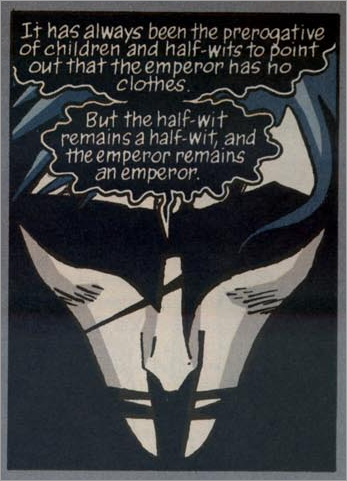
DREAM: It has always been the prerogative of children and half-wits to point out that the emperor has no clothes. But the half-wit remains a half-wit, and the emperor remains an emperor.
Neil Gaiman (b. 1960) British author, screenwriter, fabulist
Sandman, Book 9. The Kindly Ones, # 60 “The Kindly Ones: 4” (1994-06)
(Source)
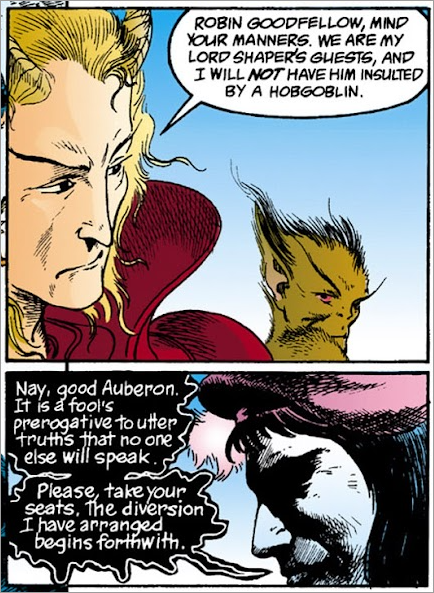
DREAM: It is a fool’s prerogative to utter truths that no one else will speak.
Neil Gaiman (b. 1960) British author, screenwriter, fabulist
Sandman, Book 3. Dream Country, # 19 “A Midsummer Night’s Dream” (1990)
(Source)
Because the story includes William Shakespeare as a character, and is named after Shakespeare's play (which is performed in the story), this line is sometimes misattributed to Shakespeare himself.
See also this later comment by Dream.
Education must be based on two things: ethics and prudence; ethics in order to develop your good qualities, prudence to protect you from other people’s bad ones. If you attach too great an importance to goodness, you produce credulous fools; if you’re too prudent, you produce self-serving, scheming rogues.
[L’Éducation doit porter sur deux bases, la morale et la prudence ; la morale, pour appuyer la vertu ; la prudence, pour vous défendre contre les vices d’autrui. En faisant pencher la balance du côté de la morale, vous ne faites que des dupes ou des martyrs; en la faisant pencher de l’autre côté, vous faites des calculateurs égoïstes.]
Nicolas Chamfort (1741–1794) French writer, epigrammist (b. Nicolas-Sébastien Roch)
Products of Perfected Civilization [Produits de la Civilisation Perfectionée], Part 1 “Maxims and Thoughts [Maximes et Pensées],” ch. 5, ¶ 321 (1795) [tr. Parmée (2003), ¶ 205]
(Source)
(Source (French)). Other translations:Education must have two foundations -- morality as a support for virtue, prudence as a defence for self against the vices of others. By letting the balance incline to the side of morality, you only make dupes or martyrs; by letting it incline to the other, you make calculating egoists.
[tr. Hutchinson (1902)]Education should rest on the dual support of moral philosophy and prudence, moral philosophy as the stay of virtue, and prudence as a shield against the vice in others. If you tip the scale on the moral side you will produce none but dupes and martyrs, and by tilting it in the other direction you will develop a quality of selfish calculation only.
[tr. Mathers (1926)]Education should be constructed on two bases: morality and prudence. Morality in order to assist virtue, and prudence in order to defend you against the vices of others. In tipping the scales toward morality, you merely produce dupes and martyrs. In tipping it the other way, you produce egotistical schemers.
[tr. Merwin (1969)]Education must have two foundations, morality and carefulness: morality to support virtue; carefulness to defend against others' vices. By inclining this balance to the side of morality, you only make dupes and martyrs; by inclining it to carefulness, you make calculating egoists.
[tr. Siniscalchi (1994)]
He that’s cheated twice by the same Man is an Accomplice with the Cheater.
Thomas Fuller (1654–1734) English physician, preacher, aphorist, writer
Gnomologia: Adages and Proverbs (compiler), # 2281 (1732)
(Source)
“I don’t keer w’at you do wid me, Brer Fox,” sezee, “so you don’t fling me in dat brier-patch. Roas’ me, Brer Fox” sezee, “but don’t fling me in dat brier-patch,” sezee.
Joel Chandler Harris (1848–1908) American writer
Legends of the Old Plantation, “How Mr. Rabbit was too sharp for Mr. Fox” (1886)

The World is full of fools and faint hearts; and yet every one has courage enough to bear the misfortunes, and wisdom enough to manage the Affairs of his neighbour.
Benjamin Franklin (1706–1790) American statesman, scientist, philosopher, aphorist
Poor Richard (1743 ed.)
(Source)
You may fool all the people some of the time; you can even fool some of the people all the time; but you can’t fool all of the people all the time.
Abraham Lincoln (1809–1865) American lawyer, politician, US President (1861–65)
(Attributed)
A possible precursor to this quote is the widely-republished Jacques Abbadie, "Treatise on the Truth of the Christian Religion [Traité de la Vérité de la Religion Chrétienne]," ch. 2 (1684):… ont pû tromper quelques hommes, ou les tromper tous dans certains lieux & en certains tems, mais non pas tous les hommes, dans tous les lieux & dans tous les siécles.
[One can fool some men, or fool all men in some places and times, but one cannot fool all men in all places and ages.]
A similar passage was used in Denis Diderot and Jean le Rond d’Alembert, ed., Encyclopédie: ou Dictionnaire Raisonné des Sciences, des Arts et des Métiers, Vol. 4 (1754).
An early English version came from a speech by William J. Groo to a convention of Prohibitionists; the newspaper recording of it does not include any attribution by Groo to anyone else:You can fool all the people part of the time, or you can fool some people all the time, but you cannot fool all people all the time.
First attributed to Lincoln by Fred F. Wheeler, interviewed in the Albany Times (1886-03-08): "You can fool part of the people some of the time, you can fool some of the people all of the time, but you cannot fool all the people all of the time."
First cited in detail in Alexander K. McClure, “Abe” Lincoln’s Yarns and Stories, (1904), in the above form; it was cited as a Lincoln speech in Clinton, Ill. (1858-09-02), but the passage is not found in any surviving Lincoln documents. No Lincoln reference is found in contemporary writings.
Also attributed to P.T. Barnum and Bob Dylan. See also Lawrence J. Peter.
More detailed discussion of the quotation and its origins can be found here:

TOUCHSTONE: I do now remember a saying, “The fool doth think he is wise, but the wise man knows himself to be a fool.”
William Shakespeare (1564–1616) English dramatist and poet
As You Like It, Act 5, sc. 1, l. 30ff (5.1.30-32) (1599)
(Source)
Any fool can criticize, condemn, and complain — and most fools do.
Dale Carnegie (1888–1955) American writer, lecturer
How to Win Friends and Influence People, Part 1, ch. 1 (1936)
(Source)
Also attributed to Ben Franklin; this may be due to the preceding paragraph quoting Franklin.
He that dies a martyr proves that he is not a knave, but by no means that he is not a fool.
Charles Caleb "C. C." Colton (1780–1832) English cleric, writer, aphorist
Lacon: Or, Many Things in Few Words, Vol. 1, § 410 (1820)
(Source)
Look around the table. If you don’t see a sucker, get up, because you’re the sucker.
"Amarillo Slim" Preston (1928–2012) American gambler [Thomas Austin Preston, Jr.]
(Attributed)
Though he used the phrase, he did not take credit for it. More information here.Variants:
- "If after ten minutes at the poker table you do not know who the patsy is -- you are the patsy."
- "If you sit in on a poker game and don't see a sucker, get up. You're the sucker."
- "If you enter a poker game and you don't see a sucker, get up and leave -- you’re it."
No! I am not Prince Hamlet, nor was meant to be;
Am an attendant lord, one that will do
To swell a progress, start a scene or two,
Advise the prince; no doubt, an easy tool,
Deferential, glad to be of use,
Politic, cautious, and meticulous;
Full of high sentence, but a bit obtuse;
At times, indeed, almost ridiculous —
Almost, at times, the Fool.T. S. Eliot (1888–1965) American-British poet, critic, playwright [Thomas Stearns Eliot]
“The Love Song of J. Alfred Prufrock” (1917)
We are never so ridiculous through what we are as through what we pretend to be.
[On n’est jamais si ridicule par les qualités que l’on a que par celles que l’on affecte d’avoir.]
François VI, duc de La Rochefoucauld (1613–1680) French epigrammatist, memoirist, noble
Réflexions ou sentences et maximes morales [Reflections; or Sentences and Moral Maxims], ¶134 (1665-1678) [tr. FitzGibbon (1957)]
(Source)
Present in the 1st (1665) edition.
(Source (French)). Other translations:The Qualities a man really hath, make him not so ridiculous as those which out of pure affectation he pretends to have.
[tr. Davies (1669), ¶15]Men become Ridiculous, not so much for the Qualities they have, as those they would be thought to have, when they really have them not.
[tr. Stanhope (1694), ¶135]We are never made so ridiculous by the qualities we have, as by those we affect to have.
[pub. Donaldson (1783), ¶22; ed. Lepoittevin-Lacroix (1797), ¶130]Never are we made so ridiculous; by the qualities we have, as by those we affect to have.
[ed. Carvill (1835), ¶19]We are never so ridiculous from the qualities we have, as from those we affect to have.
[ed. Gowens (1851), ¶137]We are never so ridiculous from the habits we have as from those that we affect to have.
[tr. Bund/Friswell (1871), ¶134]Our true qualities never make us as ridiculous as those we affect.
[tr. Heard (1917), ¶134]Our real qualities never excite such ridicule as those we pretend to possess.
[tr. Stevens (1939), ¶134]We are never so ridiculous for the qualities we have as for those we pretend to.
[tr. Kronenberger (1959), ¶134]We are never so ridiculous through qualities we have as through those we pretend to have.
[tr. Tancock (1959), ¶134]One is never as ridiculous with the qualities one has, as with those one affects to have. [tr. Siniscalchi (c. 1994)]We are never so ridiculous in our personal qualities, as in those which we pretend to have.
[tr. Whichello (2016) ¶134]
A common mistake people make when trying to design something completely foolproof is to underestimate the ingenuity of complete fools.
Douglas Adams (1952–2001) English author, humorist, screenwriter
Hitchhiker’s Guide No. 5, Mostly Harmless, ch. 12 (1992)
(Source)