A cat may looke on a King.
John Heywood (1497?-1580?) English playwright and epigrammist
Proverbs, Part 2, ch. 5 (1546)
(Source)
Revised spelling from the 1874 edition. Original editions had it, "A cat maie looke on a kyng." This is the earliest text found with this recorded as an English proverb.
Thomas Fuller included the phrase ("A Cat may look upon a King") in his Gnomologia, # 35 (1732).
For more information on this phrase and its history, see: meaning and origin of the phrase ‘a cat may look at a king’ – word histories.
Quotations about:
disdain
Note not all quotations have been tagged, so Search may find additional quotes on this topic.

Long ago, I made up my mind that, when things were said involving only me, I would pay no attention to them, except when valid criticism was carried by which I could profit.
Eleanor Roosevelt (1884–1962) American politician, diplomat, activist; First Lady of the US (1933–45)
Column (1942-01-14), “My Day”
(Source)

The worst illiterate is the political illiterate. He hears nothing, sees nothing, takes no part in political life. He doesn’t seem to know that the cost of living, the price of beans, of flour, of rent, of medicines all depend on political decisions. He even prides himself on his political ignorance, sticks out his chest and says he hates politics. He doesn’t know, the imbecile, that from his political non-participation comes the prostitute, the abandoned child, the robber and, worst of all, corrupt officials, the lackeys of exploitative multinational corporations.
Bertolt Brecht (1898–1956) German poet, playwright, director, dramaturgist
(Attributed)
A chewy quote that is widely attributed to Brecht, but no actual citation has been found.

Like the Athenian miser, who was wont
To meet men’s curses with a hero’s front:
“Folks hiss me,” said he, “but myself I clap
When I tell o’er my treasures on my lap.”[Ut quidam memoratur Athenis
sordidus ac dives, populi contemnere voces
sic solitus: ‘populus me sibilat, at mihi plaudo
ipse domi, simul ac nummos contemplor in arca.’]Horace (65–8 BC) Roman poet, satirist, soldier, politician [Quintus Horatius Flaccus]
Satires [Saturae, Sermones], Book 1, # 1 “Qui fit, Mæcenas,” l. 64ff (1.1.64-67) (35 BC) [tr. Conington (1874)]
(Source)
(Source (Latin)). Other translations:Such one we reade of in olde tyme, that dwelte in Athins towne,
A man in substance passinge rytche, nathlesse a niggerde cloune,
At whose scarceheade, and covetyce the worlde did outas make,
But all in vayne, he forste it not, he sought not howe to slake
Blacke fame, that frisked everye wheare, and bounsed at ytche eare,
"A figge for them (brasen face) I force not howe I heare,
"They hauke, they hem, they hisse at me, I weygh it not an hawe,
"Whilste I may harbor in mine arke, and lodge wythin my lawe
"My darlynge goulde, my leaves gueste, my solace and my glee,
"He is the bone companion, its he that cheares up me."
[tr. Drant (1567)]Thus that Athenian Monster Timon, which
Hated Man-kind, a sordid Knave, but rich,
Was wont to say, When ere I walk abroad
The People hiss me, but I do applaud
And hug my self at home, when I behold
My chests brim-full with Silver and with Gold.
[tr. A. B.; ed. Brome (1666)]Since He, as the Athenian Chuff, will cry
The People hiss me, True, but what care I?
Let the poor fools hiss me where e're I come,
I bless my self to see my bags at home.
[tr. Creech (1684)]At Athens liv'd a wight, in days of yore,
Though miserably rich, yet fond of more,
But of intrepid spirit to despise
The abusive crowd. "Let them hiss on," he cries,
" While, in my own opinion fully blest,
I count my money, and enjoy my chest."
[tr. Francis (1747)]Self-cursed as that same miser must have been,
Who lived at Athens, rich as he was mean, --
Who, when the people hiss'd, would turn about
And drily thus accost the rabble-rout:
"Hiss on; I heed you not, ye saucy wags,
While self-applauses greet me o'er my bags."
[tr. Howes (1845)]As a certain person is recorded [to have lived] at Athens, covetous and rich, who was wont to despise the talk of the people in this manner: “The crowd hiss me; but I applaud myself at home, as soon as I contemplate my money in my chest.”
[tr. Smart/Buckley (1853)]As wretched as, at Athens, some rich miser was, who (as they say) was wont to thus despise what people said of him: "Aha ! the Public hiss, but in my heart I say I m right, directly that I gaze upon the coins in my strong-box."
[tr. Millington (1870)]He is like a rich miser in Athens who, they say, used thus to scorn the people's talk: "The people hiss me, but at home I clap my hands for myself, once I gaze on the moneys in my chest."
[tr. Fairclough (Loeb) (1926)]Like the man they tell of
In Athens, filthy but rich, who despised the voice
Of the people and kept saying, "So! The citizens hiss at me!
Ah! But I applaud myself alone at home
When I gaze on the coins in my strongbox."
[tr. Palmer Bovie (1959)]They're like an Athenian I heard about
Rich and stingy, he thought nothing of the people's snide remarks,
and always said, "They hiss me, but I applaud myself
at home, as soon as I lay eyes on the money in my chest."
[tr. Fuchs (1977)]As the Athenian miser
Is said to have answered, when citizens
Mocked him: "They hiss me, but at home I
Applaud myself, counting the coins in my safe."
[tr. Raffel (1983)]Like that one
about whom the story was told in Athens:
stingy and rich, he used to express
his scorn of the people’s jibes with these words:
"The people may hiss me, but at home
I applaud myself as I contemplate
my gold in the strongbox."
[tr. Alexander (1999)]He’s like the miser in Athens
who scorned, it’s said, what people thought of him.
“They hiss me in the streets, but once I’m home
I stare at my bright coffers and applaud
myself.”
[tr. Matthews (2002)]He's like the rich
Athenian miser who treated the people's remarks with contempt.
"The people hiss me," he would say, "but I applaud myself
when I reach home and set eyes on all the cash in my box!"
[tr. Rudd (2005 ed.)]Like the rich Athenian miser
Who used to hold the voice of the crowd in contempt:
"They hiss at me, that crew, but once I’m home I applaud
Myself, as I contemplate all the riches in my chests."
[tr. Kline (2015)]
Thare iz a grate deal ov charity in this world so koldly rendered that it fairly hurts, it iz like lifting a drowning man out ov the water bi the hair ov the hed, and then letting him drop on the ground.
[There is a great deal of charity in this world so coldly rendered that it fairly hurts. It is like lifting a drowning man out of the water by the hair of the head, and then letting him drop on the ground.]Josh Billings (1818–1885) American humorist, aphorist [pseud. of Henry Wheeler Shaw]
Everybody’s Friend, Or; Josh Billing’s Encyclopedia and Proverbial Philosophy of Wit and Humor, ch. 155 “Affurisms: Ink Lings” (1874)
(Source)

No, what was sad in his case was that he, who didn’t care for carved oak, should have his drawing-room paneled with it, while people who do care for it have to pay enormous prices to get it. It seems to be the rule of this world. Each person has what he doesn’t want, and other people have what he does want.
Jerome K. Jerome (1859–1927) English writer, humorist [Jerome Klapka Jerome]
Three Men in a Boat (To Say Nothing of the Dog), ch. 6 (1889)
(Source)

FASHION, n. A deity whom the wise ridicule, yet the discreet obey.
Ambrose Bierce (1842–1914?) American writer and journalist
“Fashion,” The Cynic’s Word Book (1906)
(Source)
In The Devil's Dictionary (1911), it is defined as: "FASHION, n. A despot whom the wise ridicule and obey."
Originally published in the "Devil's Dictionary" column in the San Francisco Wasp (1884-06-28).

Scorn for wealth among philosophers was at bottom a desire to avenge themselves against fate, by despising the very things of which she deprived them. It was a strategic way of avoiding the humiliations of poverty, a roundabout way of gaining an esteem they could not gain through wealth.
[Le mépris des richesses était dans les philosophes un désir cache de venger leur mérite de l’injustice de la fortune par le mépris des mêmes biens dont elle les privait; c’était un secret pour se garantir de l’avilissement de la pauvreté; c’était un chemin détourné pour aller à la considération qu’ils ne pouvaient avoir par les richesses.]
François VI, duc de La Rochefoucauld (1613–1680) French epigrammatist, memoirist, noble
Réflexions ou sentences et maximes morales [Reflections; or Sentences and Moral Maxims], ¶54 (1665-1678) [tr. Kronenberger (1959)]
(Source)
This maxim appeared in the first edition, with various small modifications across subsequent editions.
(Source (French)). Other translations:The contempt of wealth, in the Philosophers, was a secret desire of vindicating their merit, against the injustice of Fortune, by an affected slighting of those goods, whereof she depriv'd them. It was an humorous secret, which they had found out, to indemnifie themselves from the disparagement accessory to Poverty. In fine, it was a winding path, or by-way to get into that esteem, which they could not obtain by Riches.
[tr. Davies (1669), ¶170]When the Philosophers despised Riches, it was because they had a mind to vindicate their own Merit, and take a Revenge upon the injustice of Fortune, by vilifying those Enjoyments which She had not given them: This was a secret to ward off the Contempt that Poverty brings, a kind of winding By-path to get into the Esteem of the World, and when Riches had not made them considerable, to make themselves so some other way.
[tr. Stanhope (1694), ¶55]The contempt of riches in the philosophers was a concealed desire of revenging on Fortune the injustice done to their merit, by despising the good she denied them. It was a secret to shelter them from the ignominy of poverty ; a bye-way to arrive at the esteem they could not procure by wealth.
[pub. Donaldson (1783), ¶341; ed. Lepoittevin-Lacroix (1797), ¶54]Contempt of riches in the old philosophers was a concealed desire of revenge, by despising the good which Fortune had denied them. It was an artful shelter from the disgrace of poverty: a by-way to arrive at that esteem which they could not procure by wealth.
[ed. Carville (1835), ¶301]The contempt of riches among the philosophers was a hidden desire to revenge their merit for the injustice of Fortune, by contempt of the very advantages of which she deprived them. It was a secret to secure themselves from the degradation of poverty: it was a by road to arrive at that consideration which they could not obtain by riches.
[ed. Gowens (1851), ¶55]The contempt of riches in philosophers was only a hidden desire to avenge their merit upon the injustice of fortune, by despising the very goods of which fortune had deprived them; it was a secret to guard themselves against the degradation of poverty, it was a back way by which to arrive at that distinction which they could not gain by riches.
[tr. Bund/Friswell (1871)]The Philosophers' scorn of wealth was but their secret ambition to exalt their merit above fortune by deriding those blessings which Fate denied them. It was a ruse to shield them from the sordidness of poverty, and a subterfuge to attain that distinction which they could not achieve by wealth.
[tr. Heard (1917)]Contempt of wealth was, among the early philosophers, due to a secret desire to vindicate their worth agaiunst the malignity of fate, by affecting to despise those very gifts of which it deprived them. It was a means of insurance against the ignominy of poverty, a round-about way of acquiring the esteem they were unable to command by the possession of wealth.
[tr. Stevens (1939)]Philosophers have expressed their contempt for material riches; they thus reveal their wish to vindicate their merit on their fate by displaying their contempt for those gifts which fate has withheld from them; it is a secret remedy to save them from those degradations which poverty entails; it is also an indirect method for obtaining that respect which they cannot gain through wealth.
[tr. FitzGibbon (1957)]The scorn for riches displayed by the philosophers was a secrete desire to recompense their own merit for the injustice of Fortune by scorning those very benefits she had denied them; it it was a private way of remaining unsullied by poverty, a devious path towards the high respect they could not command by wealth.
[tr. Tancock (1959)]The contempt which philosophers professed for wealth, was but a hidden desire of getting revenge for their merit upon the injustice of Fortune, by despising those goods of which she had deprived them: it was a secret by which to protect themselves against the degradation of poverty; it was an alternate path by which to gain that consideration which they had not been able to attain through riches.
[tr. Whichello (2016)]

BENEDICK: What, my dear Lady Disdain! Are you yet living?
BEATRICE: Is it possible disdain should die while she hath such meet food to feed it as Signior Benedick? Courtesy itself must convert to disdain, if you come in her presence.
William Shakespeare (1564–1616) English dramatist and poet
Much Ado About Nothing, Act 1, sc. 1, l. 116ff (1.1.116-121) (1598)
(Source)

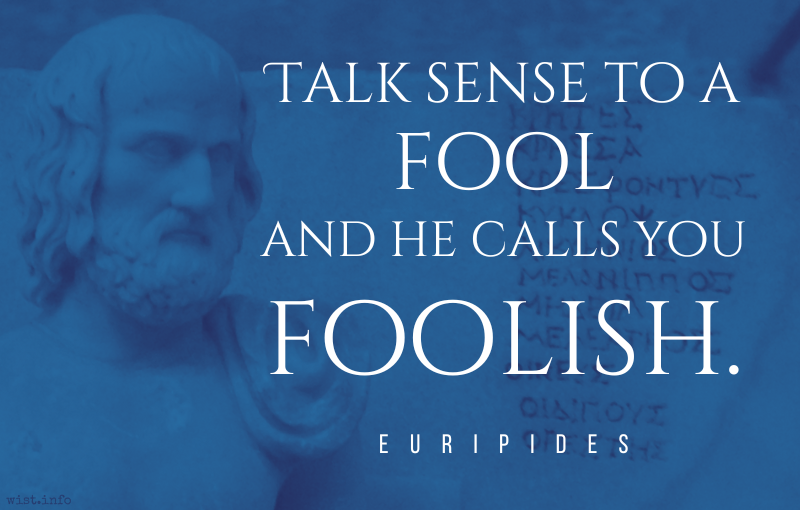
Talk sense to a fool
and he calls you foolish.[δόξει τις ἀμαθεῖ σοφὰ λέγων οὐκ εὖ φρονεῖν.]
Euripides (485?-406? BC) Greek tragic dramatist
Bacchæ [Βάκχαι], l. 480 [Dionysus/Διόνυσος] (405 BC) [tr. Arrowsmith (1960)]
(Source)
Replying to Pentheus' charge that he's being foolishly evasive.
(Source (Greek)). Other translations:He must seem devoid
Of reason, who mysterious truths unfolds
To those who lack discretion.
tr. Wodhull (1809)]One will seem to be foolish if he speaks wisely to an ignorant man.
[tr. Buckley (1850)]Who wiseliest speaks, to the fool speaks foolishness.
[tr. Milman (1865)]Boors think a wise man’s words devoid of sense.
[tr. Rogers (1872), l. 457]He were a fool, methinks, who would utter wisdom to a fool.
[tr. Coleridge (1891)]Wise answers seem but folly to a fool.
[tr. Way (1898)]Wise words being brought
To blinded eyes will seem as things of nought.
[tr. Murray (1902)]He who talks wisdom to an ignorant man will seem out of his senses.
[tr. Kirk (1970)]A wise speech sleeps in a foolish ear.
[tr. Vellacott (1973)]Talk truth to a deaf man and he
Begs your pardon.
[tr. Soyinka (1973)]Wise speech seems thoughtless to the ignorant.
[tr. Neuburg (1988)]What makes no sense is talking sense to a fool.
[tr. Cacoyannis (1982)]To the ignorant, wisdom will seem folly.
[tr. Blessington (1993)]To the ignorant man, any speaker of wisdom will seem foolish.
[tr. Esposito (1998)]Speak wisdom to a fool and he'll think you have no sense at all.
[tr. Woodruff (1999)]Wise things to the ignorant will sound like nonsense.
[tr. Gibbons/Segal (2000)]Speak wisdom to a fool and he will think you foolish.
[tr. Kovacs (2002)]Wise words spoken in the ear of a fool turn into nothingness.
[tr. Rao/Wolf (2004)]It is not wise for someone to say anything wise to the ignorant.
[tr. Theodoridis (2005)]Wise words will appear foolishness -- to an idiot.
[tr. Valerie (2005)]Yes, but, then,
a man can seem really ignorant
when speaking to a fool.
[tr. Johnston (2008)]Sense is nonsense to a fool.
[tr. Robertson (2014)]Wisdom always sounds silly to the unwise.
[tr. Pauly (2019)]Only a fool takes a warning for an insult.
[tr. Behr/Foster (2019)]One will seem to be foolish if he speaks wise things [sopha] to a senseless man.
[tr. Buckley/Sens/Nagy (2020)]
To ridicule philosophy, that is really to act the philosopher.
[Se moquer de la philosophie c’est vraiment philosophe.]
Blaise Pascal (1623–1662) French scientist and philosopher
Thoughts [Pensées], Article 7, #35 (1670)
Pascal's works are sorted and classified by translators in a variety of ways, so numbering is inconsistent. Other translations:
- "To have no time for philosophy is to be a true philosopher." [tr. Krailsheimer (2003); Series 22, #513]
- "To make light of philosophy is to be a true philosopher." [tr. Paul (1885), "Various Thoughts"; also Trotter (1958), Sec. 1, #4]
- "To ridicule philosophy is really to philosophize." [#430]
- "To ridicule philosophy is truly philosophical."
- "To mock philosophy is to philosophize truly"
- "To mock philosophy is to be a true philosopher."

The best way to drive out the devil, if he will not yield to texts of Scripture, is to jeer and flout him, for he cannot bear scorn.
Martin Luther (1483–1546) German priest, theologian, writer, religious reformer
Table Talk
(Source)
Variations:
- "The best way to drive out the devil, if he will not go for texts of Scripture, is to jeer and flout him, for he cannot bear scorn."
- The best way to expel the devil, if he will not depart for texts from Holy Scripture, is to jeer and flout him. [Source]


I suppose he’s entitled to his opinion, but I don’t suppose it very hard.
Isaac Asimov (1920–1992) Russian-American author, polymath, biochemist
“Seven Steps to Grand Master,” Nebula Awards 22 (1988) [ed. G. Zebrowski]

To avoid dissensions we should ever be on our guard, more especially with those who drive us to argue with them, with those who vex and irritate us, and who say things likely to excite us to anger. When we find ourselves in company with quarrelsome, eccentric individuals, people who openly and unblushingly say the most shocking things, difficult to put up with, we should take refuge in silence, and the wisest plan is not to reply to people whose behavior is so preposterous.
Those who insult us and treat us contumeliously are anxious for a spiteful and sarcastic reply: the silence we then affect disheartens them, and they cannot avoid showing their vexation; they do all they can to provoke us and to elicit a reply, but the best way to baffle them is to say nothing, refuse to argue with them, and to leave them to chew the cud of their hasty anger. This method of bringing down their pride disarms them, and shows them plainly that we slight and despise them.[Sed etiam ille cavendus; est, qui videri potest, quicumque inritat, quicumque incitat, quicumque exasperat, quicumque incentiva luxuriae aut libidinis suggerit. Quando ergo aliquis nobis convitiatur, lacessit, ad violentiam provocat, ad iurgium vocat: tunc silentium exerceamus, tunc muti fieri non erubescamus. Peccator est enim qui nos provocat, qui iniuriam facit et nos similes sui fieri desiderat.
Denique si taceas, si dissimules, solet dicere: Quid taces? Loquere, si audes; sed non audes, mutus es, elinguem te feci. Si ergo taceas, plus rumpitur; victum sese putat, inrisum, posthabitum atque inlusum.]Ambrose of Milan (339–397) Roman theologian, statesman, Christian prelate, saint, Doctor of the Church [Aurelius Ambrosius]
De Officiis Ministrorum [On the Duties of the Clergy], Book 1, ch. 5, sec. 17-18 (AD 386)
(Source)
(Source (Latin)). Another translation:But he also is to be shunned which is visible whosoever he be that provoketh, whosoever he be that inciteth, whosoever he be that exaspereth, whosoever he be that giveth the first breath, that suggesteth the first blast to kindle the coales to luxurie, and lustfulnesse. When some one therefore doth raile at us, doth vexe, provoke to violence, stirre up to wrath, then let us exercise silence; then let us not be ashamed to be dumbe.
For hee is a very sinfull wretch, that provoking, that offering injurie is desirous therein to make us like himselfe. To shut up the matter if thou holdest thy peace, if thou seemest not to regard whatsoever he speakes, he is wont to say, why art thou mute? speake if thou darest? but thou darest not, thou art put to a non-plus, I have made thee lose thy tongue; If therefore thou be silent he is more molested, and ready to breake with anger, because he thinkes himselfe overcome, skorned, deluded, and contemned.
[tr. Humfrey (1637)]

TRELANE: I don’t know if I like your tone. It’s most challenging. That’s what you’re doing, challenging me?
SPOCK: I object to you. I object to intellect without reason. I object to power without constructive purpose.
TRELANE: Why, Mr. Spock, you do have a saving grace, after all — you’re ill-mannered!
Paul Schneider (1923–2008) American screenwriter
Star Trek, 1×17 “The Squire of Gothos” (1967)

MAL: Well, my days of not taking you seriously are certainly coming to a middle.
Joss Whedon (b. 1964) American screenwriter, author, producer [Joseph Hill Whedon]
Firefly, 1×06 “Our Mrs. Reynolds” (2 Oct 2002)

It is one of the most difficult yet necessary things in life to learn to disdain. Disdain protects and crushes. It is a breastplate and a club. You have enemies? Why, it is the story of every man who has done a great deed or created a new idea. It is the cloud which thunders around everything, which shines. Fame must have enemies, as light must have gnats. Do not bother yourself about it; disdain. Keep your mind serene as you keep your life clear. Do not give your enemies the satisfaction of thinking that they cause you grief or pain. Be happy, be cheerful, be disdainful, be firm.
[C’est une des choses les plus difficiles et les plus nécessaires de la vie que d’apprendre à dédaigner. Le dédain protège et écrase. C’est une cuirasse et une massue. Vous avez des ennemis? Mais c’est l’histoire de tout homme qui a fait une action grande ou créé une idée neuve. C’est la nuée qui bruit autour de tout ce qui brille. Il faut que la renommée ait des ennemis comme il faut que la lumière ait des moucherons. Ne vous en inquiétez pas; dédaignez! Ayez la sérénité dans votre esprit comme vous avez la limpidité dans votre vie. Ne donnez pas à vos ennemis cette joie de penser qu’ils vous affligent et qu’ils vous troublent. Soyez content, soyez joyeux, soyez dédaigneux, soyez fort.]
Victor Hugo (1802–1885) French writer, journalist, human rights activist, politician
Diary (1845-12-07), “Villemain,” Things Seen [Choses Vues], Vol. 1 (1887)
(Source)
Dictated 1845-12-03 by Hugo to Juliette Drouet.
Sometimes attributed (in a shortened form) to Winston Churchill.
(Source (French)). Another translation:One of the hardest and most important things in life is learning to treat things with disdain. Disdain can protect, it can crush; it’s a breastplate and a club. You’ve got enemies? Why, that’s the story of every man who has done a great deed or come up with a new idea. It’s the thundercloud around everything that shines. Fame will attract enemies just as light will attract insects. Don’t fret about it. Treat it with disdain. Keep your mind calm, just as you keep your life clean. Don’t give your enemies the satisfaction of thinking that they’re hurting you and upsetting you. Be happy and cheerful and disdainful and strong.
[tr. Blackmore (2004)]

It was a cold, disapproving gaze, such as a fastidious luncher who was not fond of caterpillars might have directed at one which he had discovered in his portion of salad …
P. G. Wodehouse (1881–1975) Anglo-American humorist, playwright and lyricist [Pelham Grenville Wodehouse]
The Adventures of Sally (1922)