Men, even good men, cannot be trusted to take care of women’s interests.
Alice Henry (1857–1943) Australian suffragist, journalist, trade unionist
The Trade Union Woman, ch. 12 (1915)
(Source)
On the need for women to have the vote.
Quotations about:
battle of the sexes
Note not all quotations have been tagged, so Search may find additional quotes on this topic.
JASON: O children, what a wicked mother she was to you!
MEDEA: They died from a disease they caught from their father.
JASON: I tell you it was not my hand that destroyed them.
MEDEA: But it was your insolence, and your virgin wedding.
JASON: And just for the sake of that you chose to kill them.
MEDEA: Is love so small a pain, do you think, for a woman?[ἸΆΣΩΝ: ὦ τέκνα, μητρὸς ὡς κακῆς ἐκύρσατε.
ΜΉΔΕΙΑ: ὦ παῖδες, ὡς ὤλεσθε πατρῴᾳ νόσῳ.
ἸΆΣΩΝ: οὔτοι νιν ἡμὴ δεξιά γ᾽ ἀπώλεσεν.
ΜΉΔΕΙΑ: ἀλλ᾽ ὕβρις οἵ τε σοὶ νεοδμῆτες γάμοι.
ἸΆΣΩΝ: λέχους σφε κἠξίωσας οὕνεκα κτανεῖν;
ΜΉΔΕΙΑ: σμικρὸν γυναικὶ πῆμα τοῦτ᾽ εἶναι δοκεῖς;]Euripides (485?-406? BC) Greek tragic dramatist
Medea [Μήδεια], l. 1363ff (431 BC) [tr. Warner (1944)]
(Source)
Medea and Jason arguing over her murder of their sons. Here Medea blames Jason for deserting her (which he did) in favor of Princess Glauce (whom she has also killed).
(Source (Greek)). Other translations:JASON: How vile a Mother, O my sons, was yours!
MEDEA: How did ye perish thro' your Father's lust!
JASON: But my right hand was guiltless of their death.
MEDEA: Not so thy cruel taunts, and that new marriage.
JASON: Was my new marriage a sufficient cause
For thee to murder them?
MEDEA:Canst thou suppose
Such wrongs sit light upon the female breast?
[tr. Wodhull (1782)]JASON: My children, a bad mother have you found.
MEDEA: My sons, you perish'd through your father's folly.
JASON: Yet my right hand plung'd not the muurderous sword.
MEDEA: But thy foul wrongs, and thy new nuptials plung'd it.
JASON: And for these nupturals hast thou kill'd thy sons?
MEDEA: This to a woman deem'st thou a slight pain?
[tr. Potter (1814)]JASON: Oh sons, how foul a mother have ye had!
MEDEA: Oh boys, how died ye by your father's guilt!
JASON: Not this right hand of mine slew them, indeed.
MEDEA: No, but thine outrage and new wedding ties.
JASON: So for a bed lost thou thoughtst fit to slay them?
MEDEA: Dost thou count that a light wrong to a woman?
[tr. Webster (1868)]JASON: O my children, how vile a mother ye have found!
MEDEA: My sons, your father's feeble lust has been your ruin!
JASON: 'Twas not my hand, at any rate, that slew them.
MEDEA: No, but thy foul treatment of me, and thy new marriage.
JASON: Didst think that marriage cause enough to murder them?
MEDEA: Dost think a woman counts this a trifling injury?
[tr. Coleridge (1891)]JASON: My children, what a wicked mother have ye found!
MEDEA: My sons, how did ye perish by your father's fault!
JASON: Nevertheless my hand slew them not.
MEDEA: But injury, and thy new nuptials.
JASON: And on account of thy bed didst thou think fit to slay them?
MEDEA: Dost thou deem this a slight evil to a woman?
[tr. Buckley (1892)]JASON: O children mine, what miscreant mother had ye!
MEDEA: O sons, destroyed by your own father's lust!
JASON: Sooth, 'twas no hand of mine that murdered them.
MEDEA: Nay, but thine insolence and thy new-forged bonds.
JASON: How, claim the right for wedlock's sake to slay them!
MEDEA: A light affliction count'st thou this to woman?
[tr. Way (Loeb) (1894)]JASON: Oh, what a womb of sin my children bore!
MEDEA: Sons, did ye perish for your father's shame?
JASON: How? It was not my hand that murdered them.
MEDEA: 'Twas thy false wooings, 'twas thy trampling pride.
JASON: Thou hast said it! For thy lust of love they died.
MEDEA: And love to women a slight thing should be?
[tr. Murray (1906)]JASON: O children, what a wicked mother Fate gave you!
MEDEA: O sons, your father’s treachery cost you your lives.
JASON: It was not my hand that killed my sons.
MEDEA:No, not your hand;
But your insult to me, and your new-wedded wife.
JASON: You thought that reason enough to murder them, that I
No longer slept with you?
MEDEA:And is that injury
A slight one, do you imagine, to a woman?
[tr. Vellacott (1963)]JASON: O children, what an evil mother you encountered!
MEDEA: O children, how your father’s illness killed you!
JASON: At least it wasn’t my right hand that killed them.
MEDEA: No, your insults and your recent marriage.
JASON: Was it really for sex that you decided to kill them?
MEDEA: Do you think that this is small suffering for a woman?
[tr. Podlecki (1989)]JASON: Children, what an evil mother you got.
MEDEA: Children, how you have perished by your father's fault.
JASON: It was not my hand, you know, that killed them.
MEDEA: No: it was the outrage of your new marriage.
JASON: Did you really think it right to kill them because of a marriage?
MEDEA: Do you imagine that loss of love is a trivial grief for a woman?
[tr. Kovacs (Perseus)]JASON: Children, what an evil mother you got!
MEDEA: Children, how you have perished by your father's fault!
JASON: It was not my hand, you know, that killed them.
MEDEA: No: it was the outrage of your new marriage.
JASON: Did you really think it right to kill them because of a marriage?
MEDEA: Do you imagine that loss of this is a trivial grief for a woman?
[tr. Kovacs (Loeb) (1994)]JASON: O children, what a wicked mother you had!
MEDEA: O my sons, how your father's weakness caused your deaths!
JASON: Yet it was no right hand of mine that dealt them ruin!
MEDEA: No, it was your lustful heart and that new marriage of yours.
JASON: What? You decided to kill them because I loved another?
MEDEA: Do you think this is a minor annoyance to a woman?
[tr. Davie (1996)]JASON: My darling children! What a despicable woman gave birth to you!
MEDEA: My darling children! What a despicable man gave you such a destruction!
JASON: They were not murdered by my hand!
MEDEA: No, what killed them was the shame and your new marriage.
JASON: Was an empty bed a good enough reason for your murders?
MEDEA: Do you think an empty bed is such a small thing for a woman?
[tr. Theodoridis (2004)]JASON: Oh children, what a terrible mother you had.
MEDEA: Oh children, how you were destroyed by your father’s disease.
JASON: My right hand did not strike them.
MEDEA: But your abuse and your new marriage.
JASON: You thought the marriage bed was worth your children’s lives?
MEDEA: Do you think this a trivial wrong for a woman?
[tr. Luschnig (2007)]JASON:O my children,
you had such an evil mother!
MEDEA:O my children,
victims of your father’s evil actions!
JASON: At least it was not my hand that killed them.
MEDEA: No. It was an insult — your new marriage.
JASON: Was it right to murder them for that?
MEDEA: Do you think an insult to a woman
is something insignificant?
[tr. Johnston (2008)]JASON: My children, how kakē is the mother you have found!
MEDEA: My sons, your father’s lust has been your ruin.
JASON: It was not my right hand that slew them.
MEDEA: No, your hubris and your new marriage-bed.
JASON: Did you think that that was reason enough to murder them?
MEDEA: Do you think a woman finds that a tiny pain?
[tr. Coleridge / Ceragioli / Nagy / Hour25]JASON: Oh, children, what a wicked mother you had!
MEDEA: Oh, sons, you were ruined by your father's disease.
JASON: It wasn't my right hand that murdered them.
MEDEA: No, it was your insolence, your new-forged marriage.
JASON: You judged it right to kill them for your bed?
MEDEA: You think that pain's a small thing for a woman?
[tr. Kovacs / Kitzinger (2016)]
In the jungles of central Klatch there are, indeed, lost kingdoms of mysterious Amazonian princesses who capture male explorers for specifically masculine duties. These are indeed rigorous and exhausting and the luckless victims do not last long.*
* This is because wiring plugs, putting up shelves, sorting out the funny noises in attics, and mowing lawns can eventually reduce even the strongest constitution.

Not for the first time she reflected that there were many drawbacks to being a swordswoman, not least of which was that men didn’t take you seriously until you’d actually killed them, by which time it didn’t really matter anyway.
Here’s all you need to know about men and women: Women are crazy and men are stupid. And the main reason women are crazy is that men are stupid. It’s not the only reason, but it’s a big one. And by the way, if you don’t think men are stupid, check the newspaper. […] And if you don’t think women are crazy, ask a man. That’s the one thing men aren’t stupid about: they know for sure, way deep down in their hearts, that women are straight-out fucking nuts.
George Carlin (1937–2008) American comedian
Book (2004), When Will Jesus Bring the Pork Chops?, “Guys & Dolls: Part 1”
(Source)

One good Husband is worth two good Wives; for the scarcer things are the more they’re valued.
Benjamin Franklin (1706–1790) American statesman, scientist, philosopher, aphorist
Poor Richard (1742 ed.)
(Source)
Men have always detested women’s gossip because they suspect the truth: their measurements are being taken and compared.

A lot of men got upset at the feminist movement because they had all the toys and we wanted some.
Judith Martin (b. 1938) American author, journalist, etiquette expert [a.k.a. Miss Manners]
Interview (1997-03), “She Says: Miss Manners,” by Sandy Fernández, Ms magazine, Vol. 7, No. 5 (1997-03/04)
(Source)

AGAMEMNON:But women?
Women overpower men?HECUBA:There is power
in numbers, and cunning makes us strong.ἈΓΑΜΈΜΝΩΝ: καὶ πῶς γυναιξὶν ἀρσένων ἔσται κράτος;
ἙΚΆΒΗ: δεινὸν τὸ πλῆθος σὺν δόλῳ τε δύσμαχον.
Euripides (485?-406? BC) Greek tragic dramatist
Hecuba [Hekabe; Ἑκάβη], l. 883ff (c. 424 BC) [tr. Arrowsmith (1958)]
(Source)
Hecuba telling Agamemnon that she will rely on her fellow captive Trojan women to help exact her revenge on Polymestor.
(Source (Greek)). Alternate translations:AGAMΕΜΝΟΝ. How shall weak women; over men prevail?
HECUBA. Numbers are strong; add stratagem, resistless.
[tr. Potter (1781)]AGAMEMNON:How can the female sex
O'er men obtain a conquest?
HECUBA:Numbers strike
A foe with terror, and the wiles of women
Are hard to be withstood.
[tr. Wodhull (1809)]AGAMEMNON: And how shall the victory over men be to women?
HECUBA: Numbers are powerful, with stratagem invincible.
[tr. Edwards (1826)]AGAMEMNON: How? -- women gain the mastery over men?
HECUBA: Mighty are numbers: joined with craft, resistless.
[tr. Way (Loeb) (1894)]AGAMEMNON: How are women to master men?
HECUBA: Numbers are a fearful thing, and joined to craft a desperate foe.
[tr. Coleridge (1938)]AGAMEMNON: How can women win against men?
HECUBA: Who can stand against a tribe
A wild tribe of wise women?
[tr. McGuinness (2004)]AGAMEMNON: How can you women overpower a man?
HECUBA: Enough of them would scare you soon enough and with cunning they're a force hard to resist.
[tr. Harrison (2005)]AGAMEMNON: But how will the women be able to overcome the strength of men?
HEKABE: Numbers, when joined with treachery, can cause great terror.
[tr. Theodoridis (2007)]AGAMEMNON:But how?
You are women. How will women defeat men?
HECUBA: There is unnerving strength in numbers, especially when
you add deceit.
[tr. Karden/Street (2011)]
STEVE: (to Susan) It is not scientifically possible for a man to know what a woman wants. And that’s not fair, because you always know what we want.
PATRICK: We always have the decency to only want one thing.
STEVE: And do you ever thank us for making it so simple?
PATRICK: Never!
Steven Moffat (b. 1961) Scottish television writer, producer
Coupling, 03×02 “Faithless” (2002-09-30)
(Source)
(Source (Video) at 24:03; dialog verified)

MEDEA: Of all creatures that live and understand,
we women suffer most.
In the first place we must, for a vast sum,
buy a husband; what’s worse,
with him our bodies get a master.
And here’s what’s most at stake:
Did we get a man who’s good or bad?ΜΉΔΕΙΑ: πάντων δ᾽ ὅσ᾽ ἔστ᾽ ἔμψυχα καὶ γνώμην ἔχει
γυναῖκές ἐσμεν ἀθλιώτατον φυτόν:
ἃς πρῶτα μὲν δεῖ χρημάτων ὑπερβολῇ
πόσιν πρίασθαι, δεσπότην τε σώματος
[λαβεῖν: κακοῦ γὰρ τοῦτ᾽ ἔτ᾽ ἄλγιον κακόν].
κἀν τῷδ᾽ ἀγὼν μέγιστος, ἢ κακὸν λαβεῖν
ἢ χρηστόν.Euripides (485?-406? BC) Greek tragic dramatist
Medea [Μήδεια], l. 230ff (431 BC) [tr. Kovacs / Kitzinger (2016)]
(Source)
Speaking to the women of Corinth (the Chorus).
(Source (Greek)). Other translations:But sure among all those
Who have with breath and reason been endued.
We women are the most unhappy race,
First with abundant gold are we constrain'd
To buy a husband, and in him receive
A haughty master. Still doth there remain
One mischief than this mischief yet more grievous.
The hazard whether we. procure a mate
Worthless or virtuous.
[tr. Wodhull (1782)]Thus is it, of all beings, that have life
And sense, we women are most wretched; first
With all our dearest treasures we must buy
A husband, and in him receive a lord:
And hardship this: a greater hardship yet
Awaits us; here's the question, if this lord
Prove gentle, or a tyrant.
[tr. Potter (1814)]Aye, of all living and of reasoning things
Are woman the most miserable race:
Who first needs buy a husband at great price,
To take him then for owner of our lives:
For this ill is more keen than common ills.
And of essays most perilous is this,
Whether one good or evil do we take.
[tr. Webster (1868)]Of all things that have life and sense we women are the most hapless creatures; first must we buy a husband at an exorbitant price, and o'er ourselves a tyrant set which is an evil worse than the first; and herein lies the most important issue, whether our choice be good or bad.
[tr. Coleridge (1891)]But of all things as many as have life and intellect, we women are the most wretched race. Who indeed first must purchase a husband with excess of money, and receive him a lord of our persons; for this is a still greater ill than the former. And in this is the greatest risk, whether we receive a bad one or a good one.
[tr. Buckley (1892)]Surely, of creatures that have life and wit,
We women are of all things wretchedest,
Who, first, must needs, as buys the highest bidder,
Thus buy a husband, and our body's master
So win—for deeper depth of ill is this.
Nay, risk is dire herein, -- or shall we gain
An evil lord or good?
[tr. Way (Loeb) (1894)]Oh,
Of all things upon earth that bleed and grow,
A herb most bruised is woman. We must pay
Our store of gold, hoarded for that one day,
To buy us some man's love; and lo, they bring
A master of our flesh! There comes the sting
Of the whole shame. And then the jeopardy,
For good or ill, what shall that master be.
[tr. Murray (1906)]We women are the most unfortunate creatures.
Firstly, with an excess of wealth it is required
For us to buy a husband and take for our bodies
A master; for not to take one is even worse.
And now the question is serious whether we take
A good or bad one.
[tr. Warner (1944)]Surely, of all creatures that have life and will, we women
Are the most wretched. When, for an extravagant sum,
We have bought a husband, we must then accept him as
Possessor of our body. This is to aggravate
Wrong with worse wrong. Then the great question: will the man
We get be bad or good?
[tr. Vellacott (1963)]Of all creatures that live and have understanding
We women are the wretchedest breed alive;
First, we must use excessive amounts of cash
To buy our husbands, and what we get are masters
Of our bodies. This is the worst pain of all.
In fact, this is no small struggle, whether he’ll be
A good or bad one.
[tr. Podlecki (1989)]Of all creatures that have breath and sensation, we women are the most unfortunate. First at an exorbitant price we must buy a husband and master of our bodies. [This misfortune is more painful than misfortune.] And the outcome of our life's striving hangs on this, whether we take a bad or a good husband.
[tr. Kovacs (1994)]Of all creatures that have life and reason we women are the most miserable of specimens! In the first place, at great expense we must buy a husband, taking a master to play tyrant with our bodies (this is an injustice that crowns the other one). And here lies the crucial issue for us, whether we get a good man or a bad.
[tr. Davie (1996)]Of all the living things, of all those things that have a soul and a sense, we, yes we, the women, are the most pathetic!
Imagine!
We need to spend a fortune to buy us a man who -- what will he do? He will become the master of our bodies! And, it’s obvious, that this dangerous thing we do, becomes even more dangerous when we don’t find the right husband. Is he a good husband? Or is he a bad one? By the time you find that out it’s already too late.
[tr. Theodoridis (2004)]Of all creatures that have life and reason
we women are the sorriest lot:
first we must at a great expenditure of money
buy a husband and even take on a master
over our body: this evil is more galling than the first.
Here is the most challenging contest, whether we will get a bad man
or a good one.
[tr. Luschnig (2007)]Of all things with life and understanding,
we women are the most unfortunate.
First, we need a husband, someone we get
for an excessive price. He then becomes
the ruler of our bodies. And this misfortune
adds still more troubles to the grief we have.
Then comes the crucial struggle: this husband
we have selected, is he good or bad?
[tr. Johnston (2008)]Of every creature that’s alive and capable of thought
We women are most wretched.
First we must buy a husband with a massive dowry,
then subject our bodies to his mastery --
and that's the worse of the two evils.
In this the stakes are very high -- whether we get
a bad man or a good one.
[tr. Ewans (2022)]Of all things that have psūkhē and intelligence, we women are the most wretched creatures: first we must buy a husband at too high a price, and then acquire a master of our bodies—an evil thing [kakon] yet more evil [kakon].But in this lies the most important ordeal [agōn], whether our choice is good or bad [kakon].
[tr. Coleridge / Ceragioli / Nagy / Hour25]Of all things that have life and sense, we women are most wretched. For we are compelled to buy with gold a husband who is also -- worst of all -- the master of our person. And on his character, good or bad, our whole fate rests.
[Source]
Then let no woman hence in man believe,
Or think a lover speaks but to deceive.
He, while ungratified desire is high,
Shrinks from no oath, no promise will deny;
Soon as his lust is satiate with its prize,
He spurns his vows and perjury’s curse defies.
[Nunc iam nulla viro iuranti femina credat,
nulla viri speret sermones esse fideles;
quis dum aliquid cupiens animus praegestit apisci,
nil metuunt iurare, nihil promittere parcunt:
sed simul ac cupidae mentis satiata libido est,
dicta nihil metuere, nihil periuria curant.]Catullus (c. 84 BC – c. 54 BC) Latin poet [Gaius Valerius Catullus]
Carmina # 64 “The Nuptuals of Peleus and Thetis,” ll. 144-149 [tr. Lamb (1821)]
(Source)
Ariadne lamenting Theseus' faithlessness.
(Source (Latin)). Other translations:Hear this, and wisdom learn, ye witless fair!
Ne'er let false man with empty oaths deceive,
No protestations of the sex believe!
Is there a wish their ardent souls would gain;
they swear, they promise, and at length obtain;
The wish obtain'd, they fearless break their word,
Nor plighted faith, nor solemn vows regard.
[tr. Nott (1795), # 61; ll. 173ff.]Henceforth let woman; never trust the oaths that man shall make,
Nor ever more his honeyed speech within her bosom take!
While yet the fire of his desire is hot within his breast,
What will he not to woman swear, to heav'n what not protest?
But let her in an evil hour resign her maiden trust,
And yield the blossom of her youth to sate his selfish lust,
Then what recks he of lavish oath, or vow, or whisper'd pray'r?
He triumphs in his perjuries, and spurns at her despair.
[tr. T. Martin (1861)]Henceforth let never woman trust an oath than man shall swear,
Nor count the tender speeches true his lying lips declare:
For when with lusting soul he yearns some object to enjoy,
No oath, no promise then he deems too sacred to employ;
But when his soul is sated, and his burning passion dies,
He fears to break no plighted vows, cares nought for perjuries.
[tr. Cranstoun (1867)]Let not a woman trust, since that first treason, a lover's
Desperate oath, none hope true lover's promise is earnest.
They, while fondly to win their amorous humour essayeth,
Fear no covetous oath, all false free promises heed not;
They if once lewd pleasure attain unruly possession,
Lo they fear not promise, of oath or perjury reck not.
[tr. Ellis (1871)]Now, let woman no more trust her to man when he sweareth,
Ne'er let her hope to find or truth or faith in his pleadings,
Who when lustful thought forelooks to somewhat attaining,
Never an oath they fear, shall spare no promise to promise.
Yet no sooner they sate all lewdness and lecherous fancy,
Nothing remember of words and reck they naught of fore-swearing.
[tr. Burton (1893)]Now, now, let no woman give credence to man's oath, let none hope for faithful vows from mankind; for while their eager desire strives for its end, nothing fear they to swear, nothing of promises forbear they: but instantly their lusting thoughts are satiate with lewdness, nothing of speech they remember, nothing of perjuries care.
[tr. Smithers (1894)]Henceforth let no woman believe a man's oath, let none believe that a man's speeches can be trustworthy. They, while their mind desires something and longs eagerly to gain it, nothing fear to swear, nothing spare to promise; but as soon as the lust of their greedy mind is satisfied, they fear not then their words, they heed not their perjuries.
[tr. Warre Cornish (1904)]Hereafter let; no woman trust man's promises, or hope for faithful words; for when they wish to attain their desires, there is nothing they will not swear, no promise do they scruple to make: but once their desires have been satisfied, they fear no broken words and care nothing for their perjuries.
[tr. Stuttaford (1912)]Never let maid believe a lover's oath;
Nor hope a man be faithful to his troth;
Long as men's hearts are spurred by keen desire,
No oath they shrink from and no promise spare;
Soon as their sated lust begins to tire
No oath they heed and nought for falsehood care.
[tr. Symons-Jeune (1923)]Henceforth, no woman trust the oath of man,
No woman dream the word of man is true:
They, whensoe'er they lust for anything,
Swear every oath and every promise make,
But, when their eager lust is satisfied,
Nor reck of oaths nor promises regard.
[tr. MacNaghten (1925)]Henceforth let never listening maid believe
Protesting man! When their false hearts conceive
The selfish wish, to all but pleasure blind,
No words they spare, no oaths unuttered leave.
But when possession cloys their pampered mind,
No care have they for oaths, no words their honour bind.
[tr. Wright (1926)]From this hour
may no woman believe what men say, for men (minds set upon a single end) will promise everything,
but once the shrewd mind satisfies its passion, it plunges forward (the broken promise merely words that trail behind tall bravery).
[tr. Gregory (1931)]Let no woman ever believe any oath that a man swears,
or ever expect him to keep faith with his fine speeches!
When they want something, when they are anxious to get it,
they take oaths without fear, and pour out promises freely;
but just as soon as their hot desire is sated,
none of their lies & deceptions ever disturb them.
[tr. C. Martin (1979)]From now on let no woman believe a man's sworn promises.
From now on let no woman hope a man's talk is true.
So long as their desiring minds are eager to get something,
they swear to anything. No promise do they spare.
But as soon as the lust in their desirous intent is gratified,
they remember nothing they said, they care nothing for their lies.
[tr. Banks (1997)]Now, no woman should believe a man’s pledges,
or believe there’s any truth in a man’s words:
when their minds are intent on their desire,
they have no fear of oaths, don’t spare their promises:
but as soon as the lust of their eager mind is slaked
they fear no words, they care nothing for perjury.
[tr. Kline (2001)]Henceforth let no woman trust a man's sworn promise,
or hope that he'll ever be true to his given word,
for as long as his lustful heart is bent on possession
he'll shrink from no oath, stop short at no promises,
but the moment hte urge of his ardent mind is sated
he forgets all he's said, breaks oaths without a tremor.
[tr. Green (2005)]Now already let no woman trust a man swearing,
let none hope that the speeches of man are faithful,
for whom while the desiring mind is eager to grasp something,
They fear to swear nothing, they spare to promise nothing.
But as soon as the lust of the desiring mind has been satisfied,
They feared the words as nothing, they care for the false oaths not at all.
[tr. Wikisource (2018)]

A man always blames the woman who fools him. In the same way he blames the door he walks into in the dark.
H. L. Mencken (1880–1956) American writer and journalist [Henry Lewis Mencken]
A Little Book in C Major, ch. 6, § 1 (1916)
(Source)
Repeated in A Book of Burlesques, ch. 12 "The Old Subject," § 6 (1924)] and Chrestomathy, ch. 30 "Sententiae" (1949).
BENEDICK: What, my dear Lady Disdain! Are you yet living?
BEATRICE: Is it possible disdain should die while she hath such meet food to feed it as Signior Benedick? Courtesy itself must convert to disdain, if you come in her presence.
William Shakespeare (1564–1616) English dramatist and poet
Much Ado About Nothing, Act 1, sc. 1, l. 116ff (1.1.116-121) (1598)
(Source)

Men are convinced that women have it easy, but they haven’t convinced many women.
Mignon McLaughlin (1913–1983) American journalist and author
The Second Neurotic’s Notebook, ch. 3 (1966)
(Source)

It is always incomprehensible to a man that a woman should ever refuse an offer of marriage. A man always imagines a woman to be ready for any body who asks her.
I cannot think well of a man who sports with any woman’s feelings; and there may often be a great deal more suffered than a stander-by can judge of.
“Educate women like men,” says Rousseau, “and the more they resemble our sex the less power will they have over us.” This is the very point I aim at. I do not wish them to have power over men; but over themselves.
Mary Wollstonecraft (1759–1797) English social philosopher, feminist, writer
A Vindication of the Rights of Woman, ch. 4 (1792)
(Source)
Usually elided to "I do not wish women to have power over men; but over themselves."

The commitment problem has caused many women to mistakenly conclude that men, as a group, have the emotional maturity of hamsters. This is not the case. A hamster is much more capable of making a lasting commitment to a woman, especially if she gives it those little food pellets. Whereas a guy, in a relationship, will consume the pellets of companionship, and he will run on the exercise wheel of lust, but as soon as he senses the door of commitment is about to close and trap him in the wire cage of true intimacy, he’ll squirm out, scamper across the kitchen floor of uncertainty, and hide under the refrigerator of nonreadiness.
Dave Barry (b. 1947) American humorist, author, columnist
The Greatest Invention in the History of Mankind is Beer (2001)
(Source)

Men weren’t really the enemy — they were fellow victims suffering from an outmoded masculine mystique that made them feel unnecessarily inadequate when there were no bears to kill.
Betty Friedan (1921–2006) American writer, feminist, activist
The Feminine Mystique, Epilogue (1974 ed.)
(Source)
Sometimes paraphrased: "Man is not the enemy here, but the fellow victim."

Agatha looked up. “I guess. I just wonder how many other girls have to worry about whether or not it’s smart to really trust their … you know, the guys they –”
Lady Vitriox crossed her arms. “All of them,” she said flatly.
“But mine has an army!”
The old woman shook her head. “They all do, my Lady. It consists of other men.”
Phil Foglio (b. 1956) American writer, cartoonist
Agatha H. and the Siege of Mechanicsburg (2020) [with Kaja Foglio]
(Source)

If Nature had arranged that husbands and wives should have children alternately, there would never be more than three in a family.
Laurence Housman (1865–1959) English playwright, writer, illustrator
(Attributed)

Men who don’t like girls with brains don’t like girls.
Mignon McLaughlin (1913–1983) American journalist and author
The Second Neurotic’s Notebook, ch. 3 (1966)
(Source)
Originally published in McLaughlin's "The Neurotic's Notebook" column in The Atlantic, some time in 1965.
Man forgives woman anything save the wit to outwit him.
Minna Antrim (1861–1950) American epigrammatist, writer
Naked Truth and Veiled Allusions (1901)
There is, in fact, no incompatibility between the principles of feminism and the possibility that men and women are not psychologically identical. To repeat: equality is not the empirical claim that all groups of humans are interchangeable; it is the moral principle that individuals should not be judged or constrained by the average properties of their group. In the case of gender, the barely defeated Equal Rights Amendment put it succinctly: “Equality of Rights under the law shall not be denied or abridged by the United States or any state on account of sex.” If we recognize this principle, no one has to spin myths about the indistinguishability of the sexes to justify equality. Nor should anyone invoke sex differences to justify discriminatory policies or to hector women into doing what they don’t want to do.
Steven Pinker (b. 1954) Canadian-American cognitive psychologist, linguist, author
The Blank Slate, Part 5, ch. 18 (2002)
(Source)

BAIT, n. A preparation that renders the hook more palatable. The best kind is beauty.
Ambrose Bierce (1842–1914?) American writer and journalist
“Bait,” The Cynic’s Word Book (1906)
(Source)
Included in The Devil's Dictionary (1911). Originally published in the "Devil's Dictionary" column in the San Francisco Wasp (1881-04-23).

The allurement that women hold out to men is precisely the allurement that Cape Hatteras holds out to sailors: they are enormously dangerous and hence enormously fascinating.
H. L. Mencken (1880–1956) American writer and journalist [Henry Lewis Mencken]
“The Incomparable Buzz-Saw,” The Smart Set (May 1919)
(Source)
We cannot do without it [marriage] yet we go and besmirch it, with the result that it is like birds and cages: the ones outside despair of getting in: the ones inside only care to get out.
[Nous ne nous en pouvons passer, & l’allons avilissant. Il en advient ce qui se voit aux cages, les oiseaux qui en sont dehors, desesperent d’y entrer ; & d’un pareil soin en sortir, ceux qui sont au dedans]
Michel de Montaigne (1533–1592) French essayist
Essays, Book 3, ch. 5 (3.5), “Of Some Verses of Virgil [Sur des vers de Virgile]” (1586) [tr. Screech (1987)]
(Source)
First published in the 1588 ed.
(Source (French)). Other translations:We cannot be without it, and yet we disgrace and vilifie the same. It may be compared to a cage, the birdes without dispaire to get in, and those within dispaire to get out.
[tr. Florio (1603)]We cannot live without it, and yet we do nothing but decry it. It happens, as with Cages, the Birds without despair to get in, and those within despair of getting out.
[tr. Cotton (1686); Cotton/Hazlitt (1877)]We can not do without it, and yet we express contempt for it. The same thing happens that we see about cages: the birds outside are in despair at not getting in, and those within feel equal discomfort at not getting out.
[tr. Ives (1925)]We cannot do without it, and yet we go about’ debasing it. The result is what is observed about cages: the birds outside despair of getting in, and those inside are equally anxious to get out.
[tr. Frame (1943)]

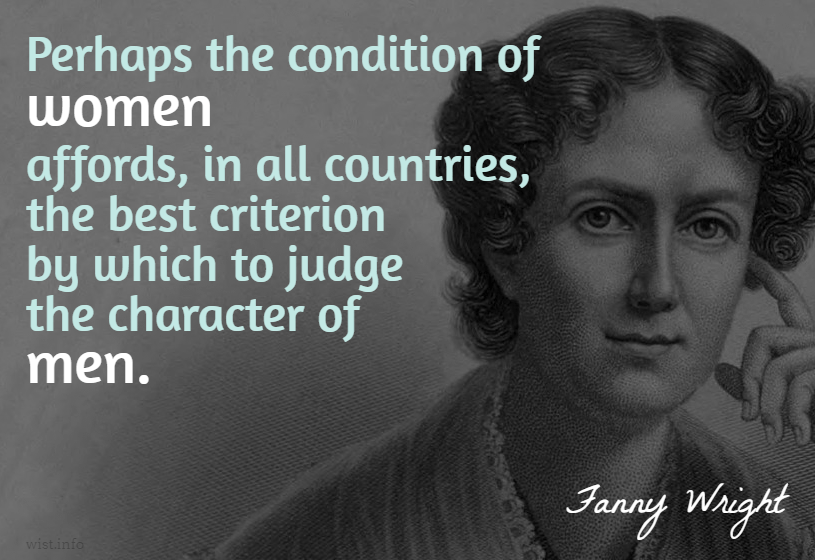
Perhaps the condition of women affords, in all countries, the best criterion by which to judge the character of men.
Frances "Fanny" Wright (1795–1852) Scottish-American writer, lecturer, social reformer
Views of Society and Manners in America, Letter 23, Mar. 1820 (1821)
(Source)
Women are supposed to be very calm generally; but women feel just as men feel; they need exercise for their faculties and a field for their efforts as much as their brothers do; they suffer from too rigid a restraint, too absolute a stagnation, precisely as men would suffer; and it is narrow-minded in their more privileged fellow-creatures to say that they ought to confine themselves to making puddings and knitting stockings, to playing on the piano and embroidering bags. It is thoughtless to condemn them, or laugh at them, if they seek to do more or learn more than custom has pronounced necessary for their sex.
Charlotte Brontë (1816–1855) British novelist [pseud. Currer Bell]
Jane Eyre, ch. 12 [Jane] (1847)
(Source)

“The female mind is certainly a devious one, my lord.”
Vetinari looked at his secretary in surprise. “Well, of course it is. It has to deal with the male one.”Terry Pratchett (1948–2015) English author
Discworld No. 37, Unseen Academicals (2009)
That your Sex are Naturally Tyrannical is a Truth so thoroughly established as to admit of no dispute, but such of you as wish to be happy willingly give up the harsh title of Master for the more tender and endearing one of Friend. Why then, not put it out of the power of the vicious and the Lawless to use us with cruelty and indignity with impunity. Men of Sense in all Ages abhor those customs which treat us only as the vassals of your Sex. Regard us then as Beings placed by providence under your protection and in immitation of the Supreem Being make use of that power only for our happiness.
Abigail Adams (1744–1818) American correspondent, First Lady (1797–1801)
Letter (1776-03-31) to John Adams
(Source)
I long to hear that you have declared an independancy — and by the way in the new Code of Laws which I suppose it will be necessary for you to make I desire you would Remember the Ladies, and be more generous and favourable to them than your ancestors. Do not put such unlimited power into the hands of the Husbands. Remember all Men would be tyrants if they could. If perticuliar care and attention is not paid to the Laidies we are determined to foment a Rebelion, and will not hold ourselves bound by any Laws in which we have no voice, or Representation.
Abigail Adams (1744–1818) American correspondent, First Lady (1797–1801)
Letter (1776-03-31) to John Adams
(Source)
She continues here.
John Adams' response to her was more than a bit flippant, though he elsewhere had more serious thoughts about the role of women in civil authority.
Men know that women are an over-match for them, and therefore they choose the weakest or most ignorant. If they did not think so, they never could be afraid of women knowing as much as themselves.
Samuel Johnson (1709–1784) English writer, lexicographer, critic
Comment
In James Boswell, Tour to the Hebrides (1785).
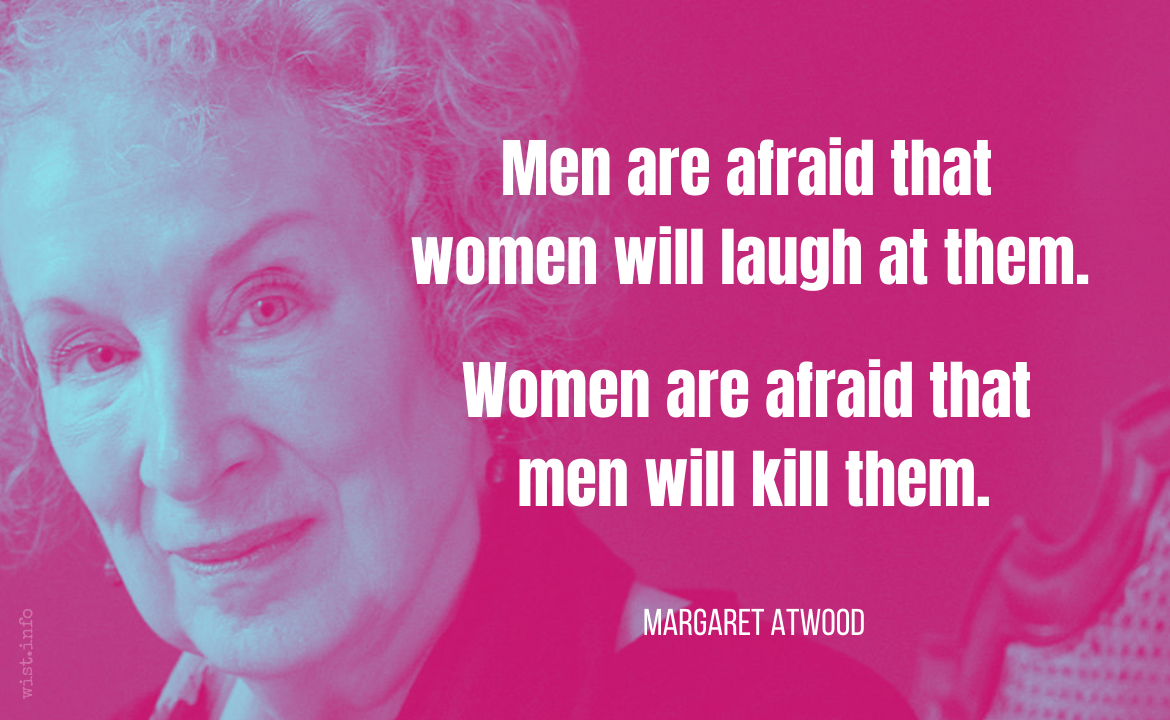
“Why do men feel threatened by women?” I asked a male friend of mine. (I love that wonderful rhetorical device, “a male friend of mine.” It’s often used by female journalists when they want to say something particularly bitchy but don’t want to be held responsible for it themselves. It also lets people know that you do have male friends, that you aren’t one of those fire-breathing mythical monsters, The Radical Feminists, who walk around with little pairs of scissors and kick men in the shins if they open doors for you. “A male friend of mine” also gives — let us admit it — a certain weight to the opinions expressed.) So this male friend of mine, who does by the way exist, conveniently entered into the following dialogue. “I mean,” I said, “men are bigger, most of the time, they can run faster, strangle better, and they have on the average a lot more money and power.” “They’re afraid women will laugh at them,” he said. “Undercut their world view.” Then I asked some women students in a quickie poetry seminar I was giving, “Why do women feel threatened by men?” “They’re afraid of being killed,” they said.
Margaret Atwood (b. 1939) Canadian writer, literary critic, environmental activist
“Writing the Male Character,” Hagey Lecture, U. of Waterloo (9 Feb 1982)
(Source)
Published in a revised version as "Writing the Male Character," Second Words: Selected Critical Prose, 1960-1982 (1983).
Usually paraphrased, "Men are afraid that women will laugh at them. Women are afraid that men will kill them."

POLYMESTOR: What need
For talk? The sum of all the infamies
The tongues of men, past, present, and to come,
Ascribe to woman, I’ll endorse, and say
There’s no such monster bred on land or sea;
And none has dealings with their kind, but know it.ΠΟΛΥΜΉΣΤΩΡ: [ὡς δὲ μὴ μακροὺς τείνω λόγους,
εἴ τις γυναῖκας τῶν πρὶν εἴρηκεν κακῶς
ἢ νῦν λέγων ἔστιν τις ἢ μέλλει λέγειν,
1180ἅπαντα ταῦτα συντεμὼν ἐγὼ φράσω:
γένος γὰρ οὔτε πόντος οὔτε γῆ τρέφει
τοιόνδ᾽: ὁ δ᾽ αἰεὶ ξυντυχὼν ἐπίσταται.]Euripides (485?-406? BC) Greek tragic dramatist
Hecuba [Hekabe; Ἑκάβη], l. 1177ff (c. 424 BC) [tr. Sheppard (1924)]
(Source)
King Polymestor -- who murdered Priam and Hecuba's youngest son, Polydorus, with him for safekeeping, in order to steal the Trojan treasury also entrusted to him -- complaining to Agamemnon about how Hecuba and the Trojan Women, out of revenge, killed his sons in turn and blinded him.
(Source (Greek)). Other translations:To spare a long harangue.
The whole of what 'gainst woman hath been said
By those of antient times, is saying now.
Or shall be said hereafter, in few words
Will I comprise; nor ocean's waves, nor earth,
Nurture so vile a race, as he who most
Hath with the sex conversed, but knows too well.
[tr. Wodhull (1809)]But that I may not extend my speech to a greater length, if any one of those of ancient times hath reviled women, or if any one doth now, or shall hereafter revile them, I will comprise the whole when I say, that such a race neither doth the sea nor the earth produce, but he who is always with them knows it best.
[tr. Edwards (1826)]To be brief,
If any in past times with severe taunts
Have censured women, if now any vents
His obloquies, or shall hereafter vent,
In one brief sentence I comprise the whole,
It is a breed, not all th’ extended earth,
Nor the sea’s ample depths produce the like;
This truth he feels the most who knows them best.
[ed. Ramage (1864)]Wherefore needeth many words?
Whoso ere now hath spoken ill of women,
Or speaketh now, or shall hereafter speak,
All this in one word will I close and say: --
Nor sea nor land doth nurture such a breed:
He knoweth, who hath converse with them most.
[tr. Way (Loeb) (1894)]But to spare you a lengthy speech, if any of the men of former times have spoken ill of women, if any does so now, or shall do so hereafter, I will say all this in one short sentence; for neither land or sea produces such a race, as whoever has had to do with them knows.
[tr. Coleridge (1938)]On behalf of all those dead
who learned their hatred of women long ago,
for those who hate them now, for those unborn
who shall live to hate them yet, I now declare
my firm conviction:
neither earth nor ocean
produces a creature as savage and monstrous
as woman.
This is my experience.
I know that this is true.
[tr. Arrowsmith (1958)]I'll say no more than this:
The old saying is true now
As ever was and will be.
They are a breed apart
On earth and on sea.
Any man in a woman's power
He knows that in his bones.
[tr. McGuinness (2004)]Not to go on too long, if any man in the past, the present or the future said bad things about women, let me top them all and say: sea or land breeds nothing worse. Even a brief encounter proves it true.
[tr. Harrison (2005)]But let me spare you the many words: If any of the men from olden days or if any of them now, or in the future, will utter ill words against women, let me put all those words in one short sentence: Neither land nor sea produces such a race and whoever had any dealings with them knows this very well.
[tr. Theodoridis (2007)]Let me tell you, if anyone in the past has spoken
ill of women, or speaks so now or will speak so
in the future, I’ll sum it up for him: Neither sea
nor land has ever produced a more monstrous
creature than woman. I say this for a fact.
[tr. Karden/Street (2011)]
Man is a creature who lives not upon bread alone, but principally by catchwords; and the little rift between the sexes is astonishingly widened by simply teaching one set of catchwords to the girls and another to the boys.
Robert Louis Stevenson (1850–1894) Scottish essayist, novelist, poet
Essay (1881), “Virginibus Puerisque, Part 2”
(Source)
Playing off of the Biblical passages Luke 4:4 and Matthew 4:4, in turn from Deuteronomy 8:3.
First published in Virginibus Puerisque and Other Papers, ch. 1, part 2 (1881)