

“But honestly, you know — horrible things do happen, thanks to the imperfection of human nature, but you can forgive the means if the end is a rejuvenated nation that –”
“I can do nothing of the kind! I can never forgive evil and lying and cruel means, and still less can I forgive fanatics that use that for an excuse! [… A] country that tolerates evil means — evil manners, standards of ethics — for a generation, will be so poisoned that it never will have any good end.”Sinclair Lewis (1885–1951) American novelist, playwright
It Can’t Happen Here, ch. 24 [Phillip and Doremus] (1935)
(Source)
Quotations about:
self-justification
Note not all quotations have been tagged, so Search may find additional quotes on this topic.
Knaves imagine nothing can be done without knavery.
Thomas Fuller (1654–1734) English physician, preacher, aphorist, writer
Gnomologia: Adages and Proverbs (compiler), # 3135 (1732)
(Source)

It is understandable that we should look for others to side with us when we have a just grievance and crave to retaliate against those who wronged us. The puzzling thing is that when our hatred does not spring from a visible grievance and does not seem justified, the desire for allies becomes more pressing. It is chiefly the unreasonable hatreds that drive us to merge with those who hate as we do, and it is this kind of hatred that serves as one of the most effective cementing agents.
Eric Hoffer (1902–1983) American writer, philosopher, longshoreman
True Believer: Thoughts on the Nature of Mass Movements, Part 3, ch. 14, § 68 (3.14.68) (1951)
(Source)

EXPEDIENCY, n. The father of all virtues.
Ambrose Bierce (1842–1914?) American writer and journalist
“Expediency,” “Devil’s Dictionary” column, San Francisco Wasp (1884-06-07)
(Source)
Not collected in later books.

JASON: O children, what a wicked mother she was to you!
MEDEA: They died from a disease they caught from their father.
JASON: I tell you it was not my hand that destroyed them.
MEDEA: But it was your insolence, and your virgin wedding.
JASON: And just for the sake of that you chose to kill them.
MEDEA: Is love so small a pain, do you think, for a woman?[ἸΆΣΩΝ: ὦ τέκνα, μητρὸς ὡς κακῆς ἐκύρσατε.
ΜΉΔΕΙΑ: ὦ παῖδες, ὡς ὤλεσθε πατρῴᾳ νόσῳ.
ἸΆΣΩΝ: οὔτοι νιν ἡμὴ δεξιά γ᾽ ἀπώλεσεν.
ΜΉΔΕΙΑ: ἀλλ᾽ ὕβρις οἵ τε σοὶ νεοδμῆτες γάμοι.
ἸΆΣΩΝ: λέχους σφε κἠξίωσας οὕνεκα κτανεῖν;
ΜΉΔΕΙΑ: σμικρὸν γυναικὶ πῆμα τοῦτ᾽ εἶναι δοκεῖς;]Euripides (485?-406? BC) Greek tragic dramatist
Medea [Μήδεια], l. 1363ff (431 BC) [tr. Warner (1944)]
(Source)
Medea and Jason arguing over her murder of their sons. Here Medea blames Jason for deserting her (which he did) in favor of Princess Glauce (whom she has also killed).
(Source (Greek)). Other translations:JASON: How vile a Mother, O my sons, was yours!
MEDEA: How did ye perish thro' your Father's lust!
JASON: But my right hand was guiltless of their death.
MEDEA: Not so thy cruel taunts, and that new marriage.
JASON: Was my new marriage a sufficient cause
For thee to murder them?
MEDEA:Canst thou suppose
Such wrongs sit light upon the female breast?
[tr. Wodhull (1782)]JASON: My children, a bad mother have you found.
MEDEA: My sons, you perish'd through your father's folly.
JASON: Yet my right hand plung'd not the muurderous sword.
MEDEA: But thy foul wrongs, and thy new nuptials plung'd it.
JASON: And for these nupturals hast thou kill'd thy sons?
MEDEA: This to a woman deem'st thou a slight pain?
[tr. Potter (1814)]JASON: Oh sons, how foul a mother have ye had!
MEDEA: Oh boys, how died ye by your father's guilt!
JASON: Not this right hand of mine slew them, indeed.
MEDEA: No, but thine outrage and new wedding ties.
JASON: So for a bed lost thou thoughtst fit to slay them?
MEDEA: Dost thou count that a light wrong to a woman?
[tr. Webster (1868)]JASON: O my children, how vile a mother ye have found!
MEDEA: My sons, your father's feeble lust has been your ruin!
JASON: 'Twas not my hand, at any rate, that slew them.
MEDEA: No, but thy foul treatment of me, and thy new marriage.
JASON: Didst think that marriage cause enough to murder them?
MEDEA: Dost think a woman counts this a trifling injury?
[tr. Coleridge (1891)]JASON: My children, what a wicked mother have ye found!
MEDEA: My sons, how did ye perish by your father's fault!
JASON: Nevertheless my hand slew them not.
MEDEA: But injury, and thy new nuptials.
JASON: And on account of thy bed didst thou think fit to slay them?
MEDEA: Dost thou deem this a slight evil to a woman?
[tr. Buckley (1892)]JASON: O children mine, what miscreant mother had ye!
MEDEA: O sons, destroyed by your own father's lust!
JASON: Sooth, 'twas no hand of mine that murdered them.
MEDEA: Nay, but thine insolence and thy new-forged bonds.
JASON: How, claim the right for wedlock's sake to slay them!
MEDEA: A light affliction count'st thou this to woman?
[tr. Way (Loeb) (1894)]JASON: Oh, what a womb of sin my children bore!
MEDEA: Sons, did ye perish for your father's shame?
JASON: How? It was not my hand that murdered them.
MEDEA: 'Twas thy false wooings, 'twas thy trampling pride.
JASON: Thou hast said it! For thy lust of love they died.
MEDEA: And love to women a slight thing should be?
[tr. Murray (1906)]JASON: O children, what a wicked mother Fate gave you!
MEDEA: O sons, your father’s treachery cost you your lives.
JASON: It was not my hand that killed my sons.
MEDEA:No, not your hand;
But your insult to me, and your new-wedded wife.
JASON: You thought that reason enough to murder them, that I
No longer slept with you?
MEDEA:And is that injury
A slight one, do you imagine, to a woman?
[tr. Vellacott (1963)]JASON: O children, what an evil mother you encountered!
MEDEA: O children, how your father’s illness killed you!
JASON: At least it wasn’t my right hand that killed them.
MEDEA: No, your insults and your recent marriage.
JASON: Was it really for sex that you decided to kill them?
MEDEA: Do you think that this is small suffering for a woman?
[tr. Podlecki (1989)]JASON: Children, what an evil mother you got.
MEDEA: Children, how you have perished by your father's fault.
JASON: It was not my hand, you know, that killed them.
MEDEA: No: it was the outrage of your new marriage.
JASON: Did you really think it right to kill them because of a marriage?
MEDEA: Do you imagine that loss of love is a trivial grief for a woman?
[tr. Kovacs (Perseus)]JASON: Children, what an evil mother you got!
MEDEA: Children, how you have perished by your father's fault!
JASON: It was not my hand, you know, that killed them.
MEDEA: No: it was the outrage of your new marriage.
JASON: Did you really think it right to kill them because of a marriage?
MEDEA: Do you imagine that loss of this is a trivial grief for a woman?
[tr. Kovacs (Loeb) (1994)]JASON: O children, what a wicked mother you had!
MEDEA: O my sons, how your father's weakness caused your deaths!
JASON: Yet it was no right hand of mine that dealt them ruin!
MEDEA: No, it was your lustful heart and that new marriage of yours.
JASON: What? You decided to kill them because I loved another?
MEDEA: Do you think this is a minor annoyance to a woman?
[tr. Davie (1996)]JASON: My darling children! What a despicable woman gave birth to you!
MEDEA: My darling children! What a despicable man gave you such a destruction!
JASON: They were not murdered by my hand!
MEDEA: No, what killed them was the shame and your new marriage.
JASON: Was an empty bed a good enough reason for your murders?
MEDEA: Do you think an empty bed is such a small thing for a woman?
[tr. Theodoridis (2004)]JASON: Oh children, what a terrible mother you had.
MEDEA: Oh children, how you were destroyed by your father’s disease.
JASON: My right hand did not strike them.
MEDEA: But your abuse and your new marriage.
JASON: You thought the marriage bed was worth your children’s lives?
MEDEA: Do you think this a trivial wrong for a woman?
[tr. Luschnig (2007)]JASON:O my children,
you had such an evil mother!
MEDEA:O my children,
victims of your father’s evil actions!
JASON: At least it was not my hand that killed them.
MEDEA: No. It was an insult — your new marriage.
JASON: Was it right to murder them for that?
MEDEA: Do you think an insult to a woman
is something insignificant?
[tr. Johnston (2008)]JASON: My children, how kakē is the mother you have found!
MEDEA: My sons, your father’s lust has been your ruin.
JASON: It was not my right hand that slew them.
MEDEA: No, your hubris and your new marriage-bed.
JASON: Did you think that that was reason enough to murder them?
MEDEA: Do you think a woman finds that a tiny pain?
[tr. Coleridge / Ceragioli / Nagy / Hour25]JASON: Oh, children, what a wicked mother you had!
MEDEA: Oh, sons, you were ruined by your father's disease.
JASON: It wasn't my right hand that murdered them.
MEDEA: No, it was your insolence, your new-forged marriage.
JASON: You judged it right to kill them for your bed?
MEDEA: You think that pain's a small thing for a woman?
[tr. Kovacs / Kitzinger (2016)]
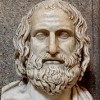
MEDEA: Women, my task is fixed: as quickly as I may
To kill my children, and start away from this land,
And not, by wasting time, to suffer my children
To be slain by another hand less kindly to them.
Force every way will have it they must die, and since
This must be so, then I, their mother, shall kill them.
Oh, arm yourself in steel, my heart! Do not hang back
From doing this fearful and necessary wrong.
Oh, come, my hand, poor wretched hand, and take the sword,
Take it, step forward to this bitter starting point,
And do not be a coward, do not think of them,
How sweet they are, and how you are their mother. Just for
This one short day be forgetful of your children,
Afterward weep; for even though you will kill them,
They were very dear — Oh, I am an unhappy woman!
(With a cry she rushes into the house.)[ΜΉΔΕΙΑ: φίλαι, δέδοκται τοὔργον ὡς τάχιστά μοι
παῖδας κτανούσῃ τῆσδ᾽ ἀφορμᾶσθαι χθονός,
καὶ μὴ σχολὴν ἄγουσαν ἐκδοῦναι τέκνα
ἄλλῃ φονεῦσαι δυσμενεστέρᾳ χερί.
πάντως σφ᾽ ἀνάγκη κατθανεῖν: ἐπεὶ δὲ χρή,
ἡμεῖς κτενοῦμεν οἵπερ ἐξεφύσαμεν.
ἀλλ᾽ εἶ᾽ ὁπλίζου, καρδία: τί μέλλομεν
τὰ δεινὰ κἀναγκαῖα μὴ πράσσειν κακά;
ἄγ᾽, ὦ τάλαινα χεὶρ ἐμή, λαβὲ ξίφος,
λάβ᾽, ἕρπε πρὸς βαλβῖδα λυπηρὰν βίου,
καὶ μὴ κακισθῇς μηδ᾽ ἀναμνησθῇς τέκνων,
ὡς φίλταθ᾽, ὡς ἔτικτες, ἀλλὰ τήνδε γε
λαθοῦ βραχεῖαν ἡμέραν παίδων σέθεν
κἄπειτα θρήνει: καὶ γὰρ εἰ κτενεῖς σφ᾽, ὅμως
φίλοι γ᾽ ἔφυσαν: δυστυχὴς δ᾽ ἐγὼ γυνή.]Euripides (485?-406? BC) Greek tragic dramatist
Medea [Μήδεια], l. 1236ff (431 BC) [tr. Warner (1944)]
(Source)
Medea, soliloquizing to the Chorus (of women) as she self-justifies killing her and Jason's sons. Though earlier she said she was doing so to revenge herself on him, here she seizes on the idea that they would otherwise be executed for her killing of Creon and Glauce through gifts that the boys carried to them. (There is a version of the Medea myth where that exact thing happens.)
(Source (Greek)). Other translations:My friends,
I am resolv'd, as soon as I have slain
My Children, from these regions to depart.
Nor thro' inglorious sloth will I abandon
My Sons to perish by detested hands;
They certainly must die: since then they must,
I bore and I will slay them. O my heart!
Be arm'd with tenfold firmness. What avails it
To loiter, when inevitable ills
Remain to be accomplish'd? take the sword.
And, O my band, on to the goal that ends
Their life, nor let one intervening thought
Of pity or maternal tenderness
Suspend thy purpose: for this one short day
Forget how fondly thou didst love thy Sons,
How bring them forth, and after that lament
Their cruel fate: altho' thou art resolv'd
To slay, yet hast thou ever held them dear.
But I am of all women the most wretched.
Exit Medea
[tr. Wodhull (1782)]This deed, my friends, is fix'd, to slay my sons
With quickest speed, then hasten from this land;
Nor fondly lingering leave them to be slain
By some more hostile hand: since they must die,
(For die they must) by me, who gave them life,
Death shall be given: and thou, my heart, be arm'd:
Yield not to weak reluctance, nor delay
A dreadful, but necessary deed.
Come, my unhappy hand, seize thou the sword,
Seize it, and wind thy progress to the goal
Of miserable life: faint not, nor thing
Of thy poor children, O how dear to me!
For this short day remember not thy sons,
Hereafter mourn at leisure: though I kill them,
Yet they were dear, and I -- a very wretch.
[tr. Potter (1814)]My friends, this purpose stand approved to me,
Slaying my boys to hurry from this realm;
Not, making weak delays, to give my sons
By other and more cruel hands to die.
Nay, steel thyself my heart. Why linger we
As not to do that horror which yet must be?
Come, oh my woeful hand, take take the sword:
On to my new life's mournful starting point,
And be no coward, nor think on thy boys,
How dear, how thou didst give them birth. Nay rather
For this short day forget they are thy sons:
Then weep them afterwards. For though thou slay'st them
Oh but they're dear, and I a desolate woman.
[tr. Webster (1868)]My friends, I am resolved upon the deed; at once will I slay my children and then leave this land, without delaying long enough to hand them over to some more savage hand to butcher. Needs must they die in any case; and since they must, I will slay them — I, the mother that bare them. O heart of mine, steel thyself! Why do I hesitate to do the awful deed that must be done? Come, take the sword, thou wretched hand of mine! Take it, and advance to the post whence starts thy life of sorrow! Away with cowardice! Give not one thought to thy babes, how dear they are or how thou art their mother. This one brief day forget thy children dear, and after that lament; for though thou wilt slay them yet they were thy darlings still, and I am a lady of sorrows.
[tr. Coleridge (1891)]The deed is determined on by me, my friends, to slay my children as soon as possible, and to hasten from this land; and not by delaying to give my sons for another hand more hostile to murder. But come, be armed, my heart; why do we delay to do dreadful but necessary deeds? Come, O wretched hand of mine, grasp the sword, grasp it, advance to the bitter goal of life, and be not cowardly, nor remember thy children how dear they are, how thou broughtest them into the world; but for this short day at least forget thy children; hereafter lament. For although thou slayest them, nevertheless they at least were dear, but I a wretched woman.
[tr. Buckley (1892)]Friends, my resolve is taken, with all speed
To slay my children, and to flee this land,
And not to linger and to yield my sons
To death by other hands more merciless.
They needs must die: and, since it needs must be,
Even I will give them death, who gave them life.
Up, gird thee for the fray, mine heart! Why loiter
To do the dread ill deeds that must be done?
Come, wretched hand of mine, grasp thou the sword;
Grasp it; — move toward life's bitter starting-post,
And turn not craven: think not on thy babes,
How dear they are, how thou didst bear them: nay,
For this short day do thou forget thy sons,
Thereafter mourn them. For, although thou slay,
Yet dear they are, and I a wretched woman.
[Exit Medea.
[tr. Way (Loeb) (1894)]Women, my mind is clear. I go to slay
My children with all speed, and then, away
From hence; not wait yet longer till they stand
Beneath another and an angrier hand
To die. Yea, howsoe'er I shield them, die
They must. And, seeing that they must, 'tis I
Shall slay them, I their mother, touched of none
Beside. Oh, up and get thine armour on,
My heart! Why longer tarry we to win
Our crown of dire inevitable sin?
Take up thy sword, O poor right hand of mine,
Thy sword: then onward to the thin-drawn line
Where life turns agony. Let there be naught
Of softness now: and keep thee from that thought,
'Born of thy flesh,' 'thine own belovèd.' Now,
For one brief day, forget thy children: thou
Shalt weep hereafter. Though thou slay them, yet
Sweet were they. . . . I am sore unfortunate.
[She goes into the house.
[tr. Murray (1906)]My friends, the deed’s resolved — that with all haste
I will kill my children and set forth from Corinth,
Not, hesitating here, yield up my sons
For other and less loving hands to murder.
Die they must, either way; and since they must,
Then I will slay them that did bring them forth.
Come steel thyself, my heart. What help to linger
Shrinking to do that dreadful thing thou must?
The sword, O miserable hand, the sword —
Take it and onward to that bitter race
Thy feet must run! No weakening now, no thought
Of thy sons, how dear they are, how thou didst once
Give life to them. For this one little day
Forget thy babes, and, after, weep for them.
For though thou slay them, yet dear-loved were they,
Thine own, — and I a miserable woman.
[tr. Lucas, ed. Higham (1938)]Friends, now my course is clear: as quickly as possible
To kill the children and then to fly from Corinth; not
Delay and so consign them to another hand
To murder with a better will. For they must die,
In any case; and since they must, then I who gave
Them birth will kill them. Arm yourself, my heart: the thing
That you must do is fearful, yet inevitable.
Why wait, then? My accursed hand, come, take the sword;
Take it, and forward to your frontier of despair.
No cowardice, no tender memories; forget
That once you loved them, that of your body they were born.
For one short day forget your children; afterwards
Weep: though you kill them, they were your beloved sons.
Life has been cruel to me.
Medea goes into the house.
[tr. Vellacott (1963)]My friends, I have decided to kill the children
Without delay and quickly depart from this country;
I shall not, by delaying, give my children over
To another, more unfriendly, hand to murder.
In any case, their death is inevitable, and since
It is, I who gave them birth shall kill them.
Up then! Arm yourself, my heart! Why wait
To do the dreadful evil that must be done?
Come, my wretched hand, take up the sword,
Take it and go to life’s goal of grief,
Do not be cowardly, do not remember the children,
How dear they are, how you bore them; for this short day
At least forget all about your children,
Then grieve. For even if you kill them, still,
You bore them, you loved them. I am an unlucky woman.
[tr. Podlecki (1989)]My friends, my resolve is fixed on the deed, to kill my children with all speed and to flee from this land: I must not, by lingering, deliver my children for murder to a less kindly hand. They must die at all events, and since they must, I who gave them birth shall kill them. Come, put on your armor, my heart. Why do I put off doing the terrible deed that must be done? Come, wretched hand, take the sword, take it and go to your life's miserable goal. Do not weaken, do not remember that you love the children, that you gave them life. Instead, for this brief day forget them — and mourn hereafter: for even if you kill them, they were dear to you. Oh, what an unhappy woman I am! Exit Medea into the house.
[tr. Kovacs (Perseus) (1994); tr. Kovacs / Zhang / Rogak]My friends, my resolve is fixed on the deed, to kill my children with all speed and to flee from this land: I must not, by lingering, deliver my children for murder to a less kindly hand. They must die at all events, and since they must, I who gave them birth shall kill them. Come, put on your armor, my heart. Why do I put off doing the terrible deed that must be done? Come, luckless hand, take the sword, take it and go to your life's miserable goal. Do not weaken, do not remember that you love the children, that you gave them life. Instead, for this brief day forget them — and mourn hereafter: for even if you kill them, they were dear to you. Oh, what an unhappy woman I am!
Exit Medea into the house.
[tr. Kovacs (Loeb) (1994)]My friends, I have decided to act and at once. I will kill the children and then quit this land. I will not delay and so deliver them to other hands to spill their blood more eagerly. They must be killed; there is no other way. And since they must, I will take their life, I who gave them life. Come, my heart, put on your armour! We must not hesitate to do this deed, this terrible yet necessary deed! Come, wretched hand of mine, grip the sword, grip it! On to the starting line! A painful race awaits you now! No time now for cowardice or thinking of your children, how much you love them, how you brought them into this world. No, for one day, one fleeting day, forget your children; there will be the rest of your life for weeping. For though you will put them to the sword, you loved them well. Oh, I am a woman born to sorrow!
[Medea turns and goes into the house.]
[tr. Davie (1996)]Enough, my friends!
My mind is made up. I’ve decided to kill my children and to leave this country. I haven’t a moment longer lest someone takes my children and they are slaughtered by some enemy’s hands. Die they must and so, better they die by me who gave birth to them.
Come, my heart, arm yourself. This is no time for equivocations. Need has forced this evil. So why wait? Come terrible hand, pick up the knife! Take it and take also the final, the most bitter step, the last step of life. Don’t be a coward now. Don’t think about the love you have for them, the life you gave them.
Today, forget that you have any children at all! Leave the crying for another day.
So what if you’re their murderer?
Their love will follow you for ever -- just as misery will.
Exit Medea
[tr. Theodoridis (2004)]My friends. I have determined to do the deed at once,
to kill my children and leave this land,
and not to falter or give my children
over to let a hand more hostile murder them.
They must die and since they must
I, who brought them into the world, will kill them.
But arm yourself, my heart. Why hesitate
to do these tragic, yet necessary, evils?
Come, unhappy hand of mine, take the sword
take it, move to the dismal turning point of life.
Do not be a coward. Do not think of your children —
how much you love them, how you gave them birth.
For this one short day forget your children,
and mourn tomorrow. For even if you kill them
still you loved them very much. I am an unhappy woman.
Exit Medea.
[tr. Luschnig (2007)]I’ve made up my mind, my friends.
I’ll do it — kill my children now, without delay,
and flee this land. I must not hesitate.
That would hand them over to someone else
to be slaughtered by a hand less loving.
No matter what, the children have to die.
Since that’s the case, then I, who gave them life,
will kill them. Arm yourself for this, my heart.
Why do I put off doing this dreadful act,
since it must be done? Come, pick up the sword,
wretched hand of mine. Pick up the sword,
move to where your life of misery begins.
Don’t play the coward. Don’t remember now
how much you love them, how you gave them life.
For this short day forget they are your children
and mourn them later. Although you kill them,
still you loved them. As a woman, I’m so sad.
[Exit MEDEA into the house.]
[tr. Johnston (2008)]Philai, I am resolved upon the deed: I shall slay my children at once, and then leave this land. I will not delay and so surrender them over to some hostile hand for butchering. They must die in any case, and since they must, I will slay them — I, the mother who bore them. But come, my heart, arm yourself! Why do I hesitate to do the terrible [deina] evils [kaka] that must be done? Come, take the sword, poor hand of mine! Take it, and advance to the starting-post, where your life of sorrow begins! Away with cowardice! Forget your children, forget how most phila they are, and how you bore them. For this brief day forget, and after that lament. Though you will slay them, yet they are your philoi still. And I am a woman of sorrows.
Medea enters the house.
[tr. Coleridge / Ceragioli / Nagy / Hour25]
The head never rules the heart, but just becomes its partner in crime.
Mignon McLaughlin (1913–1983) American journalist and author
The Second Neurotic’s Notebook, ch. 5 (1966)
(Source)

Evil when we are in its power is not felt as evil but as a necessity, or even a duty.

People may see hypocrisy and cynicism all around them, but in my experience, almost without exception, they believe their own views and actions — even when contradictory, even when private motivations differ from public explanations — are righteous and principled.
John F. Harris (b. c. 1963) American political journalist, editor
“‘He Is Our O.J.'” Politico (9 Jan 2020)
(Source)

The kitten has a luxurious, Bohemian, unpuritanical nature. It eats six meals a day, plays furiously with a toy mouse and a piece of rope, and suddenly falls into a deep sleep whenever the fit takes it. It never feels the necessity to do anything to justify its existence; it does not want to be a Good Citizen; it has never heard of Service. It knows that it is beautiful and delightful, and it considers that a sufficient contribution to the general good. And in return for its beauty and charm it expects fish, meat, and vegetables, a comfortable bed, a chair by the grate fire, and endless petting.
Robertson Davies (1913–1995) Canadian author, editor, publisher
The Diary of Samuel Marchbanks, ch. 20 (1947)
(Source)

Macbeth’s self-justifications were feeble — and his conscience devoured him. Yes, even Iago was a little lamb, too. The imagination and spiritual strength of Shakespeare’s evildoers stopped short at a dozen corpses. Because they had no ideology.
Ideology — that is what gives evildoing its long-sought justification and gives the evildoer the necessary steadfastness and determination. That is the social theory which helps to make his acts seem good instead of bad in his own and others’ eyes, so that he won’t hear reproaches and curses but will receive praise and honors. That was how the agents of the Inquisition fortified their wills: by invoking Christianity; the conquerors of foreign lands, by extolling the grandeur of their Motherland; the colonizers, by civilization; the Nazis, by race; and the Jacobins (early and late), by equality, brotherhood, and the happiness of future generations.
Alexander Solzhenitsen (1918–2008) Russian novelist, emigre [Aleksandr Isayevich Solzhenitsyn]
The Gulag Archipelago, Vol. 1, Part 1, ch. 4 (1973) [tr. Whitney]
(Source)
In their moral justification, the argument of the lesser evil has played a prominent role. If you are confronted with two evils, thus the argument runs, it is your duty to opt for the lesser one, whereas it is irresponsible to refuse to choose altogether. […] Politically, the weakness of the argument has always been that those who choose the lesser evil forget very quickly that they chose evil.

Someone who sees himself as a victim will almost never morally evaluate himself or put limits on his own actions. Why should he? He is the victim.
Thomas Friedman (b. 1953) American journalist, columnist, author
From Beirut to Jerusalem, ch. 6 (1989)
(Source)

Few of us take the pains to study the origin of our cherished convictions; indeed, we have a natural repugnance to so doing. We like to continue to believe what we have been accustomed to accept as true, and the resentment aroused when doubt is cast upon any of our assumptions leads us to seek every manner of excuse for clinging to them. The result is that most of our so-called reasoning consists in finding arguments for going on believing as we already do.
James Harvey Robinson (1863–1936) American historian and educator
The Mind in the Making, ch. 4 “Rationalizing” (1921)
(Source)
For the Bolsheviki the end to be achieved was the Communist State, or the so-called Dictatorship of the Proletariat. Everything which advanced that end was justifiable and revolutionary. The Lenins, Radeks, and Zorins were therefore quite consistent. Obsessed by the infallibility of their creed, giving of themselves to the fullest, they could be both heroic and despicable at the same time. They could work twenty hours a day, live on herring and tea, and order the slaughter of innocent men and women. Occasionally they sought to mask their killings by pretending a “misunderstanding,” for doesn’t the end justify all means? They could employ torture and deny the inquisition, they could lie and defame, and call themselves idealists. In short, they could make themselves and others believe that everything was legitimate and right from the revolutionary viewpoint; any other policy was weak, sentimental, or a betrayal of the Revolution.
Emma Goldman (1869–1940) Lithuanian-American anarchist, activist
My Disillusionment in Russia, ch. 12 (1920)
(Source)

That which we call sin in others, is experiment for us.
Ralph Waldo Emerson (1803–1882) American essayist, lecturer, poet
“Experience,” Essays: Second Series (1844)
(Source)

The power of fortune is confessed only by the miserable; for the happy impute all their success to prudence or merit.
Jonathan Swift (1667–1745) English writer and churchman
“Thoughts on Various Subjects” (1706)
(Source)

The more lies are told, the more important it becomes for the liars to justify themselves by deep moral commitments to high-sounding objectives that mask the pursuit of money and power.
Bertram M. Gross (1912–1997) American social scientist, academic, bureaucrat
Friendly Fascism: The New Face of Power in America, ch. 9 (1980)
I fear one lies more to one’s self than to anyone else.

Propaganda thus serves more to justify ourselves than to convince others; and the more reason we have to feel guilty, the more fervent our propaganda.
Eric Hoffer (1902–1983) American writer, philosopher, longshoreman
True Believer: Thoughts on the Nature of Mass Movements, Part 3, ch. 14, § 84 (3.14.84) (1951)
(Source)
Propaganda does not deceive people; it merely helps them to deceive themselves.
Eric Hoffer (1902–1983) American writer, philosopher, longshoreman
Passionate State of Mind, Aphorism 260 (1955)
(Source)
There is a powerful craving in most of us to see ourselves as instruments in the hands of others and thus free ourselves from the responsibility for acts which are prompted by our own questionable inclinations and impulses. Both the strong and the weak grasp at this alibi. The latter hide their malevolence under the virtue of obedience: they acted dishonorably because they had to obey orders. The strong, too, claim absolution by proclaiming themselves the chosen instrument of a higher power — God, history, fate, nation or humanity.
Eric Hoffer (1902–1983) American writer, philosopher, longshoreman
Passionate State of Mind, Aphorism 85 (1955)
(Source)
What stuck in the minds of these men who had become murderers was simply the notion of being involved in something historic, grandiose, unique (“a great task that occurs once in two thousand years”), which must therefore be difficult to bear. This was important, because the murderers were not sadists or killers by nature; on the contrary, a systematic effort was made to weed out all those who derived physical pleasure from what they did. The troops of the Einsatzgruppen had been drafted from the Armed S.S., a military unit with hardly more crimes in its record than any ordinary unit of the German Army, and their commanders had been chosen by Heydrich from the S.S. élite with academic degrees. Hence the problem was how to overcome not so much their conscience as the animal pity by which all normal men are affected in the presence of physical suffering. The trick used by Himmler — who apparently was rather strongly afflicted by these instinctive reactions himself — was very simple and probably very effective; it consisted in turning these instincts around, as it were, in directing them toward the self. So that instead of saying: What horrible things I did to people!, the murderers would be able to say: What horrible things I had to watch in the pursuance of my duties, how heavily the task weighed upon my shoulders!
Hannah Arendt (1906–1975) German-American philosopher, political theorist
Eichmann in Jerusalem: A Report on the Banality of Evil, ch. 6 (1963)
(Source)
RECONSIDER, v. To seek a justification for a decision already made.
Ambrose Bierce (1842–1914?) American writer and journalist
“Reconsider,” The Devil’s Dictionary (1911)
(Source)
Originally published in the The Devil's Dictionary [A-Z] as Vol. 7 of his Collected Works.