Knaves imagine nothing can be done without knavery.
Thomas Fuller (1654–1734) English physician, preacher, aphorist, writer
Gnomologia: Adages and Proverbs (compiler), # 3135 (1732)
(Source)
Quotations about:
self-rationalization
Note not all quotations have been tagged, so Search may find additional quotes on this topic.

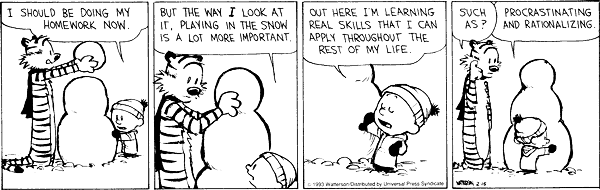
CALVIN: (building a snowman) I should be doing my homework now. But the way I look at it, playing in the snow is a lot more important. Out here I’m learning real skills that I can apply throughout the rest of my life.
HOBBES: Such as?
CALVIN: Procrastinating and rationalizing.

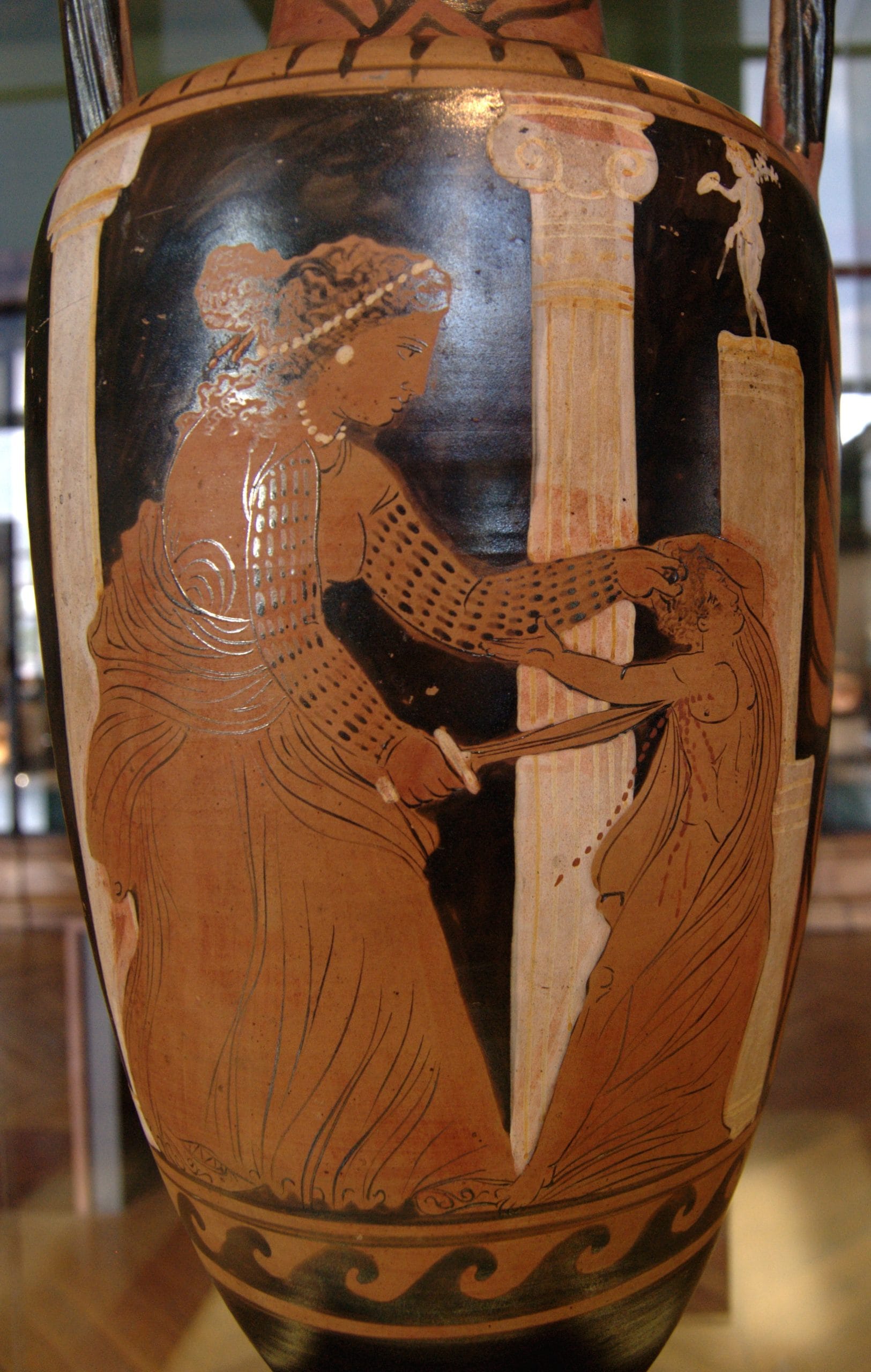
MEDEA: Women, my task is fixed: as quickly as I may
To kill my children, and start away from this land,
And not, by wasting time, to suffer my children
To be slain by another hand less kindly to them.
Force every way will have it they must die, and since
This must be so, then I, their mother, shall kill them.
Oh, arm yourself in steel, my heart! Do not hang back
From doing this fearful and necessary wrong.
Oh, come, my hand, poor wretched hand, and take the sword,
Take it, step forward to this bitter starting point,
And do not be a coward, do not think of them,
How sweet they are, and how you are their mother. Just for
This one short day be forgetful of your children,
Afterward weep; for even though you will kill them,
They were very dear — Oh, I am an unhappy woman!
(With a cry she rushes into the house.)[ΜΉΔΕΙΑ: φίλαι, δέδοκται τοὔργον ὡς τάχιστά μοι
παῖδας κτανούσῃ τῆσδ᾽ ἀφορμᾶσθαι χθονός,
καὶ μὴ σχολὴν ἄγουσαν ἐκδοῦναι τέκνα
ἄλλῃ φονεῦσαι δυσμενεστέρᾳ χερί.
πάντως σφ᾽ ἀνάγκη κατθανεῖν: ἐπεὶ δὲ χρή,
ἡμεῖς κτενοῦμεν οἵπερ ἐξεφύσαμεν.
ἀλλ᾽ εἶ᾽ ὁπλίζου, καρδία: τί μέλλομεν
τὰ δεινὰ κἀναγκαῖα μὴ πράσσειν κακά;
ἄγ᾽, ὦ τάλαινα χεὶρ ἐμή, λαβὲ ξίφος,
λάβ᾽, ἕρπε πρὸς βαλβῖδα λυπηρὰν βίου,
καὶ μὴ κακισθῇς μηδ᾽ ἀναμνησθῇς τέκνων,
ὡς φίλταθ᾽, ὡς ἔτικτες, ἀλλὰ τήνδε γε
λαθοῦ βραχεῖαν ἡμέραν παίδων σέθεν
κἄπειτα θρήνει: καὶ γὰρ εἰ κτενεῖς σφ᾽, ὅμως
φίλοι γ᾽ ἔφυσαν: δυστυχὴς δ᾽ ἐγὼ γυνή.]Euripides (485?-406? BC) Greek tragic dramatist
Medea [Μήδεια], l. 1236ff (431 BC) [tr. Warner (1944)]
(Source)
Medea, soliloquizing to the Chorus (of women) as she self-justifies killing her and Jason's sons. Though earlier she said she was doing so to revenge herself on him, here she seizes on the idea that they would otherwise be executed for her killing of Creon and Glauce through gifts that the boys carried to them. (There is a version of the Medea myth where that exact thing happens.)
(Source (Greek)). Other translations:My friends,
I am resolv'd, as soon as I have slain
My Children, from these regions to depart.
Nor thro' inglorious sloth will I abandon
My Sons to perish by detested hands;
They certainly must die: since then they must,
I bore and I will slay them. O my heart!
Be arm'd with tenfold firmness. What avails it
To loiter, when inevitable ills
Remain to be accomplish'd? take the sword.
And, O my band, on to the goal that ends
Their life, nor let one intervening thought
Of pity or maternal tenderness
Suspend thy purpose: for this one short day
Forget how fondly thou didst love thy Sons,
How bring them forth, and after that lament
Their cruel fate: altho' thou art resolv'd
To slay, yet hast thou ever held them dear.
But I am of all women the most wretched.
Exit Medea
[tr. Wodhull (1782)]This deed, my friends, is fix'd, to slay my sons
With quickest speed, then hasten from this land;
Nor fondly lingering leave them to be slain
By some more hostile hand: since they must die,
(For die they must) by me, who gave them life,
Death shall be given: and thou, my heart, be arm'd:
Yield not to weak reluctance, nor delay
A dreadful, but necessary deed.
Come, my unhappy hand, seize thou the sword,
Seize it, and wind thy progress to the goal
Of miserable life: faint not, nor thing
Of thy poor children, O how dear to me!
For this short day remember not thy sons,
Hereafter mourn at leisure: though I kill them,
Yet they were dear, and I -- a very wretch.
[tr. Potter (1814)]My friends, this purpose stand approved to me,
Slaying my boys to hurry from this realm;
Not, making weak delays, to give my sons
By other and more cruel hands to die.
Nay, steel thyself my heart. Why linger we
As not to do that horror which yet must be?
Come, oh my woeful hand, take take the sword:
On to my new life's mournful starting point,
And be no coward, nor think on thy boys,
How dear, how thou didst give them birth. Nay rather
For this short day forget they are thy sons:
Then weep them afterwards. For though thou slay'st them
Oh but they're dear, and I a desolate woman.
[tr. Webster (1868)]My friends, I am resolved upon the deed; at once will I slay my children and then leave this land, without delaying long enough to hand them over to some more savage hand to butcher. Needs must they die in any case; and since they must, I will slay them — I, the mother that bare them. O heart of mine, steel thyself! Why do I hesitate to do the awful deed that must be done? Come, take the sword, thou wretched hand of mine! Take it, and advance to the post whence starts thy life of sorrow! Away with cowardice! Give not one thought to thy babes, how dear they are or how thou art their mother. This one brief day forget thy children dear, and after that lament; for though thou wilt slay them yet they were thy darlings still, and I am a lady of sorrows.
[tr. Coleridge (1891)]The deed is determined on by me, my friends, to slay my children as soon as possible, and to hasten from this land; and not by delaying to give my sons for another hand more hostile to murder. But come, be armed, my heart; why do we delay to do dreadful but necessary deeds? Come, O wretched hand of mine, grasp the sword, grasp it, advance to the bitter goal of life, and be not cowardly, nor remember thy children how dear they are, how thou broughtest them into the world; but for this short day at least forget thy children; hereafter lament. For although thou slayest them, nevertheless they at least were dear, but I a wretched woman.
[tr. Buckley (1892)]Friends, my resolve is taken, with all speed
To slay my children, and to flee this land,
And not to linger and to yield my sons
To death by other hands more merciless.
They needs must die: and, since it needs must be,
Even I will give them death, who gave them life.
Up, gird thee for the fray, mine heart! Why loiter
To do the dread ill deeds that must be done?
Come, wretched hand of mine, grasp thou the sword;
Grasp it; — move toward life's bitter starting-post,
And turn not craven: think not on thy babes,
How dear they are, how thou didst bear them: nay,
For this short day do thou forget thy sons,
Thereafter mourn them. For, although thou slay,
Yet dear they are, and I a wretched woman.
[Exit Medea.
[tr. Way (Loeb) (1894)]Women, my mind is clear. I go to slay
My children with all speed, and then, away
From hence; not wait yet longer till they stand
Beneath another and an angrier hand
To die. Yea, howsoe'er I shield them, die
They must. And, seeing that they must, 'tis I
Shall slay them, I their mother, touched of none
Beside. Oh, up and get thine armour on,
My heart! Why longer tarry we to win
Our crown of dire inevitable sin?
Take up thy sword, O poor right hand of mine,
Thy sword: then onward to the thin-drawn line
Where life turns agony. Let there be naught
Of softness now: and keep thee from that thought,
'Born of thy flesh,' 'thine own belovèd.' Now,
For one brief day, forget thy children: thou
Shalt weep hereafter. Though thou slay them, yet
Sweet were they. . . . I am sore unfortunate.
[She goes into the house.
[tr. Murray (1906)]My friends, the deed’s resolved — that with all haste
I will kill my children and set forth from Corinth,
Not, hesitating here, yield up my sons
For other and less loving hands to murder.
Die they must, either way; and since they must,
Then I will slay them that did bring them forth.
Come steel thyself, my heart. What help to linger
Shrinking to do that dreadful thing thou must?
The sword, O miserable hand, the sword —
Take it and onward to that bitter race
Thy feet must run! No weakening now, no thought
Of thy sons, how dear they are, how thou didst once
Give life to them. For this one little day
Forget thy babes, and, after, weep for them.
For though thou slay them, yet dear-loved were they,
Thine own, — and I a miserable woman.
[tr. Lucas, ed. Higham (1938)]Friends, now my course is clear: as quickly as possible
To kill the children and then to fly from Corinth; not
Delay and so consign them to another hand
To murder with a better will. For they must die,
In any case; and since they must, then I who gave
Them birth will kill them. Arm yourself, my heart: the thing
That you must do is fearful, yet inevitable.
Why wait, then? My accursed hand, come, take the sword;
Take it, and forward to your frontier of despair.
No cowardice, no tender memories; forget
That once you loved them, that of your body they were born.
For one short day forget your children; afterwards
Weep: though you kill them, they were your beloved sons.
Life has been cruel to me.
Medea goes into the house.
[tr. Vellacott (1963)]My friends, I have decided to kill the children
Without delay and quickly depart from this country;
I shall not, by delaying, give my children over
To another, more unfriendly, hand to murder.
In any case, their death is inevitable, and since
It is, I who gave them birth shall kill them.
Up then! Arm yourself, my heart! Why wait
To do the dreadful evil that must be done?
Come, my wretched hand, take up the sword,
Take it and go to life’s goal of grief,
Do not be cowardly, do not remember the children,
How dear they are, how you bore them; for this short day
At least forget all about your children,
Then grieve. For even if you kill them, still,
You bore them, you loved them. I am an unlucky woman.
[tr. Podlecki (1989)]My friends, my resolve is fixed on the deed, to kill my children with all speed and to flee from this land: I must not, by lingering, deliver my children for murder to a less kindly hand. They must die at all events, and since they must, I who gave them birth shall kill them. Come, put on your armor, my heart. Why do I put off doing the terrible deed that must be done? Come, wretched hand, take the sword, take it and go to your life's miserable goal. Do not weaken, do not remember that you love the children, that you gave them life. Instead, for this brief day forget them — and mourn hereafter: for even if you kill them, they were dear to you. Oh, what an unhappy woman I am! Exit Medea into the house.
[tr. Kovacs (Perseus) (1994); tr. Kovacs / Zhang / Rogak]My friends, my resolve is fixed on the deed, to kill my children with all speed and to flee from this land: I must not, by lingering, deliver my children for murder to a less kindly hand. They must die at all events, and since they must, I who gave them birth shall kill them. Come, put on your armor, my heart. Why do I put off doing the terrible deed that must be done? Come, luckless hand, take the sword, take it and go to your life's miserable goal. Do not weaken, do not remember that you love the children, that you gave them life. Instead, for this brief day forget them — and mourn hereafter: for even if you kill them, they were dear to you. Oh, what an unhappy woman I am!
Exit Medea into the house.
[tr. Kovacs (Loeb) (1994)]My friends, I have decided to act and at once. I will kill the children and then quit this land. I will not delay and so deliver them to other hands to spill their blood more eagerly. They must be killed; there is no other way. And since they must, I will take their life, I who gave them life. Come, my heart, put on your armour! We must not hesitate to do this deed, this terrible yet necessary deed! Come, wretched hand of mine, grip the sword, grip it! On to the starting line! A painful race awaits you now! No time now for cowardice or thinking of your children, how much you love them, how you brought them into this world. No, for one day, one fleeting day, forget your children; there will be the rest of your life for weeping. For though you will put them to the sword, you loved them well. Oh, I am a woman born to sorrow!
[Medea turns and goes into the house.]
[tr. Davie (1996)]Enough, my friends!
My mind is made up. I’ve decided to kill my children and to leave this country. I haven’t a moment longer lest someone takes my children and they are slaughtered by some enemy’s hands. Die they must and so, better they die by me who gave birth to them.
Come, my heart, arm yourself. This is no time for equivocations. Need has forced this evil. So why wait? Come terrible hand, pick up the knife! Take it and take also the final, the most bitter step, the last step of life. Don’t be a coward now. Don’t think about the love you have for them, the life you gave them.
Today, forget that you have any children at all! Leave the crying for another day.
So what if you’re their murderer?
Their love will follow you for ever -- just as misery will.
Exit Medea
[tr. Theodoridis (2004)]My friends. I have determined to do the deed at once,
to kill my children and leave this land,
and not to falter or give my children
over to let a hand more hostile murder them.
They must die and since they must
I, who brought them into the world, will kill them.
But arm yourself, my heart. Why hesitate
to do these tragic, yet necessary, evils?
Come, unhappy hand of mine, take the sword
take it, move to the dismal turning point of life.
Do not be a coward. Do not think of your children —
how much you love them, how you gave them birth.
For this one short day forget your children,
and mourn tomorrow. For even if you kill them
still you loved them very much. I am an unhappy woman.
Exit Medea.
[tr. Luschnig (2007)]I’ve made up my mind, my friends.
I’ll do it — kill my children now, without delay,
and flee this land. I must not hesitate.
That would hand them over to someone else
to be slaughtered by a hand less loving.
No matter what, the children have to die.
Since that’s the case, then I, who gave them life,
will kill them. Arm yourself for this, my heart.
Why do I put off doing this dreadful act,
since it must be done? Come, pick up the sword,
wretched hand of mine. Pick up the sword,
move to where your life of misery begins.
Don’t play the coward. Don’t remember now
how much you love them, how you gave them life.
For this short day forget they are your children
and mourn them later. Although you kill them,
still you loved them. As a woman, I’m so sad.
[Exit MEDEA into the house.]
[tr. Johnston (2008)]Philai, I am resolved upon the deed: I shall slay my children at once, and then leave this land. I will not delay and so surrender them over to some hostile hand for butchering. They must die in any case, and since they must, I will slay them — I, the mother who bore them. But come, my heart, arm yourself! Why do I hesitate to do the terrible [deina] evils [kaka] that must be done? Come, take the sword, poor hand of mine! Take it, and advance to the starting-post, where your life of sorrow begins! Away with cowardice! Forget your children, forget how most phila they are, and how you bore them. For this brief day forget, and after that lament. Though you will slay them, yet they are your philoi still. And I am a woman of sorrows.
Medea enters the house.
[tr. Coleridge / Ceragioli / Nagy / Hour25]
Solitude is the climax of the negative virtues. When we go to bed after a solitary day we can tell ourselves that we have not been unkind nor dishonest nor untruthful; and the negative virtues are agreeable to that dangerous faculty we call the conscience. That they should ever be admitted for a part of virtue is what I cannot explain. I do not care two straws for all the nots.
Robert Louis Stevenson (1850–1894) Scottish essayist, novelist, poet
Essay (1880-01/02?), “Reflections and Remarks on Human Life,” § 4.6 “Solitude and Society”
(Source)
A collection of aphorisms and musings, first published in the Edinburgh Edition of his Works, vol. 28 (1898).
Even the acquisition of knowledge is often much facilitated by the advantages of society: he that never compares his notions with those of others, readily acquiesces in his first thoughts, and very seldom discovers the objections which may be raised against his opinions; he, therefore, often thinks himself in possession of truth, when he is only fondling an errour long since exploded. He that has neither companions nor rivals in his studies, will always applaud his own progress, and think highly of his performances, because he knows not that others have equalled or excelled him. And I am afraid it may be added, that the student who withdraws himself from the world, will soon feel that ardour extinguished which praise or emulation had enkindled, and take the advantage of secrecy to sleep, rather than to labour.
Samuel Johnson (1709–1784) English writer, lexicographer, critic
Essay (1754-01-19), The Adventurer, No. 126
(Source)
Nothing in the world is more common than unsuccessful people with talent, leave the house before you find something worth staying in for.
Banksy (b. 1974?) England-based pseudonymous street artist, political activist, film director
Wall and Piece, “Street Furniture,” “Advice on Making Stencils” (2005)
(Source)

The head never rules the heart, but just becomes its partner in crime.
Mignon McLaughlin (1913–1983) American journalist and author
The Second Neurotic’s Notebook, ch. 5 (1966)
(Source)

Evil when we are in its power is not felt as evil but as a necessity, or even a duty.

How convenient does it prove to be a rational animal, that knows how to find or invent a plausible pretext for whatever it has an inclination so to do.
Benjamin Franklin (1706–1790) American statesman, scientist, philosopher, aphorist
The Life of Benjamin Franklin (1791)
(Source)
Often paraphrased: "Man is a rational animal. He can think up a reason for anything he wants to believe." Sometimes attributed to Anatole France.
Propaganda thus serves more to justify ourselves than to convince others; and the more reason we have to feel guilty, the more fervent our propaganda.
Eric Hoffer (1902–1983) American writer, philosopher, longshoreman
True Believer: Thoughts on the Nature of Mass Movements, Part 3, ch. 14, § 84 (3.14.84) (1951)
(Source)
Few men are sufficiently discerning to appreciate all the evil they do.
[Il n’y a guère d’homme assez habile pour connoître tout le mal qu’il fait.]
François VI, duc de La Rochefoucauld (1613–1680) French epigrammatist, memoirist, noble
Réflexions ou sentences et maximes morales [Reflections; or Sentences and Moral Maxims], ¶269 (1665-1678) [tr. Tancock (1959), ¶269]
(Source)
First appeared in the 2nd (1666) edition. In manuscript, it reads "... assez pénétrant pour apercevoir tout le mal qu’il fait."
(Source (French)). Other translations:There are but few Men Wise enough to know all the Mischief Wisdom does.
[tr. Stanhope (1694), ¶270]There are but few Men wise enough to know all the Mischief they do.
[tr. Stanhope (1706), Powell ed., ¶269]Few men are able to know all the ill they do.
[pub. Donaldson (1783), ¶5]Few men are able to know all the ill they do.
[ed. Lepoittevin-Lacroix (1797), ¶252]Few of us have abilities to know all the ill we occasion.
[ed. Carvill (1835), ¶3]Scarcely any man is clever enough to know all the evil he does.
[ed. Gowens (1851), ¶280]No man is clever enough to know all the evil he does.
[tr. Bund/Friswell (1871), ¶269]No one is sufficiently keen to realize to the full the harm he does.
[tr. Heard (1917), ¶277]Scarcely any man is clever enough to realize all the harm he does.
[tr. Stevens (1939), ¶269]There is hardly a man clever enough to recognize the full extent of the evil that he does.
[tr. FitzGibbon (1957), ¶269]Almost no one is perceptive enough to realize all the harm he does.
[tr. Kronenberger (1959), ¶269]There is scarcely a man alive clever enough to know all the evil he does.
[tr. Whichello (2016) ¶269]

The greatest of faults, I should say, is to be conscious of none.
Thomas Carlyle (1795–1881) Scottish essayist and historian
Lecture (1840-05-08), “The Hero as Prophet,” Home House, Portman Square, London
(Source)
The lecture notes were collected by Carlyle into On Heroes, Hero-Worship, & the Heroic in History, Lecture 2 (1841).