No face which we can give to a matter will stead us so well at last as the truth. This alone wears well.
Henry David Thoreau (1817–1862) American philosopher and writer
Walden; or, Life in the Woods, ch. 18 “Conclusion” (1854)
(Source)
Quotations about:
reality check
Note not all quotations have been tagged, so Search may find additional quotes on this topic.
You can not live at all if you do not learn to adapt yourself to your life as it happens to be.
Eleanor Roosevelt (1884–1962) American politician, diplomat, activist; First Lady of the US (1933–45)
Memoir (1949), This I Remember, ch. 20 “The Last Term: 1944–1945”
(Source)
This passage was not included in her compiled Autobiography (1961).

DEMEA: No one has ever plotted out his life’s plan so successfully that he never faces
New challenges and discoveries brought about by circumstances, the passing of time,
Or experience itself. Inevitably, you discover you don’t know what you thought you did,
And the principles we first formed don’t hold up in the face of everyday practice.[Nunquam ita quisquam bene subducta ratione ad vitam fuit
Quia res, Ætas usus semper aliquid apportet novi
Aliquid moneat, ut illa, quæ te scire credas, nescias
Et, quæ tibi putaris prima, in experiundo ut repudies.]Terence (186?-159 BC) African-Roman dramatist [Publius Terentius Afer]
Adelphoe [Adelphoi; Adelphi; The Brothers], Act 5, sc. 4, l. 855ff (160 BC) [tr. Christenson (2010), Sc. 22]
(Source)
Sometimes attributed to Richard Steele, as he used the quote as an epigraph to an essay in The Spectator, No. 544 (1712-11-24).
(Source (Latin)). Other translations:No man was ever so completely skilled in the conduct of life, as not to receive new information from age and experience: insomuch that we find ourselves really ignorant of what we thought we understood, and see cause to reject what we fancied our truest interest.
[tr. Steele (1712)]Never could there be anyone with a method for life so well drawn up, but that circumstance, time, experience ever brings something new, teaches something; so that you know not those things which you think that you know, and that you repudiate in experience the things which you have thought essential for you.
[tr. Giles, c. 1850]Never was there any person of ever such well-trained habits of life, but that experience, age, and custom are always bringing him something new, or suggesting something; so much so, that what you believe you know you don't know, and what you have fancied of first importance to you, on making trial you reject.
[tr. Riley (1874)]However well a man may have calculated his scheme of life, still circumstances, years, experience, always introduce a new element and teach new lessons. You find that you don't know what you thought you did know, and what you thought of primary importance that in practice you reject.
[tr. Sargeaunt (Loeb) (1912), Act 6]You never add things up so well in this life that something unexpected doesn’t turn up and set you wondering -- some money matter, some event, some personal problem. As a result, you find you don’t know what you thought you knew, and things that seemed fine turn out to be worthless when they're put to the test.
[tr. Copley (1967)]No matter how neatly you keep your accounts in life,
experience, age, and circumstance always show up
to toss something new on the books and teach you a lesson.
You find out you don't know what you thought you did, and what seemed
so important in theory turns out to be pointless in practice.
[tr. Berg/Parker (1999)]There never was a person so well-bred
And so refined but that into his head
Come new thoughts springing from experience
And age and custom, so that what you sense
You know you don’t know and what you before
Believed was most important you abhor.
[tr. Kelk (2022)]

Even the acquisition of knowledge is often much facilitated by the advantages of society: he that never compares his notions with those of others, readily acquiesces in his first thoughts, and very seldom discovers the objections which may be raised against his opinions; he, therefore, often thinks himself in possession of truth, when he is only fondling an errour long since exploded. He that has neither companions nor rivals in his studies, will always applaud his own progress, and think highly of his performances, because he knows not that others have equalled or excelled him. And I am afraid it may be added, that the student who withdraws himself from the world, will soon feel that ardour extinguished which praise or emulation had enkindled, and take the advantage of secrecy to sleep, rather than to labour.
Samuel Johnson (1709–1784) English writer, lexicographer, critic
Essay (1754-01-19), The Adventurer, No. 126
(Source)

For years I have hoped that we could stop war as an instrument for settling any national and international difficulties. I have worked for it and shall continue to work for it. However, one has to face the world as it is and, without discarding one’s ideals, meet the realities of the day and keep on working for what one hopes will be a better future.
Eleanor Roosevelt (1884–1962) American politician, diplomat, activist; First Lady of the US (1933–45)
Column (1940-05-17), “My Day”
(Source)
When he was a boy, he’d read books about great military campaigns, and visited museums and had looked with patriotic pride at the paintings of famous cavalry charges, last stands, and glorious victories. It had come as rather a shock, when he later began to participate in some of these, to find that the painters had unaccountably left out the intestines. Perhaps they just weren’t very good at them.

What could I do! Facts are such horrid things!
Jane Austen (1775–1817) English author
Lady Susan, Letter 32 “Mrs. Johnson to Lady Susan” (1794, pub 1871)
(Source)

A soiled baby, with a neglected nose, cannot be conscientiously regarded as a thing of beauty; and inasmuch as babyhood spans but three short years, no baby is competent to be a joy “forever.”
Mark Twain (1835–1910) American writer [pseud. of Samuel Clemens]
“Answers to Correspondents,” Sketches New and Old (1875)
(Source)
Ostensibly in response to a "Young Mother" who had written that her new baby was a thing of beauty and a joy forever.

Scratch the surface of most cynics and you find a frustrated idealist — someone who made the mistake of converting his ideals into expectations.
Peter Senge (b. 1947) American systems scientist, lecturer, academic
The Fifth Discipline, Part 3, ch. 8 (1990)
(Source)

Unless one is raised in the minion mindset, it is difficult to understand the allure of the lifestyle. Outside observers merely see put-upon underlings who live and work in insanely dangerous positions, whose lives are ruled by dictatorial psychopaths who have little regard for their lives or sanity. Acclimatized minions realize that everyone on Earth lives under these strictures, they just don’t fool themselves. With clarity comes freedom.
Phil Foglio (b. 1956) American writer, cartoonist
Agatha H and the Voice of the Castle (2014) [with Kaja Foglio]
(Source)

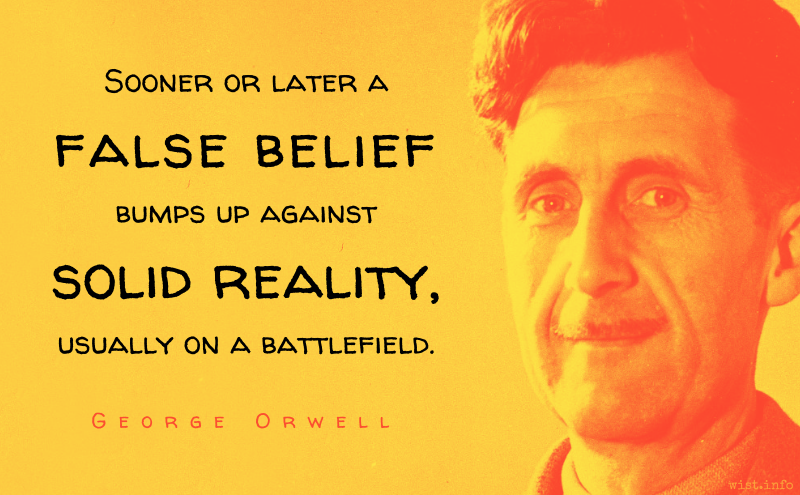
The point is that we are all capable of believing things which we know to be untrue, and then, when we are finally proved wrong, impudently twisting the facts so as to show that we were right. Intellectually, it is possible to carry on this process for an indefinite time: the only check on it is that sooner or later a false belief bumps up against solid reality, usually on a battlefield.
George Orwell (1903–1950) English journalist, essayist, writer [pseud. of Eric Arthur Blair]
Essay (1946-03-22), “In Front of Your Nose,” “As I Please” column, Tribune Newspaper
(Source)
The general uncertainty as to what is really happening makes it easier to cling to lunatic beliefs. Since nothing is ever quite proved or disproved, the most unmistakable fact can be impudently denied.
George Orwell (1903–1950) English journalist, essayist, writer [pseud. of Eric Arthur Blair]
Essay (1945-05), “Notes on Nationalism,” Polemic Magazine (1945-10)
(Source)
One of the most troublesome things in life is that what you do or do not want has very little to do with what does or does not happen.
Lemony Snicket (b. 1970) American author, screenwriter, musician (pseud. for Daniel Handler)
The Carnivorous Carnival (2002)

Though the terrain of frustration may be vast — from a stubbed toe to an untimely death — at the heart of every frustration lies a basic structure: the collision of a wish with an unyielding reality.
Alain de Botton (b. 1969) Swiss-British author
The Consolations of Philosophy, ch. 3 “Consolation For Frustration” (2000)

A wise man weaves a philosophy out of each acceptance life forces upon him.


At its core, therefore, science is a form of arrogance control.
Carol Tavris (b. 1944) American social psychologist and author
Mistakes Were Made (But Not by Me): Why We Justify Foolish Beliefs, Bad Decisions, and Hurtful Acts (2008) [with Elliot Aronson]

Where religion speaks of the heart and soul, and of what happens before we’re born and after we die, and why, then agreeing or disagreeing with it is a matter of personal taste, spirit, and judgment. Where it speaks of the objective, of the real world, of what evidence of our eyes should be accepted or rejected, it is worth no more than anyone else spouting off at a cocktail party.
Graham Ericsson (b. 1961) American technologist, writer, aphorist
Journal (2008-07-27)

For a successful technology, reality must take precedence over public relations, for nature cannot be fooled.
Richard Feynman (1918–1988) American physicist
Rogers Commission Report into the Challenger Crash, Appendix F “Personal Observations on Reliability of Shuttle,” sec. F5 (1986-06)
(Source)
Closing words of the section.
HENRY: Are these things then necessities?
Then let us meet them like necessities.William Shakespeare (1564–1616) English dramatist and poet
Henry IV, Part 2, Act 3, sc. 1, l. 94ff (3.1.94-95) (c. 1598)
(Source)

Facts are stubborn things; and whatever may be our wishes, our inclinations, or the dictates of our passions, they cannot alter the state of facts and evidence.
John Adams (1735–1826) American lawyer, Founder, statesman; US President (1797–1801)
Speech (1770-12-04), “Argument in Defence of the Soldiers in the Boston Massacre Trials”
(Source)

Do what you need to do.
Graham Ericsson (b. 1961) American technologist, writer, aphorist
Journal (undated)
O wad some Pow’r the giftie gie us
To see oursels as others see us!
It wad frae mony a blunder free us,
An’ foolish notion ….Robert Burns (1759–1796) Scottish national poet
“To a Louse,” l.43-46 (1786)
The poem is reprinted in various forms and anglicizations of Burns' Scottish, e.g.,O wad some Power the giftie gie us
To see oursels as ithers see us!
It wad frae monie a blunder free us
An foolish notionO would some Power the gift to give us
To see ourselves as others see us!
It would from many a blunder free us,
And foolish notion:
Nothing hath an uglier Look to us than Reason, when it is not on our side.
George Savile, Marquis of Halifax (1633–1695) English politician and essayist
“Reason and Passion,” Political, Moral, and Miscellaneous Thoughts and Reflections (1750)
(Source)