Time and Tyde stayes for no man.
James Howell (c. 1594–1666) Welsh historian, writer, aphorist
Paroimiographia [Παροιμιογραφία]: Proverbs, or, Old Sayed Sawes & Adages, “English Proverbs” (1659) [compiler]
(Source)
Modern: "Time and tide wait for no man."
This phrase actually dates back at least as far as St. Marher (1225): "And te tide and te time þat tu iboren were, schal beon iblescet [The tide nor time abides for, tarrieth for no man]." A version appears in Chaucer's Canterbury Tales (late 14th C): Though we sleep, or wake, or roam, or ride / Aye fleeth time, it will no man abide." Variations become common in the 16th Century, e.g., "Time nor tide tarrieth no man."
Though tide works here as most interpret it (the tide comes in, the tide goes out), the original usage of the word in this phrase meant more broadly "season" or "period" or any recurring interval (including oceanic tides). It could be found in terms like "Christmastide" and "eventide," and remains in modern English in words like "tidings" and "tidy."
For more info, see:
Quotations about:
passage of time
Note not all quotations have been tagged, so Search may find additional quotes on this topic.
So here hath been dawning
Another blue Day:
Think wilt thou let it
Slip useless away.Thomas Carlyle (1795-1881) Scottish essayist and historian
Poem (1837-08), “Today,” st. 1
(Source)
This poem is usually called "Today" or "To-day," though in its first appearance I can find (The Monthly Repository, Vol. 11 (1837-08)) it is titled "Lilliputian."
The poem was resurfaced in Carlyle's Critical and Miscellaneous Essays (1838-1839) in Vol. 1, Appendix 1 "Fractions (1823-1833)," item No. 7. This (with a date of 1840) is usually given as the citation.
FAUSTUS. Ah, Faustus,
Now hast thou but one bare hour to live,
And then thou must be damn’d perpetually!
Stand still, you ever-moving Spheres of Heaven,
That time may cease, and midnight never come;
Fair Nature’s eye, rise, rise again, and make
Perpetual day; or let this hour be but
A year, a month, a week, a natural day,
That Faustus may repent and save his soul!

CALVIN: There’s never enough time to do all the nothing you want.


The shortest unit of time in the multiverse is the New York Second, defined as the period of time between the traffic lights turning green and the cab behind you honking.

Tell yourself, when you feel exasperated and out of all patience, that this mortal life endures but a moment; it will not be long before we shall one and all have been laid to rest.
[ὅταν λίαν ἀγανακτῇς ἢ καὶ δυσπαθῇς, ἀκαριαῖος ὁ ἀνθρώπειος βίος καὶ μετ᾿ ὀλίγον πάντες ἐξετάθημεν.]
Marcus Aurelius (AD 121-180) Roman emperor (161-180), Stoic philosopher
Meditations [To Himself; Τὰ εἰς ἑαυτόν], Book 11, ch. 18 (11.18) (AD 161-180) [tr. Staniforth (1964)]
(Source)
Marcus' 6th point to remember when aggravated by another's actions.
(Source (Greek)). Alternate translations:That whensoever thou doest take on grievously, or makest great woe, little doest thou remember then that a man's life is but for a moment of time, and that within a while we shall all be in our graves.
[tr. Casaubon (1634)]When you are most Angry and Gall'd, remember that Humane Life lasts but a Moment, and that we shall all of us very quickly , be laid in our Graves.
[tr. Collier (1701)]When your anger and resentment is highest, remember human life is but for a moment. We shall be all presently stretched out dead corpses.
[tr. Hutcheson/Moor (1742)]When you are excessively provoked and suffer some real injury, reflect that human life is but of a moment's duration, and that in a short time we shall all be laid in our tombes together.
[tr. Graves (1792)]Consider when thou art much vexed or grieved, that man's life is only a moment, and after a short time we are all laid out dead.
[tr. Long (1862)]When you are most angry and vexed remember that human life lasts but a moment, and that we shall all of us very quickly be laid in our graves.
[tr. Collier/Zimmern (1887)]When sorely provoked and out of patience, remember that man's life is but for a moment; a little while, and we all lie stretched in death.
[tr. Rendall (1898)]When you are vexed or worried overmuch, remember that man’s life is but for a moment, and that in a little we shall all be laid to rest.
[tr. Hutcheson/Chrystal (1902)]When thou art above measure angry or even out of patience, bethink thee that man's life is momentary, and in a little while we shall all have been laid out.
[tr. Haines (Loeb) (1916)]When you are highly indignant or actually suffering, that man's life is but a moment, and in a little we are one and all laid low in death.
[tr. Farquharson (1944)]When you are annoyed beyond measure and losing all patience, remember that human life lasts but a moment, and that in a short while we shall all have been laid to rest.
[tr. Hard (1997 ed. and 2011 ed.)]When you lose your temper, or even feel irritated: that human life is very short. Before long all of us will be laid out side by side.
[tr. Hays (2003)]When you are high in indignation and perhaps losing patience, remember that human life is a mere fragment of time and shortly we are all in our grave.
[tr. Hammond (2006)]Whenever you are excessively disturbed or even suffering, remember that human life lasts only a moment and that in a short time we will all be laid out for burial.
[tr. Needleman/Piazza (2008)]Whenever you are really angry and upset, [remember] that human life is short and soon we will all be in the ground.
[tr. @sentantiq (2020)]

We refuse sympathy and intimacy with people, as if we waited for some better sympathy and intimacy to come. But whence and when? To-morrow will be like to-day. Life wastes itself whilst we are preparing to live. Our friends and fellow-workers die off from us. Scarcely can we say we see new men, new women, approaching us. We are too old to regard fashion, too old to expect patronage of any greater or more powerful. Let us suck the sweetness of those affections and consuetudes that grow near us. These old shoes are easy to the feet.
Ralph Waldo Emerson (1803-1882) American essayist, lecturer, poet
Essay (1841), “Prudence,” Essays: First Series, No. 7
(Source)
Based on a lecture (winter 1837–1838), Boston, the seventh in his course on "Human Culture."
Nothing flourishes for ever; each generation gives place to its successor.
[Nihil enim semper floret; aetas succedit aetati.]
Marcus Tullius Cicero (106-43 BC) Roman orator, statesman, philosopher
Philippics [Philippicae; Antonian Orations], No. 11, ch. 15 / sec. 39 (11.15/11.39) (43-02 BC) [ed. Harbottle (1897)]
(Source)
(Source (Latin)). Other translations:For there is nothing which flourishes for ever. Age succeeds age.
[tr. Yonge (1903)]For nothing is for ever flourishing; age succeeds to age.
[tr. Ker (Loeb) (1926)]
I feel like I was walking across Nevada, like the pioneers, carrying a lot of stuff I need, but as I go along I have to keep dropping off things. I had a piano once but it got swamped at a crossing of the Platte. I had a good frypan but it got too heavy and I left it in the Rockies. I had a couple ovaries but they wore out around the time we were in the Carson Sink. I had a good memory but pieces of it keep dropping off, have to leave them scattered around in the sage brush, on the sand hills.

The old ladies sitting on the side porch waved and called out to him, and he waved back at them. They sat like a bunch of ancient crows on a branch. Time was shooting them down, one by one.

Soon you will have forgotten the world, and soon the world will have forgotten you.
[Ἐγγὺς μὲν ἡ σὴ περὶ πάντων λήθη, ἐγγὺς δὲ ἡ πάντων περὶ σοῦ λήθη.]
Marcus Aurelius (AD 121-180) Roman emperor (161-180), Stoic philosopher
Meditations [To Himself; Τὰ εἰς ἑαυτόν], Book 7, ch. 21 (7.21) (AD 161-180) [tr. Staniforth (1964)]
(Source)
(Source (Greek)). Alternate translations:The time when thou shalt have forgotten all things, is at hand. And that time also is at hand, when thou thyself shalt be forgotten by all.
[tr. Casaubon (1634), 7.16]'Twill not be long before you will have forgotten all the World; and in a little time, to be even, all the World will forget you too.
[tr. Collier (1701)]The time approaches when you shall forget all things, and be forgotten by all.
[tr. Hutcheson/Moor (1742)]The time is speedily approaching, when you will have forgotten every one, and every one will have forgotten you.
[tr. Graves (1792), 7.19]Near is thy forgetfulness of all things; and near the forgetfulness of thee by all.
[tr. Long (1862)]It will not be long before you will have forgotten all the world, and in a little time all the world will forget you too.
[tr. Collier/Zimmern (1887)]Soon you will have forgotten all; soon all will have forgotten you.
[tr. Rendall (1898)]The time is at hand when you shall forget all things, and when all shall forget you.
[tr. Hutcheson/Chrystal (1902)]A little while and thou wilt have forgotten everything, a little while and everything will have forgotten thee.
[tr. Haines (Loeb) (1916)]Near at hand is your forgetting all; near, too, all forgetting you.
[tr. Farquharson (1944)]Close is the time when you will forget all things; and close, too, thie time when all will forget you.
[tr. Hard (1997 ed.)]Close to forgetting it all, close to being forgotten.
[tr. Hays (2003)]Soon you will have forgotten all things: soon all things will have forgotten you.
[tr. Hammond (2006)]Close is the time when you will forget all things; and close, too, the time when all will forget you.
[tr. Hard (2011 ed.)]
GAUNT: What is six winters? They are quickly gone.
BOLINGBROKE: To men in joy; but grief makes one hour ten.
William Shakespeare (1564-1616) English dramatist and poet
Richard II, Act 1, sc. 3, l. 266ff (1.3.266-267) (1595)
(Source)

MYCETES: Time passeth swift away;
Our life is frail, and we may die to-day.Christopher "Kit" Marlowe (1564-1593) English dramatist and poet
Tamburlaine the Great, Part 1, Act 1, sc. 1 (1586-1587)
(Source)
More on the historical Tamburlaine (Tamerlane, Timur).
Our doings are not so important as we naturally suppose; our successes and failures do not after all matter very much. Even great sorrows can be survived; troubles which seem as if they must put an end to happiness for life, fade with the lapse of time until it becomes almost impossible to remember their poignancy. But over and above these self-centered considerations is the fact that one’s ego is no very large part of the world. The man who can center his thoughts and hopes upon something transcending self can find a certain peace in the ordinary troubles of life which is impossible to the pure egoist.
Bertrand Russell (1872-1970) English mathematician and philosopher
Conquest of Happiness, Part 1, ch. 5 “Fatigue” (1930)
(Source)
KING HENRY: O God! Methinks it were a happy life
To be no better than a homely swain,
To sit upon a hill as I do now,
To carve out dials quaintly, point by point,
Thereby to see the minutes how they run:
How many makes the hour full complete,
How many hours brings about the day,
How many days will finish up the year,
How many years a mortal man may live.
When this is known, then to divide the times:
So many hours must I tend my flock,
So many hours must I take my rest,
So many hours must I contemplate,
So many hours must I sport myself,
So many days my ewes have been with young,
So many weeks ere the poor fools will ean,
So many years ere I shall shear the fleece;
So minutes, hours, days, months, and years,
Passed over to the end they were created,
Would bring white hairs unto a quiet grave.
Ah, what a life were this! How sweet, how lovely!William Shakespeare (1564-1616) English dramatist and poet
Henry VI, Part 3, Act 3, sc. 5, l. 21ff (3.5.21-41) (1591)
(Source)
"Ean" means to give birth to lambs.
PRESENT, n. That part of eternity dividing the domain of disappointment from the realm of hope.
Ambrose Bierce (1842-1914?) American writer and journalist
“Present,” The Devil’s Dictionary (1911)
(Source)
Originally published in the "Cynic's Word Book" column in the New York American (1906-05-30) and the "Cynic's Dictionary" column in the San Francisco Examiner (1906-06-20).

You are young, and then you are middle-aged, but it is hard to tell the moment of passage from one state to the next. Then you are old, but you hardly know when it happened.
Doris Lessing (1919-2013) British author, biographer, playwright [b. Doris May Tayler]
The Summer Before the Dark (1973)
(Source)

He that would have a short Lent, let him borrow Money to be repaid at Easter.
Benjamin Franklin (1706-1790) American statesman, scientist, philosopher, aphorist
Poor Richard (1738 ed.)
(Source)

Men’s ideas are like card-playing or any other game. Ideas which in the past I’ve seen considered reckless have since become commonplace, almost trivial, and adopted by men unworthy of sharing them. Ideas which now seem extraordinary will be regarded feeble and perfectly ordinary by our descendants.
[Les idées des hommes sont comme les cartes et autres jeux. Des idées que j’ai vu autrefois regarder comme dangereuses et trop hardies, sont depuis devenues communes, et presque triviales, et ont descendu jusqu’à des hommes peu dignes d’elles. Quelques-unes de celles à qui nous donnons le nom d’audacieuses seront vues comme faibles et communes par nos descendans.]Nicolas Chamfort (1741-1794) French writer, epigrammist (b. Nicolas-Sébastien Roch)
Products of Perfected Civilization [Produits de la Civilisation Perfectionée], Part 1 “Maxims and Thoughts [Maximes et Pensées],” ch. 2, ¶ 145 (1795) [tr. Parmée (2003), ¶ 115]
(Source)
(Source (French)). Alternate translations:Men’s ideas are like cards and other games. Ideas which I remember to have seen regarded as dangerous and over-bold have since become commonplace and almost trite, and have descended to men little worthy of them. So it is that some of the ideas which to-day we call audacious will be considered feeble and conventional by our descendants.
[tr. Hutchinson (1902), "The Cynic's Breviary"]Man's ideas are like card & other games. Ideas which I once heard stigmatised as dangerous and over-daring have since become common and even trivial, and have sunk to be the tenets of quite unworthy persons. Some ideas which we call audacious nowadays will seem feeble and ordinary to our descendants.
[tr. Mathers (1926)]The ideas of men are like cards and other games. ideas that at one time, to my own knowledge, were considered dangerous and rash, have since become general, almost commonplace, and have descended to men who are little worthy of them. Some of those that we call daring will seem feeble and ordinary to our descendants.
[tr. Merwin (1969)]The ideas of men are like cards and other games. Some ideas, which formerly I observed to be considered dangerous and intemperate, have since become universal, even trivial, and have been adopted by men scarcely worthy of them. Some notions which we call bold will be regarded as feeble and commonplace by our descendants.
[tr. Pearson (1973)]

If your anger decreases with time, you did injustice; if it increases, you suffered injustice.
Nassim Nicholas Taleb (b. 1960) Lebanese-American essayist, statistician, risk analyst, aphorist
The Bed of Procrustes: Philosophical and Practical Aphorisms, “Preludes” (2010)
(Source)

When we think of loss we think of the loss, through death, of people we love. But loss is a far more encompassing theme in our life. For we lose not only through death, but also by leaving and being left, by changing and letting go and moving on. And our losses include not only our separations and departures from those we love, but our conscious and unconscious losses of romantic dreams, impossible expectations, illusions of freedom and power, illusions of safety — and the loss of our own younger self, the self that thought it would always be unwrinkled and invulnerable and immortal.
Judith Viorst (b. 1931) American writer, journalist, psychoanalysis researcher
Necessary Losses, Introduction (1986)
(Source)

Ah, Postumus! they fleet away,
Our years, nor piety one hour
Can win from wrinkles and decay,
And Death’s indomitable power.
[Eheu fugaces, Postume, Postume,
labuntur anni nec pietas moram
rugis et instanti senectae
adferet indomitaeque morti.]Horace (65–8 BC) Roman poet, satirist, soldier, politician [Quintus Horatius Flaccus]
Odes [Carmina], Book 2, # 14, l. 1ff (2.14.1-4) (23 BC) [tr. Conington (1872)]
(Source)
"To Postumus." It is unclear which acquaintance of Horace this was addressed to; the name is popularly associated (back to Horace's time) with being given to a child born after the death of their father (which gives it a certain irony here); in reality, it was originally given to the (broader) category of last children of a father.
(Source (Latin)). Alternate translations:Ah Posthumus! the years of man
Slide on with winged pace, nor can
Vertue reprieve her friend
From wrinkles, age, and end.
[tr. Fanshawe; ed. Brome (1666)]Time (Posthumus) goes with full sail,
Nor can thy honest heart avail
A furrow'd brow, old age at hand,
Or Death unconquer'd to withstand:
One long night,
Shall hide this light
From all our sight,
And equal Death
Shall few dayes hence,
stop every breath.
[tr. S. W.; ed. Brome (1666)]The whirling year, Ah Friend! the whirling year Rouls on apace;
And soon shall wrinkles plough thy wither'd Face:
In vain you wast your Pious breath,
No prayers can stay, no vows defer
The swift approach of Age, and conqu'ring Death.
[tr. Creech (1684)]Alas! my Postumus, my Postumus, the fleeting years glide on; nor will piety cause any delay to wrinkles, and advancing old age, and insuperable death.
[tr. Smart/Buckley (1853)]Ah, Posthumus, the years, the fleeting years
Still onwards, onwards glide;
Nor mortal virtue may
Time's wrinkling fingers stay,
Nor Age's sure advance, nor Death's all-conquering stride.
[tr. Martin (1864)]Postumus, Postumus, the years glide by us,
Alas! no piety delays the wrinkles,
Nor old age imminent,
Nor the indomitable hand of Death.
[tr. Bulwer-Lytton (1870)]Ah! Postumus! Devotion fails
The lapse of gliding years to stay,
With wrinkled age it nought avails
Nor conjures conquering Death away.
[tr. Gladstone (1894)]Ah me! how quickly, Postumus, Postumus,
Glide by the years! nor even can piety
Delay the wrinkles, and advancing
Age, and attacks of unconquer'd Hades.
[tr. Phelps (1897)]Alas! Postumus, Postumus, the fleeing years
Slip by, and duteousness does not give pause
To wrinkles, or to hasting age,
Or death unconquerable.
[tr. Garnsey (1907)]Ah! Postumus, Postumus, fast fly the years,
And prayers to wrinkles and impending age
Bring not delay; nor shalt assuage
Death's stroke with pious tears.
[tr. Marshall (1908)]Alas, O Postumus, Postumus, the years glide swiftly by, nor will righteousness give pause to wrinkles, to advancing age, or Death invincible.
[tr. Bennett (Loeb) (1912)]Ah, Postumus, my Postumus, the fleeting years roll by;
Wrinkles and ever nearing eld stay not for piety:
Relentless they, relentless death's unconquered tyranny.
[tr. Mills (1924)]Ah, how they glide by, Postumus, Postumus,
The years, the swift years! Wrinkles and imminent
Old age and death, whom no one conquers --
Piety cannot delay their onward
March.
[tr. Michie (1963)]Oh year by year, Póstumay,
Póstumay, time slips by,
And holiness can't stop us drying,
Or hold off death.
[tr. Raffel (1983)]How the years go by, alas how the years go by.
Behaving well can do nothing at all about it.
Wrinkles will come, old age will come, and death,
Indomitable. Nothing at all will work.
[tr. Ferry (1997)]Alas! O Postumus, Postumus! Swiftly the years glide by, and no amount of piety will wrinkles delay or halt approaching age or ineluctable death.
[tr. Alexander (1999)]Oh how the years fly, Postumus, Postumus,
they’re slipping away, virtue brings no respite
from the wrinkles that furrow our brow,
impending old age, Death the invincible.
[tr. Kline (2015)]
On a long enough time line, the survival rate for everyone will drop to zero.
Chuck Palahniuk (b. 1962) American novelist and freelance journalist
Fight Club, ch. 2 (1997)
(Source)
The phrase also shows up later in the book, in ch. 24: "On a long enough time line, everyone's survival rate drops to zero."
In the 1999 movie adaptation (screenplay by Jim Uhls), the Narrator's line is "On a long enough time line the survival rate for everyone drops to zero."

“Pooh, promise you won’t forget about me, ever. Not even when I’m a hundred.”
Pooh thought for a little.
“How old shall I be then?”
“Ninety-nine.”
Pooh nodded.
“I promise,” he said.A. A. Milne (1882-1956) English poet and playwright [Alan Alexander Milne]
The House at Pooh Corner, ch. 10 [Christopher Robin and Pooh] (1928)
(Source)
Possibly the inspiration of the spurious Pooh quotation:If you live to be a hundred, I want to live to be a hundred minus one day, so I never have to live without you.
For more discussion about this and related quotes, see May You All Live Forever. May I Live Forever Less A Day – Quote Investigator®.
The only way to forget time is to make use of it.
[On ne peut oublier le temps qu’en s’en servant.]
Charles Baudelaire (1821-1867) French poet, essayist, art critic
Journaux Intimes [Intimate Journals], “Mon cœur mis à nu [My Heart Laid Bare],” § 111 (1864–1867; pub. 1887) [tr. Sieburth (2022)]
(Source)
(Source (French)). Alternate translations:One can only forget Time by making use of it.
[tr. Isherwood (1930)]One can only forget about time by making use of it.
[Common, e.g.]

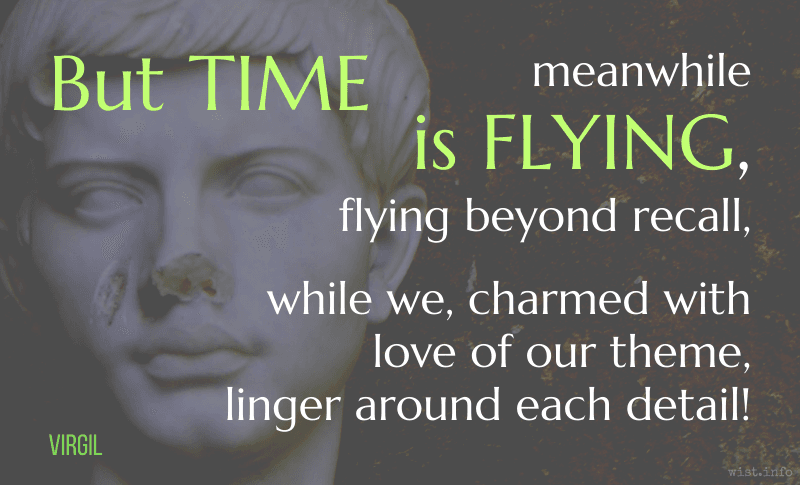
But time meanwhile is flying, flying beyond recall, while we, charmed with love of our theme, linger around each detail!
[Sed fugit interea, fugit inreparabile tempus,
singula dum capti circumvectamur amore.]
Virgil (70-19 BC) Roman poet [b. Publius Vergilius Maro; also Vergil]
Georgics [Georgica], Book 3, l. 284ff (3.284-285) (29 BC) [tr. Fairclough (Loeb) (1916)]
(Source)
After a lengthy description of the springtime mating habits of wild animals and horses, Virgil basically saying, "But I digress ..." (and, a bit more directly, "And there's fifteen minutes you're never getting back").
Origin of the phrase tempus fugit ("time flies").
(Source (Latin)). Alternate translations:But time irreparable hastes away.
Whil'st we with love transported waste the day.
[tr. Ogilby (1649)]But time is lost, which never will renew,
While we too far the pleasing Path pursue;
Surveying Nature, with too nice a view.
[tr. Dryden (1709), l. 448ff]But, while love's copious themes our course delay,
Time flits, irrevocably flits away.
[tr. Nevile (1767), l. 337]But time irreparable flies away,
While in the maze of love we fondly stray.
[tr. Sotheby (1800)]But time flies meanwhile, flies irretrievable, while we, enamoured [of the theme], minutely trace particulars.
[tr. Davidson (1854)]But time is flying, flying, and for aye,
And we, love's prisoners, on his circuit stray.
[tr. Blackmore (1871)]But time meanwhile is flying, flying past recall, while, enamoured of our voyage, we are coasting every point.
[tr. Wilkins (1873)]Fast flies meanwhile the irreparable hour,v
As point to point our charmed round we trace.
[tr. Rhoades (1881)]But lo! while we of love seductive sing,
Time onward flies, nor stays his restless wing.
[tr. King (1882), l. 293ff]But meanwhile Time, Time that cannot be recalled, is fleeting, while enamored of my theme I enter into all details.
[tr. Bryce (1897)]But time fleets meanwhile, fleets beyond recovery, while in loving enthrallment we pass on and on.
[tr. Mackail (1899)]But the time meanwhile is fleeting, is fleeting past recall,
While we hover around each flower of the field that holds us in thrall.
[tr. Way (1912)]But time runs by, irreparable time.
As mastered by my subject's charm, I course
Slowly from point to point.
[tr. Williams (1915)]But time is on the move still, time that will not return,
While we go cruising around this subject whose lore delights us.
[tr. Day-Lewis (1940)]But time slides past, slides past beyond recall,
While, spellbound, we drift off among details.
[tr. Bovie (1956)]But meantime it escapes us, time, never to be recaptured, escapes us while we linger over details, captivated by love. [tr. Miles (1980)]But time is flying, flying beyond recall.
While captivated I linger lovingly,
Touring from this to that.
[tr. Wilkinson (1982)]But meanwhile time flies, flies irretrievably,
while, captivated by passion, I describe each detail.
[tr. Kline (2001)]But meanwhile time flies, it flies beyond recovery
while, captive to each fact, we are carried away by love.
[tr. Lembke (2004)]Meanwhile, it flies, time flies irretrievably,
while captivated with love we ramble through minutiae.
[tr. Johnson (2009)]But meanwhile uncoverable time
Is flying, flying past us while we linger,
Enraptured by our theme.
[tr. Ferry (2015)]
MARVIN: The first ten million years were the worst. And the second ten million, they were the worst too. The third ten million I didn’t enjoy at all. After that I went into a bit of a decline.
Douglas Adams (1952-2001) English author, humorist, screenwriter
Hitchhiker’s Guide to the Galaxy, Phase 1, “Fit the 5th” (BBC Radio) (1978-04-05)
(Source)
When adapted as a novel, Hitchhiker's Guide No. 2, The Restaurant at the End of the Universe, ch. 18 (1980), this line by Marvin the Paranoid Android remained the same.

MACBETH: To-morrow, and to-morrow, and to-morrow,
Creeps in this petty pace from day to day
To the last syllable of recorded time,
And all our yesterdays have lighted fools
The way to dusty death. Out, out, brief candle!
Life’s but a walking shadow, a poor player
That struts and frets his hour upon the stage
And then is heard no more: it is a tale
Told by an idiot, full of sound and fury,
Signifying nothing.William Shakespeare (1564-1616) English dramatist and poet
Macbeth, Act 5, sc. 5, l. 22ff (5.5.22-31) (1606)
(Source)
All streams are but tributary to the ocean, which itself does not stream, and the shores are unchanged but in longer periods than man can measure. Go where we will, we discover infinite change in particulars only, not in generals.
Henry David Thoreau (1817-1862) American philosopher and writer
A Week on the Concord and Marrimack Rivers, “Monday” (1849)
(Source)
The most important thing I learned on Tralfamadore was that when a person dies he only appears to die. He is still very much alive in the past, so it is very silly for people to cry at his funeral. All moments, past, present and future, always have existed, always will exist. The Tralfamadorians can look at all the different moments just that way we can look at a stretch of the Rocky Mountains, for instance. They can see how permanent all the moments are, and they can look at any moment that interests them. It is just an illusion we have here on Earth that one moment follows another one, like beads on a string, and that once a moment is gone it is gone forever.
Kurt Vonnegut, Jr. (1922-2007) American novelist, journalist
Slaughterhouse-Five, ch. 2 (1969)
(Source)
The beginning of Billy's second letter.

It is said an Eastern monarch once charged his wise men to invent him a sentence, to be ever in view, and which should be true and appropriate in all times and situations. They presented him the words: “And this, too, shall pass away.” How much it expresses! How chastening in the hour of pride! — how consoling in the depth of affliction!
Abraham Lincoln (1809-1865) American lawyer, politician, US President (1861-65)
Speech (1859-09-30), Wisconsin State Agricultural Society, Milwaukee
(Source)
The anecdote Lincoln tells comes from a 12th Century Persian tale, which became popular in English in the early 19th Century, particularly through English poet Edward FitzGerald in 1852.

The powerful — be they church leaders or politicians — always seem to forget the one lesson of history: everything changes. The party in power today is not going to be the party in power in a decade, or next year. The group you made a gentleman’s agreement with this election cycle is going to be a completely different group, with different demands, next one. And yet, the powerful insist on trying to weaken the rules that keep them from being still more powerful, as if that could fend off the day of their fall — and the rise of others, probably their opponents, who will operate under the same weakened rules and ugly precedents. Unfortunately, in those sorts of payback situations, nobody’s a winner.
Graham Ericsson (b. 1961) American technologist, writer, aphorist
Journal (2007-08-29)

Thus times do shift, each thing his turn does hold;
New things succeed, as former things grow old.Robert Herrick (1591-1674) English poet
“Ceremonies for Candlemas Eve,” Hesperides, # 892 (1648)
(Source)
Dost thou love Life? then do not squander Time; for that’s the Stuff Life is made of.
Benjamin Franklin (1706-1790) American statesman, scientist, philosopher, aphorist
Poor Richard (1746 ed.)
(Source)
Reprinted in Poor Richard Improved (1758 ed.). This edition was Franklin's final Poor Richard, and he had it prefaced (1757-07-07) by a new character, Father Abraham, who combined a hundred aphorisms from previous Poor Richard almanacs. This preface became reprinted and (often abridged) known separately as "The Way to Wealth."
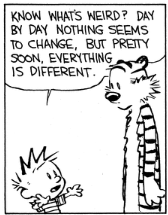
CALVIN: Know what’s weird? Day by day nothing seems to change. But pretty soon, everything is different.