He questioned and answered himself; he glorified and insulted himself. One could hear him from the street monologuing in his hut. The passers-by, who have their own way of appreciating witty people, said: he is an idiot.
[Il s’interrogeait et se répondait ; il se glorifiait et s’insultait. On l’entendait de la rue monologuer dans sa cahute. Les passants, qui ont leur manière à eux d’apprécier les gens d’esprit, disaient : c’est un idiot.]
Victor Hugo (1802–1885) French writer, journalist, human rights activist, politician
The Man Who Laughs [L’Homme qui rit; The Laughing Man; By Order of the King], Part 1, Preliminary, ch. 1 (1.0.1) (1869) [tr. Lavelle (2003)]
(Source)
(Source (French)). Other translations:He questioned himself, answered himself, praised himself, blamed himself. You heard him in the street soliloquizing in his van. The passers-by, who have their own way of appreciating clever people, used to say, "He is an idiot."
[tr. Unknown (1869); Unknown, Authorized (1871)]He questioned himself and answered himself; he glorified himself and insulted himself. He could be heard from the street, indulging in a monologue in his hut. The passers-by, who have their own way of appreciating men of wit, said, "he is an idiot."
[tr. Hapgood (1888)]He questioned and answered himself; he glorified and insulted himself. He could be heard from the street talking to himself in his hut. The passers-by, who have their own way of appreciating clever people, said: "He's a fool."
[tr. Phillips (1894)]
Quotations about:
monologuing
Note not all quotations have been tagged, so Search may find additional quotes on this topic.

Whoever has lived alone, knows to what a degree monologue is innate. The inward word itches. Haranguing space is an outlet. To speak aloud and alone makes the effect of a dialogue with the god which is within one. This was, as is well known, the habit of Socrates. He harangued himself. So did Luther.
[Quiconque a vécu solitaire sait à quel point le monologue est dans la nature. La parole intérieure démange. Haranguer l’espace est un exutoire. Parler tout haut et tout seul, cela fait l’effet d’un dialogue avec le dieu qu’on a en soi. C’était, on ne l’ignore point, l’habitude de Socrate. Il se pérorait. Luther aussi.]
Victor Hugo (1802–1885) French writer, journalist, human rights activist, politician
The Man Who Laughs [L’Homme qui rit; The Laughing Man; By Order of the King], Part 1, Preliminary, ch. 1 (1.0.1) (1869) [tr. Phillips (1894)]
(Source)
(Source (French)). Other translations:Any one who has lived a solitary life knows how deeply seated monologue is in one's nature. Speech imprisoned longs to find a vent. To harangue space is an outlet. To talk out loud when one is alone is as it were to have a dialogue with the divinity within. It was, as is well known, a habit with Socrates; he declaimed to himself. Luther did the same.
[tr. Unknown (1869); Unknown, Authorized (1871)]Any one who has lived alone, knows how natural monologue is. The inner word itches. Haranguing space offers a vent. Speaking aloud and alone, produces the effect of a dialogue with the god which one has within one. This was Socrates' habit, as the reader is aware. He declaimed. So did Luther.
[tr. Hapgood (1888)]Anyone who has lived alone knows how much monologue is in nature. Inner speech itches. Haranguing the space is an outlet. Talking out loud and alone feels like a dialogue with the god within. It was, as we know, Socrates' habit. He used to talk to himself. Luther, too.
[tr. Lavelle (2003)]
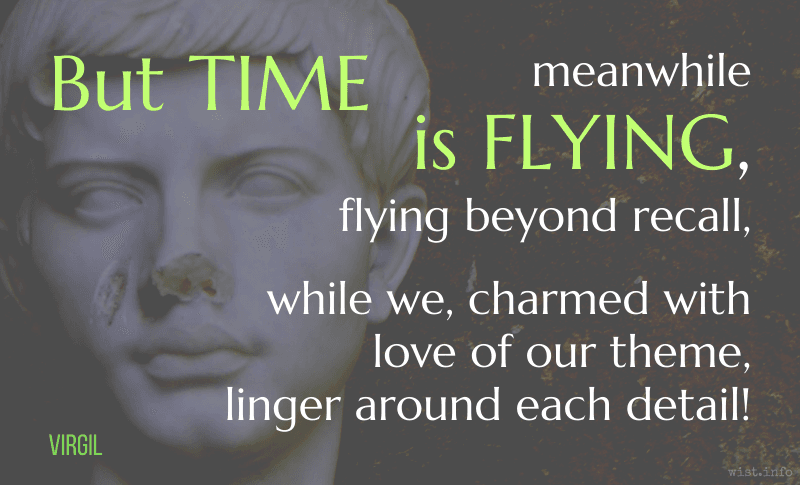
But time meanwhile is flying, flying beyond recall, while we, charmed with love of our theme, linger around each detail!
[Sed fugit interea, fugit inreparabile tempus,
singula dum capti circumvectamur amore.]
Virgil (70–19 BC) Roman poet [b. Publius Vergilius Maro; also Vergil]
Georgics [Georgica], Book 3, l. 284ff (3.284-285) (29 BC) [tr. Fairclough (Loeb) (1916)]
(Source)
After a lengthy description of the springtime mating habits of wild animals and horses, Virgil basically saying, "But I digress ..." (and, a bit more directly, "And there's fifteen minutes you're never getting back").
Origin of the phrase tempus fugit ("time flies").
(Source (Latin)). Other translations:But time irreparable hastes away.
Whil'st we with love transported waste the day.
[tr. Ogilby (1649)]But time is lost, which never will renew,
While we too far the pleasing Path pursue;
Surveying Nature, with too nice a view.
[tr. Dryden (1709), l. 448ff]But, while love's copious themes our course delay,
Time flits, irrevocably flits away.
[tr. Nevile (1767), l. 337]But time irreparable flies away,
While in the maze of love we fondly stray.
[tr. Sotheby (1800)]But time flies meanwhile, flies irretrievable, while we, enamoured [of the theme], minutely trace particulars.
[tr. Davidson (1854)]But time is flying, flying, and for aye,
And we, love's prisoners, on his circuit stray.
[tr. Blackmore (1871)]But time meanwhile is flying, flying past recall, while, enamoured of our voyage, we are coasting every point.
[tr. Wilkins (1873)]Fast flies meanwhile the irreparable hour,v
As point to point our charmed round we trace.
[tr. Rhoades (1881)]But lo! while we of love seductive sing,
Time onward flies, nor stays his restless wing.
[tr. King (1882), l. 293ff]But meanwhile Time, Time that cannot be recalled, is fleeting, while enamored of my theme I enter into all details.
[tr. Bryce (1897)]But time fleets meanwhile, fleets beyond recovery, while in loving enthrallment we pass on and on.
[tr. Mackail (1899)]But the time meanwhile is fleeting, is fleeting past recall,
While we hover around each flower of the field that holds us in thrall.
[tr. Way (1912)]But time runs by, irreparable time.
As mastered by my subject's charm, I course
Slowly from point to point.
[tr. Williams (1915)]But time is on the move still, time that will not return,
While we go cruising around this subject whose lore delights us.
[tr. Day-Lewis (1940)]But time slides past, slides past beyond recall,
While, spellbound, we drift off among details.
[tr. Bovie (1956)]But meantime it escapes us, time, never to be recaptured, escapes us while we linger over details, captivated by love. [tr. Miles (1980)]But time is flying, flying beyond recall.
While captivated I linger lovingly,
Touring from this to that.
[tr. Wilkinson (1982)]But meanwhile time flies, flies irretrievably,
while, captivated by passion, I describe each detail.
[tr. Kline (2001)]But meanwhile time flies, it flies beyond recovery
while, captive to each fact, we are carried away by love.
[tr. Lembke (2004)]Meanwhile, it flies, time flies irretrievably,
while captivated with love we ramble through minutiae.
[tr. Johnson (2009)]But meanwhile uncoverable time
Is flying, flying past us while we linger,
Enraptured by our theme.
[tr. Ferry (2015)]
Something Vimes had learned as a young guard drifted up from memory. If you have to look along the shaft of an arrow from the wrong end, if a man has you entirely at his mercy, then hope like hell that man is an evil man. Because the evil like power, power over people, and they want to see you in fear. They want you to know you’re going to die. So they’ll talk. They’ll gloat.
They’ll watch you squirm. They’ll put off the moment of murder like another man will put off a good cigar.
So hope like hell your captor is an evil man. A good man will kill you with hardly a word.