The honor we receive from those who fear us is not honor.
[L’honneur que nous recevons de ceux qui nous craignent, ce n’est pas honneur.]
Michel de Montaigne (1533–1592) French essayist Essays, Book 1, ch. 42 (1.42), “Of the Inequality among Us [De l’inequalité qui est entre nous]” (1572) [tr. Frame (1943)]
(Source)
This essay and passage were in the first (1580) edition.
When I find myself hotly defending something, when I am, in fact, zealous, it is time for me to step back and examine whatever it is that has me so hot under the collar. Do I think it’s going to threaten my comfortable rut? Make me change and grow? — and growing always causes growing pains. Am I afraid to ask questions?
Madeleine L'Engle (1918–2007) American writer
Speech (1983-11-16), “Dare To Be Creative,” Lecture, Library of Congress, Washington, DC
(Source)
THE DOCTOR: Now drop your weapons, or I’ll kill him with this deadly jelly baby.
LUGO: Kill him, then.
THE DOCTOR: What?
LUGO: Kill him, then.
THE DOCTOR: I don’t take orders from anyone. [Eats jelly baby] Take me to your leader.
Doctor Who (1963–1989) British science fiction television series, original run (BBC)
14×04 “The Face of Evil,” Part 1 (1977-01-01) [w. Chris Boucher]
(Source)
Hope, in this deep and powerful sense, is not the same as joy that things are going well, or willingness to invest in enterprises that are obviously headed for early success, but, rather, an ability to work for something because it is good, not just because it stands a chance to succeed. The more unpropitious the situation in which we demonstrate hope, the deeper that hope is. Hope is definitely not the same thing as optimism. It is not the conviction that something will turn out well, but the certainty that something makes sense, regardless of how it turns out.
Václav Havel (1936–2011) Czech playwright, essayist, dissident, politician Disturbing the Peace: A Conversation with Karel Hvížďala, ch. 5 “The Politics of Hope” (1986) [tr. Wilson (1990)]
(Source)
We have come to depend obsessively on an enormous capability of violence — for security, for national self-esteem, even for economic stability.
Wendell Berry (b. 1934) American farmer, educator, poet, conservationist
Speech (1968-02-10), “A Statement Against the War in Vietnam,” Kentucky Conference on the War and the Draft, University of Kentucky
(Source)
Collected in The Long-Legged House, Part 2 (1969).
The forest was shrinking, but the trees kept voting for the axe because its handle was made of wood and they thought it was one of the them.
Proverbs, Sayings, and Adages
Turkish Proverb
While this particular phrasing is widely labeled online as a Turkish proverb, it is a fairly recent reformulation of a Talmudic or Turkish set of proverbs, and is not credited solely to the Turks.
The Babylonian Talmud (6th Century AD) includes a passage (Sanhedrin, Perek 4, 39B), indicating it was a common proverb:
As this is as people say: From and within the forest comes the ax to it, as the handle for the ax that chops the tree is from the forest itself.
The axe goes to the wood, from whence it borrowed its helve: [the saying] is used against those who are injurious to those from whom they are derived, or from whom they have received their power.
Ray's work continued in reprint for over a century, well-establishing the phrase in English.
In a similar vein, Metin Yurtbaşı's Dictionary of Turkish Proverbs (1993) includes two such phrases, indexed under "Ingratitude". It attributes these back to Ebüzziya Tevfik, Durüb-ı, Emsâl-i Osmaniyye [Ottoman Proverbs] (1885). First:
They struck at the tree with an ax; and the tree said: “The handle is made from my body.”
An ax went into the woods and its handle was of itself.
[Ormana (bir) balta girmiş sapı yine kendisinden (imiş).]
There are a variety of later uses, in books and then in social media, that further evolved the concept into the quotation that leads this entry, which was first tweeted by @mabarsayaaaaa (2018-02-24). In this more political form, it and further variants have also been credited as an African (Yoruba) proverb (often by African tweeters).
For more discussion of the background and origin of this quotation, see:
Certainly the influence of the past is very strong at the present time; it is reviving, and this rejuvenation of a corpse is surprising. It is on the march, and it seems to be winning — a dead thing yet a conqueror! It comes with its army of superstitions, its sword, which is despotism, its banner, which is ignorance, and in recent years it has won ten battles. It advances, laughs, and threatens; it is at our door.
[Le passé, il est vrai, est très fort à l’heure où nous sommes. Il reprend. Ce rajeunissement d’un cadavre est surprenant. Le voici qui marche et qui vient. Il semble vainqueur ; ce mort est un conquérant. Il arrive avec sa légion, les superstitions, avec son épée, le despotisme, avec son drapeau, l’ignorance ; depuis quelque temps il a gagné dix batailles. Il avance, il menace, il rit, il est à nos portes.]
Victor Hugo (1802–1885) French writer, journalist, human rights activist, politician Les Misérables, Part 4 “St. Denis,” Book 7 “Argot,” ch. 4 (4.7.4) (1862) [tr. Denny (1976)]
(Source)
The past, it is true, is very strong at the present hour. It is reviving. This revivification of a corpse is surprising. Here it is walking and advancing. It seems victorious; this dead man is a conqueror. He comes with his legion, the superstitions, with his sword, despotism, with his banner, ignorance; within a little time he has won ten battles. He advances, he threatens, he laughs, he is at our doors.
[tr. Wilbour (1862)]
The past, we grant, is very powerful at the present hour, and is beginning again. This rejuvenescence of a corpse is surprising, yet here it is, marching straight toward us. The dead man appears a victor, and is a conqueror; he arrives with his legion, superstitions; with his sword, despotism; with his banner, ignorance; and during sometime past he has gained ten battles. He advances, he threatens, he laughs, he is at our gates.
[tr. Wraxall (1862)]
The past is very strong, it is true, at the present moment. It censures. This rejuvenation of a corpse is surprising. Behold, it is walking and advancing. It seems a victor; this dead body is a conqueror. He arrives with his legions, superstitions, with his sword, despotism, with his banner, ignorance; a while ago, he won ten battles. He advances, he threatens, he laughs, he is at our doors.
[tr. Hapgood (1887)]
The past, it is true, is very strong right now. It is reviving. This revivification of a corpse is surprising. Here it is walking and advancing. It seems victorious; this dead man is a conqueror. He comes with his legion, superstitions, with his sword, despotism, with his banner, ignorance; within a little time he has won ten battles. He advances, he threatens, he laughs, he is at our door.
[tr. Wilbour/Fahnestock/MacAfee (1987)]
At the moment, it is true, the past is very strong. It is reviving. This rejuvenation of a corpse is astounding. Back on its feet again, here it comes. It looks victorious. This defunct is a conqueror, it arrives with its legion -- superstitions -- with its sword -- despotism -- with its banner -- ignorance. Recently, it has won a dozen battles. It is advancing, threatening, laughing, it is at our gates.
[tr. Donougher (2013)]
Our greatest danger is not from invasion by foreign armies. Our dangers are that we may commit suicide from within by complaisance with evil. Or by public tolerance of scandalous behavior. Or by cynical acceptance of dishonor. These evils have defeated nations many times in human history.
Herbert Hoover (1874–1964) American engineer, bureaucrat, US President (1929–33)
Speech (1951-08-30), “Concerning Honor in Public Life,” Iowa Centennial Celebration, Des Moines, Iowa (radio broadcast)
(Source)
Great perils have this beauty, that they bring to light the fraternity of strangers.
[Les grands périls ont cela de beau qu’ils mettent en lumière la fraternité des inconnus.]
Victor Hugo (1802–1885) French writer, journalist, human rights activist, politician Les Misérables, Part 4 “Saint Denis,” Book 12 “Corinth,” ch. 4 (4.12.4) (1862) [tr. Wilbour (1862)]
(Source)
On the varied Parisians working together at building the barricades.
But to go mad with watching, nights and days, To stand in dread of thieves, fires, runaways
Who filch and fly, — in these if wealth consist, Let me rank lowest on the paupers’ list.
[An vigilare metu exanimem, noctesque diesque
formidare malos fures, incendia, servos,
ne te conpilent fugientes, hoc iuvat? Horum
semper ego optarim pauperrimus esse bonorum.]
Horace (65–8 BC) Roman poet, satirist, soldier, politician [Quintus Horatius Flaccus] Satires [Saturae, Sermones], Book 1, # 1 “Qui fit, Mæcenas,” l. 76ff (1.1.76-79) (35 BC) [tr. Conington (1874)]
(Source)
To wake all nyghte with shiveryng corpse, both nighte and day to quake, To sit in dreade, and stande in awe of theeves, leste they should breake
Perforce thy dores, and robb thy chests, and carve thy weasaunte pype: Leste flickeryng fyer should stroye thy denne, and sease with wastefull grype
Uppon thyne house, leste runagats should pilfer ought from thee, Be these thy gaines, by rytches repte? then this beheste to me
O Iove betake, that I may be devoyde of all those gooddes That brews such baneful broyles, or brings of feare suche gastfull fluddes.
[tr. Drant (1567)]
To sit up and to watch whole dayes and nights, To be out of thy wits with constant frights,
To fear that thieves will steal, or fire destroy, Or servants take thy wealth, and run away.
Is this delightful to thee? then I will Desire to live without those Riches still.
[tr. A. B.; ed. Brome (1666)]
But now to watch all day, and wake all night,
Fear Thieves and Fire, and be in constant fright, If These are Goods, if these are a delight:
I am content, Heavens grant me sleep and ease, If These are Goods, I would be poor of These.
[tr. Creech (1684)]
But, with continual watching almost dead, House-breaking thieves, and midnight fires to dread,
Or the suspected slave's untimely flight With the dear pelf; if this be thy delight,
Be it my fate, so heaven in bounty please, Still to be poor of blessings such as these!
[tr. Francis (1747)]
But what are your indulgencies? All day, All night, to watch and shudder with dismay,
Lest ruffians fire your house, or slaves by stealth Rifle your coffers, and abstract your wealth?
If this be affluence -- this her boasted fruit, Of all such joys may I live destitute!
[tr. Howes (1845)]
What, to watch half dead with terror, night and day, to dread profligate thieves, fire, and your slaves, lest they should run away and plunder you; is this delightful? I should always wish to be very poor in possessions held upon these terms.
[tr. Smart/Buckley (1853)]
Or, pray, is this your joy? To dread thieves' villainy, the firing of your house, or lest your slaves should steal your stores and run away? I'd ever pray to be extremely poor in blessings such as these.
[tr. Millington (1870)]
What, to lie awake half-dead with fear, to be in terror night and day of wicked thieves, of fire, of slaves, who may rob you and run away -- is this so pleasant? In such blessings I could wish ever to be poorest of the poor.
[tr. Fairclough (Loeb) (1926)]
Would you rather stand guard, half-dead with fright, and tremble
Day and night over sneak thieves, fire, or slaves
Running off with your loot? If this craven type seems to lead
The more abundant life, I prefer to be poor.
[tr. Palmer Bovie (1959)]
Staying awake half-dead with terror, living night and day
in fear of ogreish theives, of fires, of slaves who might
rob you as they run away -- you like this life? Of such
advantages I hope I'll always be thoroughly deprived.
[tr. Fuchs (1977)]
Is it pleasant, lying half dead with fear,
Day and night dreading thieves, and fire, and slaves
Who might rob you and run? With wealth
Like that, I'd choose to be poorer than poor!
[tr. Raffel (1983)]
Half dead with fear,
night and day sitting vigil on your loot
to frighten off wicked thieves, arsonists,
slaves fleeing after having robbed you.
Does that please you? Of such benefits
I would always prefer to be most poor.
[tr. Alexander (1999)]
Instead, you lie awake in bed half-dead and stiff
as a plank from fear of broad-daylight thieves, dead-if-night thieves, fire, vengeful and fleeing slaves --
is this the bounty you foreswore pleasure for? If so, let me be poorest of the poor.
[tr. Matthews (2002)]
Or maybe you prefer to lie awake half dead with fright,
to spend your days and nights in dread of burglars or fire
or your own slaves, who may fleece you and then disappear? For myself,
I think I can always do without blessing like those!
[tr. Rudd (2005 ed.)]
Does it give you pleasure to lie awake half dead of fright,
Terrified night and day of thieves or fire or slaves who rob
You of what you have, and run away? I’d always wish
To be poorest of the poor when it comes to such blessings.
[tr. Kline (2015)]
You wretches, detestable on land and sea; you who seek equality with lords are unworthy to live. Give this message to your colleagues: rustics you were and rustics you are still: you will remain in bondage, not as before but incomparably harsher. For as long as we live we will strive to suppress you, and your misery will be an example in the eyes of posterity. How ever, we will spare your lives if you remain faithful and loyal. Choose now which course you want to follow .
Richard II of England (1367–1400) King of England (1377–1399) [Richard of Bordeaux]
Speech (1381-06-22) to the peasant followers of Wat Tyler at Walthamstow, St Alban’s Chronicle (Source)
The religion that has to be supported by law is without value, not only, but a fraud and curse. The religious argument that has to be supported by a musket, is hardly worth making. A prayer that must have a cannon behind it, better never be uttered. Forgiveness ought not to go in partnership with shot and shell. Love need not carry knives and revolvers.
Robert Green Ingersoll (1833–1899) American lawyer, freethinker, orator
Speech (1876-07-04), “Centennial Oration [The Declaration of Independence],” Peoria, Illinois
(Source)
It seems as though nations love perils, and when they have none, they create them.
[Il semble que les peuples aiment les périls, et que lorsqu’ils en manquent, ils s’en créent.]
Joseph Joubert (1754–1824) French moralist, philosopher, essayist, poet Pensées [Thoughts], ch. 16 “Des Mœurs publiques et privées; du Caractère des Nations [On Morality and the Character of Nations],” ¶ 57 (1850 ed.) [tr. Lyttelton (1899), ch. 15, ¶ 26]
(Source)
Have no fear of robbers or murderers. They are external dangers, petty dangers. We should fear ourselves. Prejudices are the real robbers; vices the real murderers. The great dangers are within us. Why worry about what threatens our heads or our purses? Let us think instead of what threatens our souls.
[Ne craignons jamais les voleurs ni les meurtriers. Ce sont là les dangers du dehors, les petits dangers. Craignons-nous nous-mêmes. Les préjugés, voilà les voleurs; les vices, voilà les meurtriers. Les grands dangers sont au dedans de nous. Qu’importe ce qui menace notre tête ou notre bourse! Ne songeons qu’à ce qui menace notre âme.]
Victor Hugo (1802–1885) French writer, journalist, human rights activist, politician Les Misérables, Part 1 “Fantine,” Book 1 “An Upright Man,” ch. 7 (1.1.7) [Bp. Myriel] (1862) [tr. Wilbour/Fahnestock/MacAfee (1987)]
(Source)
Have no fear of robbers or murderers. Such dangers are without, and are but petty. We should fear ourselves. Prejudices are teh real robbers; vices the real murderers. The great dangers are within us. What mater it what threatens our heads or our purses? Let us think only of what threatens our souls.
[tr. Wilbour (1862)]
Never let us fear robbers or murderers. These are external and small dangers; let us fear ourselves; prejudices are the real robbers, vices the true murderers. The great dangers are within ourselves. Let us not trouble about what threatens our head or purse, and only think of what threatens our soul.
[tr. Wraxall (1862)]
Let us never fear robbers nor murderers. Those are dangers from without, petty dangers. Let us fear ourselves. Prejudices are the real robbers; vices are the real murderers. The great dangers lie within ourselves. What matters it what threatens our head or our purse! Let us think only of that which threatens our soul.
[tr. Hapgood (1887)]
We must never fear robbers or murderers. They are dangers from outside, small dangers. It is ourselves we have to fear. Prejudice is the real robber, and vice the real murderer. Why should we be troubled by a threat to our person or our pocket? What we have to beware of is the threat to our souls.
[tr. Denny (1976)]
Never fear robbers or murderers. Thiose are dangers that come from without. Small dangers. Let us fear ourselves. Prejudices are the real robbers. Vices are the real murderers. The great dangers are within us. Never mind what endangers our life or our purse! Let's be mindful only of what endangers our soul.
[tr. Donougher (2013)]
THE DOCTOR: They’re coming. The angels are coming for you, but listen, your life could depend on this: don’t blink. Don’t even blink. Blink and you’re dead. They are fast, faster than you could believe. Don’t turn your back, don’t look away, and don’t blink!
Doctor Who (2005-Present) British science fiction television series, revival (BBC)
03×10 “Blink” (2007-06-09) [w. Steven Moffat]
(Source)
Anxiety is love’s greatest killer. It creates the failures. It makes others feel as you might when a drowning man holds on to you. You want to save him, but you know he will strangle you with his panic.
Anaïs Nin (1903–1977) Catalan-Cuban-French author, diarist
Diary (1947-02)
(Source)
The man of firm and righteous will, No rabble, clamorous for the wrong,
No tyrant’s brow, whose frown may kill, Can shake the strength that makes him strong.
[Iustum et tenacem propositi virum
non civium ardor prava iubentium,
non voltus instantis tyranni
mente quatit solida]
Horace (65–8 BC) Roman poet, satirist, soldier, politician [Quintus Horatius Flaccus] Odes [Carmina], Book 3, # 3, l. 1ff (3.3.1-4) (23 BC) [tr. Conington (1872)]
(Source)
An honest and resolved man, Neither a peoples tumults can,
Neither a Tyrants indignation, Un-center from his fast foundation.
[tr. Fanshaw; ed. Brome (1666)]
Not the rage of the people pressing to hurtful measures, not the aspect of a threatening tyrant can shake from his settled purpose the man who is just and determined in his resolution.
[tr. Smart/Buckley (1853)]
He that is just, and firm of will Doth not before the fury quake
Of mobs that instigate to ill,
Nor hath the tyrant's menace skill His fixed resolve to shake.
[tr. Martin (1864)]
Not the rage of the million commanding things evil,
Not the doom frowning near in the brows of the tyrant, Shakes the upright and resolute man In his solid completeness of soul.
[tr. Bulwer-Lytton (1870)]
Neither the fury of the populace, commanding him to do what is wrong, nor the face of the despot which confronts him, [...] shakes from his solid resolve a just and determined man.
[tr. Elgood (1893)]
The just man, in his purpose strong,
No madding crowd can bend to wrong.
The forceful tyrant's brow and word,
[...] His firm-set spirit cannot move.
[tr. Gladstone (1894)]
Him who is just, and stands to his purpose true.
Not the unruly ardour of citizens Shall shake from his firm resolution, Nor visage of the oppressing tyrant.
[tr. Phelps (1897)]
The upright man holding his purpose fast,
No heat of citizens enjoining wrongful acts, No overbearing despot's countenance, Shakes from his firm-set mind.
[tr. Garnsey (1907)]
The man that's just and resolute of mood
No craze of people's perverse vote can shake, Nor frown of threat'ning monarch make To quit a purposed good.
[tr. Marshall (1908)]
The man tenacious of his purpose in a righteous cause is not shaken from his firm resolve by the frenzy of his fellow citizens bidding what is wrong, not by the face of threatening tyrant.
[tr. Bennett (Loeb) (1912)]
Who loves the Right, whose will is resolute,
His purpose naught can shake — nor rage of brute Mob bidding him work evil; nor the eye Of threatening despot
[tr. Mills (1924)]
A mob of citizens clamouring for injustice,
An autocrat's grimace of rage [...] cannot stagger
The just and steady-purposed man.
[tr. Michie (1963)]
The man who knows what's right and is tenacious
In the knowledge of what he knows cannot be shaken. Not by people righteously impassioned In a wrong cause, and not by menacings
Of tyrants' frowns.
[tr. Ferry (1997)]
The just man, tenacious in his resolve,
will not be shaken from his settled purpose by the frenzy of his fellow citizens imposing that evil be done,
or by the frown of a threatening tyrant.
[tr. Alexander (1999)]
The passion of the public, demanding what
is wrong, never shakes the man of just and firm intention, from his settled purpose, nor the tyrant’s threatening face.
[tr. Kline (2015)]
Neither the passion of citizens demanding crooked things,
Not the face of a threatening tyrant Shakes the man who is righteous and set in purpose From his strong mind.
[tr. Wikisource (2021)]
Fear of change is, no doubt, in all of us, but it most afflicts the man who fears that any change must lead to loss of his wealth and status. When this fear becomes inordinate, he will, if he has political power, abrogate such things as civil rights and the rule of law, using the argument that he abrogates them only to preserve them. In my own country, the government, in order to preserve Christian civilization, uses methods incompatible with Christianity and abrogates values which are essential to any civilization which calls itself Christian. If only a man would say, “I do this because I’m afraid,” one could bear it; but when he says, “I do this because I’m good,” that is a bit too much.
Alan Paton (1903–1988) South African author, activist
“The Challenge of Fear,” The Saturday Review (1967-09-09)
(Source)
Thou knowest that since the invention of gun-powder, there is no place impregnable: that is to say, Usbek, there is no longer any asylum upon earth against injustice and violence. I always tremble for fear at last some invention will be found out of a shorter way to destroy mankind, and to depopulate whole nations and whole kingdoms.
[Tu sais que, depuis l’invention de la poudre, il n’y a plus de places imprenables ; c’est-à-dire, Usbek, qu’il n’y a plus d’asile sur la terre contre l’injustice et la violence. Je tremble toujours qu’on ne parvienne à la fin à découvrir quelque secret qui fournisse une voie plus abrégée pour faire périr les hommes, détruire les peuples et les nations entières.]
Charles-Lewis de Secondat, Baron de Montesquieu (1689–1755) French political philosopher Persian Letters [Lettres Persanes], Letter 106, Rhedi to Usbek (1721) [tr. Ozell (1760 ed.), # 105]
(Source)
Thou knowest, that since the Invention of gun-powder, there is no place impregnable; that is to say, Ushek, that there is not any longer an asylum upon earth against injustice and violence. I always tremble, left they should at arrive at last, at the discovery of some secret, which may furnish them with a shorter way to destroy mankind, and to depopulate whole nations and whole kingdoms.
[tr. Floyd (1762), # 105]
You know that since the invention of gunpowder no place is impregnable; that is to say, Usbek, that there is no longer upon the earth a refuge from injustice and violence. I dread always lest they should at last discover some secret which will furnish them with a briefer method of destroying men, by killing them off wholesale in tribes and nations.
[tr. Davidson (1891)]
You know that, since the invention of gunpowder, no fortress is impregnable; that is to say, Usbek, that there is no longer upon earth an asylum against injustice and violence. I am always in terror lest some secret or other should be at length discovered that will not only kill men, but destroy entire tribes and nations.
[tr. Betts (1897)]
You know that since the invention of gunpowder there have been no impregnable places; and this is to say, Usbek, that there is no longer an asylum from injustice and violence any¬ where on the earth. I am in constant terror that ultimately someone will succeed in discovering some secret which will furnish an even more efficient way to kill men, by destroying whole peoples and entire nations.
[tr. Healy (1964)]
You know, since the invention of gunpowder, no fortification is impregnable; in other words, Usbek, there no longer exists, anywhere on earth, any asylum from injustice and violence. I live in fear that men of science will eventually discover some secret which would offer a faster day to kill people, destroy races, and wipe out entire nations.
[tr. Mauldon (2008)]
You know that since the invention of gunpowder, no place is impregnable -- and that is to say, Usbek, that there is no place on earth where we are safe from injustice and violence. I tremble at the thought that eventually someone will discover some new secret that will lead to an even more efficient way to kill even more people, perhaps to destroy entire populations and nations.
[tr. MacKenzie (2014), # 105]
At long last, citizens, Lucius Catilina, blazing with insolence, breathing forth blasts of every audacious rascality, outrageously plotting to overthrow his country, menacing yourselves and our city with fire and sword, has been expelled from Rome by our action, or allowed to leave, or bidden farewell as he took his departure. Gone, retired, run away, broken out, express it how you will.
[Tandem aliquando, Quirites, L. Catilinam, furentem audacia, scelus anhelantem, pestem patriae nefarie molientem, vobis atque huic urbi ferro flammaque minitantem ex urbe vel eiecimus vel emisimus vel ipsum egredientem verbis prosecuti sumus. Abiit, excessit, evasit, erupit.]
Marcus Tullius Cicero (106–43 BC) Roman orator, statesman, philosopher Orationes in Catilinam [Catilinarian Orations], No. 2, § 1, cl. 1 (2.1.1) (63-11-09 BC) [tr. Grant (1960)]
(Source)
Informing the Senate that Catiline and many of his co-conspirators had fled Rome the day before.
At last with much ado, have we either expelled, or let out, or else waited upon L. Catiline of himself, going out of Town, foaming with rage, breathing Treason, unnaturally plotting the destruction of his Countrey, and menacing you and this City with Fire and Sword. He is gone, he is got his way, he is escaped, he is broke loose.
[tr. Wase (1671)]
At length, my fellow-citizens, Lucius Catiline, that nefarious traitor, burning with frantic fury, breathing vengeance and destruction; that public enemy, who meditated the ruin of his country, and threatened this city with sword and fire; that monster of iniquity has sounded his retreat. He is gone; he is fled; he has escaped; he has disappeared.
[tr. Sydney (1795)]
At length, O Romans, we have dismissed from the city, or driven out, or, when he was departing of his own accord, we have pursued with words, Lucius Catiline, mad with audacity, breathing wickedness, impiously planning mischief to his country, threatening fire and sword to you and to this city. He is gone, he has departed, he has disappeared, he has rushed out.
[tr. Yonge (1856)]
At length, at last, oh Romans! we have either cast out of the city Lucius Catiline, raging with audacity, panting after crime, impiously attempting the destruction of our native land, threatening you and this city with sword and with flame, or we have sent him forth, or we have followed with words him when going out. He has gone away, he has departed, he has escaped, he has burst forth.
[tr. Mongan (1879)]
At length, Romans, either we have cast out of the city, L. Catiline, raging with audacity, panting after crime, attempting nefariously the pest (destruction) of the country, threatening sword and flame to you and to this city, or we have sent (him) out, or we have followed with words himself going out. He has departed, he has gone out, he has escaped, he has burst out.
[tr. Underwood (1885)]
At length, finally, Romans, L. Catiline, raging with insolence, breathing out crime, attempting impiously the ruin of the country, threatening sword and flame to you and to this city, either we have cast out of the city, or we have sent (him) out, or with words we have followed him going himself. He has departed, he has gone forth, he has escaped, he has burst out.
[tr. Dewey (1916)]
He is gone, he has fled, he has eluded our vigilance, he has broken through our guards.
[Source]
But if you have a fear of unpopularity, is that arising from the imputation of vigour and boldness, or that arising from that of inactivity and indecision most to be feared? When Italy is laid waste by war, when cities are attacked and houses in flames, do you not think that you will be then consumed by a perfect conflagration of hatred?
[Sed si quis est invidiae metus, non est vehementius severitatis ac fortitudinis invidia quam inertiae ac nequitiae pertimescenda. An, cum bello vastabitur Italia, vexabuntur urbes, tecta ardebunt, tum te non existimas invidiae incendio conflagraturum]
Marcus Tullius Cicero (106–43 BC) Roman orator, statesman, philosopher Orationes in Catilinam [Catilinarian Orations], No. 1, § 11, cl. 29 (1.11.29) (63-11-08 BC) [tr. Yonge (1856)]
(Source)
Speaking (aloud, rhetorically) to himself about his concerns of public reaction to his acting so passionately against Cataline's conspiracy.
But if there be any fear of Envy, is the Censure of Severity and Courage more greatly to be feared, than that of Baseness and Cowardise? Do you not think, when Italy shall be made desolate with War, the Cities plundered, the Houses a-fire, you shall then fall under a flagrant Envy?
[tr. Wase (1671)]
If fear is to operate, which do you think is most to be dreaded, reproach for cowardice, or censure for magnanimity? When Italy is laid waste; when her cities are taken by storm; when her temples and mansions are wrapt in flames; it is then your danger will begin; it is then that the clamours of mankind will be loud against you.
[tr. Sydney (1795)]
But if there is any fear of odium, whether should the odium resulting from severity and determinati0on be dreaded more violently than that of indolence and wickedness? Whether, when Italy shall be ravaged by war, when the cities shall be harassed, when roofs shall be burning, dost thou not think that thou then will burn with a conflagration of odium?
[tr. Mongan (1879)]
But if there is any fear of envy (displeasure), whether is the envy of severity and of fortitude to be feared more violently, than (that) of inactivity and of negligence? Whether, when Italy shall be devastated with war, cities shall be burned, roofs (houses) shall be on fire: dost thou think thyself not (to be) about to burn then with a conflagration of envy (unpopularity)?
[tr. Underwood (1885)]
But if there is any fear of ill will, is the ill will because of strictness and courage to be feared more strongly, than (that) because of inactivity and negligence? When Italy shall be devastated with war, cities shall be harassed, roofs [houses] shall burn: do you think (you) yourself will not (about to) be consumed then with a conflagration of ill will?
[tr. Dewey (1916)]
If the question of inviting disapproval arises at all, the unpopularity resulting from firmness and determination is no more to be dreaded than the opprobrium produced by culpable failure to act. For when Italy is to be ravaged by war, when cities are assaulted and houses gutted by fire, do you not see how utterly the flames of hatred will consume you then?
[tr. Grant (1960)]
But if there is any fear of hatred, it is not hatred of harshness and firmness requiring to be feared more violently than (hatred) of idleness and worthlessness. Or when Italy is laid waste to, the cities will be harassed, the buildings will burn, then do you not think that you will be consumed by burning hatred?
[IB Notes]
Any man with few needs appears a menace to the rich for he is always in a position to escape from them, and the tyrants see that thus they lose a slave.
[Tout homme qui a peu de besoins semble menacer les riches d’être toujours prêt à leur échapper. Les tyrans voient par là qu’ils perdent un esclave.]
Nicolas Chamfort (1741–1794) French writer, epigrammist (b. Nicolas-Sébastien Roch) Products of Perfected Civilization [Produits de la Civilisation Perfectionée], Part 1 “Maxims and Thoughts [Maximes et Pensées],” ch. 3, ¶ 266 (1795) [tr. Mathers (1926)]
(Source)
Any man whose needs are few seems to threaten the rich with the possibility of his escaping them. Tyrants are thereby faced with the prospect of losing a slave.
[tr. Merwin (1969)]
Any man who has few needs seems to threaten the rich with his readiness to escape from them. Thereby tyrants realize that they are losing a slave.
[tr. Pearson (1973)]
Every man who has few needs seems to menace the wealthy with the constant threat of escaping from them. Tyrants see in such a proposition the loss of a slave.
[tr. Siniscalchi (1994)]
Anyone whose needs are small seems threatening to the rich, because he's always ready to escape their control. This is how tyrants recognize that they're losing a slave.
[tr. Parmée (2003)]
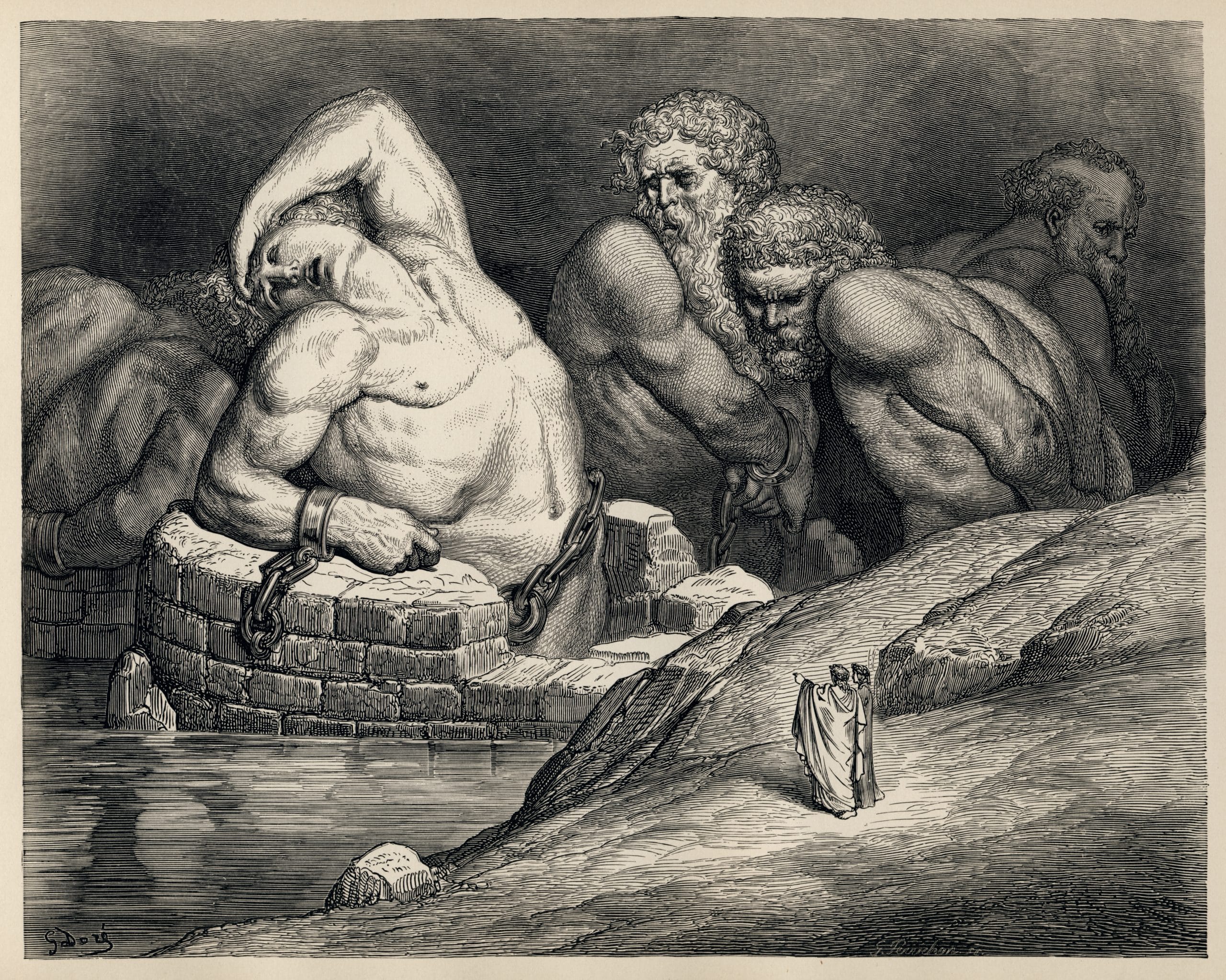
For when the faculty of intellect is joined with brute force and with evil will, no man can win against such an alliance.
[Ché dove l’argomento de la mente s’aggiugne al mal volere e a la possa, nessun riparo vi può far la gente.]
Dante Alighieri (1265–1321) Italian poet The Divine Comedy [Divina Commedia], Book 1 “Inferno,” Canto 31, l. 55ff (31.55) (1309) [tr. Musa (1971)]
(Source)
Why Nature no longer allows human-like giants, while still producing whales and elephants.
For where the mind to bad Intention's join'd,
And with a Pow'r what's ill design'd to act,
None can himself from such a force defend.
[tr. Rogers (1782), l. 49ff]
But not the forest tribes, nor finny race,
With equal rage their native walks deface, As he whose deadly arm by Reason's light
Directed falls, and mocks the warding hand;
Conspiring realms in vain his pow'r withstand, In vain embattled hosts defend their right.
[tr. Boyd (1802), st. 9]
For when brute force
And evil will are back’d with subtlety,
Resistance none avails.
[tr. Cary (1814)]
For discourse of mind,
Wedded with power and inbred lust of wrong,
Had left nor help nor rescue for mankind.
[tr. Dayman (1843)]
For where [the instrument] of [the] mind is joined to evil will and potency, men can make no defence against it.
[tr. Carlyle (1849)]
For when a reasoning and a subtle mind Is joined, besides, to evil will and power, Who can resist? -- for all defence must cower.
[tr. Bannerman (1850)]
For when the reasoning faculty combines With evil will and with destructive pow'r, Then there remains no more defence for man.
[tr. Johnston (1867)]
For where the argument of intellect Is added unto evil will and power, No rampart can the people make against it.
[tr. Longfellow (1867)]
For where the equipment of the mind is joined to illwill and to power, folk can make no rampart against it.
[tr. Butler (1885)]
For where the assistance of the intellect Is added unto evil will and power, 'Gainst it no refuge could mankind erect.
[tr. Minchin (1885)]
For where the faculty of the mind is added to evil will and to power, the human race can make no defense against it.
[tr. Norton (1892)]
For where the force of intellect is joined to evil will, and power to do such will, mankind is helpless to find resource against it.
[tr. Sullivan (1893)]
For, where the equipment and the use of reason Are joined to ill intent and power of action, No sort of refuge can folk make against it.
[tr. Griffith (1908)]
For where the equipment of the mind is joined to evil will and to power men can make no defence against it.
[tr. Sinclair (1939)]
For if with the mind's instrument unite Power and an evil purpose both at once, Men have no means against such force to fight.
[tr. Binyon (1943)]
For where the instrument of thinking mind Is joined to strength and malice, man’s defence Cannot avail to meet those powers combined.
[tr. Sayers (1949)]
For where the instrument of intelligence is added to brute power and evil will, mankind is powerless in its own defense.
[tr. Ciardi (1954)]
For where the instrument of the mind is added to an evil will and to great power, men can make no defense against it.
[tr. Singleton (1970)]
For where the mind’s acutest reasoning is joined to evil will and evil power, there human beings can’t defend themselves.
[tr. Mandelbaum (1980)]
For, where the argument of reason is
Joined with an evil will and potency,
There is no possible defence for man.
[tr. Sisson (1981)]
The power of the mind, along with that Of immense strength, upon an evil will Then people will have no defense from it.
[tr. Pinsky (1994), l. 52ff]
For where sharpness of mind is joined to evil will and power, there is no defence people can make against them.
[tr. Durling (1996)]
Where the instrument of mind is joined to ill will and power, men have no defence against it.
[tr. Kline (2002)]
For when the powers of working intellect are wed to strength and absolute illwill, then humans cannot find a place to hide.
[tr. Kirkpatrick (2006)]
For when the power of thought is coupled with ill will and naked force there is no refuge from it for mankind.
[tr. Hollander/Hollander (2007)]
For when the thinking powers of human brains Are tools of malicious will and enormous strength, Smaller creatures like men have no defense.
[tr. Raffel (2010)]
For only when ill will and massive strength
Are joined with mental power does it arise
That the invincible is born.
[tr. James (2013), l. 58ff]
When a sensible man
has a good cause to defend, to be eloquent
is no great feat. Your tongue is so nimble
one might think you had some sense, but your words
contain none at all. The powerful man
who matches insolence with glibness is worst than a fool.
He is a public danger!
When the wise man hath found a specious topic
On which to argue, he with ease may frame
An eloquent harangue. Your tongue indeed
Is voluble like theirs who reason well,
But in your language no discretion reigns.
He who possesses courage, sovereign power. A
And fluency of speech, if not endued
With wisdom, is an evil citizen.
[tr. Wodhull (1809)]
Whenever a wise man takes a good occasion for his speech, it is not a great task to speak well. You have a rapid tongue as though you were sensible, but there is no sense in your words. A man powerful in his boldness, one capable of speaking well, becomes a bad citizen in his lack of sense.
[tr. Buckley (1850)]
'Tis easy to be eloquent, for him
That's skilled in speech, and hath a stirring theme.
Thou hast the flowing tongue of a wise man,
But there's no wisdom in thy fluent words;
For the bold demagogue, powerful in speech,
Is but a dangerous citizen lacking sense.
[tr. Milman (1865)]
When wise men reason from sound principles,
They find it no hard task to reason well.
Thy tongue’s as fluent as the wisest man’s,
And yet thy argument is void of sense.
[tr. Rogers (1872), l. 253ff]
Whenso a man of wisdom finds a good topic for argument, it is no difficult matter to speak well; but thou, though possessing a glib tongue as if endowed with sense, art yet devoid thereof in all thou sayest. A headstrong man, if he have influence and a capacity for speaking, makes a bad citizen because he lacks sense.
[tr. Coleridge (1891)]
Whene'er a wise man finds a noble theme
For speech, 'tis easy to be eloquent.
Thou -- roundly runs thy tongue, as thou wert wise;
But in these words of thine sense is there none.
The rash man, armed with power and ready of speech,
Is a bad citizen, as void of sense.
[tr. Way (1898)]
Good words, my son, come easily, when he
That speaks is wise, and speaks but for the right.
Else come they never! Swift are thine, and bright
As though with thought, yet have no thought at all.
[tr. Murray (1902)]
Give a wise man an honest brief to plead
and his eloquence is no remarkable achievement.
But you are glib; your phrases come rolling out
smoothly on the tongue, as though your words were wise
instead of foolish. The man whose glibness flows
from his conceit of speech declares the thing he is:
a worthless and a stupid citizen.
[tr. Arrowsmith (1960)]
When a wise man chooses a sane basis
for his arguments, it is no great task to speak well;
but you have a glib tongue, as though in your right mind,
yet in your words there is no real sense.
The man who is influential by sheer aggressiveness, and knows how to speak,
proves to be a bad citizen -- for he lacks sanity.
[tr. Kirk (1970)]
When a clever man has a plausible theme to argue, to be eloquent is no great feat. But though you seem, by your glib tongue, to be intelligent, yet your words are foolish. Power and eloquence in a headstrong man can only lead to folly; and such a man is a danger to the state.
[tr. Vellacott (1973)]
Oh it's so easy for some to make speeches.
They pick a soft target and the words rush out.
Now listen you. Your tongue runs loose
Makes a plausible sound and might
Almost be taken for sense. But you have none.
Your glibness flows from sheer conceit.
Arrogant, over-confident and a gift -- yes --
A gift for phrases, and that makes you a great
Danger to your fellow men.
[tr. Soyinka (1973)]
A man who takes a fair basis for speaking,
a wise man, has no trouble speaking well;
you have a well-wheeled tongue, as though thinking,
but in the words you speak there is no thought.
A man empowered by daring and able to speak
becomes a bad citizen, devoid of reason.
[tr. Neuburg (1988)]
When some wise man has a fair cause
o present, to speak well is easy.
You have a tongue, glib like thought,
But no sense lies in your words.
The man that rashness prompts to speak
Proves an evil citizen and senseless.
[tr. Blessington (1993)]
Whenever a wise man sets out to argue an honest case
it's no great undertaking to argue well.
Your tongue runs smooth like a wheel, as if you were a man of reason,
but your words reveal no reason.
If he behaves recklessly, an able and articulate man
turns out to be a bad citizen because he lacks good sense.
[tr. Esposito (1998)]
When a prudent speaker takes up a noble cause, he’ll have no great trouble to speak well. You, on the other hand, have a tongue that runs on smoothly and sounds intelligent. But what it says is brainless. True, boldness can help a man speak powerfully, but he’ll turn out bad for the city because he'll have no sense.
[tr. Woodruff (1999)]
It's no great task to speak well, when a man's
Intelligent and starts well with good words.
But you: your tongue runs smoothly, as if you had
Some understanding. Yet your words are senseless.
A man like you, whose strength is that he's bold,
Who's good at speaking, too, can only make
a bad citizen -- for he lacks good sense.
[tr. Gibbons/Segal (2000)]
When a wise man has a good case to argue, eloquence is easy. As for you, though you think yourself clever and have a ready tongue, there is no intelligence in what you say. [A man whose power lies in brashness and who is a fluent speaker becomes a bad citizen if he lacks sense.]
[tr. Kovacs (2002)]
As for you -- your tongue is quick and your talk runs as if you had wit, but there is none in what you say. A man who confuses impudence with strength is a fool.
[tr. Rao/Wolf (2004)]
When a wise man is given the opportunity to speak, it’s no big problem to speak the truth. You, Pentheus, you are, of course an articulate man, or so you think, but your words lack logic. Audacity, strength and eloquence all on their own, make for a bad citizen -- a stupid one.
[tr. Theodoridis (2005)]
When a man who's wise in words starts his speech
from a proper course, it is no great task to speak well;
and you, spinning a tricky tongue, seem to make sense,
but there is no sense in what you are saying;
and a man who is bold, powerful and a clever speaker
makes for a bad citizen, if he has not the proper mind.
[tr. Valerie (2005)]
When a man of wisdom has good occasion to speak out and takes the opportunity, it's not that hard to give an excellent speech. You've got a quick tongue and seem intelligent, but your words don't make any sense at all. A fluent orator whose power comes from self-assurance and from nothing else makes a bad citizen, for he lacks sense.
[tr. Johnston (2008)]
When a wise man has an honest case to plead, then eloquence, I find, is very easy to achieve. You think yourself clever, and have a smooth tongue, but, your words are foolish. The man whose power lies in his conceit does not make a good citizen.
[tr. Robertson (2014)]
It’s no great task for a wise man to speak well when the time comes, if he picks it carefully.
You hold yourself as if you’re one of these ready-tongued individuals. You’re not. Your words lack sense behind them.
Even the boldest speaker fails as a citizen when his words lack sense.
[tr. Pauly (2019)]
Wisdom from the wise surprises no one. But your clever tongue makes yuou seem wise when you have no understanding. Rash eloquence is society's disaster.
[tr. Behr/Foster (2019)]
Whenever a sophos man takes a good occasion for his speech, it is not a great task to speak well. You have a fluent tongue as though you are sensible, but there is no sense in your words. A bold and powerful man, one capable of speaking well, becomes a kakos citizen if he lacks sense.
[tr. Buckley/Sens/Nagy (2020)]
Men who want to be feared must necessarily fear the very people who fear them.
[Etenim qui se metui volent, a quibus metuentur, eosdem metuant ipsi necesse est.]
Marcus Tullius Cicero (106–43 BC) Roman orator, statesman, philosopher De Officiis [On Duties; On Moral Duty; The Offices], Book 2, ch. 7 (2.7) / sec. 24 (44 BC) [tr. Edinger (1974)]
(Source)
There is no hate without fear. Hate is crystallized fear, fear’s dividend, fear objectivized. We hate what we fear and so where hate is, fear will be lurking. Thus we hate what threatens our person, our liberty, our privacy, our income, our popularity, our vanity and our dreams and plans for ourselves.
Cyril Connolly (1903–1974) English intellectual, literary critic and writer. The Unquiet Grave, Part 3 “La Clé des Chants” (1944)
(Source)
If there were
Of divers-languag’d men an army here
Of fifty companies, all driving hence
Thy sheep and oxen, and with violence
Offer’d to charge us, and besiege us round,
Thou shouldst their prey reprise, and them confound.
[tr. Chapman (1616)]
Though fifty bands of men should us oppose,
You should their herds of cattle drive away.
[tr. Hobbes (1675), l. 37ff]
Were we hemm’d around
By fifty troops of shouting warriors bent
To slay thee, thou should’st yet securely drive
The flocks away and cattle of them all.
[tr. Cowper (1792), l. 54ff]
Though fifty bands stood threatening thee and me,
All breathing slaughter, their fat kine and sheep
Thou shouldst drive off, and take their wealth in fee.
[tr. Worsley (1861), st. 6]
If fifty troops of men, as good as thou
Surround us twain, and strive to slay in battle,
Of their fat kine and sheep should'st thou be captor!
[tr. Bigge-Wither (1869)]
Though fifty bands of mortals that in speech
Articulate use their tongues around us rose
In conflict fierce to kill us both intent,
Still should'st though prove the man that all those beeves
And fatten'd flocks should to thye homestall drive.
[tr. Musgrave (1869), l. 70ff]
Even should fifty companies of mortal men compass us about eager to slay us in battle, even their kine shouldst thou drive off and their brave flocks.
[tr. Butcher/Lang (1879)]
If fifty bands of menfolk, word-speaking wights that are,
Stood round about us, eager for our slaying in the war,
Yet their kine shouldst though be driving and their goodly fatted sheep.
[tr. Morris (1887)]
Should fifty troops of mortal men stand round about us, eager in the fight to slay, you still might drive them away from their oxen and sturdy sheep.
[tr. Palmer (1891)]
Even though there were fifty bands of men surrounding us and eager to kill us, you should take all their sheep and cattle, and drive them away with you.
[tr. Butler (1898)]
If fifty troops of mortal men should stand about us, eager to slay us in battle, even their cattle and goodly sheep shouldest thou drive off.
[tr. Murray (1919)]
Though fifty troops of humans hemmed us round, all mad to kill outright, yet shuld you win through to lift their flocks and herds.
[tr. Lawrence (1932)]
If you and I were surrounded by fifty companies of men-at-arms, all thirsting for your blood, you could drive away their cows and sheep beneath their very noses.
[tr. Rieu (1946)]
Even though there were fifty battalions of mortal people
standing around us, furious to kill in the spirit of battle,
even so you could drive away their cattle and fat sheep.
[tr. Lattimore (1965)]
Even if fifty bands of mortal fighters
closed around us, hot to kill us off in battle,
still you could drive away their herds and sleek flocks!
[tr. Fagles (1996)]
Even if there were fifty squadrons of armed men
All around us, doing their mortal best to kill us,
You would still be able to run off with their cattle!
[tr. Lombardo (2000)]
If in fact there were fifty battalions of men who are mortal
Standing around us, eagerly striving to kill us in battle,
even from them you would drive their cattle away and their fat sheep.
[tr. Merrill (2002)]
You and I could be surrounded by fifty companies of men-at-arms, all thirsting for our blood, but you would still drive away their cows and sheep.
[tr. DCH Rieu (2002)]
If we were ambushed, surrounded by not one but fifty gangs of men who hoped to murder us -- you would escape, and even poach their sheep and cows.
[tr. Wilson (2017)]
If there were fifty troops of mortal men in ambush all around us, firmly determined to kill us, nevertheless even then you'd drive off their cattle and fattened sheep.
[tr. Green (2018)]
Even were fifty troops around us, to kill us, you'd end by driving off their cattle!
[tr. Green (2018), summary]
If there were fifty groups
of other men standing here around us,
intent on slaughter, even so, I say,
you’d still drive off their cattle and fine sheep.
[tr. Johnston (2019), l. 55ff]
They had all been brought up, as we still are, to believe in “the deterrent.” Firm resolve, a readiness to threaten war, would avert war itself. Some Power would always give way. This usually happened, indeed happened so often that the wisdom of the method seemed sure. In 1914 all the Powers, for different reasons, expected the yielding to come from the other side.
A. J. P. Taylor (1906–1990) British historian, journalist, broadcaster [Alan John Percivale Taylor]
“What Else Indeed?” New York Review of Books (5 Aug 1965)
(Source)
When the weak want to give an impression of strength they hint meaningfully at their capacity for evil. It is by its promise of a sense of power that evil often attracts the weak.
Eric Hoffer (1902–1983) American writer, philosopher, longshoreman Passionate State of Mind, Aphorism 91 (1955)
(Source)
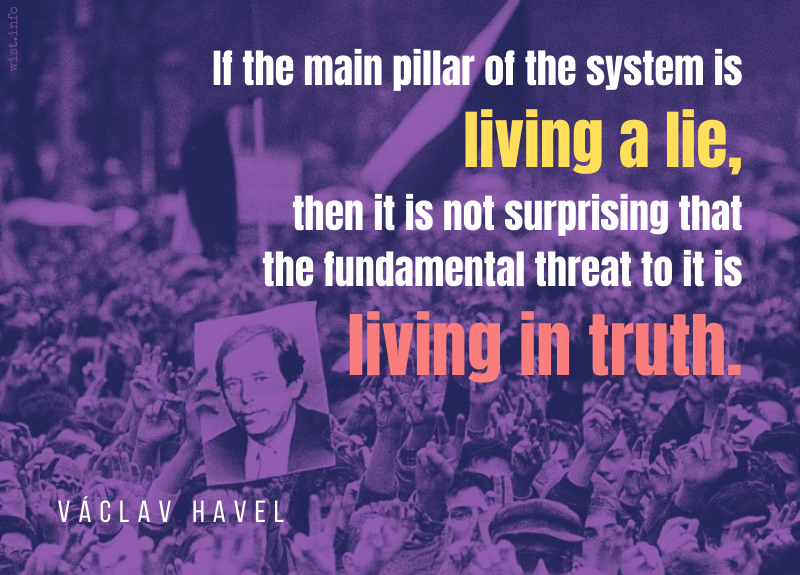
If the main pillar of the system is living a lie, then it is not surprising that the fundamental threat to it is living in truth. This is why it must be suppressed more severely than anything else.
Václav Havel (1936–2011) Czech playwright, essayist, dissident, politician
Essay (1978-10), “The Power of the Powerless,” ch. 7 [tr. Wilson], The Power of the Powerless [ed. John Keane] (1985)
(Source)
But don’t you know, there are some things that can beat smartness and foresight? Awkwardness and stupidity can. The best swordsman in the world doesn’t need to fear the second best swordsman in the world; no, the person for him to be afraid of is some ignorant antagonist who has never had a sword in his hand before; he doesn’t do the thing he ought to do, and so the expert isn’t prepared for him; he does the thing he ought not to do: and often it catches the expert out and ends him on the spot.
Mark Twain (1835–1910) American writer [pseud. of Samuel Clemens] A Connecticut Yankee in King Arthur’s Court, ch. 34 (1889)
(Source)
Something Vimes had learned as a young guard drifted up from memory. If you have to look along the shaft of an arrow from the wrong end, if a man has you entirely at his mercy, then hope like hell that man is an evil man. Because the evil like power, power over people, and they want to see you in fear. They want you to know you’re going to die. So they’ll talk. They’ll gloat. They’ll watch you squirm. They’ll put off the moment of murder like another man will put off a good cigar. So hope like hell your captor is an evil man. A good man will kill you with hardly a word.
Terry Pratchett (1948–2015) English author
Discworld No. 15, Men at Arms (1993)
(Source)
It’s one of those weird truths you learn early on as police that quite a high percentage of the public have all the survival instinct of a moth in a candle factory. They run the wrong way, they refuse to move, some will run toward the danger, and others will instantly whip out their phones and take footage.
Ben Aaronovitch (b. 1964) British author False Value (2020)
(Source)
If we stay strong, then I believe we can stabilize the world and have peace based on force. Now, peace based on force is not as good as peace based on agreement, but in the terrible world in which we live, in the world where the Russians have enslaved many millions of human beings, in the world where they have killed men, I think that for the time being the only peace we can have is the peace based on force.
Edward Teller (1908–2003) Hungarian-American theoretical physicist
“Fallout and Disarmament: A Debate Between Linus Pauling and Edward Teller,” KQED-TV, San Francisco (20 Feb 1958)
(Source)
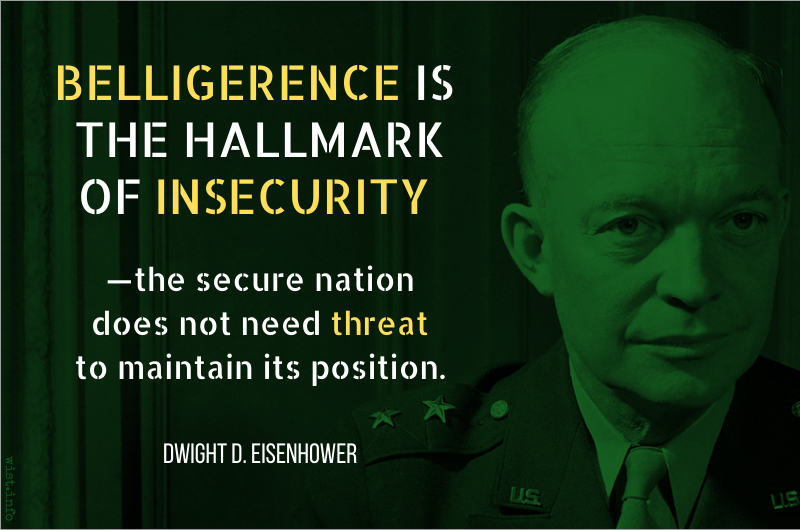
Belligerence is the hallmark of insecurity — the secure nation does not need threat to maintain its position.
Dwight David Eisenhower (1890–1969) American general, US President (1953–61)
Speech, American Newspaper Publishers Assoc, New York City (25 Apr 1946)
(Source)
The first part of the above was a common phrase of Eisenhower's.
At what point then is the approach of danger to be expected? I answer, if it ever reach us, it must spring up amongst us. It cannot come from abroad. If destruction be our lot, we must ourselves be its author and finisher. As a nation of freemen, we must live through all time, or die by suicide.
Abraham Lincoln (1809–1865) American lawyer, politician, US President (1861–65)
Speech (1838-01-27), Young Men’s Lyceum, Springfield, Illinois
(Source)
Lincoln goes on to describe growing issues of lawlessness and mob justice.
This seems to be the source of this far more prosaic, and spurious, Lincoln quote:
America will never be destroyed from the outside. If we falter and lose our freedoms, it will be because we destroyed ourselves.
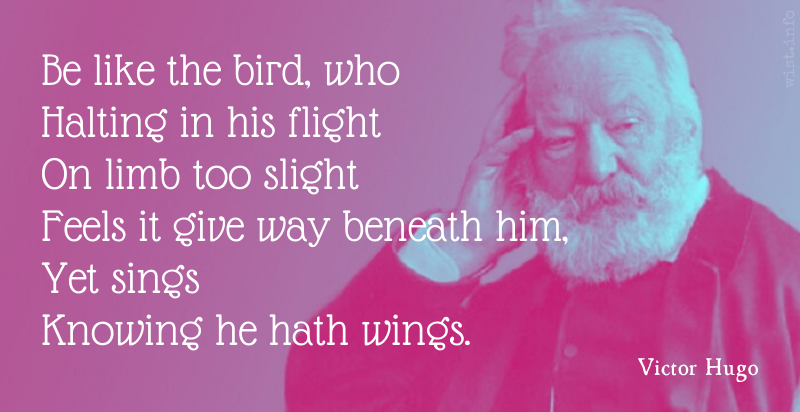
Be like the bird, who
Halting in his flight
On limb too slight
Feels it give way beneath him,
Yet sings
Knowing he hath wings.
[Soyez comme l’oiseau, posé pour un instant
Sur des rameaux trop frêles,
Qui sent ployer la branche et qui chante pourtant,
Sachant qu’il a des ailes!]
Victor Hugo (1802–1885) French writer, journalist, human rights activist, politician
Poem (1836), “In the Church of *** [Dans l’eglise de ***],” Songs of Dusk [Les chants du crepuscule], # 33 sec. 6
(Source)
Be like the bird that, on a bough too frail
To bear him, gaily sings!
He carols -- thought he slender branches fail:
He knows that he has wings.
[Source]
Be like the bird that seeks its short repose
And dauntless sings
Upon that bending twig, because it knows
That it has wings.
[Source]
Be like that bird, that halting in her flight
A while on boughs too slight;
Feels them give way beneath her,
And yet sings, yet sings,
Knowing that she hath wings.
[Laura Sedgwick Collins, 1890s song, "Be Like That Bird"]
Thou art like the bird
That alights and sings
Though the frail spray bends --
For he knows he has wings.
[tr. Kemble (Butler)]
Be as a bird that --
Pausing in its flight --
Alights upon a branch too slight
And feeling that it bends beneath it
Sings -- knowing it has wings.
[Source]
“He’s awake.” The woman’s voice is heavy with satisfaction. “All-Highest will be most pleased.” As words to wake to, those leave something to be desired; but beggars can’t be choosers.
Charles "Charlie" Stross (b. 1964) British writer The Fuller Memorandum (2010)
Molly served as the Folly’s housekeeper, cook, and rodent exterminator. She never speaks, has too many teeth and a taste for raw meat, but I try never to hold that against her or let her get between me and the exit.
Ben Aaronovitch (b. 1964) British author Moon Over Soho (2011)
Institutions like to continue doing what they have been doing, always on a grander scale, if possible. When old enemies disappear, mellow, or turn into allies, as frequently happens in international relations, new enemies must be found and new threats must be discovered. The failure to replenish the supply of enemies is the supreme threat facing any national security bureaucracy.
Richard J. Barnet (1929–2004) American scholar, writer, activist Roots of War, 5.1 (1971)
We who think we are about to die will laugh at anything.
Terry Pratchett (1948–2015) English author
Discworld No. 29, Night Watch (2002)
(Source)
Internal monologue of Sam Vimes. Vimes is riffing off of the anecdotal gladiator salute to the Roman emperor, "We who are about to die salute you [morituri te salutamus]."
Never threaten, because a threat is a promise to pay that it isn’t always convenient to meet, but if you don’t make it good it hurts your credit. Save a threat till you’re ready to act, and then you won’t need it.
George Horace Lorimer (1867–1937) American journalist, author, magazine editor Letters from a Self-Made Merchant to His Son, ch. 15 (1901)
(Source)
Peace and friendship with all mankind is our wisest policy, and I wish we may be permitted to pursue it. But the temper and folly of our enemies may not leave this in our choice.
Thomas Jefferson (1743–1826) American political philosopher, polymath, statesman, US President (1801–09)
Letter (1786-05-06) to C. W. F. Dumas
(Source)
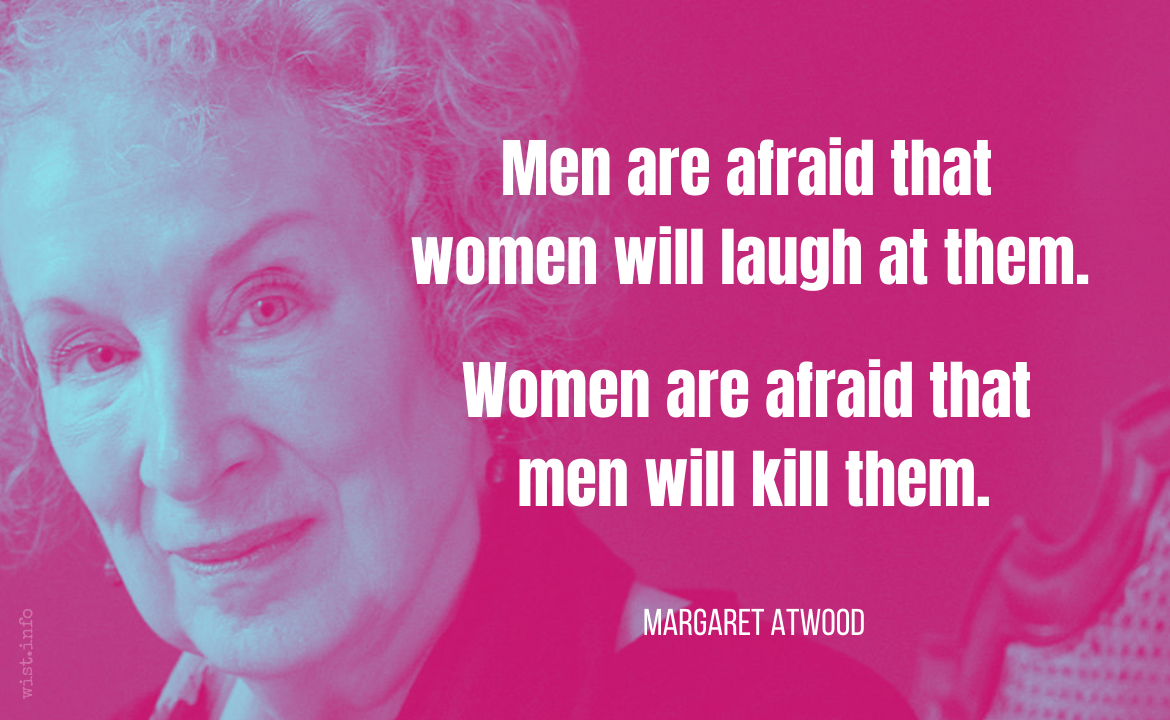
“Why do men feel threatened by women?” I asked a male friend of mine. (I love that wonderful rhetorical device, “a male friend of mine.” It’s often used by female journalists when they want to say something particularly bitchy but don’t want to be held responsible for it themselves. It also lets people know that you do have male friends, that you aren’t one of those fire-breathing mythical monsters, The Radical Feminists, who walk around with little pairs of scissors and kick men in the shins if they open doors for you. “A male friend of mine” also gives — let us admit it — a certain weight to the opinions expressed.) So this male friend of mine, who does by the way exist, conveniently entered into the following dialogue. “I mean,” I said, “men are bigger, most of the time, they can run faster, strangle better, and they have on the average a lot more money and power.” “They’re afraid women will laugh at them,” he said. “Undercut their world view.” Then I asked some women students in a quickie poetry seminar I was giving, “Why do women feel threatened by men?” “They’re afraid of being killed,” they said.
Margaret Atwood (b. 1939) Canadian writer, literary critic, environmental activist
“Writing the Male Character,” Hagey Lecture, U. of Waterloo (9 Feb 1982)
(Source)
Published in a revised version as "Writing the Male Character," Second Words: Selected Critical Prose, 1960-1982 (1983).
Usually paraphrased, "Men are afraid that women will laugh at them. Women are afraid that men will kill them."
I think that if the beast who sleeps in man could be held down by threats — any kind of threat, whether of jail or of retribution after death — then the highest emblem of humanity would be the lion tamer in the circus with his whip, not the prophet who sacrificed himself. But don’t you see, this is just the point — what has for centuries raised man above the beast is not the cudgel but an inward music: the irresistible power of unarmed truth, the powerful attraction of its example.
Boris Pasternak (1890–1960) Russian poet, novelist, and literary translator Doctor Zhivago [До́ктор Жива́го], Part 1, ch. 2 “A Girl from a Different World” [Nikolai] (1955) [tr. Hayward & Harari (1958), US ed.]
(Source)
Other translations:
I think that if the beast who sleeps in man could be held down by threats -- any kind of threat, whether of jail or of retribution after death -- then the highest emblem of humanity would be the lion tamer in the circus with his whip, not the self-sacrificing preacher. But don’t you see, this is just the point -- what has for centuries raised man above the beast is not the cudgel but an inward music: the irresistible power of unarmed truth, the attraction of its example.
[tr. Hayward & Harari (1958), UK ed.]
I think that if the beast who sleeps in man could be held down by threats -- any kind of threat, whether of jail or of retribution after death -- then the highest emblem of humanity would be the lion tamer in the circus with his whip, not the prophet who sacrificed himself. But this is just the point -- what has for centuries raised man above the beast is not the cudgel, but an inward music -- the irresistible power of unarmed truth.
[tr. Hayward & Harrai (1958); edited version quoted by Ronald Reagan, Moscow State University (1988-05-31)]
I think that if the beast dormant in man could be stopped by the threat of, whatever, the lockup or requital beyond the grave, the highest emblem of mankind would be a lion tamer with his whip, and not the preacher who sacrifices himself. But the point is precisely this, that for centuries man has been raised above the animals and borne aloft not by the rod, but by music: the irresistibility of the unarmed truth, the attraction of its example.
[tr. Pevear & Volokhonsky (2010), "A Girl from a Different Circle"]
No people in history have preserved their freedom who thought that by not being strong enough to protect themselves they might prove inoffensive to their enemies.
Dean Acheson (1893–1971) American statesman
National Security Council Report 68 (NSC-68), Sec. 7 “Present Risks” (14 Apr 1950) [with Paul Nitze]
(Source)
Usually paraphrased as "No people in history have ever survived who thought they could protect their freedom by making themselves inoffensive to their enemies."
I pray we are still a young and courageous Nation; that we have not grown so old and fat and prosperous that all we can think about is to sit back with our arms around our money bags. If we choose to do that I have no doubt that the smoldering fires will burst into flame and consume us — dollars and all.
Lyndon B. Johnson (1908–1973) American politician, educator, US President (1963–69)
Speech (1947-05-07), House of Representatives
(Source)
Speaking on spending in support of the Truman Doctrine, supporting countries threatened by the Soviet Union. Recorded in the Congressional Record, Vol. 93, Part 4, for this date.
Accius (170-c. 86 BC) Roman tragic poet, literary scholar [Lucius Accius, Lucius Attius] Atreus (fragment 168) [tr. Kline (2010)]
(Source)
A fragment from Accius' work, known only by its quotation by others. The phrase was often used by classical writers as a hallmark of a tyrannical ruler. This includes:
Cicero, Pro Sestio, 48/102 (where he regrets that Accius had "used words for evil-minded men to lay hold of").
Suetonius, Life of Tiberius, 59 (quoting Caligula, and contrasting to Tiberius use of the similar Oderint dum probent ("Let them hate me so long as they approve [of my deeds]").
(Source (Latin)). Other translations (from the above works):
Ev'n let them hate me, whilst they dread me too.
[tr. Cockman (1699)]
Let them hate me, provided they fear me.
[tr. McCartney (1798)]
Let them hate me, so they fear me.
[tr. Edmonds (1865)]
I scorn their hatred, if they do but fear me.
[tr. Thomson (1883)]
No matter how they hate me while they fear me.
[tr. Peabody (1883)]
Let them hate, provided they fear me!
[tr. Hickie (1888)]
Let them hate me, as long as they fear.
[tr. Yonge (1891)]
Let them hate, so long as they fear.
[tr. Gardiner (1899)]
Let them hate me, provided they fear me.
[tr. Stewart (1900)]
Why, let them hate me, if they fear me too!
[tr. Stewart (1900)]
What care I though all men should hate my name,
So long as fear accompanies their hate?
[tr. Yonge (1903)]
Let them hate provided that they fear.
[ed. Harbottle (1906); tr. Cooper (1995)]
Let them hate me, so they but fear me.
[tr. Rolfe (Loeb) (1913)]
Let them hate, if only they fear.
[tr. Miller (1913), Basore (1928)]
Let them hate, so but they fear.
[tr. Gardner (Loeb) (1958)]
Let them hate me, as long as they fear me.
[tr. @aleator (2010)]
They can hate as long as they are in fear.
[tr. Edinger (1974)]
People don’t support you because they like you. You can count on a person’s support only when you do something for him or something to him.
Lyndon B. Johnson (1908–1973) American politician, educator, US President (1963–69)
(Attributed)
(Source)
On support from Congress. An "embittered" comment made to Richard Nixon after Johnson had left the Presidency. Quoted in Richard Nixon, In the Arena: A Memoir of Victory, Defeat, and Renewal, ch. 21 (1990).
Dangers are sum like a kold bath, very dangerous while you stand stripped on the bank, but often not only harmless, but invigorating, if you pitch into them.
[Dangers are some like a cold bath ….]
Josh Billings (1818–1885) American humorist, aphorist [pseud. of Henry Wheeler Shaw] Everybody’s Friend, Or; Josh Billing’s Encyclopedia and Proverbial Philosophy of Wit and Humor, ch. 150 “Affurisms: Parboils” (1874)
(Source)
Mass movements can rise and spread without belief in a God, but never without belief in a devil.
Eric Hoffer (1902–1983) American writer, philosopher, longshoreman True Believer: Thoughts on the Nature of Mass Movements, Part 3, ch. 15, § 65 (1951)
(Source)
But he that touches me, (hands off! I cry, —
Avaunt, and at your peril come not nigh!)
Shall for his pains be chaunted up and down,
The jest and byeword of a chuckling Town.
[At ille,
Qui me conmorit (melius non tangere, clamo),
Fiebit et insignis tota cantabitur urbe.]
Horace (65–8 BC) Roman poet, satirist, soldier, politician [Quintus Horatius Flaccus] Satires [Saturae, Sermones], Book 2, # 1 “Sunt quibus in Satira,” l. 44ff (2.2.44-46) (30 BC) [tr. Howes (1845)]
(Source)
[...] that none woulde worke me wo.
But worke they doo, but who so does, though he be divelyshe fell,
I blason farre and nere his armes, and wanton touches tell.
He may go howle, and pule for wo, the citizens will scorn hym,
And cause him wyshe full many a tyme, his damme had never borne hym.
[tr. Drant (1567)]
And none bereave
The peace I seek. But if there do, believe
Me they will rew't, when with my keen Stile stung,
Through the whole town they shall in pomp be sung.
[tr. Fanshawe; ed. Brome (1666)]
Let none hurt Peaceful Me with envious Tongue,
For if he does, He shall repent the wrong:
The warning's fair, his Vices shall be shown,
And Life expos'd to all the Cens'ring Town.
[tr. Creech (1684)]
But who provokes me, or attacks my fame,
"Better not touch me, friend," I loud exclaim,
His eyes shall weep the folly of his tongue.
By laughing crowds in rueful ballad sung.
[tr. Francis (1747)]
But that man who shall provoke me (I give notice, that it is better not to touch me) shall weep [his folly], and as a notorious character shall be sung through all the streets of Rome.
[tr. Smart/Buckley (1853)]
But he who shall have once provoked me -- 'twill be better that he touch me not, I cry -- shall rue it, and, become notorious, shall be the theme of jest, through all the town.
[tr. Millington (1870)]
But should one seek
To quarrel with me, you shall hear him shriek:
Don't say I gave no warning: up and down
He shall be trolled and chorused through the town.
[tr. Conington (1874)]
But if one stir me up ("Better not touch me!" I shout), he shall smart for it and have his name sung up and down the town.
[tr. Fairclough (Loeb) (1926)]
But the man who provokes me will weep (HANDS OFF! I WARN YOU)
and his name will be widely rehearsed all over town.
[tr. Palmer Bovie (1959)]
But any guy
who gives me any trouble (my motto is “Hands off!”)
will become a tearful celebrity, sung about all over town.
[tr. Fuchs (1977)]
But attack -- it’s better not to, believe me -- and live
To regret it, your name paraded all over Rome!
[tr. Raffel (1983)]
But he who attacks me (O I warn you!
keep your hands to yourself!)
will have cause enough for weeping.
He will be pointed out and ridiculed
by everyone in Rome.
[tr. Alexander (1999)]
"Hands off" is my motto:
anybody who gives me any trouble, he'll be
swiftly famous for his pain and snuffling.
[tr. Matthews (2002)]
But whoever stirs me up (better keep your distance, I’m telling you!)
will be sorry; he’ll become a thing of derision throughout the city.
[tr. Rudd (2005 ed.)]
But he
Who provokes me (better not touch, I cry!) will suffer,
And his blemishes will be sung throughout the City.
[tr. Kline (2015)]
At the approach of danger there are always two voices that speak with equal force in the heart of man: one very reasonably tells the man to consider the nature of the danger and the means of avoiding it; the other even more reasonable says that it is too painful and harassing to think of the danger, since it is not a man’s power to provide for everything and escape from the general march of events; and that it is therefore better to turn aside from the painful subject till it has come, and to think of what is pleasant. In solitude a man generally yields to the first voice; in society to the second.
Leo Tolstoy (1828–1910) Russian novelist and moral philosopher War and Peace, Book 10, ch. 17 (1865-1869)
When hopes and dreams are loose in the streets, it is well for the timid to lock doors, shutter windows and lie low until the wrath has passed. For there is often a monstrous incongruity between the hopes, however noble and tender, and the action which follows them. It is as if ivied maidens and garlanded youths were to herald the four horsemen of the apocalypse.
Eric Hoffer (1902–1983) American writer, philosopher, longshoreman True Believer: Thoughts on the Nature of Mass Movements, Part 1, ch. 1, § 5 (1951)
(Source)
Obsta principiis, nip the shoots of arbitrary power in the bud, is the only maxim which can ever preserve the liberties of any people. When the people give way, their deceivers, betrayers, and destroyers press upon them so fast, that there is no resisting afterwards.
John Adams (1735–1826) American lawyer, Founder, statesman; US President (1797–1801)
Essay (1775-02-06), “Novanglus,” No. 3, Boston Gazette (Source)
The Latin means to resist the first approaches or encroachments of a problem.
This series of essays was written by Adams under the pseudonym of "Novanglus" (Latin for "New England") responding to essays from his past friend Daniel Leonard as "Massachusettensis" on colonial leadership and what the proper relationship was between the American colonies and Britain.
Every gun that is made, every warship launched, every rocket fired signifies, in the final sense, a theft from those who hunger and are not fed, those who are cold and are not clothed. This world in arms is not spending money alone. It is spending the sweat of its laborers, the genius of its scientists, the hopes of its children. The cost of one modern heavy bomber is this: a modern brick school in more than 30 cities. It is two electric power plants, each serving a town of 60,000 population. It is two fine, fully equipped hospitals. It is some 50 miles of concrete highway. We pay for a single fighter with a half million bushels of wheat. We pay for a single destroyer with new homes that could have housed more than 8,000 people. This, I repeat, is the best way of life to be found on the road the world has been taking. This is not a way of life at all, in any true sense. Under the cloud of threatening war, it is humanity hanging from a cross of iron.
Dwight David Eisenhower (1890–1969) American general, US President (1953–61)
Speech (1953-04-16), “The Chance for Peace,” American Society of Newspaper Editors, Hotel Statler, New York City
(Source)
Describing the cost of the Cold War. Also known as the "Cross of Iron" speech, it was delivered shortly into his presidency and just after Stalin's death.
Undoubtedly the stories about them [hard-boiled detectives] had a fantastic element. Such things happened, but not so rapidly, nor to so close-knit a group of people, nor within so narrow a frame of logic. This was inevitable because the demand was for constant action; if you stopped to think you were lost. When in doubt, have a man come through a door with a gun in his hand.
Raymond Chandler (1888–1959) American novelist Trouble Is My Business, Introduction (1950)
(Source)
“What a brain, Mister Vandemar. Keen and incisive isn’t the half of it. Some of us are so sharp,” he said as he leaned in closer to Richard, went up on tiptoes into Richard’s face, “we could just cut ourselves.”
Neil Gaiman (b. 1960) British author, screenwriter, fabulist Neverwhere, ch. 2 [Mr. Croup] (1996)
(Source)
So we’re just in this maze for now, trying to figure out if that glint in the distance is daylight, or a Minotaur with an Uzi.
J. Michael (Joe) Straczynski (b. 1954) American screenwriter, producer, author [a/k/a "JMS"]
rec.arts.sf.tv.babylon5.moderated, “ATTN JMS: Warner Bros” (8 Dec 1996)
(Source)
MARGARET: Now ’tis the spring, and weeds are shallow-rooted;
Suffer them now, and they’ll o’ergrow the garden
And choke the herbs for want of husbandry.
William Shakespeare (1564–1616) English dramatist and poet Henry VI, Part 2, Act 3, sc. 1, l. 31ff (3.1.31-33) (1591)
(Source)
When thy next neighbours house is all on fire,
’Tis thy concern to make his flames expire;
For fire will gather strength if let alone,
And with thy neighbours house burn down thine owne.
[Nam tua res agitur, paries cum proximus ardet.
Et neglecta solent incendia sumere vires.]
Horace (65–8 BC) Roman poet, satirist, soldier, politician [Quintus Horatius Flaccus] Epistles [Epistularum, Letters], Book 1, ep. 18 “To Lollius,” l. 84ff (1.18.84-85) (20 BC) [tr. A. B.; ed. Brome (1666)]
(Source)
On the need to defend friends who are being slandered by others.
The case is thyne, thy neighboures house when it doth flame up bright,
And burninges thowght but smal, or now have grown to dreedful might.
[tr. Drant (1567)]
For you're in danger when the Next's on fire,
And Flames neglected often blaze the higher.
[tr. Creech (1684)]
When flames your neighbour's dwelling seize,
Your own with instant rage shall blaze;
Then haste to stop the spreading fire,
Which, if neglected, rises higher.
[tr. Francis (1747)]
He that espies a neighbour's roof on fire
And calmly sees the flames to heaven aspire,
Will find them gather strength, till let alone
They with his neigbour's house burn down his own.
[tr. Howes (1845)]
For it is your own concern, when the adjoining wall is on fire: and flames neglected are wont to gain strength.
[tr. Smart/Buckley (1853)]
No time for sleeping with a fire next door;
Neglect such things, they only blaze the more.
[tr. Conington (1874)]
With the next house in flames, best look ahead —
A fire neglected's pretty sure to spread.
[tr. Martin (1881)]
For your own business is affected when your neighbor's wall is on fire, and flames neglected gather strength.
[tr. Dana/Dana (1911)]
'Tis your own safety that's at stake, when your neighbour's wall is in flames, and fires neglected are wont to gather strength.
[tr. Fairclough (Loeb) (1926)]
When your neighbor's house catches fire, your place is threatened,
And flames that are disregarded usually burn brighter.
[tr. Palmer Bovie (1959)]
If your neighbor's house is burning, your own is next;
for fires, if they're not put out, are apt to spread.
[tr. Fuchs (1977)]
Your own house is in danger when your neighbor's
House is on fire; a fire not watched can spread.
[tr. Ferry (2001)]
It's very much your affair when the house next door is ablaze.
Ignore a fire, and soon you're faced with a conflagration.
[tr. Rudd (2005 ed.)]
If your neighbour’s roof’s in flames, it’s your business too,
And neglected fires have a habit of gaining strength.
[tr. Kline (2015)]
Marcus Aurelius (AD 121–180) Roman emperor (161–180), Stoic philosopher Meditations [To Himself; Τὰ εἰς ἑαυτόν], Book 11, ch. 15 (11.15) (AD 161-180) [tr. Staniforth (1964)]
(Source)
Depending on the source material, the weapon reference is either from a native Thracian (foreign) weapon (σκάλμη) -- thus translators who use "stiletto," etc. -- or a proverbial "crooked stick" (σκαμβή), referring to a Greek proverb "You can't make a crooked stick straight." See 1, 2, 3, 4 for more details.
When peace has been broken anywhere, the peace of countries everywhere is in danger.
Franklin Delano Roosevelt (1882–1945) American lawyer, politician, statesman; US President (1933–45)
Speech (1939-09-03), “Fireside Chat” (radio broadcast)
(Source)