EPIDEMIC, n. A disease having a sociable turn and few prejudices.
Ambrose Bierce (1842–1914?) American writer and journalist
“Epidemic,” “Devil’s Dictionary” column, San Francisco Wasp (1883-04-28)
(Source)
Not collected in later books.
Quotations about:
disease
Note not all quotations have been tagged, so Search may find additional quotes on this topic.

Almost everybody is deeply affected when some one he loves suffers from cancer. Most people are moved when they see the sufferings of unknown patients in hospitals. Yet when they read that the death-rate from cancer is such-and-such, they are as a rule only moved to momentary personal fear lest they or some one dear to them should acquire the disease. The same is true of war: people think it dreadful when their son or brother is mutilated, but they do not think it a million times as dreadful that a million people should be mutilated. A man who is full of kindliness in all personal dealings may derive his income from incitement to war or from the torture of children in “backward” countries.
All these familiar phenomena are due to the fact that sympathy is not stirred, in most people, by a merely abstract stimulus. A large proportion of the evils in the modern world would cease if this could be remedied.Bertrand Russell (1872–1970) English mathematician and philosopher
Education and the Good Life, Part 1, ch. 2 “The Aims of Education” (1926)
(Source)
In his infinite goodness, God invented rheumatism and gout and dyspepsia, cancers and neuralgia, and is still inventing new diseases. Not only this, but he decreed the pangs of mothers, and that by the gates of love and life should crouch the dragons of death and pain. Fearing that some might, by accident, live too long, he planted poisonous vines and herbs that looked like food. He caught the serpents he had made and gave them fangs and curious organs, ingeniously devised to distill and deposit the deadly drop. He changed the nature of the beasts, that they might feed on human flesh. He cursed a world, and tainted every spring and source of joy. He poisoned every breath of air; corrupted even light, that it might bear disease on every ray; tainted every drop of blood in human veins; touched every nerve, that it might bear the double fruit of pain and joy; decreed all accidents and mistakes that maim and hurt and kill, and set the snares of life-long grief, baited with present pleasure, — with a moment’s joy. Then and there he foreknew and foreordained all human tears. And yet all this is but the prelude, the introduction, to the infinite revenge of the good God. Increase and multiply all human griefs until the mind has reached imagination’s farthest verge, then add eternity to time, and you may faintly tell, but never can conceive, the infinite horrors of this doctrine called “The Fall of Man.”
Robert Green Ingersoll (1833–1899) American lawyer, freethinker, orator
Lecture (1884-01-20), “Orthodoxy,” Tabor Opera House, Denver, Colorado
(Source)
Published as its own book in 1884.
We are told by the Bible and by the churches that through this fall of man
“Sin and death entered the world.”
According to this, just as soon as Adam and Eve had partaken of the forbidden fruit, God began to contrive ways by which he could destroy the lives of his children. He invented all the diseases — all the fevers and coughs and colds — all the pains and plagues and pestilences — all the aches and agonies, the malaria and spores; so that when we take a breath of air we admit into our lungs unseen assassins; and, fearing that some might live too long, even under such circumstances, God invented the earthquake and volcano, the cyclone and lightning, animalcules to infest the heart and brain, so small that no eye can detect — no instrument reach. This was all owing to the disobedience of Adam and Eve!Robert Green Ingersoll (1833–1899) American lawyer, freethinker, orator
Lecture (1884-01-20), “Orthodoxy,” Tabor Opera House, Denver, Colorado
(Source)
Published as its own book in 1884.
Life is a disease temporarily relieved every sixteen hours, by sleep. The complete cure: death.
[Vivre est une maladie dont le sommeil nous soulage toutes les seize heures. C’est un palliatif. La Mort est le remède.]
Nicolas Chamfort (1741–1794) French writer, epigrammist (b. Nicolas-Sébastien Roch)
Products of Perfected Civilization [Produits de la Civilisation Perfectionée], Part 1 “Maxims and Thoughts [Maximes et Pensées],” ch. 2, ¶ 113 (1795) [tr. Parmée (2003), ¶ 91]
(Source)
(Source (French)). Alternate translations:Life is a malady in which sleep soothes us every sixteen hours; it is a palliation; death is the remedy.
[Ballou, comp. (1872)]Living is a disease from the pains of which sleep eases us every sixteen hours; sleep is but a palliative, death alone is the cure.
[tr. Hutchinson (1902)]Life is a disease from which sleep gives us alleviation every sixteen hours. Sleep is a palliative, Death is the remedy.
[tr. Mathers (1926)]Living is an ailment which is relieved every sixteen hours by sleep. A palliative Death is the cure.
[tr. Merwin (1969)]To live is a malady from which sleep vouchsafes us relief every sixteen hours. That is a palliative. The remedy is death.
[tr. Pearson (1973)]To live is a sickness that sleep comforts every sixteen hours. It's a palliative. Death is the cure.
[tr. Siniscalchi (1994)]Life is a sickness to which sleep provides relief every sixteen hours. It's a palliative. The remedy is death.
[Source]
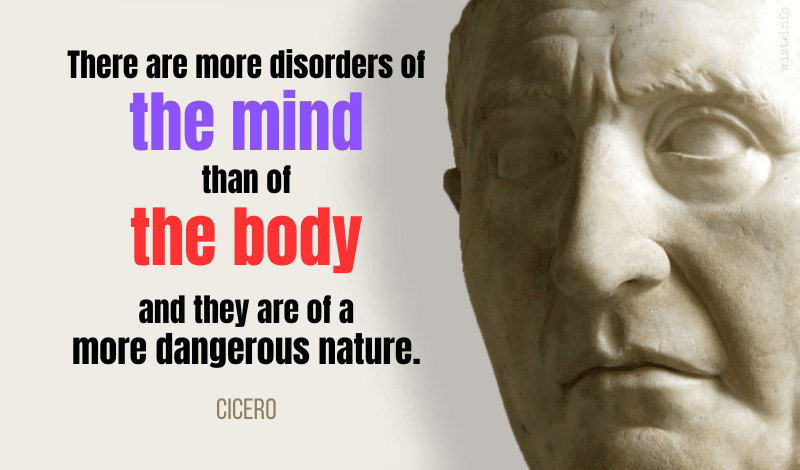
MARCUS: But there are more disorders of the mind than of the body, and they are of a more dangerous nature.
[At et morbi perniciosiores pluresque sunt animi quam corporis; hi enim ipsi odiosi sunt.]
Marcus Tullius Cicero (106–43 BC) Roman orator, statesman, philosopher
Tusculan Disputations [Tusculanae Disputationes], Book 3, ch. 3 (3.3) / sec. 5 (3.5) (45 BC) [tr. Yonge (1853)]
(Source)
(Source (Latin)). Other translations:Whereas, in truth, there are more and more dangerous Diseases of the Soul, than of the Body.
[tr. Wase (1643)]But there are more disorders of the mind than of the body, for the generality, and of a more severe nature.
[tr. Main (1824)]The diseases of the mind are more pernicious, as well as more numerous, than those of the body.
[tr. Otis (1839)]But there are more harmful disorders of the soul than of the body, and more of them.
[tr. Peabody (1886)]The diseases of the mind are more destructive and in greater number than those of the body.
[tr. Taylor/Hunt (1916)]No, the sicknesses of the mind are both more destructive and more numerous than those of the body.
[tr. Graver (2002)]
If a predatory enemy to our species can’t unite everyone on Earth to fight it, I’m left wondering what hope remains for Civilization.
Neil deGrasse Tyson (b. 1958) American astrophysicist, author, orator
Twitter (19 Apr 2020)
(Source)
Regarding the COVID-19 pandemic.

I know the colour rose, and it is lovely,
But not when it ripens in a tumour;
And healing greens, leaves and grass, so springlike,
In Limbs that fester are not springlike.Daniel "Dannie" Abse (1923–2014) Welsh poet
Poem (1968), “Pathology of Colours,” Dannie Abse
(Source)

It may be said that disease generally begins that equality which death completes; the distinctions which set one man so much above another are very little perceived in the gloom of a sick chamber.
Samuel Johnson (1709–1784) English writer, lexicographer, critic
Essay (1750-09-01), The Rambler, No. 48
(Source)

Even while I protest the assembly-line production of our food, our songs, our language, and eventually our souls, I know that it was a rare home that baked good bread in the old days. Mother’s cooking was with rare exceptions poor, that good unpasteurized milk touched only by flies and bits of manure crawled with bacteria, the healthy old-time life was riddled with aches, sudden death from unknown causes, and that sweet local speech I mourn was the child of illiteracy and ignorance. It is the nature of a man as he grows older, a small bridge in time, to protest against change, particularly change for the better.
John Steinbeck (1902–1968) American writer
Travels With Charley: In Search of America, Part 2 (1962)
(Source)