A fountain gets muddy with but little stirring up, and does not get clear by our meddling with it but by our leaving it alone. The best remedy for disturbances is to let them run their course, for so they quiet down.
[Una fuente con poca inquietud se enturbia, ni se volverá a serenar procurándolo, sino dejándola. No hay mejor remedio de los desconciertos que dejarlos correr, que así caen de sí propios.]
Baltasar Gracián y Morales (1601–1658) Spanish Jesuit priest, writer, philosopher
The Art of Worldly Wisdom [Oráculo Manual y Arte de Prudencia], § 138 (1647) [tr. Jacobs (1892)]
(Source)
(Source (Spanish)). Alternate translations:A Well will be troubled if it be in the least stirred, and its water becomes clear again, by ceasing to dabble in it. There is no better remedy for some disorders, than to let them alone. For at long run they stop of themselves.
[Flesher ed. (1685)]A fountain gets turbid by a little movement, and does not become clear by our trying to make it so, but by our leaving it to itself. The best remedy against discord and confusion is to let them run their course, for so they quiet down.
[tr. Duff (1877)]It takes little to muddy a spring, nor does it clear by being stirred, but by being left alone: there is no better remedy for turmoil, than to let it takes its course, for so it comes to rest of itself.
[tr. Fischer (1937)]It takes little to muddy a stream. you can't make it grow clear by trying to, only by leaving it alone. There is no better remedy for disorder than to leave it alone to correct itself.
[tr. Maurer (1992)]
Quotations about:
disorder
Note not all quotations have been tagged, so Search may find additional quotes on this topic.

BIGBY: Freedom is sloppy. But since tyranny’s the only guaranteed byproduct of those who insist on a perfect world, freedom will have to do.
Bill Willingham (b. 1956) American writer and comics artist
Fables: Werewolves of the Heartland, ch. 9 (2012)
(Source)
Art by Jim Fern.


The truth unquestionably is, that the only path to a subversion of the republican system of the Country is, by flattering the prejudices of the people, and exciting their jealousies and apprehensions, to throw affairs into confusion, and bring on civil commotion. Tired at length of anarchy, or want of government, they may take shelter in the arms of monarchy for repose and security.
Alexander Hamilton (1757–1804) American statesman, author
Letter (1792-08-18) to George Washington, Enclosure: “Objections and Answers Respecting the Administration,” Objection 14
(Source)
CONSTABLE: Disorder, that hath spoiled us, friend us now.
Let us on heaps go offer up our lives.ORLÉANS: We are enough yet living in the field
To smother up the English in our throngs,
If any order might be thought upon.BOURBON: The devil take order now! I’ll to the throng.
Let life be short, else shame will be too long.William Shakespeare (1564–1616) English dramatist and poet
Henry V, Act 4, sc. 5, l. 19ff (4.5.19-25) (1599)
(Source)
The French dealing with the disastrous rout of their initial attack at Agincourt.

MME. PERNELLE:This house appalls me. No one in it
Will pay attention for a single minute.
Children, I take my leave much vexed in spirit.
I offer good advice, but you won’t hear it.
You all break in and chatter on and on.
It’s like a madhouse with the keeper gone.[C’est que je ne puis voir tout ce ménage-ci,
Et que de me complaire on ne prend nul souci.
Oui, je sors de chez vous fort mal édifiée:
Dans toutes mes leçons j’y suis contrariée.
On n’y respecte rien, chacun y parle haut.
Et c’est tout justement la cour du roi Pétaud]Molière (1622–1673) French playwright, actor [stage name for Jean-Baptiste Poquelin]
Tartuffe, or the Hypocrite [Le Tartuffe, ou L’Imposteur], Act 1, sc. 1 (1669) [tr. Wilbur (1963)]
(Source)
Explaining to her daughter-in-law Elmire why she cutting short a visit to son, Orgon's, house.
Pétaud was the name supposedly given by groups of beggars in Medieval France to their chief (perhaps from the Latin peto, "I ask"), thus King Pétaud's "court" was a French metaphor of the time for a place of mad unruliness. Some translators carry over the name (footnoted); others come up with a different phrase that would be understood by English-speaking audiences.
(Source (French)). Other translations:I can't endure to see such Management, and no body takes any Care to please me. I leave your House, I tell you, very ill edify'd; my Instructions are all contradicted: you shew no respect for any thing amongst you, every one talks aloud there, and the House is a perfect Dover-Court.
[tr. Clitandre (1672)]I cannot bear to see such goings on. No one cares to please me. I leave your house very little edified: all my advice is despised; nothing is respected, every one has his say aloud, and and it is just like the court of King Pétaud.
[tr. Van Laun (1876)]I cannot bear to see what goes on in your house, and that no effort is made to comply with my wishes. Yes, I leave your house very ill edified. Things are done against all my admonitions; there is no respect paid to anything; everyone speaks out as he likes, and it is exactly like the court of King Petaud.
[tr. Wall (1879)]I cannot bear to see such goings on. No one takes any pains to please me. I leave your house, I tell you, very much shocked: all my teaching is contradicted. You have no regard for anything; every one talks at the top of his voice, and the place is a perfect Bedlam.
[tr. Mathew (1890)]I cannot bear to see such goings on and no one takes any pains to meet my wishes. Yes, I leave your house not very well pleased: you ignore all my advice, you do not show any respect for anything, everyone says what he likes, and it is just like the Court of King Pétaud.
[tr. Waller (1903)]I can't endure your carryings-on,
And no one takes the slightest pains to please me.
I leave your house, I tell you, quite disgusted;
You do the opposite of my instructions;
You've no respect for anything; each one
Must have his say; it's perfect pandemonium.
[tr. Page (1909)]I can't stand the way that things are going!
In my son's house they pay no heed to me.
I am not edified; not edified.
I give you good advice. Who pays attention?
Everyone speaks his mind, none shows respect.
This place is Bedlam; everyone is king here.
[tr. Bishop (1957)]I can’t abide the goings-on in there,
And no one in the household seems to care.
Yes, child, I’m leaving you, unedified,
My good advice ignored, if not defied.
Everyone speaks right out on everything:
It’s like a court in which Misrule is king.
[tr. Frame (1967)]I'm horrified by all of you.
I'm leaving in extreme distress,
I've never liked a household less.
Who listens to a word I say?
Or does the smallest thing my way?
It's more than I have strength to bear.
This chaos drives me to despair!
When will you people ever learn
To hold your tongues, or speak in turn,
Respecting person, time, and place?
Your slipshod ways are a disgrace!
[tr. Bolt (2002)]I cannot stand the way this household is run. No one ever makes any effort to please me. Yes, I am leaving. I've seen some shocking behavior: my instructions are rejected; no one respects me; everyohne speaks arrogantly -- it's Bedlam here.
[tr. Steiner (2008)]I simply cannot bear the way you do things here,
Nobody has a thought for me.
I'm leaving you in a state of very considerable displeasure:
All my advice is ignored,
There's no respect and everyone talks back,
In short, the whole place is an absolute shambles.
[tr. Campbell (2013)]

History is a jangle of accidents, blunders, surprises and absurdities, and so is our knowledge of it, but if we are to report it at all we must impose some order upon it.
Henry Steele Commager (1902–1998) American historian, writer, activist
The Nature and the Study of History, ch. 5 (1965)
(Source)

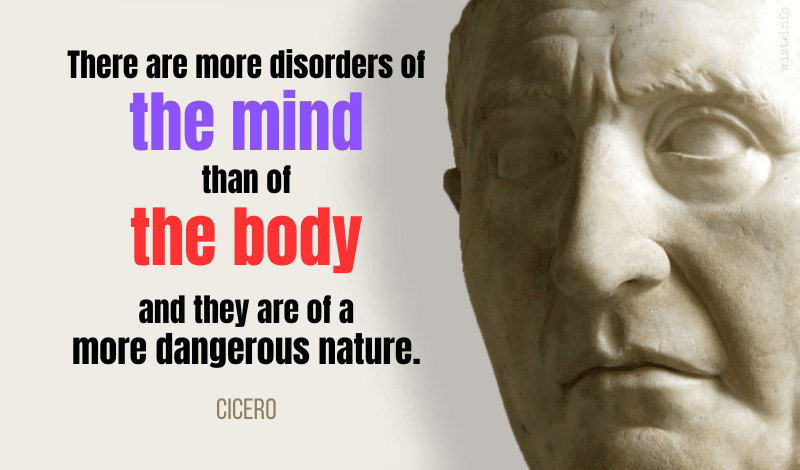
MARCUS: But there are more disorders of the mind than of the body, and they are of a more dangerous nature.
[At et morbi perniciosiores pluresque sunt animi quam corporis; hi enim ipsi odiosi sunt.]
Marcus Tullius Cicero (106–43 BC) Roman orator, statesman, philosopher
Tusculan Disputations [Tusculanae Disputationes], Book 3, ch. 3 (3.3) / sec. 5 (3.5) (45 BC) [tr. Yonge (1853)]
(Source)
(Source (Latin)). Other translations:Whereas, in truth, there are more and more dangerous Diseases of the Soul, than of the Body.
[tr. Wase (1643)]But there are more disorders of the mind than of the body, for the generality, and of a more severe nature.
[tr. Main (1824)]The diseases of the mind are more pernicious, as well as more numerous, than those of the body.
[tr. Otis (1839)]But there are more harmful disorders of the soul than of the body, and more of them.
[tr. Peabody (1886)]The diseases of the mind are more destructive and in greater number than those of the body.
[tr. Taylor/Hunt (1916)]No, the sicknesses of the mind are both more destructive and more numerous than those of the body.
[tr. Graver (2002)]
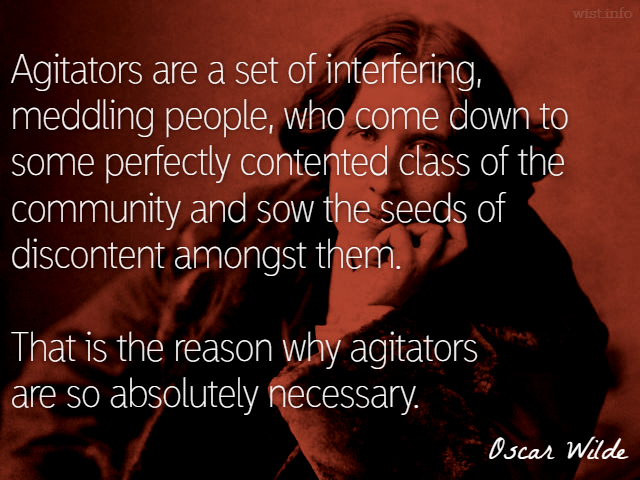
What is said by great employers of labor against agitators is unquestionably true. Agitators are a set of interfering, meddling people, who come down to some perfectly contented class of the community and sow the seeds of discontent amongst them. That is the reason why agitators are so absolutely necessary. Without them, in our incomplete state, there would be no advance towards civilization.
Oscar Wilde (1854–1900) Irish poet, wit, dramatist
“The Soul of Man Under Socialism” (1891)
(Source)

A great civilization is not conquered from without until it has destroyed itself within. The essential causes of Rome’s decline lay in her people, her morals, her class struggle, her failing trade, her bureaucratic despotism, her stifling taxes, her consuming wars.
William James (Will) Durant (1885–1981) American historian, teacher, philosopher
The Story of Civilization, Vol. 3: Caesar and Christ (1944)
(Source)
No matter that patriotism is too often the refuge of scoundrels. Dissent, rebellion, and all-around hell-rousing remain the true duty of patriots.


A thing is funny when — in some way that is not actually offensive or frightening — it upsets the established order. Every joke is a tiny revolution. If you had to define humour in a single phrase, you might define it as dignity sitting on a tin-tack. Whatever destroys dignity, and brings down the mighty from their seats, preferably with a bump, is funny. And the bigger the fall, the bigger the joke. It would be better fun to throw a custard pie at a bishop than at a curate.
George Orwell (1903–1950) English journalist, essayist, writer [pseud. of Eric Arthur Blair]
Essay (1945-07-28), “Funny, But Not Vulgar,” Leader Magazine
(Source)
Written in December 1944. More discussion of this quotation: Every Joke Is a Tiny Revolution – Quote Investigator®.


In the final result, it mattered not one whit whether the movement was in favor of one class or of another. The outcome was equally fatal, whether the country fell into the hands of a wealthy oligarchy which exploited the poor or whether it fell under the domination of a turbulent mob which plundered the rich. In both cases there resulted violent alternations between tyranny and disorder, and a final complete loss of liberty to all citizens — destruction in the end overtaking the class which had for the moment been victorious as well as that which had momentarily been defeated. The death-knell of the Republic had rung as soon as the active power became lodged in the hands of those who sought, not to do justice to all citizens, rich and poor alike, but to stand for one special class and for its interests as opposed to the interests of others.
Theodore Roosevelt (1858–1919) American politician, statesman, conservationist, writer; US President (1901–09)
Speech (1903-09-07), “The Square Deal,” Labor Day, New York State Agricultural Association, New York State Fair, Syracuse
(Source)
On the fate of historic republics.

Most of us lead lives of chaotic improvisation from day to day, bawling for peace while plunging grimly into fresh disorders.
Edward Abbey (1927–1989) American anarchist, writer, environmentalist
A Voice Crying in the Wilderness (1991)
(Source)

One of the advantages of being disorderly is that one is constantly making exciting discoveries.
A. A. Milne (1882–1956) English poet and playwright [Alan Alexander Milne]
Year In, Year Out, “July” (1952)
(Source)