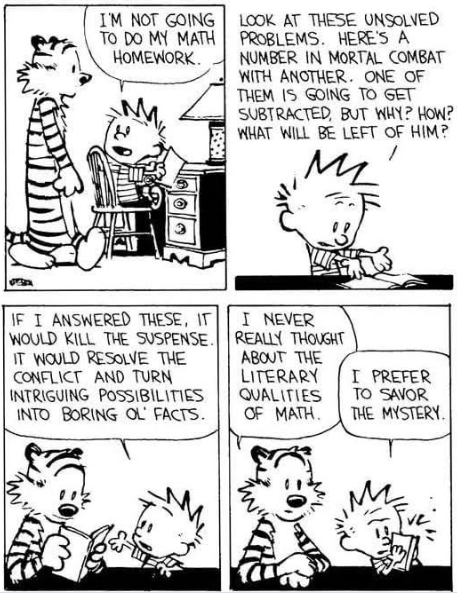
CALVIN: I’m not going to do my math homework. Look at these unsolved problems. Here’s a number in mortal combat with another. One of them is going to get subtracted. But why? How? What will be left of him? If I answered these, it would kill the suspense. It would resolve the conflict and turn intriguing possibilities into boring ol’ facts.
HOBBES: I never really thought about the literary qualities of math.
CALVIN: I prefer to savor the mystery.
Quotations about:
numbers
Note not all quotations have been tagged, so Search may find additional quotes on this topic.

Rise like Lions after slumber
In unvanquishable number,
Shake your chains to earth like dew
Which in sleep had fallen on you
Ye are many — they are few.Percy Bysshe Shelley (1792–1822) English poet
Poem (1819), “The Mask of Anarchy,” st. 38
(Source)
Writing as the voice of England talking to her children. The words are repeated in the final stanza.
The poem was subtitled "Written on the Occasion of the Massacre at Manchester," referring to the Peterloo Massacre (1819-08-16), when a large, peaceful demonstration for parliamentary representation by millworkers and their families was attacked by regular and irregular cavalry troops, attempting to arrest the protest leader, Henry Hunt, and break up the assembly. Hundreds were wounded, and around a dozen killed.

AGAMEMNON:But women?
Women overpower men?HECUBA:There is power
in numbers, and cunning makes us strong.ἈΓΑΜΈΜΝΩΝ: καὶ πῶς γυναιξὶν ἀρσένων ἔσται κράτος;
ἙΚΆΒΗ: δεινὸν τὸ πλῆθος σὺν δόλῳ τε δύσμαχον.
Euripides (485?-406? BC) Greek tragic dramatist
Hecuba [Hekabe; Ἑκάβη], l. 883ff (c. 424 BC) [tr. Arrowsmith (1958)]
(Source)
Hecuba telling Agamemnon that she will rely on her fellow captive Trojan women to help exact her revenge on Polymestor.
(Source (Greek)). Alternate translations:AGAMΕΜΝΟΝ. How shall weak women; over men prevail?
HECUBA. Numbers are strong; add stratagem, resistless.
[tr. Potter (1781)]AGAMEMNON:How can the female sex
O'er men obtain a conquest?
HECUBA:Numbers strike
A foe with terror, and the wiles of women
Are hard to be withstood.
[tr. Wodhull (1809)]AGAMEMNON: And how shall the victory over men be to women?
HECUBA: Numbers are powerful, with stratagem invincible.
[tr. Edwards (1826)]AGAMEMNON: How? -- women gain the mastery over men?
HECUBA: Mighty are numbers: joined with craft, resistless.
[tr. Way (Loeb) (1894)]AGAMEMNON: How are women to master men?
HECUBA: Numbers are a fearful thing, and joined to craft a desperate foe.
[tr. Coleridge (1938)]AGAMEMNON: How can women win against men?
HECUBA: Who can stand against a tribe
A wild tribe of wise women?
[tr. McGuinness (2004)]AGAMEMNON: How can you women overpower a man?
HECUBA: Enough of them would scare you soon enough and with cunning they're a force hard to resist.
[tr. Harrison (2005)]AGAMEMNON: But how will the women be able to overcome the strength of men?
HEKABE: Numbers, when joined with treachery, can cause great terror.
[tr. Theodoridis (2007)]AGAMEMNON:But how?
You are women. How will women defeat men?
HECUBA: There is unnerving strength in numbers, especially when
you add deceit.
[tr. Karden/Street (2011)]
CONSTABLE: Disorder, that hath spoiled us, friend us now.
Let us on heaps go offer up our lives.ORLÉANS: We are enough yet living in the field
To smother up the English in our throngs,
If any order might be thought upon.BOURBON: The devil take order now! I’ll to the throng.
Let life be short, else shame will be too long.William Shakespeare (1564–1616) English dramatist and poet
Henry V, Act 4, sc. 5, l. 19ff (4.5.19-25) (1599)
(Source)
The French dealing with the disastrous rout of their initial attack at Agincourt.

Surprise becomes effective when we suddenly face the enemy at one point with far more troops than he expected. This type of numerical superiority is quite distinct from numerical superiority in general: it is the most powerful medium in the art of war.
[Die Überraschung zeigt sich dadurch wirksam, dass man dem Feinde auf einem Punkt viel mehr Truppen entgegen stellt, als er erwartete. Diese Überlegenheit der Zahl ist von der allgemeinen sehr verschieden, sie ist das wichtigste Agens der Kriegskunst.]
Karl von Clausewitz (1780–1831) Prussian soldier, historian, military theorist
On War [Vom Kriege], Book 6, ch. 2 “The Relations of the Offensive and Defensive to Each Other in Tactics [Wie verhalten sich Angriff und Verteidigung in der Taktik zueinander]” (6.2) (1832) [tr. Howard & Paret (1976)]
(Source)
(Source(German)). Other translations:The surprise produces an effect by opposing to the enemy a great many more troops than he expected at some particular point. The superiority in numbers in this case is very different to a general superiority of numbers; it is the most powerful agent in the art of war.
[tr. Graham (1873)]The suprise produces an effect by opposing to the enemy at some particular point a great many more troops than he expected. The superiority in numbres in this case is very different from the general superiority of numbers; it is the most powerful agent in the art of war.
[tr. Jolles (1943)]

Nay, number (itself) in armies importeth not much, where the people is of weak courage; for (as Virgil saith) It never troubles a wolf how many the sheep be.
Francis Bacon (1561–1626) English philosopher, scientist, author, statesman
Essays or Counsels Civil and Moral, No. 29 “Of the True Greatness of Kingdoms and Estates” (1612)
(Source)
The wolf reference is actually a common Latin proverb: "Non curat numerum lupus [The wolf doesn't care about the number]," or its longer form "Lupus non curat numerum ovium" [The wolf does not care about the number of sheep.].
Though Bacon explicitly notes the phrase in Virgil's Eclogues, the Latin saying is often attributed to Bacon.

CLERIC: And the Lord spake, saying, “First shalt thou take out the Holy Pin. Then shalt thou count to three, no more, no less. Three shall be the number thou shalt count, and the number of the counting shall be three. Four shalt thou not count, neither count thou two, excepting that thou then proceed to three. Five is right out. Once the number three, being the third number, be reached, then lobbest thou thy Holy Hand Grenade of Antioch towards thy foe, who, being naughty in My sight, shall snuff it.
Monty Python (b. 1969) British comedy troupe [Graham Chapman, John Cleese, Terry Gilliam, Eric Idle, Terry Jones, Michael Palin]
Monty Python and the Holy Grail (1975)

For when many rejoice together, the joy of each one is richer: they warm themselves at each other’s flame.
[Quando enim cum multis gaudetur, et in singulis uberius est gaudium, quia fervefaciunt se et inflammantur ex alterutro.]
Augustine of Hippo (354–430) Christian church father, philosopher, saint [b. Aurelius Augustinus]
Confessions, Book 8, ch. 4 / ¶ 9 (8.4.9) [tr. Sheed (1943)] (c. AD 398)
(Source)
(Source (Latin)). Other translations:For when many joy together, each also has more exuberant joy for that they are kindled and inflamed one by the other.
[tr. Pusey (1838)]For when many rejoice together, each also has more exuberant joy; for that they are kindled and inflamed one by the other.
[ed. Shedd (1860)]For when many rejoice together, the joy of each one is the fuller in that they are incited and inflamed by one another.
[tr. Pilkington (1876)]For when many rejoice together, in each there is an overflowing joy, for they kindle themselves and are kindled by one another.
[tr. Hutchings (1890)]For, when joy is shared with many, the joy of each is richer, because they warm one another, catch fire from one another.
[tr. Bigg (1897)]For when many rejoice together the joy of each one is fuller, in that they warm one another, catch fire from each other.
[tr. Outler (1955)]For when many men rejoice together, there is a richer joy in each individual, since they enkindle themselves and they inflame one another.
[tr. Ryan (1960)]When large numbers of people share their joy in common, the happiness of each is greater because each adds fuel to the other’s flame.
[tr. Pine-Coffin (1961)]For when many people rejoice together, the joy of each individual is all the richer, since each one inflames the other and the warmth spreads throughout them all.
[tr. Warner (1963)]For when joy is shared with many, joy is fuller in each. They grow ardent and are fired each by the other.
[tr. Blaiklock (1983)]