

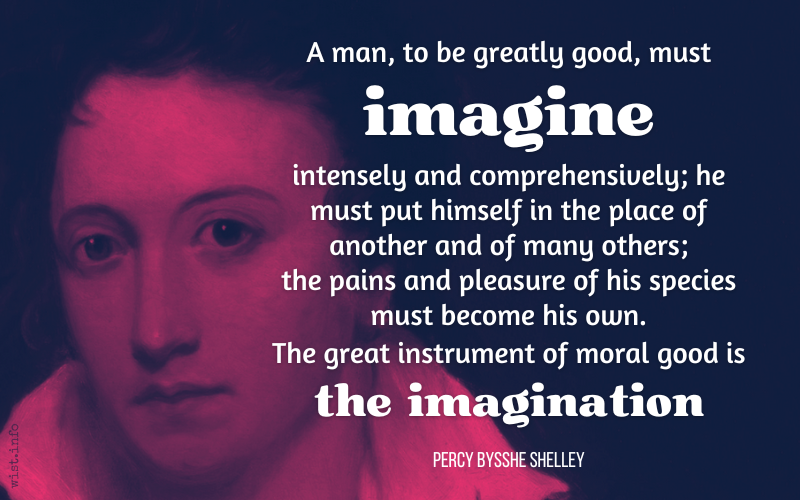
A man, to be greatly good, must imagine intensely and comprehensively; he must put himself in the place of another and of many others; the pains and pleasure of his species must become his own. The great instrument of moral good is the imagination; and poetry administers to the effect by acting upon the cause.
Quotations by:
Shelley, Percy Bysshe
First our pleasures die — and then
Our hopes, and then our fears — and when
These are dead, the debt is due,
Dust claims dust — and we die too.Percy Bysshe Shelley (1792–1822) English poet
“Death,” st. 3 (1820)
I met a traveller from an antique land
Who said: — Two vast and trunkless legs of stone
Stand in the desert. Near them on the sand,
Half sunk, a shatter’d visage lies, whose frown
And wrinkled lip and sneer of cold command
Tell that its sculptor well those passions read
Which yet survive, stamp’d on these lifeless things,
The hand that mock’d them and the heart that fed.
And on the pedestal these words appear:
“My name is Ozymandias, king of kings:
Look on my works, ye mighty, and despair!”
Nothing beside remains: round the decay
Of that colossal wreck, boundless and bare,
The lone and level sands stretch far away.
Love withers under constraint: its very essence is liberty: it is compatible neither with obedience, jealousy, nor fear.
Our sincerest laughter
With some pain is fraught;
Our sweetest songs
Are those that tell of saddest thought.
Falsehood is a scorpion that will sting itself to death.
Percy Bysshe Shelley (1792–1822) English poet
A Declaration of Rights, ch. 12 (1812)
If a person’s religious ideas correspond not with your own, love him nevertheless. How different would yours have been, had the chance of birth placed you in Tartary or India!
Percy Bysshe Shelley (1792–1822) English poet
Declaration of Rights, article 25 (1812)
Hell is a city much like London —
A populous and smoky city.Percy Bysshe Shelley (1792–1822) English poet
Peter Bell the Third, Pt. III, st. 1 (1819)Full text.
Familiar acts are beautiful through love.
Percy Bysshe Shelley (1792–1822) English poet
Prometheus Unbound, “The Earth,” Act IV, l. 403 (1819)
Awful as silence. Hark! the rushing snow!
The sun-awakened avalanche! whose mass,
Thrice sifted by the storm, had gathered there
Flake after flake, in heaven-defying minds
As thought by thought is piled, till some great truth
Is loosened, and the nations echo round,
Shaken to their roots, as do the mountains now.
If he is infinitely good, what reason should we have to fear him? If he is infinitely wise, why should we have doubts concerning our future? If he knows all, why warn him of our needs and fatigue him with our prayers? If he is everywhere, why erect temples to him? If he is just, why fear that he will punish the creatures that he has filled with weaknesses? If grace does everything for them, what reason would he have for recompensing them? If he is all-powerful, how offend him, how resist him? If he is reasonable, how can he be angry at the blind, to whom he has given the liberty of being unreasonable? If he is immovable, by what right do we pretend to make him change his decrees? If he is inconceivable, why occupy ourselves with him? IF HE HAS SPOKEN, WHY IS THE UNIVERSE NOT CONVINCED? If the knowledge of a God is the most necessary, why is it not the most evident and the clearest?
Percy Bysshe Shelley (1792–1822) English poet
The Necessity of Atheism (1811)
Full text, 1813 ed. The text is followed by a citation of "Systeme de la Nature (1781)" (by Baron d'Holbach), but it's unclear whether, or what part of, this is being quoted by Shelley.
Rise like Lions after slumber
In unvanquishable number,
Shake your chains to earth like dew
Which in sleep had fallen on you
Ye are many — they are few.Percy Bysshe Shelley (1792–1822) English poet
Poem (1819), “The Mask of Anarchy,” st. 38
(Source)
Writing as the voice of England talking to her children. The words are repeated in the final stanza.
The poem was subtitled "Written on the Occasion of the Massacre at Manchester," referring to the Peterloo Massacre (1819-08-16), when a large, peaceful demonstration for parliamentary representation by millworkers and their families was attacked by regular and irregular cavalry troops, attempting to arrest the protest leader, Henry Hunt, and break up the assembly. Hundreds were wounded, and around a dozen killed.
First our pleasures die — and then
Our hopes, and then our fears — and when
These are dead, the debt is due,
Dust claims dust — and we die too.Percy Bysshe Shelley (1792–1822) English poet
Poem (1820), “Death,” st. 3, Posthumous Poems (1824)
(Source)
All things that we love and cherish,
Like ourselves must fade and perish;
Such is our rude mortal lot —
Love itself would, did they not.Percy Bysshe Shelley (1792–1822) English poet
Poem (1820), “Death,” st. 4, Posthumous Poems (1824)
(Source)