
It is becoming increasingly clear that it is respect for the dignity of the individual that most sharply differentiates democratic from totalitarian system. Granted this basic principle, it follows that any conduct of the state that impairs the dignity of man is dangerous. And any argument for conformity that finds its ultimate sanction in force rather than in reason strikes at the integrity of the individual, and thus at the basic principle of democracy.
Henry Steele Commager (1902–1998) American historian, writer, activist
Essay (1954), “The Necessity of Freedom,” Freedom, Loyalty, Dissent
(Source)
An earlier version of the essay was given as "The Pragmatic Necessity for Freedom," Cooper Lecture, Swarthmore College (1951), and a lecture of this name at Cornell University (1953-10).
Quotations about:
dignity
Note not all quotations have been tagged, so Search may find additional quotes on this topic.

We claim the dignity of age, but the truth is, age leaves us without any dignity at all.
Elizabeth Bear (b. 1971) American author [pseud. for Sarah Bear Elizabeth Wishnevsky]
Bone and Jewel Creatures, ch. 4 [Bijou] (2010)
(Source)

For men ought not to be so elated by the dignity of the affairs which they have undertaken to manage, as to have no regard to their ease; nor ought they to dwell with fondness on any sort of ease which is inconsistent with dignity.
[Neque enim rerum gerendarum dignitate homines ecferri ita convenit ut otio non prospiciant, neque ullum amplexari otium quod abhorreat a dignitate.]
Marcus Tullius Cicero (106–43 BC) Roman orator, statesman, philosopher
Pro Sestio [For Publius Sestius], ch. 45 / sec. 98 (56-02 BC) [tr. Yonge (1891)]
(Source)
Part of Cicero's discussion of otium cum dignitate ("peace with dignity"), an idealized active private life after retiring from public service. See here for more.
(Source (Latin)). Other translations:For neither is it fitting that men be so carried away by political freedom as to make no provision for tranquility, nor to accept any tranquility which is inconsistent with freedom.
[tr. Hickie (1888)]For just as it ill befits men to be so carried away by the dignity of a public career that they are indifferent in peace, so too it is unfitting for them to welcome a peace which is inconsistent with dignity.
[tr. Gardner (Loeb) (1958)]
But thare iz lots ov pholks who kant see enny phun in enny thing, yu couldn’t fire a joke into them with a double barrell gun, 10 paces off, they go thru life az sollum az a cow. Menny people think it iz beneath their dignity to relish a joke, sutch people are simply fools, and dont seem to kno it.
[But there are lots of folks who can’t see any fun in anything; you couldn’t fire a joke into them with a double-barrel gun, ten paces off; they go through life as solemn as a cow. May people think it is beneath their dignity to relish a joke; such people are simply fools, and don’t seem to know it.]
Josh Billings (1818–1885) American humorist, aphorist [pseud. of Henry Wheeler Shaw]
Josh Billings’ Farmer’s Allminax, 1875-04 “Fun” (1875 ed.)
(Source)

And if now (but may the immortal gods avert the omen!) that worst of fates shall befall the republic, then, as brave gladiators take care to perish with honor, let us too, who are the chief men of all countries and nations, take care to fall with dignity rather than to live as slaves with ignominy.
[Quodsi iam, quod di omen avertant! fatum extremum rei publicae venit, quod gladiatores nobiles faciunt, ut honeste decumbant, faciamus nos principes orbis terrarum gentiumque omnium, ut cum dignitate potius cadamus quam cum ignominia serviamus.]
Marcus Tullius Cicero (106–43 BC) Roman orator, statesman, philosopher
Philippics [Philippicae; Antonian Orations], No. 3, ch. 14 / sec. 35 (2.14/3.35.3) (44-12-20 BC) [tr. Yonge (1903)]
(Source)
(Source (Latin)). Other translations:But if already -- may the Gods avert the omen! -- the State has been brought to its latest pass, let us, the leaders of the world and of all nations, do what stout gladiators do to die with honour, let us fall with dignity rather than serve with ignominy. [tr. Ker (Loeb) (1926)]If -- may the Gods avert the omen! -- the final episode in the history of the Res publica has arrived, let us behave like champion gladiators: they meet death honorably; let us, who stand foremost in the world and all nations, see to it that we fall with dignity rather than serve with ignominy.
[tr. Manuwald (2007)]But if, may the Gods avert the omen, final fate has come to the State, let us, leaders of the world and all nations, do what noble gladiators do to die with dignity: let us fall on our sword rather than serve with ignominy.
[tr. Wiseman]
Nothing is more detestable than disgrace, nothing more shameful than slavery. We have been born for glory and freedom — let us either hold on to these things or die with dignity.
[Nihil est detestabilius dedecore, nihil foedius servitute. Ad decus et ad libertatem nati sumus; aut haec teneamus aut cum dignitate moriamur.]
Marcus Tullius Cicero (106–43 BC) Roman orator, statesman, philosopher
Philippics [Philippicae; Antonian Orations], No. 3, ch. 14 / sec. 36 (3.14/3.36) (44-12-20 BC) [tr. @sentantiq (2019)]
(Source)
(Source (Latin)). Other translations:Nothing is more detestable than disgrace, nothing fouler than servitude. It is to glory and to liberty we were born; let us either hold fast to these or die with dignity.
[tr. Yonge (1903)]There is nothing more detestable than disgrace; nothing more shameful than slavery. We have been born to glory and to liberty; let us either preserve them or die with dignity.
[tr. Ker (Loeb) (1926)]Nothing is more abominable than disgrace, nothing is uglier than slavery. We were born for honor and freedom: let us either retain them or die with dignity.
[tr. Manuwald (2007)]
YEVGRAF: I told myself it was beneath my dignity to arrest a man for pilfering firewood. But nothing ordered by the Party is beneath the dignity of any man. And the Party was right: one man desperate for a bit of fuel is pathetic; five million people desperate for fuel will destroy a city.
Robert Bolt (1924–1995) English dramatist
Doctor Zhivago, film (1965)
(Source)
Watching Yuri scavenging wood from a fence.
This line is not in the 1957 Boris Pasternak novel.

Etiquette systems of one kind or another govern all social intercourse, formal and informal, which is why faulty ones are able to do so much damage. A system that denies the innate human need for dignity to specific categories of people, typically the poor and the enslaved, fosters incendiary resentment.
Judith Martin (b. 1938) American author, journalist, etiquette expert [a.k.a. Miss Manners]
Star-Spangled Manners, ch. 1 (2003)
(Source)

The greatest monarch on the proudest throne, is oblig’d to sit upon his own arse.
Benjamin Franklin (1706–1790) American statesman, scientist, philosopher, aphorist
Poor Richard (1737 ed.)
(Source)

There is no Negro problem. There is no Southern problem. There is no Northern problem. There is only an American problem. And we are met here tonight as Americans — not as Democrats or Republicans — we are met here as Americans to solve that problem.
This was the first nation in the history of the world to be founded with a purpose. The great phrases of that purpose still sound in every American heart, North and South: “All men are created equal” — “government by consent of the governed” — “give me liberty or give me death.” Well, those are not just clever words, or those are not just empty theories. In their name Americans have fought and died for two centuries, and tonight around the world they stand there as guardians of our liberty, risking their lives.
Those words are a promise to every citizen that he shall share in the dignity of man. This dignity cannot be found in a man’s possessions; it cannot be found in his power, or in his position. It really rests on his right to be treated as a man equal in opportunity to all others. It says that he shall share in freedom, he shall choose his leaders, educate his children, and provide for his family according to his ability and his merits as a human being.
To apply any other test — to deny a man his hopes because of his color or race, his religion or the place of his birth — is not only to do injustice, it is to deny America and to dishonor the dead who gave their lives for American freedom.Lyndon B. Johnson (1908–1973) American politician, educator, US President (1963–69)
Speech (1965-03-15), “The American Promise,” Joint Session of Congress [07:41]
(Source)
To show lack of consideration for those who in any capacity serve us — whether in restaurants, hotels, or stores, or in public places anywhere — is always an evidence of ill-breeding as well as inexcusable selfishness. It is only those who are afraid that someone may encroach upon their exceedingly insecure dignity who show neither courtesy nor consideration except to those whom they think it would be to their advantage to please.
Emily Post (1872–1960) American author, columnist [née Price]
Etiquette: The Blue Book of Social Usage, ch. 8 “Entertaining at a Restaurant” (1922; 1955 10th ed.)
(Source)
See also Paul Eldridge.

Unless a thing is dignified, it cannot be undignified. Why is it funny that a man should sit down suddenly in the street? There is only one possible or intelligent reason: that man is the image of God. It is not funny that anything else should fall down; only that a man should fall down. No one sees anything funny in a tree falling down. No one sees a delicate absurdity in a stone falling down. No man stops in the road and roars with laughter at the sight of the snow coming down. The fall of thunderbolts is treated with some gravity. The fall of roofs and high buildings is taken seriously. It is only when a man tumbles down that we laugh. Why do we laugh? Because it is a grave religious matter: it is the Fall of Man. Only man can be absurd: for only man can be dignified.
Gilbert Keith Chesterton (1874–1936) English journalist and writer
“Spiritualism,” All Things Considered (1908)
(Source)
KING: From lowest place when virtuous things proceed,
The place is dignified by the doer’s deed.William Shakespeare (1564–1616) English dramatist and poet
All’s Well That Ends Well, Act 2, sc. 3, l. 136ff (2.3.136-137) (1602?)
(Source)

Dignity of character ought to be graced by a house; but from a house it is not wholly derived. A master is not to be honored by a house; but a house by its master.
[Ornanda enim est dignitas domo, non ex domo tota quaerenda, nec domo dominus, sed domino domus honestanda est.]
Marcus Tullius Cicero (106–43 BC) Roman orator, statesman, philosopher
De Officiis [On Duties; On Moral Duty; The Offices], Book 1, ch. 39 (1.39) / sec. 139 (44 BC) [tr. McCartney (1798)]
(Source)
(Source (Latin)). Other translations:It is well if a man can enhance that credit and reputation he has gotten by the splendour of his house; but he must not depend on his house alone for it; for the master ought to bring honour to his fine seat, and not the fine seat bring honour to its master.
[tr. Cockman (1699)]For dignity should be adorned by a palace, but not be wholly sought from it: -- the house ought to be ennobled by the master, and not the master by the house.
[tr. Edmonds (1865)]In truth, high standing in the community should be adorned by a house, not sought wholly from a house; nor should the owner be honored by the house, but the house by the owner.
[tr. Peabody (1883)]The house should not constitute, though it may enhance, the dignity of the master; let the master honour the house, not the house the master.
[tr. Gardiner (1899)]Your house may add lustre to your dignity, but it will not suffice that you should derive all your dignity from your house: the master should ennoble the house, not the house the master.
[ed. Harbottle (1906)]The truth is, a man's dignity may be enhanced by the house he lives in, but not wholly secured by it; the owner should bring honour to his house, not the house to its owner.
[tr. Miller (1913)]A house may enhance a man's dignity, but it should not be the only source of dignity; the house should not glorify its owner, but he should enhance it.
[tr. Edinger (1974)]
Here is the crisis of the times as I see it: We talk about problems, issues, policies, but we don’t talk about what democracy means — what it bestows on us — the revolutionary idea that it isn’t just about the means of governance but the means of dignifying people so they become fully free to claim their moral and political agency.
Bill Moyers (1934–2025) American journalist and public commentator
“The Power of Democracy,” speech, Woodrow Wilson National Fellowship Foundation, New York City (7 Feb 2007)
(Source)
Accepting the Frank E. Taplin, Jr. Public Intellectual Award. Reprinted in Bill Moyers, Moyers on Democracy (2008).

Our greatest danger is that in the great leap from slavery to freedom we may overlook the fact that the masses of us are to live by the productions of our hands, and fail to keep in mind that we shall prosper in proportion as we learn to dignify and glorify common labour and put brains and skill into the common occupations of life; shall prosper in proportion as we learn to draw the line between the superficial and the substantial, the ornamental gewgaws of life and the useful. No race can prosper till it learns that there is as much dignity in tilling a field as in writing a poem.
Booker T. Washington (1856–1915) American educator, writer
Speech, Cotton States and International Exposition, Atlanta (18 Nov 1895)
(Source)
Reprinted in his autobiography, Up from Slavery, ch. 14 "The Atlanta Exposition Address" (1907).
People become wedded to their beliefs, because the validity of those beliefs reflects on their competence, commends them as authorities, and rationalizes their mandate to lead. Challenge a person’s beliefs, and you challenge his dignity, standing, and power.
Steven Pinker (b. 1954) Canadian-American cognitive psychologist, linguist, author
The Better Angels of Our Nature, ch. 4 (2011)
(Source)

The greatest problem about old age is the fear that it may go on too long.
A. J. P. Taylor (1906–1990) British historian, journalist, broadcaster [Alan John Percivale Taylor]
An Old Man’s Diary, entry from 1981 (1984)
What then, is the object proposed to themselves by these directors of the republic, which they are bound to keep their eyes fixed upon, and towards which they ought to direct their course? That which is most excellent and most desirable to all men in their senses, and to all good and happy men, — ease conjoined with duty.
[Quid est igitur propositum his rei publicae gubernatoribus quod intueri et quo cursum suum derigere debeant? Id quod est praestantissimum maximeque optabile omnibus sanis et bonis et beatis, cum dignitate otium.]
Marcus Tullius Cicero (106–43 BC) Roman orator, statesman, philosopher
Pro Sestio [For Publius Sestius], ch. 45 / sec. 98 (56-03 BC) [tr. Yonge (1891)]
(Source)
The discussion of otium cum dignitate, coined by Cicero, is a key point in Pro Sestio. It is also translated as "leisure with dignity," "peace with dignity," "peace with honor," "fruitful leisure." Socially, it means an active, studious, useful private life or retirement after public service -- as distinguished from idleness, sloth, and indolence. Politically, Cicero used it to reference a secure, stable, peaceful, but still vigorous state, led by the "best men" (aristocrats or optimates).
(Source (Latin)). Other translations:What, therefore, is the aim of these conductors of the affairs of the state, which they ought to keep their eyes upon, and towards which they ought to direct their course? That which is most excellent and most to be desired by all sane and good and well-to-do citizens, tranquillity with freedom.
[tr. Hickie (1888)][...] That which stands first, and is most to be desired by all happy, honest, and healthy-minded men, is ease with dignity.
[ed. Harbottle (1897)]What then is the mark set before those who guide the helm of state, upon which they ought to keep their eyes and towards which they ought to direct their course? It is that which is far the best and the most desirable for all who are sound and good and prosperous; it is "peace with dignity."
[tr. Gardner (Loeb) (1958)]What then are the ideals and objectives towards which these men ought to steer the res publica? They are the finest, the noblest aims of all men of wisdom, integrity, and substance: civil peace for Rome and honour for those who deserve it.
[tr. Wilson/Lacey (1978)][...] What is desired the most, by those who are healthy, good, and blessed, is leisure with honor.
[in Jasper (2008)][...] The thing that is the most outstanding, and chiefly to be desired by all healthy and good and well-off persons, is leisure with honor.
[ed. Stone (2013)]
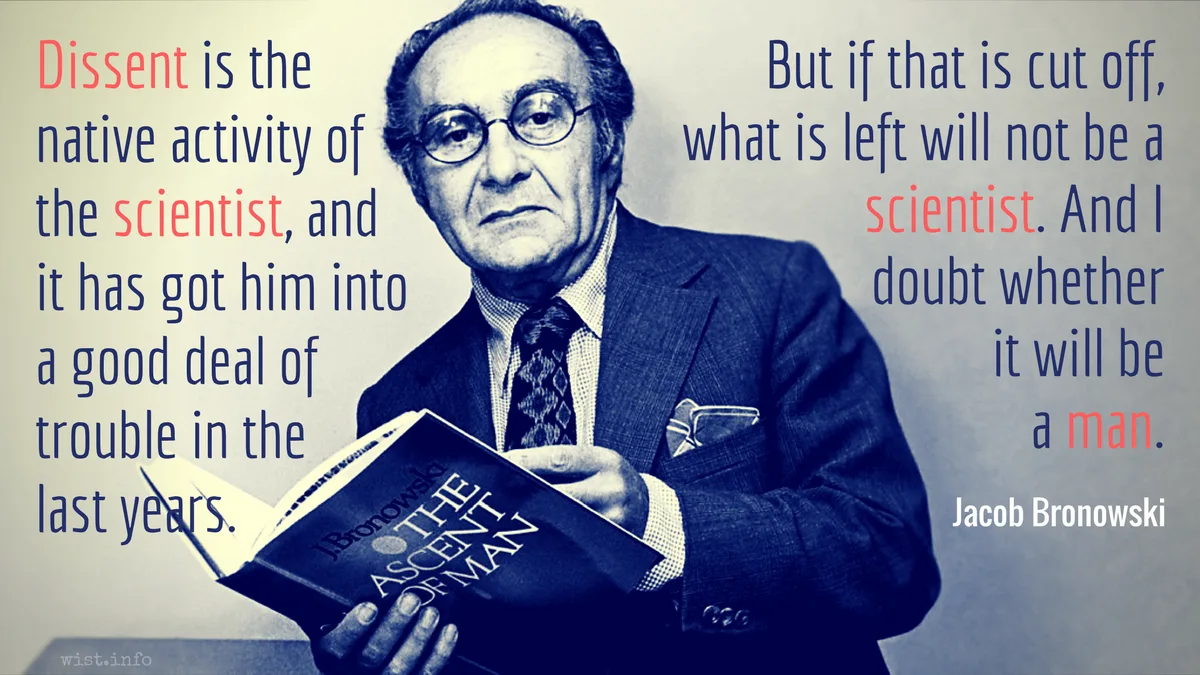
Dissent is the native activity of the scientist, and it has got him into a good deal of trouble in the last years. But if that is cut off, what is left will not be a scientist. And I doubt whether it will be a man.
Jacob Bronowski (1908–1974) Polish-English humanist and mathematician
Lecture, MIT (19 Mar 1953)
(Source)
Reprinted as Science and Human Values, Part 3, sec. 5 "The Sense of Human Dignity" (1961).

There is a difference between tragedy and blind brutal calamity. Tragedy has meaning, and there is dignity in it. Tragedy stands with its shoulders stiff and proud. But there is no meaning, no dignity, no fulfillment, in the death of a child.
Walter M. Miller Jr. (1923–1996) American writer
“The Will” (1953)

The only kind of dignity which is genuine is that which is not diminished by the indifference of others.
Dag Hammarskjöld (1905–1961) Swedish diplomat, author, UN Secretary-General (1953–61)
Markings (1964)

On the whole, with scandalous exceptions, Democracy has given the ordinary worker more dignity than he ever had.
Sinclair Lewis (1885–1951) American novelist, playwright
It Can’t Happen Here (1935)

The conflict to different approaches to the liberty of man and mind or between different views of human dignity and the right of the individual is continuous. The dividing line goes within ourselves, within our own peoples, and also within other nations. It does not coincide with any political or geographical boundaries. The ultimate fight is one between the human and the subhuman. We are on dangerous ground if we believe that any individual, any nation, or any ideology has a monopoly on rightness, liberty, and human dignity.
Dag Hammarskjöld (1905–1961) Swedish diplomat, author, UN Secretary-General (1953–61)
“The Walls of Distrust,” speech, Cambridge University (5 Jun 1958)
If the human animal has any value at all, he is too valuable to be property. If he has an inner dignity, he is much too proud to own other men. I don’t give a damn how scrubbed and perfumed he may be, a slave owner is subhuman.
Robert A. Heinlein (1907–1988) American writer
Time Enough For Love [Lazarus Long] (1973)
There is a certain dignity to be kept up in pleasures, as well as in business.
Lord Chesterfield (1694–1773) English statesman, wit [Philip Dormer Stanhope]
Letter to his son, #216 (5 Feb 1750)
(Source)
Behind every great man is a woman rolling her eyes.
Jim Carrey (b. 1962) Canadian American actor, comedian, producer.
(Attributed)
The central fact of American civilization — one so hard for others to understand — is that freedom and justice and the dignity of man are not just words to us. We believe in them. Under all the growth and the tumult and abundance, we believe. And so, as long as some among us are oppressed — and we are part of that oppression — it must blunt our faith and sap the strength of our high purpose.
Lyndon B. Johnson (1908–1973) American politician, educator, US President (1963–69)
Speech (1965-08-06), Signing of the Voting Rights Act, Washington, D.C.
(Source)
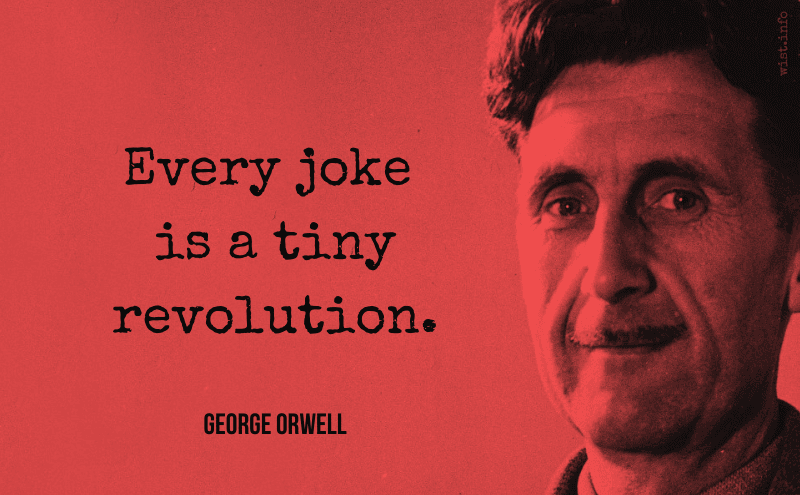
A thing is funny when — in some way that is not actually offensive or frightening — it upsets the established order. Every joke is a tiny revolution. If you had to define humour in a single phrase, you might define it as dignity sitting on a tin-tack. Whatever destroys dignity, and brings down the mighty from their seats, preferably with a bump, is funny. And the bigger the fall, the bigger the joke. It would be better fun to throw a custard pie at a bishop than at a curate.
George Orwell (1903–1950) English journalist, essayist, writer [pseud. of Eric Arthur Blair]
Essay (1945-07-28), “Funny, But Not Vulgar,” Leader Magazine
(Source)
Written in December 1944. More discussion of this quotation: Every Joke Is a Tiny Revolution – Quote Investigator®.

Pride may be allowed to this or that degree, else a man cannot keep up his dignity. In gluttony there must be eating, in drunkenness there must be drinking; ’tis not the eating, nor ’tis not the drinking that is to be blamed, but the excess. So in pride.
John Selden (1584–1654) English jurist, legal scholar, antiquarian, polymath
Table Talk, § 53.3 “Humility” (1689)
(Source)

Just as our national policy in internal affairs has been based upon a decent respect for the rights and the dignity of all our fellow men within our gates, so our national policy in foreign affairs has been based on a decent respect for the rights and dignity of all nations, large and small. And the justice of morality must and will win in the end.
Franklin Delano Roosevelt (1882–1945) American lawyer, politician, statesman; US President (1933–45)
Speech (1941-01-06), “State of the Union [Four Freedoms],” Washington, D. C.
(Source)

I praise loudly, I blame softly.
Catherine II (1762–1796) Russian empress [Catherine the Great; b. Sophie of Anhalt-Zerbst]
Letter (23 Aug. 1794)

Dignity does not consist in possessing honors, but in deserving them.
Aristotle (384–322 BC) Greek philosopher
(Attributed)
Variant: "Dignity consists not in possessing honors, but in the consciousness that we deserve them."
Citation not identified. Earliest reference found in 1854.