Most tyrants are, by nature, short-sighted. Though they aspire to an eternal panoply of statues and symphonies in their honor, they rarely focus on constructive present actions that will lead to a future where their name is even known, let alone praised. As time goes on, they either fall into the delusion of omnipotence, or else become obsessed with holding onto embattled power until the bitter end. Neither mental state leads to laying a healthy foundation for posterity.
Graham Ericsson (b. 1961) American technologist, writer, aphorist
Journal (2026-04-22)
Quotations about:
self-destructiveness
Note not all quotations have been tagged, so Search may find additional quotes on this topic.

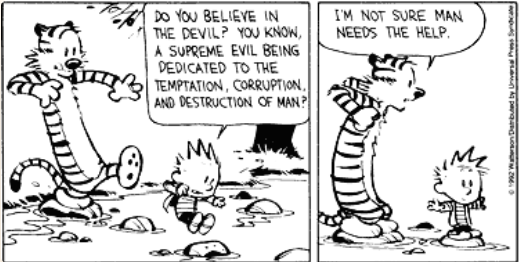
CALVIN: Do you believe in the Devil? You know, a supreme evil being dedicated to the temptation, corruption, and destruction of Man?
HOBBES: I’m not sure Man needs the help.
MEDEA: I know indeed what evil I intend to do,
But stronger than all my afterthoughts is my fury,
Fury that brings upon mortals the greatest evils.[ΜΉΔΕΙΑ: Καὶ μανθάνω μὲν οἷα τολμήσω κακά,
θυμὸς δὲ κρείσσων τῶν ἐμῶν βουλευμάτων,
ὅσπερ μεγίστων αἴτιος κακῶν βροτοῖς.]Euripides (485?-406? BC) Greek tragic dramatist
Medea [Μήδεια], l. 1078ff (431 BC) [tr. Warner (1944)]
(Source)
As she is about to murder her children as part of her revenge on Jason, their father.
(Source (Greek)). Other translations:I now am well aware
What crimes I venture on: but rage, the cause
Of woes most grievous to the human race,
Over my better reason hath prevail'd.
[tr. Wodhull (1782)]I know, I feel the ills, my soul now dares;
But rage, which lords it ov'er my breast, gives birth
To all the dreadful ills that chasten man.
[tr. Potter (1814)]Oh I do know what sorrows I shall make,
But anger keeps the mastery of my thoughts,
Which is the chiefest cause of human woes.
[tr. Webster (1868)]At last I understand the awful deed I am to do; but passion, that cause of direst woes to mortal man, hath triumphed o'er my sober thoughts.
[tr. Coleridge (1891)]I know indeed the ills that I am about to dare, but my rage is master of my counsels, which is indeed the cause of the greatest calamities to men.
[tr. Buckley (1892)]I know, indeed, the evil of that I purpose; but my inclination gets the better of my judgment.
[Bartlett's (1892)]Now, now, I learn what horrors I intend:
But passion overmastereth sober thought:
And this is cause of direst ills to men.
[tr. Way (Loeb) (1894)]Yea, I know to what bad things
I go, but louder than all thought doth cry
Anger, which maketh man's worst misery.
[tr. Murray (1906)]I understand
The horror of what I am going to do; but anger,
The spring of all life's horror, masters my resolve.
[tr. Vellacott (1963)]I understand how evilly I am about to act,
But my spirit is stronger than my will to resist,
Spirit, the greatest cause of evil for men.
[tr. Podlecki (1989)]And I know well what pain I am about to undergo, but my wrath overbears my calculation, wrath that brings mortal men their gravest hurt.
[tr. Kovacs (Loeb) (1994)]I am well aware how terrible a crime I am about to commit, but my passion is master of my reason, passion that causes the greatest suffering in the world.
[tr. Davie (1996)]I know only too well how horrible the crime I am about to commit is. Logic makes it clear for me but anger, the only cause of man’s most terrible suffering, anger, conquers my logic.
[tr. Theodoridis (2004)]I understand what evil I am about to do
but my wrath is stronger even than my thoughts,
which is the cause of the greatest wrongs of humankind.
[tr. Luschnig (2007)]I understand too well the dreadful act
I’m going to commit, but my judgment
cannot check my anger, and that incites
the greatest evils human beings do.
[tr. Johnston (2008)]I know well what evil I intend to do,
but anger overbears my calculation,
anger, cause of the worst misery to man.
[ed. Yeroulanos (2016)]I know how great a crime I'm going to commit,
but anger has control over my plans
anger, which is the greatest cause of human pain.
[tr. Ewans (2022)]At last I understand the evils [kaka] that I will perform; but my thūmos, responsible [aitios] for the greatest troubles [kaka] for mortals, is stronger than my sober thoughts.
[tr. Coleridge / Ceragioli / Nagy / Hour25]And I know well what pain I am about to undergo, but my wrath overpowers my calculation, wrath that brings mortal men their gravest hurt.
[tr. Kovacs / Zhang / Rogak]

Man is subject to innumerable pains and sorrows by the very condition of humanity, and yet, as if nature had not sown evils enough in life, we are continually adding grief to grief, and aggravating the common calamity by our cruel treatment of one another.
Joseph Addison (1672–1719) English essayist, poet, statesman
Essay (1711-09-13), The Spectator, No. 169
(Source)

The neurotic feels as though strapped in a gas-filled room where at any moment someone, probably himself, will strike a match.
Mignon McLaughlin (1913–1983) American journalist and author
The Second Neurotic’s Notebook, ch. 4 (1966)
(Source)

In pushing other species to extinction, humanity is busy sawing off the limb on which it perches.
Paul Ehrlich (b. 1932) American conservation biologist and ecologist
(Attributed)
All citations for this I found are from a reference in Elizabeth Kolbert, The Sixth Extinction: An Unnatural History, ch. 13 (2014), to a sign in the American Museum of Natural History's Hall of Biodiversity which "offers a quote from the Stanford ecologist Paul Ehrlich," giving the above text.
I was unable to find the phrase in Ehrlich's written work, though it could be from a speech, media comment, etc.
In Ehrlich's One with Ninevah: Politics, Consumption, and the Human Future (2005), the epigraph for chapter 2 is a quotation from William R. Catton, Jr., Overshoot: The Ecological Basis of Revolutionary Change, ch. 2 (1980), regarding Earth's finite non-renewable resources:This fact puts mankind out on a limb which the activities of modern life are busily sawing off.
This might be the source of a misattribution to Ehrlich, though the context is not quite the same, and the metaphor of sawing off the branch one is sitting on is not unique to Ehrlich or Cotton. More research is needed.
You can’t save others from themselves because those who make a perpetual muddle of their lives don’t appreciate your interfering with the drama they’ve created. They want your poor-sweet-baby sympathy, but they don’t want to change. This is a truth I never seem to learn.

It’s like this: if you have one piece of cake, and you eat it, that’s fine. If you have two pieces of cake, you should probably share some with a friend. But maybe not. Occasionally we could all use two pieces of cake. But if you have a whole cake, and you eat all of it, that’s not very cool. It’s not just selfish, it’s kinda sick and unhealthy.
Patrick Rothfuss (b. 1973) American author
“Concerning Cake, Bilbo Baggins and Charity,” Blog Entry (19 Jan 2014)
(Source)

At what point then is the approach of danger to be expected? I answer, if it ever reach us, it must spring up amongst us. It cannot come from abroad. If destruction be our lot, we must ourselves be its author and finisher. As a nation of freemen, we must live through all time, or die by suicide.
Abraham Lincoln (1809–1865) American lawyer, politician, US President (1861–65)
Speech (1838-01-27), Young Men’s Lyceum, Springfield, Illinois
(Source)
Lincoln goes on to describe growing issues of lawlessness and mob justice.
This seems to be the source of this far more prosaic, and spurious, Lincoln quote:America will never be destroyed from the outside. If we falter and lose our freedoms, it will be because we destroyed ourselves.

The central fact of American civilization — one so hard for others to understand — is that freedom and justice and the dignity of man are not just words to us. We believe in them. Under all the growth and the tumult and abundance, we believe. And so, as long as some among us are oppressed — and we are part of that oppression — it must blunt our faith and sap the strength of our high purpose.
Lyndon B. Johnson (1908–1973) American politician, educator, US President (1963–69)
Speech (1965-08-06), Signing of the Voting Rights Act, Washington, D.C.
(Source)