INHUMANITY, n. One of the signal and characteristic qualities of humanity.
Ambrose Bierce (1842–1914?) American writer and journalist
“Inhumanity,” “Devil’s Dictionary” column, San Francisco Wasp (1885-10-17)
(Source)
Not collected in later books.
Quotations about:
self-destruction
Note not all quotations have been tagged, so Search may find additional quotes on this topic.

We Americans are not usually thought to be a submissive people, but of course we are. Why else would we allow our country to be destroyed? Why else would we be rewarding its destroyers? Why else would we all — by proxies we have given to greedy corporations and corrupt politicians — be participating in its destruction? Most of us are still too sane to piss in our own cistern, but we allow others to do so and we reward them for it. We reward them so well, in fact, that those who piss in our cistern are wealthier than the rest of us.
Wendell Berry (b. 1934) American farmer, educator, poet, conservationist
Essay (1970-01-01), “Compromise, Hell!” Orion Magazine
(Source)

The sinner sins against himself. The wrong-doer wrongs himself by making himself evil.
[Ὁ ἁμαρτάνων ἑαυτῷ ἁμαρτάνει: ὁ ἀδικῶν ἑαυτὸν ἀδικεῖ, ἑαυτὸν, ἑαυτὸν κακὸν ποιῶν.]
Marcus Aurelius (AD 121–180) Roman emperor (161–180), Stoic philosopher
Meditations [To Himself; Τὰ εἰς ἑαυτόν], Book 9, ch. 4 (9.4) (AD 161-180) [tr. Hutcheson/Chrystal (1902)]
(Source)
(Source (Greek)). Alternate translations:He that sinneth, sinneth unto himself. He that is unjust, hurts himself, in that he makes himself worse than he was before.
[tr. Casaubon (1634)]He that commits a Fault Abroad , is a Trespasser at Home; And he that injures his Neighbour, hurts himself , for to make himself an ill Man is a shrew'd Michief.
[tr. Collier (1701)]He who does wrong, does a wrong to himself. He who is injurious, does evil to himself, by making himself evil.
[tr. Hutcheson/Moor (1742)]He that commits a crime, is guilty of an offence against his own interest, and he that acts unjustly, injures himself: for to make himself a bad man, is an essential injury.
[tr. Graves (1792)]He who does wrong does wrong against himself. He who acts unjustly acts unjustly to himself, because he makes himself bad.
[tr. Long (1862)]He that commits a fault abroad is a trespasser at home; and he that injures his neighbour, hurts himself, for to make himself an evil man is a great mischief.
[tr. Collier/Zimmern (1887)]He who sins, sins against himself; he who does wrong, wrongs himself, making himself evil.
[tr. Rendall (1898)]He that does wrong, does wrong to himself. The unjust man is unjust to himself, for he makes himself bad.
[tr. Haines (Loeb) (1916)]Whosoever does wrong, wrongs himself; whosoever does injustice, does it to himself, making himself evil.
[tr. Farquharson (1944)]The sinner sins against himself; the wrongdoer wrongs himself, becoming the worse by his own action.
[tr. Staniforth (1964)]Whoever does wrong, wrongs himself; whosever acts unjustly, acts unjustly toward himself, because he makes himself bad.
[tr. Hard (1997 ed., 2011 ed.)]To do harm is to do yourself harm. To do an injustice is to do yourself an injustice -- it degrades you.
[tr. Hays (2003)]The sinner sins against himself: the wrongdoer wrongs himself, by making himself morally bad.
[tr. Hammond (2006)]He who acts wrongly harms himself. If a person commits an injustice, he acts badly toward himself, thus making himself bad.
[tr. Needleman/Piazza (2008)]
Do nothing, only keep agitating, debating; and things will destroy themselves.
Thomas Carlyle (1795–1881) Scottish essayist and historian
The French Revolution: A History, Part 1, Book 6, ch. 3 (1.6.3) (1837)
(Source)
On the inactivity of the elected National Assembly leading up to the Revolution.

The neurotic feels as though trapped in a gas-filled room where at any moment someone, probably himself, will strike a match.
Mignon McLaughlin (1913–1983) American journalist and author
The Second Neurotic’s Notebook, ch. 4 (1966)
(Source)

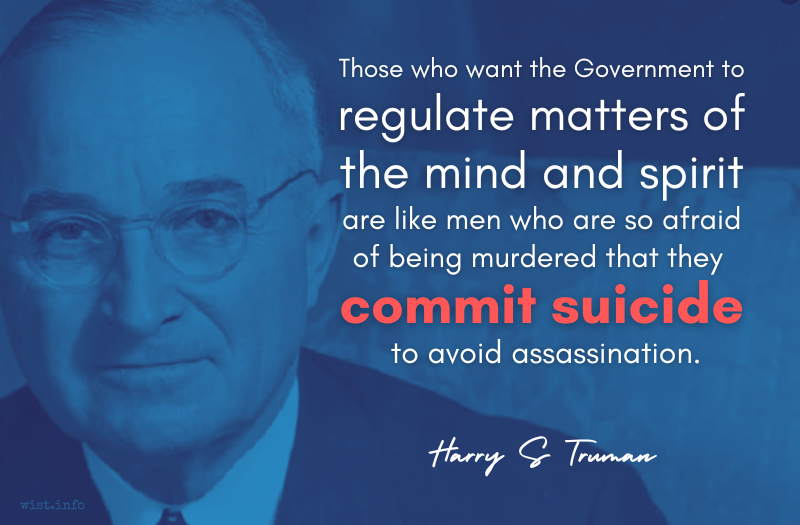
Those who want the Government to regulate matters of the mind and spirit are like men who are so afraid of being murdered that they commit suicide to avoid assassination.
Those whom the Gods wish to destroy, they first make bored.
Ian Fleming (1908–1964) British writer, journalist, intelligence officer
From Russia with Love, Part 2, ch. 11 (1957)
(Source)
A "curious bastard quotation" (variant of a phrase attributed to Euripides) that crosses Bond's mind when wondering if ennui is driving him to tank his own career.
Of course someone would be that stupid. Some humans would do anything to see if it was possible to do it. If you put a large switch in some cave somewhere, with a sign on it saying “End-of-the-World Switch. PLEASE DO NOT TOUCH,” the paint wouldn’t even have time to dry.

The Fear of Death often proves Mortal, and sets People on Methods to save their Lives, which infallibly destroy them.
Joseph Addison (1672–1719) English essayist, poet, statesman
Essay (1711-03-24), The Spectator, No. 25
(Source)

Ignorance is not bliss — it is oblivion. Determined ignorance is the hastiest kind of oblivion.
It was foolish indeed — thus to run farther and farther from all who could help her, as if she had been seeking a fit spot for the goblin-creature to eat her in at his leisure; but that is the way fear serves us: it always sides with the thing we are afraid of.
George MacDonald (1824–1905) Scottish novelist, poet
The Princess and the Goblin, ch. 14 (1872)
(Source)

We injure ourselves more than our enemies, by indulging hatred towards them.
Marguerite Gardiner, Countess of Blessington (1789–1849) Irish novelist [Lady Blessington, b. Margaret Power]
Desultory Thoughts and Reflections (1839)
(Source)

My word, how mortals take the gods to task!
All their afflictions come from us, we hear.
And what of their own failings? Greed and folly
double the suffering in the lot of man.[ὢ πόποι, οἷον δή νυ θεοὺς βροτοὶ αἰτιόωνται.
ἐξ ἡμέων γάρ φασι κάκ’ ἔμμεναι· οἱ δὲ καὶ αὐτοὶ
σφῇσιν ἀτασθαλίῃσιν ὑπὲρ μόρον ἄλγε’ ἔχουσιν.]Homer (fl. 7th-8th C. BC) Greek author
The Odyssey [Ὀδύσσεια], Book 1, l. 32ff (1.32) [Zeus] (c. 700 BC) [tr. Fitzgerald (1961)]
(Source)
Original Greek. Other translations:O how falsely men
Accuse us Gods as authors of their ill!
When, by the bane their own bad lives instill,
They suffer all the mis’ries of their states,
Past our inflictions, and beyond their fates.
[tr. Chapman (1616)]Ha! how dare mortals tax the Gods, and say,
Their harms do all proceed from our decree,
And by our setting; when by their crimes they
Against our wills make their own destiny?
[tr. Hobbes (1675), l. 37ff]Perverse mankind! whose wills, created free,
Charge all their woes on absolute degree;
All to the dooming gods their guilt translate,
And follies are miscall'd the crimes of fate.
[tr. Pope (1725)]Alas! how prone are human-kind to blame
The Pow’rs of Heav’n! From us, they say, proceed
The ills which they endure, yet more than Fate
Herself inflicts, by their own crimes incur.
[tr. Cowper (1792), l. 41ff]Mortals, ye Powers, upbraid us with their voice,
And brand us for the fount of all their ill,
Who, of their own acts, not of fate but choice,
Heap to themselves much toil and sorrow still.
[tr. Worsley (1861), st. 6]Why! what reproach,
Ye gods! do mortals cast on deities!
To us all their calamities they trace,
While they, themselves, through their own senseless acts,
Feel pangs their destiny had ne'er decreed.
[tr. Musgrave (1869)]Oh heavens! how mortals now to blame the gods!
From us they say spring ills! but they themselves
By their own folly bring unfated woes.
[tr. Bigge-Wither (1869)]Lo you now, how vainly mortal men do blame the gods! For of us they say comes evil, whereas they even of themselves, through the blindness of their own hearts, have sorrows beyond that which is ordained.
[tr. Butcher/Lang (1879)]Lo, how men blame the gods! From us, they say, spring troubles. But through their own perversity and more than is their due they meet with sorrow.
[tr. Palmer (1891)]See now, how men lay blame upon us gods for what is after all nothing but their own folly.
[tr. Butler (1898)]Oh my, how mortals hold us gods responsible! For they say that their misfortunes come from us. But they get their sufferings, beyond what is fated, by way of their own acts of recklessness.
[tr. Butler (1898), rev. Kim/McCray/Nagy/Power (2018)]Look you now, how ready mortals are to blame the gods. It is from us, they say, that evils come, but they even of themselves, through their own blind folly, have sorrows beyond that which is ordained.
[tr. Murray (1919)]It vexes me to see how mean are these creatures of a day towards us Gods, when they charge against us the evils (far beyond our worst dooming) which their own exceeding wantonness has heaped upon themselves.
[tr. Lawrence (1932)]What a lamentable thing it is that men should blame the gods and regard us as the source of their troubles, when it is their own wickedness that brings them sufferings worse than any which Destiny allots them.
[tr. Rieu (1946)]Oh for shame, how the mortals put the blame upon us
gods, for they say evils come from us, but it is they, rather,
who by their own recklessness win sorrow beyond what is given.
[tr. Lattimore (1965)]Men are so quick to blame the gods: they say
that we devise their misery. But they
themselves -- in their depravity -- design
grief greater than the griefs that fate assigns.
[tr. Mandelbaum (1990)]Ah how shameless -- the way these mortals blame the gods.
From us alone, they say, come all their miseries, yes,
but they themselves, with their own reckless ways,
compound their pains beyond their proper share.
[tr. Fagles (1996)]Mortals! They are always blaming the gods
For their troubles, when their own witlessness
Causes them more than they were destined for!
[tr. Lombardo (2000), l. 37ff]Strange to behold, what blame these mortals can bring against godhead! For their ills, they assert, are from us, when they themselves by their mad recklessness have pain far past what is fated.
[tr. Merrill (2002)]How surprising that men blame the gods, and say their troubles come from us, though they, through their own un-wisdom, find suffering beyond what is fated.
[tr. Kline (2004)]What a lamentable thing it is that men should blame the gods and regard us as the source of their troubles, when it is their own transgressions which bring them suffering that was not their destiny.
[tr. DCH Rieu (2002)]This is not good! See how mortals find fault with us gods!
They say it is from us that all evil things come, yet it is by their
own recklessness that they suffer hardship beyond their destiny.
[tr. Verity (2016)]This is absurd,
that mortals blame the gods! They say we cause
their suffering, but they themselves increase it
by folly.
[tr. Wilson (2017)]My oh my, the way mortals will fasten blame on the gods!
From us, they say, evils come, yet they themselves
through their own blind recklessness have ills beyond
their fated lot.
[tr. Green (2018)]It’s disgraceful how humans blame the gods.
They say their tribulations come from us,
when they themselves, through their own foolishness,
bring hardships which are not decreed by Fate.
[tr. Johnston (2019), l. 41ff]
At what point then is the approach of danger to be expected? I answer, if it ever reach us, it must spring up amongst us. It cannot come from abroad. If destruction be our lot, we must ourselves be its author and finisher. As a nation of freemen, we must live through all time, or die by suicide.
Abraham Lincoln (1809–1865) American lawyer, politician, US President (1861–65)
Speech (1838-01-27), Young Men’s Lyceum, Springfield, Illinois
(Source)
Lincoln goes on to describe growing issues of lawlessness and mob justice.
This seems to be the source of this far more prosaic, and spurious, Lincoln quote:America will never be destroyed from the outside. If we falter and lose our freedoms, it will be because we destroyed ourselves.

The disturbing factor in the success of totalitarianism is rather the true selflessness of its adherents: it may be understandable that a Nazi or Bolshevik will not be shaken in his conviction by crimes against people who do not belong to the movement or are even hostile to it; but the amazing fact is that neither is he likely to waver when the monster begins to devour its own children, and not even if he becomes a victim of persecution himself, if he is framed and condemned, if he is purged from the party and sent to a forced-labor or concentration camp. On the contrary, to the wonder of the whole civilized world, he may even be willing to help in his own prosecution and frame his own death sentence if only his status as a member of the movement is not touched.

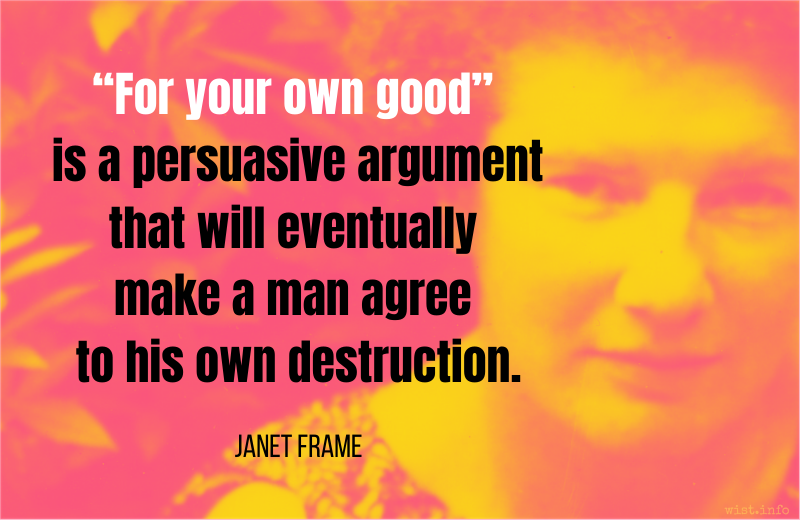
“For your own good” is a persuasive argument that will eventually make a man agree to his own destruction.
Janet Frame (1924–2004) New Zealand author [pen name of Nene Janet Paterson Clutha]
Faces in the Water, ch. 4 (1961)

A man can’t eat anger for breakfast and sleep with it at night and not suffer damage to his soul.
Garrison Keillor (b. 1942) American entertainer, author
“Could I Have Been Any More Inept?” Salon.com (26 Oct 1999)
(Source)
Holding on to anger is like grasping a hot coal with the intent of throwing it at someone else; you are the one who gets burned.
Buddha (c.563–483 BC) Indian mystic, philosopher [b. Siddharta Gautama]
(Attributed)
Not authoritatively sourced.

Anger is an acid that can do more harm to the vessel in which it is stored than to anything on which it is poured.
Mark Twain (1835–1910) American writer [pseud. of Samuel Clemens]
(Spurious)
Frequently attributed to Twain, but not found in his writing or in any contemporary sources.

Learn this from me. Holding anger is a poison. It eats you from inside. We think that hating is a weapon that attacks the person who harmed us. But hatred is a curved blade. And the harm we do, we do to ourselves.
Mitch Albom (b. 1958) American author, journalist, broadcaster, musician
The Five People You Meet in Heaven, “The Third Lesson” [Ruby] (2003)
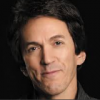
Sin is a queer thing. It isn’t the breaking of divine commandments. It is the breaking of one’s own integrity.
David Herbert "D. H." Lawrence (1885–1930) English novelist
Studies in Classic American Literature, ch. 8 (1923)

9 Men in 10 are suicides.
Benjamin Franklin (1706–1790) American statesman, scientist, philosopher, aphorist
Poor Richard Improved (1749 ed.)
(Source)

Like an unchecked cancer, hate corrodes the personality and eats away its vital unity. Hate destroys a man’s sense of values and his objectivity. It causes him to describe the beautiful as ugly and the ugly as beautiful, and to confuse the true with the false and the false with the true.
Martin Luther King, Jr. (1929–1968) American clergyman, civil rights leader, social activist, preacher
Strength to Love, ch. 5 “Loving Your Enemies,” sec. 2 (1963)
(Source)
ANGER: Of the Seven Deadly Sins, anger is possibly the most fun. To lick your wounds, to smack your lips over grievances long past, to roll over your tongue the prospect of bitter confrontations still to come, to savor to the last toothsome morsel both the pain you are given and the pain you are giving back — in many ways it is a feast fit for a king. The chief drawback is that what you are wolfing down is yourself. The skeleton at the feast is you.

When you’re young, you look at television and think, There’s a conspiracy. The networks have conspired to dumb us down. But when you get a little older, you realize that’s not true. The networks are in business to give people exactly what they want. That’s a far more depressing thought. Conspiracy is optimistic! You can shoot the bastards! We can have a revolution! But the networks are really in business to give people what they want. It’s the truth.
Steve Jobs (1955–2011) American computer inventor, entrepreneur
Interview, Wired (Feb 1996)

Burn not thy fingers to snuff another man’s candle.
James Howell (c. 1594–1666) Welsh historian, writer, aphorist
Paroimiographia [Παροιμιογραφία], or, Old Sayed Sawes & Adages, “New Sayings” (1659)
(Source)

We desire nothing so much as what we ought not to have.
Publilius Syrus (d. 42 BC) Assyrian slave, writer, philosopher [less correctly Publius Syrus]
Sententiae [Moral Sayings], # 559
Church and state are drawn to each other like moths and flame, and when they are, it’s always about power — power over the population, power over souls. power over votes. But religious and political leaders alike should remember what happens when the moth and flame finally get together.
Graham Ericsson (b. 1961) American technologist, writer, aphorist
Journal (2007-08-13)

Heaven-sent calamities you may stand up against, but you cannot survive those brought on by yourself.
Shu Ching (6th Century BC) Chinese collection of political philosophy [Shujing, Shu-kin, Shangshu, The Book of History, The Book of Documents, or The Classic of History]
T’ai Chia
Also cited as Shu Ching 4, 5
Democracy is the theory that the common people know what they want, and deserve to get it good and hard.
H. L. Mencken (1880–1956) American writer and journalist [Henry Lewis Mencken]
A Little Book in C Major, ch. 2, § 1 (1916)
(Source)