When we observe the lives of those whom an ample inheritance has let loose to their own direction, what do we discover that can excite our envy? Their time seems not to pass with much applause from others, or satisfaction to themselves: many squander their exuberance of fortune in luxury and debauchery, and have no other use of money than to inflame their passions, and riot in a wide range of licentiousness; others, less criminal indeed, but surely not much to be praised, lie down to sleep, and rise up to trifle, are employed every morning in finding expedients to rid themselves of the day, chase pleasure through all the places of publick resort, fly from London to Bath, and from Bath to London, without any other reason for changing place, but that they go in quest of company as idle and as vagrant as themselves, always endeavouring to raise some new desire, that they may have something to pursue, to rekindle some hope which they know will be disappointed, changing one amusement for another which a few months will make equally insipid, or sinking into languor and disease for want of something to actuate their bodies or exhilarate their minds.
Samuel Johnson (1709–1784) English writer, lexicographer, critic
Essay (1753-11-27), The Adventurer, No. 111
(Source)
Quotations about:
ennui
Note not all quotations have been tagged, so Search may find additional quotes on this topic.

Work, therefore, is desirable, first and foremost, as a preventive of boredom, for the boredom that a man feels when he is doing necessary though uninteresting work is as nothing in comparison with the boredom that he feels when he has nothing to do with his days.
Bertrand Russell (1872–1970) English mathematician and philosopher
Conquest of Happiness, Part 2, ch. 14 “Work” (1930)
(Source)

To delight in reading is to trade life’s dreary moments for moments of pure joy.
[Aimer à lire, c’est faire un échange des heures d’ennui que l’lon doit avoir en sa vie contre des heures délicieuses.]
Charles-Lewis de Secondat, Baron de Montesquieu (1689–1755) French political philosopher
Pensées Diverses [Assorted Thoughts], # 1632 / 1143 (1720-1755) [ed. Guterman (1963)]
(Source)
(Source (French)). Other translations:To enjoy reading is to transform wearisome hours into delightful ones.
[E.g. (1880)]A fondness for reading changes the inevitable dull hours of our life into exquisite hours of delight.
[E.g. (1900)]To love to read is to exchange hours of ennui for hours of delight.
[E.g. (1936)]To love to read is to make an exchange of the inevitable hours of boredom in one's life, for some delightful hours.
[tr. Clark (2012)]


One must work, if not out of inclination, at least out of despair. All things considered, work is far less boring than entertaining oneself.
[Il faut travailler, sinon par goût, au moins par désespoir, puisque, tout bien vérifié, travailler est moins ennuyeux que s’amuser.]Charles Baudelaire (1821–1867) French poet, essayist, art critic
Journaux Intimes [Intimate Journals], “Mon cœur mis à nu [My Heart Laid Bare],” § 40 (1864–1867; pub. 1887) [tr. Sieburth (2022)]
(Source)
(Source (French)). Other translations:One must work, if not from inclination at least from despair, since, as I have fully proved, to work is less wearisome than to amuse oneself.
[tr. Isherwood (1930)]It is necessary to work, if not from inclination, at least from despair. As it turns out, work is less boring than amusing oneself.
[Source, e.g.]One must work, if not from inclination, at least out of despair -- since it proves, on close examination, that work is less boring than amusing oneself.
[Source, e.g.]
Those whom the Gods wish to destroy, they first make bored.
Ian Fleming (1908–1964) British writer, journalist, intelligence officer
From Russia with Love, Part 2, ch. 11 (1957)
(Source)
A "curious bastard quotation" (variant of a phrase attributed to Euripides) that crosses Bond's mind when wondering if ennui is driving him to tank his own career.
I am convinced that boredom is one of the greatest tortures. If I were to imagine Hell, it would be the place where you were continually bored.

Here’s a comforting thought for you, Peter. However long you may live, the world will never lose its ability to surprise you with its beauty.

Travel, trouble, music, art,
A kiss, a frock, a rhyme —
I never said they feed my heart,
But still they pass my time.Dorothy Parker (1893–1967) American writer, poet, wit
“Faute de Mieux,” Enough Rope (1926)
Faute de mieux means "for lack of something better or more desirable."

Most of life is so dull that there is nothing to be said about it, and the books and talks that would describe it as interesting are obliged to exaggerate, in the hope of justifying their own existence. Inside its cocoon of work or social obligation, the human spirit slumbers for the most part, registering the distinction between pleasure and pain, but not nearly as alert as we pretend. There are periods in the most thrilling day during which nothing happens, and though we continue to exclaim, “I do enjoy myself,” or, “I am horrified,” we are insincere. “As far as I feel anything, it is enjoyment, horror” — it’s no more than that, really, and a perfectly adjusted organism would be silent.
E. M. Forster (1879–1970) English novelist, essayist, critic, librettist [Edward Morgan Forster]
A Passage to India, ch. 14 (1924)
(Source)
The most general survey shows us that the two foes of human happiness are pain and boredom.
[Der allgemeinste Überblick zeigt uns, als die beiden Feinde des menschlichen Glückes, den Schmerz und die Langeweile.]
Arthur Schopenhauer (1788–1860) German philosopher
Parerga and Paralipomena, Vol. 1, “Aphorisms on the Wisdom of Life [Aphorismen zur Lebensweisheit],” ch. 2 “Of What One Is” [Von dem, was einer ist]” (1851) [tr. Saunders (1890)]
(Source)
(Source (German)). Another translation:The most general survey shows that pain and boredom are the two foes of human happiness.
[tr. Payne (1974)]

Men love better books which please them than those which instruct. Since their ennui troubles them more than their ignorance, they prefer being amused to being informed.
Jean-Antoine Dubois (1765–1848) French Catholic missionary in India [Abbe J. A. Dubois]
(Attributed)
(Source)
Earliest found attribution in The New Era (Jan 1873).

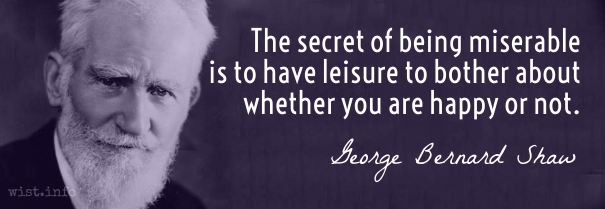
The secret of being miserable is to have leisure to bother about whether you are happy or not. The cure for it is occupation, because occupation means pre-occupation; and the pre-occupied person is neither happy nor unhappy, but simply alive and active, which is pleasanter than any happiness until you are tired of it.
George Bernard Shaw (1856–1950) Irish playwright and critic
Treatise on Parents and Children, “Children’s Happiness” (1914)
(Source)

Human life must be some kind of mistake. The truth of this will be sufficiently obvious if we only remember that man is a compound of needs and necessities hard to satisfy; and that even when they are satisfied, all he obtains is a state of painlessness, where nothing remains to him but abandonment to boredom. This is direct proof that existence has no real value in itself; for what is boredom but the feeling of the emptiness of life? If life — the craving for which is the very essence of our being — were possessed of any positive intrinsic value, there would be no such thing as boredom at all: mere existence would satisfy us in itself, and we should want for nothing. But as it is, we take no delight in existence except when we are struggling for something; and then distance and difficulties to be overcome make our goal look as though it would satisfy us — an illusion which vanishes when we reach it; or else when we are occupied with some purely intellectual interest — when in reality we have stepped forth from life to look upon it from the outside, much after the manner of spectators at a play. And even sensual pleasure itself means nothing but a struggle and aspiration, ceasing the moment its aim is attained. Whenever we are not occupied in one of these ways, but cast upon existence itself, its vain and worthless nature is brought home to us; and this is what we mean by boredom. The hankering after what is strange and uncommon — an innate and ineradicable tendency of human nature — shows how glad we are at any interruption of that natural course of affairs which is so very tedious.
[Daß das menschliche Daseyn eine Art Verirrung seyn müsse, geht zur Genüge aus der einfachen Bemerkung hervor, daß der Mensch ein Konkrement von Bedürfnissen ist, deren schwer zu erlangende Befriedigung ihm doch nichts gewährt, als einen schmerzlosen Zustand, in welchem er nur noch der Langenweile Preis gegeben ist, welche dann geradezu beweist, daß das Daseyn an sich selbst keinen Werth hat: denn sie ist eben nur die Empfindung der Leerheit desselben. Wenn nämlich das Leben, in dem Verlangen nach welchem unser Wesen und Daseyn besteht, einen positiven Werth und realen Gehalt in sich selbst hätte; so könnte es gar keine Langeweile geben: sondern das bloße Daseyn, an sich selbst, müßte uns erfüllen und befriedigen. Nun aber werden wir unsers Daseyns nicht anders froh, als entweder im Streben, wo die Ferne und die Hindernisse das Ziel als befriedigend uns vorspiegeln, welche Illusion nach der Erreichung verschwindet; oder aber in einer rein intellektuellen Beschäftigung, in welcher wir jedoch eigentlich aus dem Leben heraustreten, um es von außen zu betrachten, gleich Zuschauern in den Logen. Sogar der Sinnengenuß selbst besteht in einem fortwährenden Streben und hört auf, sobald sein Ziel erreicht ist. So oft wir nun nicht in einem jener beiden Fälle begriffen, sondern auf das Daseyn selbst zurückgewiesen sind, werden wir von der Gehaltlosigkeit und Nichtigkeit desselben überführt, und Das ist die Langeweile. Sogar das uns inwohnende und unvertilgbare, begierige Haschen nach dem Wunderbaren zeigt an, wie gern wir die so langweilige, natürliche Ordnung des Verlaufs der Dinge unterbrochen sähen.]
Arthur Schopenhauer (1788–1860) German philosopher
Parerga and Paralipomena, Vol. 2, ch. 11 “The Vanity of Existence [Der Nichtigkeit des Daseins],” § 146 (1851)
(Source)
(Source (German)). Another translation:That human life must be a kind of mistake is sufficiently clear from the fact that man is a compound of needs, which are difficult to satisfy; moreover, if they are satisfied, all he is granted is a state of painlessness, in which he can only give himself up to boredom. This is a precise proof that existence in itself has no value, since boredom is merely the feeling of the emptiness of life. If, for instance, life, the longing for which constitutes our very being, had in itself any positive and real value, boredom could not exist; mere existence in itself would supply us with everything, and therefore satisfy us. But our existence would not be a joyous thing unless we were striving after something; distance and obstacles to be overcome then represent our aim as something that would satisfy us -- an illusion which vanishes when our aim has been attained; or when we are engaged in something that is of a purely intellectual nature, when, in reality, we have retired from the world, so that we may observe it from the outside, like spectators at a theatre. Even sensual pleasure itself is nothing but a continual striving, which ceases directly its aim is attained. As soon as we are not engaged in one of these two ways, but thrown back on existence itself, we are convinced of the emptiness and worthlessness of it; and this it is we call boredom. That innate and ineradicable craving for what is out of the common proves how glad we are to have the natural and tedious course of things interrupted.
[tr. Dircks]That human existence must be some kind of error, is sufficiently clear from the simple observation that man is a concretion of needs and wants. Their satisfaction is hard to attain and yet affords him nothing but a painless state in which he is still abandoned to boredom. This, then, is a positive proof that, in itself, existence has no value; for boredom is just that feeling of its emptiness. Thus if life, in the craving for which our very essence and existence consist, had a positive value and in itself a real intrinsic worth, there could not possibly be any boredom. On the contrary, mere existence in itself would necessarily fill our hearts and satisfy us. Now we take no delight in our existence except in striving for something when the distance and obstacles make us think that the goal will be satisfactory, an illusion that vanishes when it is reached; or else in a purely intellectual occupation where we really step out of life in order to contemplate it from without, like spectators in the boxes. Even sensual pleasure itself consists in a constant striving and ceases as soon as its goal is attained. Now whenever we are not striving for something or are not intellectually occupied, but are thrown back on existence itself, its worthlessness and vanity are brought home to us; and this is what is meant by boredom. Even our inherent and ineradicable tendency to run after what is strange and extraordinary shows how glad we are to see an interruption in the natural course of things which is so tedious.
[tr. Payne (1974)]
It is possible to imagine something more terrible than a hell of suffering, and that is a hell of boredom.
[On peut rêver quelque chose de plus terrible qu’un enfer où l’on souffre, c’est un enfer où l’on s’ennuierait.]
Victor Hugo (1802–1885) French writer, journalist, human rights activist, politician
Les Misérables, Part 2 “Cosette,” Book 4 “The Gorbeau Tenement,” ch. 1 (2.4.1) (1862) [tr. Donougher (2013)]
(Source)
See Fromm (1931).
(Source (French)). Other translations:Something more terrible than a hell of suffering may be conceived; to wit, a hell of ennui.
[tr. Wilbour (1862)]It is possible to imagine something more horrible than an Inferno in which people suffer; it is on in which they are bored.
[tr. Wraxall (1862)]Something more terrible than a hell where one suffers may be imagined, and that is a hell where one is bored.
[tr. Hapgood (1887)]It is possible to conceive of something even more terrible than a hell of suffering, and that is a hell of boredom.
[tr. Denny (1976)]There is something more terrible than a hell of suffering -- a hell of boredom.
[tr. Wilbour/Fahnestock/MacAfee (1987)]One can dream of something more terrible than a hell where one suffers; it’s a hell where one would get bored.
[E.g.]

Far better it is to dare mighty things, even though checkered by failure, than to take rank with those who neither enjoy much or suffer much, because they live in the gray twilight that knows not victory nor defeat.
Theodore Roosevelt (1858–1919) American politician, statesman, conservationist, writer; US President (1901–09)
Speech (1899-04-10), “The Strenuous Life,” Hamilton Club, Chicago
(Source)

We can forgive people who bore us, but never those whom we bore.
[Nous pardonnons souvent à ceux qui nous ennuient, mais nous ne pouvons pardonner à ceux que nous ennuyons.]
François VI, duc de La Rochefoucauld (1613–1680) French epigrammatist, memoirist, noble
Réflexions ou sentences et maximes morales [Reflections; or Sentences and Moral Maxims], ¶304 (1665-1678) [tr. Heard (1917), ¶311]
(Source)
This first appeared in the 3rd (1671) edition.
(Source (French)). Other translations:We often forgive those that have Injured us, but we can never Pardon those that we have Injured.
[tr. Stanhope (1694), ¶304]We often forgive those who tire us, but cannot forgive those whom we tire.
[pub. Donaldson (1783), ¶481]We easily forgive those who weary us; but we never forgive those who are wearied by us.
[ed. Carvill (1835), ¶408]We often pardon those who weary us, but we cannot pardon those whom we weary.
[ed. Gowens (1851), ¶314]We may forgive those who bore us, we cannot forgive those whom we bore.
[tr. Bund/Friswell (1871), ¶304]We often forgive those who bore us; but we cannot forgive those whom we bore ourselves.
[tr. Stevens (1939), ¶304]We often forgive those who bore us, but that others should find us boring is quite unforgiveable.
[tr. FitzGibbon (1957), ¶304]We often forgive those who bore us; we cannot forgive those whom we bore.
[tr. Kronenberger (1959), ¶304]We often forgive those who bore us, but we cannot forgive those who find us boring.
[tr. Tancock (1959), ¶304]We often forgive those who bore us; but never can we forgive those we have bored.
[tr. Whichello (2016) ¶304]