I am sure that university life would be better, both intellectually and morally, if most university students had temporary childless marriages. This would afford a solution to the sexual urge neither restless nor surreptitious, neither mercenary nor casual, and of such a nature that it need not take up time which ought to be given to work.
Bertrand Russell (1872–1970) English mathematician and philosopher
Education and the Social Order [Education and the Modern World], ch. 9 “Sex in Education” (1932)
(Source)
Quotations about:
distraction
Note not all quotations have been tagged, so Search may find additional quotes on this topic.
To Sherlock Holmes she is always the woman. I have seldom heard him mention her under any other name. In his eyes she eclipses and predominates the whole of her sex. It was not that he felt any emotion akin to love for Irene Adler. All emotions, and that one particularly, were abhorrent to his cold, precise but admirably balanced mind. He was, I take it, the most perfect reasoning and observing machine that the world has seen, but as a lover he would have placed himself in a false position. He never spoke of the softer passions, save with a gibe and a sneer. They were admirable things for the observer — excellent for drawing the veil from men’s motives and actions. But for the trained reasoner to admit such intrusions into his own delicate and finely adjusted temperament was to introduce a distracting factor which might throw a doubt upon all his mental results. Grit in a sensitive instrument, or a crack in one of his own high-power lenses, would not be more disturbing than a strong emotion in a nature such as his. And yet there was but one woman to him, and that woman was the late Irene Adler, of dubious and questionable memory.
Arthur Conan Doyle (1859–1930) British writer and physician
Story (1891-07), “A Scandal in Bohemia,” ch. 1, The Strand Magazine, Vol. 2, No. 1
(Source)
The reason we are not often wholly possessed by a single vice, is that we are distracted by several.
[Ce qui nous empêche souvent de nous abandonner à un seul vice est que nous en avons plusieurs.]
François VI, duc de La Rochefoucauld (1613–1680) French epigrammatist, memoirist, noble
Réflexions ou sentences et maximes morales [Reflections; or Sentences and Moral Maxims], ¶195 (1665-1678) [pub. Donaldson (1783), ¶442]
(Source)
Present in 1st (1665) edition. In the manuscript, the ending reads "est que nous en avons plusieurs à la fois."
(Source (French)). Other translations:The only Reason why we do not give our selves entirely to one Vice, is oftentimes, because our Affections are divided, and we are fond of several.
[tr. Stanhope (1694), ¶196]The reason we are not often wholly possessed by a single vice, is, that we are distracted by several.
[ed. Lepoittevin-Lacroix (1797), ¶187]We are not often possessed wholly by a single vice: the reason is, we are distracted by several.
[ed. Carvill (1835), ¶378]What often prevents our abandoning ourselves to a single vice is, our having more than one.
[ed. Gowens (1851), ¶204]The reason which often prevents us abandoning a single vice is having so many.
[tr. Bund/Friswell (1871), ¶195]We are not the victims of a single vice only because we are the victims of so many.
[tr. Heard (1917), ¶200]We are often saved from exclusive addiction to a single vice by the possession of others.
[tr. Stevens (1939), ¶195]The multiplicity of our vices often prevents us from abandoning ourselves entirely to one.
[tr. FitzGibbon (1957), ¶195]What often prevents our being enslaved by a single vice is that we have a number of others.
[tr. Kronenberger (1959), ¶195]What often prevents our giving ourselves up to a single vice is that we have several.
[tr. Tancock (1959), ¶195]What often prevents us from giving ourselves up to one single vice, is that we possess several of them.
[tr. Whichello (2016) ¶195]

The majority of the stupid is invincible and guaranteed for all time. The terror of their tyranny, however, is alleviated by their lack of consistency.
[Die Majorität der Dummen ist unüberwindbar und für alle Zeiten gesichert. Der Schrecken ihrer Tyrannei ist indessen gemildert durch Mangel an Konsequenz.]
Albert Einstein (1879–1955) German-American physicist
Essay (1953-05-23), “Aphorisms for Leo Baeck [Neun Aphorismen], No. 5, Essays Presented to Leo Baeck on the Occasion of His Eightieth Birthday (1954) [Einstein Archives 28-962]
(Source)
“The best advice I would give you is, ‘If under attack, cause a diversion.'”
“A diversion?”
“Yes, trip over the dog, spill a glass of wine on your attacker, burst into song, challenge your attacker to a duel.”Kerry Greenwood (b. 1954) Australian author and lawyer
Phryne Fisher, Book 13, The Castlemaine Murders, ch. 4 [Phryne to Jane] (2003)
(Source)

I do have a compulsion to read in out-of-the-way places, and it is often a blessing; on the other hand, it sometimes comes between me and what I tell the children is “my work.” As a matter of fact, I will read anything rather than work. And I don’t mean interesting things like the yellow section of the telephone book or the enclosures that come with the Bloomingdale bill about McKettrick classics in sizes 12 to 20, blue, brown, or navy @ 12.95 (by the way, did you know that colored facial tissue is now on sale at the unbelievably low price of 7.85 a carton? ). The truth is that, rather than put a word on paper, I will spend a whole half hour reading the label on a milk-of-magnesia bottle. “Philips’ Milk of Magnesia,” I read with the absolute absorption of someone just stumbling on Congreve, “is prepared only by the Charles H. Philips Co., division of Sterling Drug, Inc. Not to be used when abdominal pain, nausea, vomiting, or other symptoms of appendicitis are present, etc.”
Jean Kerr (1922–2003) American author and playwright [b. Bridget Jean Collins]
Essay (1957), “Introduction,” Please Don’t Eat the Daisies
(Source)

Do you think that what I say each day on such a variety of topics could come to me if I did not cultivate my mind with learning, or that my mind could bear such a strain if I did not relax it by this same learning?
Indeed I confess that I have devoted myself to these interests. Let others be ashamed who have so buried themselves in books that they can offer nothing for the common enjoyment and can bring nothing forward into the light and the sight of men; but, gentlemen of the jury, why should I be ashamed, I who have lived so long in such a way that leisurely interests have never lured me nor pleasure called me nor sleep kept me from timely service to anyone?
Who, I ask, can censure me on this account, who can rightfully be angry at me, if I take as much time for the pursuit of these studies as is granted others to attend to their interests, to celebrate the festive days of the games, as much time as they devote to other pleasures and the relaxation of mind and body, as much time as others give to early-opening banquets, or even to throwing dice and playing ball?[An tu existimas aut suppetere nobis posse quod cotidie dicamus in tanta varietate rerum, nisi animos nostros doctrina excolamus, aut ferre animos tantam posse contentionem, nisi eos doctrina eadem relaxemus?
Ego vero fateor me his studiis esse deditum: ceteros pudeat, si qui se ita litteris abdiderunt, ut nihil possint ex his neque ad communem adferre fructum neque in aspectum lucemque proferre: me autem quid pudeat, qui tot annos ita vivo, iudices, ut a nullius umquam me tempore aut commodo aut otium meum abstraxerit aut voluptas avocarit aut denique somnus retardarit?
Qua re quis tandem me reprehendat aut quis mihi iure suscenseat, si, quantum ceteris ad suas res obeundas, quantum ad festos dies ludorum celebrandos, quantum ad alias voluptates et ad ipsam requiem animi et corporis conceditur temporum, quantum alii tribuunt tempestivis conviviis, quantum denique alveolo, quantum pilae, tantum mihi egomet ad haec studia recolenda sumpsero?]Marcus Tullius Cicero (106–43 BC) Roman orator, statesman, philosopher
Pro Archia Poeta [For Archia the Poet], ch. 6 / sec. 12-13 (62 BC) [tr. Guinach (1962)]
(Source)
Cicero defends his reading and study habits.
(Source (Latin)). Other translations:Do you think it possible that we could find a supply for our daily speeches, when discussing such a variety of matters, unless we were to cultivate our minds by the study of literature; or that our minds could bear being kept so constantly on the stretch if we did not relax them by that same study?
But I confess that I am devoted to those studies, let others be ashamed of them if they have buried themselves in books without being able to produce anything out of them for the common advantage or anything which may bear the eyes of men and the light. But why need I be ashamed, who for many years have lived in such a manner as never to allow my own love of tranquility to deny me to the necessity or advantage of another or my fondness for pleasure to distract, or even sleep to delay my attention to such claims?
Who then can reproach me or who has any right to be angry with me, if I allow myself as much time for the cultivation of these studies as some take for the performance of their own business, or for celebrating days of festival and games, or for other pleasures, or even for the rest and refreshment of mind and body, or as others devote to early banquets, to playing at dice, or at ball?
[tr. Yonge (1856)]Do you think this can be afforded us as we speak every day in such a variety of cases, unless we abstract our minds from learning; or that our minds can bear such contention, unless we relax them from the same learning?
But I acknowledge I am devoted to these studies; the rest of my brethren may be ashamed if they withdraw from literature in such a manner as from it to be unable either to bear common fruit , or to bring it forth to light to be gazed on; but why am I to be ashamed that my sense of leisure has never led me to remain away in the hour of danger for convenience' sake, or pleasure never allured, or finally slumber never retarded me, who will thus continue to act for as many years as I live?
Why, indeed, should anyone blame me , or have a right to be angry with me if I employ , in the enumeration of these studies, as much time as is allowed to everyone else to attend to their own affairs, to celebrate the festal days of the games, to devote to other pleasures and to the rest of mind and body itself as much time as others devote to protracted banquets, or, in fine, to the gaming-table, or the javelin?
[tr. M'Donogh Mahony (1886)]Or do you suppose, either (that it) would be possible for us to have at hand, what we might utter daily, in such a variety of things [actions], unless we cultivated our minds by study, or (that) (our) minds could bear such great efforts, unless we relaxed them by the same study?
I indeed confess (that), I am given to these pursuits; let it shame others, if they hagve so buried themselves in letters, that they can neither bring nothing [anything] from these (studies), for the common advantage, nor to produce (anything) to view and to light. But why may I be ashamed, O judges who so many years live [have lived] so, that ever [never] either my leisure may have drawn me away or pleasure may have called (me) aside or in fine sleep may have kept (me) back from the emergency or the advantage of any one?
Wherefore who, pray, may reproach me, or who by right may be offended at me, if as much time as is conceded to others, for transacting their affairs, as much for celebrating festival days of games, as much for others pleasures, and for the rest itself of the mind and of the body; much as others devote to protracted banquets, as much in fine as to dice, as much as to ball playing.
[tr. Dewey (1916)]Do you think that I could find inspiration for my daily speeches on so manifold a variety of topics, did I not cultivate my mind with study, or that my mind could endure so great a strain, did not study too provide it with relaxation?
I am a votary of literature, and make the confession unashamed; shame belongs rather to the bookish recluse, who knows not how to apply his reading to the good of his fellows, or to manifest its fruits to the eyes of all. But what shame should be mine, gentlemen, who have made it a rule of my life for all these years never to allow the sweets of a cloistered ease or the seductions of pleasure or the enticements of repose to prevent me from aiding any man in the hour of his need?
How then can I justly be blamed or censured, if it shall be found that I have devoted to literature a portion of my leisure hours no longer than others without blame devote to the pursuit of material gain, to the celebration of festivals or games, to pleasure and the repose of mind and body, to protracted banqueting, or perhaps to the gaming-board? or to ball-playing?
[tr. Watts (Loeb) (1923)]Surely you do not believe that we can keep ourselves supplied with something to say every day on such a variety of topics, unless we thoroughly cultivate our minds by study? Surely you do not think that our minds could endure such strain unless we should give them the relaxation of the same study?
For my part I own that I am devoted to the pursuit of this. The rest of the world may be ashamed to have so buried themselves with literature as to be able neither to produce therefrom anything to the common profit, nor to bring it into sight and publicity. But why should I be ashamed , gentlemen of the jury, to have been living now so many years in such fashion, that neither has my love of retirement ever withdrawn me from any man's time of peril or season of advantage, nor has indulgence called me away, nor, in short, has sloth kept me back from it?
Who therefore, I pray, could find fault with me, or who could, with justice, be vexed with me, if I have myself appropriated to the resumption of such studies just so much out of my leisure hours as the rest of the world devotes to the transaction of their affairs, meeting of private engagements, or to attending the holidays of the Games, or to other indulgences and the mere rest of their minds and bodies? -- just so much time as some devote to lengthy dinners, or even to the dice-box and the tennis-ball?
[tr. Allcroft/Plaistowe (c. 1925)]How do you imagine I could find material for my daily speeches on so many different subjects if I did not train my mind with literary study, and how could my mind cope with so much strain if I did not use such study to help it unwind?
Yes, I for one am not ashamed to admit that I am devoted to the study of literature. Let others be ashamed if they have buried their heads in books and have not been able to find anything in them which could either be applied to the common good or brought out into the open and the light of day. But why should I be ashamed, gentlemen, given that in all the years I have lived my private pastimes have never distracted me, my own pleasures have never prevented me, and not even the need for sleep has ever called me away from helping anyone in his hour of danger or of need?
Who, then, can justly censure or reproach me if I allow myself the same amount of time for pursuing these studies as others set aside for dealing with their own personal affairs, celebrating festivals and games, indulging in other pleasures, and resting their minds and bodies, or as much as they devote to extended partying and to playing dice and ball?
[tr. Berry (2000)][...] I confess indeed that I am obsessed with studying literature. Let this fact shame others who do not know how to make use of their books so that they can’t provide anything from their reading to common profit or to make their benefit clear in sight.
Why, moreover, should I be ashamed when I have lived so many years in such a way that my hobby never prevented me from being useful to anyone at any time and its pleasure or sleepiness never distracted me or slowed me down? In what way, then, can anyone criticize me or censure me if I am discovered to have spent that very same amount of time in pursuing these studies as others do without blame in pursuing profit, or in celebrating festivals or games, in seeking the pleasure and rest of the body and mind, or dragging out hours in dining, gambling or ballgames?
[tr. @sentantiq (2019)]
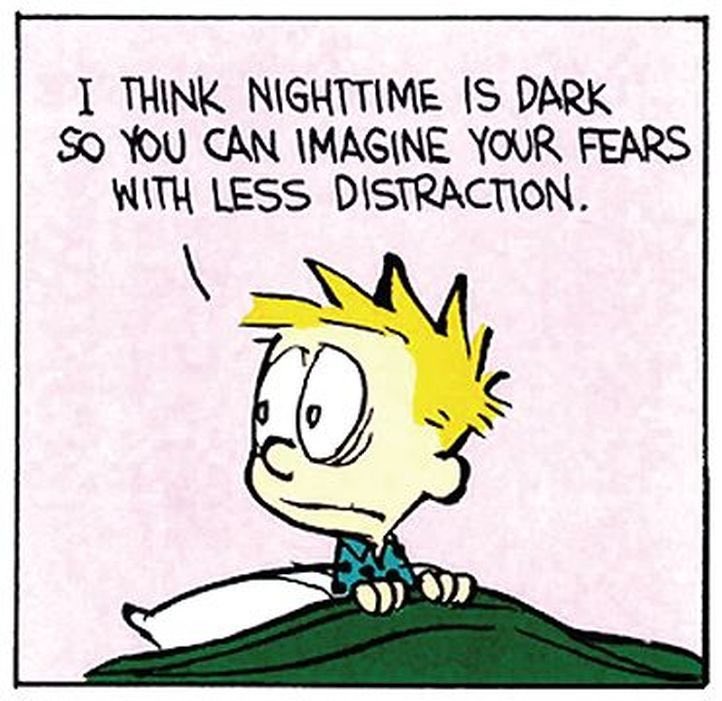
CALVIN: I think nighttime is dark so you can imagine your fears with less distraction.

In order to subdue his subjects, the Prince labours to blind them. Conscious of the unlawfulness of his own designs, and sensible of what he has to fear from clear-sighted men, he endeavours to deprive the people of every means of acquiring knowledge.
How many crafty devices have not Princes employed to oppose the progress of learning? Some banish science out of their dominions; others prohibit their subjects from traveling into foreign countries; others again divert the people from reflecting, by continually entertaining them with feasts and shews, or keeping up among the the spirit of gaming; and all stand up against men of spirit, who dedicate either their voices or their pen to defend the cause of liberty.[Persuadés d’ailleurs combien il est commode de régner sur un peuple abruti, ils [les princes] s’efforcent de le rendre tel. Que d’obstacles n’opposent-ils pas au progrès des lumières? Les uns bannissent les lettres de leurs Etats; les autres défendent à leurs sujets de voyager; d’autres empêchent le peuple de réfléchir, en l’amusant continuellement par des parades, des spectacles, des fêtes, ou en le livrant aux fureurs du jeu. Tous s’élèvent contre les sages qui consacrent leur voix et leur plume à défendre la cause de la liberté.]
Jean-Paul Marat (1743–1793) French physician, political theorist, scientist, journalist
The Chains of Slavery (Les Chaînes de L’Esclavage, ch. 40 “Of Ignorance” (1774) [Beckett ed. (1774)]
(Source)
Source (French)). Other translations:As sovereigns are persuaded of the convenience of ruling an ignorant people, they try to make it so. What won’t they do to prevent the progress of knowledge? Some banish anyone scholarly from their nation; others ban their subjects from traveling; others don't give the people the time to think, constantly amusing them with parades, shows, festivals, or by delivering them over to the passion for games. All of them denounce the wise who give their voice and pen to defend the cause of freedom.Convinced, moreover, how convenient it is to reign over a stupefied people, they [princes] strive to make them so. How many obstacles do they not place in the way of progress of enlightenment? Some banish letters from their states; others forbid their subjects from traveling; others prevent the people from thinking, by continually amusing them with parades, spectacles, festivals, or by delivering them to the furies of gambling. All rise up against the wise men who devote their voice and their pen to defending the cause of liberty.
[Google Translate]
Here is Edward Bear, coming downstairs now, bump, bump, bump, on the back of his head, behind Christopher Robin. It is, as far as he knows, the only way of coming downstairs, but sometimes he feels that there really is another way, if only he could stop bumping for a moment and think about it.
A. A. Milne (1882–1956) English poet and playwright [Alan Alexander Milne]
Winnie-the-Pooh, ch. 1 “We Are Introduced” (1926)
(Source)
Opening lines of the book. Art by E H Shepard.

Sam Vimes could parallel process. Most husbands can. They learn to follow their own line of thought while at the same time listening to what their wives say. And the listening is important, because at any time they could be challenged and must be ready to quote the last sentence in full. A vital additional skill is being able to scan the dialogue for telltale phrases such as “and they can deliver it tomorrow” or “so I’ve invited them for dinner” or “they can do it in blue, really quite cheaply.”
Terry Pratchett (1948–2015) English author
Discworld Series No. 24, The Fifth Elephant (1999)
(Source)

The wise man thinks about his troubles only when there is some purpose in doing so; at other times he thinks about other things, or, if it is night, about nothing at all.
Bertrand Russell (1872–1970) English mathematician and philosopher
Conquest of Happiness, Part 1, ch. 5 “Fatigue” (1930)
(Source)
And others are those sown among the thorns: these are the ones who hear the word, but the cares of the age and the lure of wealth and the desire for other things come in and choke the word, and it yields nothing.
[καὶ ἄλλοι εἰσὶν οἱ εἰς τὰς ἀκάνθας σπειρόμενοι· οὗτοί εἰσιν οἱ τὸν λόγον ἀκούσαντες, καὶ αἱ μέριμναι τοῦ αἰῶνος καὶ ἡ ἀπάτη τοῦ πλούτου καὶ αἱ περὶ τὰ λοιπὰ ἐπιθυμίαι εἰσπορευόμεναι συμπνίγουσιν τὸν λόγον καὶ ἄκαρπος γίνεται.]
The Bible (The New Testament) (AD 1st - 2nd C) Christian sacred scripture
Book 2. Gospel of Mark 4:18ff (Mark 4:18–19) (Jesus) [NRSV (2021 ed.)]
(Source)
Part of the Parable of the Sower. This passage is paralleled in Matthew 13:22 and Luke 8:14.
(Source (Greek)). Alternate translations:And these are they which are sown among thorns; such as hear the word, and the cares of this world, and the deceitfulness of riches, and the lusts of other things entering in, choke the word, and it becometh unfruitful.
[KJV (1611)]Then there are others who receive the seed in thorns. These have heard the word, but the worries of this world, the lure of riches and all the other passions come in to choke the word, and so it produces nothing.
[JB (1966)]Other people are like the seeds sown among the thorn bushes. These are the ones who hear the message, but the worries about this life, the love for riches, and all other kinds of desires crowd in and choke the message, and they don't bear fruit.
[GNT (1966)]Then there are others who are sown in thorns. These have heard the word, but the worries of the world, the lure of riches and all the other passions come in to choke the word, and so it produces nothing.
[NJB (1985)]Others are like the seed scattered among the thorny plants. These are the ones who have heard the word; but the worries of this life, the false appeal of wealth, and the desire for more things break in and choke the word, and it bears no fruit.
[CEB (2011)]

A man may feel so completely thwarted that he seeks no form of satisfaction, but only distraction and oblivion. He then becomes a devotee of “pleasure.” That is to say, he seeks to make life bearable by becoming less alive. Drunkenness, for example, is temporary suicide: the happiness that it brings is merely negative, a momentary cessation of unhappiness.
Bertrand Russell (1872–1970) English mathematician and philosopher
Conquest of Happiness, Part 1, ch. 1 “What Makes People Unhappy?” (1930)
(Source)
Most of us spend so much time thinking about where we have been or where we are supposed to be going that we have a hard time recognizing where we actually are.
Barbara Brown Taylor (b. 1951) American minister, academic, author
An Altar in the World, ch. 4 (2009)
(Source)

PATRICK: It was just so embarrassing. I didn’t know what to do.
STEVE: Happens to us all mate.
JEFF: All of us, in our time, are visited by the Melty Man.
PATRICK: The what?
JEFF: Don’t say his name, Patrick. Don’t even think his name or he will rise from the shadow dimensions to do his evil work on your terrified pants.
PATRICK: (chuckle) Terrified pants?
STEVE: (gravely) There’s nothing funny about the Melty Man, Patrick.
PATRICK: (face falls) You know about the Melty Man, too?
STEVE: We all know the Melty Man.
PATRICK: Who is he?
STEVE: The archenemy of trouser confidence.
JEFF: Professor Moriarty, in groin form.
STEVE: Darth Vader.
JEFF: Without the helmet.
PATRICK: What does he do?!
JEFF: Patrick, you know what he does.
PATRICK: (looks down) Oh, right.
JEFF: You’re in bed with a woman. Everything’s going fine. That’s when the Melty Man strikes.
STEVE: Suddenly you find yourself thinking, “Maybe she’s really bored.”
JEFF: Maybe you’re licking her neck too much. Are you over-wetting her neck?
STEVE: Are you spending an equal amount of time on each breast? I mean, what happens if one breast gets ahead?
JEFF: Should you be switching between them really quickly or should you squish ’em both together and do them at once?
STEVE: Or are you allowed to just skip one breast completely, just to save time?
JEFF: She’s wriggling about a bit. Is that a good sign or is she just trying to dry her neck?
STEVE: Should you kiss her now or does that mean you gotta start at the top again?
JEFF: Should you be making noises yet? Is it too soon to grunt?
STEVE: And then, the killer — out of nowhere, for no reason you can think of, you call her (huskily) “baby.”
JEFF: You never called her baby before.
STEVE: You’ve never called anyone baby before.
JEFF: So why did you just call her baby? Suddenly you’re starting to blush.
STEVE: Now, you’re blushing and you’ve got an erection. No-one’s got enough blood!
JEFF: (Scotty voice) It’s the engines, Cap’n! They cannae take it!
STEVE: Then the Melty Man hits you with his secret weapon.
JEFF: Just one single thought placed in your mind at this crucial time.
STEVE: “Please God! Don’t let me lose my erection!”
JEFF: (lowers his hand) Poof.
PATRICK: (with terror and disblief) How do you guys manage to have sex?
STEVE: We don’t.
JEFF: I haven’t had sex in years.
STEVE: It’s just not possible anymore.
JEFF: We are followers of the Melty Man.
STEVE: And you are one of us now.
Steven Moffat (b. 1961) Scottish television writer, producer
Coupling, 02×04 “The Melty Man Cometh” (2001-09-24)
(Source)
(Source (Video) -- dialog verified)

That Greek one then is my hero, who watched the bath water
rise above his navel and rushed out naked. “I found it,
I found it” into the street in all his shining, and forgot
that others would only stare at his genitals. What laughter!Daniel "Dannie" Abse (1923–2014) Welsh poet
Poem (1952), “Letter to Alex Comfort,” Walking Under Water
(Source)
Referring to Archimedes.

It’s not so easy to go on to the balcony unless of course that’s what you want. As it turned out, that isn’t what I want. The great terror of public speaking is that you begin to listen to yourself. By and by, since you are always telling people what to think, you begin to forget what you do to think. And the moment that happens, of course, it’s over. It’s over.
James Baldwin (1924–1987) American novelist, playwright, activist
Interview (1965-07), “Race, Hate, Sex, and Colour: A Conversation,” with Colin MacInnes and James Mossman, Encounter, BBC Two TV
(Source)
On fame and the increased calls for him to speak and lecture rather than write.
Transcribed in Vol. 25, issue 1 of Encounter magazine (1965-07). I cannot narrow down if it was the episode on 8 or 22 July. (Some sources suggest the 18 February episode; the July date may just come from the magazine version.)
Work destroys your soul by stealthily invading your brain during the hours not officially spent working; be selective about professions.
Nassim Nicholas Taleb (b. 1960) Lebanese-American essayist, statistician, risk analyst, aphorist
The Bed of Procrustes: Philosophical and Practical Aphorisms, “Preludes” (2010)
(Source)

Study has always been for me the sovereign remedy against life’s unpleasantness, since I have never experienced any sorrow that an hour’s reading did not eliminate.
[L’étude a été pour moi le souverain remède contre les dégoûts de la vie, n’ayant jamais eu de chagrin qu’une heure de lecture n’ait dissipé.]
Charles-Lewis de Secondat, Baron de Montesquieu (1689–1755) French political philosopher
Pensées Diverses [Assorted Thoughts], # 213 (1720-1755) [tr. Clark (2012)]
(Source)
(Source (French)). Other translations:Study has been my sovereign remedy against the worries of life. I have never had a care that an hour's reading could not dispel.
[Source (1826)]Study is a sovereign remedy against the troubles of life; there is no vexation which an hour's reading cannot mitigate.
[E.g. (1877)]Study has been to me a sovereign remedy against the vexations of life, having never had an annoyance that one hour's reading did not dissipate.
[E.g. (1905)]Study has been my sovereign remedy against life's disappointment; I have never known any distress that an hour's reading did not relieve.
[ed. Guterman (1963)]
When we are working at a difficult task and strive after a good thing we fight a righteous battle, the direct reward of which is that we are kept from much evil.

We must try to keep the mind in tranquility. For just as the eye which constantly shifts its gaze, now turning to the right or to the left, now incessantly peering up and down, cannot see distinctly what lies before it, but the sight must be fixed firmly on the object in view if one would make his vision of it clear, so too man’s mind when distracted by his countless worldly cares cannot focus itself distinctly on the truth.
Basil of Caesarea (AD 330–378) Christian bishop, theologian, monasticist, Doctor of the Church [Saint Basil the Great, Ἅγιος Βασίλειος ὁ Μέγας]
Letter to Gregory of Nazianzus (c. AD 358) [tr. Defarrari (1926)]
(Source)

A shrewd man has to arrange his interests in order of importance and deal with them one by one; but often our greed upsets this order and makes us run after so many things at once that through over-anxiety to have the trivial we miss the most important.
[Un habile homme doit régler le rang de ses intérêts et les conduire chacun dans son ordre. Notre avidité le trouble souvent en nous faisant courir à tant de choses à la fois que, pour désirer trop les moins importantes, on manque les plus considérables.]
François VI, duc de La Rochefoucauld (1613–1680) French epigrammatist, memoirist, noble
Réflexions ou sentences et maximes morales [Reflections; or Sentences and Moral Maxims], ¶66 (1665-1678) [tr. Tancock (1959)]
(Source)
Present in the first, 1665 edition in a slightly longer form:Un habile homme doit savoir régler le rang de ses intérêts et les conduire chacun dans son ordre. Notre avidité le trouble souvent en nous faisant courir à tant de choses à la fois que, pour désirer trop les moins importantes, nous ne les faisons pas assez servir à obtenir les plus considérables.
(Source (French)). Other translations:In this the prudent man is distinguishable from the imprudent, that he regulates his interests, and directs them to the prosecution of his designs each in their order. Our earnestness does many times raise a disturbance in them, by hurrying us after a hundred things at once. Thence it proceeds, that out of an excessive desire of the less important, we do not what is requisite for the attainment of the most considerable.
[tr. Davies (1669), ¶165]A wise Man should order his Designs, and set all his Interests in their proper places. This Order is often disturbed by a foolish greediness, which, while it puts us upon pursuing several things at once, makes us eager for matters of less consideration; and while we grasp at trifles, we let go things of greater Value.
[tr. Stanhope (1694), ¶67]An able man will arrange his interests, and conduct each in its proper order. Our greediness often hurts us, by making us prosecute so many things at once; by too earnestly desiring the less considerable, we lose the more important.
[pub. Donaldson (1783), ¶205; ed. Lepoittevin-Lacroix (1797), ¶65]An able man will arrange his respective interests;, and conduct each in its proper order. Ambition is often injurious, by tempting us to prosecute too much at once. By earnestly desiring the less considerable, we lose the more important.
[ed. Carville (1835), ¶473]A clever man should regulate his interests, and place them in proper order. Our avidity often deranges them by inducing us to undertake too many things at once; and by grasping at minor objects, we lose our hold of more important ones.
[ed. Gowens (1851), ¶67]A clever man ought to so regulate his interests that each will fall in due order. Our greediness so often troubles us, making us run after so many things at the same time, that while we too eagerly look after the least we miss the greatest.
[tr. Bund/Friswell (1871)]A wise man co-ordinates his interests, and develops them according to their merits. Cupidity defeats its own ends by following so many at once that in our greed for trifles we lose sight of important matters.
[tr. Heard (1917)]A clever man will know how to range his interests, and will pursue each according to its merits. Our greed, however, will often confuse our method; for we run after so many things at once that we frequently miss what is of importance in pursuit of what is negligible.
[tr. FitzGibbon (1957)]Clever men should arrange their desires in the proper order and seek each in turn. In our eagerness we often attempt too many things at once, and by striving too much after the small ones we lose the big.
[tr. Kronenberger (1959)]A wise man ought to arrange his interests in their true order of importance. Our greed often disturbs this order by making us pursue so many things at once that, for too much desiring the least important, we miss those that are most so.
[tr. Whichello (2016)]
People who are too much concerned with little things usually become incapable of big ones.
[Ceux qui s’appliquent trop aux petites choses deviennent ordinairement incapables des grandes.]François VI, duc de La Rochefoucauld (1613–1680) French epigrammatist, memoirist, noble
Réflexions ou sentences et maximes morales [Reflections; or Sentences and Moral Maxims], ¶41 (1665-1678) [tr. Kronenberger (1959)]
(Source)
Present from the 1665 edition. See here for more discussion (English).
(Source (French)). Other translations:They that use to employ their minds too much upon Trifles, commonly make themselves incapable of any thing that is serious or great.
[tr. Stanhope (1694), ¶42]Those who apply themselves too much to little things, commonly become incapable of great ones.
[pub. Donaldson (1783), ¶38; ed. Lepoittevin-Lacroix (1797), ¶41]]Those who apply themselves much to little things, commonly become incapable of great ones.
[ed. Carville (1835), ¶35]Those who bestow too much application on trifling things, become generally incapable of great ones.
[ed. Gowens (1851), ¶42]Those who apply themselves too closely to little things often become incapable of great things.
[tr. Bund/Friswell (1871)]Undue attention to details tends to unfit us for greater enterprises.
[tr. Heard (1917)]Too close attention to trifles generally breeds incapacity in matters of moment.
[tr. Stevens (1939)]Men too involved in details usually become unable to deal with great matters.
[tr. FitzGibbon (1957)]People too much taken up with little things usually become incapable of big ones.
[tr. Tancock (1959)]Those who apply themselves too much to little things, ordinarily become incapable of great ones.
[tr. Whichello (2016)]
I don’t know ov a better kure for sorrow than tew pity sum boddy else.
[I don’t know of a better cure for sorrow than to pity somebody else.]

Nearly all of history is only a string of horrors. If tyrants dismiss it while they are alive, it seems that their successors allow people to transmit to posterity the crimes of their predecessors, in order to offer diversion away from the horror that they inspire themselves.
[Presque toute l’Histoire n’est qu’une suite d’horreurs. Si les tyrans la détestent, tandis qu’ils vivent, il semble que leurs successeurs souffrent qu’on transmette à la postérité les crimes de leurs devanciers, pour faire diversion à l’horreur qu’ils inspirent eux-mêmes.]
Nicolas Chamfort (1741–1794) French writer, epigrammist (b. Nicolas-Sébastien Roch)
Products of Perfected Civilization [Produits de la Civilisation Perfectionée], Part 1 “Maxims and Thoughts [Maximes et Pensées],” ch. 8, ¶ 474 (1795) [tr. Siniscalchi (1994)]
(Source)
(Source (French)). Other translations:Nearly all History is a procession of horrors; but, although tyrants hate History in their own lifetime, a general transmission of such crimes is not unpleasing to their descendants, for it distracts attention from their own.
[tr. Mathers (1926)]Almost the whole of history is nothing but a series of horrors. If tyrants detest it while they are alive, their successors seem willing to allow the crimes of their predecessors to be transmitted to posterity, to divert attention from the horror that they themselves inspire.
[tr. Merwin (1969)]Almost the whole of history is nothing more than a series of horrors. If tyrants detest it while they are alive, it seems that their that their successors suffer that the crimes of their predecessors should be laid at the door of posterity, in order to divert attention from the horrors to which they themselves give rise.
[tr. Pearson (1973)]Almost all of history is a story of horror. If tyrants condemn it during their lifetime, their successors seem to allow the crimes of their predecessors to be passed on to posterity, thereby diverting attention from the horror they themselves inspire.
[tr. Parmée (2003)]

Everybody knows if you are too careful you are so occupied in being careful that you are sure to stumble over something.
Gertrude Stein (1874–1946) American expatriate author, feminist
Everybody’s Autobiography, ch. 1 (1937)
(Source)

Cats are dangerous companions for writers because cat watching is a near-perfect method of writing avoidance.
Dan Greenburg (1936–2023) American writer, humorist, journalist
In Bill Hayward, Cat People (1978)
(Source)
The enemy for the fanatic is pleasure, which makes it extremely important to continue to indulge in pleasure. Dance madly. That is how you get rid of terrorism.
Salman Rushdie (b. 1947) Indian novelist
“Public Event, Private Lives,” speech, University of Colorado, Boulder (2013-04-17)
(Source)

For always the man in whom thought springs up over thought sets his mark farther off, for the one thought saps the force of the other.
[Ché sempre l’omo in cui pensier rampolla
sovra pensier, da sé dilunga il segno,
perché la foga l’un de l’altro insolla]Dante Alighieri (1265–1321) Italian poet
The Divine Comedy [Divina Commedia], Book 2 “Purgatorio,” Canto 5, l. 16ff (5.16-18) (1314) [tr. Sinclair (1939)]
(Source)
Virgil telling Dante he's overthinking things, letting himself be distracted.
(Source (Italian)). Other translations:He, that permits his Fancy thus to stray.
With every lure, will rarely find his way
To that great end, to which his soul is bent:
For gath'ring fancies warp the steady light
Of Reason's beam, and leave her whelm'd in night,
For ever baffled of her first intent.
[tr. Boyd (1802), st. 3]He, in whose bosom thought on thought shoots out,
Still of his aim is wide, in that the one
Sicklies and wastes to nought the other’s strength.
[tr. Cary (1814)]He in whose bosom thought springs up to thought,
Destroys himself the figures of his loom --
The birth of one prepares the others's tomb.
[tr. Bannerman (1850)]For evermore the man in whom is springing
Thought upon thought, removes from him the mark,
Because the force of one the other weakens.
[tr. Longfellow (1867)]For ever the man, in whom thought wells up over thought, removes far from himself his mark, because the rush of the second slackens the first.
[tr. Butler (1885)]Always the man in whom new thought doth grow
On previous thought, from his true course doth roam,
Because the one doth flag the other's glow.
[tr. Minchin (1885)]For always the man in whom thought on thought wells up removes from himself his aim, for the force of one weakens the other.
[tr. Norton (1892)]For ever the man in whom thought wells up on thought, sets back his mark, because the one saps the force of the other.
[tr. Okey (1901)]For always he in whom thought overtakes
The former thought, his goal less clearly sees.
Because the one the other must relax.
[tr. Binyon (1943)]He aims beside the mark whose fancies bubble
One on another, driving back and drumming
Each other out, so that his eye sees double.
[tr. Sayers (1955)]For when a man lets his attention range
toward every wisp, he loses true direction,
sapping his mind's force with continual change.
[tr. Ciardi (1961)]For always the man in whom thought wells
up on thought sets back his mark,
for one thought weakens the force of the other.
[tr. Singleton (1973)]The man who lets his thoughts be turned aside
by one thing or another, will lose sight
of his true goal, his mind sapped of its strength.
[tr. Musa (1981)]Because the man in whom thoughts bubble up
One after the other, goes wide of the mark,
Because one thought weakens the force of another.
[tr. Sisson (1981)]The man in whom thought thrusts ahead of thought
allows the goal he’s set to move far off --
the force of one thought saps the other’s force.
[tr. Mandelbaum (1982)]For always the man in whom one care sprouts above the other makes his target more distant, because the impulse of the one weakens the other.
[tr. Durling (2003)]Since the man, in whom thought rises on thought, sets himself back, because the force of the one weakens the other.
[tr. Kline (2002)]When thought is bred too rampantly from thought,
then, of himself, a man will miss the mark.
Each mental thrust debilitates the first.
[tr. Kirkpatrick (2007)]For any man who lets one thought --
and then another -- take him over
will soon lose track of his first goal.
[tr. Hollander/Hollander (2007)]A man whose mind is distracted lets thought after thought
Keep him from getting where he wants to go:
They hammer each other down; nothing can grow.
[tr. Raffel (2010)]

Parents are often so busy with the physical rearing of children that they miss the glory of parenthood, just as the grandeur of trees is lost when raking leaves.
Marcelene Cox (1900–1998) American writer, columnist, aphorist
“Ask Any Woman” column, Ladies’ Home Journal (1945-05)
(Source)

I feel that art has something to do with the achievement of stillness in the midst of chaos. A stillness that characterizes prayer, too, and the eye of the storm. I think that art has something to do with an arrest of attention in the midst of distraction.

There is nothing like employment, active indispensable employment, for relieving sorrow. Employment, even melancholy, may dispel melancholy, and her occupations were hopeful.

Sparks are a secretive lot, and they keep their blasphemous secrets held close to their vests. On average, a good Spark will invest anywhere from one-half to two-thirds of his or her time and energy on the design and hiding of an elaborate lair, as they seem to have an instinctual understanding that people work best in an environment where the controls to all the deathtraps are right at their fingertips. This is a good thing, overall, as time spent digging an elaborate “Maze of Madness” is less time spent trying to find a way to turn the nearest city into a beautiful volcanic moonscape.
Phil Foglio (b. 1956) American writer, cartoonist
Agatha H and the Voice of the Castle (2014) [with Kaja Foglio]
(Source)
At least there are more forms of escapism than those who bandy that word about are always aware of. An artist, for instance, may escape from the problems of his art — which are hard to solve — into a consideration of the problems of society which he sometimes seems to think require of him only that he complain about them. Even the ordinary citizen is not always guiltless of similar techniques and it is, for example, sometimes easier to head an institute for the study of child guidance than it is to turn one brat into a decent human being.

Clichés, stock phrases, adherence to conventional, standardized codes of expression and conduct have the socially recognized function of protecting us against reality, that is, against the claim on our thinking attention that all events and facts make by virtue of their existence.
Hannah Arendt (1906–1975) German-American philosopher, political theorist
Lecture (1971), “Thinking and Moral Considerations,” Social Research (1971 Fall)
(Source)
Referring to Adolf Eichmann's use of "cliché-ridden language" as a sign of his "thoughtlessness."
Collected in The Life of the Mind, Part 1 "Thinking," Introduction (1974).

Objects close to the eye shut out much larger objects on the horizon; and splendors born only of the earth eclipse the stars. So a man sometimes covers up the entire disk of eternity with a dollar, and quenches transcendent glories with a little shining dust.
The worst days of darkness through which I have ever passed have been greatly alleviated by throwing myself with all my energy into some work relating to others.
James A. Garfield (1831–1881) US President (1881), lawyer, lay preacher, educator
Letter to B. A. Hinsdale (30 Apr 1874)
(Source)
Tell him I was too fucking busy — or vice versa.
Dorothy Parker (1893–1967) American writer, poet, wit
(Attributed)
In Hard Times, Vol. 6 (1967), the anecdote is that a messenger pounded on her door for several minutes, having been sent by a New Yorker editor for some promised writing. She finally opened a second-floor window, called down to find out what was the matter, and provided this retort.
In Oscar Levant, The Unimportance of Being Oscar (1968), it's phrased "Too fucking busy, and vice versa."
There’s some devil in us that drives us to and fro on everlasting idiocies. There’s time for everything except the things worth doing. Think of something you really care about. Then add hour to hour and calculate the fraction of your life that you’ve actually spent in doing it. And then calculate the time you’ve spent on things like shaving, riding to and fro on buses, waiting in railway, junctions, swapping dirty stories, and reading the newspapers.
George Orwell (1903–1950) English journalist, essayist, writer [pseud. of Eric Arthur Blair]
Coming up for Air, ch. 5 (1939)
(Source)

Travel, trouble, music, art,
A kiss, a frock, a rhyme —
I never said they feed my heart,
But still they pass my time.Dorothy Parker (1893–1967) American writer, poet, wit
“Faute de Mieux,” Enough Rope (1926)
Faute de mieux means "for lack of something better or more desirable."
ASA: Well, I guess I know enough to turn you inside out, old gal — you sockdologizing old man-trap.
(Other Authors and Sources)
Tom Taylor, Our American Cousin, Act 3, sc. 2 (1858)
The biggest laugh line in the play, so chosen by John Wilkes Booth to use as a cover for his shooting Abraham Lincoln on 14 Apr 1865.
Sockdologizing.

It is the trifles of life that are its bores, after all. Most men can meet ruin calmly, for instance, or laugh when they lie in a ditch with their own knee-joint and their hunter’s spine broken over the double post and rails: it is the mud that has choked up your horn just when you wanted to rally the pack; it’s the whip who carries you off to a division just when you’ve sat down to your turbot; it’s the ten seconds by which you miss the train; it’s the dust that gets in your eyes as you go down to Epsom; it’s the pretty little rose note that went by accident to your house instead of your club, and raised a storm from madame; it’s the dog that always will run wild into the birds; it’s the cook who always will season the white soup wrong — it is these that are the bores of life, and that try the temper of your philosophy.
Ouida (1839–1908) English novelist [pseud. of Maria Louise Ramé]
Under Two Flags, ch. 1 (1867)
(Source)

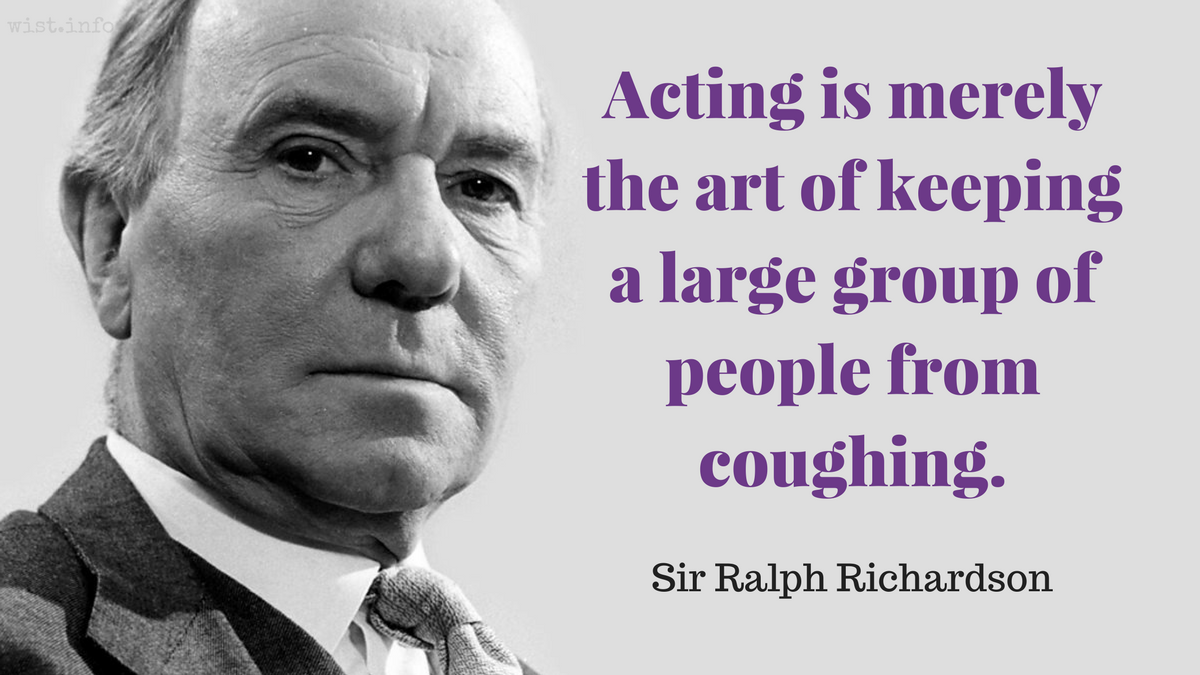
Acting is merely the art of keeping a large group of people from coughing.
There are millions of ways to not be writing.
Rod Serling (1924–1975) American screenwriter, playwright, television producer, narrator
“Rod Serling: The Facts of Life,” Interview with Linda Brevelle (4 Mar 1975)
(Source)
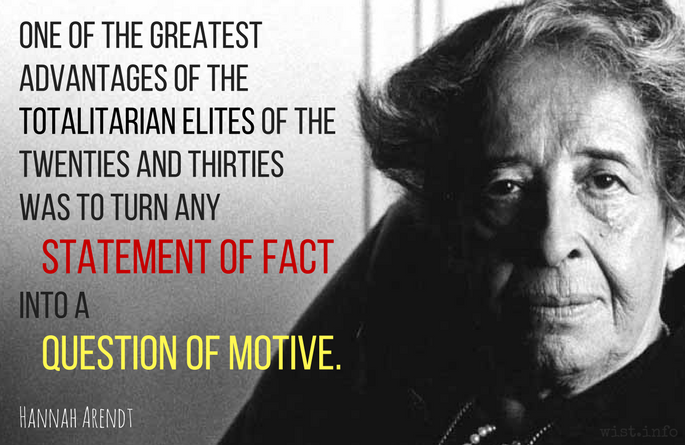
One of the greatest advantages of the totalitarian elites of the twenties and thirties was to turn any statement of fact into a question of motive.
Hannah Arendt (1906–1975) German-American philosopher, political theorist
(Spurious)
This is frequently cited to Arendt, often to The Origins of Totalitarianism, (1951), but is not found as such in her works. The source appears to be a paraphrase of Arendt in a 1999 New Yorker article.
Stuart Elden suggested the following from The Origins of Totalitarianism, Part 3, ch. 11, might be original quotation the paraphrase was built on, though the overall meaning is different:The elite is not composed of ideologists; its members’ whole education is aimed at abolishing their capacity for distinguishing between truth and falsehood, between reality and fiction. Their superiority consists in their ability immediately to dissolve every statement of fact into a declaration of purpose.
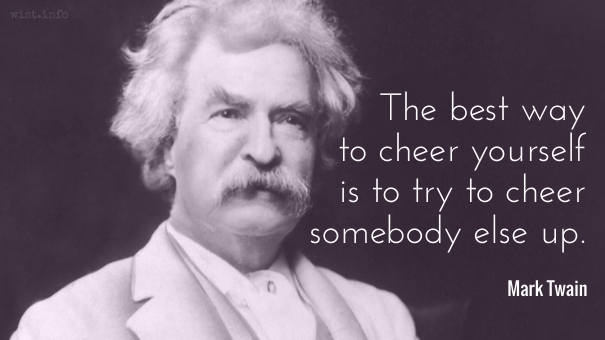
The best way to cheer yourself is to try to cheer somebody else up.
Mark Twain (1835–1910) American writer [pseud. of Samuel Clemens]
Note (1896-11-26), Mark Twain’s Notebook, ch. 27 “England” (1935) [ed. Albert Bigelow Paine]
(Source)
Written while in Guilford, England, shortly after the death of his daughter Susy in America.
Often given as "The best way to cheer yourself up is to try to cheer somebody else up." More discussion here.
We discovered at one point that the brick wall of the pillar would hold up a sock pretty well. This led to sorting socks by putting them on the wall, which in turn led to mosaics built entirely of socks. Mission drift is a hazard in all pursuits, including doing the laundry.
James Nicoll (b. 1961) Canadian reviewer, editor
“Another question about expectations,” rec.arts.sf.written, Usenet (22 May 2005)
(Source)

Men love better books which please them than those which instruct. Since their ennui troubles them more than their ignorance, they prefer being amused to being informed.
Jean-Antoine Dubois (1765–1848) French Catholic missionary in India [Abbe J. A. Dubois]
(Attributed)
(Source)
Earliest found attribution in The New Era (Jan 1873).
Sorrow preys upon
Its solitude, and nothing diverts it
From its sad visions of the other world
Than calling it at moments back to this.
The busy have no time for tears.George Gordon, Lord Byron (1788–1824) English poet
The Two Foscari, Act 4, sc. 1 [Loredano] (1821)
(Source)
When the spirits are low, when the day appears dark, when work becomes monotonous, when hopes hardly seems worth having, just mount a bicycle and go for a good spin down the road, without thought of anything but the ride you are taking.
Arthur Conan Doyle (1859–1930) British writer and physician
In The American Bee Keeper (May 1895)
If I had a dollar for every time I got distracted, I wish I had some ice cream.
Sig Lines
–

No man is lonely while eating spaghetti — it requires too much attention.
Christopher Morley (1890–1957) American journalist, novelist, essayist, poet
In Life (24 Oct 1969)
Composition is, for the most part, an effort of slow diligence and steady perseverance, to which the mind is dragged by necessity or resolution, and from which the attention is every moment starting to more delightful amusements.
Samuel Johnson (1709–1784) English writer, lexicographer, critic
Essay (1754-03-02), The Adventurer, No. 138
(Source)
The people that once bestowed commands, consulships, legions, and all else, now meddles no more and longs eagerly for just two things — bread and circuses!
[Nam qui dabat olim imperium, fasces, legiones, omnia, nunc se continet atque duas tantum res anxius optat, panem et circenses.]
Juvenal (c.55–127) Roman satirist [Decimus Junius Juvinalis]
Satires, Satire 10, l. 78-79
Alt. trans.: "The people long for only two things: bread and circuses."
Every whisper of infamy is industriously circulated, every hint of suspicion eagerly improved, and every failure of conduct joyfully published by those whose interest it is that the eye and voice of the public should be employed on any rather than themselves.
Samuel Johnson (1709–1784) English writer, lexicographer, critic
The Rambler, #76 (8 Dec 1750)
(Source)
HARRIS: Sitting there at that moment I thought of something else Shakespeare said. He said, “Hey … life is pretty stupid; with lots of hubbub to keep you busy, but really not amounting to much.” Of course I’m paraphrasing: “Life is a tale told by an idiot, full of sound and fury, signifying nothing.”
Steve Martin (b. 1945) American comedian, actor, writer, producer, musician
L. A. Story (1991)
(Source)

Many irons on the Fire, some must cool.
Proverbs, Sayings, and Adages
Scottish Proverb
(Source)
In James Kelly, A Complete Collection of Scottish Proverbs, M.93 (1721)

What this country needs is a short, victorious war to stem the tide of revolution.
Vyacheslav von Pléhve (1846–1904) Russian Tsarist security director, Interior Minister [Vyacheslav Konstantinovich von Plehve, or Pleve; Вячесла́в Константи́нович фон Пле́ве]
Comment (1903) [tr. Walder (1974)]
(Source)
Regarding the impending Russo-Japanese War (1904-05). Possibly apocryphal; the comment is quoted in the memoirs of Count Sergei Witte, an opponent of Plehve, several years later (and well after Plehve's 1904 assassination). Witte recounted it as a retort by Plehve to General Alexey Nikolayevich Kuropatkin, who accused Plehve of supporting the conflict for adventurist/expansionist reasons.
Russia, though considered much stronger than Japan militarily, ended up losing the war, destabilizing the government and ironically leading to revolutions in 1905 and 1917.
See Churchill (1930).
Other translations:
- "We need a little victorious war to stem the tide of revolution." [tr. Yarmolinsky (1921)]
- "We need a little, victorious war to stem the revolution." [tr. Harcave (1990)]
- "To contain the revolution, we need a short victorious war." [tr Hodson (2017)]
I like too many things and get all confused and hung-up running from one falling star to another till I drop. This is the night, what it does to you. I had nothing to offer anybody except my own confusion.
Jack Kerouac (1922–1969) Canadian-American novelist and poet
On the Road, Part 2, ch. 4 (1957)
(Source)

A man is likely to mind his own business when it is worth minding. When it is not, he takes his mind off his own meaningless affairs by minding other people’s business.
Eric Hoffer (1902–1983) American writer, philosopher, longshoreman
True Believer: Thoughts on the Nature of Mass Movements, Part 1, ch. 2, § 10 (1951)
(Source)

To do a job effectively, one must set priorities. Too many people let their “in” basket set the priorities. On any given day, unimportant but interesting trivia pass through an office; one must not permit these to monopolize his time. The human tendency is to while away time with unimportant matters that do not require mental effort or energy. Since they can be easily resolved, they give a false sense of accomplishment. The manager must exert self-discipline to ensure that his energy is focused where it is truly needed.
Hyman Rickover (1900–1986) Polish-American naval engineer, admiral [b. Chaim Gdala Rykower]
Speech (1981-11-05), “Doing a Job,” Egleston Medal Award Dinner, Columbia School of Engineering and Applied Science, New York
(Source)
I confess I am a little cynical on some topics, and when a whole nation is roaring Patriotism at the top of its voice, I am fain to explore the cleanness of its hands and purity of its heart.

Boredom is therefore a vital problem for the moralist, since at least half the sins of mankind are caused by the fear of it.
Bertrand Russell (1872–1970) English mathematician and philosopher
Conquest of Happiness, Part 1, ch. 4 “Boredom and Excitement” (1930)
(Source)
In the practice of art, as well as in morals, it is necessary to keep a watchful and jealous eye over ourselves; idleness, assuming the specious disguise of industry, will lull to sleep all suspicion of our want of an active exertion of strength. A provision of endless apparatus, a bustle of infinite enquiry and research, or even the mere mechanical labour of copying, may be employed, to evade and shuffle off real labour, — the real labour of thinking.
Joshua Reynolds (1723–1792) British painter, critic
Speech to the Royal Academy, London (10 Dec 1784)
(Source)Paraphrased over a long period of time (and still attributed to Reynolds) as: "There is no expedient to which a man will not resort to avoid the real labor of thinking."
The lecture was later described as the Twelfth Discourse in a 1797 collection of Reynolds' works.
Often attributed to Thomas Edison. More information here.

I could do great things, if I weren’t so busy doing little things.
Ashleigh Brilliant (b. 1933) Anglo-American epigramist, aphorist, cartoonist
Pot-Shots, #0828