

Consider the postage stamp: Its usefulness consists in the ability to stick to one thing till it gets there.
Josh Billings (1818–1885) American humorist, aphorist [pseud. of Henry Wheeler Shaw]
(Attributed)
Quotations by:
Billings, Josh

Every man has his follies — and often they are the most interesting thing he had got.
Josh Billings (1818–1885) American humorist, aphorist [pseud. of Henry Wheeler Shaw]
(Attributed)
What the moral army needs just now is more rank and file and fewer brigadier generals.
Josh Billings (1818–1885) American humorist, aphorist [pseud. of Henry Wheeler Shaw]
(Attributed)
Building air castles is a harmless business as long as you don’t attempt to live in them.
Josh Billings (1818–1885) American humorist, aphorist [pseud. of Henry Wheeler Shaw]
(Attributed)
There’s a great power in words, if you don’t hitch too many of them together.
Josh Billings (1818–1885) American humorist, aphorist [pseud. of Henry Wheeler Shaw]
(Attributed)
Quoted in Donald Day, Uncle Sam's Uncle Josh (1972 ed., 1st pub. 1953).
It iz an actewal fackt that most ov us work harder, tew seem happy, than we should have to, to be happy.
[It is an actual fact that most of us work harder, to seem happy, than we should have to, to be happy.]
Josh Billings (1818–1885) American humorist, aphorist [pseud. of Henry Wheeler Shaw]
Everybody’s Friend, Or; Josh Billing’s Encyclopedia and Proverbial Philosophy of Wit and Humor, “Josh Settles Up with His Correspondents Summarily” (1874)
The man who never makes enny blunders seldum makes enny good hits.
[The man who never makes any blunders seldom makes any good hits.]
Josh Billings (1818–1885) American humorist, aphorist [pseud. of Henry Wheeler Shaw]
Everybody’s Friend, Or; Josh Billing’s Encyclopedia and Proverbial Philosophy of Wit and Humor, “Kindling Wood” (1874)
A wize man never enjoys himself so mutch, nor a phool so little, az when alone.
[A wise man never enjoys himself so much, nor a fool so little, as when alone.]
Josh Billings (1818–1885) American humorist, aphorist [pseud. of Henry Wheeler Shaw]
Everybody’s Friend, Or; Josh Billing’s Encyclopedia and Proverbial Philosophy of Wit and Humor, “Koarse Shot” (1874)
A weak man wants az mutch watching as a bad one.
[A weak man wants as much watching as a bad.]
Josh Billings (1818–1885) American humorist, aphorist [pseud. of Henry Wheeler Shaw]
Everybody’s Friend, Or; Josh Billing’s Encyclopedia and Proverbial Philosophy of Wit and Humor, “Koarse Shot” (1874)
Laff every good chance ya kan git, but don’t laff unless yu feal like it, for there ain’t nothing in this world more harty than a good honest laff, nor nothing more hoollow than a hartless one.
[Laugh every good chance you can get, but don’t laugh unless you feel like it, for there ain’t nothing in this world more hearty than a good, honest laugh, nor nothing more hollow than a heartless one.]
Josh Billings (1818–1885) American humorist, aphorist [pseud. of Henry Wheeler Shaw]
Everybody’s Friend, Or; Josh Billing’s Encyclopedia and Proverbial Philosophy of Wit and Humor, “Laffing” (1874)
Natur iz a kind mother. She couldn’t well afford to make us perfekt, and so she made us blind to our failings.
[Nature is a kind mother. She couldn’t well afford to make us perfect, and so she made us blind to our failings.]
Josh Billings (1818–1885) American humorist, aphorist [pseud. of Henry Wheeler Shaw]
Everybody’s Friend, Or; Josh Billing’s Encyclopedia and Proverbial Philosophy of Wit and Humor, “Lobstir Sallad” (1874)
(Source)
A slander iz like a hornet, if you kant kill it dead the fus blo, you better not strike at it.
[A slander is like a hornet, if you can’t kill it dead the first blow, you better not strike at it.]
Josh Billings (1818–1885) American humorist, aphorist [pseud. of Henry Wheeler Shaw]
Everybody’s Friend, Or; Josh Billing’s Encyclopedia and Proverbial Philosophy of Wit and Humor, “Lobstir Sallad” (1874)
(Source)
I make this distinkshun between charakter and reputashun — reputashun iz what the world thinks ov us, charakter is what the world knows of us.
[I make this distinction between character and reputation — reputation is what the world thinks of us, character is what the world knows of us.]
Josh Billings (1818–1885) American humorist, aphorist [pseud. of Henry Wheeler Shaw]
Everybody’s Friend, Or; Josh Billing’s Encyclopedia and Proverbial Philosophy of Wit and Humor, “Lobstir Sallad” (1874)
(Source)
Experience makes more timid men than it duz wise ones.
[Experience makes more timid men than it does wise ones.]
Josh Billings (1818–1885) American humorist, aphorist [pseud. of Henry Wheeler Shaw]
Everybody’s Friend, Or; Josh Billing’s Encyclopedia and Proverbial Philosophy of Wit and Humor, “Lobstir Sallad” (1874)
(Source)
Advice iz a drug in the market; the supply alwus exceeds the demand.
[Advice is a drag on the market; the supply always exceeds the demand.]
Josh Billings (1818–1885) American humorist, aphorist [pseud. of Henry Wheeler Shaw]
Everybody’s Friend, Or; Josh Billing’s Encyclopedia and Proverbial Philosophy of Wit and Humor, “Lobstir Sallad” (1874)
(Source)
Success don’t konsist in never making blunders, but in never making the same one the seckond time.
[Success doesn’t consist in never making blunders, but in never making the same one the second time.]
I don’t kno as i want tew bet enny money, and giv odds, on the man, who iz alwus anxious tew pray out loud, every chance he kan git.
[I don’t know as I want to bet any money, and give odds, on the man who is always anxious to pray out loud, every chance he can get.]
Josh Billings (1818–1885) American humorist, aphorist [pseud. of Henry Wheeler Shaw]
Everybody’s Friend, Or; Josh Billing’s Encyclopedia and Proverbial Philosophy of Wit and Humor, “Mollassis Kandy” (1874)
(Source)
The most that experience seems tew do for us, is tew sho us, what kussid phools every boddy but we, hav made of themselfs.
[The most that experience seems to do for us is to show us what cussed fools everybody but we have made of themselves.]
Josh Billings (1818–1885) American humorist, aphorist [pseud. of Henry Wheeler Shaw]
Everybody’s Friend, Or; Josh Billing’s Encyclopedia and Proverbial Philosophy of Wit and Humor, “Mollassis Kandy” (1874)
(Source)
Thare would be a grate supply ov wit and humor in this world, if we would only giv others the same credit for being witty that we claim for ourselfs.
[There would be a great supply of wit and humor in this world, if we would only give others the same credit for being witty that we claim for ourselves.]
Josh Billings (1818–1885) American humorist, aphorist [pseud. of Henry Wheeler Shaw]
Everybody’s Friend, Or; Josh Billing’s Encyclopedia and Proverbial Philosophy of Wit and Humor, “Mollassis Kandy” (1874)
(Source)
Before yu undertaik tew change a man’s politiks or religion, be sure yu have got a beter one to offer him.
[Before you undertake to change a man’s politics or religion, be sure you have got a better one to offer him.]
Josh Billings (1818–1885) American humorist, aphorist [pseud. of Henry Wheeler Shaw]
Everybody’s Friend, Or; Josh Billing’s Encyclopedia and Proverbial Philosophy of Wit and Humor, “Nosegays” (1874)
The best reformers the world haz ever seen are thoze who commense on themselves.
[The best reformers the world has ever seen are those who commence on themselves.]
Josh Billings (1818–1885) American humorist, aphorist [pseud. of Henry Wheeler Shaw]
Everybody’s Friend, Or; Josh Billing’s Encyclopedia and Proverbial Philosophy of Wit and Humor, “Nosegays” (1874)
As in a game ov cards, so in the game ov life, we must play what is dealt tew us, and the glory consists, not so mutch in winning, as in playing a poor hand well.
[As in a game of cards, so in the game of life, we must play what is dealt to us, and the glory consists, not so much in winning, as in playing a poor hand well.]
Josh Billings (1818–1885) American humorist, aphorist [pseud. of Henry Wheeler Shaw]
Everybody’s Friend, Or; Josh Billing’s Encyclopedia and Proverbial Philosophy of Wit and Humor, “Ods and Ens” (1874)
Full text.
We are happy in this world just in proporshun as we make others happy.
[We are happy in this world just in proportion as we make others happy.]
Josh Billings (1818–1885) American humorist, aphorist [pseud. of Henry Wheeler Shaw]
Everybody’s Friend, Or; Josh Billing’s Encyclopedia and Proverbial Philosophy of Wit and Humor, “Parboils” (1874)
It ain’t bekauze lovers are so sensitiff that they quarrel so often, it iz bekauze there iz so much phun in making up.
[It ain’t because lovers are so sensitive that they quarrel so often, it is because there is so much fun in making up.]
Josh Billings (1818–1885) American humorist, aphorist [pseud. of Henry Wheeler Shaw]
Everybody’s Friend, Or; Josh Billing’s Encyclopedia and Proverbial Philosophy of Wit and Humor, “Plum Pits” (1874)
There iz nothing that a man kan do that should cut him off from pitty, the fakt that he iz human should always entitle him to commiserashun.
[There is nothing that a man can do that should cut him off from pity; the fact that he is human should always entitle him to commiseration.]
Josh Billings (1818–1885) American humorist, aphorist [pseud. of Henry Wheeler Shaw]
Everybody’s Friend, Or; Josh Billing’s Encyclopedia and Proverbial Philosophy of Wit and Humor, “Plum Pits” (1874)
(Source)
The man who don’t kno himself iz a poor judge ov the other phellow.
[The man who doesn’t know himself is a poor judge of the other fellow.]
Josh Billings (1818–1885) American humorist, aphorist [pseud. of Henry Wheeler Shaw]
Everybody’s Friend, Or; Josh Billing’s Encyclopedia and Proverbial Philosophy of Wit and Humor, “Plum Pits” (1874)
(Source)
Envy iz sutch a constant companyun, that if we find no one abuv us to envy, we will envy thoze below us.
[Envy is such a constant companion, that if we find no one above us to envy, we will envy those below us.]
Josh Billings (1818–1885) American humorist, aphorist [pseud. of Henry Wheeler Shaw]
Everybody’s Friend, Or; Josh Billing’s Encyclopedia and Proverbial Philosophy of Wit and Humor, “Plum Pits” (1874)
(Source)
The truly innosent are thoze who not only are guiltless themselfes, but who think others are.
[The truly innocent are those who not only are guiltless themselves, but who think others are.]
Josh Billings (1818–1885) American humorist, aphorist [pseud. of Henry Wheeler Shaw]
Everybody’s Friend, Or; Josh Billing’s Encyclopedia and Proverbial Philosophy of Wit and Humor, “Plum Pits” (1874)
(Source)
The truly innosent are thoze who not only are guiltless themselfes, but who think others are.
[The truly innocent are those who not only are guiltless themselves, but who think others are.]
Josh Billings (1818–1885) American humorist, aphorist [pseud. of Henry Wheeler Shaw]
Everybody’s Friend, Or; Josh Billing’s Encyclopedia and Proverbial Philosophy of Wit and Humor, “Plum Pits” (1874)
(Source)
I never knu a man trubbled with melankolly, who had plenty to dew, and did it.
[I never knew a man troubled with melancholy, who had plenty to do, and did it.]
Josh Billings (1818–1885) American humorist, aphorist [pseud. of Henry Wheeler Shaw]
Everybody’s Friend, Or; Josh Billing’s Encyclopedia and Proverbial Philosophy of Wit and Humor, “Puddin and Milk” (1874)
It iz a darned sight eazier tew find six men who kan tell exactly how a thing ought tew be did than tew find one who will do it.
[It is a darned sight easier to find six men who can tell exactly how a thing ought to be done than to find one who will do it.]
Josh Billings (1818–1885) American humorist, aphorist [pseud. of Henry Wheeler Shaw]
Everybody’s Friend, Or; Josh Billing’s Encyclopedia and Proverbial Philosophy of Wit and Humor, “Puddin and Milk” (1874)
(Source)
Marrying for money iz a meaner way tew git it than counterfiting.
[Marrying for money is a meaner way to get it than counterfeiting.]
Josh Billings (1818–1885) American humorist, aphorist [pseud. of Henry Wheeler Shaw]
Everybody’s Friend, Or; Josh Billing’s Encyclopedia and Proverbial Philosophy of Wit and Humor, “Puddin and Milk” (1874)
(Source)
Every man haz a perfekt right tew hiz opinyun, provided it agrees with ours.
[Every man has a perfect right to his opinion, provided it agrees with ours.]
Josh Billings (1818–1885) American humorist, aphorist [pseud. of Henry Wheeler Shaw]
Everybody’s Friend, Or; Josh Billing’s Encyclopedia and Proverbial Philosophy of Wit and Humor, “Ramrods” (1874)
Conversashun should be enlivened with wit, not compozed ov it.
[Conversation should be enlivened with wit, not composed of it.]
Josh Billings (1818–1885) American humorist, aphorist [pseud. of Henry Wheeler Shaw]
Everybody’s Friend, Or; Josh Billing’s Encyclopedia and Proverbial Philosophy of Wit and Humor, “Sollum Thoughts” (1874)
I honestly beleave it iz better tew know nothing than two know what ain’t so.
[I honestly believe it is better to know nothing than to know what ain’t so.]
Josh Billings (1818–1885) American humorist, aphorist [pseud. of Henry Wheeler Shaw]
Everybody’s Friend, Or; Josh Billing’s Encyclopedia and Proverbial Philosophy of Wit and Humor, “Sollum Thoughts” (1874)
(Source)
This was Billings signature aphorism, and he used variations on multiple occasions. Variants and evolutions have also been misattributed to Will Rogers, Mark Twain, and Artemus Ward, sometimes from their own paraphrases of Billings. Some variations (usually without specific citations) include:In a similar vein, Billings wrote, "Wisdum don't konsist in knowing more that iz new, but in knowing less that iz false. [Wisdom doesn't consist in knowing more that is new, but in knowing less than is false.]" [Source]
- "The trouble with people is not that they don't know but that they know so much that ain't so."
- "It ain't what you don't know that gets you into trouble. It's what you know for sure that just ain't so."
- "You’d better not know so much, than know so many things that ain’t so."
More discussion about this quotation:
- It Ain’t What You Don’t Know That Gets You Into Trouble. It’s What You Know for Sure That Just Ain’t So – Quote Investigator
- Ralph Keyes, The Quote Verifier (2006)
- Ralph Keyes, Nice Guys Finish Seventh (1992)
- James Billington, Respectfully Yours (1993)
- Daniel Levitin, A Field Guide to Lies, Deluxe Ed. (2016)
Accepting praize that iz not our due iz not mutch better than tew be a receiver of stolen goods.
[Accepting praise that is not our due is not much better than to be a receiver of stolen goods.]
Josh Billings (1818–1885) American humorist, aphorist [pseud. of Henry Wheeler Shaw]
Everybody’s Friend, Or; Josh Billing’s Encyclopedia and Proverbial Philosophy of Wit and Humor, “Stray Children” (1874)
Human knowledge is very short, and don’t reach but a little ways, and even that little ways iz twilite; but faith lengthens out the road, and makes it light, so that we kan see tew read the letterings on the mile stuns.
[Human knowledge is very short, and doesn’t reach but a little way, and even that little way is twilight; but faith lengthens out the road, and makes it light, so that we can see to read the lettering on the milestones.]
Josh Billings (1818–1885) American humorist, aphorist [pseud. of Henry Wheeler Shaw]
Everybody’s Friend, Or; Josh Billing’s Encyclopedia and Proverbial Philosophy of Wit and Humor, ch. 9 “Essays: Faith” (1874)
(Source)
This may be the source of an attributed Billings quote I cannot find in his writings: "Faith was given to man to lengthen out his reason."
Experience iz a grindstun, and it iz lucky for us if we kan git brightened by it, not ground.
[Experience is a grindstone, and it is lucky for us if we can get brightened by it, not ground.
Josh Billings (1818–1885) American humorist, aphorist [pseud. of Henry Wheeler Shaw]
Everybody’s Friend, Or; Josh Billing’s Encyclopedia and Proverbial Philosophy of Wit and Humor, ch. 130 “Affurisms: Puddin & Milk” (1874)
(" target="_blank">Source)
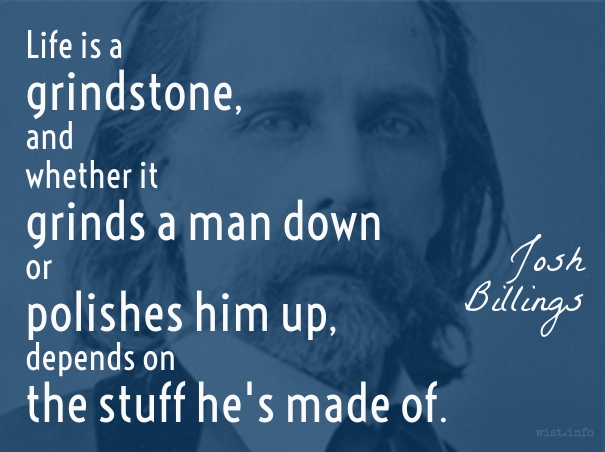
This aphorism was transformed / paraphrased in the early 1920s into something a bit more inspirational, first (it appears) in Forbes (1922-10-14), then in similar form in other periodicals such as The Beaver (1924-03) and Wood Construction (1924-09-15). The new form:Life is a grindstone, and whether it grinds a man down or polishes him up, depen's on the stuff he's made of.
In an earlier pass of Billings quotations, I did up a meme, unknowingly based on that later phrasing:
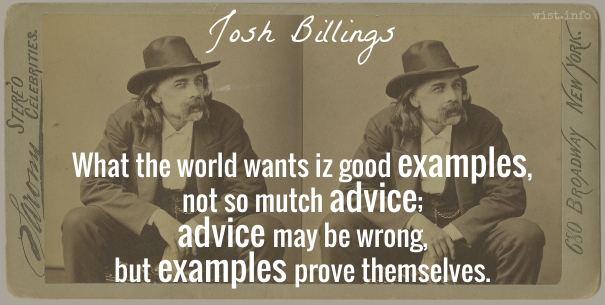
What the world wants iz good examples, not so mutch advice; advice may be wrong, but examples prove themselves.
[What the world wants is good examples, not so much advice; advice may be wrong, but examples prove themselves.]
Josh Billings (1818–1885) American humorist, aphorist [pseud. of Henry Wheeler Shaw]
Everybody’s Friend, Or; Josh Billing’s Encyclopedia and Proverbial Philosophy of Wit and Humor, ch. 130 “Affurisms: Puddin & Milk” (1874)
(Source)
The miser iz a riddle. What he possesses he haint got, and what he leaves behind him he never had.
[The miser is a riddle. What he possesses he hasn’t got, and what he leaves behind him he never had.]
Josh Billings (1818–1885) American humorist, aphorist [pseud. of Henry Wheeler Shaw]
Everybody’s Friend, Or; Josh Billing’s Encyclopedia and Proverbial Philosophy of Wit and Humor, ch. 130 “Affurisms: Puddin & Milk” (1874)
(Source)
Ignorance iz the wet nuss of prejudice.
[Ignorance is the wet nurse of prejudice.]
Josh Billings (1818–1885) American humorist, aphorist [pseud. of Henry Wheeler Shaw]
Everybody’s Friend, Or; Josh Billing’s Encyclopedia and Proverbial Philosophy of Wit and Humor, ch. 130 “Affurisms: Puddin & Milk” (1874)
(Source)
I don’t know ov a better kure for sorrow than tew pity sum boddy else.
[I don’t know of a better cure for sorrow than to pity somebody else.]
It iz a darned sight eazier tew find six men who kan tell exactly how a thing ought tew be did than tew find one who will do it.
[It is a darned sight easier to find six men who can tell exactly how a thing ought to be done than to find one who will do it.]
Josh Billings (1818–1885) American humorist, aphorist [pseud. of Henry Wheeler Shaw]
Everybody’s Friend, Or; Josh Billing’s Encyclopedia and Proverbial Philosophy of Wit and Humor, ch. 130 “Affurisms: Puddin & Milk” (1874)
(Source)
Human happiness konsists in having what yu want, and wanting what yu hav.
[Human happiness consists in having what you want, and wanting what you have.]
Josh Billings (1818–1885) American humorist, aphorist [pseud. of Henry Wheeler Shaw]
Everybody’s Friend, Or; Josh Billing’s Encyclopedia and Proverbial Philosophy of Wit and Humor, ch. 131 “Affurisms: Plum Pits (1)” (1874)
(Source)
Trusting to luck is only another name for trusting to lazyness.
Josh Billings (1818–1885) American humorist, aphorist [pseud. of Henry Wheeler Shaw]
Everybody’s Friend, Or; Josh Billing’s Encyclopedia and Proverbial Philosophy of Wit and Humor, ch. 131 “Affurisms: Plum Pits (1)” (1874)
(Source)
I luv mi phailings. It iz theze that make me pheel that i have that tutch ov natur in me that makes me brother tew every man living.
[I love my failings. It is these that make me feel that I have that touch of nature in me that makes me brother to every man living.]
Josh Billings (1818–1885) American humorist, aphorist [pseud. of Henry Wheeler Shaw]
Everybody’s Friend, Or; Josh Billing’s Encyclopedia and Proverbial Philosophy of Wit and Humor, ch. 131 “Affurisms: Plum Pits (1)” (1874)
(Source)
I never diskuss politiks nor sektarianism; i beleave in letting every man fight hiz rooster hiz own way.
[I never discuss politics nor [religious] sectarianism; I believe in letting every man fight his rooster his own way.]Josh Billings (1818–1885) American humorist, aphorist [pseud. of Henry Wheeler Shaw]
Everybody’s Friend, Or; Josh Billing’s Encyclopedia and Proverbial Philosophy of Wit and Humor, ch. 131 “Affurisms: Plum Pits (1)” (1874)
(Source)
Fortune sumtimes shows us the way, but it iz energy that achieves sucksess.
[Fortune sometimes shows us the way, but it is energy that achieves success.]
Josh Billings (1818–1885) American humorist, aphorist [pseud. of Henry Wheeler Shaw]
Everybody’s Friend, Or; Josh Billing’s Encyclopedia and Proverbial Philosophy of Wit and Humor, ch. 131 “Affurisms: Plum Pits (1)” (1874)
(Source)
The eazyest thing for our freinds to diskover in us, and the hardest thing for us to diskover in ourselfs, is that we are growing old.
[The easiest thing for our friends to discover in us, and the hardest thing for us to discover in ourselves, is that we are growing old.]
Josh Billings (1818–1885) American humorist, aphorist [pseud. of Henry Wheeler Shaw]
Everybody’s Friend, Or; Josh Billing’s Encyclopedia and Proverbial Philosophy of Wit and Humor, ch. 131 “Affurisms: Plum Pits (1)” (1874)
(Source)
One ov the most diffikult, and at the sametime one ov the most necessary, things for us old phellows to know, is that we aint ov so mutch ackount now az we waz.
[One of the most difficult, and at the same time one of the most necessary, things for us old fellows to know, is that we aren’t of so much account now as we were.]Josh Billings (1818–1885) American humorist, aphorist [pseud. of Henry Wheeler Shaw]
Everybody’s Friend, Or; Josh Billing’s Encyclopedia and Proverbial Philosophy of Wit and Humor, ch. 131 “Affurisms: Plum Pits (1)” (1874)
(Source)
The richest man in the world is the one who dispizes riches the most.
[The riches man in the world is the one who despises riches the most.]
Josh Billings (1818–1885) American humorist, aphorist [pseud. of Henry Wheeler Shaw]
Everybody’s Friend, Or; Josh Billing’s Encyclopedia and Proverbial Philosophy of Wit and Humor, ch. 131 “Affurisms: Plum Pits (1)” (1874)
(Source)
It is not the whole ov our duty tew foller the examples ov good men, but tew leave behind us sum decent tracks for others tew foller.
[It is not the whole of our duty to follow the examples of good men, but to leave behind us some decent tracks for others to follow.]
Josh Billings (1818–1885) American humorist, aphorist [pseud. of Henry Wheeler Shaw]
Everybody’s Friend, Or; Josh Billing’s Encyclopedia and Proverbial Philosophy of Wit and Humor, ch. 132 “Affurisms: Chips” (1874)
(Source)
If you are looking after happiness don’t take the turnpike, take one ov the byroads, yu will avoid the tollgates, and find it less crowded and dursty.
[If you are looking after happiness, don’t take the turnpike, take one of the byroads; you will avoid the tollgates, and find it less crowded and dusty.]
Josh Billings (1818–1885) American humorist, aphorist [pseud. of Henry Wheeler Shaw]
Everybody’s Friend, Or; Josh Billing’s Encyclopedia and Proverbial Philosophy of Wit and Humor, ch. 132 “Affurisms: Chips” (1874)
(Source)
About one-half the discumfert ov this life iz the result ov gitting tired ov ourselfs.
[About one-half the discomfort of this life is the result of getting tired of ourselves.]
Josh Billings (1818–1885) American humorist, aphorist [pseud. of Henry Wheeler Shaw]
Everybody’s Friend, Or; Josh Billing’s Encyclopedia and Proverbial Philosophy of Wit and Humor, ch. 132 “Affurisms: Chips” (1874)
(Source)
Iz it charity tew giv tew a thankless cuss in need? certainly; jest az mutch az it would be to save a drouning cow.
[Is it charity to give to a thankless cuss in need? Certainly; just as much as it would be to save a drowning cow.]
Josh Billings (1818–1885) American humorist, aphorist [pseud. of Henry Wheeler Shaw]
Everybody’s Friend, Or; Josh Billing’s Encyclopedia and Proverbial Philosophy of Wit and Humor, ch. 132 “Affurisms: Chips” (1874)
(Source)
We sumtimes hit a thing right the fust blow, but most always a suckcess iz the result ov menny failures.
[We sometimes hit a thing right the first blow, but almost always a success is the result of many failures.]
Josh Billings (1818–1885) American humorist, aphorist [pseud. of Henry Wheeler Shaw]
Everybody’s Friend, Or; Josh Billing’s Encyclopedia and Proverbial Philosophy of Wit and Humor, ch. 132 “Affurisms: Chips” (1874)
(Source)
In the UK collection Wit and Wisdom of Josh Billings (1913) [ed. H. Montague], this reads:We sometimes hit the bulls-eye at the first crack, but SUCCESS is usually the result of many failures.
The lion and the lamb may, possibly, sumtime lay down in this world together for a fu minnits, but when the lion kums tew git up, the lamb will be missing.
[The lion and the lamb may, possibly, sometime lay down in this world together for a few minutes, but when the lion comes to get up, the lamb will be missing.]
Josh Billings (1818–1885) American humorist, aphorist [pseud. of Henry Wheeler Shaw]
Everybody’s Friend, Or; Josh Billing’s Encyclopedia and Proverbial Philosophy of Wit and Humor, ch. 134 “Affurisms: Slips of the Pen” (1874)
(Source)
A reference (using the more common phrasing) to Isaiah 11:6.
Thare iz plenty ov happiness in this life if we only knu it: and one way tew find it iz, when we hav got the old rumatiz tew thank Heaven that it aint the old gout.
[There is plenty of happiness in this life if we only knew it: and one way to find it is, when we have got the old rheumatism to thank Heaven that it ain’t the old gout.]
Josh Billings (1818–1885) American humorist, aphorist [pseud. of Henry Wheeler Shaw]
Everybody’s Friend, Or; Josh Billing’s Encyclopedia and Proverbial Philosophy of Wit and Humor, ch. 137 “Affurisms: Tadpoles” (1874)
(Source)
In Fred Lewis Pattee, A History of American Literature Since 1870 (1915), this is paraphrased "The best cure for rheumatism is to thank the Lord it ain't the gout."
In a similar vein, in Josh Billings' Old Farmer's Allminax, 1870-1879, January 1878, "Chips" (1902):The best relief for the rumatiz, that haz been diskovered yet, iz to find sum phellow who haz got the gout bad, and then pitty him.
[The best relief for the rheumatism that has been discovered yet is to find some fellow who has got the gout bad, and then pity him.]
and in H. Montague, ed., Wit and Wisdom of Josh Billings (1913)The best remedy for RHEUMATISM that's ever yet been discovered is to find some fellow who has a bad case of the gout, pity him and forget yourself.
The best way I kno ov tew repent of enny thing is tew do better next time.
[The best way I know of to repent of anything is to do better next time.]
Josh Billings (1818–1885) American humorist, aphorist [pseud. of Henry Wheeler Shaw]
Everybody’s Friend, Or; Josh Billing’s Encyclopedia and Proverbial Philosophy of Wit and Humor, ch. 139 “Affurisms: Hooks & Eyes” (1874)
(Source)
Variant:The best way I know to REPENT of anything is not to do it again and to do better next time.
[H. Montague, ed., Wit and Wisdom of Josh Billings (1913)]
Every boddy in this world wants watching, but none more than ourselves.
[Everybody in this world wants watching, but none more than ourselves.]
Josh Billings (1818–1885) American humorist, aphorist [pseud. of Henry Wheeler Shaw]
Everybody’s Friend, Or; Josh Billing’s Encyclopedia and Proverbial Philosophy of Wit and Humor, ch. 142 “Affurisms: Fust Impreshuns” (1874)
(Source)
Forgiving our enemys haz the same refreshing effekt upon our souls az it duz tew confess our sins.
[Forgiving our enemies has the same refreshing effect upon our souls as it does to confess our sins.]
Josh Billings (1818–1885) American humorist, aphorist [pseud. of Henry Wheeler Shaw]
Everybody’s Friend, Or; Josh Billing’s Encyclopedia and Proverbial Philosophy of Wit and Humor, ch. 144 “Affurisms: Gnats” (1874)
(Source)
What a lamentable cuss man iz, he pittys hiz nabors misfortunes, bi calling them judgments from heaven.
[What a lamentable cuss man is: he pities his neighbors’ misfortunes, by calling them judgments from heaven.]Josh Billings (1818–1885) American humorist, aphorist [pseud. of Henry Wheeler Shaw]
Everybody’s Friend, Or; Josh Billing’s Encyclopedia and Proverbial Philosophy of Wit and Humor, ch. 144 “Affurisms: Gnats” (1874)
(Source)
It takes a grate deal of money tew make a man ritch, but it don’t take but little virtew.
[It takes a great deal of money to make a man rich, but it doesn’t take but little virtue.]
Josh Billings (1818–1885) American humorist, aphorist [pseud. of Henry Wheeler Shaw]
Everybody’s Friend, Or; Josh Billing’s Encyclopedia and Proverbial Philosophy of Wit and Humor, ch. 144 “Affurisms: Gnats” (1874)
(Source)
“Experience iz a good schoolmaster,” but reason iz a better one.
[“Experience is a good schoolmaster,” but reason is a better one.]
Josh Billings (1818–1885) American humorist, aphorist [pseud. of Henry Wheeler Shaw]
Everybody’s Friend, Or; Josh Billing’s Encyclopedia and Proverbial Philosophy of Wit and Humor, ch. 148 “Affurisms: Ink Brats” (1874)
(Source)
I don’t beleave in fighting; i am solemly aginst it; but if a man gits teu fighting, i am also solemly aginst hiz gitting licked. After a fight iz once opened, all the virtew thare iz in it iz tew lick the other party.
[I don’t believe in fighting; I am solemnly against it; but if a man gets to fighting, I am also solemnly against his getting licked. After a fight is once opened, all the virtue there is in it is to lick the other party.]
Josh Billings (1818–1885) American humorist, aphorist [pseud. of Henry Wheeler Shaw]
Everybody’s Friend, Or; Josh Billing’s Encyclopedia and Proverbial Philosophy of Wit and Humor, ch. 148 “Affurisms: Ink Brats” (1874)
(Source)
Put not oph till to-morrow what can be enjoyed to-day.
[Put not off till tomorrow what can be enjoyed today.]
Josh Billings (1818–1885) American humorist, aphorist [pseud. of Henry Wheeler Shaw]
Everybody’s Friend, Or; Josh Billing’s Encyclopedia and Proverbial Philosophy of Wit and Humor, ch. 148 “Affurisms: Ink Brats” (1874)
(Source)
Awl plezzures are lawful that don’t end in making us feel sorry.
[All pleasures are lawful that don’t end in making us feel sorry.]Josh Billings (1818–1885) American humorist, aphorist [pseud. of Henry Wheeler Shaw]
Everybody’s Friend, Or; Josh Billing’s Encyclopedia and Proverbial Philosophy of Wit and Humor, ch. 148 “Affurisms: Ink Brats” (1874)
(Source)
Fear makes evry thing and evry body masters over us; it iz the wust slavery thare iz.
[Fear makes everything and everybody masters over us; it is the worst slavery there is.]
Josh Billings (1818–1885) American humorist, aphorist [pseud. of Henry Wheeler Shaw]
Everybody’s Friend, Or; Josh Billing’s Encyclopedia and Proverbial Philosophy of Wit and Humor, ch. 148 “Affurisms: Ink Brats” (1874)
(Source)
Advice iz like kastor-ile, eazy enuff to give, but dredful uneazy tew take.
[Advice is like castor oil, easy enough to give, but dreadfully uneasy to take.]
Josh Billings (1818–1885) American humorist, aphorist [pseud. of Henry Wheeler Shaw]
Everybody’s Friend, Or; Josh Billing’s Encyclopedia and Proverbial Philosophy of Wit and Humor, ch. 148 “Affurisms: Ink Brats” (1874)
(Source)
The phrase also shows up twice in Wit and Wisdom of Josh Billings (1913) [ed. H. Montague] (which, being published in England, did away with the misspellings):Advice is like castor oil -- easy enough to give but dreadful hard to take.
["Advice"]Advice is like castor oil -- awful easy to give but mighty hard to take.
["How to Select a Husband"]
Sum folks, az they gro older, gro wizer; but most folks simply gro stubbornner.
[Some folks, as they grow older, grow wiser; but most folks simply grow more stubborn.]Josh Billings (1818–1885) American humorist, aphorist [pseud. of Henry Wheeler Shaw]
Everybody’s Friend, Or; Josh Billing’s Encyclopedia and Proverbial Philosophy of Wit and Humor, ch. 148 “Affurisms: Ink Brats” (1874)
(Source)
People travel to learn; most ov them (before they start) should learn to travel.
Josh Billings (1818–1885) American humorist, aphorist [pseud. of Henry Wheeler Shaw]
Everybody’s Friend, Or; Josh Billing’s Encyclopedia and Proverbial Philosophy of Wit and Humor, ch. 148 “Affurisms: Ink Brats” (1874)
(Source)
Dangers are sum like a kold bath, very dangerous while you stand stripped on the bank, but often not only harmless, but invigorating, if you pitch into them.
[Dangers are some like a cold bath ….]
Josh Billings (1818–1885) American humorist, aphorist [pseud. of Henry Wheeler Shaw]
Everybody’s Friend, Or; Josh Billing’s Encyclopedia and Proverbial Philosophy of Wit and Humor, ch. 150 “Affurisms: Parboils” (1874)
(Source)
“Familiarity breeds kontempt.” This only applies tew men, not tew hot bukwheat slapkakes, well buttered and sugared.
[“Familiarity breeds contempt.” This only applies to men, not to hot buckwheat slapcakes, well buttered and sugared.]
Take awl the prophecys that hav cum tew pass, and awl that hav caught on the center, and failed tew cum tew time, and make them up into an average, and yer will find, that buying stock, on the Codfish Bank ov Nufoundland, at 50 per cent, for a rise, iz, in comparison, a good spekulatiff bizziness.
[Take all the prophecies that have come to pass, and all that have caught on the center and failed to come to time, and make them up into an average, and you will find that buying stock on the codfish Bank of Newfoundland, at 50 percent, for a rise, is, in comparison, a good speculative business.]Josh Billings (1818–1885) American humorist, aphorist [pseud. of Henry Wheeler Shaw]
Everybody’s Friend, Or; Josh Billing’s Encyclopedia and Proverbial Philosophy of Wit and Humor, ch. 150 “Affurisms: Parboils” (1874)
(Source)
He whom the good praize and wicked hate ought tew be satisfied with hiz reputashun.
[He whom the good praise and the wicked hate ought to be satisfied with his reputation.]Josh Billings (1818–1885) American humorist, aphorist [pseud. of Henry Wheeler Shaw]
Everybody’s Friend, Or; Josh Billing’s Encyclopedia and Proverbial Philosophy of Wit and Humor, ch. 150 “Affurisms: Parboils” (1874)
(Source)
Avarice iz like a grave yard, it takes all that it kan git, and givs nothing back.
[Avarice is like a graveyard; it takes all that it can get, and gives nothing back.]
Josh Billings (1818–1885) American humorist, aphorist [pseud. of Henry Wheeler Shaw]
Everybody’s Friend, Or; Josh Billing’s Encyclopedia and Proverbial Philosophy of Wit and Humor, ch. 150 “Affurisms: Parboils” (1874)
(Source)
Everything on this earth iz bought and sold, except air and water, and they would be if a kind Creator had not made the supply too grate for the demand.
[Everything on this earth is bought and sold, except air and water, and they would be if a kind Creator had not made the supply too great for the demand.]Josh Billings (1818–1885) American humorist, aphorist [pseud. of Henry Wheeler Shaw]
Everybody’s Friend, Or; Josh Billing’s Encyclopedia and Proverbial Philosophy of Wit and Humor, ch. 150 “Affurisms: Parboils” (1874)
(Source)
I hav lived in this world jist long enuff tew look karefully the seckond time into things that i am the most certain ov the fust time.
[I have lived in this world just long enough to look carefully the second time into things that I am the most certain of the first time.]
Josh Billings (1818–1885) American humorist, aphorist [pseud. of Henry Wheeler Shaw]
Everybody’s Friend, Or; Josh Billing’s Encyclopedia and Proverbial Philosophy of Wit and Humor, ch. 152 “Affurisms: Chicken Feed” (1874)
(Source)
In repenting ov sins, men are apt tew repent ov thoze they hain’t got, and overlook those they hav.
[In repenting of sins, men are apt to repent of those they haven’t got, and overlook those they have.]
Josh Billings (1818–1885) American humorist, aphorist [pseud. of Henry Wheeler Shaw]
Everybody’s Friend, Or; Josh Billing’s Encyclopedia and Proverbial Philosophy of Wit and Humor, ch. 155 “Affurisms: Ink Lings” (1874)
(Source)
Repentanse should be the effekt ov love — not fear.
[Repentance should be the effect of love — not fear.]
Josh Billings (1818–1885) American humorist, aphorist [pseud. of Henry Wheeler Shaw]
Everybody’s Friend, Or; Josh Billing’s Encyclopedia and Proverbial Philosophy of Wit and Humor, ch. 155 “Affurisms: Ink Lings” (1874)
(Source)
The fust intimashun i had that i waz gitting old waz, i found myself telling to mi friends the same storys over again.
[The first intimation I had that I was getting old was, I found myself telling to my friends the same stories over again.]
Josh Billings (1818–1885) American humorist, aphorist [pseud. of Henry Wheeler Shaw]
Everybody’s Friend, Or; Josh Billing’s Encyclopedia and Proverbial Philosophy of Wit and Humor, ch. 155 “Affurisms: Ink Lings” (1874)
(Source)
We all git tired pretty soon looking at a goose standing on one leg.
Josh Billings (1818–1885) American humorist, aphorist [pseud. of Henry Wheeler Shaw]
Everybody’s Friend, Or; Josh Billing’s Encyclopedia and Proverbial Philosophy of Wit and Humor, ch. 155 “Affurisms: Ink Lings” (1874)
(Source)
Revenge sumtimes sleeps, but vanity always keeps one eye open.
Josh Billings (1818–1885) American humorist, aphorist [pseud. of Henry Wheeler Shaw]
Everybody’s Friend, Or; Josh Billing’s Encyclopedia and Proverbial Philosophy of Wit and Humor, ch. 155 “Affurisms: Ink Lings” (1874)
(Source)
I hav larn’t one thing, bi grate experience, and that iz, I want as much watching az mi nabors do.
[I have learned one thing, by great experience, and that is, I want as much watching as my neighbors do.]Josh Billings (1818–1885) American humorist, aphorist [pseud. of Henry Wheeler Shaw]
Everybody’s Friend, Or; Josh Billing’s Encyclopedia and Proverbial Philosophy of Wit and Humor, ch. 155 “Affurisms: Ink Lings” (1874)
(Source)
In H. Montague, ed., Wit and Wisdom of Josh Billings (1913), this is given:I've learned one thing from experience -- that I'll bear watching about as much as some of my neighbors.
I am satisfied that thare iz more weakness among men than malice.
[I am satisfied that there is more weakness among men than malice.]
Josh Billings (1818–1885) American humorist, aphorist [pseud. of Henry Wheeler Shaw]
Everybody’s Friend, Or; Josh Billing’s Encyclopedia and Proverbial Philosophy of Wit and Humor, ch. 155 “Affurisms: Ink Lings” (1874)
(Source)
A phool seems tew be a person who haz more will than judgment, and more vanity than either.
[A fool seems to be a person who has more will than judgment, and more vanity than either.]
Josh Billings (1818–1885) American humorist, aphorist [pseud. of Henry Wheeler Shaw]
Everybody’s Friend, Or; Josh Billing’s Encyclopedia and Proverbial Philosophy of Wit and Humor, ch. 155 “Affurisms: Ink Lings” (1874)
(Source)
Thare iz a grate deal ov charity in this world so koldly rendered that it fairly hurts, it iz like lifting a drowning man out ov the water bi the hair ov the hed, and then letting him drop on the ground.
[There is a great deal of charity in this world so coldly rendered that it fairly hurts. It is like lifting a drowning man out of the water by the hair of the head, and then letting him drop on the ground.]Josh Billings (1818–1885) American humorist, aphorist [pseud. of Henry Wheeler Shaw]
Everybody’s Friend, Or; Josh Billing’s Encyclopedia and Proverbial Philosophy of Wit and Humor, ch. 155 “Affurisms: Ink Lings” (1874)
(Source)
We are always a-looking ahed, and that iz the way tew look; if the man at the wheel looks back he will soon beach hiz vessell.
[We are always a-looking ahead, and that is the way to look; if the man at the wheel looks back he will soon beach his vessel.]
Josh Billings (1818–1885) American humorist, aphorist [pseud. of Henry Wheeler Shaw]
Everybody’s Friend, Or; Josh Billing’s Encyclopedia and Proverbial Philosophy of Wit and Humor, ch. 156 “Affurisms: Embers on the Harth” (1874)
(Source)
How menny people thare iz whoze importance depends entirely upon the size ov their hotel bills.
[How many people there are whose importance depends entirely upon the size of their hotel bills.]
Josh Billings (1818–1885) American humorist, aphorist [pseud. of Henry Wheeler Shaw]
Everybody’s Friend, Or; Josh Billing’s Encyclopedia and Proverbial Philosophy of Wit and Humor, ch. 156 “Affurisms: Embers on the Harth” (1874)
(Source)
Mankind ain’t apt tew respekt verry mutch what they are familiar with, it iz what we don’t know, or kant see, that we hanker for.
[Mankind ain’t apt to respect very much what they are familiar with; it is what we don’t know, or can’t see, that we hanker for.]
Josh Billings (1818–1885) American humorist, aphorist [pseud. of Henry Wheeler Shaw]
Everybody’s Friend, Or; Josh Billing’s Encyclopedia and Proverbial Philosophy of Wit and Humor, ch. 156 “Affurisms: Embers on the Harth” (1874)
(Source)
I am just az certain that thare iz sitch a thing az “Spiritual manafestashuns” az i am that there iz plenty ov superstishun and trickery.
[I am just as certain that there is such a thing as “spiritual manifestations” as I am that there is plenty of superstition and trickery.]
Josh Billings (1818–1885) American humorist, aphorist [pseud. of Henry Wheeler Shaw]
Everybody’s Friend, Or; Josh Billing’s Encyclopedia and Proverbial Philosophy of Wit and Humor, ch. 156 “Affurisms: Embers on the Harth” (1874)
(Source)
We are never nearer right than we am when we fear we are rong.
[We are never nearer right than we are when we fear we are wrong.]
Josh Billings (1818–1885) American humorist, aphorist [pseud. of Henry Wheeler Shaw]
Everybody’s Friend, Or; Josh Billing’s Encyclopedia and Proverbial Philosophy of Wit and Humor, ch. 156 “Affurisms: Embers on the Harth” (1874)
(Source)
A man may git a big fut, or a pug noze, bi birthright, but nine-tenths ov hiz virtews are the effekt ov associashun or edukashun.
[A man may git a big foot, or a pug nose, by birthright, but nine-tenths of his virtues are the effect of association or education.]
Josh Billings (1818–1885) American humorist, aphorist [pseud. of Henry Wheeler Shaw]
Everybody’s Friend, Or; Josh Billing’s Encyclopedia and Proverbial Philosophy of Wit and Humor, ch. 156 “Affurisms: Embers on the Harth” (1874)
(Source)
Confess yure sorrows, yure fears, yure hopes, yure love, and even yure deviltrys tew men, but don’t let them git a smell ov yure poverty—poverty haz no friends, not even among paupers.
[Confess your sorrows, your fears, your hopes, your love, and even your deviltries to men, but don’t let them get a smell of your poverty — poverty has no friends, not even among paupers.]
Josh Billings (1818–1885) American humorist, aphorist [pseud. of Henry Wheeler Shaw]
Everybody’s Friend, Or; Josh Billing’s Encyclopedia and Proverbial Philosophy of Wit and Humor, ch. 156 “Affurisms: Embers on the Harth” (1874)
(Source)
Patience will tire out ennything but musketoes.
[Patience will tire out anything but mosquitoes.]
Josh Billings (1818–1885) American humorist, aphorist [pseud. of Henry Wheeler Shaw]
Everybody’s Friend, Or; Josh Billing’s Encyclopedia and Proverbial Philosophy of Wit and Humor, ch. 156 “Affurisms: Embers on the Harth” (1874)
(Source)
The love that a man gains by flattery, is worth just about az mutch az the flattery is.
[The love that a man gains by flattery is worth just about as much as the flattery is.]
Josh Billings (1818–1885) American humorist, aphorist [pseud. of Henry Wheeler Shaw]
Everybody’s Friend, Or; Josh Billing’s Encyclopedia and Proverbial Philosophy of Wit and Humor, ch. 156 “Affurisms: Embers on the Harth” (1874)
(Source)
“Happy as a king,” iz a libel on happiness, and on the king to.
[“Happy as a king,” is a libel on happiness, and on the king, too.]
Josh Billings (1818–1885) American humorist, aphorist [pseud. of Henry Wheeler Shaw]
Everybody’s Friend, Or; Josh Billing’s Encyclopedia and Proverbial Philosophy of Wit and Humor, ch. 156 “Affurisms: Embers on the Harth” (1874)
(Source)
To be thoroughly good-natured, and yet avoid being imposed upon, shows great strength ov character.
Josh Billings (1818–1885) American humorist, aphorist [pseud. of Henry Wheeler Shaw]
Everybody’s Friend, Or; Josh Billing’s Encyclopedia and Proverbial Philosophy of Wit and Humor, ch. 157 “Affurisms: Hot Korn” (1874)
(Source)
Thare iz more weak men in this world than thare iz wicked ones.
[There are more weak men in this world than there are wicked ones.]
Josh Billings (1818–1885) American humorist, aphorist [pseud. of Henry Wheeler Shaw]
Everybody’s Friend, Or; Josh Billing’s Encyclopedia and Proverbial Philosophy of Wit and Humor, ch. 281 “Variety: Bred and Butter” (1874)
(Source)
The most dangerous men we hav in this world are thoze who are alwus repenting ov the sins they hav made up their mind tew commit.
[The most dangerous men we have in this world are those who are always repenting of the sins they have made up their mind to commit.]
Josh Billings (1818–1885) American humorist, aphorist [pseud. of Henry Wheeler Shaw]
Everybody’s Friend, Or; Josh Billing’s Encyclopedia and Proverbial Philosophy of Wit and Humor, ch. 281 “Variety: Bred and Butter” (1874)
(Source)
This haz alwus bin the rule, and alwus will be — no man iz grate unless he iz good.
[This has always been the rule, and always will be — no man is great unless he is good.]
Josh Billings (1818–1885) American humorist, aphorist [pseud. of Henry Wheeler Shaw]
Everybody’s Friend, Or; Josh Billing’s Encyclopedia and Proverbial Philosophy of Wit and Humor, ch. 281 “Variety: Bred and Butter” (1874)
(Source)
He who don’t luv himself vents hiz spleen bi hating everyboddy else.
[He who doesn’t love himself vents his spleen by hating everybody else.]
Josh Billings (1818–1885) American humorist, aphorist [pseud. of Henry Wheeler Shaw]
Everybody’s Friend, Or; Josh Billing’s Encyclopedia and Proverbial Philosophy of Wit and Humor, ch. 281 “Variety: Bred and Butter” (1874)
(Source)
Luv kan’t liv on buty; it must hav sum hash, or it will fade and di.
[Love can’t live on beauty; it must have some hash, or it will fade and die.]
Josh Billings (1818–1885) American humorist, aphorist [pseud. of Henry Wheeler Shaw]
Everybody’s Friend, Or; Josh Billing’s Encyclopedia and Proverbial Philosophy of Wit and Humor, ch. 281 “Variety: Bred and Butter” (1874)
(Source)
Cheerfullness makes the plainest features butiful, the severest winter agreeable; it elevates the lowly, and adds a charm tew grateness, all its own.
[Cheerfulness makes the plainest features beautiful, the severest winter agreeable; it elevates the lowly, and adds a charm to greatness.]
Josh Billings (1818–1885) American humorist, aphorist [pseud. of Henry Wheeler Shaw]
Everybody’s Friend, Or; Josh Billing’s Encyclopedia and Proverbial Philosophy of Wit and Humor, ch. 281 “Variety: Bred and Butter” (1874)
(Source)
Thare iz no man so necessary in this world, but that when he dies hiz plase iz quickly filled, and he iz soon forgotten.
[There is no man so necessary in this world, but that when he dies his place is quickly filled, and he is soon forgotten.]
While we are poor, the necessarys ov life are the luxurys; after we git ritch, the luxurys are the necessarys.
[While we are poor, the necessaries of life are the luxuries; after we get rich, the luxuries are the necessaries.]
Josh Billings (1818–1885) American humorist, aphorist [pseud. of Henry Wheeler Shaw]
Everybody’s Friend, Or; Josh Billing’s Encyclopedia and Proverbial Philosophy of Wit and Humor, “Mollassis Kandy” (1874)
(Source)
Ambishun iz like hunger — it obeys no law but its appetight.
[Ambition is like hunger — it obeys no law but its appetite.]Josh Billings (1818–1885) American humorist, aphorist [pseud. of Henry Wheeler Shaw]
Everybody’s Friend, Or; Josh Billing’s Encyclopedia and Proverbial Philosophy of Wit and Humor, “Affurisms,” “Plum Pits” (1874)
(Source)
I must respekt thoze, I suppose, who never make enny blunders, but I don’t luv them.
[I must respect those, I suppose, who never make any blunders, but I don’t love them.]
It aint often that a man’s reputashun outlasts his munny.
[It ain’t often that a man’s reputation outlasts his money.]
Josh Billings (1818–1885) American humorist, aphorist [pseud. of Henry Wheeler Shaw]
His Sayings, ch. 39 (1867)
The only wa tu pleze evra boddy, is tu make evry boddy think yu ar a bigger fule than tha ar.
[The only way to please everybody is to make everybody think you are a bigger fool than they are.]
Josh Billings (1818–1885) American humorist, aphorist [pseud. of Henry Wheeler Shaw]
His Sayings, ch. 45 (1867)
Education is a good thing generally, but most folks educate their prejudices.
Josh Billings (1818–1885) American humorist, aphorist [pseud. of Henry Wheeler Shaw]
Josh Billing’s Encyclopedia (1874)
1st Moral – Advice iz good only az corroborating testimony.
2nd Moral – If yu put yureself into the hands ov yure frends, yu must expekt that the kindness ov their hearts iz no protekshun aginst the willfullness ov their judgments.
3rd Moral – Advice iz like a doktor’s pills: it iz often advisabel tew receive them without taking them.
4th Moral – One man kan alwus milk a cow better than 4 kan.[1st Moral – Advice is good only as corroborating testimony.
2nd Moral – If you put yourself into the hands of your friends, you must expect that the kindness of their hearts is no protection against the willfulness of their judgments.
3rd Moral – Advice is like a doctor’s pills: it is often advisable to receive them without taking them.
4th Moral – One man can always milk a cow better than four can.]Josh Billings (1818–1885) American humorist, aphorist [pseud. of Henry Wheeler Shaw]
Josh Billings on Ice and Other Things, ch. 6 “Josh Billings: Hiz Shade Tree” (1868)
(Source)
Lieing is the lowest grade of sin, — it is more cowardly than stealing, bekause thare is less risk in it — it is more demoralising than burglary, bekause there is no cure for it, — it is more dangerous than swareing, bekause swareing don’t hurt enny boddy else, — it waz the fust sin committed, bekause it was the easiest and most natral, and it will probably be the last one committed, bekause no man ever gits so poor and degraded but what he kan tell quite a respectabel lie.
[Lying is the lowest grade of sin — it is more cowardly than stealing, because there is less risk in it — it is more demoralizing than burglary, because there is no cure for it — it is more dangerous than swearing, because swearing doesn’t hurt anybody else — it was the first sin committed, because it was the easiest and most natural, and it will probably be the last one committed, because no man ever gets so poor and degraded but what he can tell quite a respectable lie.]
Josh Billings (1818–1885) American humorist, aphorist [pseud. of Henry Wheeler Shaw]
Josh Billings on Ice, and Other Things, ch. 23 “Lying” (1868)
(Source)
About the most originality that enny writer kan hope tew arrive at honestly, now-a-days, is tew steal with good judgment.
[About the most originality that any writer can hope to arrive at honestly, nowadays, is to steal with good judgment.]
Josh Billings (1818–1885) American humorist, aphorist [pseud. of Henry Wheeler Shaw]
Josh Billings on Ice, and Other Things, ch. 41 “Orphan Children” (1868)
(Source)
Variant: "About the most originality that any writer can hope to achieve honestly is to steal with good judgment."
But since whiskee haz got into this world, I don’t think it kan be got out, enny more than small pox kan, but it kan be made komparitively harmless, in the same way, and only in the same way, and that iz by constant vaccination.
[But since whiskey has gotten into this world, I don’t think it can be gotten out, any more than smallpox can, but it can be made comparatively harmless, in the same way, and only in the same way, and that is by constant vaccination.]
Josh Billings (1818–1885) American humorist, aphorist [pseud. of Henry Wheeler Shaw]
Josh Billings on Ice, and Other Things, ch. 61 “Milk, Whiskee and Beer” (1868)
(Source)
Politeness haz won more viktorys than logick ever haz.
[Politeness has won more victories than logic ever has.]
Josh Billings (1818–1885) American humorist, aphorist [pseud. of Henry Wheeler Shaw]
Josh Billings: His Sayings (1865)
Nature never makes any blunders; when she makes a fool she means it.
Josh Billings (1818–1885) American humorist, aphorist [pseud. of Henry Wheeler Shaw]
Josh Billings: His Sayings (1865)
As scarce as truth is, the supply has always been in excess of the demand.
Josh Billings (1818–1885) American humorist, aphorist [pseud. of Henry Wheeler Shaw]
Josh Billings: His Sayings (1865)
I don’t care how much a man talks, if he only says it in a few words.
Josh Billings (1818–1885) American humorist, aphorist [pseud. of Henry Wheeler Shaw]
Josh Billings: His Sayings, “Affurisms” (1865)
Tew bring up a child in the wa he should go — travel that wa yourself.
[To bring up a child in the way he should go — travel that way yourself.]
Josh Billings (1818–1885) American humorist, aphorist [pseud. of Henry Wheeler Shaw]
Josh Billings: His Sayings, 78 (1865)
I don’t kno az i want tew bet enny money, and giv odds, on the man, who iz alwus anxious tew pray out loud, every chance he kan git.
[I don’t know as I want to bet any money, and give odds, on the man, who is always anxious to pray out loud, every chance he can get.]
Josh Billings (1818–1885) American humorist, aphorist [pseud. of Henry Wheeler Shaw]
Josh Billings: His Works, Complete (1873)
If we giv up our minds tew little things we never shall be fit for big ones. I knew a man once who could ketch more flies with one swoop ov his hand than enny boddy else could, and he want good at ennything else.
[If we give up our minds to little things we never shall be fit for big ones. I knew a man once who could catch more flies with one swoop of his hand than anybody else could, and he wasn’t good at anything else.]
Josh Billings (1818–1885) American humorist, aphorist [pseud. of Henry Wheeler Shaw]
Josh Billings: His Works, Complete (1873)
If we would all ov us take kare ov our own souls, and let our nabors alone, thare would be less time lost, and more souls saved.
[If we would all of us take care of our own souls, and let our neighbors alone, there would be less time lost and more souls saved.]
Josh Billings (1818–1885) American humorist, aphorist [pseud. of Henry Wheeler Shaw]
Josh Billings: His Works, Complete (1873)
If thare iz enny human being that i thoroughly loath, it iz the one who haz nothing tew boast ov but hiz money — a mere pimp tew hiz welth.
[If there is any human being that I thoroughly loathe, it is the one who has nothing to boast of but his money — a mere pimp to his wealth.]
Josh Billings (1818–1885) American humorist, aphorist [pseud. of Henry Wheeler Shaw]
Josh Billings: His Works, Complete (1873)
Pedantry iz the science ov investing what little yu know in one kind ov perfumery, and insisting upon sticking that under every man’s knose whom you meet.
[Pedantry is the science of investing what little you know in one kind of perfumery, and insisting upon sticking that under every man’s nose whom you meet.]
Josh Billings (1818–1885) American humorist, aphorist [pseud. of Henry Wheeler Shaw]
Josh Billings: His Works, Complete (1873)
Politeness iz often wasted, but it iz a good and cheap mistake tew make.
[Politeness is often wasted, but it is a good and cheap mistake to make.]
Josh Billings (1818–1885) American humorist, aphorist [pseud. of Henry Wheeler Shaw]
Josh Billings: His Works, Complete (1873)
About one haff the pitty in this world iz not the result ov sorrow, but satisfackshun that it aint our hoss that haz had hiz leg broke.
[About one half the pity in this world is not the result of sorrow, but satisfaction that it ain’t our hoss that has his leg broke.]
Josh Billings (1818–1885) American humorist, aphorist [pseud. of Henry Wheeler Shaw]
Josh Billings: His Works, Complete (1873)
I wouldn’t undertake tew korrekt a mans sektarian views enny quicker than i would tell him which road tew take at a 4 corners, when i didn’t know miself which waz the right one.
[I wouldn’t undertake to correct a man’s sectarian views any quicker than I would tell him which road to take at a four corners, when I didn’t know myself which was the right one.]
Josh Billings (1818–1885) American humorist, aphorist [pseud. of Henry Wheeler Shaw]
Josh Billings: His Works, Complete (1873)
Truth dont require the aid ov elegant and high stepping words, tew express its force, or buty, it iz like water, tastes better out ov a wooden bucket, than it duz out ov a golden goblet.
[Truth don’t require the aid of elegant and high-stepping words, to express its force, or beauty; it is like water, tastes better out of a wooden bucket, than it does out of a golden goblet.]
Josh Billings (1818–1885) American humorist, aphorist [pseud. of Henry Wheeler Shaw]
Josh Billings: His Works, Complete (1873)
Too mutch religion iz wuss than none at all. Yu kant sho me a kuntry that haz existed yet, whare the people, all ov them, professed one religion and persekuted all other kinds, but what the religion ruined the country.
[Too much religion is worse than none at all. You can’t show me a country that has existed yet, where the people, all of them, professed one religion and persecuted all other kinds, but what the religion ruined the country.]
Josh Billings (1818–1885) American humorist, aphorist [pseud. of Henry Wheeler Shaw]
Josh Billings: His Works, Complete (1873)
Poor human natur iz too full ov its own grievances tew have enny pitty to spare, — if yu show a man a big bile on yure arm, he will tell yu he had one twice az big az that, on the same spot, last year.
[Poor human nature is too full of its own grievances to have any pity to spare, — if you show a man a big boil on your arm, he will tell you he had one twice as big as that, on the same spot, last year.]
Josh Billings (1818–1885) American humorist, aphorist [pseud. of Henry Wheeler Shaw]
Josh Billings: His Works, Complete (1873)
Giv every one you meet, my boy, the time ov day and halff the road, and if that dont make him civil dont waste enny more fragrance on the cuss.
[Give everyone you meet, my boy, the time of day and half the road, and if that don’t make him civil don’t waste any more fragrance on the cuss.]
Josh Billings (1818–1885) American humorist, aphorist [pseud. of Henry Wheeler Shaw]
Josh Billings: His Works, Complete (1873)
I dont never hav enny trouble in regulating mi own kondukt, but tew keep other pholks straight iz what bothers me.
[I don’t never have any trouble in regulating my own conduct, but to keep other folks straight is what bothers me.]
Josh Billings (1818–1885) American humorist, aphorist [pseud. of Henry Wheeler Shaw]
Josh Billings: His Works, Complete (1873)
I hope i shall never hav so much reputashun that i shan’t feel obliged to be alwus civil.
[I hope I shall never have so much reputation that I shan’t feel obliged to be always civil.]
Josh Billings (1818–1885) American humorist, aphorist [pseud. of Henry Wheeler Shaw]
Josh Billings: His Works, Complete (1873)
We are happy in this world just in proporshun as we make others happy — i stand reddy tew bet 50 dollars on this saying.
[We are happy in this world just in proportion as we make others happy — I stand ready to bet 50 dollars on this saying.]
Josh Billings (1818–1885) American humorist, aphorist [pseud. of Henry Wheeler Shaw]
Josh Billings: His Works, Complete (1873)
Self-made men are most alwus apt tew be a leetle too proud ov the job.
[Self-made men are almost always apt to be a little too proud of the job.]
Josh Billings (1818–1885) American humorist, aphorist [pseud. of Henry Wheeler Shaw]
Josh Billings’ Farmer’s Allminax for 1873, “05 – May,” “Kold Slau” (1873)
(Source)
Flattery iz like colone water, tew be smelt ov, not swallered.
[Flattery is like cologne water, to be smelt of, not swallowed.]
Josh Billings (1818–1885) American humorist, aphorist [pseud. of Henry Wheeler Shaw]
Josh Billings’ Farmer’s Allminax, 1870-02 (1870 ed.)
(Source)
This passage can be originally found in column material, e.g., in the Middlesex County Journal (Massachusetts) (1969-07-10), "Sollum Thoughts":Flattery is like kolone water, tew be smelt ov, not swallowed.
I hope i shall never hav so mutch reputashun, that i shant feel obliged tew be civil.
[I hope I shall never have so much reputation, that I shan’t feel obliged to be civil.]
Josh Billings (1818–1885) American humorist, aphorist [pseud. of Henry Wheeler Shaw]
Josh Billings’ Farmer’s Allminax, 1870-03 (1870 ed.)
(Source)
Tew learn yure offspring to steal, make them beg hard for all that yu giv them.
[To learn your offspring to steal, make them beg hard for all that you give them.]
Josh Billings (1818–1885) American humorist, aphorist [pseud. of Henry Wheeler Shaw]
Josh Billings’ Farmer’s Allminax, 1870-06 “Words Tew Housewifes” (1870 ed.)
(Source)
The time tew be karefullest iz when we hav a hand full ov trumps.
[The time to be carefullest is when we have a hand full of trumps.]
Josh Billings (1818–1885) American humorist, aphorist [pseud. of Henry Wheeler Shaw]
Josh Billings’ Farmer’s Allminax, 1870-06 (1870 ed.)
(Source)
Repeated in Everybody's Friend, Or; Josh Billing's Encyclopedia and Proverbial Philosophy of Wit and Humor, ch. 156 "Affurisms: Embers on the Harth" (1874).
Old dorgs nuss their grudges, but yung purps fite, and then frolick.
[Old dogs nurse their grudges, but young pups fight and then frolic.]
Josh Billings (1818–1885) American humorist, aphorist [pseud. of Henry Wheeler Shaw]
Josh Billings’ Farmer’s Allminax, 1870-06 (1870 ed.)
(Source)
This aphorism shows up again in Everybody's Friend, Or; Josh Billing's Encyclopedia and Proverbial Philosophy of Wit and Humor, ch. 156 "Affurisms: Embers on the Harth" (1874), with slight spelling changes:Old dorgs nuss their grudges, but yung pupps fight and then frolik.
The chains ov slavery are none the lighter for being made ov gold.
[The chains of slavery are none the lighter for being made of gold.]
Josh Billings (1818–1885) American humorist, aphorist [pseud. of Henry Wheeler Shaw]
Josh Billings’ Farmer’s Allminax, 1870-12 (1870 ed.)
(Source)
In Everybody's Friend, Or; Josh Billing's Encyclopedia and Proverbial Philosophy of Wit and Humor, ch. 156 "Affurisms: Embers on the Harth" (1874), this is rendered:The chains ov slavery are none the less gauling for being made ov gold.
[The chains of slavery are none the less galling for being made of gold.]
Love iz sed tew be blind, but i kno lots ov phellows in love, who kan see twice az mutch in their sweethearts as i kan.
[Love is said to be blind, but I know lots of fellows in love who can see twice as much in their sweethearts as I can.]
Josh Billings (1818–1885) American humorist, aphorist [pseud. of Henry Wheeler Shaw]
Josh Billings’ Farmer’s Allminax, 1870-12 (1870 ed.)
(Source)
Mankind loves misterys, a hole in the ground excites more wonder than a star up in heaven.
[Mankind loves mysteries; a hole in the ground excites more wonder than a star in the heaven.]
Josh Billings (1818–1885) American humorist, aphorist [pseud. of Henry Wheeler Shaw]
Josh Billings’ Farmer’s Allminax, 1871-01 (1871 ed.)
(Source)
Reused in Everybody's Friend, Or; Josh Billing's Encyclopedia and Proverbial Philosophy of Wit and Humor, ch. 148 "Affurisms: Ink Brats" (1874):Mankind loves misterys -- a hole in the ground, excites more wonder than a star in the heavens.
Cleaned up and expanded in Wit and Wisdom of Josh Billings (1913) [ed. H. Montague]:Mankind in general love MYSTERIES. A hole in the ground generally excites more wonder and stirs up more curiosity than a strange star in the heavens.
To bring up a child in the way he should go, travel that way yourself once in a while.
Josh Billings (1818–1885) American humorist, aphorist [pseud. of Henry Wheeler Shaw]
Josh Billings’ Farmer’s Allminax, 1871-03 “Housekeer’s Guide” (1871 ed.)
(Source)
I dont know ov enny thing more remorseless, on the face ov the earth, than 7 per cent interest.
[I don’t know of anything more remorseless on the face of the earth than 7 percent interest.]
Josh Billings (1818–1885) American humorist, aphorist [pseud. of Henry Wheeler Shaw]
Josh Billings’ Farmer’s Allminax, 1871-03 (1871 ed.)
(Source)
Whenever a minister haz preached a sermon that pleazes the whole congregashun, he probably haz preached one that the Lord wont endorse.
[Whenever a minister has preached a sermon that pleases the whole congregation, he probably haz preached one that the Lord won’t endorse.]
Josh Billings (1818–1885) American humorist, aphorist [pseud. of Henry Wheeler Shaw]
Josh Billings’ Farmer’s Allminax, 1871-06 (1871 ed.)
(Source)
The man who wont beleave enny thing he kant see, aint so wize az a mule, for they will kick at a thing in the dark.
[The man who won’t believe anything he can’t see, ain’t so wise as a mule, for they will kick at a thing in the dark.]
Josh Billings (1818–1885) American humorist, aphorist [pseud. of Henry Wheeler Shaw]
Josh Billings’ Farmer’s Allminax, 1871-06 (1871 ed.)
(Source)
Every time a man laffs he takes a kink out ov the chain ov life, and thus lengthens it.
[Every time a man laughs he takes a kink out of the chain of life, and thus lengthens it.]
Josh Billings (1818–1885) American humorist, aphorist [pseud. of Henry Wheeler Shaw]
Josh Billings’ Farmer’s Allminax, 1871-07 (1871 ed.)
(Source)
Man iz mi brother, and i konsider that i am nearer related tew him through hiz vices, than i am through hiz virtews.
[Man is my brother, and I consider that I am nearer related to him through his vices, than I am through his virtues.]
Josh Billings (1818–1885) American humorist, aphorist [pseud. of Henry Wheeler Shaw]
Josh Billings’ Farmer’s Allminax, 1871-07 (1871 ed.)
(Source)
Lazyness iz a good deal like money, — the more a man haz ov it the more he seems tew want.
[Laziness is a good deal like money — the more a man has of it, the more he seems to want.]
Josh Billings (1818–1885) American humorist, aphorist [pseud. of Henry Wheeler Shaw]
Josh Billings’ Farmer’s Allminax, 1871-08 (1871 ed.)
(Source)
It iz one ov the hardest things on earth for a man to learn, — that he plays a third rate game ov whist.
[It is one of the hardest things on earth for a man to learn — that he plays a third-rate game of whist.]

Convince a phool ov hiz errors, and you make him yure enemy.
[Convince a fool of his errors, and you make him your enemy.]
Josh Billings (1818–1885) American humorist, aphorist [pseud. of Henry Wheeler Shaw]
Josh Billings’ Farmer’s Allminax, 1872-07 (1872 ed.)
(Source)
I hav known people who waz virtewous just bekauze they waz lazy, they hadn’t snap enuff in them tew brake one of the 10 commandments.
[I have known people who were virtuous just because they were lazy; they hadn’t snap enough in them to break one of the Ten Commandments.]
I believe pitty iz more ov an impulse than a principle, for we seldum respekt thoze that we pitty.
[I believe pity is more of an impulse than a principle, for we seldom respect those that we pity.]
Josh Billings (1818–1885) American humorist, aphorist [pseud. of Henry Wheeler Shaw]
Josh Billings’ Farmer’s Allminax, 1874-11 (1874 ed.)
(Source)
He who suspekts everyboddy, should be watched by everyboddy.
[He who suspects everybody should be watched by everybody.]
Josh Billings (1818–1885) American humorist, aphorist [pseud. of Henry Wheeler Shaw]
Josh Billings’ Farmer’s Allminax, 1874-11 (1874 ed.)
(Source)
See Johnson (1763).
In his 1879 Allminax (April), Billings provided a similar adage:Whenever yu cum akrost a man who distrusts everyboddy, yu have found one whom it is safe for everyboddy to distrust.
[Whenever you come across a man who distrusts everybody, you have found one whom it is safe for everybody to distrust.]
Whare thare iz one man obstinate bekauze he iz wize, thare iz 4,695,853 obstinate bekauze they are ignorant.
[Where there is one man obstinate because he is wise, there are 4,685,853 obstinate because they are ignorant.]
Josh Billings (1818–1885) American humorist, aphorist [pseud. of Henry Wheeler Shaw]
Josh Billings’ Farmer’s Allminax, 1874-12 (1874 ed.)
(Source)
But thare iz lots ov pholks who kant see enny phun in enny thing, yu couldn’t fire a joke into them with a double barrell gun, 10 paces off, they go thru life az sollum az a cow. Menny people think it iz beneath their dignity to relish a joke, sutch people are simply fools, and dont seem to kno it.
[But there are lots of folks who can’t see any fun in anything; you couldn’t fire a joke into them with a double-barrel gun, ten paces off; they go through life as solemn as a cow. May people think it is beneath their dignity to relish a joke; such people are simply fools, and don’t seem to know it.]
Josh Billings (1818–1885) American humorist, aphorist [pseud. of Henry Wheeler Shaw]
Josh Billings’ Farmer’s Allminax, 1875-04 “Fun” (1875 ed.)
(Source)
Fun is the cheapest fisick that haz bin diskovered yet, and the eazyest to take. Fun pills are sugar coated, and no change ov diet iz necessary while taking them. A little fun will sumtimes go a grate ways, i hav known men to liv to a good old age on one joke, which they managed to tell az often az once a day, and do all the laffing themselves besides that waz done.
[Fun is the cheapest physic that has been discovered yet, and the easiest to take. Fun pills are sugar coated, and no change of diet is necessary while taking them. A little fun will sometimes go a great ways; I have known men to live to a good old age on one joke, which they managed to tell as often as once a day, and do all the laughing themselves besides that was done.]
Josh Billings (1818–1885) American humorist, aphorist [pseud. of Henry Wheeler Shaw]
Josh Billings’ Farmer’s Allminax, 1875-04 “Fun” (1875 ed.)
(Source)
The man who haz sworn not to forgiv haz uttered the wust oath he kan take.
[The man who has sworn not to forgive has uttered the worst oath he can take.]
Josh Billings (1818–1885) American humorist, aphorist [pseud. of Henry Wheeler Shaw]
Josh Billings’ Farmer’s Allminax, 1875-04 (1875 ed.)
(Source)
A good karakter is allwuss gained bi inches, but iz often lost in one chunk.
[A good character is always gained by inches, but is often lost in one chunk.]
Josh Billings (1818–1885) American humorist, aphorist [pseud. of Henry Wheeler Shaw]
Josh Billings’ Farmer’s Allminax, 1875-04 (1875 ed.)
(Source)
Helth is like munny, we never hav a true idea ov its value untill we lose it.
[Health is like money; we never have a true idea of its value until we lose it.]
Josh Billings (1818–1885) American humorist, aphorist [pseud. of Henry Wheeler Shaw]
Josh Billings’ Farmer’s Allminax, 1875-05 (1875 ed.)
(Source)
One ov the most perfekt viktorys yu kan achieve over enny man, iz to beat him in politeness.
[One of the most perfect victories you can achieve over any man, is to beat him in politeness.]
Josh Billings (1818–1885) American humorist, aphorist [pseud. of Henry Wheeler Shaw]
Josh Billings’ Farmer’s Allminax, 1875-07 “2 Fakts” (1875 ed.)
(Source)
He who expekts to be praized every time he duz a virtewous thing will soon git tired of the bizzness.
[He who expects to be praised every time he does a virtuous thing will soon get tired of the business.]
Josh Billings (1818–1885) American humorist, aphorist [pseud. of Henry Wheeler Shaw]
Josh Billings’ Farmer’s Allminax, 1875-07 (1875 ed.)
(Source)
Thare may cum a time, when the Lion, and the Lam will lie down together, — i shall be az glad to see it az enny boddy, — but i am still betting on the Lion.
[There may come a time, when the Lion and the Lamb will like down together — I shall be as glad to see it as anybody — but I am still betting on the Lion.]
Josh Billings (1818–1885) American humorist, aphorist [pseud. of Henry Wheeler Shaw]
Josh Billings’ Farmer’s Allminax, 1875-09 (1875 ed.)
(Source)

To lie about a man never hurts him, but to tell the truth about him sumtimes duz.
[To lie about a man never hurts him, but to tell the truth about him sometimes does.]
Josh Billings (1818–1885) American humorist, aphorist [pseud. of Henry Wheeler Shaw]
Josh Billings’ Farmer’s Allminax, 1875-10 (1875 ed.)
(Source)
The quickest way to take the starch out ov a man who iz allwuss blameing himself, is to agree with him, this aint what he iz looking for.
[The quickest way to take the starch out of a man who is always blaming himself, is to agree with him; this ain’t what he is looking for.]
Josh Billings (1818–1885) American humorist, aphorist [pseud. of Henry Wheeler Shaw]
Josh Billings’ Farmer’s Allminax, 1875-11 (1875 ed.)
(Source)
Thare iz nothing we are more apt to parade before others, than our kares and sorrows, and thare iz nothing the world kares so little about.
[There is nothing we are more apt to parade before others, than our cares and sorrows, and there is nothing the world cares so little about.]
Josh Billings (1818–1885) American humorist, aphorist [pseud. of Henry Wheeler Shaw]
Josh Billings’ Farmer’s Allminax, 1875-12 (1875 ed.)
(Source)
I think it iz good taste, and also good judgement, when a man prays for the sins ov the people, that he should count himself in.
[I think it is good taste, and also good judgement, when a man prays for the sins of the people, that he should count himself in.]
Josh Billings (1818–1885) American humorist, aphorist [pseud. of Henry Wheeler Shaw]
Josh Billings’ Farmer’s Allminax, 1876-01 (1876 ed.)
(Source)
This showed up again in the Allminax entry for 1878-01:I allwuss think that it is good taste, and pretty good religion too, when a man prays for the sins ov the people, to count himself in.
[I always think that it is good taste, and pretty good religion, too, when a man prays for the sins of the people, to count himself in.]
In the British Wit and Wisdom of Josh Billings (1913) [ed. H. Montague], this is given (with standard spelling):I always did think that it was good taste and pretty good religion too, when a man prayed for the SINS of other folks, to include himself also.
Pashunce iz a good thing for a man to hav, but when he haz got so mutch of it, that he kan fish all day, over the side of a boat, without enny bait on hiz hook, lazyness iz what’s the matter of him.
[Patience is a good thing for a man to have, but when he has got so much of it that he can fish all day, over the side of a boat, without any bait on his hook, laziness is what’s the matter of him.]
Josh Billings (1818–1885) American humorist, aphorist [pseud. of Henry Wheeler Shaw]
Josh Billings’ Farmer’s Allminax, 1876-01 (1876 ed.)
(Source)
This was reworked in the 1879-05 entry as:Patience iz a good thing for a man to hav, but when he haz got so mutch of it, that he kan fish all day long, without enny bate on hiz hook, -- Lazyness, is what's the matter ov him.
[Patience is a good thing for a man to have, but when he has got so much of it that he can fish all day long, without any bait on his hook -- laziness is what's the matter of him.]

Kats are very humble, espeshily just after they hav committed sum nu kind ov deviltry.
[Cats are very humble, especially just after they have committed some new kind of deviltry.]
Josh Billings (1818–1885) American humorist, aphorist [pseud. of Henry Wheeler Shaw]
Josh Billings’ Farmer’s Allminax, 1876-02 (1876 ed.)
(Source)
I dont kno which iz the biggest phool, the man who kan spend two hours bragging about himself, or the one who kan sit pashuntly and listen to him.
[I don’t know which is the biggest fool, the man who can spend two hours bragging about himself, or the one who can sit patiently and listen to him.]
Josh Billings (1818–1885) American humorist, aphorist [pseud. of Henry Wheeler Shaw]
Josh Billings’ Farmer’s Allminax, 1876-04 (1876 ed.)
(Source)
It aint no disgrace for a man to fall, but to lay thare, and grunt, iz.
[It ain’t no disgrace for a man to fall, but to lay there, and grunt, is.]
Josh Billings (1818–1885) American humorist, aphorist [pseud. of Henry Wheeler Shaw]
Josh Billings’ Farmer’s Allminax, 1876-06 (1876 ed.)
(Source)
I am allwuss more than haff afraid ov the man, who kant talk 5 minnitts with me, on enny subjekt, without expressing grate anxiety about my soul.
[I am always more than half afraid of the man who can’t talk five minutes with me, on any subject, without expressing great anxiety about my soul.]
Josh Billings (1818–1885) American humorist, aphorist [pseud. of Henry Wheeler Shaw]
Josh Billings’ Farmer’s Allminax, 1876-07 (1876 ed.)
(Source)
He who aims at perfekshun will probably miss the mark, but he who aims at nothing, iz sure to hit it every time.
[He who aims at perfection will probably miss the mark, but he who aims at nothing, is sure to hit it every time.]
Whiskey makes a grate menny wize men to day, and phools tommorow.
[Whiskey makes a great many wise men today, and fools tomorrow.]
Josh Billings (1818–1885) American humorist, aphorist [pseud. of Henry Wheeler Shaw]
Josh Billings’ Farmer’s Allminax, 1876-12 (1876 ed.)
(Source)
Life aint mutch more than a farce enny how, but it iz quite necessary that the play should go on, and the farce be well ackted.
[Life ain’t much more than a farce anyhow, but it is quite necessary that the play should go on, and the farce be well-acted.]
Man kant make cirkumstanses, but he kan take them bi the horns, insted ov the tale.
[Man can’t make circumstances, but he can take them by the horns, instead of the tail.]
Josh Billings (1818–1885) American humorist, aphorist [pseud. of Henry Wheeler Shaw]
Josh Billings’ Farmer’s Allminax, 1877-05 “Artikles Ov Faith” (1877 ed.)
(Source)
Mizery luvs company but iz allwuss jealous, — there never waz a man yet but what thought hiz lame back was a good deal lamer than hiz nabors.
[Misery loves company but is always jealous — there never was a man yet but what thought his lame back was a good deal more lame than his neighbor’s.]
Josh Billings (1818–1885) American humorist, aphorist [pseud. of Henry Wheeler Shaw]
Josh Billings’ Farmer’s Allminax, 1877-07 “Dregs” (1877 ed.)
(Source)
Thare are two kinds of men that fear makes phools ov, them who are afrade of nothing, and them who are afrade of everything.
[There are two kinds of men that fear makes fools of, them who are afraid of nothing, and them who are afraid of everything.]
Josh Billings (1818–1885) American humorist, aphorist [pseud. of Henry Wheeler Shaw]
Josh Billings’ Farmer’s Allminax, 1877-09 (1877 ed.)
(Source)
The reputashun that a man gits from hiz ansesstors often wants az mutch altering to fit him, az their old clothes would.
[The reputation that a man gets from his ancestors often wants as much altering to fit him, as their old clothes would.]
Josh Billings (1818–1885) American humorist, aphorist [pseud. of Henry Wheeler Shaw]
Josh Billings’ Farmer’s Allminax, 1877-10 “Blossoms” (1877 ed.)
(Source)
I never knu a man to brag ov hiz munny, or hiz pedigree, who had enny thing else worth bragging about.
[I never knew a man to brag of his money, or his pedigree, who had anything else worth bragging about.]
Josh Billings (1818–1885) American humorist, aphorist [pseud. of Henry Wheeler Shaw]
Josh Billings’ Farmer’s Allminax, 1877-10 (1877 ed.)
(Source)
Biographys are delitesum reading, we kompare all the virtews ov the persons karakter with our own, and all hiz failings with our nabors.
[Biographies are delightsome reading; we compare all the virtues of the person’s character with our own, and all his failings with our neighbors.]
Josh Billings (1818–1885) American humorist, aphorist [pseud. of Henry Wheeler Shaw]
Josh Billings’ Farmer’s Allminax, 1877-11 (1877 ed.)
(Source)
Honesty iz the rarerest welth enny one kan possess, and yet all the honesty in the world, aint lawful tender for a loaf ov bread.
[Honesty is the rarest wealth anyone can possess, and yet all the honesty in the world, ain’t lawful tender for a loaf of bread.]
Josh Billings (1818–1885) American humorist, aphorist [pseud. of Henry Wheeler Shaw]
Josh Billings’ Farmer’s Allminax, 1878-04 “Imps” (1878 ed.)
(Source)
One haff the trubbles ov this life kan be traced to saying “Yes” too quick, and not saying “No” soon enough.
[One half the troubles of this life can be traced to saying “Yes” too quickly, and not saying “No” soon enough.]
Josh Billings (1818–1885) American humorist, aphorist [pseud. of Henry Wheeler Shaw]
Josh Billings’ Farmer’s Allminax, 1878-05 (1878 ed.)
(Source)
Whenever yu cum akrost a man, who praizes yu immoderately, and kusses every boddy else in proportion, yu kan make up yure mind, that yure turn for kussing will cum soon.
[Whenever you come across a man, who praises you immoderately, and cusses everybody else in proportion, you can make up your mind, that your turn for cussing will come soon.]
Josh Billings (1818–1885) American humorist, aphorist [pseud. of Henry Wheeler Shaw]
Josh Billings’ Farmer’s Allminax, 1878-09 (1878 ed.)
(Source)
Experience teaches us mutch, but learns us little.
[Experience teaches us much, but learns us little.]
Josh Billings (1818–1885) American humorist, aphorist [pseud. of Henry Wheeler Shaw]
Josh Billings’ Farmer’s Allminax, 1879-02 “Slung Shot” (1879 ed.)
(Source)
Intelekt without judgement iz what ails about one halff the smart people in this world.
[Intellect without judgment is what ails about one half the smart people in this world.]
Josh Billings (1818–1885) American humorist, aphorist [pseud. of Henry Wheeler Shaw]
Josh Billings’ Farmer’s Allminax, 1975-02 “Heliotropes” (1875 ed.)
(Source)
Philosophy iz a fust rate thing to hav, but yu kant alleviate the gout with it, unless the gout happens to be on sum other phellow.
[Philosophy is a first rate thing to have, but you can’t alleviate the gout with it, unless the gout happens to be on some other fellow.]
Josh Billings (1818–1885) American humorist, aphorist [pseud. of Henry Wheeler Shaw]
Josh Billings’ Trump Kards, ch. 2 “Grand Pa” (1874)
(Source)
Yung phools are comparatiff harmless, it iz the old phools that make most ov the trubble in this world.
[Young fools are comparatively harmless; it is the old fools that make most of the trouble in this world.]
Josh Billings (1818–1885) American humorist, aphorist [pseud. of Henry Wheeler Shaw]
Josh Billings’ Trump Kards, ch. 6 “Pets” (1874)
(Source)
After a man gits to be 38 years old he kant form enny new habits mutch, the best he kan do is steer hiz old ones.
[Affter a man gets to be 38 years old he can’t form any new habits much; the bet he can do is steer his old ones.]
Josh Billings (1818–1885) American humorist, aphorist [pseud. of Henry Wheeler Shaw]
Josh Billings’ Trump Kards, ch. 6 “Pets” (1874)
(Source)
Experiense iz a good teacher, but she iz a dredphull slo one, before we git haff thru her lessons, the bell rings, and we are summoned to judgement.
[Experience is a good teacher, but she is a dreadful slow one; before we get half through her lessons, the bell rings, and we are summoned to judgement.]
Josh Billings (1818–1885) American humorist, aphorist [pseud. of Henry Wheeler Shaw]
Josh Billings’ Trump Kards, ch. 6 “Pets” (1874)
(Source)
I notiss that when a man runs hiz hed aginst a post, he cusses the post fust, all kreashun next, and sumthing else last, and never thinks ov cussing himself.
[I notice that when a man runs his head against a post, he cusses the post first, all creation next, and something else last, and never thinks of cussing himself.]
Josh Billings (1818–1885) American humorist, aphorist [pseud. of Henry Wheeler Shaw]
Josh Billings’ Trump Kards, ch. 7 “When I waz a Boy” (1874)
(Source)
He returned to this theme a few years later in Josh Billings' Farmer's Allminax, 1876-03 (1876 ed.):I notiss one thing, when a man stubs his toe he cussess all kreashun fust, then the toe, but never himself.
[I notice one thing, when a man stubs his toe he cusses all creation first, then the toe, but never himself.]
We all ov us beleave that we are the espeshall favourites ov fortune, but fortune don’t beleave enny sutch thing.
[We all of us believe that we are the especial favorites of fortune, but fortune don’t believe any such thing.]Josh Billings (1818–1885) American humorist, aphorist [pseud. of Henry Wheeler Shaw]
Josh Billings’ Trump Kards, ch. 8 “Lager Beer and Spruce Gum” (1874)
(Source)
It iz very eazy to manage our nabors bizzness, but our own sumtimes bothers us.
[It is very easy to manage our neighbors’ business, but our own sometimes bothers us.]
Josh Billings (1818–1885) American humorist, aphorist [pseud. of Henry Wheeler Shaw]
Josh Billings’ Trump Kards, ch. 8 “Lager Beer and Spruce Gum” (1874)
(Source)
Thoze people who are trieing to git to heaven on their kreed will find out at last that they didn’t hav a thru ticket.
[Those people who are trying to get to heaven on their creed will find out at last that they didn’t have a through ticket.]
Josh Billings (1818–1885) American humorist, aphorist [pseud. of Henry Wheeler Shaw]
Josh Billings’ Trump Kards, ch. 9 “The Ram and Crawfish” (1874)
(Source)
Natur seldum makes a phool, she simply furnishes the raw materials, and lets the fellow finish the job to suit himself.
[Nature seldom makes a fool, she simply furnishes the raw materials and lets the fellow finish the job to suit himself.]
I kant help but respekt the man who haint got enny failings, but i dont seem to luv him, he iz too diffrent from me.
[I can’t help but respect the man who ain’t got any failings, but I don’t seem to love him; he is too different from me.]
Be mersiphull to all the dum animals — no man can ride into heaven, on a sore-backed horse.
[Be merciful to all the dumb animals — no man can ride into heaven on a sore-backed horse.]
Josh Billings (1818–1885) American humorist, aphorist [pseud. of Henry Wheeler Shaw]
Josh Billings’ Trump Kards, ch. 11 “The Mermaid” (1874)
(Source)